Writing a book in 365 days – 135

Day 135

There is always something to see, especially when you are told, ‘nothing to see here, move along’.

What lies beneath.

That’s the question every thriller/mystery writer wants to get to the bottom of by the end of the story.

As a rule, it’s never really what you see or what you think you see, but it can be hiding in plain sight.

Someone once told me that we are trained to see what we want to see, often not what it is that’s there in front of us. 

Like reading a story with spelling errors, gaps, and bad punctuation, our eyes gloss over those errors because we’re trained to read words quickly using only a few letters.

It’s why we sometimes misinterpret words and find ourselves up that proverbial garden path.  I know I have done it myself.  I know those apps that predict the word you want to use but invariably display the wrong one are as flawed as our eyes and brains can be at times, so I try not to use them.

A good detective looks beneath the surface to see what others don’t.

You look at a shop window and see several products on sale at ridiculously low prices.

A detective looks at the same store window and sees the third dress along on the rack of sale items had a blood stain on the bottom hemline, and deduces the dress was worn by the murderer of a bystander.

Someone in the shop, customer, or employee had a case to answer.

Then, sometimes, we can’t see the wood for the trees.  It’s an interesting expression but quite true.

Any time I visit a new place, I try to get as much visitor information as possible, and then, based on the description, go visit.

How many times have I been disappointed?  A few.  What they sometimes describe is the ambience, which may be there when there are fewer people about, but not when there are so many you cannot enjoy the view, the sidewalk cafes, and most of all the ambience.

This is translated into your writing, and I like the idea of depicting a place so that if you decide to go there, you see what I see, and not necessarily what the brochures tell you.

Then, of course, there is ‘beauty is in the eye of the beholder’.  That is not easy to convey in words, but I’m working on it.

One day! 

Writing a book in 365 days – 135

Day 135

There is always something to see, especially when you are told, ‘nothing to see here, move along’.

What lies beneath.

That’s the question every thriller/mystery writer wants to get to the bottom of by the end of the story.

As a rule, it’s never really what you see or what you think you see, but it can be hiding in plain sight.

Someone once told me that we are trained to see what we want to see, often not what it is that’s there in front of us. 

Like reading a story with spelling errors, gaps, and bad punctuation, our eyes gloss over those errors because we’re trained to read words quickly using only a few letters.

It’s why we sometimes misinterpret words and find ourselves up that proverbial garden path.  I know I have done it myself.  I know those apps that predict the word you want to use but invariably display the wrong one are as flawed as our eyes and brains can be at times, so I try not to use them.

A good detective looks beneath the surface to see what others don’t.

You look at a shop window and see several products on sale at ridiculously low prices.

A detective looks at the same store window and sees the third dress along on the rack of sale items had a blood stain on the bottom hemline, and deduces the dress was worn by the murderer of a bystander.

Someone in the shop, customer, or employee had a case to answer.

Then, sometimes, we can’t see the wood for the trees.  It’s an interesting expression but quite true.

Any time I visit a new place, I try to get as much visitor information as possible, and then, based on the description, go visit.

How many times have I been disappointed?  A few.  What they sometimes describe is the ambience, which may be there when there are fewer people about, but not when there are so many you cannot enjoy the view, the sidewalk cafes, and most of all the ambience.

This is translated into your writing, and I like the idea of depicting a place so that if you decide to go there, you see what I see, and not necessarily what the brochures tell you.

Then, of course, there is ‘beauty is in the eye of the beholder’.  That is not easy to convey in words, but I’m working on it.

One day! 

Writing a book in 365 days – 134

Day 134

Good twists and turns are hard for any writer to pull off. Write a story with a twist that no one sees coming.

Sometimes, when you are in the moment, you don’t get to see what comes out of left field.

First, the inheritance.

A castle, yes, a real castle with a moat and a drawbridge.  Towers at each corner and a thousand acres of adjoining lands

Second, the responsibility.

Not to hand it over to the blood sucking developers who wanted to the the property onto a gold course and millionaire condos.

Third, the fact that my life was so consumed with work, and then more work.

I didn’t know just how hard it was to run Sn estant such as the castle and surroundings.  I gad no idea how my grandmother had done it or why she picked me for the job.

Mu bother would have made a better fist of it, but he was too busy chasing the girl of his dreams in Bermuda. Now, he had his inheritance.

He actually felt sorry for me after briefly lamenting that our grandmother hadn’t left him the place.

Good thing, too. He would have sold it out from under us and blown away any chance of regaining the affinity we were supposed to have with the land we had inhabited since William the Conqueror.

Our names were in the Doomsday book.

This morning was like any other morning: busy, and I was out of my depth. The help I had, those who had last helped grandmother, had lost their patience with the new Master, and several had given their notice.

I was trying to organise replacements with a hiring compliant in London, and it looked like I would have to go down

That’s when broadest, the butler, whom my grandmother specifically asked to keep on, came in, after lightly rapping on the door to the study, which was supposed to be my refuge.

“What is it that you can’t wait?” I asked in a slightly testy tone.  It was not his fault I was losing it, but there was a limit, and I’d reached it.

“There’s a lady to see you, Miss Emily Wentworth.”

“Who is she?”

“I believe an old friend of your grandmother’s who hadn’t seen her for years and came to visit.”

“You did tell me she died recently?”

“Not part of my remit, sir,” with the most inscrutable expression I’d ever seen.  He could be covered in blood, a knife in each hand, and still look that inscrutable.

I glared at him.  Nothing, apparently, was part of his remit.

“Where is she?’

“In the drawing room, sir.”

“Tea for two?”

“Already in hand, sir.”

He could make the word sir sound like an insult, and had it not been for my grandmother’s insistence that he stay on, I would have long since tossed him to the wolves.

I looked over towards Mary, my late grandmother’s personal assistant, a woman who was as impossible to work with as she was a walking encyclopaedia of my grandmother’s reign as mistress.

“You know an Emily Wentworth?”

“No, sir.  Not in the ten years I was working with her.”

“Who do you think she is?”

“Someone from before my time.  She knew a lot of different people.  Hundreds of Christmas cards.  Christmas was an event, sir.”

“Thank you, Mary.  We’ll pick this up later.”

I went down the passage and left towards the drawing room, my favourite room in the building.  It was where breakfast was served, where the book collection, dating back well over two hundred years, existed.

When I was feeling overwhelmed, I just found a first edition of one of my favourite authors, the same into the luxurious leather lounge chairs, and read.

I opened the double doors to the room and went in.  The sun was out, and the gardens were looking immaculate.

An old lady, older than my grandmother, stood by the window looking out.  She turned as I came into the room.

“Young David, I believe?”

“Miss Wentworth.  You have me at a disadvantage.”

“Oh, I’m an old friend, very old, and hadn’t realised she had recently passed.  I am so sorry for your loss.”

“Thank you.  What can I do for you?”

“Your grandmother once said that I’d I ever needed a place to stay. I would be very welcome to stay here with her.  It seems that might be difficult now that she is no longer here.”

“Slightly.  She did not mention you in any of the papers she left for me.”  They had mentioned about a hundred others, some I was familiar with, others she warned me about, and the rest worth half a line or two.

At least there were no scheming relatives I had to challenge to a duel.

Yet.

She rummaged around in her voluminous handbag and pulled out a yellowed, crumpled envelope and handed it to me.  “This might explain the circumstances.”

I took it.  It had a furious aroma of mildew and mothballs.  I took out the single folded sheet and read,

My dear Emily,

It was with interest and alarm that I read of your predicament, first in the newspaper and then in your letter.

I always suspected that Adolf was one of those men.
You poor thing.  Of course, you may come and stay for as long as it takes to regain your sanity.

I am looking forward to your imminent arrival.

Love, Matilda

It was my grandmother’s writing.  But it was dated 13th December 1957, some 68 years ago.  The woman before me had to be approaching a hundred, but hardly looked a day over seventy.

“You do realise this invitation was written 69l8 years ago.”

“I was in America.  It took a long time to get here.”

I was waiting for her to tell me she had walked, but no.  She chose to leave the conversation right there.

I shrugged.

“Have you been here before?”

“On the occasion of her wedding to your grandfather.  Did she tell you about me?”

“She did not.”

“Pity.  It might have been possible you were my grandson, but your grandfather chose her, not me.  There’s a story there, but not today.”

Broadhurst appeared as if I had summoned him.  He had a habit of doing that, and it was scary.

“Sir?”

I shook my head.  “Take her to whatever spare room is available.  She will be staying for a while.  Tell the cook, there’s an extra person for dinner.”

“Thank you,” she said.  “Your grandmother was right about you.”

It wasn’t until after she left the room that I realised that it was impossible for her to know anything about me.  If she had not seen my grandmother in 68 years, how could she know about the 40-year-old grandson?

A question to ask at dinner.

..

I spent the afternoon reading through my grandmother’s diaries for that period from 75 years ago, and sure enough, Emily Wentwoth was there, large as life, the girl who was bold, brave, and rebellious

The girl who got into mischief at Miss Irene Davenport’s Finishing school, where apparently raggle-taggle guttersnipes were turned into elegant and charming young ladies.

I could not imagine my grandmother being a raggle-taggle guttersnipe.  Emily Wentworth was a different story and had that look of defiance even now.  I could be easily persuaded to believe Emily would lead her well and truly down the garden path.

I remember my mother once telling me how she had easily been led in her younger days.  It was hard to imagine it, in her later years, when she presented as almost formidable.

It seemed those days at the finishing school would have made interesting reading, but pages had been ripped out, perhaps because she preferred to forget about them.

There was, however, a section around the time of her wedding to my grandfather.

The incomparable and treacherous Miss Emily Wentworth arrived this morning; in defiance of mother’s orders, she was barred at the gate.

That despicable act of trying to entrap Herbert in an attempt to snatch him away from me was about as low as she could get.  This is the girl who could have any man she wanted.

And with Herbert denying the affair, well, this wedding is hanging by a knife’s edge.  Daddy wants to kill him and is certain to challenge him to a duel at dawn.

It’s an impossible situation.

There was nothing more written until two weeks later, the first day of her honeymoon, with the wonderful Herbert.

Two weeks of intrigue.  I was looking forward to dinner.

I had dined formally once since I had arrived at the castle.  A group of my grandmothers friends insisted on a wake, and Broadhurst and two serving girls presided over what could only be described as a feast.

Although there would be two of us, it would be no less a feast, presided over by Broadhurst and Anna, who attended breakfast time.

One feature of dinner was dressing up, a tradition I took seriously, as did Emily, who had an amazing gown befitting the dowager she was.

I escorted her into the dining room, and Broadhurst made sure she was seated comfortably.  There was no sitting at either end of a table that sat 24.  We’d need cell phones to talk.

We started with a glass of champagne and the first verbal duel. I led with the first question, “Tell me about Miss Irene Davenport’s Finishing School.”

She smiled, “My, if I were a betting woman, I would not have expected that question.  Miss Davenport.”  She closed her eyes and, after a few seconds, sighed.   “Yes.  All the girls believed she was a witch.”

“At that age, somewhere around sixteen, I think, all girls would have thought that.  After being indulged by your parents all your life, I guess running into a formidable disciplinarian would have been a shock.”

She looked at me with a curious expression, one that told me that she had probably thought I would not have such knowledge.

“You must have had some interesting conversations with your grandmother.”

“She maintained a diary, well, quite a few.”

An almost imperceptible change in expression.  “Well, that’s surprising.  She never struck me as a person who would.  Certainly, she never mentioned it, and we were best friends, shared everything when we were younger.”

Perhaps without realising that she had overstepped certain boundaries.  Or that Emily was that sort of friend who assumed she could.  I had read more about the relationship that existed between them, and my interpretation was that Emily was more worldly than her friend and had to a certain extent, both taken advantage of the situation and of her naivety.

It made me wonder just why she was here.

The question was asked in a tone that suggested an answer or comment to repudiate it was expected, a test to see exactly how much I knew.  She had not lost any of her powers of manipulation.

“Yes.  It was what I understood from her writing.  Typical girlish stuff.  She never mentioned anything about her time at Miss Davenport’s to my mother or to me, but she did tell me about her dancing lessons in Paris, under Mademoiselle Dubois.  She always insisted that the foundation for becoming a proper gentleman was grooming, manners, and being able to execute a perfect tango.”

“That’s one thing she excelled at, the tango.  It was what brought Matilda and Herbert together.  They could set the dance floor alight.”

Was it said as a wistful memory or with just a touch of envy?

“Sadly, my rendition of the tango is somewhat lacking.  She tried to smooth the rough edges, but I think in the end, she decided I was a lost cause.”

“Are you married?”

“No.  There hasn’t been a one to dazzle with my dancing skills or lack thereof.  I lack that certain charm my father and grandfather possessed.  Now, being lord of the manor, what girl would want to live in a draughty castle?”

“More than you could imagine.”  That was a wistful expression, and given what I’d read, perhaps she had at one time been one of them.

It was the right time for soup to be served.

Broadhurst had selected a very good Cabernet Sauvignon from the cellar and had poured two glasses.

The entrees were beef cheek, something I’d had before and found that a little went a long way, but no less an amazing dish.

A bit like the conversation at that time, she was picking over the memories of her best friend that she could share, perhaps with the intent of finding out how much I did know.

It was leading us into the main course, roast beef and Yorkshire pudding, which I’d had before and could take or leave.  But given the culinary experience of my grandmother’s selection of cook, I was preparing myself for an experience.

It was something I could get used to.

It also bothered me that it was difficult to consume all of the food that was prepared, given that there was mostly one of me, and the twenty-odd permanent staff who lived and worked in the castle, and on the estate.  There were a hundred or so others who didn’t.

My grandmother had decided that meals were to be provided for all those working in the castle and nearby, and I had extended that to everyone who requested a meal.  It meant hiring more staff, much needed in an area where unemployment was growing.  It was a discussion that I’d had with Mary, who had been juggling requests from organisations and individuals for employment opportunities, and one project in particular, a live-in farming community where troubled youth could break the spiral into crime and drugs by being given something useful to occupy their minds.

I know my grandmother would have taken it on in an instant.

“How are you finding being lord of the manor, as you call it?”

“More interesting than living in a tiny flat in a run-down building.”

She seemed surprised.  “You were not always wealthy.  Your mother, I believe, was a countess.”

Yes.  She was.  Married to a man who was a Count, a real Count with a real title, but one who had no money and had married her thinking he could tap into her family’s wealth and restore his fortunes.

It worked for a year before he got greedy, and his grandmother cut her off.  She got pregnant, he hung around until after I was born, and then he left.  Or not so much left as he started innumerable affairs, and Mother kicked him out.

After that, it was all downhill.  Grandmother and mother were estranged and never spoke to each other again after she had been cut off.  I visited from time to time once I left home, only because I knew my mother would explode if she knew I was seeing her.  Then mother died, a drug overdose, the end of a very unhappy life, and I disappeared into obscurity.  It seemed appropriate because, for a long time, I blamed her for my mother’s death.

“In name only, there was a title and nothing else but a pile of debts.  I’m ashamed to say my father was a scoundrel of the worst sort and only hastened my troubled mother’s path to the grave.  Wealth had never made her happy.  In fact, it was a curse.  To be honest, being lord of the manor has no real meaning. I live in a bigger house and eat better food, but my job is endlessly trying to juggle impossible projects and demanding people.”

“Perhaps you should just tell them all where to go and move to the Bahamas.  You don’t have to burden yourself with other people’s problems.”

Was that what she would do?  I had to ask.  “What would you do in my place?”

The look of amusement turned into a smile.  “I admit, once upon a time, I had thought about it.  Would it be worth pursuing Herbert to become the Marquis and Marquess?  I also admit that I envied Matilda because she had it all and never had to struggle once in her life.  It was annoying sometimes to listen to her complain endlessly about how bad it was.  I’m not sure what she writes, but I suspect there’ll be comments on me that are hardly flattering.”

She took a deep breath and took a moment.  Perhaps she was considering how far she would share her experiences.  Decision made.

“I get it.  We were teenagers, young, at times stupid, and sometimes volatile.  It’s one of the most testing times that period from 15 to 21, and we had some interesting arguments, bust ups, and reconciliations.  But we ended up best friends, as you can see by that letter, written after she married Herbert.”

Anna came and cleared the dishes from the table and left us wondering what was for dessert.  I could use some coffee to dilute the effects of the wine.

When Broadhurst brought out the tray, I knew instantly it was my favourite, a pudding my grandmother insisted on when I visited.

Roly Poly.

I could see Emily’s eyes light up when she saw it.

Of course, there could be no more conversation until we had devoured two helpings, one with custard, the other with clotted cream.  I could not remember the last time I had it because I could never find the recipe, or that is to say, the proper recipe.

Then, when the coffee came, along with a vintage Portuguese port, I could see she had more to say.

“Let’s stop dancing around the elephant in the room.”

It was a curious expression, one my grandmother used and at times my mother.  I’d been known to use it myself.

“You will have read, no doubt, about my efforts to steal Herbert away from your grandmother.  It’s true.  I did.  Try, that is.  I got tired of her telling me how he was the one, that he had only eyes for her, that there was no other woman for him.  It was tosh, but I doubt she would have believed me if I told her he was dating two other girls at the same time he was dating her.”

It was not surprising, after what my mother had told me.  The affairs continued after the wedding, mostly unknown to his wife.

“It was a month before the wedding, and Matilda had organised a birthday party for him and invited a few close friends.  One of those was a girl called Eloise, daughter of a Duke, another of Miss Davenport’s protégés, and as it happens, a former girlfriend of said Herbert.  I knew from a friend of a friend that they were still an item, only more on the hush-hush side because his family needed the family connection to Matildas.”

In my mind, I would have thought a Duke was better than a Marquis, but I could be wrong.  But the story that marriages were arranged for such reasons was common and had an element of truth, especially considering the times.  Could I believe it of my grandmother, perhaps?  She had always said she would have married for love, that she had never been forced into marriage, but it could have been orchestrated by scheming parents.

“Did you try?”

“Of course, and was disappointed when he turned up in my room late one night, one where Matilda decided she needed a heart-to-heart. It was as if I expected him to come; I had dropped hints, not expecting him to act on them.  He did. She came, and it all blew up.”

“Yet you came to the wedding?”

“Matilda’s mother contacted me about a week later, after Matilda had told Herbert that the wedding was off and that she never wanted to see me again.  It was quite an affair.  The problem was that Herbert’s parents couldn’t afford for this match, not to come to fruition.  She asked me what my game was, and I told her it was simply to prove that Herbert was not exactly the man he made himself out to be and that I never had any intention of trying to seduce him.”

At a time when there was a far stricter moral code enforced on daughters, it was not hard to imagine the scenes that played out in those weeks before the wedding.  Men could virtually do whatever they liked, and women couldn’t because of the risk to their virtue and getting a reputation that could ruin their position in society.  I remember my grandmother lamenting the fact that men had all the freedom and women had none.

It also gave me pause in how I considered my grandmother, given this information.  If it was correct.  I still didn’t know what the purpose of telling all this was.

“I can’t see my grandmother forgiving you.”

“It wasn’t the first time.  We were not exactly angels when we were at Miss Davenport’s.  That place was one where, if you were so inclined, you could get into a great deal of trouble.  Two of the girls in the class did.  The dance instructor, a devilishly handsome Frenchman with the most exotic accent, had his way with them, resulting in the worst possible outcome.  None of us was immune to his wiles.”

“Are you saying…”

“He had his way with her.  Yes.  But he did with me, too.  I think it was the first time for both of us, and as impressionable girls, it was a delirious, happy time followed by the depths of despair when we were rejected.  Still, although I never knew for certain because I didn’t see her again for about a year, I believe she got pregnant, had a child, and then had it adopted.  Or her parents would have.”

If it happened, I could see why it had been kept a secret.  Her reputation and character would be ruined.  But I was trying to reconcile the description Emily was giving me with what I knew of her.  It was impossible.

I took a deep breath.  “Why are you telling me this?”

“I’m not here to cause trouble.  Nor am I here to drag skeletons out of the closet.  The fact is, I’m here to warn you.  Heed it or not is up to you.  Believe me or not, it is up to you.  I still have friends, though, as you can imagine, most of them have passed.  I received a letter about three weeks ago from someone whose name I didn’t recognise.  It asked me if I knew the name of the baby your grandmother had.  The first baby.  You could have knocked me over with a feather.”

“What did you do?”

“I wrote back and told them wherever they got their information it was a lie.”

“Then they sent an official copy of the birth certificate with the girl’s name and the two parents, one of whom was Matilda.  It was her signature on the document.”

“Could it be a forgery?”

“It could, so I had it checked out.  It was legitimate.  Then I wrote back and told them I would not help them prove or disprove anything out of respect for my friend.  I fear these people will not go away.  If they have gone to all this effort, then they want something from you.”

“Money, and a lot of it, or a slice of the inheritance. The thing is, if it was legitimate, why haven’t they got lawyers onto it?  Did the person who wrote the letter have a name?”

She pulled out an envelope from a hidden pocket and slid it over to me.  Inside, there was the birth certificate and a copy of the first letter written and signed by Josephine Llewellen.

“I suggest you get a team of private investigators to check her out and get ahead of it.”

“What do you want?”

“Nothing.  I’m here out of respect for my friend and to warn you of what might be possible trouble.  Other than that, a place to rest my weary bones.  I’m not long for this earth, and this is the place where I was most happy.”

She slowly got out of her chair and stood for a moment.  “Thank you for your indulgence, and a room at the inn.  I am more grateful than you could ever know.”

It was still a strange experience to wake up in what was the master bedroom in the castle.  The bed itself was so large it could fit half a dozen people with room to move.

That same bed was over three hundred years old, an antique four-poster with the curtains more like tapestries than curtains.

Broadhurst had opened the curtains and brought water and the folder with the day’s activities.  I had a quick scan, and there was nothing to attract attention

It was another half hour before I came downstairs and into the morning room.  Anna was there, refreshing the coffee, making me marvellous again at how the internal communication system knew exactly where I was.

“Good morning, sir?”

“Good morning, Anna.  Has Emily been down for breakfast?”

“Who, sir?”  She looked genuinely surprised.

“The lady who arrived yesterday afternoon.  Emily Wentworth.  We had dinner last night.”

“No, sir.  There’s been no visitors.”

Broadhurst came into the room with a tray.

“Is there a problem, sir?”

“Emily Wentworth, the lady who arrived here yesterday afternoon.  You told me of her arrival.”

He looked blank; it was the only way I could describe his expression. 

“I don’t believe I did, sir.  There are no visitors in the house at present, just yourself.”

He put the tray down on the sideboard and brought the plate over to where I had just sat down.

“Then I must be going crazy.  I would have sworn there was a visitor and that I had dinner with her last night.”

He shrugged.  “This place can be a little strange at times, sir.  The mistress used to talk to people that she could only see.  Perhaps it may have been a dream, sir.  Did you sleep well last night?”

“I did.”

“It is this place, sir.  Hundreds of years of goings on, stories my mother used to tell me.  I don’t believe in ghosts, sir, but there are odd noises.”

It felt real enough.  I would go to the study later and see if the documents she had given me were still on the desk.

I went upstairs to the room she had been allocated, and it was empty.  Moreover, it had the look of not having been used for a while.

Then I went to the study, and there was no sign of the documents, certainly not where I left them or where i thought I left them.

Was it my imagination, or as Broadhurst suggested, a dream induced by the eeriness of the castle itself?  He wasn’t wrong. The first few nights were very creepy, and I swore I’d heard a ghost.

The chauffeur, yes, there was a chauffeur and a mechanic, and a fleet of five cars, and one of the downstairs maids had just arrived back from the town about 5 miles away, to refuel and collect the mail, and any particular stores the housekeeper needed.

I was reading a document on small farming techniques sent to me by email when Anna came in to deliver the mail.  We were still getting letters and invitations to events addressed to my grandmother, invitations that were extended to me in her stead, some of which seemed interesting.

Today’s pile had three more, and one other, a curiously old envelope with my name scrawled on it.  It was not the first time I’d seen one like it, one that belonged it a time past.

I opened it and found another inside.  Just like the one that Emily Wentworth had given me.  It had her name and address on ot, somewhere in France, but the postmark was what interested me.

It was 7th October 1943.

My hands were shaking when I took out the two sheets of paper.  One indeed was the birth certificate, the other a letter, also the same as the previous evening, signed by Josephine Llewellen.

What the hell?

I put everything back in the envelope in the top drawer under a pile of folders.  I needed air.

What was going on?

I got as far as the front foyer when I saw Mrs. Rattigan, the housekeeper, talking to a young girl. 

“Good morning, sir,” she said when she saw me.

“Good morning, Mrs Rattigan.”  She had said I could address her by her first name, but given how formidable she looked, I still couldn’t.

“A visitor?”

“In a sense.  We are interviewing for the position of assistant cook. This is Josephine Llewellen.”

©  Charles Heath  2025

Writing a book in 365 days – 134

Day 134

Good twists and turns are hard for any writer to pull off. Write a story with a twist that no one sees coming.

Sometimes, when you are in the moment, you don’t get to see what comes out of left field.

First, the inheritance.

A castle, yes, a real castle with a moat and a drawbridge.  Towers at each corner and a thousand acres of adjoining lands

Second, the responsibility.

Not to hand it over to the blood sucking developers who wanted to the the property onto a gold course and millionaire condos.

Third, the fact that my life was so consumed with work, and then more work.

I didn’t know just how hard it was to run Sn estant such as the castle and surroundings.  I gad no idea how my grandmother had done it or why she picked me for the job.

Mu bother would have made a better fist of it, but he was too busy chasing the girl of his dreams in Bermuda. Now, he had his inheritance.

He actually felt sorry for me after briefly lamenting that our grandmother hadn’t left him the place.

Good thing, too. He would have sold it out from under us and blown away any chance of regaining the affinity we were supposed to have with the land we had inhabited since William the Conqueror.

Our names were in the Doomsday book.

This morning was like any other morning: busy, and I was out of my depth. The help I had, those who had last helped grandmother, had lost their patience with the new Master, and several had given their notice.

I was trying to organise replacements with a hiring compliant in London, and it looked like I would have to go down

That’s when broadest, the butler, whom my grandmother specifically asked to keep on, came in, after lightly rapping on the door to the study, which was supposed to be my refuge.

“What is it that you can’t wait?” I asked in a slightly testy tone.  It was not his fault I was losing it, but there was a limit, and I’d reached it.

“There’s a lady to see you, Miss Emily Wentworth.”

“Who is she?”

“I believe an old friend of your grandmother’s who hadn’t seen her for years and came to visit.”

“You did tell me she died recently?”

“Not part of my remit, sir,” with the most inscrutable expression I’d ever seen.  He could be covered in blood, a knife in each hand, and still look that inscrutable.

I glared at him.  Nothing, apparently, was part of his remit.

“Where is she?’

“In the drawing room, sir.”

“Tea for two?”

“Already in hand, sir.”

He could make the word sir sound like an insult, and had it not been for my grandmother’s insistence that he stay on, I would have long since tossed him to the wolves.

I looked over towards Mary, my late grandmother’s personal assistant, a woman who was as impossible to work with as she was a walking encyclopaedia of my grandmother’s reign as mistress.

“You know an Emily Wentworth?”

“No, sir.  Not in the ten years I was working with her.”

“Who do you think she is?”

“Someone from before my time.  She knew a lot of different people.  Hundreds of Christmas cards.  Christmas was an event, sir.”

“Thank you, Mary.  We’ll pick this up later.”

I went down the passage and left towards the drawing room, my favourite room in the building.  It was where breakfast was served, where the book collection, dating back well over two hundred years, existed.

When I was feeling overwhelmed, I just found a first edition of one of my favourite authors, the same into the luxurious leather lounge chairs, and read.

I opened the double doors to the room and went in.  The sun was out, and the gardens were looking immaculate.

An old lady, older than my grandmother, stood by the window looking out.  She turned as I came into the room.

“Young David, I believe?”

“Miss Wentworth.  You have me at a disadvantage.”

“Oh, I’m an old friend, very old, and hadn’t realised she had recently passed.  I am so sorry for your loss.”

“Thank you.  What can I do for you?”

“Your grandmother once said that I’d I ever needed a place to stay. I would be very welcome to stay here with her.  It seems that might be difficult now that she is no longer here.”

“Slightly.  She did not mention you in any of the papers she left for me.”  They had mentioned about a hundred others, some I was familiar with, others she warned me about, and the rest worth half a line or two.

At least there were no scheming relatives I had to challenge to a duel.

Yet.

She rummaged around in her voluminous handbag and pulled out a yellowed, crumpled envelope and handed it to me.  “This might explain the circumstances.”

I took it.  It had a furious aroma of mildew and mothballs.  I took out the single folded sheet and read,

My dear Emily,

It was with interest and alarm that I read of your predicament, first in the newspaper and then in your letter.

I always suspected that Adolf was one of those men.
You poor thing.  Of course, you may come and stay for as long as it takes to regain your sanity.

I am looking forward to your imminent arrival.

Love, Matilda

It was my grandmother’s writing.  But it was dated 13th December 1957, some 68 years ago.  The woman before me had to be approaching a hundred, but hardly looked a day over seventy.

“You do realise this invitation was written 69l8 years ago.”

“I was in America.  It took a long time to get here.”

I was waiting for her to tell me she had walked, but no.  She chose to leave the conversation right there.

I shrugged.

“Have you been here before?”

“On the occasion of her wedding to your grandfather.  Did she tell you about me?”

“She did not.”

“Pity.  It might have been possible you were my grandson, but your grandfather chose her, not me.  There’s a story there, but not today.”

Broadhurst appeared as if I had summoned him.  He had a habit of doing that, and it was scary.

“Sir?”

I shook my head.  “Take her to whatever spare room is available.  She will be staying for a while.  Tell the cook, there’s an extra person for dinner.”

“Thank you,” she said.  “Your grandmother was right about you.”

It wasn’t until after she left the room that I realised that it was impossible for her to know anything about me.  If she had not seen my grandmother in 68 years, how could she know about the 40-year-old grandson?

A question to ask at dinner.

..

I spent the afternoon reading through my grandmother’s diaries for that period from 75 years ago, and sure enough, Emily Wentwoth was there, large as life, the girl who was bold, brave, and rebellious

The girl who got into mischief at Miss Irene Davenport’s Finishing school, where apparently raggle-taggle guttersnipes were turned into elegant and charming young ladies.

I could not imagine my grandmother being a raggle-taggle guttersnipe.  Emily Wentworth was a different story and had that look of defiance even now.  I could be easily persuaded to believe Emily would lead her well and truly down the garden path.

I remember my mother once telling me how she had easily been led in her younger days.  It was hard to imagine it, in her later years, when she presented as almost formidable.

It seemed those days at the finishing school would have made interesting reading, but pages had been ripped out, perhaps because she preferred to forget about them.

There was, however, a section around the time of her wedding to my grandfather.

The incomparable and treacherous Miss Emily Wentworth arrived this morning; in defiance of mother’s orders, she was barred at the gate.

That despicable act of trying to entrap Herbert in an attempt to snatch him away from me was about as low as she could get.  This is the girl who could have any man she wanted.

And with Herbert denying the affair, well, this wedding is hanging by a knife’s edge.  Daddy wants to kill him and is certain to challenge him to a duel at dawn.

It’s an impossible situation.

There was nothing more written until two weeks later, the first day of her honeymoon, with the wonderful Herbert.

Two weeks of intrigue.  I was looking forward to dinner.

I had dined formally once since I had arrived at the castle.  A group of my grandmothers friends insisted on a wake, and Broadhurst and two serving girls presided over what could only be described as a feast.

Although there would be two of us, it would be no less a feast, presided over by Broadhurst and Anna, who attended breakfast time.

One feature of dinner was dressing up, a tradition I took seriously, as did Emily, who had an amazing gown befitting the dowager she was.

I escorted her into the dining room, and Broadhurst made sure she was seated comfortably.  There was no sitting at either end of a table that sat 24.  We’d need cell phones to talk.

We started with a glass of champagne and the first verbal duel. I led with the first question, “Tell me about Miss Irene Davenport’s Finishing School.”

She smiled, “My, if I were a betting woman, I would not have expected that question.  Miss Davenport.”  She closed her eyes and, after a few seconds, sighed.   “Yes.  All the girls believed she was a witch.”

“At that age, somewhere around sixteen, I think, all girls would have thought that.  After being indulged by your parents all your life, I guess running into a formidable disciplinarian would have been a shock.”

She looked at me with a curious expression, one that told me that she had probably thought I would not have such knowledge.

“You must have had some interesting conversations with your grandmother.”

“She maintained a diary, well, quite a few.”

An almost imperceptible change in expression.  “Well, that’s surprising.  She never struck me as a person who would.  Certainly, she never mentioned it, and we were best friends, shared everything when we were younger.”

Perhaps without realising that she had overstepped certain boundaries.  Or that Emily was that sort of friend who assumed she could.  I had read more about the relationship that existed between them, and my interpretation was that Emily was more worldly than her friend and had to a certain extent, both taken advantage of the situation and of her naivety.

It made me wonder just why she was here.

The question was asked in a tone that suggested an answer or comment to repudiate it was expected, a test to see exactly how much I knew.  She had not lost any of her powers of manipulation.

“Yes.  It was what I understood from her writing.  Typical girlish stuff.  She never mentioned anything about her time at Miss Davenport’s to my mother or to me, but she did tell me about her dancing lessons in Paris, under Mademoiselle Dubois.  She always insisted that the foundation for becoming a proper gentleman was grooming, manners, and being able to execute a perfect tango.”

“That’s one thing she excelled at, the tango.  It was what brought Matilda and Herbert together.  They could set the dance floor alight.”

Was it said as a wistful memory or with just a touch of envy?

“Sadly, my rendition of the tango is somewhat lacking.  She tried to smooth the rough edges, but I think in the end, she decided I was a lost cause.”

“Are you married?”

“No.  There hasn’t been a one to dazzle with my dancing skills or lack thereof.  I lack that certain charm my father and grandfather possessed.  Now, being lord of the manor, what girl would want to live in a draughty castle?”

“More than you could imagine.”  That was a wistful expression, and given what I’d read, perhaps she had at one time been one of them.

It was the right time for soup to be served.

Broadhurst had selected a very good Cabernet Sauvignon from the cellar and had poured two glasses.

The entrees were beef cheek, something I’d had before and found that a little went a long way, but no less an amazing dish.

A bit like the conversation at that time, she was picking over the memories of her best friend that she could share, perhaps with the intent of finding out how much I did know.

It was leading us into the main course, roast beef and Yorkshire pudding, which I’d had before and could take or leave.  But given the culinary experience of my grandmother’s selection of cook, I was preparing myself for an experience.

It was something I could get used to.

It also bothered me that it was difficult to consume all of the food that was prepared, given that there was mostly one of me, and the twenty-odd permanent staff who lived and worked in the castle, and on the estate.  There were a hundred or so others who didn’t.

My grandmother had decided that meals were to be provided for all those working in the castle and nearby, and I had extended that to everyone who requested a meal.  It meant hiring more staff, much needed in an area where unemployment was growing.  It was a discussion that I’d had with Mary, who had been juggling requests from organisations and individuals for employment opportunities, and one project in particular, a live-in farming community where troubled youth could break the spiral into crime and drugs by being given something useful to occupy their minds.

I know my grandmother would have taken it on in an instant.

“How are you finding being lord of the manor, as you call it?”

“More interesting than living in a tiny flat in a run-down building.”

She seemed surprised.  “You were not always wealthy.  Your mother, I believe, was a countess.”

Yes.  She was.  Married to a man who was a Count, a real Count with a real title, but one who had no money and had married her thinking he could tap into her family’s wealth and restore his fortunes.

It worked for a year before he got greedy, and his grandmother cut her off.  She got pregnant, he hung around until after I was born, and then he left.  Or not so much left as he started innumerable affairs, and Mother kicked him out.

After that, it was all downhill.  Grandmother and mother were estranged and never spoke to each other again after she had been cut off.  I visited from time to time once I left home, only because I knew my mother would explode if she knew I was seeing her.  Then mother died, a drug overdose, the end of a very unhappy life, and I disappeared into obscurity.  It seemed appropriate because, for a long time, I blamed her for my mother’s death.

“In name only, there was a title and nothing else but a pile of debts.  I’m ashamed to say my father was a scoundrel of the worst sort and only hastened my troubled mother’s path to the grave.  Wealth had never made her happy.  In fact, it was a curse.  To be honest, being lord of the manor has no real meaning. I live in a bigger house and eat better food, but my job is endlessly trying to juggle impossible projects and demanding people.”

“Perhaps you should just tell them all where to go and move to the Bahamas.  You don’t have to burden yourself with other people’s problems.”

Was that what she would do?  I had to ask.  “What would you do in my place?”

The look of amusement turned into a smile.  “I admit, once upon a time, I had thought about it.  Would it be worth pursuing Herbert to become the Marquis and Marquess?  I also admit that I envied Matilda because she had it all and never had to struggle once in her life.  It was annoying sometimes to listen to her complain endlessly about how bad it was.  I’m not sure what she writes, but I suspect there’ll be comments on me that are hardly flattering.”

She took a deep breath and took a moment.  Perhaps she was considering how far she would share her experiences.  Decision made.

“I get it.  We were teenagers, young, at times stupid, and sometimes volatile.  It’s one of the most testing times that period from 15 to 21, and we had some interesting arguments, bust ups, and reconciliations.  But we ended up best friends, as you can see by that letter, written after she married Herbert.”

Anna came and cleared the dishes from the table and left us wondering what was for dessert.  I could use some coffee to dilute the effects of the wine.

When Broadhurst brought out the tray, I knew instantly it was my favourite, a pudding my grandmother insisted on when I visited.

Roly Poly.

I could see Emily’s eyes light up when she saw it.

Of course, there could be no more conversation until we had devoured two helpings, one with custard, the other with clotted cream.  I could not remember the last time I had it because I could never find the recipe, or that is to say, the proper recipe.

Then, when the coffee came, along with a vintage Portuguese port, I could see she had more to say.

“Let’s stop dancing around the elephant in the room.”

It was a curious expression, one my grandmother used and at times my mother.  I’d been known to use it myself.

“You will have read, no doubt, about my efforts to steal Herbert away from your grandmother.  It’s true.  I did.  Try, that is.  I got tired of her telling me how he was the one, that he had only eyes for her, that there was no other woman for him.  It was tosh, but I doubt she would have believed me if I told her he was dating two other girls at the same time he was dating her.”

It was not surprising, after what my mother had told me.  The affairs continued after the wedding, mostly unknown to his wife.

“It was a month before the wedding, and Matilda had organised a birthday party for him and invited a few close friends.  One of those was a girl called Eloise, daughter of a Duke, another of Miss Davenport’s protégés, and as it happens, a former girlfriend of said Herbert.  I knew from a friend of a friend that they were still an item, only more on the hush-hush side because his family needed the family connection to Matildas.”

In my mind, I would have thought a Duke was better than a Marquis, but I could be wrong.  But the story that marriages were arranged for such reasons was common and had an element of truth, especially considering the times.  Could I believe it of my grandmother, perhaps?  She had always said she would have married for love, that she had never been forced into marriage, but it could have been orchestrated by scheming parents.

“Did you try?”

“Of course, and was disappointed when he turned up in my room late one night, one where Matilda decided she needed a heart-to-heart. It was as if I expected him to come; I had dropped hints, not expecting him to act on them.  He did. She came, and it all blew up.”

“Yet you came to the wedding?”

“Matilda’s mother contacted me about a week later, after Matilda had told Herbert that the wedding was off and that she never wanted to see me again.  It was quite an affair.  The problem was that Herbert’s parents couldn’t afford for this match, not to come to fruition.  She asked me what my game was, and I told her it was simply to prove that Herbert was not exactly the man he made himself out to be and that I never had any intention of trying to seduce him.”

At a time when there was a far stricter moral code enforced on daughters, it was not hard to imagine the scenes that played out in those weeks before the wedding.  Men could virtually do whatever they liked, and women couldn’t because of the risk to their virtue and getting a reputation that could ruin their position in society.  I remember my grandmother lamenting the fact that men had all the freedom and women had none.

It also gave me pause in how I considered my grandmother, given this information.  If it was correct.  I still didn’t know what the purpose of telling all this was.

“I can’t see my grandmother forgiving you.”

“It wasn’t the first time.  We were not exactly angels when we were at Miss Davenport’s.  That place was one where, if you were so inclined, you could get into a great deal of trouble.  Two of the girls in the class did.  The dance instructor, a devilishly handsome Frenchman with the most exotic accent, had his way with them, resulting in the worst possible outcome.  None of us was immune to his wiles.”

“Are you saying…”

“He had his way with her.  Yes.  But he did with me, too.  I think it was the first time for both of us, and as impressionable girls, it was a delirious, happy time followed by the depths of despair when we were rejected.  Still, although I never knew for certain because I didn’t see her again for about a year, I believe she got pregnant, had a child, and then had it adopted.  Or her parents would have.”

If it happened, I could see why it had been kept a secret.  Her reputation and character would be ruined.  But I was trying to reconcile the description Emily was giving me with what I knew of her.  It was impossible.

I took a deep breath.  “Why are you telling me this?”

“I’m not here to cause trouble.  Nor am I here to drag skeletons out of the closet.  The fact is, I’m here to warn you.  Heed it or not is up to you.  Believe me or not, it is up to you.  I still have friends, though, as you can imagine, most of them have passed.  I received a letter about three weeks ago from someone whose name I didn’t recognise.  It asked me if I knew the name of the baby your grandmother had.  The first baby.  You could have knocked me over with a feather.”

“What did you do?”

“I wrote back and told them wherever they got their information it was a lie.”

“Then they sent an official copy of the birth certificate with the girl’s name and the two parents, one of whom was Matilda.  It was her signature on the document.”

“Could it be a forgery?”

“It could, so I had it checked out.  It was legitimate.  Then I wrote back and told them I would not help them prove or disprove anything out of respect for my friend.  I fear these people will not go away.  If they have gone to all this effort, then they want something from you.”

“Money, and a lot of it, or a slice of the inheritance. The thing is, if it was legitimate, why haven’t they got lawyers onto it?  Did the person who wrote the letter have a name?”

She pulled out an envelope from a hidden pocket and slid it over to me.  Inside, there was the birth certificate and a copy of the first letter written and signed by Josephine Llewellen.

“I suggest you get a team of private investigators to check her out and get ahead of it.”

“What do you want?”

“Nothing.  I’m here out of respect for my friend and to warn you of what might be possible trouble.  Other than that, a place to rest my weary bones.  I’m not long for this earth, and this is the place where I was most happy.”

She slowly got out of her chair and stood for a moment.  “Thank you for your indulgence, and a room at the inn.  I am more grateful than you could ever know.”

It was still a strange experience to wake up in what was the master bedroom in the castle.  The bed itself was so large it could fit half a dozen people with room to move.

That same bed was over three hundred years old, an antique four-poster with the curtains more like tapestries than curtains.

Broadhurst had opened the curtains and brought water and the folder with the day’s activities.  I had a quick scan, and there was nothing to attract attention

It was another half hour before I came downstairs and into the morning room.  Anna was there, refreshing the coffee, making me marvellous again at how the internal communication system knew exactly where I was.

“Good morning, sir?”

“Good morning, Anna.  Has Emily been down for breakfast?”

“Who, sir?”  She looked genuinely surprised.

“The lady who arrived yesterday afternoon.  Emily Wentworth.  We had dinner last night.”

“No, sir.  There’s been no visitors.”

Broadhurst came into the room with a tray.

“Is there a problem, sir?”

“Emily Wentworth, the lady who arrived here yesterday afternoon.  You told me of her arrival.”

He looked blank; it was the only way I could describe his expression. 

“I don’t believe I did, sir.  There are no visitors in the house at present, just yourself.”

He put the tray down on the sideboard and brought the plate over to where I had just sat down.

“Then I must be going crazy.  I would have sworn there was a visitor and that I had dinner with her last night.”

He shrugged.  “This place can be a little strange at times, sir.  The mistress used to talk to people that she could only see.  Perhaps it may have been a dream, sir.  Did you sleep well last night?”

“I did.”

“It is this place, sir.  Hundreds of years of goings on, stories my mother used to tell me.  I don’t believe in ghosts, sir, but there are odd noises.”

It felt real enough.  I would go to the study later and see if the documents she had given me were still on the desk.

I went upstairs to the room she had been allocated, and it was empty.  Moreover, it had the look of not having been used for a while.

Then I went to the study, and there was no sign of the documents, certainly not where I left them or where i thought I left them.

Was it my imagination, or as Broadhurst suggested, a dream induced by the eeriness of the castle itself?  He wasn’t wrong. The first few nights were very creepy, and I swore I’d heard a ghost.

The chauffeur, yes, there was a chauffeur and a mechanic, and a fleet of five cars, and one of the downstairs maids had just arrived back from the town about 5 miles away, to refuel and collect the mail, and any particular stores the housekeeper needed.

I was reading a document on small farming techniques sent to me by email when Anna came in to deliver the mail.  We were still getting letters and invitations to events addressed to my grandmother, invitations that were extended to me in her stead, some of which seemed interesting.

Today’s pile had three more, and one other, a curiously old envelope with my name scrawled on it.  It was not the first time I’d seen one like it, one that belonged it a time past.

I opened it and found another inside.  Just like the one that Emily Wentworth had given me.  It had her name and address on ot, somewhere in France, but the postmark was what interested me.

It was 7th October 1943.

My hands were shaking when I took out the two sheets of paper.  One indeed was the birth certificate, the other a letter, also the same as the previous evening, signed by Josephine Llewellen.

What the hell?

I put everything back in the envelope in the top drawer under a pile of folders.  I needed air.

What was going on?

I got as far as the front foyer when I saw Mrs. Rattigan, the housekeeper, talking to a young girl. 

“Good morning, sir,” she said when she saw me.

“Good morning, Mrs Rattigan.”  She had said I could address her by her first name, but given how formidable she looked, I still couldn’t.

“A visitor?”

“In a sense.  We are interviewing for the position of assistant cook. This is Josephine Llewellen.”

©  Charles Heath  2025

Writing a book in 365 days – 133

Day 133

Writing exercise – Write a story starting with

The sound of pounding came closer and closer.

It was the crew’s worst nightmare.

A routine patrol had been marred by an equipment failure, a failure that could have been averted but had been missed or overlooked at the last docking and final inspection.

A tick missing on a form that required a thousand ticks and one that could easily be missed.  The problem was that this one was an update to a critical system, one that, if not rectified by a simple software update, could cause critical failure of the propulsion system.

And despite the odds against it happening, it did.

In a place where we should not be, and in normal circumstances, it would not have mattered.  Inside the international boundary of a foreign country that we would rather not be.

Of course, that wasn’t the only problem.  We were quite literally dead in the water, and the captain ordered the vessel to descend to the sea floor, about 450 meters, and well below our maximum depth.

That, he said, was better than staying at operational depth, some 200 meters above, and giving us a chance of not immediately being discovered.

And give us some time to see if the hapless soul who was supposed to carry out the update hadn’t left the update behind, so we could do it ourselves.

Only the ship passing overhead wasn’t far away, and searching for us.  They know we were playing a cat and mouse exercise, and we’d been practising avoidance tactics.  It meant they knew we were somewhere under them.

Aside from creating noises because of the depth, there was silence, everyone straining to hear the vessel above.   The new sound, other than the propellers of surface ships, was that of their sonar.

So far, they hadn’t found us.

A man called out contact, bearing zero five four, slow heavy screws.

I was with the XO, going through the paperwork from the last docking in the hope there might be an update or a reason why it had been overlooked.

There were hundreds of pages of documents, reports on everything that had been replaced, repaired, removed, updated, and one that was about the update that was supposed to have been implemented.  A hand-scribbled note added to the file said they had simply run out of time, and it was deemed less critical than other system updates.

At the bottom of the box was an envelope with a USB and a CD. I doubted a critical system could be updated so simply, but I gave it to the XO, who grabbed it and headed straight to Engineering.

He told me to inform the captain, which I did, when a sonar ping was heard from the passing vessel. 

He nodded, and then I thought he said a prayer that they would not find us.

It was a forlorn hope.

Several anxious minutes passed before the system’s panels that had powered down due to the fault came back to life.

The captain barked the order, four hundred meters, bearing one nine zero, flank speed, just as the first probe of the sonar hit us.

At least now we have a chance.

©  Charles Heath  2025

Writing a book in 365 days – 133

Day 133

Writing exercise – Write a story starting with

The sound of pounding came closer and closer.

It was the crew’s worst nightmare.

A routine patrol had been marred by an equipment failure, a failure that could have been averted but had been missed or overlooked at the last docking and final inspection.

A tick missing on a form that required a thousand ticks and one that could easily be missed.  The problem was that this one was an update to a critical system, one that, if not rectified by a simple software update, could cause critical failure of the propulsion system.

And despite the odds against it happening, it did.

In a place where we should not be, and in normal circumstances, it would not have mattered.  Inside the international boundary of a foreign country that we would rather not be.

Of course, that wasn’t the only problem.  We were quite literally dead in the water, and the captain ordered the vessel to descend to the sea floor, about 450 meters, and well below our maximum depth.

That, he said, was better than staying at operational depth, some 200 meters above, and giving us a chance of not immediately being discovered.

And give us some time to see if the hapless soul who was supposed to carry out the update hadn’t left the update behind, so we could do it ourselves.

Only the ship passing overhead wasn’t far away, and searching for us.  They know we were playing a cat and mouse exercise, and we’d been practising avoidance tactics.  It meant they knew we were somewhere under them.

Aside from creating noises because of the depth, there was silence, everyone straining to hear the vessel above.   The new sound, other than the propellers of surface ships, was that of their sonar.

So far, they hadn’t found us.

A man called out contact, bearing zero five four, slow heavy screws.

I was with the XO, going through the paperwork from the last docking in the hope there might be an update or a reason why it had been overlooked.

There were hundreds of pages of documents, reports on everything that had been replaced, repaired, removed, updated, and one that was about the update that was supposed to have been implemented.  A hand-scribbled note added to the file said they had simply run out of time, and it was deemed less critical than other system updates.

At the bottom of the box was an envelope with a USB and a CD. I doubted a critical system could be updated so simply, but I gave it to the XO, who grabbed it and headed straight to Engineering.

He told me to inform the captain, which I did, when a sonar ping was heard from the passing vessel. 

He nodded, and then I thought he said a prayer that they would not find us.

It was a forlorn hope.

Several anxious minutes passed before the system’s panels that had powered down due to the fault came back to life.

The captain barked the order, four hundred meters, bearing one nine zero, flank speed, just as the first probe of the sonar hit us.

At least now we have a chance.

©  Charles Heath  2025

Searching for Locations: Venice, Italy

Venice is definitely a city to explore.  It has an incredible number of canals and walkways, and each time we would start our exploration at St Marks square when it’s not underwater

Everyone I have spoken to about exploring Venice has told me how easy it is to get lost.  It has not happened to me, but with the infinite number of ways you can go, I guess it is possible.

We started our exploration of Venice in St Marks square, where, on one side there was the Museo di Palazzo Ducale and, next door, the Basilica di San Marco.  Early morning and/or at high tide, water can be seen bubbling up from under the square, partially flooding it.  I have seen this happen several times.  Each morning as we walked from the hotel (the time we stayed in the Savoia and Jolanda) we passed the Bridge of Sighs.

Around the other three sides of the square are archways and shops.  We have bought both confectionary and souvenirs from some of these stores, albeit relatively expensive.  Prices are cheaper in stores that are away from the square and we found some of these when we walked from St Marks square to the Railway station, through many walkways, and crossing many bridges, and passing through a number of small piazzas.

That day, after the trek, we caught the waterbus back to San Marco, and then went on the tour of the Museo di Palazzo Du which included the dungeons and the Bridge of Sighs from the inside.  It took a few hours, longer than I’d anticipated because there was so much to see.

The next day, we caught the waterbus from San Marco to the Ponte di Rialto bridge.  Just upstream from the wharf there was a very large passenger ship, and I noticed there were a number of passengers from the ship on the waterbus, one of whom spoke to us about visiting Venice.  I didn’t realize we looked like professional tourists who knew where we were going.

After a pleasant conversation, and taking in the views up and down the Grand Canal, we disembarked and headed for the bridge, looking at the shops, mostly selling upmarket and expensive gifts, and eventually crossing to the other side where there was a lot of small market type stalls selling souvenirs as well as clothes, and most importantly, it being a hot day, cold Limonata.  This was my first taste of Limonata and I was hooked.

Continuing on from there was a wide street at the end and a number of restaurants where we had lunch.  We had a map of Venice and I was going to plot a course back to the hotel, taking what would be a large circular route that would come out at the Accademia Bridge, and further on to the Terminal Fusina Venezia where there was another church to explore, the Santa Maria del Rosario.

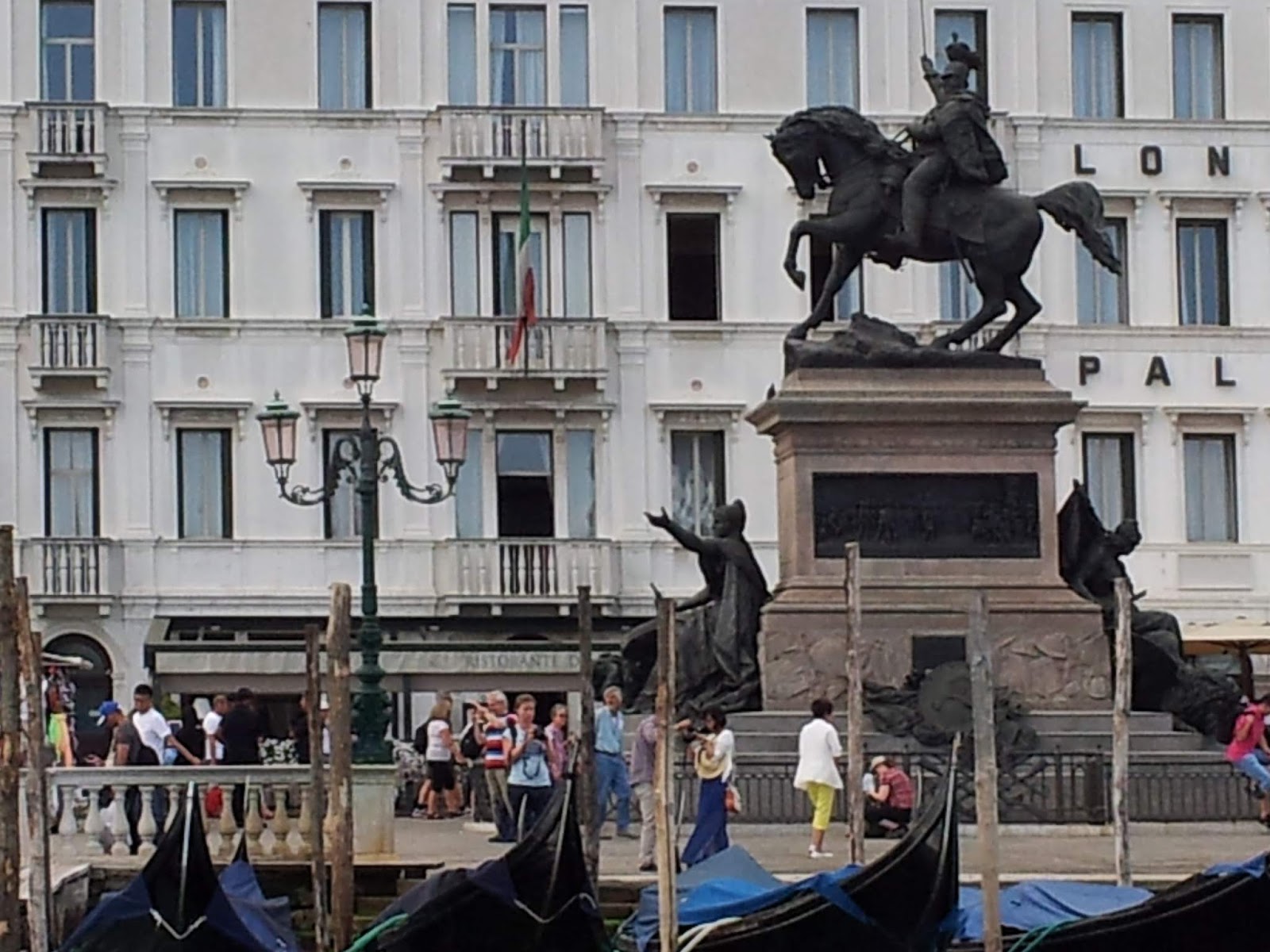
This is a photo of the Hilton Hotel from the other side of the canal.

It was useful knowledge for the second time we visited Venice because the waterbus from the Hilton hotel made its first stop, before San Marco, there.  We also discovered on that second visit a number of restaurants on the way from the terminal and church to the Accademia Bridge.

This is looking back towards San Marco from the Accademia Bridge:

And this, looking towards the docks:

Items to note:

Restaurants off the beaten track were much cheaper and the food a lot different to that in the middle of the tourist areas.

There are a lot of churches, big and small, tucked away in interesting spots where there are small piazza’s.  You can look in all of them, though some asked for a small fee.

Souvenirs, coffee, and confectionary are very expensive in St Marks square.

Writing a book in 365 days – 132

Day 132

Dealing with reviews and criticism

Probably one of the biggest hurdles in writing is criticism

It comes in many forms, from subtle to downright nasty.  The point is that every writer gets criticism. It’s simply a matter of how you handle it.

As for me…

I take every comment, good or bad, as an impetus to write better.

Just remember one very important adage, what I call my Rule No. 1, you can’t please all of the people all of the time.

If you are like me, you write most of your stories under a particular genre and read, study best-selling authors’ methods and writing style, then draft and redraft to ensure that the stories meet readers’ requirements.

That’s my Rule No. 2: always make sure you a) study best-selling authors of your genre style and themes and b) read readers’ comments on your genre because that’s who you’re writing for.

Something else to remember, every writer, including those best-selling authors who have written multiple books, gets bad reviews, and sometimes acerbic criticism.

Replying to them is not recommended. Take their views on board and spend a few moments trying to try and see what their issue is. 

Then go and read a dozen of your five-star reviews just to remind yourself that all is well, and there is always room for improvement.

Writing a book in 365 days – 132

Day 132

Dealing with reviews and criticism

Probably one of the biggest hurdles in writing is criticism

It comes in many forms, from subtle to downright nasty.  The point is that every writer gets criticism. It’s simply a matter of how you handle it.

As for me…

I take every comment, good or bad, as an impetus to write better.

Just remember one very important adage, what I call my Rule No. 1, you can’t please all of the people all of the time.

If you are like me, you write most of your stories under a particular genre and read, study best-selling authors’ methods and writing style, then draft and redraft to ensure that the stories meet readers’ requirements.

That’s my Rule No. 2: always make sure you a) study best-selling authors of your genre style and themes and b) read readers’ comments on your genre because that’s who you’re writing for.

Something else to remember, every writer, including those best-selling authors who have written multiple books, gets bad reviews, and sometimes acerbic criticism.

Replying to them is not recommended. Take their views on board and spend a few moments trying to try and see what their issue is. 

Then go and read a dozen of your five-star reviews just to remind yourself that all is well, and there is always room for improvement.

Writing a book in 365 days – 130/131

Days 130 and 131

Writing exercise – use the following with new similies incorporated into the story:

His face was worn, like a … , The sky turned stormy, as though it was … , She was … as a … , He felt miserable as a …

I had been warned that the weather could change instantly, but I believed that to be an exaggeration.

Why?

I had been told that while the place I wanted to visit was once an old alluvial gold mine with some very interesting geological structures as well as an archaeological site that had the remnants of buildings dating back to what was believed to be an ancient advanced society, it was also owned by a mysterious old man, some of whom thought him to be a ghost whose permission had to be sought first before going there.

An old man, no one seemed to know his location.

It only added to the intrigue that surrounded the area.

Numerous newspaper reports suggested that it was Dargeville’s own Bermuda Triangle, where cell phones ceased to work, where apparitions could appear, of an old man, or a young girl dressed in period costume, where strange weather could erupt at any moment.

In my mind, something was going on there that someone didn’t want anyone to discover.

I’d stopped in at the diner, one of seven shops on a short main street that boasted a drapery, a hardware store, a drug store, a gas station, and a sheriff’s office. The opposite side of the road was a park, one that had just the bare minimum of maintenance.

Dargeville was literally a one-horse town. There was a horse hitching bar, and a horse was tethered to it. There was no sign of the owner, or anyone else for that matter.

Herb, the cook, the waiter, the server, in the diner was behind the server, and I could feel him watching me from the moment I stopped the car, till I walked into his diner.

The pie holder on the counter was empty. No, ‘only Dargeville can make such delicious apple pies’ apple pie was going to be tasted today, a slight disappointment.

“Where are you headed?” was his opening gambit.

“The gold fields.”

“You need permission. Old man Dargeville doesn’t like intruders.”

“Where can I find him then?”

“That’s just it, you can’t. He domes, he goes, but no one knows exactly where he is.”

“Where was he seen last?”

“Here. Three days ago. Took the last of the apple pie.”

We both looked at the empty pie holder. I could see several crumbs that had been left behind.

“Pity,” I said. “It was the other reason why I came here. Nowhere else can I find him.”

The man waved his hand, “Out there, somewhere.”

“No pie, and no old man. What does he look like?”

He looked at me thoughtfully, thinking perhaps, correctly, I was not going to leave that easily.

“Old, dusty, bushy-bearded, battered hat. Sometimes he drops a line in at the river that’s at the end of the park, that way.” He pointed across the street and along the road. “Past the gas station.”

There was a sudden crack of thunder, followed by a few more rumblings.

Odd. The sky had been clear, except for some distant clouds.

“Time to move on, before the weather sets in. You don’t want to get stuck here; the motel is not a place I’d recommend you stay.”

Very welcoming. Not!

I shrugged. “As you say, not a place to be stranded. Thanks for your help.”

When I stepped outside and looked up, the sky was the same as it had been all morning. It made the thunder I’d just heard … Or was it my imagination?

I looked back to see the man in the diner on his cell phone. Perhaps he was telling the old man that I was coming. Or someone else.

I checked the riverside fishing spot at the end of the park, almost opposite the gas station, and indeed it showed signs that someone had been there very recently, a roll-your-own cigarette still burning through the last of the tobacco.

The call had been a heads-up that I was coming to see him.

So, the old man did exist. I decided to go ahead and visit the site, and took out my notebook to find the page with the instructions on how to get there.

Along the road I was on, for a further five miles where there was a rusted sign with a skull and cross bones and Hazardous materials written under it.

Five miles up the road, I found the sign, almost hidden behind overgrown bushes, very faded. More words, freshly painted, were added under Hazardous, ‘to your health’. Beside it was a drawing of a man with his head cut off and blood spurting out of the neck.

Someone had a sense of humour.

It was a further two miles up a track that sometimes disappeared except for tire ruts. I was glad I brought the off-road SUV. At precisely two miles, I stopped. I had to. A brand-new steel wire fence and gate had been erected, blocking the way.

Previously, from all the reports, there had been no fences or gates.

Another crack of thunder had me looking up, and there was a change. The sky turned stormy, as though it was a roiling witch’s cauldron, clouds swirling and shades of grey from dark to light changing almost like an electronic display.

I could smell rain in the air. The wind picked up and swished through the trees. Another crack of thunder, this time coming after a bolt of lightning that wasn’t far away.

On the gate was a sign. “Trespassers will be shot”, with several bullet holes above and below the words to emphasise the fact.

It did make me think twice before I got a weapon of my own, and then while searching for a way over the fence, I found a pedestrian gate about thirty yards along to the right, that wasn’t locked.

Curious. Just on the other side, I found an almost burnt-out cigarette, the same as that at the fishing spot. Whoever had been there was here.

There was a worn track on either side of the fence, so I followed it carefully. It was one of those wooded areas where you always had the feeling someone was watching you. The scrub was dense but not very high. There were trees, but sparse in number.

Long before I reached it, I could hear a river, or creek perhaps, but the sound of running water.

A few minutes later, I reached the edge of a clearing, and on the other side, away from where the track led, I saw a girl, dressed in old-fashioned clothes, not of this civilisation, dancing. She was the epitome of a summer’s day, so brightly dressed and so carefree.

She had neither seen nor heard me coming. I stayed and watched for a few minutes, and then she disappeared into the woods. I thought of following her, but it was off mission. The weather was holding off, but it might not last. I continued on towards the river.

Coming out of the woods, noting I had been following the creek for about three hundred yards, before me were the ruins of several structures that looked to me to have been built of mud bricks, and part of a much larger structure. The whole area back from the creek was paved in stones that made up a very sophisticated design.

It looked a bit like a town square, built around a well, and on the other side, what looked to be the ruins of a temple. What the gold miners made of it was anyone’s guess, but very few of their writings included anything about any ruins.

Further on from that was a seat, and there sat a man with his back to me. Battered hat, dusty clothes. I walked towards him. He didn’t turn around, as if he were expecting a visitor.

I stopped when I was alongside the seat, and then he turned to look at me. His face was worn, like that of an old leather chair, from years of exposure to the elements. I wondered if he felt as miserable as he looked.

He sighed. “I knew you’d come.”

“Hello, gramps.”

©  Charles Heath  2025