Writing a book in 365 days – 176

Day 176

Could you apply real-life work information to a story?

One of the how-to books I was reading once made several statements about what you could write about.

The first was to write about what you know. To me, that means if you were in the military, you would have the inside knowledge on how the army, navy or air force worked and you could apply that to the scenarios, the situations and the people.

Then there’s the idea that your work environment could provide you with enough inspiration and authentic information to make the story sound realistic.

I’m going with the latter because the place where I worked, in one instance, provided the detail to incorporate into a story. That workplace is a phosphate mining company, and the place where that mining took place, on a small Pacific Island.

I was also lucky enough to work on a history of the company for several years as the principal research officer. It wasn’t long before I began writing a parallel story, which I had tentatively called The phosphateers, and as each piece of research yielded yet another gem of information, so began the story.

It started in the aftermath of World War 1, and the first volume was to end when the island was evacuated, after several of the company’s ships were sunk by a German raider in World War 2.

But that was not the only story…

My acquiring of knowledge about computer systems, and in particular in those early days, the primitive sort of networking available with cables, connectors and network cards, was the basis for another story.

So, yes, a real-life job can be a gold mine of information.

Writing a book in 365 days – 176

Day 176

Could you apply real-life work information to a story?

One of the how-to books I was reading once made several statements about what you could write about.

The first was to write about what you know. To me, that means if you were in the military, you would have the inside knowledge on how the army, navy or air force worked and you could apply that to the scenarios, the situations and the people.

Then there’s the idea that your work environment could provide you with enough inspiration and authentic information to make the story sound realistic.

I’m going with the latter because the place where I worked, in one instance, provided the detail to incorporate into a story. That workplace is a phosphate mining company, and the place where that mining took place, on a small Pacific Island.

I was also lucky enough to work on a history of the company for several years as the principal research officer. It wasn’t long before I began writing a parallel story, which I had tentatively called The phosphateers, and as each piece of research yielded yet another gem of information, so began the story.

It started in the aftermath of World War 1, and the first volume was to end when the island was evacuated, after several of the company’s ships were sunk by a German raider in World War 2.

But that was not the only story…

My acquiring of knowledge about computer systems, and in particular in those early days, the primitive sort of networking available with cables, connectors and network cards, was the basis for another story.

So, yes, a real-life job can be a gold mine of information.

Writing a book in 365 days – 175

Day 175

Writing Exercise

Don’t ask me how I got in the middle of the family version or World War 3, but I just happened to call in at the family home on my way home to the residence I’d always wanted after finally moving out of the home.

Enough parental hints had been dropped that it was time to leave the ‘nest, and I agreed.

My older brother had moved out a long time ago and went overseas. I never understood why, and he never explained. He just didn’t come back, and oddly enough no one talked about it.

My younger sister was still at home, and she had hinted there was going to be some news if I decided to come to dinner, and since she was cooking, I agreed. She was a professional chef, and her cooking was not to be missed when on offer.

But…

When I let myself in and announced I’d arrived, there was … silence.

Very unusual, because the house was always a cacophony of noise for one reason or another. At the very least, Susannah and my mother would be exchanging ideas in what my father often called a robust discussion.

Then my mother came out of the dining room at the sound of my arrival, much like a spectre out of the darkness.

“You go talk to Sue. She’s under a great deal of strain and not thinking clearly.”

This meant if I interpreted the tone, my mother had tried to tell her, rather than suggest, what to do, and Sue didn’t take orders very well. She never had, and her last three years at high school had been fraught. Things had settled down after she left for college and cooking school, but it all started up again when she returned home.

Mother had a death wish, father said. He understood that Sussanah needed to find her own path, but Mother had always expected her to follow in her footsteps. She had started the family restaurant but was now getting on, as she called it, and wanted Sue to take over.

Sue said she would if she could modernise the menu. That was the proverbial red rag to the bull.

I went out to the kitchen, but it was empty, so that meant she would be upstairs in her room. I slowly climbed the stairs, thinking back on the last time I had been in the house, about a month before. Sue had just returned from a culinary tour of the south of France and was full of enthusiasm and new recipes.

I’d picked her up from the airport, and we had a discussion, whether mother would ever change her mind, or bring the restaurant into the modern era. I was sure then as I was now, the only way anything would change was if she were to retire or die. Neither option was a possibility.

The door was closed, a bad sign. Mother-daughter arguments had been the mainstay of my youth. She was too much like her mother. My brother and I just kept out of her way.

I knocked, then said, “It’s me.”

“What do you want?” It was not the most welcoming of tones.

“You did ask me to come around, with the offer of fine dining. And a revelation. I guess there’s not going to be a revelation.”

The door opened, and once again I noticed that the sister I once knew had gone, replaced by the new and more mature version of what had always been a brilliant chef. But it was the youthfulness, charm, and playful manner that made it hard to believe just how good she was.

She stood to one side and let me pass. It was probably the third time ever that I had been let into the inner sanctum. It was where she and Matilda, the girl I had always hoped to marry one day, plotted to make my life miserable.

She went back to the unmade, messy bed, and sat cross-legged in the middle, next to several stuffed animals. “How is Matty?”

Oh, by the way, I did marry her, despite the prank my sister pulled that almost made me miss the wedding.

“Wishing she didn’t have to work in New York, but it won’t be for much longer.”

“She told me.”

To further her career and make an impact back home, she had to dazzle the media moguls. That done, the prestigious award for her news coverage, which was recently presented, was enough to impress the local media people, and they finally offered her a job.

“And you? Mother says you are under a great deal of stress.”

“Who wouldn’t with her looking over your shoulder, micro-managing. I was cooking dinner until she decided I needed a hand. When is she ever going to realise I am not her clone or her lackey, that she is only partially responsible for the chef I am today?”

“Funny how she never says that about me.”

“You’re a short-order cook at the local diner. That is not fine dining, that is feeding slop to the pigs at the trough.” She said it with the exact tones and emphasis my mother did when she decried the fact I was wasting my talent in such a den of iniquity.

The truth was I had no talent. Just the ability to make slop look more appealing to the customers, at least better than what Harvey, the previous short-order chef, did. “That’s not what you said about my baseball legend hamburgers.”

She smiled. “OK. You have a knack for presenting edible food, which is a first for the diner. They’re lucky to have you. It’s better than being a busboy in our mother’s place.”

She was right. I did that every summer from the time I could wash dishes. Just because we were family didn’t mean we got privileges.

“True.” I sat down on the chair beside the makeup desk and saw, in the corner, a pile of clothes tossed in a suitcase, the one she had come home with. Hadn’t finished unpacking or getting ready to leave?

“So, silly question, but I’m guessing dinner is off?”

“Yes. She’s annoyed with me for the last time.”

“Meaning?”

“I got an offer to help update the dessert menu for a restaurant chain in LA. One of the instructors at cooking school heard there was an opening, and he always liked my desserts. I’m going to take it while my mother tries to decide what she wants to do.”

“You’re going to do a Jeremy?” My older brother, who’d stormed out after another ‘robust’ discussion with the matriarch.

“I’ve tried talking, olive branches, and common sense. She hasn’t any. That place is going downhill, and she can’t see it and can’t be told. Even father has given up. I know you’ve tried, but she is what she is.”

“When are you going?”

“I was just waiting to see you, ask you to take me to the airport. I’ll stay the night at the hotel and leave tomorrow.”

“You can stay with me, and I’ll take you.”

“Don’t you do the breakfast shift at the diner?”

“Fred can fill in. Pancakes, beans and eggs. Anyone can do that.”

She shrugged. “OK. Down in ten.”

By the time I got to the bottom of the stairs, I still didn’t have a clue how I was going to break the news. The one person who didn’t deserve this was my father, but he always knew life was going to be difficult. He’d accepted that years ago, and just got on with his own life.

Sometimes it seemed to me they were not even connected. I’d always got the impression he knew Jeremy was going to leave, and I also knew, quite by accident, that he frequently visited him in his new home. Being in sales for a company that dealt with a lot of overseas customers, he was able to travel without letting on.

I’d suspected getting me out of the house was so he could move forward with retirement plans, but that dream had been parked.

I went into the lounge room, or what was their TV room, where the TV was on CNN.

“Did you talk some sense into her?” Mother seemed agitated.

“No. But sadly, I have to agree with her. You should consider semi-retirement, and let her run the restaurant. She would be like a breath of fresh air.”

If I’d thought first, I might not have said it. It got the expected reaction.

“While there is still breath in me…”

“Yes, that’s all well and good, mother, but it’s going to be very painful when there are no customers. You know and I know what was great thirty years ago, is not any more, and you can’t deny business has dropped nearly fifty per cent. If you persist down this path, the doors will close in less than six months. You have to move with the times or close the doors. It’s that simple. Three other restaurants, like yours, have closed in the last four months.”

She glared at me. She knew as well as I did what was happening around her. Closing her eyes and hoping it would go away was never going to happen.

“This is coming from a cook at best at the local slophouse.”

“Call the diner whatever you like, mother, but it is always full. People want simple and affordable food. Families can’t afford the cost of dining out fancy any more. The diner isn’t fancy, but it’s homely, they can sit together in a booth, and it’s where their friends go.”

“So, I should turn my place into a slophouse?”

Sue had come down the stairs and left her case at the door.

“Maybe you should, if you want to still have a place.”

“You’ve been cooking for a week, what would you know about anything?”

“Only what you taught me, and if you’re denigrating your own talented mother, then I think it’s time you took a good, long, hard look at yourself. Let’s go, David. I don’t know who this woman is, but it’s not my mother.”

Then she turned and walked out. This was exactly how it ended with Jeremy. I shrugged. There was not going to be any resolution this night.

Mother looked at me, and I thought, perhaps for the first time, she realised what was happening.

“Where’s she going?”

“Away. She’s going to work in LA. At least others think she is a talented and innovative chef. By the time you realise that, it will be too late. Good night.”

I followed Susannah to where she was waiting for me at the front door. She took a long, last look around. “Pity,” she muttered.

I opened the door, and she went through, heading towards my car, parking in the street.

She didn’t look back.

©  Charles Heath 2025

Searching for locations: The Golden Mask Dynasty Show, Beijing, China

The Golden Mask Dynasty Show was located at the OCT Theatre in Beijing’s Happy Valley. 

The theatre was quite full and the seats we had were directly behind the VIP area; as our guide told us, we had the best seats in the house. 

The play has 20 different dance scenes that depict war, royal banquets, and romance.  There are eight chapters and over 200 actors, and throughout the performance we were entertained by dancers, acrobats, costumes, lighting, and acoustics.

The story:

It is of romantic legend and historical memories, the Golden Mask Queen leads her army in defeating the invading Blue Mask King’s army, and afterwards the lands return to a leisurely pastoral life until the Queen forges a ‘mysterious tree’.  When the tree has grown, the Queen has a grand celebration, and releases the captured Blue soldiers, much to the admiration of the Blue Mask King.
This is followed by monstrous floods, and to save her people, and on the advice from the ‘mysterious tree’, the Queen sacrifices herself to save her people.  The Queen then turns into a golden sunbird flying in the sky blessing the people and that of the dynasty.

Billed as the best live show in China, described as a large scale dramatic musical, “The Golden Mask Dynasty” it lived up to its reputation and was thoroughly enjoyed by all.

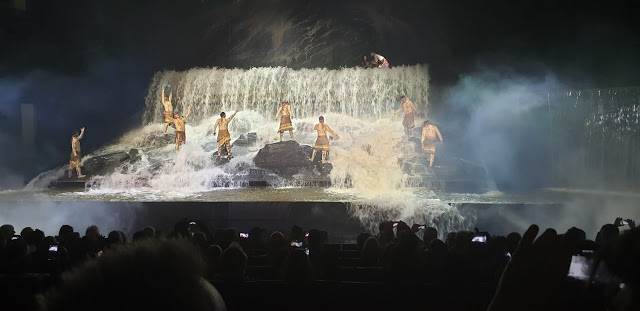
It was not just singing dancing and acrobatics, it had a story and it was told so that language and cultural issues aside, it worked.  There was a narration of the story running beside the stage, but it was hard to divide attention between what was happening, and what was being related.

Then came the peacock dance, with live peacocks

And this was followed by a waterfall, well, I don’t think anyone in that audience could believe what they were seeing.

I know I was both astonished and in awe of the performance.

What a way to finish off our first day in Beijing.

Oh, sorry, that high was dented slightly when we had to go back to our room.

Writing a book in 365 days – 175

Day 175

Writing Exercise

Don’t ask me how I got in the middle of the family version or World War 3, but I just happened to call in at the family home on my way home to the residence I’d always wanted after finally moving out of the home.

Enough parental hints had been dropped that it was time to leave the ‘nest, and I agreed.

My older brother had moved out a long time ago and went overseas. I never understood why, and he never explained. He just didn’t come back, and oddly enough no one talked about it.

My younger sister was still at home, and she had hinted there was going to be some news if I decided to come to dinner, and since she was cooking, I agreed. She was a professional chef, and her cooking was not to be missed when on offer.

But…

When I let myself in and announced I’d arrived, there was … silence.

Very unusual, because the house was always a cacophony of noise for one reason or another. At the very least, Susannah and my mother would be exchanging ideas in what my father often called a robust discussion.

Then my mother came out of the dining room at the sound of my arrival, much like a spectre out of the darkness.

“You go talk to Sue. She’s under a great deal of strain and not thinking clearly.”

This meant if I interpreted the tone, my mother had tried to tell her, rather than suggest, what to do, and Sue didn’t take orders very well. She never had, and her last three years at high school had been fraught. Things had settled down after she left for college and cooking school, but it all started up again when she returned home.

Mother had a death wish, father said. He understood that Sussanah needed to find her own path, but Mother had always expected her to follow in her footsteps. She had started the family restaurant but was now getting on, as she called it, and wanted Sue to take over.

Sue said she would if she could modernise the menu. That was the proverbial red rag to the bull.

I went out to the kitchen, but it was empty, so that meant she would be upstairs in her room. I slowly climbed the stairs, thinking back on the last time I had been in the house, about a month before. Sue had just returned from a culinary tour of the south of France and was full of enthusiasm and new recipes.

I’d picked her up from the airport, and we had a discussion, whether mother would ever change her mind, or bring the restaurant into the modern era. I was sure then as I was now, the only way anything would change was if she were to retire or die. Neither option was a possibility.

The door was closed, a bad sign. Mother-daughter arguments had been the mainstay of my youth. She was too much like her mother. My brother and I just kept out of her way.

I knocked, then said, “It’s me.”

“What do you want?” It was not the most welcoming of tones.

“You did ask me to come around, with the offer of fine dining. And a revelation. I guess there’s not going to be a revelation.”

The door opened, and once again I noticed that the sister I once knew had gone, replaced by the new and more mature version of what had always been a brilliant chef. But it was the youthfulness, charm, and playful manner that made it hard to believe just how good she was.

She stood to one side and let me pass. It was probably the third time ever that I had been let into the inner sanctum. It was where she and Matilda, the girl I had always hoped to marry one day, plotted to make my life miserable.

She went back to the unmade, messy bed, and sat cross-legged in the middle, next to several stuffed animals. “How is Matty?”

Oh, by the way, I did marry her, despite the prank my sister pulled that almost made me miss the wedding.

“Wishing she didn’t have to work in New York, but it won’t be for much longer.”

“She told me.”

To further her career and make an impact back home, she had to dazzle the media moguls. That done, the prestigious award for her news coverage, which was recently presented, was enough to impress the local media people, and they finally offered her a job.

“And you? Mother says you are under a great deal of stress.”

“Who wouldn’t with her looking over your shoulder, micro-managing. I was cooking dinner until she decided I needed a hand. When is she ever going to realise I am not her clone or her lackey, that she is only partially responsible for the chef I am today?”

“Funny how she never says that about me.”

“You’re a short-order cook at the local diner. That is not fine dining, that is feeding slop to the pigs at the trough.” She said it with the exact tones and emphasis my mother did when she decried the fact I was wasting my talent in such a den of iniquity.

The truth was I had no talent. Just the ability to make slop look more appealing to the customers, at least better than what Harvey, the previous short-order chef, did. “That’s not what you said about my baseball legend hamburgers.”

She smiled. “OK. You have a knack for presenting edible food, which is a first for the diner. They’re lucky to have you. It’s better than being a busboy in our mother’s place.”

She was right. I did that every summer from the time I could wash dishes. Just because we were family didn’t mean we got privileges.

“True.” I sat down on the chair beside the makeup desk and saw, in the corner, a pile of clothes tossed in a suitcase, the one she had come home with. Hadn’t finished unpacking or getting ready to leave?

“So, silly question, but I’m guessing dinner is off?”

“Yes. She’s annoyed with me for the last time.”

“Meaning?”

“I got an offer to help update the dessert menu for a restaurant chain in LA. One of the instructors at cooking school heard there was an opening, and he always liked my desserts. I’m going to take it while my mother tries to decide what she wants to do.”

“You’re going to do a Jeremy?” My older brother, who’d stormed out after another ‘robust’ discussion with the matriarch.

“I’ve tried talking, olive branches, and common sense. She hasn’t any. That place is going downhill, and she can’t see it and can’t be told. Even father has given up. I know you’ve tried, but she is what she is.”

“When are you going?”

“I was just waiting to see you, ask you to take me to the airport. I’ll stay the night at the hotel and leave tomorrow.”

“You can stay with me, and I’ll take you.”

“Don’t you do the breakfast shift at the diner?”

“Fred can fill in. Pancakes, beans and eggs. Anyone can do that.”

She shrugged. “OK. Down in ten.”

By the time I got to the bottom of the stairs, I still didn’t have a clue how I was going to break the news. The one person who didn’t deserve this was my father, but he always knew life was going to be difficult. He’d accepted that years ago, and just got on with his own life.

Sometimes it seemed to me they were not even connected. I’d always got the impression he knew Jeremy was going to leave, and I also knew, quite by accident, that he frequently visited him in his new home. Being in sales for a company that dealt with a lot of overseas customers, he was able to travel without letting on.

I’d suspected getting me out of the house was so he could move forward with retirement plans, but that dream had been parked.

I went into the lounge room, or what was their TV room, where the TV was on CNN.

“Did you talk some sense into her?” Mother seemed agitated.

“No. But sadly, I have to agree with her. You should consider semi-retirement, and let her run the restaurant. She would be like a breath of fresh air.”

If I’d thought first, I might not have said it. It got the expected reaction.

“While there is still breath in me…”

“Yes, that’s all well and good, mother, but it’s going to be very painful when there are no customers. You know and I know what was great thirty years ago, is not any more, and you can’t deny business has dropped nearly fifty per cent. If you persist down this path, the doors will close in less than six months. You have to move with the times or close the doors. It’s that simple. Three other restaurants, like yours, have closed in the last four months.”

She glared at me. She knew as well as I did what was happening around her. Closing her eyes and hoping it would go away was never going to happen.

“This is coming from a cook at best at the local slophouse.”

“Call the diner whatever you like, mother, but it is always full. People want simple and affordable food. Families can’t afford the cost of dining out fancy any more. The diner isn’t fancy, but it’s homely, they can sit together in a booth, and it’s where their friends go.”

“So, I should turn my place into a slophouse?”

Sue had come down the stairs and left her case at the door.

“Maybe you should, if you want to still have a place.”

“You’ve been cooking for a week, what would you know about anything?”

“Only what you taught me, and if you’re denigrating your own talented mother, then I think it’s time you took a good, long, hard look at yourself. Let’s go, David. I don’t know who this woman is, but it’s not my mother.”

Then she turned and walked out. This was exactly how it ended with Jeremy. I shrugged. There was not going to be any resolution this night.

Mother looked at me, and I thought, perhaps for the first time, she realised what was happening.

“Where’s she going?”

“Away. She’s going to work in LA. At least others think she is a talented and innovative chef. By the time you realise that, it will be too late. Good night.”

I followed Susannah to where she was waiting for me at the front door. She took a long, last look around. “Pity,” she muttered.

I opened the door, and she went through, heading towards my car, parking in the street.

She didn’t look back.

©  Charles Heath 2025

Writing a book in 365 days – 174

Day 174

Emotional Responses

Have you found yourself writing a passage where you have either burst out laughing or shed a tear?

Sometimes, when we are writing certain emotional scenes, that depth of feeling required might actually be a response to something that may have happened to you.

I never thought I could write comedy, because I didn’t believe I had that sort of humour in me. And yet, not so long ago, I was writing a scene where the lines were not meant to be comedic, but just the way the words were going on paper caused me to smile. It was actually something that made me want to write more, if possible, to feed off that first line.

It didn’t quite come as I expected, but over a few days working and reworking, the whole scene came off better than I’d expected, and I was hoping the reader got it.

The same goes for more serious stuff, and I did eventually lean on some of my own feelings on the subject.

But when I was writing it, it was sad, yes, but it didn’t evoke an emotional response.

When I came back to it a few days later, for some odd reason, it did. I actually found tears in my eyes, and I realised that it did hark back to an event where, at the time, it hadn’t affected me, but with more of the story, it did.

Now, writing about my family history and finding out a lot of things I didn’t know about my parents and grandparents, those emotions sometimes run so high, it’s not possible to write. I wonder, when someone finally gets around to reading it, they might have the same feelings.

Searching for locations: The Golden Mask Dynasty Show, Beijing, China

The Golden Mask Dynasty Show was located at the OCT Theatre in Beijing’s Happy Valley. 

The theatre was quite full and the seats we had were directly behind the VIP area; as our guide told us, we had the best seats in the house. 

The play has 20 different dance scenes that depict war, royal banquets, and romance.  There are eight chapters and over 200 actors, and throughout the performance we were entertained by dancers, acrobats, costumes, lighting, and acoustics.

The story:

It is of romantic legend and historical memories, the Golden Mask Queen leads her army in defeating the invading Blue Mask King’s army, and afterwards the lands return to a leisurely pastoral life until the Queen forges a ‘mysterious tree’.  When the tree has grown, the Queen has a grand celebration, and releases the captured Blue soldiers, much to the admiration of the Blue Mask King.
This is followed by monstrous floods, and to save her people, and on the advice from the ‘mysterious tree’, the Queen sacrifices herself to save her people.  The Queen then turns into a golden sunbird flying in the sky blessing the people and that of the dynasty.

Billed as the best live show in China, described as a large scale dramatic musical, “The Golden Mask Dynasty” it lived up to its reputation and was thoroughly enjoyed by all.

It was not just singing dancing and acrobatics, it had a story and it was told so that language and cultural issues aside, it worked.  There was a narration of the story running beside the stage, but it was hard to divide attention between what was happening, and what was being related.

Then came the peacock dance, with live peacocks

And this was followed by a waterfall, well, I don’t think anyone in that audience could believe what they were seeing.

I know I was both astonished and in awe of the performance.

What a way to finish off our first day in Beijing.

Oh, sorry, that high was dented slightly when we had to go back to our room.

Searching for locations: The Jade Factory, Beijing, China

The first stop is at a Jade Museum to learn the history of jade. In Chinese, jade is pronounced as “Yu” and it has a history in China of at least four thousand years.  On the way there, we are given a story about one of the guide’s relatives who had a jade bracelet, and how it has saved her from countless catastrophes.It is, quite literally ‘the’ good luck charm.  Chinese gamblers are known to have small pieces of jade in their hands when visiting the casinos, for good luck.  I’m not sure anything could provide a gambler with any sort of luck given how the odds are always slanted towards the house.

At any rate, this is neither the time of the place to debunk a ‘well-known fact’.

 On arrival, our guide hands us over to a local guide, a real staff member, and she begins with a discussion on jade while we watch a single worker working on an intricate piece, what looks to be a globe within a globe, sorry, there are two workers, and the second is working on a dragon.

At the end of the passage that passes by the workers, and before you enter the main showroom, you are dazzled by the ship and is nothing short of magnificent.

Then it’s into a small room just off the main showroom where we are taken through the colors, and the carving process in the various stages, without really being told how the magic happens.

Then it’s out into the main showroom where the sales are made, and before dispersing to look at the jade collection, she briefly tells us how to tell real and fake jade, and she does the usual trick of getting one of the tour group to model a piece.

Looks good, let’s move on.  To bigger and better examples.

What interested me, other than the small zodiac signs and other smallish pieces on the ‘promotion’ table, was the jade bangle our tour guide told us about on the bus.  If anyone needs one, it is my other half, with all the medical issues and her sometimes clumsiness, two particular maladies this object is supposed to prevent.
Jade to the Chinese is Diamonds to westerners, and the jade bangle is often handed down to the females of the family from generation to generation, often as an engagement present, to be worn on the left hand, the one closest to the heart.

There are literally thousands of them, but, they have to be specially fitted to your wrist because if it’s too large, you might lose it if it slips off and I didn’t think it could be too small.  
Nor is it cheap, and needing a larger size, it is reasonably expensive.  But it is jadeite, the more expensive of the types of jade, and it can only appreciate in value, not that we are interested in the monetary value, it’s more the good luck aspect.

We could use some of that.

But, just to touch on something that can be the bugbear of traveling overseas, is the subject of happy houses, a better name for toilets, and has become a recurrent theme on this tour.  It’s better than blurting out the word toilet and it seems there can be some not so happy houses given that the toilets in China are usually squat rather than sit, even for women.
And apparently, everyone has an unhappy house story, particularly the women, and generally in having to squat over a pit.  Why is this a discussion point, it seems the jade factory had what we have come to call happy, happy houses which have more proper toilets, and a stop here before going on the great wall was recommended, as the ‘happy house’ at the wall is deemed to be not such a happy house.

Not even this dragon was within my price range.  Thank heaven they had smaller more affordable models.  The object of having a dragon, large or small, is that it should be placed inside the main door to the house so that money can come in.

It also seems that stuffing the dragon’s mouth with money is also good luck.  We passed on doing that.

After spending a small fortune, there was a bonus, free Chinese tea.  Apparently, we will be coming back, after the Great Wall visit, to have lunch upstairs.


Writing a book in 365 days – 174

Day 174

Emotional Responses

Have you found yourself writing a passage where you have either burst out laughing or shed a tear?

Sometimes, when we are writing certain emotional scenes, that depth of feeling required might actually be a response to something that may have happened to you.

I never thought I could write comedy, because I didn’t believe I had that sort of humour in me. And yet, not so long ago, I was writing a scene where the lines were not meant to be comedic, but just the way the words were going on paper caused me to smile. It was actually something that made me want to write more, if possible, to feed off that first line.

It didn’t quite come as I expected, but over a few days working and reworking, the whole scene came off better than I’d expected, and I was hoping the reader got it.

The same goes for more serious stuff, and I did eventually lean on some of my own feelings on the subject.

But when I was writing it, it was sad, yes, but it didn’t evoke an emotional response.

When I came back to it a few days later, for some odd reason, it did. I actually found tears in my eyes, and I realised that it did hark back to an event where, at the time, it hadn’t affected me, but with more of the story, it did.

Now, writing about my family history and finding out a lot of things I didn’t know about my parents and grandparents, those emotions sometimes run so high, it’s not possible to write. I wonder, when someone finally gets around to reading it, they might have the same feelings.

First Dig Two Graves

A sequel to “The Devil You Don’t”

Revenge is a dish best served cold – or preferably so when everything goes right

Of course, it rarely does, as Alistair, Zoe’s handler, discovers to his peril. Enter a wildcard, John, and whatever Alistair’s plan for dealing with Zoe was dies with him.

It leaves Zoe in completely unfamiliar territory.

John’s idyllic romance with a woman who is utterly out of his comfort zone is on borrowed time. She is still trying to reconcile her ambivalence, after being so indifferent for so long.

They agree to take a break, during which she disappears. John, thinking she has left without saying goodbye, refuses to accept the inevitable, calls on an old friend for help in finding her.

After the mayhem and being briefly reunited, she recognises an inevitable truth: there is a price to pay for taking out Alistair; she must leave and find them first, and he would be wise to keep a low profile.

But keeping a low profile just isn’t possible, and enlisting another friend, a private detective and his sister, a deft computer hacker, they track her to the border between Austria and Hungary.

What John doesn’t realise is that another enemy is tracking him to find her too. It could have been a grand tour of Europe. Instead, it becomes a race against time before enemies old and new converge for what will be an inevitable showdown.