Writing a book in 365 days – 188

Day 188

Everybody has one book in them

Generally, when it comes to advice on writing books, a lot of people who want to help you realise the writing cream, will tell you, you are one of the lucky people who have a book in them.

Here’s the thing…

Everybody has one book in them.

And generally, that will be about something you know very well. Whether it’s about being a mechanic, a gardener, or piloting a spacecraft, or just playing football. Deep down, you know there is that one subject that makes you an expert.

Me?

I’m a computer expert, and used to teach people how to use various computer languages, and certain applications used on PC’s. Programming is not easy; learning the fundamentals of a programming language is hard.

But where I used to teach, the company asked me to create several course manuals to aid the teach of the subject, so in a sense, I have already published.

So, I have a suggestion.

There’s nothing like writing about the history of your family.  Yes.  I know.  My family is as boring as hell. As much as you know about them, perhaps as far back as a grandfather or grandmother on either side if you are married.

More often than not, by the time you are ready to discover the story, a lot of the participants are dead, and their stories have gone with them to the grave. Ask around, and all you get is “nothing special here”.

I was 70 when I thought I’d poke around in the lives of my forebears.  I had a few names and a mother who had a lot of paper stored in a file.

Then…

What did you know about your parents?  My parents were dead, but even when they were alive, they didn’t share much.

How did it go?

I discovered I had another grandmother on my father’s side who was an adventuress.  Born in 1889 in Dorchester, England was the second child of parents who had earlier marriages, so she had five stepbrothers and stepsisters,

She was a single child, and the brother she could have had who died two years earlier.

She became a milliner/draper at an early age and worked/lived in a draper in Gillingham, Dorset.  Her father died in 1907, her mother in 1908, and with the proceeds of their wills, she had enough to travel second class to Australia in early 1914.

A 25 year old girl in 1914 travelled for over a month on a ship with 1,200 other passengers from Tilbury, England to Melbourne, Australia.  Oddly enought there was 57 other single women on that same ship.

I have only one word, Wow!

And that’s the story right there.  I traced a diary for the same ship, the same time of year, day by day.  I have plans for the ship.  I know everyone who had been on board and where they got off and got on.

The story is going to write itself. 

Writing a book in 365 days – 188

Day 188

Everybody has one book in them

Generally, when it comes to advice on writing books, a lot of people who want to help you realise the writing cream, will tell you, you are one of the lucky people who have a book in them.

Here’s the thing…

Everybody has one book in them.

And generally, that will be about something you know very well. Whether it’s about being a mechanic, a gardener, or piloting a spacecraft, or just playing football. Deep down, you know there is that one subject that makes you an expert.

Me?

I’m a computer expert, and used to teach people how to use various computer languages, and certain applications used on PC’s. Programming is not easy; learning the fundamentals of a programming language is hard.

But where I used to teach, the company asked me to create several course manuals to aid the teach of the subject, so in a sense, I have already published.

So, I have a suggestion.

There’s nothing like writing about the history of your family.  Yes.  I know.  My family is as boring as hell. As much as you know about them, perhaps as far back as a grandfather or grandmother on either side if you are married.

More often than not, by the time you are ready to discover the story, a lot of the participants are dead, and their stories have gone with them to the grave. Ask around, and all you get is “nothing special here”.

I was 70 when I thought I’d poke around in the lives of my forebears.  I had a few names and a mother who had a lot of paper stored in a file.

Then…

What did you know about your parents?  My parents were dead, but even when they were alive, they didn’t share much.

How did it go?

I discovered I had another grandmother on my father’s side who was an adventuress.  Born in 1889 in Dorchester, England was the second child of parents who had earlier marriages, so she had five stepbrothers and stepsisters,

She was a single child, and the brother she could have had who died two years earlier.

She became a milliner/draper at an early age and worked/lived in a draper in Gillingham, Dorset.  Her father died in 1907, her mother in 1908, and with the proceeds of their wills, she had enough to travel second class to Australia in early 1914.

A 25 year old girl in 1914 travelled for over a month on a ship with 1,200 other passengers from Tilbury, England to Melbourne, Australia.  Oddly enought there was 57 other single women on that same ship.

I have only one word, Wow!

And that’s the story right there.  I traced a diary for the same ship, the same time of year, day by day.  I have plans for the ship.  I know everyone who had been on board and where they got off and got on.

The story is going to write itself. 

Writing a book in 365 days – 186/187

Days 186 and 187

Writing exercise – about something other than the book I’m writing –

I had worked very hard to improve my position from fact checker to my ultimate role, editor. It took years of dedication and application, doing everything that was asked of me, and more.

And now, after seven years, I believed my time had come, an email from the chief editor to discuss my role moving forward.

It had been the same every year but those were reviews of my work, and I knew it took time before the review became an interview for promotion.  It was my turn.

10 AM:  Montgomery Montague’s office, 45th floor, the executive level, one above editorial, the department I aspired to work for.

Chester, my recalcitrant cat, raised his head as I came into the kitchen, and gave me his usual look of disdain.  This morning, he was not going to get off as easily.

“This is my day,” I said.  “You can rejoice in my success, or you can mope.”

A meow told me he did not give one jot what was happening in my world, just get the food in the bowl now.  Yes, that look was almost one of malice.

“Not today mister.”  I selected a tin of some sort of fish, removed the lid and scooped it into the bowl. 

Before I could move the bowl to the floor he had jumped up onto the counter, sniffed it, and looked at me.  Yes, that was the ‘you gave me that yesterday’ look, and that momentary thrill of tricking him, passed.

Of course, I hadn’t.  He looked at me and meowed twice.  The rebuke.

“No,” I said.  “You eat it, or you starve.  I’m going to work now.”

I stared him down.  “You cannot rain on my parade.” Another few seconds, he turned back to the bowl and took a tentative bite.  “I’ll be back with the good news.”

Good things happened in threes, my mother used to say.  That was number one.

The train was late, a holdup over a signal failure, or that’s what I thought I heard, but to Montgomery Montague, that was not an excuse.

Despite the minor setback, I forgoed my usual early morning coffee and went straight to the office, and weas only five minutes late.

When I reached his outer office where his personal assistant sat I saw her coming out of his office, and she gave me the ‘look’.  Everyone knew it, it was not a good day.

Had an event I had no control over ruined my chance.  She sat and I took a seat.

She was going to make me wait.

And panic.

Then she looked up and smiled.  “You are very lucky I was detained in his office.  I’ll tell him you’re here.”

She called, then nodded, assent to enter the inner sanctum.  It would be the third time I had bene in his office, the first my interview for the job, the second a discussion over some facts that were in dispute. And this time. Hopefully, my promotion.

I knocked on the door, waited for the terse ‘enter’ then went in, softly closing the door behind me.

Then it was past the meeting table. The coffee table the lounge chairs, the open space, the stop at the desk.

There was always the right number of chairs for those invited.  The uncomfortable chairs so you didn’t linger longer than necessary.

“Have a seat.”

The question was, which one?  Someone said once there was a right choice and a wrong choice, and I just realised there were two seats.  Was there another person about to join the interview?

I sat in the left seat.

There was just a hint of a smile on his face.  “The pilot’s seat.  Good choice, Ben.”

He gave me the serious look, the one that rattled everyone who sat opposite his desk, from new employees to the seasoned editors, those who had been here for years.

“Do you write?”

It was an unexpected question, and perhaps a little superfluous.  Why work at a publisher if you didn’t write?  I was going to say that, but was it a trick question?

“Yes, I do.”

“And read?”

“Avidly.  Writers must read.”  It was almost a mantra in this place.

“Of course, they do.  What type of stories do you write?”

“Thrillers, espionage, but at the moment historical fiction.”

“Busy then?”

“I keep myself amused in my spare time, and Chester more so.”

“Chester?”

“My cat, and harshest critic.  I read him parts of the story, and if he complains, it’s a rewrite.”

He made a face; one I didn’t decipher.  Someone once said, don’t embellish.  “What makes you think you can edit?”

“I’ve read a great many books to learn style and composition.  Ui can see errors in manuscripts that I’ve been given to fact check and often check later what I found with the end product, and I’ve had successes.”

“Editing is more than just grammar and spelling.  It’s continuity, missing links, slight changes in titles, descriptions, and other errors that authors routinely make.  We do not want to be checking your work.  You are the final word.  But…”

And here it comes, all my hopes and dreams were about to be shattered.

“I need you to do a test case for me before I make the final decision.”

He leaned forward and opened a drawer in front of him and pulled out a folder, looked at it then put it on the desk.  It was quite thick, but old, and quite discoloured.  The front had several coffee cup stains.

“This novel has been here for at least thirty years, and so far, no one has been able to turn it into something worth reading.  We call it Pandora’s Box.  You never know what’s inside.  A word to the wise, the last 25 recipients of this manuscript failed and didn’t get to become an editor here.  I have high hopes that you will not join them.  You have three weeks.”

He pushed the file across the desk towards me.  The interview, such as it was, was over.

Good things come in threes. Let’s call the outcome of this meeting a possible second.

Clutching the folder close, I took the elevator back down to my floor.  I assumed I was not yet a fully-fledged editor, so I could not move to the editorial floor five above, where I currently worked with nine other fact-checkers.

We worked in pairs, and my pair was Josie, a graduate with more degrees than I had, and I often wondered why she was not a rocket scientist.  She certainly knew enough about them, and space.

I had been considering asking her on a date, but after hearing about her last one, I decided she was not going to be interested in someone like me.

She saw me come out of the elevator and then went back to her work until I sat down.  In the fact-checking department, a year longer than me, and having no desire to become an editor, she had this dream of the cottage, the country garden, the picket fence, the husband who came home the same time every day, and the 2.4 children.  I was not sure the last part was possible; it had to be either 2 or 3.

“How did the interview go?”

I had told her I was going to see Montague and High Hopes.  She didn’t try to dash them, having seen her fair share of hopefuls’ crash and burn, but I could see the lack of confidence in her eyes when I told her of my ambition.  All she told me was to not fly too close to the sun.

“I have a task, a test.”

“Pandora’s Box?”

“You know?”

“Everyone knows.  No one speaks of it.”

“It’s not the first time he’s brought it out?”

“No.”

“And no one has made it work?”

“They couldn’t.  It’s gibberish.  He’s reputed to have written it himself as a means to squash budding hopefuls.”

“No one?”

“None that I’ve heard of over the last 10 years.  They come, they get the call to his office, he gives them Pandora’s Box, they fail, and then they leave.”

“Why?”

“Because they know he will never promote them to editor.”

I shrugged.  “There’s always a first time.”

“Have you read any of it?”

“No.”

“Then take it home and read it to Chester.  If he turns up his nose, then you have a problem.  If not, well, there may be hope.”

That said, she returned to the pile of manuscripts, each about some aspect of space.

I put the file in my backpack along with my laptop computer and, at precisely 6:05 pm, left the office.

I thought of asking Josie if she wanted to drop into a bar that was on both our ways home.  Sometimes when she wanted a sounding board, we would drop into a quaint bar and have a drink or two and sometimes a snack.  They were not dates, even though in my imagination they were.

She had come from a small town in the Midwest, and I came from upstate, New York.  Her family were ranchers, mine bankers, so we had little in common.

This time we parted at the door, with a promise I’d tell her what my reaction was to the story.  She had only heard about it, and nothing good.

Chester was waiting, curled up on the lounge where he was not supposed to be, but then, he never listened to me.

I glared at him as I closed the door, crossed to the kitchen bench where I put dinner from the Deli up the road, and the backpack.  I thought about taking the file out, but left it.  Dinner for Chester, then dinner for me, first.

An hour later and after cleaning up. I dragged the folder out and extracted the manuscript.  It was about three hundred pages of double-spaced type, done on an old-world manual typewriter with a cloth ribbon that had seen a lot of use.  The unevenness of the typeface told me some keys were stiffer to push than others, typed by a hunter and pecker, not an accomplished typist.

Errors we xxed out, and there were handwritten notes in red ink, whether put there by the author or a hapless would-be editor.

The title:  A Continental Mystery.

No author, the sheets were yellowing and darkening around the paper edges.  All of the pages had the look and feel of being thumbed through many times.  There were dog-eared pages scattered throughout the manuscript.  I looked, but there was no reason behind any of them, and one had a coffee cup stain.

It was hardly the sort of manuscript the company would accept.  I knew their requested requirements for submissions, and they were very high.  This would never have made the cut.

So…

I had to ask myself what Montague’s game was here?

Perhaps if I read the first page…

I made myself comfortable on the lounge chair, put my feet up on the ottoman and after a few minutes, Chester came and sat next to me.

“Would you like me to read you this story?” I said, looking at him.

His expression said ‘No’.

Good.  I was not in the mood to spare him.

It was a dark early morning; the moon had disappeared behind clouds that suggested an imminent downpour.  James quickened his pace to get to King’s Cross station before the skies above him opened.

It was not the only reason he was in a hurry; he had promised Matilda, the girl he was intending to ask to marry him, that he would be at the station a half hour before the train was to depart, and she did not like tardiness.

They were taking the train to Edinburgh, where they would be collected and taken to Matilda’s family home, Barkworth Manor.  For him, it was an opportunity to travel on the latest night Scotsman service, just upgraded to rival any luxury train in the world.

“Well,” I said to Chester, who seemed to have an expression of interest.  “A girl who belongs to a wealthy family, living in such a salubrious residence to be named Barkworth Manor, in Scotland no less.”

Chester turned away and yawned.  Rich girls living in posh manor houses obviously didn’t impress him.  I shrugged.  It had my attention.  Was she an heiress?  And who was this James?

Read on…

James considered himself the luckiest man in London and had to believe he had been in the right place at the right time.  A chance meeting outside the Savoy Hotel, an awkward conversation that led to coffee and cake, which in turn led to dinner.

It seemed serendipitous; they were both down from Oxford, both studying Archaeology, and could have equally accidentally met in Oxford as in London.  It led to a semester of chance meetings, which led to study time in the Bodleian Library, which led to dinner, and then an invitation for him to spend the weekend in Scotland with her parents.

In normal circumstances, he visited his mother in Cornwall, or sometimes a weekend with his academic acquaintances.  That had all changed as his friendship with Matilda slowly became something more.

I dragged the notebook computer over and started a new document, and typed a note, ‘the start needs work’.  A better definition of the protagonists was needed.

But in my imagination, I could visualise London at night, dark clouds swirling, rain imminent, as it had rained every time I had visited England myself and then I tried to remember what Kings Cross looked like.

The year, if I was assuming correctly, was about 1928, and I remembered seeing a steam train documentary not long ago.  I would have been as excited as James, just seeing the train, let alone travelling on it.

The fact-checking part of me then went looking for information on the night trains to Edinburgh.  There was the Flying Scotsman, the overnight train from London to Edinburgh, selecting the date 1928.  There was, however, another train, the Night Scotsman, that had started in May of that year, left London at 10:35 pm and arrived in Edinburgh about eight and a half hours later.  Photos showed the locomotive, the carriages, and plans of the sleepers, first and third class.  It was between the wars, and a bustling time, but there might be a lead into the great depression, so there was going to be historical context.

Then I realised I was getting ahead of myself and needed to read more.  It wasn’t badly written, it just needed a few changes, making the characters more relatable, and whether they were on equal footing.

Or perhaps I wasn’t.

The reader always needs to know the basics.  Firstly, who was going to be the main protagonist? That was James.  Male, early twenties, perhaps the accepted age for a prospective graduate, and given the cost of his studies, perhaps reasonably wealthy parents were funding him.

Certainly, the girl, of similar age, was being funded by her parents, though at that time it might have been less acceptable for her to be studying rather than getting married.  Social mores were very different then, but times were changing, albeit slowly.  It wasn’t long after the suffragettes.

I scanned through the pages for more information on the boy.

James McArthur, the third son of Sir William McArthur, banker, the son being 24 years old.  His mother, Lady Allison McArthur, nee Benton, was a writer, not overly successful but enough to be in a circle of similar ladies, who cross all sections of the Arts.  James had been 14 at the end of the Great War, and had lost two of his brothers to it, leaving him, a younger brother and two older sisters.

Then, the girl. 

Matilda Carterville was one of four daughters and two sons of Lord and Lady Carterville, landowner and shipping magnate, whose personal Empire was as vast as the British Empire of the day.  Matilda’s mother had not been from the aristocracy, and had caught the eye of the Lord, before he became a Lord, when she was a Shakespearean actress.  For him, it had been love at first sight; for her, it had been an amusing interlude until she discovered who he was, and it ended up all over the society pages.

Several hours passed as I constructed a family tree from the first 100 pages.  I wondered if this was what other Editors did, trying to get a handle on the characters, their associations, and be ready for whatever the author threw at them. I felt, by the end of it, that I knew James and Matilda.

It was interesting to discover that James’s mother lived in a house that was described as a cottage, it also had a name, and to me sounded like it had a hundred rooms, a dozen servants who all lived in, and grounds the size of a municipal park.

That paled to insignificance when it came to the castle Matilda came from.  Yes, an actual castle, once described as sprawling, a place where one could get lost, that was described as cold and draughty, with towers, and everything made of stone.  It had a banquet hall, a dining hall, and countless other rooms and staff, a place that would cost a fortune to keep in good repair and run.

Oh, yes, it had grounds to go hunting and shooting, fox hunting, and a lake to go fishing.  Surrounding it was farmland with cattle, sheep, and various crops, and produce used in the castle kitchen.  It was hard to imagine such places still existed, especially the class divisions that I had read about, which were virtually swept away after the Second World War.  Still, I did see mention of butlers, maids, ground staff, chauffeurs and countless others.

It was a world I could only imagine existed, once upon a time.

©  Charles Heath  2025

Searching for locations: From Zhengzhou to Suzhou by train, and the Snowy Sea Hotel, Suzhou, China

For the first time on this trip, we encounter problems with Chinese officialdom at the railway station, though we were warned that this might occur.

We had a major problem with the security staff when they pulled everyone over with aerosols and confiscated them. We lost styling mousse, others lost hair spray, and the men, their shaving cream.  But, to her credit, the tour guide did warn us they were stricter here, but her suggestion to be angry they were taking our stuff was probably not the right thing to do.

As with previous train bookings, the Chinese method of placing people in seats didn’t quite manage to keep couples traveling together, together on the train.  It was an odd peculiarity which few of the passengers understood, nor did they conform, swapping seat allocations.

This train ride did not seem the same as the last two and I don’t think we had the same type of high-speed train type that we had for the last two.  The carriages were different, there was only one toilet per carriage, and I don’t think we were going as fast.

But aside from that, we had 753 kilometers to travel with six stops before ours, two of which were very large cities, and then our stop, about four and a half hours later.  With two minutes this time, to get the baggage off the team managed it in 40 seconds, a new record.

After slight disorientation getting off the train, we locate our guide, easily found by looking for the Trip-A-Deal flag.  From there it’s a matter of getting into our respective groups and finding the bus.

As usual, the trip to the hotel was a long one, but we were traveling through a much brighter, and well lit, city.

As for our guide, we have him from now until the end of the tour.  There are no more train rides, we will be taking the bus from city to city until we reach Shanghai.  Good thing then that the bus is brand new, with that new car smell.  Only issue, no USB charging point.

The Snowy Sea hotel.  

It is finally a joy to get a room that is nothing short of great.  It has a bathroom and thus privacy.

Everyone had to go find a supermarket to purchase replacements for the confiscated items.  Luckily there was a huge supermarket just up from the hotel that had everything but the kitchen sink.

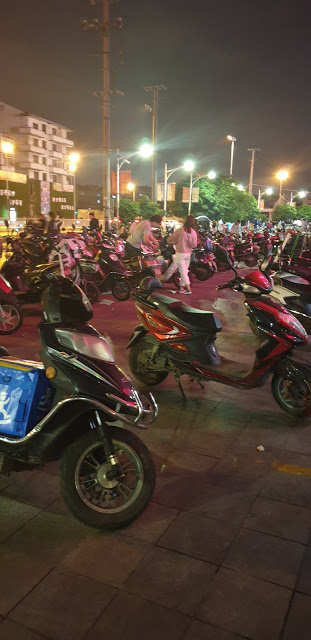
But, unlike where we live, the carpark is more of a scooter park!

It is also a small microcosm of Chinese life for the new more capitalistic oriented Chinese.

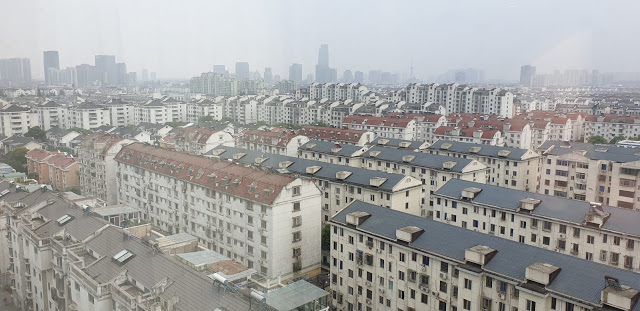
The next morning we get some idea of the scope of high-density living, though here, the buildings are not 30 stories tall, but still just as impressive.

These look like the medium density houses, but to the right of these are much larger buildings

The remarkable thing about this is those buildings stretch as far as the eye can see.

Writing a book in 365 days – 186/187

Days 186 and 187

Writing exercise – about something other than the book I’m writing –

I had worked very hard to improve my position from fact checker to my ultimate role, editor. It took years of dedication and application, doing everything that was asked of me, and more.

And now, after seven years, I believed my time had come, an email from the chief editor to discuss my role moving forward.

It had been the same every year but those were reviews of my work, and I knew it took time before the review became an interview for promotion.  It was my turn.

10 AM:  Montgomery Montague’s office, 45th floor, the executive level, one above editorial, the department I aspired to work for.

Chester, my recalcitrant cat, raised his head as I came into the kitchen, and gave me his usual look of disdain.  This morning, he was not going to get off as easily.

“This is my day,” I said.  “You can rejoice in my success, or you can mope.”

A meow told me he did not give one jot what was happening in my world, just get the food in the bowl now.  Yes, that look was almost one of malice.

“Not today mister.”  I selected a tin of some sort of fish, removed the lid and scooped it into the bowl. 

Before I could move the bowl to the floor he had jumped up onto the counter, sniffed it, and looked at me.  Yes, that was the ‘you gave me that yesterday’ look, and that momentary thrill of tricking him, passed.

Of course, I hadn’t.  He looked at me and meowed twice.  The rebuke.

“No,” I said.  “You eat it, or you starve.  I’m going to work now.”

I stared him down.  “You cannot rain on my parade.” Another few seconds, he turned back to the bowl and took a tentative bite.  “I’ll be back with the good news.”

Good things happened in threes, my mother used to say.  That was number one.

The train was late, a holdup over a signal failure, or that’s what I thought I heard, but to Montgomery Montague, that was not an excuse.

Despite the minor setback, I forgoed my usual early morning coffee and went straight to the office, and weas only five minutes late.

When I reached his outer office where his personal assistant sat I saw her coming out of his office, and she gave me the ‘look’.  Everyone knew it, it was not a good day.

Had an event I had no control over ruined my chance.  She sat and I took a seat.

She was going to make me wait.

And panic.

Then she looked up and smiled.  “You are very lucky I was detained in his office.  I’ll tell him you’re here.”

She called, then nodded, assent to enter the inner sanctum.  It would be the third time I had bene in his office, the first my interview for the job, the second a discussion over some facts that were in dispute. And this time. Hopefully, my promotion.

I knocked on the door, waited for the terse ‘enter’ then went in, softly closing the door behind me.

Then it was past the meeting table. The coffee table the lounge chairs, the open space, the stop at the desk.

There was always the right number of chairs for those invited.  The uncomfortable chairs so you didn’t linger longer than necessary.

“Have a seat.”

The question was, which one?  Someone said once there was a right choice and a wrong choice, and I just realised there were two seats.  Was there another person about to join the interview?

I sat in the left seat.

There was just a hint of a smile on his face.  “The pilot’s seat.  Good choice, Ben.”

He gave me the serious look, the one that rattled everyone who sat opposite his desk, from new employees to the seasoned editors, those who had been here for years.

“Do you write?”

It was an unexpected question, and perhaps a little superfluous.  Why work at a publisher if you didn’t write?  I was going to say that, but was it a trick question?

“Yes, I do.”

“And read?”

“Avidly.  Writers must read.”  It was almost a mantra in this place.

“Of course, they do.  What type of stories do you write?”

“Thrillers, espionage, but at the moment historical fiction.”

“Busy then?”

“I keep myself amused in my spare time, and Chester more so.”

“Chester?”

“My cat, and harshest critic.  I read him parts of the story, and if he complains, it’s a rewrite.”

He made a face; one I didn’t decipher.  Someone once said, don’t embellish.  “What makes you think you can edit?”

“I’ve read a great many books to learn style and composition.  Ui can see errors in manuscripts that I’ve been given to fact check and often check later what I found with the end product, and I’ve had successes.”

“Editing is more than just grammar and spelling.  It’s continuity, missing links, slight changes in titles, descriptions, and other errors that authors routinely make.  We do not want to be checking your work.  You are the final word.  But…”

And here it comes, all my hopes and dreams were about to be shattered.

“I need you to do a test case for me before I make the final decision.”

He leaned forward and opened a drawer in front of him and pulled out a folder, looked at it then put it on the desk.  It was quite thick, but old, and quite discoloured.  The front had several coffee cup stains.

“This novel has been here for at least thirty years, and so far, no one has been able to turn it into something worth reading.  We call it Pandora’s Box.  You never know what’s inside.  A word to the wise, the last 25 recipients of this manuscript failed and didn’t get to become an editor here.  I have high hopes that you will not join them.  You have three weeks.”

He pushed the file across the desk towards me.  The interview, such as it was, was over.

Good things come in threes. Let’s call the outcome of this meeting a possible second.

Clutching the folder close, I took the elevator back down to my floor.  I assumed I was not yet a fully-fledged editor, so I could not move to the editorial floor five above, where I currently worked with nine other fact-checkers.

We worked in pairs, and my pair was Josie, a graduate with more degrees than I had, and I often wondered why she was not a rocket scientist.  She certainly knew enough about them, and space.

I had been considering asking her on a date, but after hearing about her last one, I decided she was not going to be interested in someone like me.

She saw me come out of the elevator and then went back to her work until I sat down.  In the fact-checking department, a year longer than me, and having no desire to become an editor, she had this dream of the cottage, the country garden, the picket fence, the husband who came home the same time every day, and the 2.4 children.  I was not sure the last part was possible; it had to be either 2 or 3.

“How did the interview go?”

I had told her I was going to see Montague and High Hopes.  She didn’t try to dash them, having seen her fair share of hopefuls’ crash and burn, but I could see the lack of confidence in her eyes when I told her of my ambition.  All she told me was to not fly too close to the sun.

“I have a task, a test.”

“Pandora’s Box?”

“You know?”

“Everyone knows.  No one speaks of it.”

“It’s not the first time he’s brought it out?”

“No.”

“And no one has made it work?”

“They couldn’t.  It’s gibberish.  He’s reputed to have written it himself as a means to squash budding hopefuls.”

“No one?”

“None that I’ve heard of over the last 10 years.  They come, they get the call to his office, he gives them Pandora’s Box, they fail, and then they leave.”

“Why?”

“Because they know he will never promote them to editor.”

I shrugged.  “There’s always a first time.”

“Have you read any of it?”

“No.”

“Then take it home and read it to Chester.  If he turns up his nose, then you have a problem.  If not, well, there may be hope.”

That said, she returned to the pile of manuscripts, each about some aspect of space.

I put the file in my backpack along with my laptop computer and, at precisely 6:05 pm, left the office.

I thought of asking Josie if she wanted to drop into a bar that was on both our ways home.  Sometimes when she wanted a sounding board, we would drop into a quaint bar and have a drink or two and sometimes a snack.  They were not dates, even though in my imagination they were.

She had come from a small town in the Midwest, and I came from upstate, New York.  Her family were ranchers, mine bankers, so we had little in common.

This time we parted at the door, with a promise I’d tell her what my reaction was to the story.  She had only heard about it, and nothing good.

Chester was waiting, curled up on the lounge where he was not supposed to be, but then, he never listened to me.

I glared at him as I closed the door, crossed to the kitchen bench where I put dinner from the Deli up the road, and the backpack.  I thought about taking the file out, but left it.  Dinner for Chester, then dinner for me, first.

An hour later and after cleaning up. I dragged the folder out and extracted the manuscript.  It was about three hundred pages of double-spaced type, done on an old-world manual typewriter with a cloth ribbon that had seen a lot of use.  The unevenness of the typeface told me some keys were stiffer to push than others, typed by a hunter and pecker, not an accomplished typist.

Errors we xxed out, and there were handwritten notes in red ink, whether put there by the author or a hapless would-be editor.

The title:  A Continental Mystery.

No author, the sheets were yellowing and darkening around the paper edges.  All of the pages had the look and feel of being thumbed through many times.  There were dog-eared pages scattered throughout the manuscript.  I looked, but there was no reason behind any of them, and one had a coffee cup stain.

It was hardly the sort of manuscript the company would accept.  I knew their requested requirements for submissions, and they were very high.  This would never have made the cut.

So…

I had to ask myself what Montague’s game was here?

Perhaps if I read the first page…

I made myself comfortable on the lounge chair, put my feet up on the ottoman and after a few minutes, Chester came and sat next to me.

“Would you like me to read you this story?” I said, looking at him.

His expression said ‘No’.

Good.  I was not in the mood to spare him.

It was a dark early morning; the moon had disappeared behind clouds that suggested an imminent downpour.  James quickened his pace to get to King’s Cross station before the skies above him opened.

It was not the only reason he was in a hurry; he had promised Matilda, the girl he was intending to ask to marry him, that he would be at the station a half hour before the train was to depart, and she did not like tardiness.

They were taking the train to Edinburgh, where they would be collected and taken to Matilda’s family home, Barkworth Manor.  For him, it was an opportunity to travel on the latest night Scotsman service, just upgraded to rival any luxury train in the world.

“Well,” I said to Chester, who seemed to have an expression of interest.  “A girl who belongs to a wealthy family, living in such a salubrious residence to be named Barkworth Manor, in Scotland no less.”

Chester turned away and yawned.  Rich girls living in posh manor houses obviously didn’t impress him.  I shrugged.  It had my attention.  Was she an heiress?  And who was this James?

Read on…

James considered himself the luckiest man in London and had to believe he had been in the right place at the right time.  A chance meeting outside the Savoy Hotel, an awkward conversation that led to coffee and cake, which in turn led to dinner.

It seemed serendipitous; they were both down from Oxford, both studying Archaeology, and could have equally accidentally met in Oxford as in London.  It led to a semester of chance meetings, which led to study time in the Bodleian Library, which led to dinner, and then an invitation for him to spend the weekend in Scotland with her parents.

In normal circumstances, he visited his mother in Cornwall, or sometimes a weekend with his academic acquaintances.  That had all changed as his friendship with Matilda slowly became something more.

I dragged the notebook computer over and started a new document, and typed a note, ‘the start needs work’.  A better definition of the protagonists was needed.

But in my imagination, I could visualise London at night, dark clouds swirling, rain imminent, as it had rained every time I had visited England myself and then I tried to remember what Kings Cross looked like.

The year, if I was assuming correctly, was about 1928, and I remembered seeing a steam train documentary not long ago.  I would have been as excited as James, just seeing the train, let alone travelling on it.

The fact-checking part of me then went looking for information on the night trains to Edinburgh.  There was the Flying Scotsman, the overnight train from London to Edinburgh, selecting the date 1928.  There was, however, another train, the Night Scotsman, that had started in May of that year, left London at 10:35 pm and arrived in Edinburgh about eight and a half hours later.  Photos showed the locomotive, the carriages, and plans of the sleepers, first and third class.  It was between the wars, and a bustling time, but there might be a lead into the great depression, so there was going to be historical context.

Then I realised I was getting ahead of myself and needed to read more.  It wasn’t badly written, it just needed a few changes, making the characters more relatable, and whether they were on equal footing.

Or perhaps I wasn’t.

The reader always needs to know the basics.  Firstly, who was going to be the main protagonist? That was James.  Male, early twenties, perhaps the accepted age for a prospective graduate, and given the cost of his studies, perhaps reasonably wealthy parents were funding him.

Certainly, the girl, of similar age, was being funded by her parents, though at that time it might have been less acceptable for her to be studying rather than getting married.  Social mores were very different then, but times were changing, albeit slowly.  It wasn’t long after the suffragettes.

I scanned through the pages for more information on the boy.

James McArthur, the third son of Sir William McArthur, banker, the son being 24 years old.  His mother, Lady Allison McArthur, nee Benton, was a writer, not overly successful but enough to be in a circle of similar ladies, who cross all sections of the Arts.  James had been 14 at the end of the Great War, and had lost two of his brothers to it, leaving him, a younger brother and two older sisters.

Then, the girl. 

Matilda Carterville was one of four daughters and two sons of Lord and Lady Carterville, landowner and shipping magnate, whose personal Empire was as vast as the British Empire of the day.  Matilda’s mother had not been from the aristocracy, and had caught the eye of the Lord, before he became a Lord, when she was a Shakespearean actress.  For him, it had been love at first sight; for her, it had been an amusing interlude until she discovered who he was, and it ended up all over the society pages.

Several hours passed as I constructed a family tree from the first 100 pages.  I wondered if this was what other Editors did, trying to get a handle on the characters, their associations, and be ready for whatever the author threw at them. I felt, by the end of it, that I knew James and Matilda.

It was interesting to discover that James’s mother lived in a house that was described as a cottage, it also had a name, and to me sounded like it had a hundred rooms, a dozen servants who all lived in, and grounds the size of a municipal park.

That paled to insignificance when it came to the castle Matilda came from.  Yes, an actual castle, once described as sprawling, a place where one could get lost, that was described as cold and draughty, with towers, and everything made of stone.  It had a banquet hall, a dining hall, and countless other rooms and staff, a place that would cost a fortune to keep in good repair and run.

Oh, yes, it had grounds to go hunting and shooting, fox hunting, and a lake to go fishing.  Surrounding it was farmland with cattle, sheep, and various crops, and produce used in the castle kitchen.  It was hard to imagine such places still existed, especially the class divisions that I had read about, which were virtually swept away after the Second World War.  Still, I did see mention of butlers, maids, ground staff, chauffeurs and countless others.

It was a world I could only imagine existed, once upon a time.

©  Charles Heath  2025

“The Things we do for Love”, the story behind the story

This story has been ongoing since I was seventeen, and just to let you know, I’m 71 this year.

Yes, it’s taken a long time to get it done.

Why, you might ask.

Well, I never gave it much interest because I started writing it after a small incident when I was 17, and working as a book packer for a book distributor in Melbourne

At the end of my first year, at Christmas, the employer had a Christmas party, and that year, it was at a venue in St Kilda.

I wasn’t going to go because at that age, I was an ordinary boy who was very introverted and basically scared of his own shadow and terrified by girls.

Back then, I would cross the street to avoid them

Also, other members of the staff in the shipping department were rough and ready types who were not backwards in telling me what happened, and being naive, perhaps they knew I’d be either shocked or intrigued.

I was both adamant I wasn’t coming and then got roped in on a dare.

Damn!

So, back then, in the early 70s, people looked the other way when it came to drinking, and of course, Dutch courage always takes away the concerns, especially when normally you wouldn’t do half the stuff you wouldn’t in a million years

I made it to the end, not as drunk and stupid as I thought I might be, and St Kilda being a salacious place if you knew where to look, my new friends decided to give me a surprise.

It didn’t take long to realise these men were ‘men about town’ as they kept saying, and we went on an odyssey.  Yes, those backstreet brothels where one could, I was told, have anything they could imagine.

Let me tell you, large quantities of alcohol and imagination were a very bad mix.

So, the odyssey in ‘The things we do’ was based on that, and then the encounter with Diana. Well, let’s just say I learned a great deal about girls that night.

Firstly, not all girls are nasty and spiteful, which seemed to be the case whenever I met one. There was a way to approach, greet, talk to, and behave.

It was also true that I could have had anything I wanted, but I decided what was in my imagination could stay there.  She was amused that all I wanted was to talk, but it was my money, and I could spend it how I liked.

And like any 17-year-old naive fool, I fell in love with her and had all these foolish notions.  Months later, I went back, but she had moved on, to where no one was saying or knew.

Needless to say, I was heartbroken and had to get over that first loss, which, like any 17-year-old, was like the end of the world.

But it was the best hour I’d ever spent in my life and would remain so until I met the woman I have been married to for the last 48 years.

As Henry, he was in part based on a rebel, the son of rich parents who despised them and their wealth, and he used to regale anyone who would listen about how they had messed up his life

If only I’d come from such a background!

And yes, I was only a run away from climbing up the stairs to get on board a ship, acting as a purser.

I worked for a shipping company and they gave their junior staff members an opportunity to spend a year at sea working as a purser on a cargo ship that sailed between Melbourne, Sydney and Hobart in Australia.

One of the other junior staff members’ turn came, and I would visit him on board when he would tell me stories about life on board, the officers, the crew, and other events. These stories, which sounded incredible to someone so impressionable, were a delight to hear.

Alas, by that time, I had tired of office work and moved on to be a tradesman at the place where my father worked.

It proved to be the right move, as that is where I met my wife.  Diana had been right; love would find me when I least expected it.

Another excerpt from “Strangers We’ve Become” – A sequel to ‘What Sets Us Apart’

It was the first time in almost a week that I made the short walk to the cafe alone.  It was early, and the chill of the morning was still in the air.  In summer, it was the best time of the day.  When Susan came with me, it was usually much later, when the day was much warmer and less tolerable.

On the morning of the third day of her visit, Susan said she was missing the hustle and bustle of London, and by the end of the fourth she said, in not so many words, she was over being away from ‘civilisation’.  This was a side of her I had not seen before, and it surprised me.

She hadn’t complained, but it was making her irritable.  The Susan that morning was vastly different to the Susan on the first day.  So much, I thought, for her wanting to ‘reconnect’, the word she had used as the reason for coming to Greve unannounced.

It was also the first morning I had time to reflect on her visit and what my feelings were towards her.  It was the reason I’d come to Greve: to soak up the peace and quiet and think about what I was going to do with the rest of my life.

I sat in my usual corner.  Maria, one of two waitresses, came out, stopped, and there was no mistaking the relief in her manner.  There was an air of tension between Susan and Maria I didn’t understand, and it seemed to emanate from Susan rather than the other way around.  I could understand her attitude if it was towards Alisha, but not Maria.  All she did was serve coffee and cake.

When Maria recovered from the momentary surprise, she said, smiling, “You are by yourself?”  She gave a quick glance in the direction of my villa, just to be sure.

“I am this morning.  I’m afraid the heat, for one who is not used to it, can be quite debilitating.  I’m also afraid it has had a bad effect on her manners, for which I apologise.  I cannot explain why she has been so rude to you.”

“You do not have to apologise for her, David, but it is of no consequence to me.  I have had a lot worse.  I think she is simply jealous.”

It had crossed my mind, but there was no reason for her to be.  “Why?”

“She is a woman, I am a woman, she thinks because you and I are friends, there is something between us.”

It made sense, even if it was not true.  “Perhaps if I explained…”

Maria shook her head.  “If there is a hole in the boat, you should not keep bailing but try to plug the hole.  My grandfather had many expressions, David.  If I may give you one piece of advice, as much as it is none of my business, you need to make your feelings known, and if they are not as they once were, and I think they are not, you need to tell her.  Before she goes home.”

Interesting advice.  Not only a purveyor of excellent coffee, but Maria was also a psychiatrist who had astutely worked out my dilemma.  What was that expression, ‘not just a pretty face’?

“Is she leaving soon?” I asked, thinking Maria knew more about Susan’s movements than I did.

“You would disappoint me if you had not suspected as much.  Susan was having coffee and talking to someone in her office on a cell phone.  It was an intense conversation.  I should not eavesdrop, but she said being here was like being stuck in hell.  It is a pity she does not share your love for our little piece of paradise, is it not?”

“It is indeed.  And you’re right.  She said she didn’t have a phone, but I know she has one.  She just doesn’t value the idea of getting away from the office.  Perhaps her role doesn’t afford her that luxury.”

And perhaps Alisha was right about Maria, that I should be more careful.  She had liked Maria the moment she saw her.  We had sat at this very table, the first day I arrived.  I would have travelled alone, but Prendergast, my old boss, liked to know where ex-employees of the Department were, and what they were doing.

She sighed.  “I am glad I am just a waitress.  Your usual coffee and cake?”

“Yes, please.”

Several months had passed since we had rescued Susan from her despotic father; she had recovered faster than we had thought, and settled into her role as the new Lady Featherington, though she preferred not to use that title, but go by the name of Lady Susan Cheney.

I didn’t get to be a Lord, or have any title, not that I was expecting one.  What I had expected was that Susan, once she found her footing as head of what seemed to be a commercial empire, would not have time for details like husbands, particularly when our agreement made before the wedding gave either of us the right to end it.

There was a moment when I visited her recovering in the hospital, where I was going to give her the out, but I didn’t, and she had not invoked it.  We were still married, just not living together.

This visit was one where she wanted to ‘reconnect’ as she called it, and invite me to come home with her.  She saw no reason why we could not resume our relationship, conveniently forgetting she indirectly had me arrested for her murder, charges both her mother and Lucy vigorously pursued, and had the clone not returned to save me, I might still be in jail.

It was not something I would forgive or forget any time soon.

There were other reasons why I was reluctant to stay with her, like forgetting small details, an irregularity in her character I found odd.  She looked the same, she sounded the same, she basically acted the same, but my mind was telling me something was not right.  It was not the Susan I first met, even allowing for the ordeal she had been subjected to.

But, despite those misgivings, there was no question in my mind that I still loved her, and her clandestine arrival had brought back all those feelings.  But as the days passed, I began to get the impression my feelings were one-sided and she was just going through the motions.

Which brought me to the last argument, earlier, where I said if I went with her, it would be business meetings, social obligations, and quite simply her ‘celebrity’ status that would keep us apart.  I reminded her that I had said from the outset I didn’t like the idea of being in the spotlight, and when I reiterated it, she simply brushed it off as just part of the job, adding rather strangely that I always looked good in a suit.  The flippancy of that comment was the last straw, and I left before I said something I would regret.

I knew I was not a priority.  Maybe somewhere inside me, I had wanted to be a priority, and I was disappointed when I was not.

And finally, there was Alisha.  Susan, at the height of the argument, had intimated she believed I had an affair with her, but that elephant was always in the room whenever Alisha was around.  It was no surprise when I learned Susan had asked Prendergast to reassign her to other duties. 

At least I knew what my feelings for Alisha were, and there were times when I had to remember she was persona non grata.  Perhaps that was why Susan had her banished, but, again, a small detail; jealousy was not one of Susan’s traits when I first knew her.

Perhaps it was time to set Susan free.

When I swung around to look in the direction of the lane where my villa was, I saw Susan.  She was formally dressed, not in her ‘tourist’ clothes, which she had bought from one of the local clothing stores.  We had fun that day, shopping for clothes, a chore I’d always hated.  It had been followed by a leisurely lunch, lots of wine and soul searching.

It was the reason why I sat in this corner; old habits die hard.  I could see trouble coming from all directions, not that Susan was trouble or at least I hoped not, but it allowed me the time to watch her walking towards the cafe in what appeared to be short, angry steps; perhaps the culmination of the heat wave and our last argument.

She glared at me as she sat, dropping her bag beside her on the ground, where I could see the cell phone sitting on top.  She followed my glance down, and then she looked unrepentant back at me.

Maria came back at the exact moment she was going to speak.  I noticed Maria hesitate for a second when she saw Susan, then put her smile in place to deliver my coffee.

Neither spoke nor looked at each other.  I said, “Susan will have what I’m having, thanks.”

Maria nodded and left.

“Now,” I said, leaning back in my seat, “I’m sure there’s a perfectly good explanation as to why you didn’t tell me about the phone, but that first time you disappeared, I’d guessed you needed to keep in touch with your business interests.  I thought it somewhat unwisethat you should come out when the board of one of your companies was trying to remove you, because of what was it, an unexplained absence?  All you had to do was tell me there were problems and you needed to remain at home to resolve them.”

My comment elicited a sideways look, with a touch of surprise.

“It was unfortunate timing on their behalf, and I didn’t want you to think everything else was more important than us.  There were issues before I came, and I thought the people at home would be able to manage without me for at least a week, but I was wrong.”

“Why come at all.  A phone call would have sufficed.”

“I had to see you, talk to you.  At least we have had a chance to do that.  I’m sorry about yesterday.  I once told you I would not become my mother, but I’m afraid I sounded just like her.  I misjudged just how much this role would affect me, and truly, I’m sorry.”

An apology was the last thing I expected.

“You have a lot of work to do catching up after being away, and of course, in replacing your mother and gaining the requisite respect as the new Lady Featherington.  I think it would be for the best if I were not another distraction.  We have plenty of time to reacquaint ourselves when you get past all these teething issues.”

“You’re not coming with me?”  She sounded disappointed.

“I think it would be for the best if I didn’t.”

“Why?”

“It should come as no surprise to you that I’ve been keeping an eye on your progress.  You are so much better doing your job without me.  I told your mother once that when the time came I would not like the responsibilities of being your husband.  Now that I have seen what it could possibly entail, I like it even less.  You might also want to reconsider our arrangement, after all, we only had a marriage of convenience, and now that those obligations have been fulfilled, we both have the option of terminating it.  I won’t make things difficult for you if that’s what you want.”

It was yet another anomaly, I thought; she should look distressed, and I would raise the matter of that arrangement.  Perhaps she had forgotten the finer points.  I, on the other hand, had always known we would not last forever.  The perplexed expression, to me, was a sign she might have forgotten.

Then, her expression changed.  “Is that what you want?”

“I wasn’t madly in love with you when we made that arrangement, so it was easy to agree to your terms, but inexplicably, since then, my feelings for you changed, and I would be sad if we parted ways.  But the truth is, I can’t see how this is going to work.”

“In saying that, do you think I don’t care for you?”

That was exactly what I was thinking, but I wasn’t going to voice that opinion out loud.  “You spent a lot of time finding new ways to make my life miserable, Susan.  You and that wretched friend of yours, Lucy.  While your attitude improved after we were married, that was because you were going to use me when you went to see your father, and then almost let me go to prison for your murder.”

“I had nothing to do with that, other than to leave, and I didn’t agree with Lucy that you should be made responsible for my disappearance.  I cannot be held responsible for the actions of my mother.  She hated you; Lucy didn’t understand you, and Millie told me I was stupid for not loving you in return, and she was right.  Why do you think I gave you such a hard time?  You made it impossible not to fall in love with you, and it nearly changed my mind about everything I’d been planning so meticulously.  But perhaps there was a more subliminal reason why I did because after I left, I wanted to believe, if anything went wrong, you would come and find me.”

“How could you possibly know that I’d even consider doing something like that, given what you knew about me?”

“Prendergast made a passing comment when my mother asked him about you; he told us you were very good at finding people and even better at fixing problems.”

“And yet here we are, one argument away from ending it.”

I could see Maria hovering, waiting for the right moment to deliver her coffee, then go back and find Gianna, the café owner, instead.  Gianna was more abrupt and, for that reason, was rarely seen serving the customers.  Today, she was particularly cantankerous, banging the cake dish on the table and frowning at Susan before returning to her kitchen.  Gianna didn’t like Susan either.

Behind me, I heard a car stop, and when she looked up, I knew it was for her.  She had arrived with nothing, and she was leaving with nothing.

She stood.  “Last chance.”

“Forever?”

She hesitated and then shook away the look of annoyance on her face.  “Of course not.  I wanted you to come back with me so we could continue working on our relationship.  I agree there are problems, but it’s nothing we can’t resolve if we try.”

I had been trying.  “It’s too soon for both of us, Susan.  I need to be able to trust you, and given the circumstances, and all that water under the bridge, I’m not sure if I can yet.”

She frowned at me.  “As you wish.”  She took an envelope out of her bag and put it on the table.  “When you are ready, it’s an open ticket home.  Please make it sooner rather than later.  Despite what you think of me, I have missed you, and I have no intention of ending it between us.”

That said, she glared at me for a minute, shook her head, then walked to the car.  I watched her get in and the car drive slowly away.

No kiss, no touch, no looking back. 

© Charles Heath 2018-2025

strangerscover9

Writing a book in 365 days – My Story 26

More about my story

Part two, if that’s what I’m going to call, it went from 46 pages to nearly 100.

Why.

The previous version didn’t have the reasons why, well, not exactly the reasons and what was behind the need to seek redress or take specific action.

So, I sat down and went through the six main protagonists.

Quinn, the one who has been sifting old records for blackmail material, finds it and puts it up for sale. There are three takers: Whitelaw, who needs it to destroy McConnell, FitzWalter, to retired sans scandal, and McConnell to get the goods on Whitelaw.

Thus,

Whitelaw, the one who seeks revenge on those who stopped him from fulfilling a dream.

FitzWalter, the one who ruined his own ambitions, but wanted to blame everyone else

Archibald, the one who reached the pinnacle, but has a bunch of warring minions to sort out

McConnell, the one who could never get his job done because of perceived wrongs that were caused by someone else.

Natasha, the fixer, the one who knew all of them bar McConnell, and also knows their innermost secrets.

Be that as it may, how does our main character fit into all of this?

That was the question I had to ask myself, because without a reason, why is there another part of this story?

You can’t just throw something out there and leave it hanging.

Willoughby was sent on a flawed operation, one of many, but in the end, it ultimately had the organisation shut down pending an investigation that was always going to have the same result. A permanent shutdown. 

He could have been out of a job, but was given a second chance. Was that second chance for a reason? So, here’s a premise: What if McConnell, seeing the writing on the wall, needs a scapegoat? He ropes Willoughby in for one last hurrah, the go-between between Quinn and himself.

 Before they get to the main dance, a reception to formally announce FitzWalters’ retirement, and in the backrooms, a deal for Quinn’s information, several of the protagonists show their hands, and it;’s not friendly.

And what usually happens at an auction where greed and murderous intent lurk?

Trouble.

Searching for locations: From Zhengzhou to Suzhou by train, and the Snowy Sea Hotel, Suzhou, China

For the first time on this trip, we encounter problems with Chinese officialdom at the railway station, though we were warned that this might occur.

We had a major problem with the security staff when they pulled everyone over with aerosols and confiscated them. We lost styling mousse, others lost hair spray, and the men, their shaving cream.  But, to her credit, the tour guide did warn us they were stricter here, but her suggestion to be angry they were taking our stuff was probably not the right thing to do.

As with previous train bookings, the Chinese method of placing people in seats didn’t quite manage to keep couples traveling together, together on the train.  It was an odd peculiarity which few of the passengers understood, nor did they conform, swapping seat allocations.

This train ride did not seem the same as the last two and I don’t think we had the same type of high-speed train type that we had for the last two.  The carriages were different, there was only one toilet per carriage, and I don’t think we were going as fast.

But aside from that, we had 753 kilometers to travel with six stops before ours, two of which were very large cities, and then our stop, about four and a half hours later.  With two minutes this time, to get the baggage off the team managed it in 40 seconds, a new record.

After slight disorientation getting off the train, we locate our guide, easily found by looking for the Trip-A-Deal flag.  From there it’s a matter of getting into our respective groups and finding the bus.

As usual, the trip to the hotel was a long one, but we were traveling through a much brighter, and well lit, city.

As for our guide, we have him from now until the end of the tour.  There are no more train rides, we will be taking the bus from city to city until we reach Shanghai.  Good thing then that the bus is brand new, with that new car smell.  Only issue, no USB charging point.

The Snowy Sea hotel.  

It is finally a joy to get a room that is nothing short of great.  It has a bathroom and thus privacy.

Everyone had to go find a supermarket to purchase replacements for the confiscated items.  Luckily there was a huge supermarket just up from the hotel that had everything but the kitchen sink.

But, unlike where we live, the carpark is more of a scooter park!

It is also a small microcosm of Chinese life for the new more capitalistic oriented Chinese.

The next morning we get some idea of the scope of high-density living, though here, the buildings are not 30 stories tall, but still just as impressive.

These look like the medium density houses, but to the right of these are much larger buildings

The remarkable thing about this is those buildings stretch as far as the eye can see.

Writing a book in 365 days – My Story 26

More about my story

Part two, if that’s what I’m going to call, it went from 46 pages to nearly 100.

Why.

The previous version didn’t have the reasons why, well, not exactly the reasons and what was behind the need to seek redress or take specific action.

So, I sat down and went through the six main protagonists.

Quinn, the one who has been sifting old records for blackmail material, finds it and puts it up for sale. There are three takers: Whitelaw, who needs it to destroy McConnell, FitzWalter, to retired sans scandal, and McConnell to get the goods on Whitelaw.

Thus,

Whitelaw, the one who seeks revenge on those who stopped him from fulfilling a dream.

FitzWalter, the one who ruined his own ambitions, but wanted to blame everyone else

Archibald, the one who reached the pinnacle, but has a bunch of warring minions to sort out

McConnell, the one who could never get his job done because of perceived wrongs that were caused by someone else.

Natasha, the fixer, the one who knew all of them bar McConnell, and also knows their innermost secrets.

Be that as it may, how does our main character fit into all of this?

That was the question I had to ask myself, because without a reason, why is there another part of this story?

You can’t just throw something out there and leave it hanging.

Willoughby was sent on a flawed operation, one of many, but in the end, it ultimately had the organisation shut down pending an investigation that was always going to have the same result. A permanent shutdown. 

He could have been out of a job, but was given a second chance. Was that second chance for a reason? So, here’s a premise: What if McConnell, seeing the writing on the wall, needs a scapegoat? He ropes Willoughby in for one last hurrah, the go-between between Quinn and himself.

 Before they get to the main dance, a reception to formally announce FitzWalters’ retirement, and in the backrooms, a deal for Quinn’s information, several of the protagonists show their hands, and it;’s not friendly.

And what usually happens at an auction where greed and murderous intent lurk?

Trouble.