Reading a newspaper can be like reading a good book

Why?

A lot of writers, particularly those who write murder mysteries or conspiracies, used to be either law enforcement or journalists.

A lot of writers have a background in journalism like I have.  Some work for major newspapers or did, and after the first bestseller retired to write more.

But reading newspaper accounts of events, no matter what the subject, somehow takes on the persona of a good story.  It has to if it wants to engage the reader.

There are elements of truth, there are elements of conjecture, and all the while you have to wonder, can this all possibly be true?

What’s that old journalistic adage my editor once told me?  Never let the truth get in the way of a good story.

My aspirations of a Pulitzer prize died right there.

Perhaps it’s true.

But for just one minute, let’s examine a possibility or two about the news.  Does it depend on the journalist’s personal feelings, or if not, the view of the editorial staff, who sometimes rewrite a piece to suit a certain editorial slant?

Let’s say we don’t like the current President.  Nothing that is written will be positive, though it will generally stick to the facts, and make them work towards a particular end.

Let’s say we like the current President, and what he’s doing.  We will take the facts and write a glowing piece about all the good he is doing.  There is no doubt that the story will ignore certain facts that might seem detrimental.

But that works for both sides of the fence.  No one seems to want to sit on the fence.

I once watched a show called Braindead when alien ants from outer space came to earth and started eating parts of brains.  It happened to be in Washington, it happened to eat politicians brains, and it exacerbated the animosity between the Democrats and the Republicans.  It was very funny, but who knew it was dead right about the parties, and it’s leaders, brains half eaten or not.

They should air it again in this current political brinkmanship climate to show everyone just how Washington politics works, or in reality, doesn’t work.

Then there’s fake news.  What is fake news exactly?

Using the wrong facts?  Painting a white sheep black?  Or just reporting one side of the story?

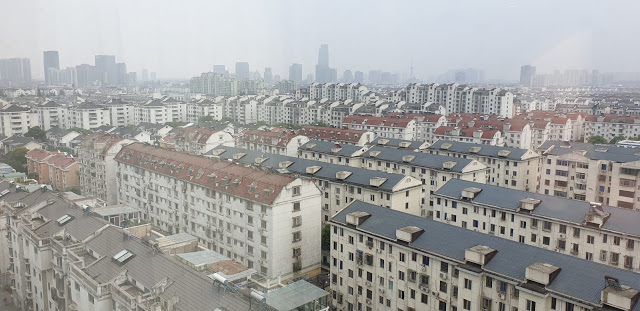
As a writer, I now view the newspapers as the number one resource for finding plots, conspiracies, and just plain oddities, mainly because the truth, if it is the truth, really is stranger than fiction.


Just one of many reading lists – part 3

**Please don’t assume that you have to, nor would I ever expect you to,  read any or all of these books.  You don’t.**

Everyone, it seems, will publish what they call the top 100 books that you should read. Some are voted on, some belong to the opinion of the editor of the book review section of a newspaper, and, as you know, there are a lot of newspapers, a lot of editors, and a lot of opinions.

I’m not a newspaper, I’m not an editor, but I have a list, based on personal experience, and many, many years of reading.

It’s in no particular order.

41.  The Hound of the Baskervilles by Sir Arthur Conan Doyle, as well as a host of other Sherlock Holmes stories

42.  The Secret Agent by Joseph Conrad, one of Conrad’s later political novels, set in London in 1886 and deals with anarchism and espionage.  In those days spies were called anarchists.

43.  The Ipcress File by Len Deighton, introducing us to Harry Palmer, who was personified by Michael Caine and led to Horse Under Water, and Funeral in Berlin.  More of Len Deighton later on in the list

44.  The Remorseful Day by Colin Dexter introducing the somewhat enigmatic detective, Morse, his first name not revealed for a long time but oddly, Endeavour.  John Thaw brought him to life

45.  Crime and Punishment by Fyodor Dostoevsky, hard to pronounce and even harder to read, but perhaps worth it in the end.  By the time I read this I was wishing for a Russian writer had could use an economy of words

46.  Dr. Zhivago by Boris Pasternak wasn’t it.  A vast and lengthy dissertation on lost love, I felt very sad for Zhivago in the end.  I saw a stage play of the same name, and I’m sorry, but it’s a few hours of my life I will never get back

47.  Casino Royale, the first of the James Bond novels by Ian Fleming.  I have to say these are among my favorite spy books.  I must say I preferred the new James Bond in Casino Royale, though Sean Connery still rules!

48.  The Day of the Jackal by Frederick Forsythe, a fascinating story about an assassin

49.  Anything written by John Le Carre, but in particular, the George Smiley collection.  Finally unmasking his nemesis the Russian spymaster made it all so satisfying.

50.  The Bourne Identity by Robert Ludlam, inspiring a long series by both Ludlam and Eric Lustbader makes entertaining reading, but the first, the man who did not know who or what he really was, was excellent.  Matt Damon didn’t harm his persona either.

51.  Murder Must Advertise by Dorothy Sayers, whose detective is Lord Peter Whimsey, a 1933 mystery novel that’s eighth in the series

52.  Gorky Park by Martin Cruz Smith.  You have to admit that his Russian detective Arkady Renko is up against it when his investigation goes in a direction that uncovers corruption and dishonest in his superiors

53.  The Way of All Flesh by Samuel Butler, a semi-autobiographical novel written between 1987 and 1884, and published in 1903.  The story of the Pontifex family.

54.  Howards End by E. M. Forster, first published in 1910, is an interesting insight into the behavior of the, and between the classes, with the Schlegels acting as the catalyst.

55.  Washington Square by Henry James, originally published as a serial, and covers the conflict between daughter and father.  I must say I prefer The Ambassadors to Washington Square.

56.  Ulysses by James Joyce, a day in the life of an ordinary man, Leopold Bloom, why could it not be the 7th June rather than the 16th, for obvious reasons

57.  The Go-Between by L. P. Hartley is a view of society at the end of the Victorian period through the eyes of a young boy.  I read this while still at school and had no clue why, but later, when I read it again, I understood the meaning

58.  Atonement by Ian McEwan, I saw the film and then read the book.  Never a good idea.  Basically, a young girl makes a bad mistake and tries to atone for it.

59.  Gone With The Wind by Margaret Mitchell, the War and Peace of Americal novels, and as long by comparison.  The only book written by Mitchell, and the second most read book by Americans.  The film was interesting but awfully long.

60.  The English Patient by Michael Ondaatje, with a man with severe burns and the effect he had on three others.  Colin Firth is villain one day and hero the next, this time in the cinematic version, an out and out cad.

More to come…


The cinema of my dreams – I always wanted to go on a treasure hunt – Episode 43

Here’s the thing…

Every time I close my eyes, I see something different.

I’d like to think the cinema of my dreams is playing a double feature but it’s a bit like a comedy cartoon night on Fox.

But these dreams are nothing to laugh about.

Once again there’s a new installment of an old feature, and we’re back on the treasure hunt.


For a thug like Alex to actually have something that resembled a good idea, perhaps it was more the people he surrounded himself with that made him look clever.

Boggs had not mentioned anything about the people who owned the land before the Naval yard had been constructed. Perhaps he had maps dating back to then, or maybe he didn’t. Boggs didn’t exactly confide in me everything he knew.

Maybe he didn’t trust me.

But there was a new lead now, courtesy of Alex, and it was one that I was going to chase down and bring it to Boggs at the appropriate time.

I need to find information about the Ormiston family, and whether or not there were any descendants in the area. But first, I would have to go to the library and talk to the ‘old biddy’, Gwendoline Frobisher, Gwen to her friends. Fortunately, I knew her well from the days of studying in the library.

And on some of my free days, helped her out with cataloging and returning books to their shelf positions. She only had one helper then, and she was older the Gwen, and not a lot of help putting books back on the higher shelves.

The rest of my shift was uneventful, and I closed and locked the door at precisely 11 pm. On the way to where I left my bicycle, my cell phone rang. Boggs? He knew when I finished, and how punctual I was when leaving.

I looked at the screen. Private Number.

I was going to ignore it, but, in the end, curiosity got the better of me.

“Yes?”

“Smidge?”

Nadia. What was she calling me for at this hour of the night?

“I told you not to call me Smidge.”

“Sorry, a force of habit. It sort of suits you though.”

“Then I’m hanging up.”

I went to press the disconnect button, but I could hear her saying, ‘don’t do that, I have some news.”

I waited a few seconds before I answered, “What news.”

“Not the sort you talk of over the phone.”

But it is the sort of hook someone would use to lure you to a place where Vince could beat you up. She had done it before.

“Not if it’s a trap. Sorry, but too many bad memories of your treachery, Nadia.”

“It’s not like that, now. You know what I think of Vince these days.”

“I know how you’d like me to think you think of Vince, but that could be all show. You are, after all, a Cossatino, and you can’t change those spots.”

“I can, and I have. Promise. Meet me at the hotel.”

“Now?”

“It’s not as if anyone’s going to notice, and, if they do, you can guess what they’ll be thinking.”

I sighed. It was giving me a headache. “Half an hour,” I said, and disconnected the call.

Half of me was saying not to go, the other half was intrigued, not so much for the news, but visiting Nadia in the middle of the night. Many years ago, I used have dreams about Nadia, not ones that were spoken of out loud. Now I had the chance to fulfill one; not so sure.

Near to midnight, everyone should be in bed, everyone except those staying at the hotel. Lights we on in several of the rooms, and a customer was in the office.

I parked the bike near the office and walked quickly to her room, knocked on the door lightly, and braced myself for the ‘surprise’, Vince waiting for me.

She opened the door and I looked over her shoulder. It looked empty but there was a lot of space I couldn’t see from that position.

“There’s no one here.” She grabbed me by the shoulder and dragged me in, looked up and down the corridor, then closed the door.

I quickly checked the bathroom. Clothes hanging from the shower rail, a very messy room. My impression of her was shattered.

“You see anything interesting in there?”

I assumed she was referring to the underwear. There might have been a momentary stray thought, but it was not one I’d admit to.

And in her dressing gown, it was hard to suppress the shive down my spine.

I sat on the end of the unmade bed. An odd thought, didn’t she let the housemaids in to tidy up, or, had she spent all day in bed? Scrub those thoughts.

“What is this news?”

“What were you doing at the mall?”

Was that Nadia in the yellow? I glanced around her room and then my eyes rested for a second on a yellow jacked tossed in a corner on the floor. Damn.

“What mall? I tried to sound convincingly surprised.

“You know what mall. You were with Boggs. What were you two up to?”

“I thought you had news for me?”

“I have. Stay away from that place. Otherwise, you might get buried there. That’s the Benderby’s torture chamber, and where they bury the evidence of their crimes.”

“Those are only rumors.”

“Not according to Vince. He reckons he’s seen a body there.”

“Perhaps he was mistaking it for a dressed mannequin. Even I’ve seen that.”

“You’re a fool. Don’t keep following that Boggs around like his little lap dog. He’s eventually going to get you into a mess you can’t get out of. There’s a lot of his father in him. Doesn’t know when to let it go.”

“This coming from Vince or you, because it sure sounds like Vince trying to put us of the scent.”

“What do you think happened to that archaeologist they found on Rico’s boat?”

“Well, my first thought was the Benderby’s did for him. As far as I can tell, the Benderby’s got him to verify the provenance of the gold coins they found on the ocean bed.”

“You mean the two surfers?”

“The Benderby’s bought them off them.”

“You mean the Benderby’s paid them, then two days later they turn up in a dive hotel having overdosed on heroin and not a cent to their names? That event was not widely known because Benderby bought off the reporter for the local paper.

“If you know about it, why did the Cossatino’s make some noise?”

“Because it was their heroin.”

This was terrifying, to be caught between a turf war with either side willing to stitch up the other, for points, or for their silence. Boggs and I were two small fish in a very smelly pond, with no chance at outwitting these two.

“Life’s complicated,” I said.

“It doesn’t have to be.”
© Charles Heath 2020
My disdain for some reporters, and reporting these days

It is sometimes quite trashy and that’s saying something!

Having been a journalist in a previous lifetime, and one that always believed that the truth mattered, it didn’t take long to realize that journalists should never let the truth get in the way of a good story.

Newspapers, and all other forms of media, will only write what they believe will sell, or what they think the public wants to read. The truth, sadly, is not the first thing on the reader’s mind, only that someone is to blame for something they have no control over, and it doesn’t matter who.

And the more outlandish the situation, the more the public will buy into it.

This, I guess, is why we like reading about celebrities and royalty, not for the good they might do, but the fact they stumble and make mistakes, and that somehow makes us feel better about ourselves.

Similarly, if the media can beat up a subject, like the corona-virus, and make it worse than it is, then people will lap up the continuing saga, as it relates to them, and will take one of two stances, that they believe the horror of it, and do as they’re asked, or disbelieve it because nothing can be that bad, and ignore it and the consequences of disobedience. knowing the government will not press too hard against the non-compliers simply because of democracy issues it will stir up.

That is, then the media will get a hold of this angle and push it, and people will start to think disobedience is a good thing, not a bad one.

So, our problems of trying to get a fair and balanced look at what the coronavirus is all about is nigh on impossible. We are continuously bombarded with both right and wrong information, and the trouble is, both sides are very plausibly supported by facts.

And that’s the next problem we have in reporting. We can get facts to prove anything we want. It’s called the use and abuse of statistics and was an interesting part of the journalism degree I studied for. We were told all about statistics, good and bad, and using them to prove the veracity of our piece.

I remember writing a piece for the tutor extolling the virtues of a particular person who was probably the worst human since Vlad the Impaler, using only the facts that suited my narrative. I also remember the bollocking he gave me for doing so but had to acknowledge that sometimes that would happen.

The integrity of reporting only went as far as the editor, and if the editor hated something, you had to hate it too. This is infamously covered in various texts where newspaper publishers pick sides and can influence elections, and governments. It still happens.

So, the bottom line is, when I’m reading an article in the media, I always take it with a grain of salt, and do my own fact-checking, remembering, of course, not just to fact check to prove the bias one way of the other, but then get a sense of balance.

We have state elections coming up where I live, but it does not sink to the personal sniping level as it does in the US, we haven’t sunk that low yet, but we haven’t got past the sniping about all the wrongs and failed promises of the government of the day, or the endless tirade against the opposition and how bad a job they did when they were previously in government.

You can see, no one is talking about what they’re going to do for us, no one is telling us what their policies are. It’s simply schoolyard tit for tat garbage speak. What happened to the town hall meeting, a long and winding speech encompassing the policies, what the government plans to do for its people in the next three years, and then genuinely answering questions?

Perhaps we should ban campaigning, and just get each party to write a book about what they intend to do, and keep them away from the papers, the TV, and any other form of media, in other words, don’t let them speak!

And don’t get me started about the drivel they speak in the parliament. Five-year-olds could do a better job.

OK, rant over.

Whatever happened to free websites?

There’s nothing more certain that a favourite web site you go to and use often, sooner or later starts charging a subscription ‘fee’.

I remember when the NANOWRIMO site had been updated, and the changes look good.  At that moment the site was free, but you do get a lot of emails and requests to purchase products, which I think is a reasonable way to raise money for keeping the site free.

But, how long is this going to last before a ‘fee’ is introduced, and then a ‘fee’ to enter your book?

It’s the airline principle, once it was a flat charge for the ticket, now you pay for this tax, that tax, fuel tax, baggage tax, tax on the tax, and then if that’s not enough, a charge for the food and water.  Soon it will be a charge for toilets, and then the air you breathe.

It’s inevitable, and once these charges start they don’t stop and only get higher with each passing year.

A lot of the sites I use are free.  Some have since started to charge and have put up a firewall to stop you getting any free information.

I’m not a rich author, so sadly I have to discontinue using these sites.

Perhaps the problem is that the owner of the site has come up with a good idea, thousands of people sign up, and suddenly a small web site becomes a big one, and hosting costs suddenly go through the roof.

Like airlines, it’s the user that pays.

Often I see or get an email from, various people with what looks to be a useful site.  Some start out by giving you a month free to have a look and use the facilities.  In some cases they are quite good, in other, well, there’s a dozen others like it that are still free.

But, after a month, you have to pay.  What gets me with some of them, they are asking somewhere between 50 and 100 US dollars a month, you heard that right, a month, which you can basically double that for me after the exchange rate and a dozen bank fees.

Sometimes there are different levels, but basically, if you look at the fine print, the lowest level set, which gives you very little, is set low deliberately.  Say it’s 10 dollars a month.  It’s no different to the free version except they probably don’t have annoying ads and advertise, what for many, is non-existent 24/7 help (via an email, no guarantee they look at it more than once a week, if at all).  Money for jam for the site owner, as the saying goes.

Why can’t there be a more reasonable option?

But I get it.  Everyone wants to get rich quick, it’s an objective that’s built into all of us, but it seems I missed the inoculation given the day after you’re born.

I also get it that these people worked hard on coming up with the web sites and facilities, and they deserve a reward for that hard work, but to me it would make more sense if they sold the service for 10 dollars or even 20 dollars a month if the systems were available and they worked.  And flowing from that wouldn’t 20,000 sales at 20 dollars, be better than 2000 at a 100 dollars?

The same seems to go for the so-called decent web site hosts, like WordPress, Wix and GoDaddy.  The free option is good but just for show and tell, but I’m sure they deliberately nobble it so it’s slow and kludgy just the sort of attributes that turn potential visitors off.

I thought if I paid a monthly charge for Wix, and reading the inclusions for what my site could do over the free one was very persuasive, so I signed up.  The site was no better than it was before and half the options that were on the list weren’t available, and still aren’t.  But I suspect if I paid them 100 plus dollars a month or more for their premium package I’d get it.

But, to pay for it I would have to be selling a million books a month, and I doubt, no matter how good my web site is, it wouldn’t attract that kind of business.

Not one of the basic packages, read affordable for me, has the ability to allow downloads after sales.  You can’t even have a sales page where you can actually sell books to people like you were a bookshop.  That’s in all of the premium packages, so they say, and that costs far too much.

GoDaddy were by far the worst, telling me if I signed up to the 60 dollars a month package I could have sales and downloads.  I tried to add it to the web page, which I might add was as difficult to create as all hell, and when it didn’t work, rang up to ask why I couldn’t have downloading after sales and was met with silence.

No, that’s not available at the moment, I was told, and not likely in the future.  What am I paying all this money for?  I don’t have a GoDaddy site any more.  I had a Wix site that I paid for, and I don’t have that any more.  They don’t offer anything useful, and they too, make it virtually impossible to create a useful site, so it sits out there in the ether with disappointment written all over it.

Perhaps others have had better luck, or things have changed in the last few years but I won’t be going back.

Maybe one day someone might understand the needs of the majority who can afford to pay exorbitant monthly charges but just not as much as we are expected to, for very little in return.

What’s that saying, hope springs eternal.

PS Sorry about the rant!

The cinema of my dreams – I always wanted to write a war story – Episode 34

For a story that was conceived during those long boring hours flying in a steel cocoon, striving to keep away the thoughts that the plane and everyone in it could just simply disappear as planes have in the past, it has come a long way.

Whilst I have always had a fascination with what happened during the second world war, not the battles or fighting, but in the more obscure events that took place, I decided to pen my own little sidebar to what was a long and bitter war.

And, so, it continues…


We gathered up what food there was to take with us.  There were no weapons left behind.  Leonardo had assumed correctly we would have used them if they’d been left there.

Carlo had changed slowly into an automaton, and I guess if I could read his mind, I’d know exactly what he was thinking.  Enrico had attached himself to Carlo, and I knew Carlo would look after him.

When I said that the burials would have to wait, Carlo agreed.

We had a short discussion on what we would be doing next, and in the first instance, we would be going back to the other soldiers and the church.  There, with both of our knowledge of the castle, its entrances, secret or otherwise, and the internal passageways which I knew Wallace and the others there were not too familiar with, we would formulate a plan to go in and pick them off one by one.

It seemed a good plan when we first talked about it, but on the way back to the church, and I had time to consider how it would work, it seemed we would only get an advantage once, and we would have to kill or capture as many as we could in the first raid.

Then it was going to be difficult.

Unless Carlo knew of more places we could enter the castle without being seen or heard.

I only knew of three.

And the first post we had to hit, and silence, the radio room.


My war had not been as start or as terrifying as most of those whom I’d known or worked with.  My part was more selective, finding and eliminating spies, informers, and enemy cells on home territory.  

Sometimes that would extend into enemy territory, particularly France where, as one who could speak French fluently, I found myself working with the resistance, using intelligence gathered by a network of spies we had, not only in France but in all parts of enemy territory.  That also meant, sometimes, accompanying weapons and other supplies into enemy territory.

It hadn’t included anything like what I’d just seen back at the underground cavern.

I’d been told, often, about the enemy executing whole villages, and large groups as retaliation for resistance operations that killed German soldiers, and particularly officers, but I’d not seen it first-hand.

Now I had.

I’d been told, along with the others who had been at the training camp way back at the start of the war, that we would inevitably see atrocities.  Those instructors, men who had survived the first war, were speaking from experience.  We were told it would make us angry.  It had.  I had this immediate thought of doing as much damage as I could to the perpetrators of that massacre.

But we had also been told that we had to harness that anger, and use it to drive our actions, bot in a reckless manner, but with a measured calm and with planning.  Blind rage, which had been predicted, would only get us killed.

I had left the cavern at the blind rage stage, but the walk to the church wore some of that off, and I began to piece together the seeds of a plan to get our revenge.  We were only a small group, but even so, we could work more efficiently than those at the castle. 

Leonardo was not going to tell Wallace that he hadn’t captured or killed me in his ambush, but it might make Wallace think that my ability to retaliate would be weakened.  Leonardo would know that Carlo and I were still alive.  He would not know about Blinky and his men.

It would be interesting to see if Wallace would commit any of his men to hunt us down, send Leonardo back out to finish the job, or just wait until Meyer turned up.  His contact in Gaole would know about the castle’s change of allegiance, but he would not know that Martina was not going to be there to greet them when they arrived in the village.

That was several days away.  We would have to be there, but it was going to be dangerous unless we found a way to neutralize the castle.  So far, in my head, we’d neutralized the radio and got as far as the dungeons before meeting enemy resistance.

The same had happened in the next six scenarios, after playing out the last we had arrived back at the church.


Chiara was resting as comfortably as the Sergeant could make her.

He had made a more thorough assessment of her injuries, and aside for the severe beating, she had sustained a few cracked ribs and several broken fingers.  The broken fingers were a surprise.  The sergeant had reset them as best he could.

Other than that, she would recover physically.  Mentally, he said, would be something else.  She was lucky, he said, her torturer was an amateur, and Italian.  Had it been the German Gestapo, she would be dead.

She was lucid and I told her we would make Leonardo pay for what he’d done.  I thought it best not to tell her about what had happened back at the cavern.  She had enough on her conscience without adding the senseless deaths of the villagers.

Then we had a meeting, where I asked Carlo to draw a plan of the castle and the places where we could breach their defenses and give us an element of surprise.

He had one that I hadn’t known about, one that might give us a fighting chance.

© Charles Heath 2020

Searching for locations: From Zhengzhou to Suzhou by train, and the Snowy Sea Hotel, Suzhou, China

For the first time on this trip, we encounter problems with Chinese officialdom at the railway station, though we were warned that this might occur.

We had a major problem with the security staff when they pulled everyone over with aerosols and confiscated them. We lost styling mousse, others lost hair spray, and the men, their shaving cream.  But, to her credit, the tour guide did warn us they were stricter here, but her suggestion to be angry they were taking our stuff was probably not the right thing to do.

As with previous train bookings, the Chinese method of placing people in seats didn’t quite manage to keep couples traveling together, together on the train.  It was an odd peculiarity which few of the passengers understood, nor did they conform, swapping seat allocations.

This train ride did not seem the same as the last two and I don’t think we had the same type of high-speed train type that we had for the last two.  The carriages were different, there was only one toilet per carriage, and I don’t think we were going as fast.

But aside from that, we had 753 kilometers to travel with six stops before ours, two of which were very large cities, and then our stop, about four and a half hours later.  With two minutes this time, to get the baggage off the team managed it in 40 seconds, a new record.

After slight disorientation getting off the train, we locate our guide, easily ground by looking for the Trip-A-Deal flag.  From there it’s a matter of getting into our respective groups and finding the bus.

As usual, the trip to the hotel was a long one, but we were traveling through a much brighter, and well lit, city.

As for our guide, we have him from now until the end of the tour.  There are no more train rides, we will be taking the bus from city to city until we reach Shanghai.  Good thing then that the bus is brand new, with that new car smell.  Only issue, no USB charging point.

The Snowy Sea hotel.  

It is finally a joy to get a room that is nothing short of great.  It has a bathroom and thus privacy.

Everyone had to go find a supermarket to purchase replacements for the confiscated items.  Luckily there was a huge supermarket just up from the hotel that had everything but the kitchen sink.

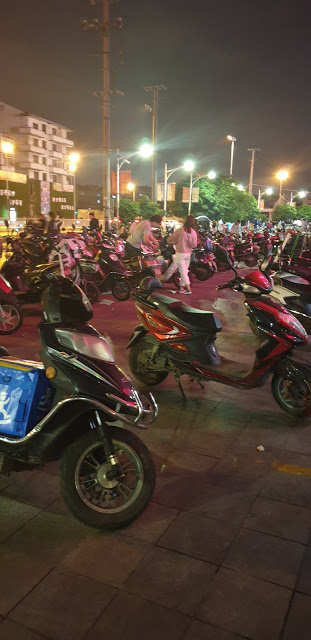
But, unlike where we live, the carpark is more of a scooter park!

It is also a small microcosm of Chinese life for the new more capitalistic oriented Chinese.

The next morning we get some idea of the scope of high-density living, though here, the buildings are not 30 stories tall, but still just as impressive.

These look like the medium density houses, but to the right of these are much larger buildings

The remarkable thing about this is those buildings stretch as far as the eye can see.

Waiting rooms, a great source of material to write about

Watching the doors that lead to the consulting rooms is about as exciting as watching pigeons standing on a window ledge.

But…

When you have little else to do while waiting to see the doctor, it can take on new meaning, especially if you don’t want to be like 95% of the others waiting and be on their mobile phones.

What you basically have is a cross-section of people right in front of you, a virtual cornucopia of characters just waiting to stay in your next novel, of course with some minor adjustments.  It’s the actions and traits I’m looking for, and since it is a hospital, there’s bound to be some good ones.

It’s a steady drip of patients getting called, and it seems like more are arriving than being seen, and those that are being called have arrived and barely got to sit down, whilst a steady core has been waiting, and waiting, and waiting…

Everyone reacts differently to waiting.

A lady arrives, walking tentatively into the waiting area.  It’s reasonably full so the first thing she does is look for a spot where she doesn’t have to sit next to anyone else.  I’m the same, nothing worse if you sit next to a talker, and getting their life history.

Or they are reading a broadsheet newspaper.  It’s not the aroma of the ink that is annoying you.

Another sits, looking like they’re going to read; they brought a book with them but it sits on her lap.  Is she far too worried to be able to concentrate?  Or is there something else in the room that compels her attention?

The phone comes out, a quick scan, then it remains in hand.  Is she expecting a call or text wishing her luck?  It’s not the oncology clinic so she doesn’t have cancer.  Hopefully.  The fact she brought a book tells me she’s been here before and knows a 9:00 appointment is rarely on time.

As we are discovering.

A couple arrives, maybe a mother and daughter, maybe a patient and her support person.  Both of them don’t look very well do it’s a toss-up who is there to see the doctor.

Next is a man who could easily pass as living on the street.  It’s probably an injustice to say so, but his appearance is compelling, and I’m not the only one who thinks so.

He sits and the person next to him gets up, apparently looking for something, then moves subtly to another seat.  Someone else nearby wrinkles her nose.  Two others look in his direction and then whisper to each other.  No guesses what the subject is.

More arrive, fewer seats, some are called, but everyone notices, and avoids, the man.

The sign of the door where the stream of patients are going, says no entry staff only, and periodically a staff member comes striding out either purposely or sedately, clutching a piece of all-important paper, the sign of someone who knows where they’re going, on an important mission.  Names are being called from this door and various other sections of the room, requiring you to keep one ear open in all directions.

And, to be sure, if you have to go to the restroom, that’s when your name will be called.

It seems all hospitals are branches of the United Nations, medical staff, and particularly doctors, are recruited from all over the world, and it seems to be able to speak understandable English is not one of the mandatory requirements, and sometimes the person calling out the name has a little difficulty with the pronunciation.

Perhaps like the UN, we need interpreters.  No, most of the names are recognizable until there is a foreign name that’s unpronounceable, or a person with English as a second language calls an English name.  It makes what could be an interminable wait into something more interesting.

And then there are the people who have names that are completely at odds with their nationality.  They are lucky enough to have the best of a number of cultures, and perhaps a deeper level of understanding where others do not.  I’m reminded never to judge a book by it’s cover.

I start trying to figure out those indecipherable names and then move on to trying to match a name with its owner.  I’m zero out fo four so far.

When there is a lull in arrivals and call-ups, there’s the doctor in consult room 2.  He’s apparently the doctor with no patients and periodically he comes out to look in his pigeonhole, or just look over the patients waiting, and more importantly checking the door handle when not delivering printouts to the consulting room next door.

He’s a doctor with no patients, get my drift.  Well, that joke fell very flat, so, fortunately, he comes out, a piece of paper in hand, and calls a name.  His quiet period is over.  Someone else will have to look at the door handle.

But we’re still waiting, waiting.

It’s been an hour and four minutes, and a little frustrating.  Surely when you check-in they should give you an estimated waiting time, or better still how many patients there are before you.

I guess its time to join the rest and pick up the mobile phone.

The good news, I only got to type one word before my name was called.  By a person who could pronounce it correctly.

The doctor, well that’s another story.

A new way of doing things

Well, welcome to the new world.

Perhaps in a lot of things, we should have been there a long time ago, but I suspect complacency and laziness has a lot to do with some of the issues.

Like washing your hands. It’s usually hell on earth to get a child to do anything and you have to be at them and at them to do anything.

I’m not sure about social distancing, but I’ve long wanted people in the supermarket to stop leaning over me to get stuff off the shelves when they could wait one minute longer.

Or being crowded into a restaurant where you can practically eat off the plate of the person at the next table. I like the distance, and the privacy it brings.

I’m also a fan of the new click and collect phenomenon where I don’t have to go out to get something I want; just get it delivered.

Of course, there’s still the necessity to go to a shop and physically see an item before you buy it, in my case clothes and shoes, but online sales for a lot of things are so much better, especially books and magazines.

I guess future traffic jams won’t be cars but delivery trucks.

I like the idea of working from home. Aside from having to face time with colleagues every now and then, if you don’t have to be in an office, then give it up. It will reduce pressure on roads, public transport, and reduce the concentration of the population in one place. You might even get to work on time, and get something to eat before you arrive!

As long as they get the internet right, which in this country is a pretty big if.

And perhaps now people will stop blaming 5g for the COVID virus.

Perhaps this homeschooling thing might work as well, as over the last few weeks I’ve seen it in action, and in most cases it works. Of course the isolation of students could be a problem, and there is always a need for face time for teachers and other students for interaction with contemporaries, but perhaps a compromise could be found.

Among the negatives in a time like this is the fear of using public transport, a fear no one is taking lightly, leading to children having to be taken to and brought home from school, and the fact there are potentially 800 cars needed to do it.

I used to leave home 30 mins before school end and was first in the pickup queue. Now I leave 45 minutes before and the closest I can get in nearly a mile from the school. And the traffic is a dangerous hazard in the main street, blocking driveways, bus stops, and lanes. It’s basically a mess, and it cannot continue without more organization.

Or we find a cure, or at the very least, a vaccine.

But there’s another problem. The anti-vaxxers. Everywhere in the world, it seems, not more than 50% of the population will get vaccinated, so it means that we may NEVER get past where we are now.

And the very worst problem that this new world has sprung on us, we may never travel again. Anywhere.

Perhaps we really do need a miracle.

A story inspired by Castello di Brolio – Episode 33

For a story that was conceived during those long boring hours flying in a steel cocoon, striving to keep away the thoughts that the plane and everyone in it could just simply disappear as planes have in the past, it has come a long way.

Whilst I have always had a fascination with what happened during the second world war, not the battles or fighting, but in the more obscure events that took place, I decided to pen my own little sidebar to what was a long and bitter war.

And, so, it continues…

Neither of us knew what to expect, and I had tried to steel myself for the worst. It was war, and I’d seen some awful things, but when it had happened to people you knew, and to a certain extent civilians that were nothing to do with the war, it was all that much harder to both understand why, and see.

There were dead, I counted at least ten, villagers who were innocent of any crime other than the fact they didn’t like Leonardo. They had no chance, shot and left to die in almost the same positions I’d seen them when I’d left earlier.

But, after checking everywhere, I could not find Martina.

Then Jack appeared. He came up to me and tugged on my trouser leg. “So this is where you got to?” I said. Why had he come back, though?

He headed back further into the cavern near where we had been earlier, a doorway I had not seen. It was ajar. Jack simply stood still, looking at it.

I pulled out my service pistol, not wanting to be caught unaware, and moved quietly towards the door, then slowly pulled it open.

At first, I saw nothing, then, looking down, I saw a figure on the floor. I knelt down to see who it was. The boy, Enrico. I’d seen his parents earlier, both dead. He must have escaped and hidden in the room, and, luckily, no one had followed him.

Except for Jack. Or had Jack come back, having sensed something awful had happened?

I checked him but there didn’t seem to be any wounds, and, when I shook his shoulder, he jolted, and jumped up ready to attack me, until he saw who it was, then grabbed hold of me. He was shaking, and suddenly sobbing. He had seen what had happened, and it was not something he was going to forget.

And he was going to want to exact revenge.

He was not the only one.

It took ten minutes before he had calmed, and managed to sit, leaning back against the wall. The room was where empty bottles were stored on wooden boxes, and he must have hidden among the crates. Anyone searching quickly wouldn’t venture much past the doorway.

It had saved his life.

Then, when I asked, he related what happened.

It was over very quickly. There had been a pounding on the door, and Martina had assumed it was Chiara returning. Chiara, he said, had said she had a small errand to run before locking herself in with the others.

When Martina opened the door, Leonardo was there, and they captured her, then set about killing everyone else. Enrico had been in the rear of the cavern looking for extra places for the others to camp when he heard the shots being fired.

Instead of going back to see what was happening, he hid in the bottle room, afraid for his life. Afraid for his parents and the others, but he had quickly realized there was nothing he could do. Leonardo had used the act of surprise.

One of Leonardo’s men had come back to where he was hiding, and just as he put his head in the door, Leonardo had called him back. They had to leave before Carlo and I returned. One of his men suggested they remain and capture us when we came back, but Leonardo said we’d come to him as soon as we saw what had happened.

He was right.

Carlo had made up a list of the dead and found that not only Martina was missing, so was Giuseppe and Francesco.

I told him Chiara was still alive, but barely, that Leonardo and his men had almost killed her, extracting the other’s whereabouts.

Martina and the others were most likely receiving the same punishment Chiara had received, up at the castle in one of the dungeons.

We were going to have to rescue them if they were still alive.

In fact, now that Thompson had sent reinforcements, the fight was going to be a little more in our favor with six of us, instead of two. Perhaps seven, if I could not persuade Enrico not to come, but that was going to be difficult. In his place, I would feel exactly the same.

When Enrico was ready, we went back out to the main cavern where Carlo was sitting, head in hands. It was probably the only time he would get to mourn his fellow villagers/

Jack was seeking forgiveness for deserting me, but I was not mad at him. That he was able to give some form of companionship to Enrico probably saved him from making a mistake thinking he could exact revenge on his own.

I told him Leonardo would pay for this, and, predictably, he told me that he would be coming with us. I promised myself that I would find some way of keeping him safe.
© Charles Heath 2020