Searching for locations: O’Reilly’s guesthouse

Sometimes it’s not about the destination, but getting there, because sometimes the destination is not what you were expecting.

I have had some experience it staying in iconic guest houses, both here and overseas, and I guess those stays spoiled this one. I have a preference for old, creaky but warm and inviting old mansions mostly built around the early 1900s.

That was what I was expecting this time too, given what I’d read.

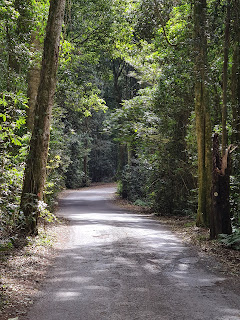
The road, from the turn-off from the Greenlee cottages, is narrow, winding, and not one you can go faster than 40ks.  Buses and trucks are restricted to 20kph, but as you get further into the mountains, it’s difficult to see how they can get along the road at all.

It’s difficult enough in a mid-size SUV.

But, in all fairness, these are the sort of roads that nearly always lead to that mountaintop retreat.

At times the road is so narrow that you wonder how trucks and buses could get between the trees, because the close you get to the guest house, the narrower the road. And, at times, the car has to scrape by the overhanging branches, especially when having to make way for oncoming traffic.

The road is definitely not wide enough for two cars, and there are a lot of points where you can pull off to the side to let them pass.

It is tarred, but being in the middle of a dense tropical forest, it’s pitted and rutted, and very uneven.  There is not one moment where can relax, or take your eyes off the road, as some of us do, to take in the surrounding scenery.

But, whilst most of it looks the same, it’s certainly not boring, and every now and then you break out of the darkness into a clearing. And, sometimes a house.

Yes, people do live on the side of a mountain, and, just to be clear, their view, every morning, from the back verandah must be spectacular

At the end of the three-quarters of an hour drive, we emerge onto a mountain top, and what is O’Reilly’s guest house, though, after a more investigative look around, the guests stay in motel-like rooms.

There is an old wooden structure, but if this is the original guest house, it doesn’t look like people stay there anymore.

But, it’s not the accommodation the people come here for, it’s the endless bush walks.  Of course, there’s other stuff there, but it’s more about communing with nature, discovering the wildlife, and taking in the fresh country air.

What do you call time away from what you usually do?

And, do you truly ever have any time ‘off’?

Of course, in our minds, this time off has any one of a large number of different descriptions, like Annual Leave, Vacation, Holiday, Leave.

We want to believe this is a time when we can rest and relax.

Can we do this at home?

No.

Can we do this when we are away?

Maybe.

It depends on where ‘away’ is.

A holiday shack, or cabin?  Chances are it is deep in the woods, or on the shore of a lake, or river, or beside the sea somewhere in another state, or just far enough away that home is no longer home.

Except, you have all the comforts of home?  Then it really isn’t a holiday as such, just a decamping to another location.

So, do we go for the ‘real’ holiday, out of the country and far away, far enough away that we might not be reminded of our usual life?

Maybe that will do the trick.

If we don’t deliberately take our cell phones, just in case the boss calls, or there is a problem.  And that’s the point, some of us cannot find a cutoff point.

Those long days at the office, the decisions, the deadlines, the endless pressure of having to achieve the impossible are supposed to all melt away when you walk out the door.

Does it?  Can it?  Will it?

Let’s just say you have made the effort, you’ve switched off, and that pesky phone.

As anyone will tell  you, it’s often wise to travel the next day if at all possible, because you need some time to decompress before tackling what sometimes can be an arduous getting to the final destination, especially if it is at a peak holiday period, or on planes where anything and everything can go wrong very quickly.

Been there done that.

But, this time, we traveled the next day, nothing went wrong, and all is fine.

Except …

As a writer and having spent the last few months finishing off my last novel, I was looking forward to some downtime.  The editor has the final draft, and I’m happy.

Then, as it always does, the best-laid plans of mice and men …

It all comes unstuck.

Inspiration often comes out of left field; something happens, a piece in a newspaper, an item on TV, or just lying down staring at the ceiling, when ‘bang’  it hits you.

The start of a story, a theme that you can run with.

Damn.

I’ve been away for four days now and written seven chapters and the words will not stop.

If only …

Hey, what a great title for the story…

Sorry, got to get back to work!

Searching for locations: O’Reilly’s guesthouse

Sometimes it’s not about the destination, but getting there, because sometimes the destination is not what you were expecting.

I have had some experience it staying in iconic guest houses, both here and overseas, and I guess those stays spoiled this one. I have a preference for old, creaky but warm and inviting old mansions mostly built around the early 1900s.

That was what I was expecting this time too, given what I’d read.

The road, from the turn-off from the Greenlee cottages, is narrow, winding, and not one you can go faster than 40ks.  Buses and trucks are restricted to 20kph, but as you get further into the mountains, it’s difficult to see how they can get along the road at all.

It’s difficult enough in a mid-size SUV.

But, in all fairness, these are the sort of roads that nearly always lead to that mountaintop retreat.

At times the road is so narrow that you wonder how trucks and buses could get between the trees, because the close you get to the guest house, the narrower the road. And, at times, the car has to scrape by the overhanging branches, especially when having to make way for oncoming traffic.

The road is definitely not wide enough for two cars, and there are a lot of points where you can pull off to the side to let them pass.

It is tarred, but being in the middle of a dense tropical forest, it’s pitted and rutted, and very uneven.  There is not one moment where can relax, or take your eyes off the road, as some of us do, to take in the surrounding scenery.

But, whilst most of it looks the same, it’s certainly not boring, and every now and then you break out of the darkness into a clearing. And, sometimes a house.

Yes, people do live on the side of a mountain, and, just to be clear, their view, every morning, from the back verandah must be spectacular

At the end of the three-quarters of an hour drive, we emerge onto a mountain top, and what is O’Reilly’s guest house, though, after a more investigative look around, the guests stay in motel-like rooms.

There is an old wooden structure, but if this is the original guest house, it doesn’t look like people stay there anymore.

But, it’s not the accommodation the people come here for, it’s the endless bush walks.  Of course, there’s other stuff there, but it’s more about communing with nature, discovering the wildlife, and taking in the fresh country air.

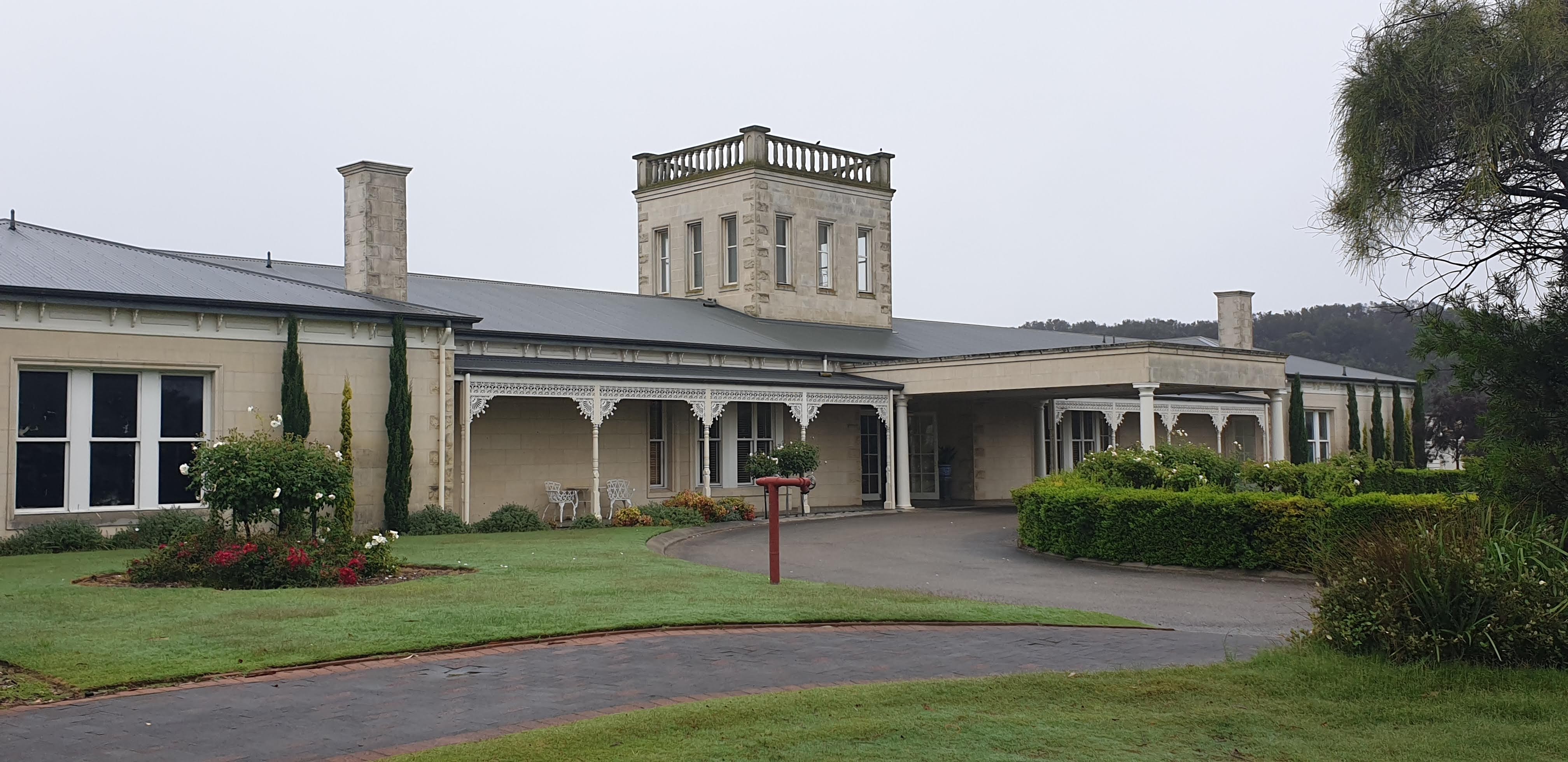
A photograph from the inspirational bin – 24

When I first saw it I thought it was an old country estate, converted and expanded into a golf clubhouse.

It wasn’t.  It is a purpose-built clubhouse and function center for corporate seminars and wedding receptions, as well as catering to the golfer, and golf tournaments.

20200215_100153

It also has a very good outlook over the golf course.

But, in my writer’s mind, this will provide inspiration for a story that could be set in a large country house,  with the central tower and lookout featuring in what might be a grisly death, and a group of guests who have gathered together to enact a mock murder that turns out to be very real.

Yes, the idea has been done to death over many many years, but I have a few new twists in mind.

Stay tuned.

What do you call time away from what you usually do?

And, do you truly ever have any time ‘off’?

Of course, in our minds, this time off has any one of a large number of different descriptions, like Annual Leave, Vacation, Holiday, Leave.

We want to believe this is a time when we can rest and relax.

Can we do this at home?

No.

Can we do this when we are away?

Maybe.

It depends on where ‘away’ is.

A holiday shack, or cabin?  Chances are it is deep in the woods, or on the shore of a lake, or river, or beside the sea somewhere in another state, or just far enough away that home is no longer home.

Except, you have all the comforts of home?  Then it really isn’t a holiday as such, just a decamping to another location.

So, do we go for the ‘real’ holiday, out of the country and far away, far enough away that we might not be reminded of our usual life?

Maybe that will do the trick.

If we don’t deliberately take our cell phones, just in case the boss calls, or there is a problem.  And that’s the point, some of us cannot find a cutoff point.

Those long days at the office, the decisions, the deadlines, the endless pressure of having to achieve the impossible are supposed to all melt away when you walk out the door.

Does it?  Can it?  Will it?

Let’s just say you have made the effort, you’ve switched off, and that pesky phone.

As anyone will tell  you, it’s often wise to travel the next day if at all possible, because you need some time to decompress before tackling what sometimes can be an arduous getting to the final destination, especially if it is at a peak holiday period, or on planes where anything and everything can go wrong very quickly.

Been there done that.

But, this time, we traveled the next day, nothing went wrong, and all is fine.

Except …

As a writer and having spent the last few months finishing off my last novel, I was looking forward to some downtime.  The editor has the final draft, and I’m happy.

Then, as it always does, the best-laid plans of mice and men …

It all comes unstuck.

Inspiration often comes out of left field; something happens, a piece in a newspaper, an item on TV, or just lying down staring at the ceiling, when ‘bang’  it hits you.

The start of a story, a theme that you can run with.

Damn.

I’ve been away for four days now and written seven chapters and the words will not stop.

If only …

Hey, what a great title for the story…

Sorry, got to get back to work!

My disdain for some reporters, and reporting these days

It is sometimes quite trashy and that’s saying something!

Having been a journalist in a previous lifetime, and one that always believed that the truth mattered, it didn’t take long to realize that journalists should never let the truth get in the way of a good story.

Newspapers, and all other forms of media, will only write what they believe will sell, or what they think the public wants to read. The truth, sadly, is not the first thing on the reader’s mind, only that someone is to blame for something they have no control over, and it doesn’t matter who.

And the more outlandish the situation, the more the public will buy into it.

This, I guess, is why we like reading about celebrities and royalty, not for the good they might do, but the fact they stumble and make mistakes, and that somehow makes us feel better about ourselves.

Similarly, if the media can beat up a subject, like the corona-virus, and make it worse than it is, then people will lap up the continuing saga, as it relates to them, and will take one of two stances, that they believe the horror of it, and do as they’re asked, or disbelieve it because nothing can be that bad, and ignore it and the consequences of disobedience. knowing the government will not press too hard against the non-compliers simply because of democracy issues it will stir up.

That is, then the media will get a hold of this angle and push it, and people will start to think disobedience is a good thing, not a bad one.

So, our problems of trying to get a fair and balanced look at what the coronavirus is all about is nigh on impossible. We are continuously bombarded with both right and wrong information, and the trouble is, both sides are very plausibly supported by facts.

And that’s the next problem we have in reporting. We can get facts to prove anything we want. It’s called the use and abuse of statistics and was an interesting part of the journalism degree I studied for. We were told all about statistics, good and bad, and using them to prove the veracity of our piece.

I remember writing a piece for the tutor extolling the virtues of a particular person who was probably the worst human since Vlad the Impaler, using only the facts that suited my narrative. I also remember the bollocking he gave me for doing so but had to acknowledge that sometimes that would happen.

The integrity of reporting only went as far as the editor, and if the editor hated something, you had to hate it too. This is infamously covered in various texts where newspaper publishers pick sides and can influence elections, and governments. It still happens.

So, the bottom line is, when I’m reading an article in the media, I always take it with a grain of salt, and do my own fact-checking, remembering, of course, not just to fact check to prove the bias one way of the other, but then get a sense of balance.

We have state elections coming up where I live, but it does not sink to the personal sniping level as it does in the US, we haven’t sunk that low yet, but we haven’t got past the sniping about all the wrongs and failed promises of the government of the day, or the endless tirade against the opposition and how bad a job they did when they were previously in government.

You can see, no one is talking about what they’re going to do for us, no one is telling us what their policies are. It’s simply schoolyard tit for tat garbage speak. What happened to the town hall meeting, a long and winding speech encompassing the policies, what the government plans to do for its people in the next three years, and then genuinely answering questions?

Perhaps we should ban campaigning, and just get each party to write a book about what they intend to do, and keep them away from the papers, the TV, and any other form of media, in other words, don’t let them speak!

And don’t get me started about the drivel they speak in the parliament. Five-year-olds could do a better job.

OK, rant over.

My disdain for some reporters, and reporting these days

It is sometimes quite trashy and that’s saying something!

Having been a journalist in a previous lifetime, and one that always believed that the truth mattered, it didn’t take long to realize that journalists should never let the truth get in the way of a good story.

Newspapers, and all other forms of media, will only write what they believe will sell, or what they think the public wants to read. The truth, sadly, is not the first thing on the reader’s mind, only that someone is to blame for something they have no control over, and it doesn’t matter who.

And the more outlandish the situation, the more the public will buy into it.

This, I guess, is why we like reading about celebrities and royalty, not for the good they might do, but the fact they stumble and make mistakes, and that somehow makes us feel better about ourselves.

Similarly, if the media can beat up a subject, like the corona-virus, and make it worse than it is, then people will lap up the continuing saga, as it relates to them, and will take one of two stances, that they believe the horror of it, and do as they’re asked, or disbelieve it because nothing can be that bad, and ignore it and the consequences of disobedience. knowing the government will not press too hard against the non-compliers simply because of democracy issues it will stir up.

That is, then the media will get a hold of this angle and push it, and people will start to think disobedience is a good thing, not a bad one.

So, our problems of trying to get a fair and balanced look at what the coronavirus is all about is nigh on impossible. We are continuously bombarded with both right and wrong information, and the trouble is, both sides are very plausibly supported by facts.

And that’s the next problem we have in reporting. We can get facts to prove anything we want. It’s called the use and abuse of statistics and was an interesting part of the journalism degree I studied for. We were told all about statistics, good and bad, and using them to prove the veracity of our piece.

I remember writing a piece for the tutor extolling the virtues of a particular person who was probably the worst human since Vlad the Impaler, using only the facts that suited my narrative. I also remember the bollocking he gave me for doing so but had to acknowledge that sometimes that would happen.

The integrity of reporting only went as far as the editor, and if the editor hated something, you had to hate it too. This is infamously covered in various texts where newspaper publishers pick sides and can influence elections, and governments. It still happens.

So, the bottom line is, when I’m reading an article in the media, I always take it with a grain of salt, and do my own fact-checking, remembering, of course, not just to fact check to prove the bias one way of the other, but then get a sense of balance.

We have state elections coming up where I live, but it does not sink to the personal sniping level as it does in the US, we haven’t sunk that low yet, but we haven’t got past the sniping about all the wrongs and failed promises of the government of the day, or the endless tirade against the opposition and how bad a job they did when they were previously in government.

You can see, no one is talking about what they’re going to do for us, no one is telling us what their policies are. It’s simply schoolyard tit for tat garbage speak. What happened to the town hall meeting, a long and winding speech encompassing the policies, what the government plans to do for its people in the next three years, and then genuinely answering questions?

Perhaps we should ban campaigning, and just get each party to write a book about what they intend to do, and keep them away from the papers, the TV, and any other form of media, in other words, don’t let them speak!

And don’t get me started about the drivel they speak in the parliament. Five-year-olds could do a better job.

OK, rant over.

Inspiration, maybe – Volume 1

50 photographs, 50 stories, of which there is one of the 50 below.

They all start with –

A picture paints … well, as many words as you like.  For instance:

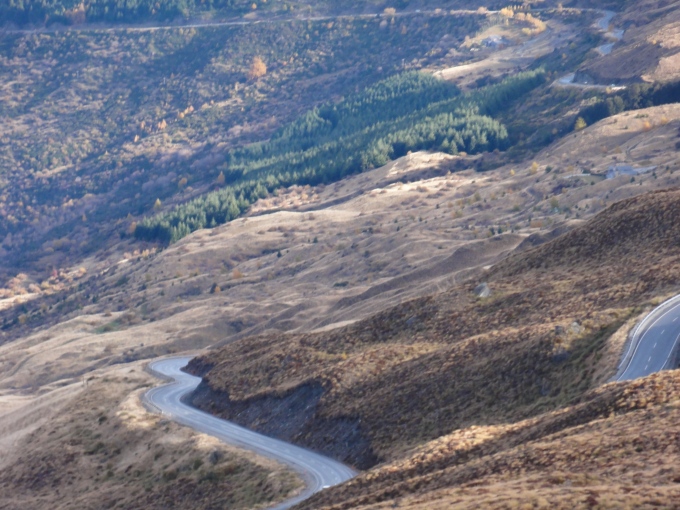
lookingdownfromcoronetpeak

And the story:

It was once said that a desperate man has everything to lose.

The man I was chasing was desperate, but I, on the other hand, was more desperate to catch him.

He’d left a trail of dead people from one end of the island to the other.

The team had put in a lot of effort to locate him, and now his capture was imminent.  We were following the car he was in, from a discrete distance, and, at the appropriate time, we would catch up, pull him over, and make the arrest.

There was nowhere for him to go.

The road led to a dead-end, and the only way off the mountain was back down the road were now on.  Which was why I was somewhat surprised when we discovered where he was.

Where was he going?

“Damn,” I heard Alan mutter.  He was driving, being careful not to get too close, but not far enough away to lose sight of him.

“What?”

“I think he’s made us.”

“How?”

“Dumb bad luck, I’m guessing.  Or he expected we’d follow him up the mountain.  He’s just sped up.”

“How far away?”

“A half-mile.  We should see him higher up when we turn the next corner.”

It took an eternity to get there, and when we did, Alan was right, only he was further on than we thought.”

“Step on it.  Let’s catch him up before he gets to the top.”

Easy to say, not so easy to do.  The road was treacherous, and in places just gravel, and there were no guard rails to stop a three thousand footfall down the mountainside.

Good thing then I had the foresight to have three agents on the hill for just such a scenario.

Ten minutes later, we were in sight of the car, still moving quickly, but we were going slightly faster.  We’d catch up just short of the summit car park.

Or so we thought.

Coming quickly around another corner we almost slammed into the car we’d been chasing.

“What the hell…” Aland muttered.

I was out of the car, and over to see if he was in it, but I knew that it was only a slender possibility.  The car was empty, and no indication where he went.

Certainly not up the road.  It was relatively straightforward for the next mile, at which we would have reached the summit.  Up the mountainside from here, or down.

I looked up.  Nothing.

Alan yelled out, “He’s not going down, not that I can see, but if he did, there’s hardly a foothold and that’s a long fall.”

Then where did he go?

Then a man looking very much like our quarry came out from behind a rock embedded just a short distance up the hill.

“Sorry,” he said quite calmly.  “Had to go if you know what I mean.”

I’d lost him.

It was as simple as that.

I had been led a merry chase up the hill, and all the time he was getting away in a different direction.

I’d fallen for the oldest trick in the book, letting my desperation blind me to the disguise that anyone else would see through in an instant.

It was a lonely sight, looking down that road, knowing that I had to go all that way down again, only this time, without having to throw caution to the wind.

“Maybe next time,” Alan said.

“We’ll get him.  It’s just a matter of time.”

© Charles Heath 2019-2021

Find this and other stories in “Inspiration, maybe”  available soon.

InspirationMaybe1v1

The first case of PI Walthenson – “A Case of Working With the Jones Brothers”

This case has everything, red herrings, jealous brothers, femme fatales, and at the heart of it all, greed.

See below for an excerpt from the book…

Coming soon!

PIWalthJones1

An excerpt from the book:

When Harry took the time to consider his position, a rather uncomfortable position at that, he concluded that he was somehow involved in another case that meant very little to him.

Not that it wasn’t important in some way he was yet to determine, it was just that his curiosity had got the better of him, and it had led to this: sitting in a chair, securely bound, waiting for someone one of his captors had called Doug.

It was not the name that worried him so much, it was the evil laugh that had come after the name was spoken.

Doug what? Doug the ‘destroyer’, Doug the ‘dangerous’, Doug the ‘deadly’; there was any number of sinister connotations, and perhaps that was the point of the laugh, to make it more frightening than it was.

But there was no doubt about one thing in his mind right then: he’d made a mistake. A very big. and costly, mistake. Just how big the cost, no doubt he would soon find out.

His mother, and his grandmother, the wisest person he had ever known, had once told him never to eavesdrop.

At the time he couldn’t help himself and instead of minding his own business, listening to a one-sided conversation which ended with a time and a place. The very nature of the person receiving the call was, at the very least, sinister, and, because of the cryptic conversation, there appeared to be, or at least to Harry, criminal activity involved.

For several days he had wrestled with the thought of whether he should go. Stay on the fringe, keep out of sight, observe and report to the police if it was a crime. Instead, he had willingly gone down the rabbit hole.

Now, sitting in an uncomfortable chair, several heat lamps hanging over his head, he was perspiring, and if perspiration could be used as a measure of fear, then Harry’s fear was at the highest level.

Another runnel of sweat rolled into his left eye, and, having his hands tied, literally, it made it impossible to clear it. The burning sensation momentarily took his mind off his predicament. He cursed and then shook his head trying to prevent a re-occurrence. It was to no avail.

Let the stinging sensation be a reminder of what was right and what was wrong.

It was obvious that it was the right place and the right time, but in considering his current perilous situation, it definitely was the wrong place to be, at the worst possible time.

It was meant to be his escape, an escape from the generations of lawyers, what were to Harry, dry, dusty men who had been in business since George Washington said to the first Walthenson to step foot on American soil, ‘Why don’t you become a lawyer?” when asked what he could do for the great man.

Or so it was handed down as lore, though Harry didn’t think Washington meant it literally, the Walthenson’s, then as now, were not shy of taking advice.

Except, of course, when it came to Harry.

He was, Harry’s father was prone to saying, the exception to every rule. Harry guessed his father was referring to the fact his son wanted to be a Private Detective rather than a dry, dusty lawyer. Just the clothes were enough to turn Harry off the profession.

So, with a little of the money Harry inherited from one of his aunts, he leased an office in Gramercy Park and had it renovated to look like the Sam Spade detective agency, you know the one, Spade and Archer, and The Maltese Falcon.

There’s a movie and a book by Dashiell Hammett if you’re interested.

So, there it was, painted on the opaque glass inset of the front door, ‘Harold Walthenson, Private Detective’.

There was enough money to hire an assistant, and it took a week before the right person came along, or, more to the point, didn’t just see his business plan as something sinister. Ellen, a tall cool woman in a long black dress, or so the words of a song in his head told him, fitted in perfectly.

She’d seen the movie, but she said with a grin, Harry was no Humphrey Bogart.

Of course not, he said, he didn’t smoke.

Three months on the job, and it had been a few calls, no ‘real’ cases, nothing but missing animals, and other miscellaneous items. What he really wanted was a missing person. Or perhaps a beguiling, sophisticated woman who was as deadly as she was charming, looking for an errant husband, perhaps one that she had already ‘dispatched’.

Or for a tall, dark and handsome foreigner who spoke in riddles and in heavily accented English, a spy, or perhaps an assassin, in town to take out the mayor. The man was such an imbecile Harry had considered doing it himself.

Now, in a back room of a disused warehouse, that wishful thinking might be just about to come to a very abrupt end, with none of the romanticized trappings of the business befalling him. No beguiling women, no sinister criminals, no stupid policemen.

Just a nasty little man whose only concern was how quickly or how slowly Harry’s end was going to be.

© Charles Heath 2019
Inspiration, maybe – Volume 1

50 photographs, 50 stories, of which there is one of the 50 below.

They all start with –

A picture paints … well, as many words as you like.  For instance:

lookingdownfromcoronetpeak

And the story:

It was once said that a desperate man has everything to lose.

The man I was chasing was desperate, but I, on the other hand, was more desperate to catch him.

He’d left a trail of dead people from one end of the island to the other.

The team had put in a lot of effort to locate him, and now his capture was imminent.  We were following the car he was in, from a discrete distance, and, at the appropriate time, we would catch up, pull him over, and make the arrest.

There was nowhere for him to go.

The road led to a dead-end, and the only way off the mountain was back down the road were now on.  Which was why I was somewhat surprised when we discovered where he was.

Where was he going?

“Damn,” I heard Alan mutter.  He was driving, being careful not to get too close, but not far enough away to lose sight of him.

“What?”

“I think he’s made us.”

“How?”

“Dumb bad luck, I’m guessing.  Or he expected we’d follow him up the mountain.  He’s just sped up.”

“How far away?”

“A half-mile.  We should see him higher up when we turn the next corner.”

It took an eternity to get there, and when we did, Alan was right, only he was further on than we thought.”

“Step on it.  Let’s catch him up before he gets to the top.”

Easy to say, not so easy to do.  The road was treacherous, and in places just gravel, and there were no guard rails to stop a three thousand footfall down the mountainside.

Good thing then I had the foresight to have three agents on the hill for just such a scenario.

Ten minutes later, we were in sight of the car, still moving quickly, but we were going slightly faster.  We’d catch up just short of the summit car park.

Or so we thought.

Coming quickly around another corner we almost slammed into the car we’d been chasing.

“What the hell…” Aland muttered.

I was out of the car, and over to see if he was in it, but I knew that it was only a slender possibility.  The car was empty, and no indication where he went.

Certainly not up the road.  It was relatively straightforward for the next mile, at which we would have reached the summit.  Up the mountainside from here, or down.

I looked up.  Nothing.

Alan yelled out, “He’s not going down, not that I can see, but if he did, there’s hardly a foothold and that’s a long fall.”

Then where did he go?

Then a man looking very much like our quarry came out from behind a rock embedded just a short distance up the hill.

“Sorry,” he said quite calmly.  “Had to go if you know what I mean.”

I’d lost him.

It was as simple as that.

I had been led a merry chase up the hill, and all the time he was getting away in a different direction.

I’d fallen for the oldest trick in the book, letting my desperation blind me to the disguise that anyone else would see through in an instant.

It was a lonely sight, looking down that road, knowing that I had to go all that way down again, only this time, without having to throw caution to the wind.

“Maybe next time,” Alan said.

“We’ll get him.  It’s just a matter of time.”

© Charles Heath 2019-2021

Find this and other stories in “Inspiration, maybe”  available soon.

InspirationMaybe1v1