Inspiration, maybe

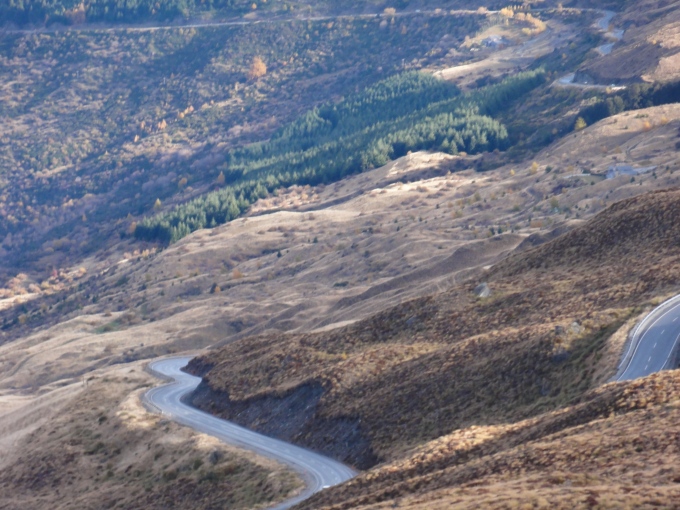
A picture paints … well, as many words as you like.  For instance:

lookingdownfromcoronetpeak

And the story:


It was once said that a desperate man has everything to lose.

The man I was chasing was desperate, but I, on the other hand, was more desperate to catch him.

He’d left a trail of dead people from one end of the island to the other.

The team had put in a lot of effort to locate him, and now his capture was imminent.  We were following the car he was in, from a discrete distance, and, at the appropriate time, we would catch up, pull him over, and make the arrest.

There was nowhere for him to go.

The road led to a dead-end, and the only way off the mountain was back down the road were now on.  Which was why I was somewhat surprised when we discovered where he was.

Where was he going?


“Damn,” I heard Alan mutter.  He was driving, being careful not to get too close, but not far enough away to lose sight of him.

“What?”

“I think he’s made us.”

“How?”

“Dumb bad luck, I’m guessing.  Or he expected we’d follow him up the mountain.  He’s just sped up.”

“How far away?”

“A half-mile.  We should see him higher up when we turn the next corner.”

It took an eternity to get there, and when we did, Alan was right, only he was further on than we thought.”

“Step on it.  Let’s catch him up before he gets to the top.”

Easy to say, not so easy to do.  The road was treacherous, and in places just gravel, and there were no guard rails to stop a three thousand footfall down the mountainside.

Good thing then I had the foresight to have three agents on the hill for just such a scenario.


Ten minutes later, we were in sight of the car, still moving quickly, but we were going slightly faster.  We’d catch up just short of the summit car park.

Or so we thought.

Coming quickly around another corner we almost slammed into the car we’d been chasing.

“What the hell…” Aland muttered.

I was out of the car, and over to see if he was in it, but I knew that it was only a slender possibility.  The car was empty, and no indication where he went.

Certainly not up the road.  It was relatively straightforward for the next mile, at which we would have reached the summit.  Up the mountainside from here, or down.

I looked up.  Nothing.

Alan yelled out, “He’s not going down, not that I can see, but if he did, there’s hardly a foothold and that’s a long fall.”

Then where did he go?

Then a man looking very much like our quarry came out from behind a rock embedded just a short distance up the hill.

“Sorry,” he said quite calmly.  “Had to go if you know what I mean.”


I’d lost him.

It was as simple as that.

I had been led a merry chase up the hill, and all the time he was getting away in a different direction.

I’d fallen for the oldest trick in the book, letting my desperation blind me to the disguise that anyone else would see through in an instant.

It was a lonely sight, looking down that road, knowing that I had to go all that way down again, only this time, without having to throw caution to the wind.

“Maybe next time,” Alan said.

“We’ll get him.  It’s just a matter of time.”


© Charles Heath 2019

Find this and other stories in “Inspiration, maybe”  available soon.

InspirationMaybe1v1


“Trouble in Store” – Short stories my way:  Editing becomes re-writing (6)

I’ve been looking at the start again, and something about it is nagging at me.

The main character needs a little work, and the start doesn’t exactly grab by the lapels of your coat.

Not yet.


The fact that smoking might kill him yet was, at that moment, an understatement.   If he was honest, when he told Maisie he had given them up, it should have been the truth.

And if it had been, he would not be in the situation he was.  A lame excuse to go down to the corner shop, had him panicking about getting there before the shop closed at 11 p.m.

His momentum propelled him through the door, causing the customer warning bell to ring loudly as the door bashed into it, and before the sound had died away, he knew he was in trouble.

It took a second, perhaps three, to sum up the situation. 

A young girl, about 16 or 17, scared, looking sideways at a man on the ground, then Alphonse, and then Jack.  He recognized the gun, a Luger, German, relic of WW2, perhaps the boy or her father’s souvenir, or more likely a stolen weapon, now pointing at him then Alphonse, then back to him.

Jack took another second or two to consider if he could disarm her.  No, the distance was too great.  He put his hands out where she could see them.  No sudden movements, try to remain calm, but his heart rate up to the point of cardiac arrest.  No point making a bad situation worse.

Pointing with the gun, she said, “Move closer to the counter where I can see you better.”

Everything but her hand was steady as a rock.  The only telltale signs of stress, the beads of perspiration on her brow and the slight tremor of her gun hand. 

It was 40 degrees Fahrenheit in the shop; almost mind-numbing.

Jack shivered and then did as he was told. 

A few seconds more for him to decide she was going to be unpredictable.

“What’s wrong with your friend?”  Jack tried the friendly approach after he’d taken the three steps sideways necessary to reach the counter.

The shopkeeper, Alphonse, who, Jack noted seemed to have aged another ten years in the last few months, spoke instead; “I suspect he’s an addict, looking for a score.  At the end of his tether, my guess, and here to get some money for a fix.”

A simple hold up that had gone very wrong. 

Wrong time, wrong place, in more ways than one Jack thought, now realizing he had walked into a very dangerous situation.  She didn’t look like a user.  The boy on the ground; he did, and he looked like he was going through the beginnings of withdrawal.

Oddly, though, when he first came in Jack had noticed a look pass between the shopkeeper and the girl.

 Then, as the tense silence reached an almost unbearable level, she said, “All you had to do was give us the stuff, and we wouldn’t be here, now.”  She was glaring back at Alphonse.  “You can still make this right.”

She used the word ‘stuff’ not money.  A flicker of memory jumped out of the depths on Jack’s mind, something discussed at the dinner table with their neighbors, something about the shop as a pick-up point for drugs.

The boy on the floor, he was not here for the money.

Jack thought he’d try another approach.  “Look, I don’t want trouble, and you don’t want trouble.  I’ll go, forget this ever happened.  You might want to do the same.  There’s nothing you can do for him now.”

The boy was intermittently writhing and moaning.  It looked to Jack like it might be more than just withdrawal.

The girl looked at the man on the ground, at the door, and back again, like she was thinking.  The gun, though, still moved between him and the shopkeeper.

Another assessment of the girl; she was completely out of place here, now.  It was evident she was from a better class of people, a different part of town.  Caught up in a downward spiral because of her acquaintance on the floor.

Caught in a situation she was not equipped to deal with.


© Charles Heath 2018-2020

“Trouble in Store” – Short stories my way:  Editing becomes re-writing (4)

I’ve been looking at the role of the [policewoman, and her interaction with the shop’s participants.

I’m still working on whether she needs more or less of an introduction, but, for the time being, this is what I’m going with:


It had been another long day at the office for Officer Margaret O’Donnell, or, out in the streets, coping with people who either didn’t know or didn’t care about the law.

People who couldn’t cross the road where there were crossings and lights to protect them, silly girls shoplifting on a dare, and boys who thought they were men and could walk on water.

The one they scraped of the road would never get to grow up, and his mother, well, she was not doing another call on a family to give them the bad news.

That was her day.

So far.

At the end of the day, she was glad to be getting home, putting her feet up, and forgetting about everything until the next morning when it would start all over again.

Coming around that last corner, the home stretch she called it, she was directly opposite the corner shop, usually closed at this hour of the night.  It was not.  The lights were still on.

She looked at her watch and saw it was ten minutes to midnight, and long past closing time.  She looked through the window, but from the other side of the road, she could only see three heads and little else.

Damn, she thought, I’m going to have to check it out. 

She was aware of the rumors, from her co-residents and also her colleagues down at the station, rumors she hoped were not true.


© Charles Heath 2016-2020

“The Price of Fame”, A Short Story

I looked at the invitation, a feeling of dread coming over me.  It was not entirely unexpected but like a great many things that had suddenly come into my life, it caused equal measures of fear and excitement.

The gold edging and the perfect script displaying my name in the exact centre of the envelope made it almost unique.  Very few people ever received such an invitation.

I held it in my hand for a longer than necessary, then put it down on the desk carefully, as if it would explode if I dropped it.

My first instinct, driven by fear, was not to accept.

But, fear or not, there was no question of me not attending.  Circumstances had painted me into a corner; I’d agreed to go a long time ago when I thought there was no chance it would come to pass.

Way back then, I had been compared to the aspiring painter in an attic having to die before I made any sort of impression.  In those days people thought it amusing.  I thought it was amusing.  Kirsty, in particular, had thought it was as impossible as I had.

Now it was not amusing.  Not even remotely.


My life was once quiet, peaceful, sedate, even boring.  That didn’t mean I lacked imagination, it was just not out on display for everyone to see.  Inspired by reading endless books, I had the capacity to transport myself into another world, divorced from reality, where my boring existence became whatever I wanted it to be.

It was also instrumental in bringing Kirsty into my life.  In reality, I thought she’d never take a second look at me, let alone a first.  So I pretended to be someone else.  Original, witty, charming, underneath more scared than I’d ever known.

And yet she knew, she’d always known and didn’t care.

As we spent more time together, she discovered I liked to write, not finish anything, just start, write a hundred pages, then lose interest.  Like everything I did.  Start, and never finish.

Why not?  It would never be published.  It would never succeed.

So she bribed me.  If I didn’t finish my first book and send it away, I couldn’t marry her.  It didn’t matter if it was rejected, all I had to do was finish a book, and send it.

The thought of marrying her had not entered my mind, because I hadn’t thought she would.  Incentive enough, I picked out one of the unfinished manuscripts and humoured her.  She read bits of it, not saying a word.  Sometimes she’d put a note or two on the manuscript, her equivalent to sweet nothings, and with it I gained inner confidence in my own ability, not only to write but in many other aspects of my life.

When it was finished, it was Kirsty who sent it off.  She read it, packaged it, addressed it, and sent it before I had a chance to change her mind.  Once gone, I heaved a huge sigh of relief.  It was done. That was, as far as I was concerned, the end of it.


It was not possible that one letter could change a person’s life so dramatically.  I came home to the all-knowing smile, and mischievous whimsicality that had always suggested trouble.

Trouble indeed!

My book was accepted.  With a cheque called an advance.  For more money than I knew what to do with.

This was followed not long after by publication.  And a dramatic change to my life, one I didn’t want.  To become a public person, to face an enormous number of people, people I didn’t know.

I went back to being scared.


Kirsty smiled at me and told me how wonderful I looked in my monkey suit.  Why couldn’t I go in jeans and a dress shirt?  All the best actors in Hollywood did it.

“This is not Hollywood.  You’re not an actor.”  It was a simple, practical, answer.

The hell I wasn’t.  I could act sick, dying, fake a heart attack, anything.  “What am I going to say?”

“You could talk about books.”  Quiet, efficient, oozing the confidence I didn’t feel.

She didn’t fuss.  She took it in her stride.  She dressed in her usual simple elegance, in a manner that made me love to be seen with her.  I couldn’t tie my tie, so she did it for me.  She straightened my jacket because I couldn’t do that either.  Nerves.  Can’t live with them, can’t live without them.  Or was that a reference to wives, or mistresses, or something else?

The palms of my hands were sweating.  Meatball hands, I thought, the sort of palms that betrayed the pretenders.  Me, I was the pretender.  My neck felt too large for the shirt.  Beads of sweat formed on my brow.  Where was a sponge when you needed one?

“I can’t do this.”

“You can.”

We hadn’t even left the hotel yet.

“How long before the execution.”

She looked at me with her whimsical smile.  “Long enough for me to give you a hard time.”


I lost count of the number of times I had to go to the bathroom, for one thing, or another.  Nerves I said.  Perhaps a dozen Valium or something similar.  Did I have any?  Had she hidden them?  Why did she keep smiling?

In the car, I looked at my watch at least a dozen times.  I couldn’t breathe.  It was too hot, too cold.  She held my hand, and it served best to stop the trembling that had set in.  Why did I agree to this?  Why?

We were greeted by the Events Manager, who was polite and genuinely interested.  He took us inside where he introduced the interviewer, another woman who oozed confidence and charm, who went over the format and generally tried to set me at ease.

I didn’t let Kirsty’s hand go.  Not yet.  She was my lifeline, the umbilical cord.  When it was severed, I knew I was going to die.

Bathroom?  Where was the bathroom?  Hell, five minutes to go, and I felt like passing out.  No, Kirsty couldn’t come in.  Comb my hair.  Straighten my tie, no it was straight.  Maybe I could hide in here?  I looked around.  No, maybe not.

Time.

The cue man was standing beside me, hand gently on my back.  He knew the score.  He knew I would turn and run the first chance I got.  Kirsty was on the other side, smiling.  Did she know too?

Then the announcement, my cue to walk on.

The gentle shove, the bright lights, the deafening applause, the seemingly endless walk to the chair, dear God, would I make it without tripping over?

How many times had I made this trip?  I stood, facing the audience, waved, then sat.  It was the fifteenth.  You’d think I’d learned by now.

There was nothing to it.


© Charles Heath 2016-2019


I’ve always wanted to go on a Treasure Hunt – Part 36

Here’s the thing…

Every time I close my eyes, I see something different.

I’d like to think the cinema of my dreams is playing a double feature but it’s a bit like a comedy cartoon night on Fox.

But these dreams are nothing to laugh about.

Once again there’s a new installment of an old feature, and we’re back on the treasure hunt.


“How long have you been working on this?”

“A week. Lying in bed is boring, so I decided to look at everything I’ve got again, and then again. There were some old maps of the coastline stored with the treasure maps, so I think my father was trying to find the actual location his treasure maps were based on and came up against the same problem. Physical landmarks on the treasure maps are no longer there, and if you didn’t know any better, I would think you were looking in the wrong place.”

“So, in actual fact, what you’re saying now is that your father had no idea where the treasure was buried, that he was just producing maps for the Cossatino’s’ to sell.”

That, of course, could be looked at from a different angle, one that I wasn’t going to suggest right then because Boggs was not ready to hear it. I think the real maps Boggs had found with eh treasure maps were the basis for the treasure maps, that is, his father had to give them real-life elements to keep the punters interested.

“No, not necessarily. I think he knew it was somewhere along this coastline give or take a hundred miles, because of its proximity to the Spanish Maine, but essentially you’re right. He probably had no idea.”

So, he hadn’t come to the same conclusion I had. Yet.

And if I could come to that conclusion, surely Cossatino also would, after all, he was the one who got Boggs senior to make the maps. Why all of a sudden did he think that there was a real treasure map. It couldn’t be simply because Boggs had said there was one. He’d have to know that anything Boggs junior found was an invention commissioned by him,

Or hadn’t Vince told his father what he was doing? Surely the father would have told the son about the treasure map scam.

As for Benderby, senior could base his assumption of the fact that he’d found some old coins off the coast nearby that could be part of the trove. Alex then may have decided to usurp his father’s search with one of his own, conveniently forgetting the treasure maps were an invention of the Cossatino’s. IT was a tangled web of lies deceit and one-upmanship, one that was going to leave a trail of human wreckage in its wake.

Boggs and I were two of the first three. We had lived to tell about it, Frobisher was the first casualty.

But what I suppose was more despairing was how taken Boggs was with the notion that the treasure was real, hidden out there somewhere, and that his father had ‘the’ map. I was loath to label him delusional, but his pathological desire to prove his father’s so-called legacy was going to not end well, especially when we found nothing.

And, yet, I had to admire the lengths he had gone to, to prove his case. Even now, looking at the overlaid maps, there was no guarantee we’d find anything, but at first look, the evidence was compelling.

Except I had a feeling Boggs had something up his sleeve. I had to ask the question. “Where did you get the idea of matching the treasure map to the real map?”

“My father’s journal. It was tossed in the bottom of a box of his other stuff. There are about ten boxes stacked in the shed, stuff my mother just couldn’t be bothered sorting through after he disappeared. Again, boredom pushed me into going through everything over and over just in case I missed something.”

He reached in under the mattress of his bed and pulled out an old leather-bound notebook. It had a strap that bound it together, and by the look of it had extra papers inserted or glued to pages, as well as papers at the start and back of the volume, making it look about twice the original size.

He handed it to me. The leather was old, cracked, and had that distinctive aroma of the hide. I loosened the strap and the top cover opened. The first page was a newspaper cutting, a small piece about some old coins being found about a hundred yards offshore by some surfers. Were these the same coins that Benderby had claimed were part to the trove?

“Benderby was getting that antiquarian that was murdered to identify some coins,” I said after a quick glance through the article.

“I spoke to one of the surfers the other day,” Boggs said. “He told me he came off his board on a big wave and as he was going down saw something glinting on the seabed. He managed to pull up three coins. There were more but he had to come up for air. When he went down again, he realized he’d been dragged away by the current.”

Tides and currents along this part of the coast were particularly bad, and the undertow, at times could get surfers and swimmers alike into a lot of trouble. I’d been caught out once in a dinghy myself, finishing up ten miles further down the coast that I expected to be.

“Then, I take it he can’t remember the exact spot so he could go back.”

“He tried, but alas no. Said he sold the coins to old man Benderby for a hundred apiece and told him approximately where he thought the others were, but nothing’s been found since.”

Not that Benderby would tell anyone if he did. But it explained where the coins came from that he gave to Frobisher.

“Except we can assume that it’s off our coastline somewhere, right?”

“Five miles of coastline to be precise. He and his mate always had a few reefers before they went out, made the ride more interesting he said. He could have been off the coast of Peru for all he knew.”

Surfers, drugs and a colorful story.

“It explains why Benderby and a team of divers have been out in his new boat,” Boggs added, “probably trying to either find the location or line up landmarks on his map from the seaward side at the same time. But he doesn’t know what we know.”

What did we know? I leafed through a few more pages of the diary, but the scrawled notes were almost illegible. I picked up various words, like a marina, underground river, dry lakebed, but none of it made any sense.

“Which map did we give to Alex?”

Boggs went over to a drawer in the wardrobe and leafed through the papers in it and pulled out one and gave it to me. Like the rest it showed the shore, the hills, the lake, and two what looked to be rivers flowing into the sea. Each of the maps had those same features but in different places.

I didn’t want to say it, but it seemed to me we were playing a very dangerous game. The maps might look different in some respects, but the chances were, if Alex was smart enough to hire an expert, that we might run across him out there, and, to be honest, he would be the last person I’d want to see.

“You do realize our paths are going to cross at some point.”

“Maybe, maybe not.”

A shiver went down my spine, an omen I thought. Boggs has something up his sleeve, and I really didn’t want to know.

Not right then.


© Charles Heath 2020

Inspiration, maybe

A picture paints … well, as many words as you like.  For instance:

lookingdownfromcoronetpeak

And the story:


It was once said that a desperate man has everything to lose.

The man I was chasing was desperate, but I, on the other hand, was more desperate to catch him.

He’d left a trail of dead people from one end of the island to the other.

The team had put in a lot of effort to locate him, and now his capture was imminent.  We were following the car he was in, from a discrete distance, and, at the appropriate time, we would catch up, pull him over, and make the arrest.

There was nowhere for him to go.

The road led to a dead-end, and the only way off the mountain was back down the road were now on.  Which was why I was somewhat surprised when we discovered where he was.

Where was he going?


“Damn,” I heard Alan mutter.  He was driving, being careful not to get too close, but not far enough away to lose sight of him.

“What?”

“I think he’s made us.”

“How?”

“Dumb bad luck, I’m guessing.  Or he expected we’d follow him up the mountain.  He’s just sped up.”

“How far away?”

“A half-mile.  We should see him higher up when we turn the next corner.”

It took an eternity to get there, and when we did, Alan was right, only he was further on than we thought.”

“Step on it.  Let’s catch him up before he gets to the top.”

Easy to say, not so easy to do.  The road was treacherous, and in places just gravel, and there were no guard rails to stop a three thousand footfall down the mountainside.

Good thing then I had the foresight to have three agents on the hill for just such a scenario.


Ten minutes later, we were in sight of the car, still moving quickly, but we were going slightly faster.  We’d catch up just short of the summit car park.

Or so we thought.

Coming quickly around another corner we almost slammed into the car we’d been chasing.

“What the hell…” Aland muttered.

I was out of the car, and over to see if he was in it, but I knew that it was only a slender possibility.  The car was empty, and no indication where he went.

Certainly not up the road.  It was relatively straightforward for the next mile, at which we would have reached the summit.  Up the mountainside from here, or down.

I looked up.  Nothing.

Alan yelled out, “He’s not going down, not that I can see, but if he did, there’s hardly a foothold and that’s a long fall.”

Then where did he go?

Then a man looking very much like our quarry came out from behind a rock embedded just a short distance up the hill.

“Sorry,” he said quite calmly.  “Had to go if you know what I mean.”


I’d lost him.

It was as simple as that.

I had been led a merry chase up the hill, and all the time he was getting away in a different direction.

I’d fallen for the oldest trick in the book, letting my desperation blind me to the disguise that anyone else would see through in an instant.

It was a lonely sight, looking down that road, knowing that I had to go all that way down again, only this time, without having to throw caution to the wind.

“Maybe next time,” Alan said.

“We’ll get him.  It’s just a matter of time.”


© Charles Heath 2019

Find this and other stories in “Inspiration, maybe”  available soon.

InspirationMaybe1v1


What happens after the action-packed start – Part 37

Our hero knows he’s in serious trouble.

The problem is, there are familiar faces and a question of who is a friend and who is foe made all the more difficult because of the enemy, if it was the enemy, simply because it didn’t look or sound or act like the enemy.

Now, it appears, his problems stem from another operation he participated in, and because of it, he has now been roped into what might be called a suicide mission.


An hour later we were stopped by the side of the road, at a point where another road, or, rather, a track headed to the left into the forest.

A short distance before that I noticed a sign, battered and faded, advertising an airport, a sign I thought had been put there as a joke.

Of course, when I remembered the conversation I had with Monroe back on the plane and the fact we had a specialist pilot in our group, it all began to make sense.

Our exit strategy.

I only wished I had internet coverage so I could check the presence of an airport in what looked to be the middle of nowhere.

Only Davies seemed unperturbed.

I had to ask.  “Did you know there was an airport here?”

“Of one, used by fly-ins for the Garamba National Park.  Not much of an airstrip though, and we don’t exactly have up to the minute details on its surface, but as recently as a week ago a small plane had landed there.”

“Thanks for telling me.”

“All you had to do was ask the right question.”

It seems I didn’t know what the right questions were, what might be called an occupational hazard on a job like this.

Everyone had got out of their cars to stretch their legs and prepare for the next phase of the operation, which was to meet with the kidnappers.  I expected Jacobi would be on the sat phone talking to their leader, advising we had arrived.

I went back to Mobley, standing with the Ugandan soldier that had been assigned as his driver, smoking a cigarette.  I was surprised he hadn’t joined the others who had gathered ahead of the lead vehicle.

“Nice shooting back there,” I said.  It was for a man under pressure to make the shots, and give the rest of us a chance to take care of the others.  That no one else got shot was a miracle.

“Just another day at the office.”

“Well, it hasn’t ended yet.  I want you to go to the airstrip and get it under surveillance.  There is supposed to be an aircraft there, whether for our use or just there so we can steal it I’m not quite sure.  But if there’s a plane there, I want you to make sure it doesn’t leave, but as quietly as possible.  We should be along later with the packages.  I’m going up to tell the Colonel he’ll be joining you.  He might not want to, but he’s done enough for us.  I don’t want him to make enemies unnecessarily.”

“As you wish.  I’ll be along shortly.”

“Good.  Make sure your radio is working and on.  I need to know if anything goes sideways.”

“It won’t.”

I wish I had his confidence.

A minute later I reached the front of the convoy and saw why there seemed little animation among the group.  Monroe had Jacobi on his knees and a gun on the back of his neck.

“This is an interesting development Lieutenant.  Is there a problem I should know about?”

“I reckon the weasel sold us out back there.  Maybe even called them in to shake us down for one reason or another.  Didn’t try too hard to negotiate with the commander.”

No, he hadn’t.  And the thought had crossed my mind too.  A bit of cash on the side, split with the commander.  There didn’t seem to be any intent of the commander’s part to shoot us, so it was a pity we had to kill them all.  If they were part of the kidnapper’s operations, things might get a little dangerous.

“Before you kill him,” I said, “Did he tell you how the call to the kidnappers went?”

“Didn’t ask.”

“Perhaps you should.”

Mobley picked that moment to drive up alongside Jacobi and the Lieutenant.

“Problem?” he asked through the window.

“No.  We’re practicing our run at the kidnappers.”

He shrugged.  I looked over at the Colonel.  “Time for you to be moving on.  You don’t need to be in on the next part, for plausible deniability.  I suspect if the leader of this group sees you, and makes any connection back to the Ugandans, it could cause trouble.”

“Nothing I couldn’t handle.”

“Better if you didn’t have to.  My man needs help at the airstrip and a man of your authority might just smooth over problems if he needs it.”

“You’re having a plane sent in?”

“I’d like to think so, might even get you home in time for a late supper.”  I glared at Jacobi.  “How does he get to the airstrip?”

“Normally, through the town, but there’s a track about 200 yards up the road.  Go left, follow the road, then turn right at the first fork.”

He stood staring at the ground for a minute, hopefully considering doing as I asked.  I was not sure what I was going to do if he didn’t.  It was preferable he didn’t come with us.

“OK.  You have a point.  No need stirring up my Congo friends any more than I already have.”

He went over to Mobley’s car and got in, replacing the Ugandan soldier as a driver.

“See you when we see you,” Mobley said, and the Colonel drove off after a wave.

Back to my other problem.

“You’ve had time to think about your answer, Jacobi, so tell us.”

“An eight-mile drive along the next track, then instead of taking the fork to the airstrip, go left, and drive to you reach the checkpoint.”

“The meeting is on.”

“They’re waiting for us.”

“In more ways than one, I’d say,” Monroe muttered.  “He’s outlived his usefulness in my book.”

Ordinarily, I would agree with her, but we still needed him.  There might have been an initial negotiation, but it was far from what the end deal would be, and he had to be there to complete it.  And if he was leading us into a trap, well, we’d just have to wait and see.

“We still need him, so ease up on the aggression.  If he has double-crossed us, you can shoot him.  Until then, play nice.  But, just as a precaution, you and Stark can bring up the rear, stop about a mile short, and do some recon between there and the checkpoint.  If anyone is thinking of sneaking up behind us, I want to know about it.”

Monroe shook her head, then eased the gun away from him.  A nod to me.

“He can go with you in the lead car.  Davies can come with me and keep driving the car.  They’ll be expecting four vehicles.”

“Fair enough.”  I turned to Baines, the first time I’d addressed him since getting on the plane at the black site.  “You wouldn’t happen to know if there’s a portable rocket launcher among that film equipment, would you?”

“And half a dozen shells.  Don’t know how they managed it, but it’s there.”

“Easy to get at?”

“If need be.”

“Good.”  I looked around at the rest of the team.  “Everyone had time to calm their nerves.”

I’d watched Jacobi drag himself to his feet and try to brush the dust of his clothes.  It didn’t help restore what was once quite clean and crisp linen.  No one helped him, in fact, if I gave the order to shoot, all of them would.  Monroe’s accusation struck a chord with the others.

“We’d better get going,” she said, heading for the last vehicle after being joined by Davies.  Out of earshot, she said something to her, and I heard them laughing.

I was not sure what it was about, but as long as it eased the tension in her.  She had discovered which car was carrying the diamonds, co-incidentally the car I’d been driving, so we needed a situation so that we could remove the diamonds from the equation when we arrived at the checkpoint.  There was no way the kidnappers were going to let us retrieve the package once we got there, and I had no doubt we would be separated from the cars, and the equipment, so that, if possible, the kidnappers could gain the upper hand.

Or that was how I suspected it would go down.  It was only a matter of time before I was proved right or wrong.

Everyone else got back into the cars, and with Jacobi sitting in the front with me, I started moving forward.

I wasn’t prepared, not mentally anyway.  I never was when going into battle.


© Charles Heath 2019-2020
“Trouble in Store” – Short stories my way:  Editing becomes re-writing (3)

I have reworked the first part of the story with a few new elements about the characters and changed a few of the details of how the characters finish up in the shop before the policewoman makes her entrance.

This is part of the new first section is the one that involves the shopkeeper`:


This wasn’t the shopkeeper’s first hold up.  In fact, over the years there had been a dozen.  But only one got reported to the police, and that was only because the robber was shot and killed.

He’d taken a bullet that night, too, which, from the police point of view, made him a concerned citizen simply defending himself.

The rest had been scared off by the double-barrel shotgun he kept under the counter for just such emergencies.

The young punk who came into the shop with his girlfriend had pulled out the pistol and told him if he reached for the shotgun he’d shoot him.  The kid looked unstable and he’d backed away.

When the kid collapsed, he should have gone for the shotgun, but instead, he thought he could get to the gun before the girl realized what was happened.  She wasn’t an addict and clearly looked like she was only along for the ride.  Her expression, when the kid pulled out the gun told him she’d known nothing about her partner’s true intentions.

But, he wasn’t fast enough, and she had the gun pointing at him before he’d got past the counter.

From one pair of unpredictable hands to another.

Like the girl, he was just as surprised when the customer burst in the door, just before closing time.

The situation might have been salvageable before the customer came in the door, getting the girl to go along with the robbery being about money, but there was no denying what the kid on the floor’s problem was.

Damn.

He had to try and salvage the situation simply because there was a lot of money involved, and other people depending on him.  He looked at the boy, on the floor, then the girl.

“Listen to me, young lady, you would be well advised to let this man go as he suggests.  And, please put the gun down before someone gets hurt.  Your friend needs medical help and I can call an ambulance.”

The girl switched her attention back to him.  “No one’s going anywhere, so just shut the hell up and let me think.”

The storekeeper glanced over at the customer. 

He’d seen him come into the shop once or twice, probably lived in the neighborhood, the sort who’d make a reliable witness, either a lawyer or an accountant.  Not like most of the residents just beyond the fringe of respectability.

If only he hadn’t burst into the shop when he did.


© Charles Heath 2016-2020

“Trouble in Store” – Short stories my way: Editing becomes re-writing (1)

I have reworked the first part of the story with a few new elements about the characters and changed a few of the details of how the characters finish up in the shop before the policewoman makes her entrance.

This is part of the new first section that involves Jack:


Jack was staring down the barrel of a gun.

He had gone down to the corner shop to get a pack of cigarettes.

He had to hustle because he knew the shopkeeper, Alphonse, liked to close at 11:00 pm sharp.  His momentum propelled him through the door, causing the customer warning bell to ring loudly as the door bashed into it, and before the sound had died away, he knew he was in trouble.

It took a second, perhaps three, to sum up the situation. 

A young girl, about 16 or 17, scared, looking sideways at a man on the ground, then Alphonse, and then Jack.  He recognized the gun, a Luger, German, relic of WW2, perhaps her father’s souvenir, or more likely a stolen weapon, now pointing at him then Alphonse, then back to him.

Jack took another second or two to consider if he could disarm her.  No, the distance was too great.  He put his hands out where she could see them.  No sudden movements, try to remain calm, his heart rate up to the point of cardiac arrest.  No point making a bad situation worse.

Pointing with the gun, she said, “Move closer to the counter where I can see you better.”

Everything but her hand steady as a rock.  Only telltale sign of stress, the bead of perspiration on her brow.  It was 40 degrees Fahrenheit in the shop.

Jack shivered and then did as he was told. 

A few seconds more for him to decide she was in an unpredictable category.

“What’s wrong with your friend?”  Jack tried the friendly approach after he’d taken the three steps sideways necessary to reach the counter.

The shopkeeper, Alphonse, who, Jack noted seemed to have aged another ten years in the last few months, spoke instead; “I suspect he’s an addict, looking for a score.  At the end of his tether, my guess, and her to get some money.”

A simple hold up that had gone wrong.  Wrong time, wrong place, in more ways than one Jack thought, now realizing he had walked into a very dangerous situation.  She didn’t look like a user.  The boy on the ground, he did, and he looked like he was going through the beginnings of withdrawal.

Oddly, though, Jack had noticed a look pass between the shopkeeper and the girl.

 “All you had to go was give us the money, and we wouldn’t be here, now.”  She was glaring back at Alphonse.  “You can still make this right.”

A flicker of memory jumped out of the depths on Jack’s mind, something discussed at the dinner table with their neighbors, something about the shop as a pick-up point for drugs.

The boy on the floor, he was not here for the money.

Jack thought he’d try another approach.  “Look, I don’t want trouble, and you don’t want trouble.  I’ll go, forget this ever happened.  You might want to do the same.”

The girl looked like she was thinking.  The gun, though, still moved between him and the shopkeeper.

Another assessment of the girl; this was not her real home.  She was from a better class of people, a different part of town.  Caught up in a downward spiral because of her friend on the floor.

Caught in a situation she was not equipped to deal with.

That didn’t bode well for his, or anyone else in that shop right then, health.


© Charles Heath 2016-2020

A matter of life and … what’s worse than death? – Episode 27

For a story that was conceived during those long boring hours flying in a steel cocoon, striving to keep away the thoughts that the plane and everyone in it could just simply disappear as planes have in the past, it has come a long way.

Whilst I have always had a fascination with what happened during the second world war, not the battles or fighting, but in the more obscure events that took place, I decided to pen my own little sidebar to what was a long and bitter war.

And, so, it continues…

Rolf Mayer had only ever wanted to design and build rockets for exploration of space.

Somewhere between the germination of that desire, and where he was right now, in the back of a black Mercedes SS staff car heading south towards Nuremberg something had gone horribly wrong.

Back at Nordhausen, he may have been terrified most of the time from the demands of the Reich, and the horrors of how the Reich was achieving its goals, he was, at least, safe.

Now he was a traitor, with stolen plans, with two Britisher spies, heading for Italy and from there to, well it hadn’t quite been specified where he might end up, but he assumed it would be England.

As yet they had not asked him whether he had the answer to stop this new weapon, and, if he really thought about it, there wasn’t an answer.  Perhaps, with a sense of irony, he could say that in kidnapping him, they might not fix the gyro guidance system which caused a lot of the rockets to go off course and miss their intended targets, but still, a large number would still reach their destination with devasting effect.

As for stopping it, he doubted it could be done.  They were fired from mobile positions, there were no static launching sites so the enemy couldn’t bomb those sites, not could they stop the production of them because it was underground.  A lot of lessons had been learned since Pennemunde.

And that brought another thought to mind.  Who was the enemy now, if he was willing to go with these spies?  He was German, and he loved his country, but seeing what he had seen, it was hard to balance that patriotism with the means to achieve their goals.  Perhaps the blame lay with the Fuhrer, but no one ever spoke of what they really thought, only of their undying allegiance to the mother country and its heroic leader.

No doubt, when he reached his final destination he was going to hear a lot of things that may or may not be true about Reich and its leadership.

Mayer noticed the Standartenfuhrer had a map and at various times they would stop the car and consult the map, an older touring map that predated the war.

Listening to their conversations he had learned that the car had a 50-liter tank that was full at the start of their journey.  From Nordhausen to Weimar had been 120 kilometers and had used about 18 liters of petrol.  From that, he deduced that the car would go about 300 kilometers per tankful.  This means they would need more petrol before they reached Nurnberg.

It was one thing to say they were going to take care of the details but getting one of the most heavily rationed commodities in Germany, or anywhere within the sphere of the Reich was nigh on impossible.  He knew this simply because his superiors at the Nordhausen site couldn’t get any petrol for their vehicles.

At this stage of the war, a war they were continually told they were winning, there seemed precious little of anything still available or not rationed, especially food.  Because they were SS they fared reasonably well, but the others not so much, making him feel guilty that he was not going hungry like everyone else.

In fact, he was feeling hungry now, and he didn’t remember seeing any food in the car.

Some distances from Bayreuth, after passing through another checkpoint, they stopped a further 10 kilometers up the rood, in a layby that sheltered them from any other traffic, not that there had been anything other than army convoys.  Several ties there had been airplanes overhead, either coming or going in small groups, perhaps training runs, so perhaps there was a Luftwaffe station nearby

Outside there was another consultation of the map and then the driver headed towards the rear of the car and opened the trunk.  The Standartenfuhrer opened the door.  “You can get out and stretch your legs.”

Mayer climbed out and found just how stiff and sore he was, and it hadn’t been a very long drive, but the roads were not as good as they once were, before the war.

Then he noticed the driver lugging a large can to the petrol cap, opened it, put a funnel in and with some assistance, started refilling the tank.  When he walked towards the rear of the car he saw six such cans in the trunk.  They had come prepared, and given the nature of how they had collected him, he realized that he had been targeted, which meant someone inside the Nordhausen complex was an agent working for British Intelligence.

They emptied two of the tanks into the car, replaced the cans back in the trunk.

The Standartenfuhrer called him over to show him the map.

It had a line roughly drawn from Nordhausen down to Florence, and notes on the side in red, the most pertinent being the distance by road, if they could take the direct route, which now he knew the circumstances, they could not, was about 1,150 kilometers.

Even in the best of circumstances that would take about three days, maybe more.  And there was certainly not enough fuel in the rear truck to go the whole distance.

The Standartenfuhrer ran his finger down the line, “This is the intended route we decided on, though not exactly sticking to the main roads.  WE do not anticipate problems in Germany, but once we cross into Austria and onto Innsbruck there might be a few problems.  We’re not quite sure what to expect at the border.”

“There is no border, not as far as the Reich and the Fuehrer is concerned.”

“Let’s hope you’re right.  But I think it’s about time we had a talk about what happened if anything happens to the two of us.  We’re not planning to get captured, or killed if it’s possible but there’s a lot of risks involved in an operation like this.”

“You expect me to go on alone?”

“Yes.  With the plans and drawings.  You have to get to a town called Gaiole in Chianti which is about 70 kilometers south of Florence.  There you will need to find a man named Luigi Fosini, who will take care of the rest of your journey.  There is a code you will need to give him, but we’ll talk about that later.  All you need, for now, is the destination.”

Discussion over, the got back in the car and continued on their way.

Then he realized he’d forgotten to ask about food, but judging by the dark expressions they wore, he decided to wait a little longer.

© Charles Heath 2020