A to Z Challenge – N is for: No stone unturned…

N2020

Mondays were usually a slow day to start the week, a brief few hours after the storm the was every Friday. Some chose to come in late, others gathered on arrival to have a team debriefing.

Our department chose to have a debriefing, and it was my job to analyze all the data and turn it into a graphical representation that basically said the business was heading in the right direction – up.

But, this Monday morning, the circumstances were slightly different.

The head of the company had personally sent both an email and a memo to every employee, an event that had never happened before.

In fact, for most of us, it was an eye-opening discovery, one where had the company not become engulfed in a scandal of international proportions, his identity might have remained a secret.

Not that it mattered to the 15,000 odd people who worked for the company, because the bottom line was that it would not affect us, or our employment.  Well, that was the message the email and the memo was primarily about.

Was it too little too late?

The problem was that the morning’s paper’s headlines screamed scandal in large letters and then went on to describe how the company was basically a front for laundering money associated with various criminal activities. It stopped short of accusing the company’s upper management of being criminals, but it was clear, reading between the lines, they had to know something was wrong.

I walked into the meeting room where all of the Department’s staff were seated, talking among themselves, that dying down the moment I closed the door behind me. On the desk in front of each was one of the three morning papers, all with basically the same story.

I didn’t bring a paper in with me, nor a copy of the email, or the memo. I was hoping the meeting was not going to be about the scandal.

I was wrong.

It was one of those companies where everyone knew everyone. I knew everyone in the room, and regarded most as friends as well as workmates. The company promoted from within and on merit, and with this, I had the respect of everyone who worked under me.

I could see by the mood, and looks of expectation, that trust was going to be tested.

“I suspect that everyone has seen the news, and hopefully read both missives from management regarding the situation the company finds itself.”

That was met with a murmur of agreement.

“It was also, for some, a surprise.”

For others, it was not. Our department was basically in place to ensure that all transactions were conducted properly and that clients’ accounts were managed within the guidelines set by the company, and the various government institutions responsible for financial affairs.

Several of the senior officers had come to me with what they regarded as anomalies, and I have given them the authority to investigate. It was also within my remit to advise the relevant government authority. Most of the anomalies had simply been oversights by the account manager, except for one, which as far as I was aware, had been cleared.

Or not.

“Can we safely assume that Wally Anderson’s somewhat abrupt was not as described?”

Wally Anderson’s abrupt departure had been described to me in a one-line email, ‘taking some personal time to work through some family issues’. In the week leading up to his departure he had become increasingly agitated, and one call one of the others had taken in his absence was from a reporter.

It was one of his accounts that remained doubtful, until shortly after he left when an external investigator was brought in.

But I had a difficult line to walk, trying to placate both sides of the spectrum and management, and as a leader. Respect could be won or lost in a matter of words.

“That might or might not be the case, but the odds are, given what we’re reading, that there may be room for doubt. However, despite what we may conclude, or deduce, it is better for all of us to keep an open mind. I suspect, at some point, again based on what I read, we might be approached by the police or representatives of a number of regulatory organizations for information.”

It was as far as I got.

The side door swung open, and my superior, the Chief Accountant, strode in, along with the mystery man who was, the papers said, the Owner, followed by the harried personal assistant.

“Mr. Nelson…”

The Chief Accountant stood front and center to the group. I thought it wise to stand off to one side, the opposite, in fact, the Owner, now standing just inside the door, next to his PA who was quietly talking into her cell phone.

“I’ll take over from here, Max.”

He switched his attention back to the group and took a few seconds to run his eye over all over them, almost as if he was looking for someone or something.

“I have spent the last 48 hours in rather tedious discussions with the regulators who insist that they received information about the Ridley investigation. Unfortunately, without consulting the company, he took part of the results of the investigation to them. Was anyone here aware of his actions?”

Another eye cast over the group, and, in the end, a glance at me.

I felt responsible to answer for the group.

“Investigations are conducted by individuals, and as far as I was concerned, the Ridley investigation was his. As equally that after he departed, that investigation was completed and cleared. Are you intimating that it wasn’t?”

I knew as much about it as the others.

“It was, until someone else reopened it, and reported it. We believe it was someone in this room.”

“That’s not possible,” I said. “I have oversight of all the officers in this room, and the ability to monitor everything they do and everything they look at. You know the security protocols in place in the software itself.”

“An investigation into the software has been implemented, and it shows that certain log files were altered so that the user log wouldn’t show who looked at the records. Someone with database experience.”

“We’re basically auditors not database managers.”

“Well, someone apparently is. Everyone is on notice. We will find out who it was, and believe me when I say we will leave no stone unturned in the process.”

An almost imperceptible not from the Owner, the harried PA was still on the cell phone, the Chief Accountant gave the group another steely look, then glared at me, said, “My office, one hour,” then left pulling the other two along in his wake.

I cast an eye over the group, picking out those whom I suspected were capable of performing such a search and destroy operation. Three.

“My door is open for anyone who might have any information, with the promise of anonymity.”

I left them with that and also left.

What should have been a quiet morning’s discussion just became a witch hunt where someone would be burnt at the stake. Whether they were guilty or not.


© Charles Heath 2020

A to Z Challenge – M is for: More or less…

M2020

It was meant to be time to reacquaint as brothers.

Louis and I had not seen each other for decades, and when he returned, about a week before, I got the impression there was more than just ‘missing his brother’ going on.

But that was Louis. He was never one to say what or how he felt about anything, preferring to be the strong silent type, and it had not fared well for him transitioning from teenager to adult.

As for me, when our parents split up, Louis went with our father, and I stayed with our mother, and, given the amount of acrimony there was attached to the split, it was no surprise to anyone that Louis and I had effectively become estranged.

In fact, when I had tried to find them, about two years after the split and our mother had died suddenly, all I found were loose ends. They had effectively vanished.

With that part of my life effectively over, I had married, had children and watched 30 years disappear before Louis suddenly popped up. He simply knocked on the front door one afternoon, Helen answered it, and within minutes they were the best of friends. I’d had that rapport, once, many years before, but life and circumstances had all but ruined that.

Or perhaps that was just me, worn down by that same life and circumstances we were all supposed to take on the chin.

His arrival was a welcome distraction, and when, after a week, he suggested that he and I go on a hike, the sort our father used to take us on when we were a family, I agreed. Helen was happy to be rid of me, and I guess a week without our arguing would suit everyone.

It was probably fortuitous timing. Helen and I had finally got to the point where divorce lawyers were about to be called in. The children had all moved on and had children and problems of their own, and we, as parents just didn’t gel anymore.

Besides, I said, just before I joined Louis in the truck, ready to embark for the wilderness, it would be time to clear my head.

And by day two, my head was clear, and Louis, taking the lead, led us along the ridgeline, a trek he said, that would take us about seven hours. We’d stopped the previous night in a base camp and then headed out the next morning. We were the only two, it being early in the season with snow still on the ground.

Above was the clear cloudless blue sky and in front of us, trees and mountains. There was snow on the ground but it was not solid and showed no signs of human footsteps, only animals. The air was fresh, and it was good to be away from the city and its pressures.

Approaching noon, I’d asked him if we were about halfway. I knew he was holding back, being the fitter of us.

“More or less.”

“More or less what, more closer or less close than we should be.”

I watched him do a 360-degree turn, scoping out our position. It was a maneuver I was familiar with from my time with the National Guard. I’d used my backcountry experience that I’d learned from my father, as a skill I thought they might be able to, and eventually did, use. I got the feeling Louis was looking for something.

“You get the impression we’re not alone?” I asked. I had that nagging feeling something was not right, not from about two miles back in the forest. It was like my sixth sense being switched on.

“Doesn’t seem so, though there have been a few animals lurking behind us, probably surprised anyone’s about this time of the year. It’s been a while, so I’m just getting a feel for the trail. This is, for now, our mountain.”

There was a time, from a time when we were kids, that I could tell when he was lying. He was better at covering it, but it was still there.

Where we’d stopped was a small clearing, a staging point that would be used by other trekkers, still overgrown because of lack of trekkers. Ahead there were the signs of a trail, and after six months, it would become clear again. In places, as we had made our way from the base camp, sections of the distinctive trail had all but disappeared, but Louis seemed to know where he was going, and it was not long before we had picked up the trail again. This spot was a lookout, giving a spectacular view of the valley below, and a fast running river through it.

I walked to the edge and looked up and down the valley, and at the trail that ran along the cliff for a short distance. I looked down, not the wisest of things to do, but it was long enough to catch sight of several charred pieces of wood. On top of the snow. The thing is, someone had been along this trail before us, and recently, something I thought wise to keep to myself.

Back at the log, I sat for a moment and drank some water, while Louis stood patiently, but impatiently, for me to join him.

“You look like you’ve got somewhere to be.” Probably not the wisest thing to say but it was out before I could stop it.

A flicker of annoyance crossed his face, then it was gone. “If we stop too long, joints will freeze up, especially when it gets colder.”

“Sorry.” I put the container back in the pack and joined him. “Let’s go. The cold and I don’t get along very well, and it’s been a long time since the last time I ventured into the great unknown.”

“Helen said you gave up trekking when you married her.”

“She wasn’t a trekker, Robbie. We all have to give up something, sooner or later.”

Another hour, feeling rather weary, we’d come to another small clearing and a place where I could sit down.

“You always were the weak link, Robbie. Admittedly you were younger, but you never seemed to grasp the concept of exercise and fitness.”

I looked up at him and could see my father, the exact stance, the exact words, the exact same sneer in his voice. It all came rushing back as if it was yesterday, the reasons why I chose to go with our mother, that another day with his bullying would be one too many. And he was a bully. And, in an instant, I could see the apple hadn’t fallen far from the tree.

“Out of shape after languishing in an office, perhaps,” I said, “but I was never the disappointment our father always considered me.”

“You didn’t join the army, follow in his footsteps, as he wanted us to do. I did. Proudly served, too.”

I could see it. Like father, like son. No surprise Robbie had followed in his father’s footsteps. And it was a clue as to what Robbie had been doing since I saw him last.

“So, tell me about it.”

“You wouldn’t understand.”

“No, I probably wouldn’t. Let’s push on.”

I’d also thought, along the way, he might ask questions, delve further into the problems that Helen and I were having, but I knew she had told him all he needed to know. I’d been held up at the office, and had rung to ask her to take him to dinner, get to know him, she might get to learn something of my life before I met her, details of which I hadn’t told her other than that my mother was dead, my father had left and taken Robbie with him. My past, I’d told her from the outset, was not something I would talk about.

I didn’t ask what they talked about, but I could see a change in both of them. Perhaps she had succumbed to Robbie’s charm, back in school all the girls did, but they all soon learned he was not a nice person, not once you got to know him. I didn’t warn her, and perhaps that was regrettable on my part, but it reflected the state in which our relationship had reached.

I’d also tried, once or twice, to find out if our father was still alive, but he deflected it, changing the subject. That meant he was still alive, somewhere, perhaps annoyed at Robbie for coming to see me. If I was a betting man, I’d bet our father would have denied permission for
Robbie to do so, even if he was a grown man and capable of making his own decisions.

Odd, but not surprising. Even now I could remember my father had secrets, and those secrets had fed into the breakup of our parents.

“So, you’ve been dodging it for days now, but you still haven’t told me if dad is alive or dead. He’d be about seventy-odd now.”

He stopped and turned to face me. “Would it matter if he was alive? I doubt you’d want to see him after what mother must have said about him.”

Interesting that he would think so. “She never had a bad word for him, and wouldn’t hear of one spoken, by me or anyone. And I have wondered what became of him, and you. At least now I know you spent time in the Army. If I was to guess what happened, that would be high on my list.”

“No surprise then you became an office wanker.”

Blunt, but, to him, it was a fact. I’d used that expression when telling Helen one time after a very bad day.

“We can’t all be heroes, Robbie.”

I put my hand up. Alarm bells were going off in my head. “You can come out now,” I yelled.

Robbie looked puzzled.

“I know you’re there. You’ve been behind us for about a half-mile now.”

A few seconds passed before the cracking of a twig, and then a person in a camouflage kit came towards us.

He’d aged, hair and beard grey in places but almost white now, but the face was familiar.

“What brings you to this part of the woods, Dad. Or is it just an unlucky coincidence?”


© Charles Heath 2020

What happens after the action packed start – Part 40

Our hero knows he’s in serious trouble.

The problem is, there are familiar faces and a question of who is a friend and who is foe made all the more difficult because of the enemy, if it was the enemy, simply because it didn’t look or sound or act like the enemy.

Now, it appears, his problems stem from another operation he participated in, and because of it, he has now been roped into what might be called a suicide mission.


I left the others out the front of the hut in Barnes charge, except for Williamson who stayed inside, feigning illness.  If everything went according to plan, a sketchy plan at best, Monroe would slip the diamonds to Williamson, and then melt back into the bush, heading back towards the fork in the road heading to the airstrip.  She would then report on what troops were between us and our objective.

I signaled for Davies to join me.

The commander and the man who’d reported to him earlier strode across the compound to a smaller building that might pass as a jail.  There was a guard out the front who jumped up and snapped to attention when the commander came up the steps.

“Open the door.”

The guard fumbled with a ring of keys, found the one for the door, and unlocked it.

The commander looked at me.  “You may speak to them for five minutes.”

“Alone.  You have my word we’ll not try anything.”

He nodded at the guard.  “Bottom of the steps.  Don’t let them out of your sight.”  To me, he pointed to another building about 50 yards away, “I’ll be there, don’t keep me waiting.”

We waited for him to come down the steps and start striding to his office, then went up the stairs, and I knocked on the door.  “My name is James, and I’m here with Davies to take you home.  We’re coming in.”

I opened the door slowly pulling it towards me, and the odor that came out of the room was that of people who had not been allowed to wash for several days, if not longer.  Once the door was fully open and the interior lit, I could see two stretchers and two men sitting up, struggling with the light in their eyes.

At least they were able to sit up.

Our information was they had been captive now for about seven months, and, looking at them, they didn’t seem to appear to badly off.  They showed signs of weight loss, and pallid skin, but not to the point of being maltreated or starved.

“Who did you say you were?”  The man on the left was about 50ish, grey thinning hair, and I suspect once a lot bulkier than he was now.  There was an air of brashness about him, but that would have been beaten out of him long ago.  Now he was just a shell of his former self.

“Sgt James, and Lieutenant Davies.  Part of the rescue team sent to bring you home.  A Colonel Bamfield sent us.”

“You took your time.”

Th either man spoke.  Younger, a military type, perhaps the other man’s bodyguard.  He had a few scars, so I expect he had offered some resistance and paid for it with the butt of a gun or two.

“We tried once, but it failed.  There were not the people who had been holding you at the time though, were they?”

“No.  If that was an attempt, they were the people who came to ‘rescue’ us, only it was a means for them to use us for ransom.  It’s taken them a while to find the right people.  Bamfield you say?  Who is he?”

“Runs the military’s operations that the military doesn’t want to acknowledge.  We’re here, but we’re not here if you know what I mean.”

The older man shook his head.  “It doesn’t matter.  What happens now?”

“I go and have another chat with the commander.  We exchange gifts, and we leave.”

“You do realize that’s not going to happen,” the military type said with a degree of despondency.

“How so?”

“There are about 50 men here, possibly more, all armed, and all waiting for you to arrive.  I expect they’ll take the ransom and then kill all of us.”

“Yes, I had thought that might be the case.  But, don’t worry.  We have a few tricks up our sleeve.  So, gather your belongings, if you have any, and wait for us to come back and get you.”

“Are you going to drive out of here?”  The military man spoke again.

“A short distance, yes.  There’s an airstrip not far from here, so all we have to do is get there, and we’re halfway home.”

“There’ll be government troops there.  It’s used for people coming in to visit the national park and they provide local security.  Boroko knows the Captain in charge there, and they have an arrangement.  He’ll know what your options are, and you’ll just be walking into a trap.”

That had always been a possibility, but Bamfield wouldn’t send us there unless there was a chance we could use it for our escape.  But, what the man was saying was just another wrinkle in a plan that had lots of wrinkles.

“Provided you get a mile from this place before being attacked.”

“All very interesting points,” I said.  “But, like I said, pack your stuff and let me worry about the details.  Feel free to take in some fresh air while we’re gone.  It won’t be long.”

“I’ll stay,” Davies said.

“OK.”

I took a last look at the two, both now struggling to their feet.  They might not be in as good a condition as the commander had said.  As long as they could cover about half a mile at best, everything would be fine.

I walked slowly back to the hut where Williamson had just emerged, and I went over to him.

He handed me a package that hardly made a dent in my pocket.  It was probably the reason why diamonds were used, small, and easily transportable.  Gold bars would have been a different, and far more difficult, proposition.

From there, I walked more briskly to the commander’s hut and as I approached he came out.

“Everything in order?”

“It is.”

I pulled the package out of my pocket and handed it to him.  “You can check the contents while I wait here.”

A smile, like a cat who swallowed the canary.  A nod to a soldier standing behind me, I could hear the weapon being trained on me.

“I guess this is where…”

A second later the soldier crumpled to the ground, a bloody mess where his head had just been.  A second raised his gun and suffered the same result.

“Call off your dogs’ commander.  I’m sure we both don’t want to see people die needlessly.”

Two hands for a signal to lower weapons.

“Your missing people.”

“Out there, strategically placed.  Excellent marksmen too.  At the moment they’re showing restraint.  It’s up to you how long that lasts.”

He motioned to the guard at the prisoner’s hut to take them to the cars, “Join them, Sargeant James, I’ll be along when I’ve checked the diamonds.”

By the time the two men had joined the rest of the team at the cars, the commander had come out of his office and was walking towards us.

“Three cars, we’ll keep the other.  I assume you’re heading towards the airstrip.”

“It’s one of our options.  I hear the government had a platoon of soldiers there under the command of a Captain.  You might want to warn him we’re coming.  You might also want to warn whoever you have in the field between here and there we’re coming.”

“I can’t guarantee your safety once you leave the compound.  If there is anyone out there, it will not be my men.  We have an agreement remember.”

“Good.”  

While we were talking the others had got themselves into the cars and started the engines.  Time was of the essence.

We walked down to the barrier, and once again he ordered his guards to remove it.

Once they had the cars drove past and then the last car stopped just the other side, waiting for me.

“I wish you good luck, Sargeant James.”

“Let’s hope the atmospherics don’t interfere with my call to my people.  I’d hate to see this place destroyed because of a misunderstanding.”

I hadn’t seen Jacobi since just after we arrived, and he had headed straight to the commander’s hut.  No doubt they had a lot to talk about.

I got in the car, and we drove off.

I was half expecting a hail of bullets, but all I could see was the two guards replacing the barrier and the commander standing behind it, arms crossed, still looking like the cat who swallowed the canary.


© Charles Heath 2020

Trying to pick up the pieces

I can see how it is that a writer’s life is one that, at times, has to be shut off from the outside world.

It’s a bit hard to keep a stream of thoughts going when in one ear is some banal detective show, and in the other, a conversation that you have to keep up with.  I know how hard it is because I’ve tried doing three things at once, and failed miserably in all three.

So, out I slink to the writing room and start by re-reading the previous chapters, to get back into the plot.  I should remember where I am, and get straight to it, but the devil is in the detail.

Going back, quite often I revise, and a plotline is tweaked, and a whole new window is opened.  God, I wish I didn’t do that!

Then I get to the blank page, ready to go, and…

The phone rings.

Damn.  Damn.  Damn.

Phone answered, back to the blank page, no, it’s gone, got yo go back, blast, another revision, and back to the blank page.

Half an hour shot to pieces.

The phone rings again.

Blast scam callers.  I nearly rip the cord out of the wall.

All through this the cat just watches, and, is that a knowing smile?

It can’t be, I’ve just learned that cats can’t smile, or make any sort of face.

I’m sure his thoughts are not a vague or scrambled, or wrestling with the ploys of several stories on the go, getting locations right, getting characters to think and do their thing with a fair degree of continuity.

The cat’s world is one of which chair to lie on, where is that elusive mouse be it real or otherwise, and is this fool going to feed me, and please, please, don’t let it be the lasagna.  I am not that cat!

Unlike other professions, it’s a steady, sometimes frustrating, slog where you can’t just walk away, have a great time, and come back and pick up where you left off.  Stories have to be written from beginning to end, not a bit here and a bit there.

It’s a bit like running a marathon.  You are in a zone, the first few miles are the hardest, the middle is just getting the rhythm and breathing under control, and then you hope you get to the end because it can seem that you’ve been going forever and the end is never in sight.

But, when you reach the end, oh, isn’t the feeling one of pure joy and relief.

Sorry, not there yet.

And no comment is required from the cat gallery, thankyou!


A to Z Challenge – K is for: Knowledge can be dangerous…

K2020

It was, perhaps, the saddest week of my life.

It started with a phone call, then a visit by two police officers.  It was about my parents, but the news could not be imparted over the phone, only in person.  That statement alone told me it was very bad news, so I assumed the worst.

The two police officers, standing at the front door, grim expressions on their faces, completed the picture.  The news, my parents were dead, killed in a freak car accident.

At first, it didn’t sink in.  They were on their way back from another of their extensive holidays, one of many since my father had retired.  I’d seen them probably six months out of the last five years, and the only reason they were returning this time was that my mother needed an operation.

They hadn’t told me why, not that they ever told me very much any time since the day I’d been born, but that was who they were.  I thought them eccentric, being older when I’d come along, and others thought them, well, eccentric.

And being an only child, they packed me off to boarding school, then university, and then found me a job in London, and set me up so that I would only see them weekends if they were home.

I had once wondered if they ever cared about me, keeping me at arm’s length, but my mother some time ago had taken me aside and explained why.  It was my father’s family tradition.  The only part I’d missed was a nanny.

It most likely explained why I didn’t feel their passing as much as I should.

A week later, after a strange funeral where a great many people I’d never met before, and oddly who knew about me, I found myself sitting in the sunroom, a glass of scotch in one hand, and an envelope with my name on it, in the other.

The solicitor, a man I’d never met before, had given it to me at the funeral.   We had, as far as I knew an elderly fellow, one of my father’s old school friends, as the family solicitor, but he hadn’t shown at the funeral and wasn’t at home when I called in on my way home.

It was all very odd.

I refilled the glass and took another look at the envelope.  It was not new, in fact, it had the yellow tinge of age, with discoloration where the flap was.  The writing was almost a scrawl, but identifiable as my father’s handwriting, perhaps an early version as it was now definitely an illegible scrawl.

I’d compared it with the note he’d left me before they had embarked on their last adventure, everything I had to do while caretaking their house.  The last paragraph was the most interesting, instructing me to be present when the cleaning lady came, he’d all but accused her of stealing the candlesticks.

To be honest, I hadn’t realized there were candlesticks to steal, but there they were, on the mantlepiece over the fire in the dining room.  The whole house was almost like being in an adventure park, stairs going up to an array of rooms, mostly no longer used, and staircase to the attic, and then another going down to the cellar.  The attic was locked and had been for as long as I could remember, and the cellar was dank and draughty.

Much like the whole house, but not surprising, it was over 200 years old.

And perhaps it was now mine.  The solicitor, a man by the name of Sir Percival Algernon Bridgewater, had intimated that it might be the last will and testament and had asked me to tell him if it was.  I was surprised that Sir Percival didn’t have the document in question.

And equally. so that the man I knew as his solicitor, Lawerence Wellingham, didn’t have a copy of my father’s last will and testament either.

I finished the drink, picked up the envelope, and opened it.

It contained two sheets of paper, the will, and a letter.  A very short letter.

“If you are reading this I have died before my time.  You will need to find Albert Stritching, and ask him to help you find the murderer.”

Even the tenor of that letter didn’t faze me as it should have, because at this point nothing would surprise me.  In fact, as I  unfolded the document that proclaimed it was the will, I was ready for it to say that whole of his estate and belongings were to be left to some charity, and I would get an annual stipend of a thousand pounds.

In fact, it didn’t.  The whole of his estate was left to my mother should she outlive him, or in the event of her prior decease, to me.

I had to put all of those surprises on hold to answer a knock on the door.

Lawerence Wellingham.

I stood too e side, let him pass, closed the door, and followed him into the front room, the one my mother called the ‘drawing room’ though I never knew why.

He sat in one of the large, comfortable lounge chairs.  I sat in the other.

I showed him the will.  I kept the other back, not knowing what to make of it.

“No surprise there,” Wellingham said.

“Did you have any idea what my father used to do, beyond being, as he put it, a freelance diplomat?”

I thought it a rather odd description but it was better than one he once proffered, ‘I do odd jobs for the government’.

“I didn’t ask.  Knowledge can be dangerous, particularly when associated with your father.  Most of us preferred not to know, but one thing I can tell you.  If anyone tries to tell you what happened to your parents was not an accident, ignore them.  Go live your life, and keep those memories you have of them in the past, and don’t look back.  They were good people, Ken, remember them as such.”

We reminisced for the next hour, making a dent in the scotch, one of my father’s favorite, and he left.

Alone again, the thoughts went back to the second note from my father.  That’s when the house phone rang.

Before I could answer it, a voice said, “My name is Stritching.  Your father might have mentioned me?  We need to talk.”


© Charles Heath 2020

Inspiration, maybe

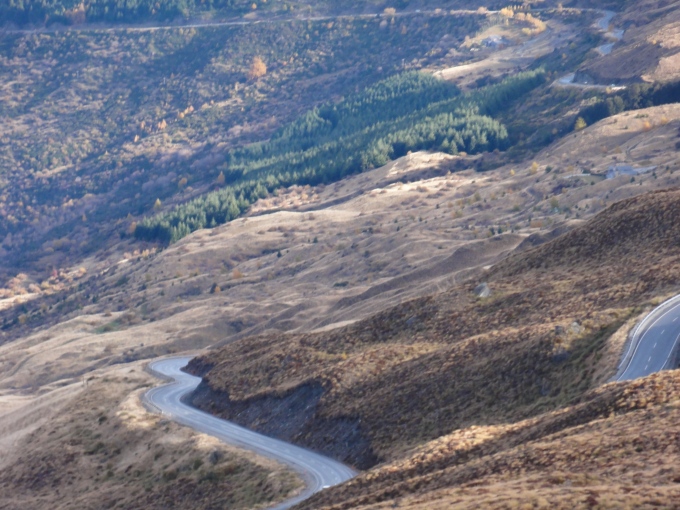
A picture paints … well, as many words as you like.  For instance:

lookingdownfromcoronetpeak

And the story:


It was once said that a desperate man has everything to lose.

The man I was chasing was desperate, but I, on the other hand, was more desperate to catch him.

He’d left a trail of dead people from one end of the island to the other.

The team had put in a lot of effort to locate him, and now his capture was imminent.  We were following the car he was in, from a discrete distance, and, at the appropriate time, we would catch up, pull him over, and make the arrest.

There was nowhere for him to go.

The road led to a dead-end, and the only way off the mountain was back down the road were now on.  Which was why I was somewhat surprised when we discovered where he was.

Where was he going?


“Damn,” I heard Alan mutter.  He was driving, being careful not to get too close, but not far enough away to lose sight of him.

“What?”

“I think he’s made us.”

“How?”

“Dumb bad luck, I’m guessing.  Or he expected we’d follow him up the mountain.  He’s just sped up.”

“How far away?”

“A half-mile.  We should see him higher up when we turn the next corner.”

It took an eternity to get there, and when we did, Alan was right, only he was further on than we thought.”

“Step on it.  Let’s catch him up before he gets to the top.”

Easy to say, not so easy to do.  The road was treacherous, and in places just gravel, and there were no guard rails to stop a three thousand footfall down the mountainside.

Good thing then I had the foresight to have three agents on the hill for just such a scenario.


Ten minutes later, we were in sight of the car, still moving quickly, but we were going slightly faster.  We’d catch up just short of the summit car park.

Or so we thought.

Coming quickly around another corner we almost slammed into the car we’d been chasing.

“What the hell…” Aland muttered.

I was out of the car, and over to see if he was in it, but I knew that it was only a slender possibility.  The car was empty, and no indication where he went.

Certainly not up the road.  It was relatively straightforward for the next mile, at which we would have reached the summit.  Up the mountainside from here, or down.

I looked up.  Nothing.

Alan yelled out, “He’s not going down, not that I can see, but if he did, there’s hardly a foothold and that’s a long fall.”

Then where did he go?

Then a man looking very much like our quarry came out from behind a rock embedded just a short distance up the hill.

“Sorry,” he said quite calmly.  “Had to go if you know what I mean.”


I’d lost him.

It was as simple as that.

I had been led a merry chase up the hill, and all the time he was getting away in a different direction.

I’d fallen for the oldest trick in the book, letting my desperation blind me to the disguise that anyone else would see through in an instant.

It was a lonely sight, looking down that road, knowing that I had to go all that way down again, only this time, without having to throw caution to the wind.

“Maybe next time,” Alan said.

“We’ll get him.  It’s just a matter of time.”


© Charles Heath 2019

Find this and other stories in “Inspiration, maybe”  available soon.

InspirationMaybe1v1


A to Z Challenge – J is for: Jump now…

J2020

It was 2 am, the ideal time to assemble a team that would be clandestinely boarding a vessel.

Dark and moonless, it was fortuitous rather than planned, and, dressed in black from head to toe, it was hard to see the others in the inky darkness.  At least something was on our side.

Up until this point, we’d had nothing but bad luck, though I was more of the opinion we had a traitor in our midst because some of the events could not have any other explanation.

It had caused me to be far more selective in who I gave details of the mission to.

Each of the four team members had arrived and let themselves into the shed.  It was not far from the ocean, and a small pier where there was a landing craft waiting.  From there, it would be a half-hour trip out to the ship in question, where, if we got close enough, we would either have to go over the side and swim, or pull alongside, but either way we’d have to go up a rope.

A lot depended on the crew member we had recruited getting a rope overboard, and given the luck we had so far, if there was a flaw in the plan, that was it.

Aside from the four people sitting in front of me, there were only three others privy to what was about to happen.  Now, with recent events, it was hard to imagine that one of them could betray us. That’s why I hadn’t completely told them what they were about to do, just that they needed to be prepared to get wet.

“I’m sure, now we’re here, you can tell us what’s going on.”  Robert was the most trusted of my team and my best friend.

“And why all the hush-hush,”  Linda added.  She had been amused at the secrecy and my explanation.

I was never very good at spinning a story.  She knew that but had not questioned why.

“It’s been touch and go for the last week.  It’s why we’ve all been on standby, with this last-minute call out.  We’ve been waiting for a particular ship to leave port, and now it has.  So, without further ado, let’s get to it.  A boat ride, just enough time to gather the courage to the sticking point, and then with any luck we won’t have to go into the water and swim, but a short shimmy up a rope.  I hope you’ve all been working out.”

The boat ride was in silence.  I’d worked with this group before and they were not big on talking.  Aside from the fact that noise traveled over water, and since we had a specially silenced motor on the boat, there was not going to be any unnecessary conversation.

We could see the ship once we reached the headland, and aside from it’s running lights, there were lights where I presumed the bridge was, and several in the crew quarters.  Closer again, I got the impression it was not moving, or if it was, it was very slow.  It was hard to tell in the darkness.  That same darkness aided our approach.

When we were within several hundred yards I could see that the ship was not moving, and, in fact, had the anchor out.

That was not expected.  Were they waiting for us?  Had they discovered the cream member who was working with us?  We’d know soon enough if there was no rope in the designated point, not far forward of the stern, a spot where we could maneuver the boat under the hull curvature.

The driver piloted the boat slowly to the designated point and the rope was there.  He would stay with the boat and wait.  The four of us would go up and collect what we came for.

I watched the three go up the rope before me, waiting for the last to stop at the top and then go over the side onto the deck.  It took nearly a minute before I got the signal it was clear to follow.

It had been too easy.

I went up the rope slowly, slower than the others, something else other than the object of the exercise on my mind.  Not three days before I had a conversation with my boss, telling him that I’d been doing the job too long and that it was time to retire.  Approaching forty wasn’t exactly retirement age, but in this job, lasting that long was almost a miracle.  The places I’d been, the sights I’d seen, and the people I’d met.  And how many lives I’d used up.

It was a dangerous thing, thinking about anything other than the job when you’re on the job.

I reached the top and pulled myself over the railing and onto the deck.  A little off balance it took a moment to stand.  By then it was too late.

Two of the three other members of the team were sitting by the superstructure, heads on their heads, two members of the crew were watching them, guns at the ready, and Linda had one pointing at me.

“I can’t imagine how MacIntyre thought he was going to convince Petra to defect.  Or how this charade of a rescue attempt was ever going to work.”

I put my hands up.  Not entirely unexpected.  “It was not the mission objective.”

“What…”

I was surprised that she had made her move so early.  If it was my operation, I would wait until we were well into the superstructure, heading to the cabin where Petra would be waiting, and then make the move.

Three seconds, three shots, two guards taken out, and Linda incapacitated.  She would not be moving or fighting back any time soon.  The Petra came out of the shadows, and I collected Linda’s gun and stood near her, just in case Petra missed the target.

Petra cut the two other’s bindings, and said, “get to the side and jump now.”

Linda looked up at me.  “What now?”

I shrugged.  “Time for us to leave.”  I gave Petra a nod, and she went over to the side, took one look back at Linda, shook her head, then jumped.

“You’re just going to leave me here?”

“If it were up to me, I’d shoot you, but MacIntire is getting a little soft in his old age.  But yes, I’m leaving you here.  Now, I really must go.”

I took a last look at Linda, who realized that if she moved it would only worsen her injury, and jumped, not exactly my preferred way of leaving the ship.

The boat came up alongside me and two hands dragged me on board, at the same time we could hear the sound of the anchor chain being pulled up, and the propellers creating a wash as the ship started moving.

Job done, and not one that pleased me.  “Let’s go home,” I told the driver, “it’s past my bedtime.”


© Charles Heath 2020

A to Z Challenge – I is for: I don’t think so…

I2020

I think I drew the short straw.

The Superintendent came out of his office and cast an eye over the available detectives, stopping firstly at Plunkett, the current star, the Detective with the best resolution rate, then, after a shake of the head, looked at me.

I was trying to hide.

“Samuels?”

Obviously, it didn’t work.  Another dead-end case was beckoning.

When I stepped into his office he told me to shut the door.  I declined to sit.

He slid a file across the desk and sat back.  “This shouldn’t take long.  Open and shut.”

I knew what open and shut meant.  The last open and shut case cost a detective his job.  It was how the Superintendent got rid of what he called the ‘chaff’.

I picked up the file and opened it.  A man sprawled on the kitchen floor, a bullet between the eyes.  It certainly didn’t look spur of the moment or a lucky shot.

“The man had a history of domestic violence and the wife had enough, acquired a gun and when he pushed her too far.  All she’s guilty of is illegal weapons charges.”

And quite possibly murder.

“I want it wrapped up by the end of the week.”

Dismissed.  I felt like I was back in school.  “I’ll do my best.”

No surprise that Plunkett had noticed our byplay, and that he should comment, “What important work has the Super set you on, then?”

There was no doubting the sarcasm and the condescending tone.  It had also gained the attention of the other members of the squad.  I could feel all eyes on me.

Stage one, the Superintendent gives the ‘dismissal’ case.

Stage two, Plunkett starts the humiliation.

“I’m sure you’re well aware of which case it is.  After all, you have a hand in case allocation, being the senior detective.”

A small change in facial expression, definitely not the answer he was expecting. He opened his mouth to retort, then shut it again.

I simply walked past him, adding in a lower voice, “Thanks for the open and shut case, by the way.”

I had hoped that all but ignoring him would fire him up.  Mercifully it didn’t, he picked up a sheet of paper from his desk and walked out.  The others went back to work.  I had no friends there.

When quiet settled over the room, I opened the file.  There were a number of documents and witness statements.  The previous detective, Robert Jackson, now working in a distant police station where there was very little crime, had come to the conclusion that was a justifiable homicide.

It fitted the facts if you didn’t read between the lines.

I started with the autopsy and the death was straightforward.  A bullet in the head, shot at close range, not a lucky shot, but it was deliberate.

The forensic team had gone over the scene, and those people in the house at the time, the victim’s wife, Imelda Archer, two children Jennifer and Dale, and the wife’s mother, Wendy O’Donnell, all said the same thing, that he deserved to die, and no, they hadn’t seen who did it, but, on the other hand, none of the three had witnessed Imelda do it, only that she had been arguing with her husband, then a gunshot, and then silence.

There were the facts that the wife tested positive for gunshot residue, and the murder weapon had not been found.  It was, at best, circumstantial but compelling evidence.

The building’s residents had been canvassed, and aside from the usual, ‘It’s none of my business’, there was the odd, ‘don’t know them’ or ‘he got what he deserved’.   Most corroborated the time of the shot that fitted the time of the death.  Some offered the opinion that they’d often heard loud and heated arguments coming from the apartment, and later seeing Imelda with lacerations and bruising.

Outside the building, among those canvassed, only one said they heard another bang, one that was thought to be a car backfiring because it was half an hour earlier than the actual shot.  The previous detective discounted it as being relevant to the case.

As a matter of interest, Detective Jackson had run a background check on Archer, to see if he had any enemies, of which there were many but all had alibis, and friends who mostly had little good to say about his wife.  Not unexpected in such a situation.

He did the same for Imelda, and her friends corroborated the story about the brutal husband, and how it was in their opinion if she did it, it would be justifiable.

I read Jacksons notes, his final report and his recommendations, and they echoed the very words the Superintendent had told me.

Sticking points were the earlier bang, which corroborated Imelda’s statement when said she had not shot her husband but had threatened him with a gun she had got from a ‘friend’, whom she refused to name, about a half-hour before she found the body on the kitchen floor.  She didn’t admit to firing a bullet, but it was possible she had.

A gun in the hand of an inexperienced, and agitated shooter was a dangerous weapon, and a shot could go almost anywhere.  I doubted, given the distance she said she was standing away from the victim, she could have hit him.

She said the gun had gone missing when she put it in a drawer after the husband left.

That meant that there were possibly two weapons, or it could be the same one used on both occasions.

Forensics had looked for a bullet in the wall, considering there may have been a first shot, one fired by Imelda when she threatened her husband earlier, if that was, in fact, what happened, but none had been found.

Nor was there any testimony that anyone had seen the husband leaving the flat, or any other movement or sounds from the apartment in the half-hour leading up to the time of death.

This was not an open and shut case.

Then there was another forensic report, still in the envelope with the word ‘copy’ on it, still unopened.  It was dated the day after the last entry by the first investigating detective.

Why hadn’t it been opened?  Had Jackson believed it was just a copy of the first original report.  It didn’t feel like anything more than a single sheet, whereas the first was ten pages and evidently came in a larger envelope.

I opened the envelope and pulled out the single page.  It had a single paragraph and a note that said ‘just thought I’d check if there was a match between the gun residue on Imelda Archer’s hand and the gunshot wound on the victims head.  They do not match.’  The report concluded that there had been two shots fired, one by Imelda that wasn’t fired from the same gun that killed her husband.

“So?”

I looked up to see the Superintendent standing in front of my desk.

“Is it an open and shut case?”

“I don’t think so.”  I handed him the sheet of paper from the previously unopened envelope and watched him read it.

“Sloppy.  Very, very sloppy.”  He glared at me.  “Find the killer.”


© Charles Heath 2020

Inspiration, maybe

A picture paints … well, as many words as you like.  For instance:

lookingdownfromcoronetpeak

And the story:


It was once said that a desperate man has everything to lose.

The man I was chasing was desperate, but I, on the other hand, was more desperate to catch him.

He’d left a trail of dead people from one end of the island to the other.

The team had put in a lot of effort to locate him, and now his capture was imminent.  We were following the car he was in, from a discrete distance, and, at the appropriate time, we would catch up, pull him over, and make the arrest.

There was nowhere for him to go.

The road led to a dead-end, and the only way off the mountain was back down the road were now on.  Which was why I was somewhat surprised when we discovered where he was.

Where was he going?


“Damn,” I heard Alan mutter.  He was driving, being careful not to get too close, but not far enough away to lose sight of him.

“What?”

“I think he’s made us.”

“How?”

“Dumb bad luck, I’m guessing.  Or he expected we’d follow him up the mountain.  He’s just sped up.”

“How far away?”

“A half-mile.  We should see him higher up when we turn the next corner.”

It took an eternity to get there, and when we did, Alan was right, only he was further on than we thought.”

“Step on it.  Let’s catch him up before he gets to the top.”

Easy to say, not so easy to do.  The road was treacherous, and in places just gravel, and there were no guard rails to stop a three thousand footfall down the mountainside.

Good thing then I had the foresight to have three agents on the hill for just such a scenario.


Ten minutes later, we were in sight of the car, still moving quickly, but we were going slightly faster.  We’d catch up just short of the summit car park.

Or so we thought.

Coming quickly around another corner we almost slammed into the car we’d been chasing.

“What the hell…” Aland muttered.

I was out of the car, and over to see if he was in it, but I knew that it was only a slender possibility.  The car was empty, and no indication where he went.

Certainly not up the road.  It was relatively straightforward for the next mile, at which we would have reached the summit.  Up the mountainside from here, or down.

I looked up.  Nothing.

Alan yelled out, “He’s not going down, not that I can see, but if he did, there’s hardly a foothold and that’s a long fall.”

Then where did he go?

Then a man looking very much like our quarry came out from behind a rock embedded just a short distance up the hill.

“Sorry,” he said quite calmly.  “Had to go if you know what I mean.”


I’d lost him.

It was as simple as that.

I had been led a merry chase up the hill, and all the time he was getting away in a different direction.

I’d fallen for the oldest trick in the book, letting my desperation blind me to the disguise that anyone else would see through in an instant.

It was a lonely sight, looking down that road, knowing that I had to go all that way down again, only this time, without having to throw caution to the wind.

“Maybe next time,” Alan said.

“We’ll get him.  It’s just a matter of time.”


© Charles Heath 2019

Find this and other stories in “Inspiration, maybe”  available soon.

InspirationMaybe1v1


A to Z Challenge – G is for: Going once, going twice…

G2020

It was the small town that we had visited once, some years ago, that had enticed me back.

Those had been happier times, times when the stench of money hadn’t overtaken sensibility, and who we really were.

Not that I had changed all that much, except for the upper west side apartment, and posh car to go with it, but what had disappointed me was the change in Liz, the woman I thought once as the love of my life.

Without the trappings of wealth, she was the kindest, most thoughtful and generous person I knew, but that had changed when I became the recipient of an inheritance that beggared belief.  We both made a promise from the outset that it would not change us, but unfortunately, it did.

And that was probably the main reason why I was standing outside an old fixer-upper house on several acres overlooking the ocean.

I’d asked Liz to come, but she was having a weekend away in Las Vegas with her new friends, or as one of the ladies rather salaciously said, a what happens in Vegas stays in Vegas kind of weekend.

Charmaine had told me about the house, one that she had admired for a long time, but didn’t have the means to buy it.

Charmaine was a painter, a rather good one, and both Liz and I had met her on a weekend away upstate, and I’d bought one of her landscapes to hang in our new apartment.  Liz hated it, but I think that had more to do with the painter than the painting, and that was because Charmaine had flirted with me, and that, I had observed over time, was how she was with everyone.

She called it her sales technique.  After all, it had worked on me.

I listened to the auctioneer go through the rules of the action and then move on to a physical description of the property.  I’d been to several viewings and got a good idea of what was needed if I was to buy it.  It had good foundations and had suffered from a lack of TLC.  It was how the auctioneer summed up.

When he called for the first bid, I felt a hand slip into mine, and a glance sideways showed it to be Charmaine.  I had asked her along for support but she had something else to do, but it appeared now, she hadn’t.

“So,” she whispered next to my ear, “you were serious about this place?”

I had been dithering, not being able to make my mind up, but Liz, in the end, made the decision for me.  I’d overheard a snippet of conversation with one of her new friends, and, to be honest, I’d been surprised.

“Perhaps it was time to find a hideaway.”

“Things that bad?”

I shrugged.  “Maybe I’m writing too much into it.  At any rate, I needed an excuse to get out of town, and being here was as good as any.”

The first bid came in at 450,000.   I knew the reserved was about 700,000, and I was prepared to 850,000.  But I was hoping to spend less than that because the renovations would be about 250,000.

“We could go and have a picnic.  It’ll certainly cost less than buying this place.”

“I’m here now.”

Holding hands was just one of Charmaine’s ‘things’, and I had never written anything into what might have been called a relationship of sorts.  We were not lovers, and the conversation had never been steered in that direction, but I did find myself gravitated towards her when Liz was off doing her thing with her friends.  To be honest, I just liked the idea of a picnic and watching Charmaine paint her landscapes.

I raised the bid to 500,000.  Another from the previous bidder, 550,000.  Another at 600,000.  It seems there were three bidders for the property.  The other sixteen people attending were observers, probably locals interested in how this would help their property value.

I went 625,000 when the auctioneer changed the increment after a lack of bidding.  It was countered, moving to 650,000.  Another at 657,000, and then the first bidder went to 700,000, the reserve.

“You do realize the other bidders are friends of the owner and are there to push the price up?” Charmaine whispered in my ear.

I’d heard of it happening, but I’d not suspected it until she mentioned it.

“Going once, going twice at 700,000.”  The auctioneer looked at me.  “I’ll accept 10,000 increments.”

I nodded.  710,000.  It quickly moved to 800,000, after I bid 790,000.

The auctioneer looked at me expectantly.  “810,000, sir?”

That was more than I wanted to spend though an elbow in the ribs was the clincher, and when I declined, there was an air of disappointment.

“Going once, going twice, all done at 800,000?”  A look around the crowd confirmed we were all done, and the gavel came down.

“Looks like we’re going on a picnic,” she said.  “I’d expect a call in an hour or so.”

Two things happened that weekend, both of which surprised me.  The first, Charmaine was right, I did get a call, and finished up with a hideaway in the country, overlooking the ocean.  The second, Liz didn’t come back from Las Vegas.  She had apparently found someone new, someone more exciting, or so she said.

I guess I was disappointed but not overly concerned.  She had changed and I had not and if the truth be told, we were drifting apart.  We parted amicably, sold the apartment, and moved on, each in a different direction.

I had a new residence, and renovations to take my mind off the break-up, and when I told Charmaine, she was just said she didn’t believe we were that perfect match.  And in the light of my new status, I could now ask her to come and stay in the spare bedroom, a lot better, I said, than the one person tent she had been using, an offer she readily accepted.

Until, a year later, it became something more than that.


© Charles Heath 2020