In a word: Zip

Which, unfortunately, I do not have a lot of in my step.

At last, we have reached the end of the alphabet because I’m running out of zip to write these blogs.

So…

Zip is the sing, the energy, the spring we have in our step, that usually gets us from a to b quickly.  Without this zest, we would need to take a bus, train, or cab.

Then comes the variations like …

Zip code, we all have one of these, though in some countries it is called a postcode.

Zip it up, meaning do not speak, especially if you’re about to spill a secret.

A zip, which is a part of some types of clothing, usually in trousers, jeans, and skirts to name a few.  Some dresses have long zips, some short, all seem to get tangled at one time or another, or, in the most embarrassing of situations, split.

Then there is a colloquial use of the word zip, meaning nothing, zilch, zero, in other words, a basis for of z words.

And that’s about as much zeal I’m going to show for writing this blog, and I’m going to close the book on it.

Thank you, and goodnight.

“Trouble in Store” – Short stories my way:  Editing becomes re-writing (5)

I have reworked the first part of the story with a few new elements about the characters and changed a few of the details of how the characters finish up in the shop before the policewoman makes her entrance.

This is part of the new first section is the one that involves the Jack, the girl, and the shopkeeper


Jack exchanged a look with the shopkeeper, who in return gave him a slight shrug as if to say he had no idea what this was about.

He could see the girl was not strung out on drugs; if she was it would be a good bet both would be shot or dead by now.  She was just the unfortunate partner of a boy who was on drugs and had found herself in a dangerous position.

Beth, his wife, had told him she didn’t like nor trust the shopkeeper and that her friend in the same apartment block had told her he had been seen selling drugs to youths who hung around just before he closed.  She had warned him it would not be safe, but he had ignored her.

It was a bit late to tell her she was right.

He took a half step towards the door, judging the distance and time it would take to open the door and get out.

Too far, and he would be too slow, his reward for running; a bullet in the back.

Perhaps another half step when she wasn’t looking.


The shopkeeper changed his expression to one more placatory, and said quietly to the girl, “Look, this is not this chap’s problem.”  He nodded in the direction of the customer.  “I’m sure he’d rather not be here, and you would glad of one less distraction.”

He could see she was wavering.  She was not holding the gun so steadily, and the longer this dragged on, the more nervous and unpredictable she would become.

And in the longer game, the customer would sing his praises no matter what happened if he could get him out of the shop alive and well.

This could still be a win-win situation.


The girl looked at Jack.  The shopkeeper was right.  If he wasn’t here this could be over. 

But there was another problem.  It didn’t look like Simmo was in any shape to getaway.  In fact, this was looking more like a suicide mission.

She waved the gun in his direction.  ‘Get out now, before I change my mind.’

As the gun turned to the shopkeeper, Jack wasn’t going to wait to be asked twice and started sidling towards the door.


© Charles Heath 2016-2020

In a word: High or is it hie

When the boss says jump, the question is usually ‘how high’.

Not that it’s possible for many of us with a challenging centre of gravity to get much elevation.

High generally means height, how far something rises above ground level, is above our heads.

That plane flies very high in the sky.

Then there’s another meaning, increased intensity, such as a high temperature, a high fever, but my favourite is, a high dudgeon.

I’m still to get a definition on what a dudgeon is.

We have secondary schools here that we call high schools. Make of that what you will

And in the idiomatic world, flying high means we are very happy, and when were left high and dry then not so much. Unless it related to a ship, in which case a lot of people would be unhappy.

We can use high just about everywhere, high hopes, high ceilings, feelings that run high, a high chair for toddlers of course, high speed which may cause s crash and land you in a high security prison.

This is not to be confused with just plain hi which is a universal greeting.

But there is another, hie, which has a more obscure meaning, to hasten or go quickly.

Conversations with my cat – 87

20160903_163858

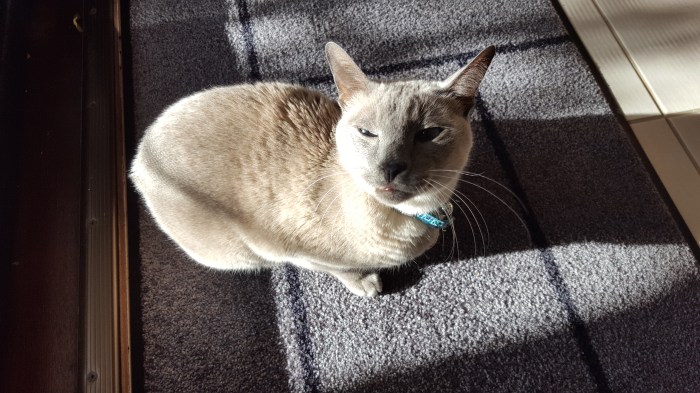
This is Chester.  He was looking very benign before he left.

Now I can’t find him.

Anywhere.

He’s in none of the usual hiding spots.

He’s not hiding under any of the beds.

He’s not hiding in any of the cupboards.

I’m worried.


He’s planning something.  It might be my demise.  I’m still trying to figure out what he could gain from my death.  Not having to listen to me reading chapters of my books?

That, to him, might be a blessing.

I found a magazine on the floor open at an article entitled, ‘Ways to check if your spouse is trying to kill you’.

It’s got me doubly worried now.

I saw him on the kitchen bench near my coffee cup.

How hard could it be for him to dip his paw into some poison or other and then put it in my coffee cup?

That expressionless expression gives him away.

It’s what he’s not saying that’s telling me everything.

Behind that bland face, there’s the heart of a plotter, plotting something bigger than blowing up parliament by Guy Faulks.

I’m going to keep a very close eye on him.  Very, very close.

When I find where he’s hiding.

I’ve always wanted to go on a Treasure Hunt – Part 36

Here’s the thing…

Every time I close my eyes, I see something different.

I’d like to think the cinema of my dreams is playing a double feature but it’s a bit like a comedy cartoon night on Fox.

But these dreams are nothing to laugh about.

Once again there’s a new installment of an old feature, and we’re back on the treasure hunt.


“How long have you been working on this?”

“A week. Lying in bed is boring, so I decided to look at everything I’ve got again, and then again. There were some old maps of the coastline stored with the treasure maps, so I think my father was trying to find the actual location his treasure maps were based on and came up against the same problem. Physical landmarks on the treasure maps are no longer there, and if you didn’t know any better, I would think you were looking in the wrong place.”

“So, in actual fact, what you’re saying now is that your father had no idea where the treasure was buried, that he was just producing maps for the Cossatino’s’ to sell.”

That, of course, could be looked at from a different angle, one that I wasn’t going to suggest right then because Boggs was not ready to hear it. I think the real maps Boggs had found with eh treasure maps were the basis for the treasure maps, that is, his father had to give them real-life elements to keep the punters interested.

“No, not necessarily. I think he knew it was somewhere along this coastline give or take a hundred miles, because of its proximity to the Spanish Maine, but essentially you’re right. He probably had no idea.”

So, he hadn’t come to the same conclusion I had. Yet.

And if I could come to that conclusion, surely Cossatino also would, after all, he was the one who got Boggs senior to make the maps. Why all of a sudden did he think that there was a real treasure map. It couldn’t be simply because Boggs had said there was one. He’d have to know that anything Boggs junior found was an invention commissioned by him,

Or hadn’t Vince told his father what he was doing? Surely the father would have told the son about the treasure map scam.

As for Benderby, senior could base his assumption of the fact that he’d found some old coins off the coast nearby that could be part of the trove. Alex then may have decided to usurp his father’s search with one of his own, conveniently forgetting the treasure maps were an invention of the Cossatino’s. IT was a tangled web of lies deceit and one-upmanship, one that was going to leave a trail of human wreckage in its wake.

Boggs and I were two of the first three. We had lived to tell about it, Frobisher was the first casualty.

But what I suppose was more despairing was how taken Boggs was with the notion that the treasure was real, hidden out there somewhere, and that his father had ‘the’ map. I was loath to label him delusional, but his pathological desire to prove his father’s so-called legacy was going to not end well, especially when we found nothing.

And, yet, I had to admire the lengths he had gone to, to prove his case. Even now, looking at the overlaid maps, there was no guarantee we’d find anything, but at first look, the evidence was compelling.

Except I had a feeling Boggs had something up his sleeve. I had to ask the question. “Where did you get the idea of matching the treasure map to the real map?”

“My father’s journal. It was tossed in the bottom of a box of his other stuff. There are about ten boxes stacked in the shed, stuff my mother just couldn’t be bothered sorting through after he disappeared. Again, boredom pushed me into going through everything over and over just in case I missed something.”

He reached in under the mattress of his bed and pulled out an old leather-bound notebook. It had a strap that bound it together, and by the look of it had extra papers inserted or glued to pages, as well as papers at the start and back of the volume, making it look about twice the original size.

He handed it to me. The leather was old, cracked, and had that distinctive aroma of the hide. I loosened the strap and the top cover opened. The first page was a newspaper cutting, a small piece about some old coins being found about a hundred yards offshore by some surfers. Were these the same coins that Benderby had claimed were part to the trove?

“Benderby was getting that antiquarian that was murdered to identify some coins,” I said after a quick glance through the article.

“I spoke to one of the surfers the other day,” Boggs said. “He told me he came off his board on a big wave and as he was going down saw something glinting on the seabed. He managed to pull up three coins. There were more but he had to come up for air. When he went down again, he realized he’d been dragged away by the current.”

Tides and currents along this part of the coast were particularly bad, and the undertow, at times could get surfers and swimmers alike into a lot of trouble. I’d been caught out once in a dinghy myself, finishing up ten miles further down the coast that I expected to be.

“Then, I take it he can’t remember the exact spot so he could go back.”

“He tried, but alas no. Said he sold the coins to old man Benderby for a hundred apiece and told him approximately where he thought the others were, but nothing’s been found since.”

Not that Benderby would tell anyone if he did. But it explained where the coins came from that he gave to Frobisher.

“Except we can assume that it’s off our coastline somewhere, right?”

“Five miles of coastline to be precise. He and his mate always had a few reefers before they went out, made the ride more interesting he said. He could have been off the coast of Peru for all he knew.”

Surfers, drugs and a colorful story.

“It explains why Benderby and a team of divers have been out in his new boat,” Boggs added, “probably trying to either find the location or line up landmarks on his map from the seaward side at the same time. But he doesn’t know what we know.”

What did we know? I leafed through a few more pages of the diary, but the scrawled notes were almost illegible. I picked up various words, like a marina, underground river, dry lakebed, but none of it made any sense.

“Which map did we give to Alex?”

Boggs went over to a drawer in the wardrobe and leafed through the papers in it and pulled out one and gave it to me. Like the rest it showed the shore, the hills, the lake, and two what looked to be rivers flowing into the sea. Each of the maps had those same features but in different places.

I didn’t want to say it, but it seemed to me we were playing a very dangerous game. The maps might look different in some respects, but the chances were, if Alex was smart enough to hire an expert, that we might run across him out there, and, to be honest, he would be the last person I’d want to see.

“You do realize our paths are going to cross at some point.”

“Maybe, maybe not.”

A shiver went down my spine, an omen I thought. Boggs has something up his sleeve, and I really didn’t want to know.

Not right then.


© Charles Heath 2020

In a word: Happy

“I’m happy to be being here.”

Yes, I actually heard that answer given in a television interview, and thought, at the time, it was a quaint expression.

But in reality, this was a person for whom English was a second language, and that was, quite literally, their translation from their language to English.

Suffice to say, that person was not happy when lost the event she was participating in.

But that particular memory was triggered by another event.

Someone asked me how happy I was.

Happy is another of those words like good, thrown around like a rag doll, used without consequence, or regard for its true meaning.

“After everything that’s happened, you should be the happiest man alive!”

I’m happy.

I should be, to them.

A real friend might also say, “Are you sure, you don’t look happy.”

I hesitate but say, “Sure.  I woke up with a headache,” or some other lame reason.

But, in reality, I’m not ‘happy’.  Convention says that we should be happy if everything is going well.  In my case, it is, to a certain extent, but it is what’s happening within that’s the problem.  We say it because people expect it.

I find there is no use complaining because no one will listen, and definitely, no one likes serial complainers.

True.

But somewhere in all those complaints will be the truth, the one item that is bugging us.

It is a case of whether we are prepared to listen.  Really listen.

And not necessarily take people at their word.


Past conversations with my cat – 49

20160922_162007

This is Chester. We are at the delicate stage of peace negotiations.

The ceasefire has been rocky, to say the least.

Blame is being thrown about like confetti at a wedding.

And to top it off, it’s Friday the thirteenth.

Im fuĺly expecting Chester to change his coat to black, and walk in front of my path with an evil grin on his face.

There’s already been signs of his mischievousness.  A long time ago we bought him some fake mice to play with since he didn’t have the inclination to chase the real rodents. Little did we know he had hidden these away, to bring them out on black Friday.

And, sitting on the floor, giving me the death stare, I wonder what his intentions are.

Not good.

So, I ignore him. I go back to the computer and get on with the day’s work. I have episodes to write, some research for a project one of my granddaughters is working on, and a novel in the throes of a third edit.

Still, I can feel those beady eyes drilling into my back.

Enough.

Do what you like, I say, turning suddenly on him, causing him to jump. Just go away and let me get on with my work. Instantly, I realise I’ve lost the battle, as he stands, gives me a final smug look, and leaves the room.

Was that a swagger?

Conversations with my cat – 86

20160921_071452

This is Chester. He’s having a hard to trying to understand the notion of a day happening only once every four years.

I try to explain to him that it’s the fault of the Romans getting the calendar wrong.

He tosses that aside and mutters, Time is irrelevant.

How so? OK, I have to bite, because I’m sure I’m about to get a catlike pearl of wisdom.

It comes and it goes, and if it wasn’t for the fact there was night and day, you’d have absolutely no idea what time it is.

About to dismiss it as crazy, I stop to think about it.

And, damn him, he’s right.

Of course, one could argue semantics, and say if I was outside, I could approximate the time by the sun, or at night by the stars, but that’s a little beyond the cat’s imagination.

So, in a sense, you might be right, but I can usually guess what the time is.

Chester shakes his head.

You’re retired, time is irrelevant for you too. You can sleep all day and work at night if you want to. Or not do anything at all.

Like you?

Another shake of the head.

What is the point in having a serious discussion with you?  But just one question before I go?

That’ll be interesting.

Was I born on the 29th of February?”

No. Not that lucky, I’m afraid. Why?

If I was I would have no reason to feel every one of those 18 human years I’ve had to put up with your nonsense. It would only be 4 and a half.

He jumps off the seat and heads out the door.

Where are you going now?

To bed. It’s been a long morning.

You’ve only been here 10 minutes.

In cat time. In your time, it feels like hours. Only call me if you see a mouse.

In a word: Murder

I started off thinking that murder was pretty straight forward, you know, someone pulls out a gun and shoots someone else: murder.  Of course, there are any other means of doing the same crime, by knife, poison, strangulation, or suffocation.

Or, by endless inane conversation.  Much less chance of going to jail with that one.

Its the stuff that keeps crime writers going, fictional detectives detecting and crime scene investigators analysing.

Still the fact someone might be getting away with murder, means they’ve successfully found a way to have their cake and eat it.

Come to think of it how many times have we used that word in vain, like when a child drives you to distraction, red-faced and you say with a great deal of conviction ‘you do that again I’ll murder you’.

Just make sure it doesn’t actually happen, or those words will come back to haunt you.

But this is only one aspect of using the word.

You could, if you want, scream blue murder, which is literally impossible.  In fact, what the does that really mean?

It can also refer to an onerous task or experience, hence the possibility that listening to that discussion about hot water bottles was absolute murder.

For one thing, it probably murdered an hour or two of my time.

It could also describe a comprehensive defeat, that we murdered the other side 86 to nothing.  Come to think of it, I never got to participate in such a game, so that might account for why I’d never heard it used before.

And, lastly…

Did you know it can refer to a flock of a particular type of bird, I think crows.

Writing about writing a book – Day 30

I’m having fun with chapter one.

Can you reach a point where you are never satisfied with what you’ve written?

What more can I say?


Looking at the mess constituting my room and my life, slob may have been an appropriate description.  I considered myself old, overweight though not necessarily fat, hair graying at the edges, and few wrinkles around the eyes, there were no real pluses in my description.

Some said I had a kindly face, but perhaps I had the look of a paternalistic grandfather.  There were several men in the office who were the same age and had grandchildren.  And some who had children at a time when they should be planning for retirement, not parenthood.

World-weary and perpetually tired, I’d passed the mid-life crisis, wondering what it was that affected other men my age.  Twenty-odd years later, I was still wondering.

I used to think I’d missed a lot in half a lifetime.

Now, I didn’t know what to think.

Did I deserve pity?  No.

Did I deserve sympathy?  No!

The only person who could get me out of the rut was myself.  For years I’d traded on Ellen’s good nature.  She deserved better, left me, and was now happier in the arms of a man who I wanted to believe treated her far better than I.  She had told me so herself, and judging by her manner, it had to be true.  Only recently had she got her smile back, the one that lit her face up, one that infectiously spread happiness to anyone near her.

There were reasons why I became the person I was now.  Some might say they were valid.  In the cold, hard light of dawn, I could see it was time I stopped using my past as a crutch and got on with the business of living.

Perhaps today would be the first day of the rest of my life.


I took the bus rather than drove.  At that hour of the morning, the traffic would be bad, and there would be no parking spaces left.  And I was using public transport more and more, have become accustomed to the convenience.  Time to read the paper, or a good book, or just dream about a different life.

This morning I thought about Ellen.  I hadn’t for a while, but that might have been fueled by the arrival of the divorce papers she wanted me to sign.  I’d had my time to be angry, and disappointed, she’d said, and she was right.  It was time to move on.

And she had stuck by me through thick and thin, coming back from overseas service a basket case after nine months in a POW camp, after a war that was more horrible than anyone could imagine.  Two mental breakdowns, periods of indolence and lassitude, leaving her to bring up the girls on her own.  I had not been a great father, and much less a husband.

I remembered that argument word for word.

I could see the looks of pain in the girl’s faces.

I remembered the hug, the kiss on the cheek, the tears.  It had not been out of hate, but a necessity.  For her and the children.  Until I found some lasting peace, they were better off at arm’s length.  Away from the arguing, the silences, the absences.

And disappointment.

After she left I tried to get my life in order.  Drugs, professional help, alcohol, meditation, then work.

Over ten years ago, it took a year, perhaps a little more before sanity returned.

She did not.

By then I knew she had found someone else, a mystery man, whom neither she would tell me who, and the girls honestly didn’t know.  She’d promised that much, any new man in her life would not get to meet the girls.  And she would tell me, and then when she was ready.

Then, suddenly, the children were no longer children but young adults and out in the world on their own, and I had become more a banker than a father, an observer rather than a participant, and it was as if we were more like ships passing in the night.  And overnight, the ships had sailed to the other side of the world.

My own fault, of course, and a bit late now to change history.  I could see Ellen’s influence over them, her prejudices and dislikes, and their contempt, like their mother, for me, simmering beneath the surface, but in fairness to them, I really hadn’t been much of a help as a parent should be.

And now I was getting my life back in order, perhaps I could try and make it up to them, and that first meeting, with them and Ellen, nearly a month ago, had been a step in the right direction.  They’d agreed to see me again, without her, during the holidays, which had now arrived.  All I had to do was make the call, and get on a plane.

This mess I was heading into, it would not take long.  I pulled out my phone and after searching for a travel agent near where I worked, I made an appointment to see about going overseas.

She had spoken to me about the divorce papers several days ago, alternately pleading with, and then abusing, me.  There had been some very strong language in the conversation, words I’d thought her incapable of using, but I confess, finally, I didn’t really know her all that well anymore.

Since then I had been calling her to arrange a meeting.  She had not yet replied.  With some distance to go before I reached the office, I tried calling her again.  I was almost glad when she didn’t answer.


I never realized just how hard it was to revise and re-write, and how much time it takes.

Perhaps that’s why first novels take so long to write!


© Charles Heath 2016-2020