In a word: Choice

We are often told that it’s the choices we make that shape our lives.

It’s true.

What distinguishes the basis of those choices is the circumstances of the individual.

What a lot of people don’t realize is the diversity of backgrounds of everyone, and that in a minority of cases, the few that really have no choices at all.

Yes, there are those who have no control over their circumstances, and therefore no choice whatsoever.

Inevitably, the people who are first to criticize those who apparently made the wrong choice, are those that have never found themselves in similar circumstances.

And probably never will.

This perhaps is the biggest problem with governments who are staffed with advisors who do not understand the plight of the common man.

I never had the same opportunities as those who could afford a university education.  My family were working class and were relatively poor.  Had I not hot a scholarship who knows what sort of education I would have got, if any.

Certainly, my father never got an opportunity to get a good education, but, at the time, during the great depression, his choices were limited, whereas those with any sort of wealth it was a different story.

And his lack of choices reflected on us, and that lack of opportunity haunted all of us as time passed.

It was always a case of the haves and the have not’s.

Yes, we all have choices, but sometimes it really is the lesser of two evils, and not whether we will have the fillet or the rib eye steak.

In a word: Line

The English language has some marvelous words that can be used so as to have any number of meanings

For instance,

Draw a line in the sand

We would all like to do this with our children, our job, our relationships, but for some reason, the idea sounds really good in our heads, but it never quite works out in reality. What does it mean, whatever it is, this I’d where it ends or changes because it can’t keep going the way it is.

Inevitably it leads to,

You’ve crossed the line

Which at some point in our lives, and particularly when children, we all do a few times until, if we’re lucky we learn where that line is. It’s usually considered 8n tandem with pushing boundaries.

Of course, there is

A line you should never cross

And I like to think we all know where that is. Unfortunately, some do not and often find their seemingly idyllic life totally shattered beyond repair. An affair from either side of a marriage or relationship can do that.

You couldn’t walk a straight line if you tried

While we might debate what straight might mean in this context, for this adaptation it means staying on the right side of legality. Some people find a life of crime more appealing than doing honest days work.

This goes hand in hand with,

You’re spinning me a line

Which means you are being somewhat loose with the truth, perhaps in explaining where you’ve been and what you’ve been doing. I think sometimes liars forget they need to have good memories.

Then there are the more practical uses of the word, such as

I have a new line of products

Is that a new fishing line?

Those I think most of us get, but it’s the more ambiguous that we have trouble with. Still, ambiguity is a writer’s best friend and we can make up a lot of stuff from just using one word.

What happens after an action-packed start – Part 38

Our hero knows he’s in serious trouble.

The problem is, there are familiar faces and a question of who is a friend and who is foe made all the more difficult because of the enemy, if it was the enemy, simply because it didn’t look or sound or act like the enemy.

Now, it appears, his problems stem from another operation he participated in, and because of it, he has now been roped into what might be called a suicide mission.


“So, Jacobi, tell me what I don’t know.”

I was taking the track slowly and keeping within a short distance of the cars behind me.  The road was little more than a dirt track, and in places, there were almost un-navigable ruts.  We would not have got a truck down this road.

He looked sideways at me.  “You know as much as I do.”

“That’s not possible.  I know nothing.  You set this up.  Tell me about the leader of this group.  Is he the heard of his own militia group?”

“An area commander of a larger group spread out across the top of the Republic, bordering onto Sudan.  They get their guns and other military hardware across that border.  Where we’re going, it’s their main camp in this location.”

“How many men will be here?”

“Twenty, thirty.  Sometimes they train new recruits.”

“Those militia back there, were they his people?”

“I don’t know.”

“I think you do, Jacobi.  And I think if you want to come out of this alive, you might consider giving me all the facts.  If they were his men, there could be ramifications if they don’t report back, especially if he was expecting to add to his payday.”

“Even if they were, there’s no communication lines out here.  They would have to report back to the camp first.  And then there’s the possibility with all the money they were supposed to collect, there might be a detour.  It’s why I think they asked for 10,000 rather than the 5,000.  The commander was going to take a cut.  Loyalty only goes so far in these places.”

“No likely surprises?”

“None that I’m aware of.  You killed them all anyway.  Dead men do not get up, walk back to come and inform.”

No, they didn’t.


A mile to go I saw the rear car stop for a few seconds and Monroe and Stark get out and disappear into the bush.  The chances were they could walk through the bush faster than we could drive on the track, and beat us there.

And, then, the checkpoint was in sight, a pair of empty petrol drums with a piece of wood across the road, each end resting on a drum.  Behind the barrier were three men, one I presumed to be the commander, the other two, guns at the ready, his guard.  Behind them was a clearing with several buildings and to one side several huts that might belong to some villagers.  There were a truck and two Toyota tray utilities parked to one side.

All in all, I could see about ten men.

When I reached the barrier, I stopped but left the engine running.  Just before we arrived, I gave the order to hide the hand weapons.  It was risky going in unarmed, but the chances were they’d take the guns if we were wearing them.  This way, if we needed them, there was a slight chance we might be able to retrieve them.

Both Jacobi and I got out.  I left my door open.  Jacobi closed his.

“Sergeant James, I presume.”  Good English, beaming smile, friendly manner.

“I think I know how Dr. Livingston felt.  I am he.”

A puzzled look for a moment, then the resumption of good nature.  He didn’t understand the nuances of British history in Africa.

There was no handshake, none was expected.  Jacobi stepped forward.  “I assume the packages are here, and in good condition.”

“Of course.  I assume that you have brought the exchange material.”

“We have.  Now, if we can just park these cars, we can get on with the exchange.”

“In a hurry, Jacobi?  Somewhere else to be?”

“Yes, as it happens.  I’m a busy man, as you are aware.”

Politeness disappeared from his face as quickly as the sun sometimes went behind a cloud.

The commander looked over towards a hut just back from the road, one I hadn’t seen from the car because it was hidden by a grove of bushes.  Two men came out.

“Move the barrier.”

As they did, he said to me, “Tell your men to get out of the vehicles and come slowly up the track.  My men will bring the vehicles into the camp.  Tell them also not to make any sudden or suspicious moves, or there will be trouble.”

A glance back showed another four of his men, also armed, appearing out of the bush towards the driver’s side of the cars.

I’d brought the radio and gave them the instructions the commander had given me.

Five minutes later we were standing outside one of the huts, the cars were parked neatly in a row, and each of us had been frisked as I thought we would.  The four who acted as drivers were now our guards, not with weapons trained on us, but they could be very quickly.

The commander waited until the guards at the checkpoint had replaced the barrier, then came striding towards us.  I could see he was counting heads and seemed perplexed by the time he reached us.

“There are men missing.  Where are they?”
© Charles Heath 2019-2020
Searching for locations: Salzburg, Austria

Along with My Fair Lady, another of my favorite musicals was Sound of Music and having seen it a number of times over the years, it had conjured up a number of images of Salzburg in my mind, and with them a desire to go there.  We had been to Salzburg once before, an overnight train stop between Vienna and Innsbruck, an afterthought, but what we saw then was reason enough to come back later and spend several days.

A pity then the day we arrived, and for much of our stay, it rained.  But, like hardened travelers, very little stops us from doing anything, and particularly sightseeing.

We stayed at the Crowne Plaza – The Pitter in a very well-appointed room.  Breakfast included, it was a great way to start the day.  The afternoon we arrived we went for a short walk to the old city passing through the Mirabelle gardens with the Pegasus Fountain, Rose Garden, and Dwarves Garden.  Later we discovered that the archway had been used in part of the filming of Sound of Music.

We took the Festungsbahn funicular railway up to the Fortress Hohensalzburg, dating back to 1077, and the largest fortress still standing in Europe.  We spent a pleasant afternoon wandering through the rooms and exhibits and then had lunch at a café, the Salzburg Fortress Café, that overlooked the countryside.  This was where we were introduced to Mozart Gold Chocolate Cream added to our coffee.

It led us to search for the product which we eventually found in a confectionary store, Holzemayr in the Alter Markt.  Not only sis we find the Gold liqueur there was also a dark chocolate variety as well.  We bought a whole box to bring back with us, as well as a number of other chocolates including Victor Schmidt Austrian Mozart Balls, a delicious chocolate and marzipan combination.

With another afternoon to spare we visited the Salzburg Residence which previously housed Salzburg’s ruling prince-archbishops.  We visited the reception rooms and living quarters, as well as the Gallery.  It is as ornate as any of the palaces in Austria, resplendent with furnishings and paintings.  After that, the visit to Mozart’s birthplace was something of an anticlimax.

But, what we were in Salzburg for, the Sound of Music tour, and the places we visited:

The Mirabelle gardens, where Maria sang Do Re Mi in front of the gates to the gardens.  We spent some time here before and after the tour, and also has a look inside the Mirabelle Palace, which is not open to the public as it is the city administrative offices.

Leopoldskron Palace where the boating scene was filmed as well as exteriors.  They were not allowed to film inside the place and were only allowed to use the exterior.  An interesting tidbit of information, one of the children nearly drowned.

Heilbrunn palace is now home to the gazebo where Rolf and Leisl sang their song, ‘16 going on 17’.  The interesting part of this was the fact the Gazebo used to film the scene was much larger than the actual Gazebo on display.

The walkway from the fortress back to the old city passes Nonnberg Abbey where Maria was a novice, and where the opening scenes were filmed.  A number of scenes were filmed here, including the song ‘Maria’ in the courtyard.  The tour only showed the exterior of the Abbey.

Salzburg lake district where panorama and picnic scenes were filmed.  Even on the dullest of days, during which throughout our tour in continually rained, the scenery was still magnificent.

Mondsee church, where the wedding scenes were filmed.  It was surprising just how small the church really is.  It was also a stop to have afternoon tea or some ‘famous’ apple strudel.

Needless to say, we watched Sound of Music straight after the tour and managed to pick out all of the places we had been to.  The only downside to the tour, singing along to the songs.  I’m sorry, but I do not sing, and some of those that were, well, I say no more.

In a word: Brevity

Now, brevity is something that I have not been able to fully wrap my head around.

The dictionary explains Brevity as

‘concise and exact use of words in writing and speech’

So…

I remember working with a writer a long time ago who explained certain authors styles, and for James A Michener of Hawaii fame, he said Michener wrote sentences instead of words, paragraphs instead of sentences, pages instead of paragraphs and chapters instead of pages.

It was a little harsh considering I’d just read the book and had liked it, despite its length and the time it took.

But some time later I realized he was not criticizing Michener, but trying to tell me, in his, what I came to discover, interesting way, that I should strive to write more compactly.

I then came across a book by Brian Callison which was exactly that, the concise version, a story that fitted into about 200 pages.

That too was a good book and it took me a day to read it, and by his use of that economy of words, it read quickly.

Of course, I have tried over the years to emulate both styles, and to a certain degree, failing, because I think I have created my own style which is somewhere in between.

Still, when editing, it is always in the back of my mind that I should be

Using words instead of sentences

Using sentences instead of paragraphs

Using paragraphs instead of pages, and

Using pages instead of chapters.

The chapters, he said, with an air of amusement, will always take care of themselves.


In a word: Ghost

Have you seen one?  I haven’t.  Yet.

I’ve stayed in a few places where ghosts were purported to be roaming the passages at night, but apparently not the night I was staying.

And that’s something else that I have a problem with, why is it ghosts only come out at night, or is that just the perception I have hot from reading up on the subject.

Maybe my view of ghosts is somewhat stilted, after all, I think my first introduction to ghosts was watching The Centerville Ghost, a movie I saw on t.v. when I was very young.

You have to admit Hollywood’s perception of ghosts is quite interesting.


But…

Do you think they are real?  Do I think they are real?

I think I would have to be presented with some fairly solid evidence they exist, but perhaps not to the point of meeting one.

There are, it seems countless examples of ethereal forces, you know, wind blowing where there’s no wind or draught outside, room temperatures dropping for no apparent reason, knocking, rattling of chains, strange noises like low moaning.


And yet…

There are hotels you can stay in such as the Chelsea Hotel in New York, where it’s possible to run into Sid Vicious.

Sorry, not staying there any time soon.

Then there’s the Hollywood Roosevelt Hotel in Los Angeles where it’s possible to run into Marylin Monroe, who lived in room 229.

That could be an interesting encounter.

Another is the Westin St Francis in San Francisco where the actress Virginia Rappe died while attending a party held in Fatty Arbuckle’s room, Arbuckle’s room, who was later accused of assaulting and murdering her, and whose career tanked after the incident.

Her ghost is seen moving about the hotel tearing her hair out.  It seems all of the spectral activity occurs on the 12th floor.


Good to know if I decide to stay there.  I wonder if they have a 13th floor?

Perhaps in too old to be running the gamut of paranormal experiences, the old heart is not as strong as it used to be.

In a word: Vision

I had one myself once, whether it was a peek into my future, or whether it was just playing out a scene for one of my stories, it was rather intense.

That variation of the word vision is one that uses one’s imagination. I do it quite a lot, and I call it the cinema of my dreams.

But…

Vision, in the simplest sense of the word, is sight, what you see.

People can try to make it better, like movie studios, who have called it rather interesting titles such as VistaVision or Panavision, either of which sounds quite remarkable, and it may have been back in the day, but it’s probably quite ordinary these days.

A vision, in another sense, might be something like a dream as mentioned before, which might happen when we are asleep, but if awake, it might be because we are very bored with our job and we’re imagining what it would be like at Santorini or the Bahamas, or anywhere but where you are now.

It might also describe our particular slant on what else we would like to happen, whether at work or somewhere else, but it’s usually confined to our closest circle of friends. Bosses never invite nor want to hear plebs ideas of improving their lot.

Hence, I have a vision…

But no one will listen. Perhaps if I was Martin Luther King, things might be different.

Then, at the end of it all…

There are visions and then there are visions, like seeing something that no one else can see, whether driven by hallucinogenic drugs or magic mushrooms, or you just happened to be there to see what no one else could.

Dragons, lizard people, or the Virgin Mary.

And no, I have not seen any of the above.

Yet.

Searching for locations: No two sunrises are the same – 2

Oreti Village, Pukawa Bay, North Island, New Zeland

On the southern tip of Lake Taupo

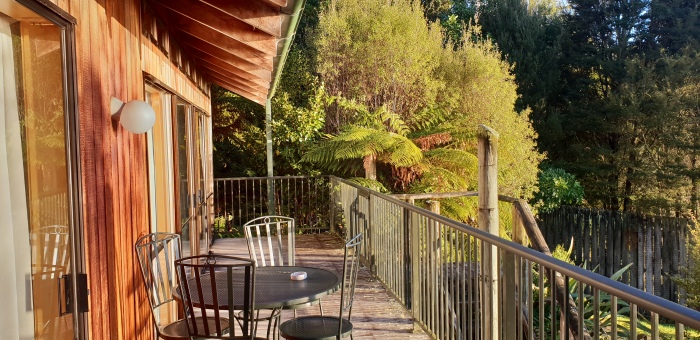
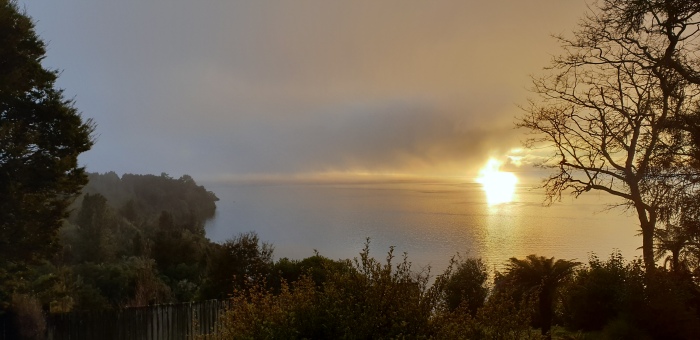
Our first morning there, a Saturday.  Winter.  Cold.  And a beautiful sunrise.

20180812_073230

This was taken from the balcony, overlooking the lake.

The sun is just creeping up over the horizon

20180812_073241

It gradually gets lighter, and then the sun breaks free of the low cloud

It lights up the balcony

20180811_074651

And the trees just beyond, a cascade of colorful ferns.

20180811_074622

It looks like it’s going to be a fine day, our first for this trip, and we will be heading to the mountains to see snow, for the first time for two of our granddaughters.

A matter of life and … what’s worse than death? – Episode 28

For a story that was conceived during those long boring hours flying in a steel cocoon, striving to keep away the thoughts that the plane and everyone in it could just simply disappear as planes have in the past, it has come a long way.

Whilst I have always had a fascination with what happened during the second world war, not the battles or fighting, but in the more obscure events that took place, I decided to pen my own little sidebar to what was a long and bitter war.

And, so, it continues…


By the time they reached the outskirts of Munich, what the Standartenfuhrer considered their biggest hurdle, it was quite dark and almost impossible to see where they were going.

The whole city seemed to have disappeared so effectively was the blackout.  

But there was one benefit, there was little or no traffic on the roads, which lessened the chance of running into another car or truck.

And it was time to refill the tank with two more petrol cans, leaving two remaining.  Filling up now, the Standartenfuhrer said, would get them to Innsbruck.

He sounded confident, but Mayer got the distinct impression it was mostly that he was putting on a brave face.  There had been one instance, the checkpoint before Munich where he nearly lost his nerve.  For the first time, there had been SS guards at the checkpoint, and which had been entirely unexpected.

An SS officer of the same rank had been summoned and he had requested their written orders.  They had paperwork, but Mayer wasn’t sure if it related to their current situation, further confirming his belief this had been a very carefully planned operation to get him out of Germany, and that there was a more pressing reason why.  It definitely had something to do with the V2’s, but had their intelligence services found out about something else, something he didn’t know about?

Given the level of risk to the two men with him, and that at every turn there was a possibility of capture or death, given the level of planning and the run so far, one he would have never thought of trying on his own, he didn’t have a very high level of confidence that they would get away with it.

Those in the SS were not fools, trusted no one, believed nothing they were told, and disregarded anything written on paper.  Check, double-check, then check again.  Take nothing as read.  The document he’d been given on what made a first-class SS officer in the eyes of the Reich, was fundamentally not him, nor most of the German population.

The officer at this checkpoint reminded him of the one who had shot the shooting in the hotel, and for at least ten tense minutes, during which time the other two had conferred quietly in English, one suggestion they cut and run.

That would have invited a hail of machine-gun fire that none of them would survive.

Both looked visibly relieved when he returned, having obviously called the name of the officer who had signed the order.  The only explanation he had for this was that the level of discontent among officers Military of SS must be greater than he thought.


They managed to cross over into Austria without any problems, the route they had taken, a series of back roads and tracks which had been given to them.  Once again, Mayer was surprised that so many people could be working against their own country, but, of what he’d seen, conditions were harsh no matter which part of Germany they were in.

The war was not going the way the German people were being told, and it was hard to see any resolution of the conflict any time soon.

Perhaps everyone in the high command was hoping the new V2 rockets were going to change the country’s fortunes in the war.  If they were, they were going to be bitterly disappointed.  What they needed was the jet-propelled fighters and bombers, something that remarkably had not been implemented years earlier, and would have given them air superiority.

He’d worked on those early jet engines and they were remarkable, and faster than anything the British or the Americans had.  It was hard to comprehend why high command had not pushed forward the new jet-propelled planes that Belin had finally decided to implement.  

And just when the trio had agreed that everything would work out about 100 kilometers from Innsbruck, on the road to the Italian border crossing, they took the wrong route.  It was a mistake brought on by tiredness, and a momentary lapse in concentration.

A checkpoint where there shouldn’t be one.

© Charles Heath 2020

“Trouble in Store” – Short stories my way: Editing becomes re-writing (8)

It’s now time to look at the shopkeeper’s involvement, and there’s more to him and his activities than meets the eye.

With this event, it appears his luck is about to run out.


This wasn’t the shopkeeper’s first hold up.  In fact, over the years there had been a dozen.  But only one got reported to the police, and that was only because the robber was shot and killed.

He’d taken a bullet that night, too, which, from the police point of view, made him a concerned citizen simply defending himself.

The rest had been scared off by the double-barrel shotgun he kept under the counter for just such emergencies.

The young punk who came into the shop with his girlfriend had pulled out the pistol and told him if he reached for the shotgun he’d shoot him.  The kid looked unstable and he’d backed away.

When the kid collapsed, he should have gone for the shotgun, but instead, he thought he could get to the gun before the girl realized what was happened.  She wasn’t an addict and clearly looked like she was only along for the ride.  Her look when the kid pulled out the gun told him she’d known nothing about her partner’s true intentions.

But, he wasn’t fast enough, and she had the gun pointing at him before he’d got past the counter.

From one pair of unpredictable hands to another.

Like the girl, he was just as surprised when the customer burst in the door, just before closing time.

The situation might have been salvageable before the customer came in the door, getting the girl to go along with the robbery being about money, but there was no denying what the kid on the floor’s problem was.

Damn.

He had to try and salvage the situation simply because there was a lot of money involved, and other people depending on him.  He looked at the boy, on the floor, then the girl.

“Listen to me, young lady, you would be well advised to let this man go as he suggests.  And, please put the gun down before someone gets hurt.  Your friend needs medical help and I can call an ambulance.”

The girl switched her attention back to him.  “No one’s going anywhere, so just shut the hell up and let me think.”

The storekeeper glanced over at the customer. 

He’d seen him come into the shop once or twice, probably lived in the neighborhood, the sort who’d make a reliable witness, either a lawyer or an accountant.  Not like most of the residents just beyond the fringe of respectability.

If only he hadn’t burst into the shop when he did.


© Charles Heath 2018-2020