In a word: Bark

Here’s the thing, a bark is the sound made by a dog.  Isn’t it?  Apparently, it can also be from a fox or a seal

Not necessarily.  A man or woman can bark orders, especially if they are in the army.

And then, their bark might be worse than their bite, this usually refers to newspaper editors and school teachers.

You can theoretically be barking up the wrong tree, and believe me, I’ve done that a few times myself.

People can be barking mad.  Just go to any old spooky hospital that is named Belleview, and has a basement.  How do I know this, I’ve seen a lot of old black and white movies.

Then there’s that other type of bark, the outer layer of a lot of trees, and can be very useful as a top layer of a garden to keep the moisture in.

It can be thin sheets of chocolate with a thin layer of nuts or other confectionaries.

You can bark your shins, that is, scrape the skin off when you trip over a tree with bark.

Or just to complicate matters, there is also a barque, usually a three-masted sailing ship, though you don’t get to see many of them these days.

Searching for locations: The Peninsula Hotel, Hong Kong

The sight of the Peninsula Hotel is very familiar to all who visit Hong Kong, if not to stay but certainly if you want to see the last vestiges of British influence in what was once a far eastern colony.

That is, we’re talking about the front building, not the new tower at the back.  In the older days there would have been a great view of the harbor from the Veranda (that area with the blue striped canopy) where today, breakfast is taken.

We had breakfast, lunch, and the famous afternoon tea in the ground floor cafe.

These days you would mostly see taxis, buses, and Teslas, if not a flurry of Mercedes and green Rolls Royces in the small car park below.  There is no clear view of the harbor anymore.

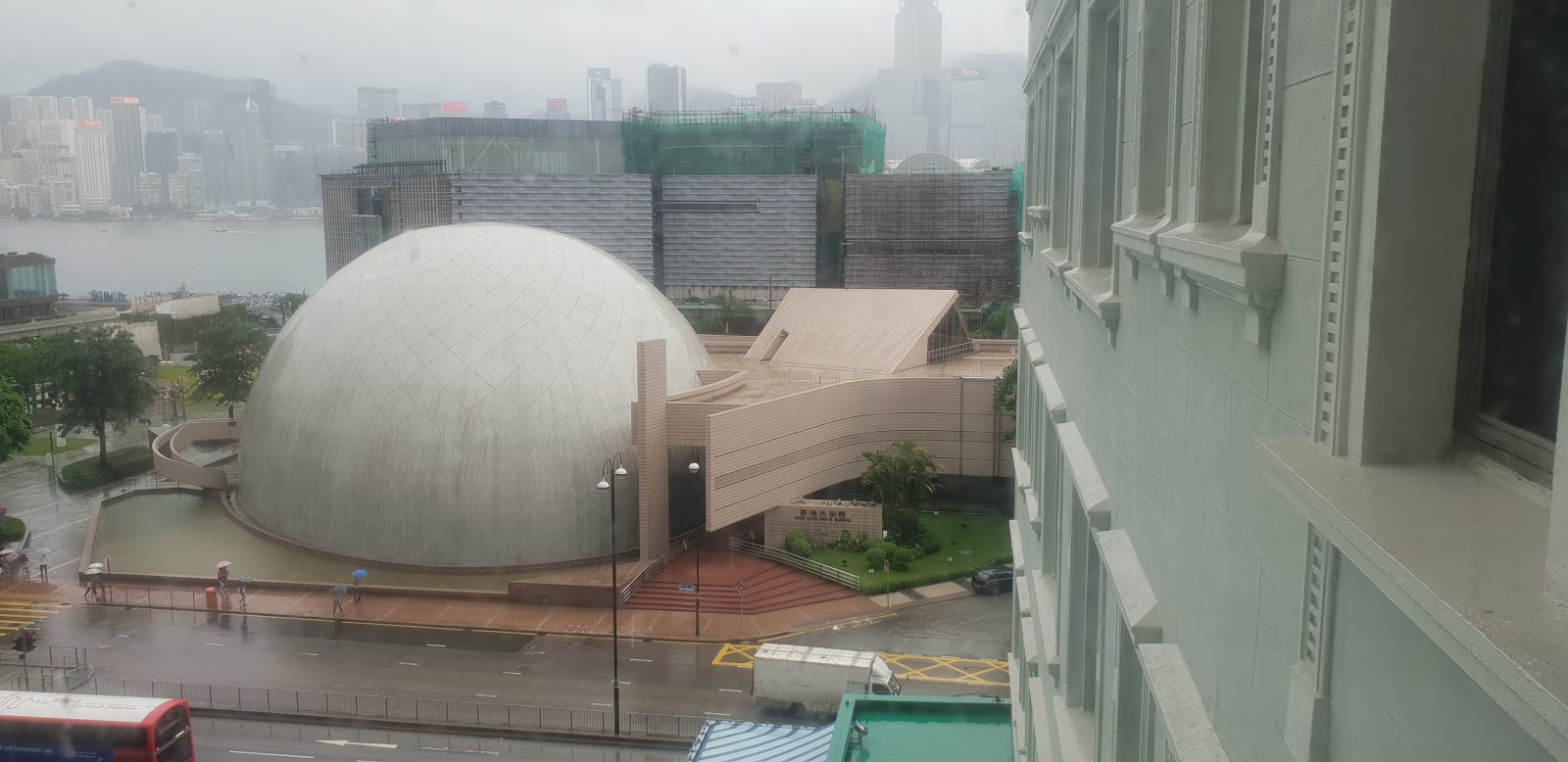
From our room, one facing the harbor we could see the space museum, and on the day we arrived, rain, at times, blotting out the harbor and Hong Kong Island barely discernable in the distance.

As for the room itself, it was excellent, a junior suite, I think, because it had two distinctive areas.  Everything was run from a tablet computer, blinds, lights, television, and most importantly, air conditioning.  This was the first hotel I’ve stayed in where it was neither too hot or too cold, but just rights.

The bed was very large and extremely comfortable, as were the pillows.  Pillows, I’m afraid, are a bugbear with me, as no hotel seems to be able to get it right.  They’re either too soft or too hard, too tall, or too shallow.  Here, they managed to get it right.

The windows were just the right size not to affect the air conditioning, ie. let too much heat in.

I’m not sure I could say the lounge chair was comfortable, but there was only one, which makes it difficult if there are two of you.  I wasn’t going to fight for it.

The desk had a surprise in the bottom drawer, a printer!

And the bathroom, though slightly smaller than expected, had some hint of what it may have been like in the early days.  It had both a shower and a bath.

The story behind the story: A Case of Working With the Jones Brothers

To write a private detective serial has always been one of the items at the top of my to-do list, though trying to write novels and a serial, as well as a blog, and maintain a social media presence, well, you get the idea.

But I made it happen, from a bunch of episodes I wrote a long, long time ago, used these to start it, and then continue on, then as now, never having much of an idea where it was going to end up, or how long it would take to tell the story.

That, I think is the joy of ad hoc writing, even you, as the author, have as much idea of where it’s going as the reader does.

It’s basically been in the mill since 1990, and although I finished it last year, it looks like the beginning to end will have taken exactly 30 years.  Had you asked me 30 years ago if I’d ever get it finished, the answer would be maybe?


My private detective, Harry Walthenson

I’d like to say he’s from that great literary mold of Sam Spade, or Mickey Spillane, or Phillip Marlow, but he’s not.

But, I’ve watched Humphrey Bogart play Sam Spade with much interest, and modeled Harry and his office on it.  Similarly, I’ve watched Robert Micham play Phillip Marlow with great panache, if not detachment, and added a bit of him to the mix.

Other characters come into play, and all of them, no matter what period they’re from, always seem larger than life.  I’m not above stealing a little of Mary Astor, Peter Lorre or Sidney Greenstreet, to breathe life into beguiling women and dangerous men alike.


Then there’s the title, like

The Case of the Unintentional Mummy – this has so many meanings in so many contexts, though I image back in Hollywood in the ’30s and ’40s, this would be excellent fodder for Abbott and Costello

The Case of the Three-Legged Dog – Yes, I suspect there may be a few real-life dogs with three legs, but this plot would involve something more sinister.  And if made out of plaster, yes, they’re always something else inside.

But for mine, to begin with, it was “The Case of the …”, because I had no idea what the case was going to be about, well, I did, but not specifically.

Then I liked the idea of calling it “The Case of the Brother’s Revenge” because I began to have a notion there was a brother no one knew about, but that’s stuff for other stories, not mine, so then went the way of the others.


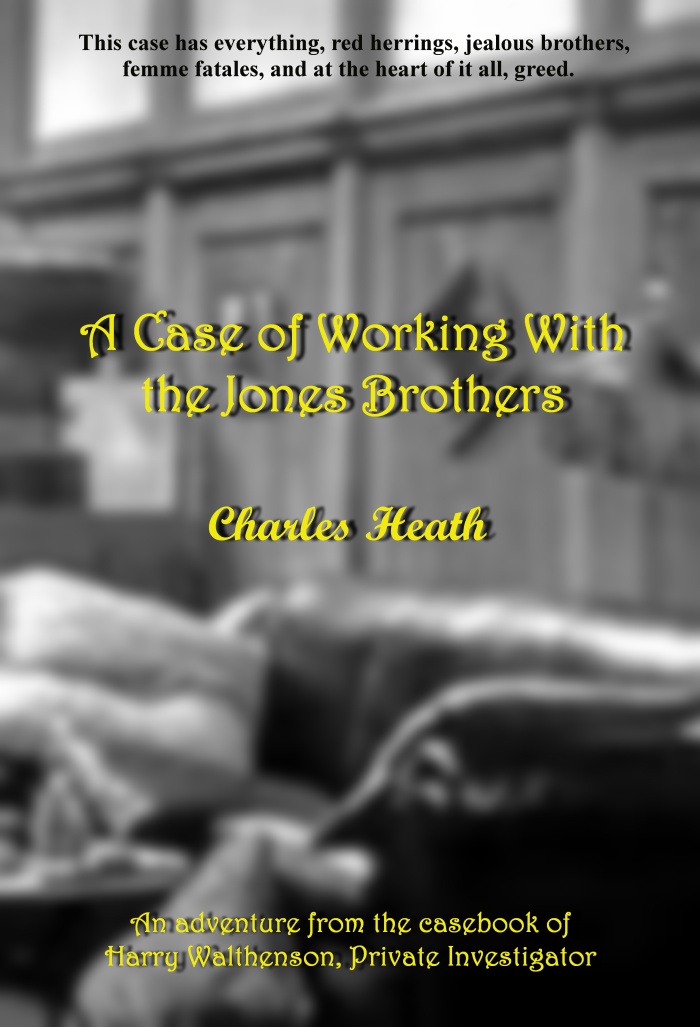
Now it’s called ‘A Case of Working With the Jones Brothers’, finished the first three drafts, and at the editor for the last.

I have high hopes of publishing it in May 2020.  It even has a cover.


PIWalthJones1

A story inspired by Castello di Brolio – Episode 30

For a story that was conceived during those long boring hours flying in a steel cocoon, striving to keep away the thoughts that the plane and everyone in it could just simply disappear as planes have in the past, it has come a long way.

Whilst I have always had a fascination with what happened during the second world war, not the battles or fighting, but in the more obscure events that took place, I decided to pen my own little sidebar to what was a long and bitter war.

And, so, it continues…


It was a good plan.

Wallace, once he discovered his search team had gone missing would send another group to find them, and we would dispatch them in the same manner.

Each foray would reduce his group at the castle until it became, for us, a manageable size.  Currently, it was 35, with four already killed.  There was also the Leonardo factor, and his men, according to Martina, numbered seven.

If I was Wallace, who would realize once he discovered the body on the road to Chiara’s, that sending his own men out to be picked off was a bad idea, would eventually send Leonardo and his men as the first foray to resolve the problem.  

That, of course, would present the same problem as Wallace’s men, there would be deadly retribution.  The villages had all hated Leonardo, and he had dislike them for not selecting him as the local head of the resistance.  That had fallen to Martina, a more popular person, and one more capable.

It seemed to me, from what she had told me, Leonardo was more a mercenary, one who would work for the highest bidder, and that was the sort of man Wallace would have no trouble employing.

Martina was right to round up the villagers to keep them safe

But, for Carlo and I, we needed to pre-emp their strike, and the safest assumption was that they would return to Chiara’s, looking for her, and for answers.  

There was some discussion as to who would be in the attack group, and I agreed that the more we had the better chances we had of beating them, but in the end, we also needed people with the villagers, just in case the worst-case scenario happened, Leonardo knew of the underground wine storage facility and came there instead.

As far as Martina was concerned, he didn’t.  Very few people knew of its existence. 

In the end, it was decided that Carlo and I should go.  He had no doubt he could take Leonardo’s seven by himself, and I didn’t doubt him, so I went along just in case he needed some help.

I took the distant ground with the sniper rifle, and when I saw them, I was not to hesitate to shoot them.  Carlo would be closer and clean up what I missed.  We had enough ammunition to take out at least twenty.

And that’s where we were, from dusk until the following morning, waiting for the search team to arrive.  It did not occur to Carlo, or me, that there was a possibility they might not come, or that Leonardo might have something else in mind.


Alone, in the dark, and surrounded by what could only be described as an eerie stillness, it was hard to imagine that a deadly war was being waged.

In this part of the world, it was not so intense, that according to our intelligence, the Germans were getting stretched very thin on the ground, and were withdrawing soldiers from the extremities of Europe to bolster the fighting closer to home, and the imminent attack in France by the allies.

Of course, there was no way the Germans could know where and when, even I didn’t know that, but it was coming.  It seemed odd to me, by way of contrast, that the Germans high command had basically wasted a formidable and hitherto undetected group of double agents to rescue a rocket scientist which, in my mind, was hardly going to save or lose the war for them.

Perhaps that’s why it had not been up to me, and I hoped that our people knew exactly what they were doing.  Those that had been filtering through the castle were not exactly the sort of people Thompson had been expecting to defect, but once he learned of Meyer’s desire to leave, that assessment had changed.

It also caused a reassessment of the operation at the castle, which led to the discovery people were not making it beyond that point and became the reason for my mission.  The fact I’d been attacked before I reached my objective was coincidental, but it didn’t take long to realize why.

From that to here had been the proverbial hop, step, and jump.

I had not anticipated having to join the resistance, not be involved in becoming a guerrilla.

Not had I expected a dog for a companion.  Jack was lying on the ground next to me, and it looked like he was getting a well-earned rest.

Then he heard something, and lifted his head, ears pricked up.

Then I heard it.

The sound of an airplane passing overhead, but some distance away.

It was not the clearest night so all we could do was hear it, not see it.  A patrol?  A plane that had lost its way.  It was a bit south of where the action was, or where I’d expect the Germans to have either fighters or bombers.

Perhaps the allies then, but late at night surrounded by darkness, there would be little to see.

A minute later, nothing.

Jack put his head down, and I was struggling to keep my eyes open.  Something had better happen soon, or I would miss it.
© Charles Heath 2020

Searching for locations: Niagra Falls, Canada

We visited the falls in winter, just after Christmas when it was all but frozen.

The weather was freezing, it was snowing, and very icy to walk anywhere near the falls

DSC00755

Getting photos is a matter of how much you want to risk your safety.

I know I slipped and fell a number of times on the ice just below the snowy surface in pursuit of the perfect photograph.  Alas, I don’t think I succeeded.

DSC00754

DSC00758

DSC00767

DSC00768

DSC00761

The mist was generated from both the waterfall and the low cloud.  It was impossible not to get wet just watching the falls.

DSC00771

Of course, unlike the braver people, you could not get me into one of the boats that headed towards the falls.  I suspect there might be icebergs and wasn’t going to tempt the fate of another Titanic, even on a lesser scale.  The water would be freezing.

In a word: Park

We mostly understand that a park is an area set aside for recreation, and can have trees, flowers, a lake, and vast lawns.  These parks are also sometimes called ‘gardens’.

A great example of a park is Central Park in New York.

Nearly every city has a park or some sort, some have more than one.

But the word park has a number of other uses.  For instance,

You can park a car, or bike, or yourself; in other words, it’s a place where you stop for a while.  For cars, it is a carpark.

You could say ‘it’s just a walk in the park’, which means that the job is going to be easy.  I never understood that analogy because quite a lot of parks have walks that are difficult, and not so much ‘a walk in the park’.

It is also used to describe a place where animals are kept, other than calling it a zoo, it can go by the name of a wildlife park.  Zoos though are more for cities.  Wildlife parks can be quite huge and many are found in Africa.

A park can also be used to describe a sporting arena or field.

You can park a bag in a locker.

You can park an idea in the back of your mind and come back to it later, or if you are like me, it disappears into the ether.

It can be an area of land around a manor house, but there are very few of those left now.  The most notable of these are in England, and were designed by a man called Capability Brown.


In a word: Flower

It’s what we expect to see when we walk past the front of some houses but instead sometimes see lawn, rocks, or a disaster.

They are what makes the difference between a delightful street and an ugly one, and by that I mean flowers.

By definition though, it means the state or period in which the plant’s flowers have developed and opened/

Just beware the man who turns up with a bunch of flowers that look vaguely familiar to those that grow in your neighbour’s gardens.

They are also in abundance in horticultural gardens, and in florist shops.

My favourites are roses.

And just a word of warning, look out for triffids.  If you read John Wyndham science fiction you’ll know what I mean.

Another mean for the word is to reach the optimum stage of development, though the word bloom could also be used to describe the same thing.

There is another similar-sounding word, flour, but this is the stuff used to make bread, scones, and puddings.

By definition, it is the result of grinding wheat or other grains to a powder.

If something is said to be floury, then it means it is bland.


I’ve always wanted to go on a Treasure Hunt – Part 40

Here’s the thing…

Every time I close my eyes, I see something different.

I’d like to think the cinema of my dreams is playing a double feature but it’s a bit like a comedy cartoon night on Fox.

But these dreams are nothing to laugh about.

Once again there’s a new installment of an old feature, and we’re back on the treasure hunt.


The passage heading towards the marina was littered with fallen rocks, timber beams, and roofing material. Much of the damage was in this wing, where the marina had started falling apart.

It was a problem with the foundations. A long and costly investigation had found that the marinas foundations had been inadequately built on a shifting base, made worse by the seasonal water flow.

It was interesting to learn that the event that caused the start of the problems had not occurred in a hundred years, but had been noted in an early newspaper report, and only that it was a phenomenon, 

No one at the time had any interest in building there, and it was understood when the navy built its marina, there was no mention of anything untoward happening that would preclude the construction.

And, over the life of the project, nothing had happened. It was why, when the mall was being touted, no one really knew anything about flooding because it hadn’t happened in living memory.  That only came later, after the damage was done.

We reached the end of the passageway and found the stairs leading up to the walkway around the marina was closed off. Someone had pulled a board away and we could peer through the crack.

There was daylight beyond, and we could see the large cracks in the staircase, and along the walls either side.  There were two sets of stairs up both at the end of a mall passageway, and, in between, there were steps down into the carpark.  To one side of that was an elevator lobby, but the elevators would not be working.

But, just out of curiosity, I pressed the button.  The light came on, but nothing happened, and, a second later, it went out again.

I looked up, but Boggs had not moved from the top of the stairs.

These steps were not blocked by a barricade, but there would be some difficulty stepping over masonry that had fallen from the roof, which now had a gaping crack and a few pieces of concrete missing.  I could see the steel reinforcing and it was rusting.

A few years, all of it would eventually come down.

“You sure this is safe,” I asked.

“Been here a few times.  I reckon it hasn’t changed much in years.”

He was looking at the map again, and I peered over his shoulder.  The stairs were there but looking down we could only see as far as the landing.  There were cracked and broken tiles everywhere, and the handrail had been bent severely out of shape by a boulder now wedged in the rail.

Boggs put the map in his back pocket and said, “Follow me.”  He started walking slowly down the stairs, flashing his cell phone light ahead so we could see if there were any hazards.

At the landing, we looked further down the stairs, and these were cleaner.  Also, the wall which kept the marina out had a crack in it, and it was damp which meant water was seeping in.  The smell was of mold, and I wondered if that could be good for our health.

I followed him down to the first level of the carpark.  In the distance, looking back towards the front entrance of the mall, way in the distance was the slatted entrance gates, light seeping in through the cracks. 

Between us and those gates were several cars, crushed by a huge concrete beam that had fallen on them.  I remembered, then, that there had been a husband and wife in one of the cars at the time and they’d been killed.  Their children had been luckier, the youngest had to go to the restroom, and that minute delay had saved them.

Still, it would not be good seeing your parents killed in front of your eyes.

“This place is giving me the creeps,” I said and shuddered. 

They said there were ghosts, and I now believed them.

“What are we looking for?: I asked.

“Evidence of the underground river.”

“That would be long gone by now, since they built this lot over it, and some of it falling into it.”

“We shall see.” 

He then went down the next flight of steps to the bottom carpark, and I followed.  There was less debris on this level, but it was much darker down here, and with only Boggs’ cell phone light, we couldn’t see much else.

“That’s strange,” Boggs said, having taken a dozen or so steps to the right.

“What is?”  I wondered what his definition of the word strange was.

“There’s supposed to be an open section here where the wall fell away, pushed by the water flow last time it flooded.  The report said that a section here wasn’t anchored properly with formwork, hence the ease in which it was moved.”

I looked at the wall.  It seemed to be still intact to me.

Boggs pulled out a pocketknife and tapped it against the surface.

The false concrete chipped and fell away, and a closer inspection showed stippled plaster over plywood, very damp plywood.  Boggs extracted a knife and worked on the wall, clearing a foot square, the damp plaster easily peeling away.

A false wall, one that no one would think twice about if they were not looking for it.

Boggs then scraped sideways until the blade hit metal, then he scraped around it until a gate-type bolt was exposed.  It didn’t have a lock.  It was rusted shut, so Boggs found a rock and hit it a few times, shaking it loose.  He opened it, then tugged on it.

Was he expecting a door to open?

“Give us some help here.”

We both pulled on it, and it gave way, showering us in plaster pieces.  At least we weren’t smothered in dust.

As it opened, light flooded in, almost blinding me.

I let Boggs open it the rest of the way while my eyes adjusted.

Then I tentatively looked out.

From where we were standing, we could see the two levels of the marina walkway, broken away at this end above the doorway, and a big hole in the side wall of what was the marina pool.  We could see, and smell the seawater, and beyond, the ocean.

Looking down, there was a sheer drop of about 30 feet, and under us, there was an opening.  At that 30 feet was flowing water, and through the water, I thought I could see clothes.

“Is that a body down there?”

It looked like one.

“No.  Don’t think so.  Someone probably threw a clothed dummy down there for fun, once when this was open.  I’d say it was closed up to make the place safer. Anyway, we’ll soon find out.  We’re going down to have a look.”

© Charles Heath 2020

The story behind the story: A Case of Working With the Jones Brothers

To write a private detective serial has always been one of the items at the top of my to-do list, though trying to write novels and a serial, as well as a blog, and maintain a social media presence, well, you get the idea.

But I made it happen, from a bunch of episodes I wrote a long, long time ago, used these to start it, and then continue on, then as now, never having much of an idea where it was going to end up, or how long it would take to tell the story.

That, I think is the joy of ad hoc writing, even you, as the author, have as much idea of where it’s going as the reader does.

It’s basically been in the mill since 1990, and although I finished it last year, it looks like the beginning to end will have taken exactly 30 years.  Had you asked me 30 years ago if I’d ever get it finished, the answer would be maybe?


My private detective, Harry Walthenson

I’d like to say he’s from that great literary mold of Sam Spade, or Mickey Spillane, or Phillip Marlow, but he’s not.

But, I’ve watched Humphrey Bogart play Sam Spade with much interest, and modeled Harry and his office on it.  Similarly, I’ve watched Robert Micham play Phillip Marlow with great panache, if not detachment, and added a bit of him to the mix.

Other characters come into play, and all of them, no matter what period they’re from, always seem larger than life.  I’m not above stealing a little of Mary Astor, Peter Lorre or Sidney Greenstreet, to breathe life into beguiling women and dangerous men alike.


Then there’s the title, like

The Case of the Unintentional Mummy – this has so many meanings in so many contexts, though I image back in Hollywood in the ’30s and ’40s, this would be excellent fodder for Abbott and Costello

The Case of the Three-Legged Dog – Yes, I suspect there may be a few real-life dogs with three legs, but this plot would involve something more sinister.  And if made out of plaster, yes, they’re always something else inside.

But for mine, to begin with, it was “The Case of the …”, because I had no idea what the case was going to be about, well, I did, but not specifically.

Then I liked the idea of calling it “The Case of the Brother’s Revenge” because I began to have a notion there was a brother no one knew about, but that’s stuff for other stories, not mine, so then went the way of the others.


Now it’s called ‘A Case of Working With the Jones Brothers’, finished the first three drafts, and at the editor for the last.

I have high hopes of publishing it in May 2020.  It even has a cover.


PIWalthJones1

In a word: Mark

A teacher will mark a test in order to give the student a mark out of 100.  Yes, to mark a test means to ascertain right and wrong answers and score it accordingly, and getting a mark out of 100 could determine a great many different outcomes at school.

Whereas a mark on your clothes could mean you’ve been playing with fire, rolled in the mud or if much older having a salacious affair with an unexplainable lipstick mark on your collar.

A mark is someone that a con man believes will be easily deceived.

A mark is a catch in certain types of football.

You can have an identifying mark on some item of property.

it’s literally the x marks the spot for someone who cannot write, i.e. make your mark

There can be a mark on a rope that indicates the depth of water.

And many, many more…

But not to be confused with marque, which could be the make or model of a particular type of car

Or marc with is the refuse of grapes after being pressed