Writing about writing a book – Day 28

So after that rather undramatic ‘off with the fairies’ moment, it’s time to come back to earth.  Holiday or not, there’s always something that can go wrong.

Even when you’ve been told to take some vacation days, and reluctantly stayed home.  The notion that vacation meant going away somewhere doesn’t enter Bill’s mind.

Perhaps he’s like a lot of workaholics, using their job as an excuse to forget about life outside work.

Maybe he was hoping something would go wrong.  Maybe he had considered manufacturing a problem so that he would have to go back.

Maybe not, but that was the sort of employee he was, not one that could willingly take a day away, just in case.

Like now.


I’d almost managed to doze off again when the phone rang.

I jumped to its equally shrill sound cutting through the silence.  It had to be a wrong number because no one at work would call me, and I didn’t have many friends, so I let it ring out.  As far as I could remember, it was only the third time it had rung since I’d moved in, four years ago.

Blissful silence.  I looked at the bedside clock.  7 am.  Who called anyone at that hour?

It rang again.

Ignore it, I thought.  If it was anyone, it would be someone from the office.  I’d told them all not to call me, not unless the building was burning down and they were all trapped in it.

And even then, I’d have to think about it.

Burying my head under the pillow didn’t shut out the insistent ringing, compelling me to answer.  Almost reluctantly I rolled back, pulled the telephone out from under the bed, and lifted the receiver to my ear.

“Bill?”

It was Carl Benton, my immediate superior; an insipid, loathsome, irritating little man, the last person I would want to speak to.  He’d insisted I take this leave, that the office could survive without me, adding in his most condescending manner that I needed the break.

I slammed the receiver down in anger.  It was a forlorn gesture.  Seconds later, it rang again.

“I seem to remember you were the one to tell me to go on holiday, that I needed a holiday.  I’m off the roster.  It can’t be that important.  Call someone else.”  I wasn’t going to give him the opportunity to speak.  Not this morning.  I was not in the mood to listen to that squeaky, falsetto voice of his, one that always turned into a whine when he didn’t get his way.

And hung up again.

Not that it would do any good.  I knew that even if I was in Tibet, he would still call.  Then I realized it was too early for him to be in the office, and if he was, he would have been dragged out of bed and put in a position where if he didn’t produce results, they might realize just how incompetent he was.

At last, my holiday had some meaning and smiled to myself.  I’d make the bastard sweat.

He left it a few minutes before he rang again.  And I let it ring out.  I could see the expression on his face, bewilderment, changing slowly into suffused anger.  How dare I ignore him!

Another five minutes, then the phone began its shrill insistence again.  Before it rang again, I’d moved it from the floor to the bed.  I counted the rings, to ten, and then picked up the receiver.

“Bill?  Don’t hang up.”  Almost pleading.

“Why?  You said I should go, away from work, away from the phones, away to recharge my batteries, I believe you said.”

“That was Friday.  This is Monday. You’re needed.  Richardson has been found shot dead by his desk.  All hell has broken loose!”  Benton rarely used adjectives, so I assumed when he said all hell had broken loose, it meant something had happened he couldn’t fix.  His flowery language and telegram style had momentarily distracted my attention from Richardson’s fate.

Harold Richardson was an accountant, rather stuffy, but good at his job.  I’d spoken to him probably twice in as many years, and he didn’t strike me as the sort who would kill himself.  So why did I think that?  Benton had only said he was shot.

Benton’s voice went up an octave, a sure sign he was going into meltdown.  “It’s a circus down here.  Jennifer is missing, Giles is not in yet, the network is down, and that bunch of nincompoops you call support staff are running around the office like headless chooks.”

It all came out in a nonstop sentence, followed by a gasp for air.  It gave me time to sift the facts.  Jennifer, my sometime assistant, and responsible for data entry and accounts maintenance, was not there, which in itself was unusual, because she kept longer hours than me, Peter Giles, my youthful assistant, just out of university and still being beaten into shape was not in, and that was usual, so it could only mean one thing.

The network was down.


© Charles Heath 2016-2020


In a word: lesson

I went to school and learned a lesson. We often hope that our children learn from these lessons, but sometimes the lesson learned was not the one intended.

This could be called a useful piece of practical wisdom, and for me that was, don’t get into fights at the back of the schoolyard.

The former lesson can be, on one hand, a section of school work, from a larger continuous topic, or, part of a book, which can be an exercise.

Then there’s the study of the past and the hope that we can learn from the lessons of the past.

Sadly, in a lot of cases, we don’t and are therefore doomed to repeat the past, only with far more devastating consequences.

A lesson can also be a passage from the bible.

Or is it lessen, where we reduce the costs.

So lessen means reduce, to make less.

In a word: Wall

There’s nothing like ‘hitting the wall’.  It’s a rather quaint expression used when you have used up all your energy and there’s nothing left.  A lot of sportspeople are very familiar with this expression.

But it doesn’t have anything to do with hitting a real wall, you know the sort, made out of plaster, or bricks, or timber.  Some people hit the wall in this case too, and soon find out what it’s like to have a broken hand.

There’s wall street, you know the one, it has a bull in it, and it’s in New York, down that end of the city where the Twin Towers used to be.  It’s rumoured lots of ‘jiggery-pokery’ goes on there.

Try stonewalling, you know, give answers to questions that don’t answer the questions, or find something else to do and put off being questioned.  I’m not sure, however, that’s how Stonewall Jackson got his name.

We can climb the walls, metaphorically speaking, but it is something we don’t actually do when we’re bored.

And, I’m sure everyone has heard of the Great Wall of China.  Even those who travel in space have seen it, from a long, long way away.  I’ve tried walking along it, and up it, yes, parts of it go up the sides of mountains, and it’s challenging.  Maybe you should try it sometime.

Perhaps a few others, just to finish with, like

I got hit by a wall of water – yep, watch out for them tidal waves

There’s a wall between us, nope, not gonna talk to you

His stomach wall is failing, which means he’s in very bad shape, and

He couldn’t get through the wall of players, oh, well, maybe we’ll win the FA cup final next year!

Writing about writing a book – Day 27

Well, it’s been a monumental process to get to the point where I think I can start writing Chapter One.

This, of course, might not be the first chapter, it might finish up somewhere else.

If there was a plan, then this would be chapter one.  In fact, right now, I’m going to sit down and do a plan with as much as I know about where the book is heading.

One, about Bill and his introduction to the reader

Two, a phone call to interrupt the dream

Three, having to go into work – there’s a disaster going on, and he’s the only one who can fix it.

Well, not necessarily others, but this is the nineteen seventies/eighties, and women were still not looked upon or considered as being able to hold the same position as Bill – we’ve certainly come a long way in forty years.

And that, of course, is anther stream in the book, proving that woman, and one in particular is clever and given the recognition she deserves.

I’ve also got to remember that there is no internet, and there are no mobile phones and a lot of other stuff that is now regarded as commonplace and taken for granted.

We had telephone boxes, telephones on desks that connected to a switchboard, dumb terminals connected to mainframes, modems that were bulky and very very slow, and comms ran very differently to those today, and networking was a variety of technologies that mostly don’t exist anymore, like ethernet and token ring, and software like 3Com and Novell.

I know I’m going to forget sometimes because it’s going to be hard not to have the MC pull out his cellphone and call on the spot.

Anyway, here’s the first attempt…


A cool breeze blew briskly across meadows of tall grass, giving the impression of the ocean in a storm.  High above, clouds scudded across the sky, occasionally allowing the sun to shine through to bathe the ground in the sunshine, intensifying the richness of the greens and browns.

It was spring.  Trees were displaying new growth, and flowers were starting to show the promise of summery delight.  An occasional light shower of rain added to the delightful aromas, particularly where the grass had recently been mowed.

I was there, too, with my grandmother, the woman who had, for the most part, brought me up at her country residence.  But, as I got older, the dream changed and sometimes there were storm clouds on the horizon, or I was caught in the rain, alone and frightened, or lost in the woods in the dark.

There were other visions like these from my childhood, now a million years away somewhere in a distant past that was hard to remember or say where and when they belonged.  It was a pity some were now based on images stolen from the start of a movie seen on TV late at night as I was trying to get to sleep.  Or that the psychiatrist had said there was some trauma from my early childhood, trying to work its way out.

Like every other morning, these images came to me as I was hovering somewhere between conscious and unconscious, just before the alarm went off.  Then it did, filling the room with a shrill noise that would have woken the dead.

I cursed, and then dragged myself over to the other side of the bed where I’d put the alarm clock, and hit it, killing the shrill sound.  I’d put it there so I would have to wake up to turn it off.  And, worse, I’d forgotten to turn it off the night before because it was, technically, the first day of my holiday.

Not that I really wanted one because since Ellen left, my life consisted of work, work, and more work.  It kept my mind off being alone, and in an empty apartment except for the books, a bed, a table, and two chairs, a desk, and a well-worn lounge chair.  I’d been there for years and still hadn’t bought any new furniture or anything else for that matter.

And the last holiday I’d gone on had been organized by Ellen fifteen years ago in Italy after our two daughters had finished school and graduated almost top of their class.  We’d been happier then, but happiness was fleeting for me, and soon after the rot had set in, and it was the beginning of the end.

I remembered it only too clearly, coming home, opening a letter addressed to her, and finding proof of what I think I’d known all along.  She was having an affair, had been for quite some time.

It should not have been a surprise given what I had put her through over the years, since my discharge from the Army, and the nightmares active service had fueled, but it was and sent me spiraling to a new low.

But that was five years ago.  I came out of the fog a year after that.  Ellen was gone, the girls came to see me from time to time, and all I had left were memories.

I rolled over and tried to go back to sleep.  I was on holiday.  No work, no pressure, nothing.  I could go back to my grandmother’s house and visit.  I had been promising myself I’d do that soon, even if it was now a country hotel.  From the advertising it had not changed one bit, the house and grounds intact.

Or I could throw a dart at a map and get on the next plane there, though knowing my ability with a dart, it would be in the middle of the ocean.

I could do almost anything I wanted.


It’s not much, just a taste.  But it’s enough for now.  I’ve made a start.  Now, all I have to do is come up with the next 100,000 words or so.


© Charles Heath 2016-2020

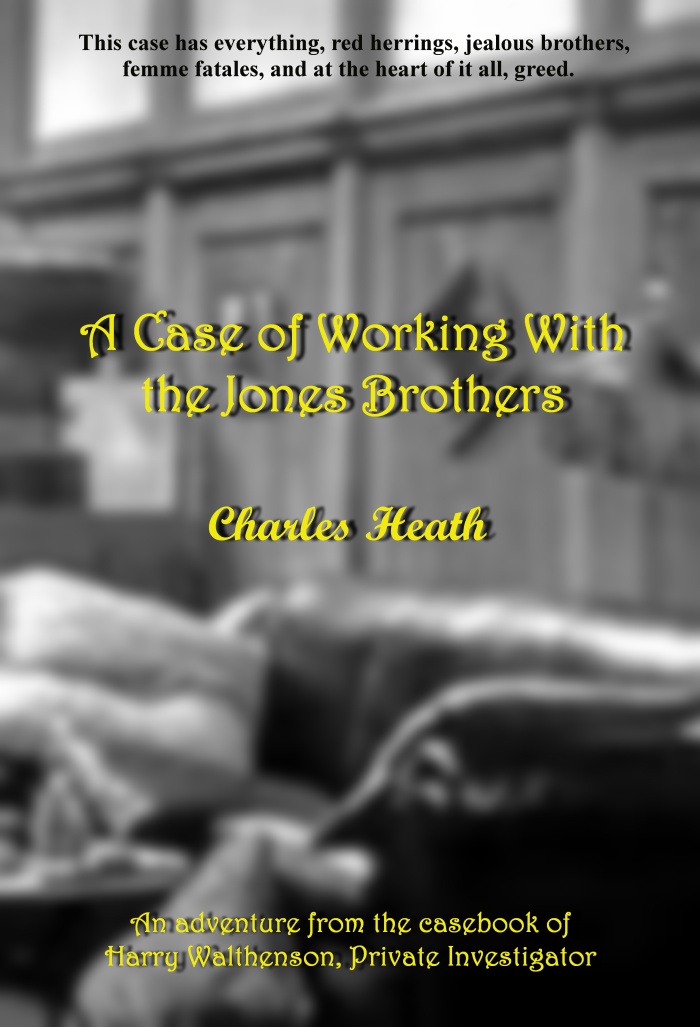
The story behind the story: A Case of Working With the Jones Brothers

To write a private detective serial has always been one of the items at the top of my to-do list, though trying to write novels and a serial, as well as a blog, and maintain a social media presence, well, you get the idea.

But I made it happen, from a bunch of episodes I wrote a long, long time ago, used these to start it, and then continue on, then as now, never having much of an idea where it was going to end up, or how long it would take to tell the story.

That, I think is the joy of ad hoc writing, even you, as the author, have as much idea of where it’s going as the reader does.

It’s basically been in the mill since 1990, and although I finished it last year, it looks like the beginning to end will have taken exactly 30 years.  Had you asked me 30 years ago if I’d ever get it finished, the answer would be maybe?


My private detective, Harry Walthenson

I’d like to say he’s from that great literary mold of Sam Spade, or Mickey Spillane, or Phillip Marlow, but he’s not.

But, I’ve watched Humphrey Bogart play Sam Spade with much interest, and modeled Harry and his office on it.  Similarly, I’ve watched Robert Micham play Phillip Marlow with great panache, if not detachment, and added a bit of him to the mix.

Other characters come into play, and all of them, no matter what period they’re from, always seem larger than life.  I’m not above stealing a little of Mary Astor, Peter Lorre or Sidney Greenstreet, to breathe life into beguiling women and dangerous men alike.


Then there’s the title, like

The Case of the Unintentional Mummy – this has so many meanings in so many contexts, though I image back in Hollywood in the ’30s and ’40s, this would be excellent fodder for Abbott and Costello

The Case of the Three-Legged Dog – Yes, I suspect there may be a few real-life dogs with three legs, but this plot would involve something more sinister.  And if made out of plaster, yes, they’re always something else inside.

But for mine, to begin with, it was “The Case of the …”, because I had no idea what the case was going to be about, well, I did, but not specifically.

Then I liked the idea of calling it “The Case of the Brother’s Revenge” because I began to have a notion there was a brother no one knew about, but that’s stuff for other stories, not mine, so then went the way of the others.


Now it’s called ‘A Case of Working With the Jones Brothers’, finished the first three drafts, and at the editor for the last.

I have high hopes of publishing it in May 2020.  It even has a cover.


PIWalthJones1

Writing about writing a book – Day 26

On the surface, the relationship between Bill and Barry is an odd one.  I’ve thought about it, and at the moment, there’s some aspects that need to be written to provide background for what follows later.

I think I would like to make Barry one of those people who were built for soldiering, and not for civilian life, and it has to be said, he is a bit of a sloth once he becomes a civilian.

And, yet, under all of that, he’d be the first one in line to help his friends.

I just have to strike that balance so that I don’t make him too unsociable.

So, a little more about them, and Barry in particular.


A groan emanated from the table, and Barry moved his head slightly.

I shifted the drink in front of him, and then a hand went out and moved it back.  He lifted his head to look at me, and then lowered it again.

“I thought it was you.” A croak.

“Mate.  Not looking too good this afternoon?”

He groaned again, and then struggled to sit up, trying to smooth his hair back into place, and failing.  He rubbed his face and realized he had a week’s stubble, giving him the look of a deranged sanatorium inmate.

“Someone’s gotta try and get me off the gut rot Ogilvy calls booze.”  He nodded in Ogilvy’s direction, but typically, Ogilvy ignored him.

“You don’t have to drink it.”

“That’s what I keep telling myself.  Only it doesn’t work.”

“Perhaps you should try harder.”

He looked me over, looking for the changes since the last time he saw me, about four months ago.

“Where you been?”

“Hospital.”

“Not surprising.  Work too hard, no fun.”  He looked at the drink on the table, took it in his hand, then holding it up to the light.  Perhaps he thought it was the magic elixir that would fix him.

“Someone shot at me.  I nearly didn’t make it.  One thing it did, though.  Brought back all those memories I’d shut away.  Now I know why I did.”

“Shot at you?  Why?”

“I don’t know.  You should see the other guy.  He’s dead.”

“What other guy?”  He put the drink down, untouched.  He was beginning to look a little more alert.

I had not expected it would make much of a difference telling him about my problems, but it had.

“Take it from the top.”  Then, over towards Ogilvy, “Bring me some coffee.  Black.”

I started, a little hesitantly, not quite sure how much or little I should say.

Ogilvy came over with coffee for him and my orange juice.  He glared at me, then Barry.

“Your account is a little overdue,” Ogilvy said, standing over him.

“It’ll get paid.”

By little, I assumed it was more than Ogilvy was willing to stand.  He was kind, but kindness had its limits.

I pulled out two hundred dollar notes and gave them to him.  “Will this settle it?”

“I don’t want your money.  You should throw him in a detox center.  That would make more sense.”

“It’s only money.  If he wants to drink himself to death, who am I to argue?”

Ogilvy shrugged and took the money.  As he turned to leave, Barry said, “And take the scotch back.  I’ve had enough.”

He looked at Barry with surprise, no, I think it was more shock, but did as he was asked.  Out of the corner of my eye, I saw Ogilvy drink the scotch himself, and another for good measure.

I picked up the story where Aitchison and I were shot in the street and related what I knew from there.  He asked only two questions, who was Jennifer, and what had happened to Ellen.  He’d absorbed the rest, and judging by his reaction, probably not understood any of it.

“You have a friend?  Does Ellen know about this friend?”

“Ellen and I are divorced.  Don’t you remember me telling you several years ago?”

“Has it been that long?”

He’d been like this off and on over the last twenty years.  It had been getting worse in the last few years, his health failing, and, at times, his memory.  I watched him pick up the coffee cup, his hand shaking so badly, he needed to hold it was two.  It took a minute or so before he could drink it, and then, his face was of a child, taking medicine.

He looked over towards the bar.  “More coffee.”  He set the cup down carefully, and then looked back at me.

“What can I do?”

“I need someone to watch my back.  I have the odd feeling I’ve got myself into a situation.  The people I work for, well, I can’t put my finger on it, but they’re probably doing something they shouldn’t.  I have some evidence, and I think they know I’ve got it, and they’ve attacked me, like I said, at least once since I got out of the hospital.”

“You want me to get this Kowalski character and beat it out of him?

I smiled at the thought.  I had no doubt if I asked him, he would do exactly that.

“Not yet.  We have to get a better case against them first.”

“So, just watch your back?”

“For the moment.  And for Jennifer.”

“But you are not sure about her.  I get the impression you think she might be involved in more ways than one.”

“Did I give that impression?”  I had no idea he would pick up on my doubts.  But he was right.  I did.

“Yes.  But it doesn’t matter.  If she is we’ll find out soon enough.”

In the space of five minutes and the arrival of the second cup of coffee, to be followed by a third, his whole manner had changed.  There was still the pained look from the hangover, but the eyes were brighter, and he had a purpose.

“Then you’re in?”

“Might as well.  It’ll be better than the last bodyguard gig I had.  Had to thump the little turd.  Smart arse needed it.”


To be honest, I didn’t expect Barry to take up the challenge.  Perhaps I’d become used to seeing him down and out, and not expecting anything else.  It was the look in his eyes that changed my opinion.  The same look I’d seen all those years ago, in the jungle.

It was another good sign when he asked for an hour to clean up so he could become inconspicuous.  I told him he could take over my place, gave him the key, gave him some money, and then told him where he could find me in an hour.

It was exactly what I needed.  The Barry of old.


© Charles Heath 2016-2020
I’ve always wanted to go on a Treasure Hunt – Part 45

Here’s the thing…

Every time I close my eyes, I see something different.

I’d like to think the cinema of my dreams is playing a double feature but it’s a bit like a comedy cartoon night on Fox.

But these dreams are nothing to laugh about.

Once again there’s a new installment of an old feature, and we’re back on the treasure hunt.

The shrill ring tone of my phone woke me.

And, for a moment I was in a state of panic because I’d woken in unfamiliar surroundings.  Until my eyes cleared and I realized I was still at Nadia’s.

And it was morning.

What the….

The phone was still ringing, and Nadia, lying on the bed beside me rolled over and said, sleepily, “Are you going to answer that?”

I picked up the phone off the bedside table and pressed the green button.  

I already knew it was Boggs.

“Don’t you know what time it is?”  It was nine, a respectable hour of the morning to call.  It was just that I was tired.

“Where are you?”

I could lie, or I could tell the truth.  I don’t think I should say at home because I suspect that was where Boggs was now.  And my mother would be there, wondering what happened to me.

“Out and about.  Nice day for some exercise.  Why?”

“Your mother is not happy you didn’t come home.  And I’m surprised.  Where were you?”

Good question.  One that needed time to consider, time I didn’t have.

“Surveillance.  I’ve been watching Alex and his friends.  It’s been a long night.  What do you want?”

“I was going to head down towards Kentville, check on the other river.  We need to drive down there.”

“Well, right now I’m busy, so it will have to wait until tomorrow morning.  Sorry.  I have a job to do, and then I have to get home before I go to work.”

“What was Alex up to?”

“Not over the phone.  I’ll tell you when I see you.  Come back home about lunchtime.”
I could tell by the silence he wasn’t happy. 

“OK.”  He hung up.

I glared at the phone and put it back on the table, then turned to look at Nadia.  First thing I noted, we were both still in the clothes we were wearing the previous night.

“What happened?”

“Nothing.”  A momentary look of disappointment crossed her face.  “You were tired and I told you to stay.”

“Nothing can happen, or I’ll become Vince fodder.”

“I wouldn’t tell him.”

“He’d find out.  He has walls as spies.”  I looked around the room looking for potential spy cameras or bug locations.

“He wouldn’t dare.”

I climbed off the bed and smoothed out my clothes.  It didn’t make much difference to the crumpled look.  “At least it looks like I’ve been on an all-night surveillance assignment.”

“What are you going to tell Boggs.”

“Nothing.  There’s nothing concrete to tell him yet, just that Alex is, like the rest of us, running around in circles.

Nadia remained on the bed, and even though she looked as messy as I did, hers was a far more alluring messy.  I could feel the pangs of a forbidden desire.  Time to go.

“Come back tonight.  We can go on a voyage of discovery, see the mall as you’ve never seen it before.”

“Sounds like a Discovery Channel documentary advert.”

She sat up then stood and teased the knots out of her hair.  It was the first time I’d seen it out.  It gave her a whole new, softer look.

“Is that a look of desire I see in your eyes, Smidge?”

And the whole moment was shot to pieces.

“Don’t call me that.  I’ll see you tonight, though I’m not sure why.”

I let myself out, after carefully checking to see if the way out was clear.  The last thing I wanted, or needed, was to tangle with Vince.

Or ending up letting the dream become reality.

 
© Charles Heath 2020

Writing about writing a book – Day 25

We’ve been given the introduction to who Barry McDougall is, or the man otherwise known as ‘Brainless’, and after three days of trying to get it straight, this is the first rough draft of his start in the story.


Barry, whose daring selfless deeds earned him the nickname Brainless because that was the only way to describe the motivation behind them, was one of the regular soldiers, and, for a long time, had been my only true friend.  His was a reputation both friends and foes alike considered awesome.  He’d been in Vietnam, and later just turned up at Davenport’s camp, reporting for duty.

Davenport was more surprised than I was at his arrival, but obviously, after checking his credentials, he was impressed because he let him stay.  And it would be true to say, if he had not, I would not be here now.

So Barry was just the sort of person I needed to help me.

That was the good news.

The bad news was Barry, at the best of times, either on one of his ‘benders’ using drugs or alcohol, whatever was easier to get at the time, lost to everyone, or locked up in a mental institution, having admitted himself.  He had no interest in participating in life, hadn’t worked in years, and often said, in moments when he was at his lowest, that he did not care if he lived or died.  It had not always been that way, but his demons had all but taken him over, and despite the help, I tried to give him, nothing could shake him out of this lethargy.  He said once he envied me that I could not remember the dark days, and, now those memories had returned, I knew what he meant.

For a long time, I could not understand why he didn’t try harder to help himself, and I guess he humored me by accepting the jobs I’d found him, and the help I offered.  I owed him a great deal, but that was probably the one honorable thing about him, he never expected, nor wanted, anything in return.

He tried to make a go of being a police officer and lasted several years before he resigned over an incident that didn’t reach the papers.  There was, he said, no place for heroics in modern society.  I hadn’t got to the bottom of it, but I heard he shot some thieves at a time when the police were trying to promote a pacifist image.

He tried a few other occupations with an equal lack of success, so now he survived on whatever money I gave him.  He lived on the street, and when he was not there, I knew he could be found in a bar, in one of the more seedier parts of the city, a ubiquitous underground bar called Jackson’s, named after a man who had a salubrious reputation that hovered between load shark and saint, and who was reputed to be buried under the storeroom floor.  The present owner, or what I assumed to be the owner, was a large, gruff, ex-prizefighter, who had the proverbial heart of gold, most of the time, and who took my money and looked after Barry without making it look like he was.

I’d called the bartender in advance, and he said he was in his usual spot, and that it was at the start of the next cycle, having just discharged himself from the hospital after a bout of pneumonia.  It was, he said, getting worse, and taking longer to recover.

It was probably only a matter of time before it took him, so perhaps this time I would have to try harder to convince him to give up his nomadic lifestyle.

When I walked in, the aroma of spilled beer, stale sweat, and vomit, mingled with the industrial-strength carbolic cleaner almost took my breath away.  In the corner, two construction workers were sitting, quietly smoking and drinking large glasses of beer.  In the other, Barry was being held up by the table, an untouched double scotch sitting in front of him.  Sitting at the bar was a woman of indeterminate age, badly made up, and thin to the point of emaciation.  I was not sure what she was drinking, or what it was she was smoking, but I could smell it from the front doorway.

The bartender, Ogilvy, no first name given, was pretending to polish glasses, standing at the end of the bar, looking at the television, playing some daytime soap.  He didn’t look over when I came in, but I knew he didn’t miss anything.  I saw him flick a glance at Barry, and then shake his head.  I think he cared as much about Barry as I did, but could recognize the sadness within him.  As much as Ogilvy said, which wasn’t much, he too had seen service in Vietnam, and it had affected him too.

I ordered an orange juice, caught the glances from the construction workers, and a steely look from the woman then went over to Barry’s table and sat down.  Despite the loud scraping noise when I moved the chair, or the creaking as I sat in it, Barry didn’t move.

Whilst the bar had that seedy aroma, Barry was showing the signs of having spent time on the street.  It was one of the disadvantages of having no permanent residence and though there was a shower at the bar which Ogilvy let Barry use from time to time, he obviously hadn’t for a few days.


Getting all of this background in shape is hard work, and having toiled long and hard, tomorrow I’ll have a go at getting Barry back.

© Charles Heath 2016-2020


Past conversations with my cat – 89

20160921_071506

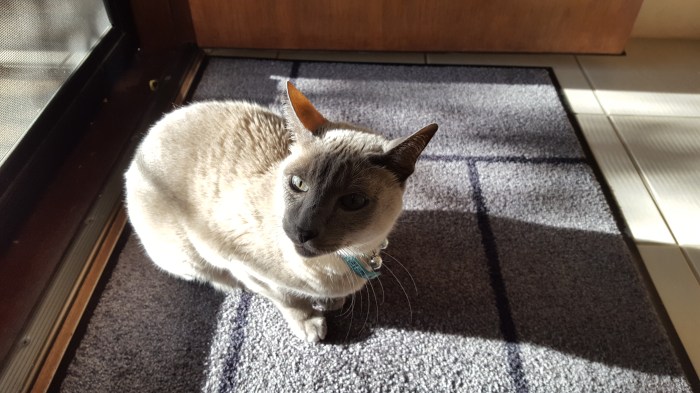
This is Chester.  We have been discussing the possibility of being stuck in the house for anything from 14 days to 10 months.

Yes, the Coronavirus is finally arriving in Australia, and though it is slow to catch on, we are being warned that it could get a lot worse, very quickly.

Chester has suggested we barricade the doors and windows.

Alas, I tell him, this is not the same as the American cowboys fending off an Indian attack.  No circling the wagons, and definitely no John Wayne to ride in and save the day.

Too many westerns on Fox.  I keep forgetting Chester has mastered the art of turning the TV on and changing channels on the Foxtel remote.

I also tell him that the virus is not only airborne, spread by those who cough or sneeze, but also by touch, like shaking hands, and hugging.

At that, Chester takes a good three, four steps back away from me.  So, he challenges me, what are the options.

Well, firstly cats may not get the virus.  Only one dog, as far as I know, had got it.  You, I tell him, do not need to worry.

As for the humans, well, we are in trouble if it comes.

We will be staying in, in some sort of forced quarantine, trying to avoid the rest of the world until it goes away,

So, he says, that means you have enough cat food and litter, the proper one?

I shake my head like he does when he’s annoyed.

Well, if it happens, I’m sure we’ll find out.  Besides, I add, you need to lose a kilo or two.

Writing about writing a book – Day 24, a missing piece of the puzzle

There’s always the necessity for creating backstories so that the reader doesn’t come across a part of the story that doesn’t make sense.

Perhaps one of my failings is that I have to go over what I’ve already written, sometimes to make sure there is continuity and that what I’ve written makes sense.

This collection of memories our main character is having serves the purpose of setting up later plot points, but more importantly, is supposed to give the reader an idea of what the main character has gone through before arriving at the start of the story.

This part will serve to provide a little more information on the relationship between Bill and Barry, though I rather like the nickname I gave him.


“Bastards,” Killer muttered.

We called him ‘Killer’ because it was the nickname the Army had given him.  We were sharing the guard duty and had spoken briefly over the watch, but up till then, the silence had stretched over an hour or so.  It didn’t take long for anyone to realize he was a man of few words.

He’d been in the regular army for years and asked for the posting.  He’d made Sergeant several times, only to lose those same stripes for fighting, usually after R&R and a bout of heavy drinking.  Now assigned to our platoon to lend his experience, the conscripts were expecting him to ‘look after’ them.  Other than myself and the Lieutenant, he was the only other regular soldier.  Unfortunately for them, he hated both conscripts and the Viet Cong in varying degrees, and depending on his mood there was little tolerance left for the rest of us.

“The people who sent us here or the people trying to kill us?” I asked before I realized I’d spoken.

I didn’t hear the reply, the skies opening up with another torrential downpour that lasted for about five minutes, and going as fast as it came.  When the sun finally came up, it would make the atmosphere steamy, hot, and unbearable.  It was quite warm now, and I was feeling both uncomfortable, and fatigued.

Killer looked just as stoic as he had before the rain.  He looked at me.  “Damn weather.  Worse than home.”

“Scotland?”

“Scapa Flow, Kirkwall.  I should have been an engineer on ships like my father, but I was too stupid.  Joined the Army, finished up here.  What’s your excuse?”

“Square peg in a round hole.  The army seems to handle us in its stride.”  It was more or less the truth.  I joined the Army to get away from my parents.

“That it does.  That it does.”

The rain came and went, during which the rest of the camp roused and went about its business.  It had been a long night for some, still getting over the shock of the attack, and the ever-pervading thought the enemy was still out there, biding their time.  It would be, for them, a waiting game, waiting for the conditions to wear us down, and lose concentration as inevitably we would.

Certainly, by the time we were relieved from sentry duty, I felt I was in no condition to match wits with a donkey, let alone the enemy on his own home ground.  When I stumbled over to the mess area and looked at the tired and haggard looks on the faces of the platoon, I realized that went for all of us.

Killer and I managed to get about an hour’s rest before the call came to move out, rain or no rain, and after a breakfast to make anyone ill, we left.  For hours it rained.  No one spoke as we strained to listen over the rain spattering on the undergrowth, all the time expecting the unexpected.  That was the benefit of the surprise attack; we no longer took for granted we would be safe.

Water gathered in pools along the trail, hiding any chance of seeing landmines.  Rainwater and sweat ran into our eyes, making it difficult to see.  Water leaked everywhere, making it very uncomfortable.  This was not war.  This was utter stupidity.

I was about to remark on the futility of it all to the Lieutenant, who had taken the lead, when one second he was talking to me and the next he crashed to the ground, a sniper’s bullet killing him instantly.   Someone yelled “Contact” and we hit the ground, bullets flying all around us. 

Too late, I thought, as I felt the hit of what seemed to be a large rock, then the searing pain in my leg, just as I hit the ground…


© Charles Heath 2015-2020