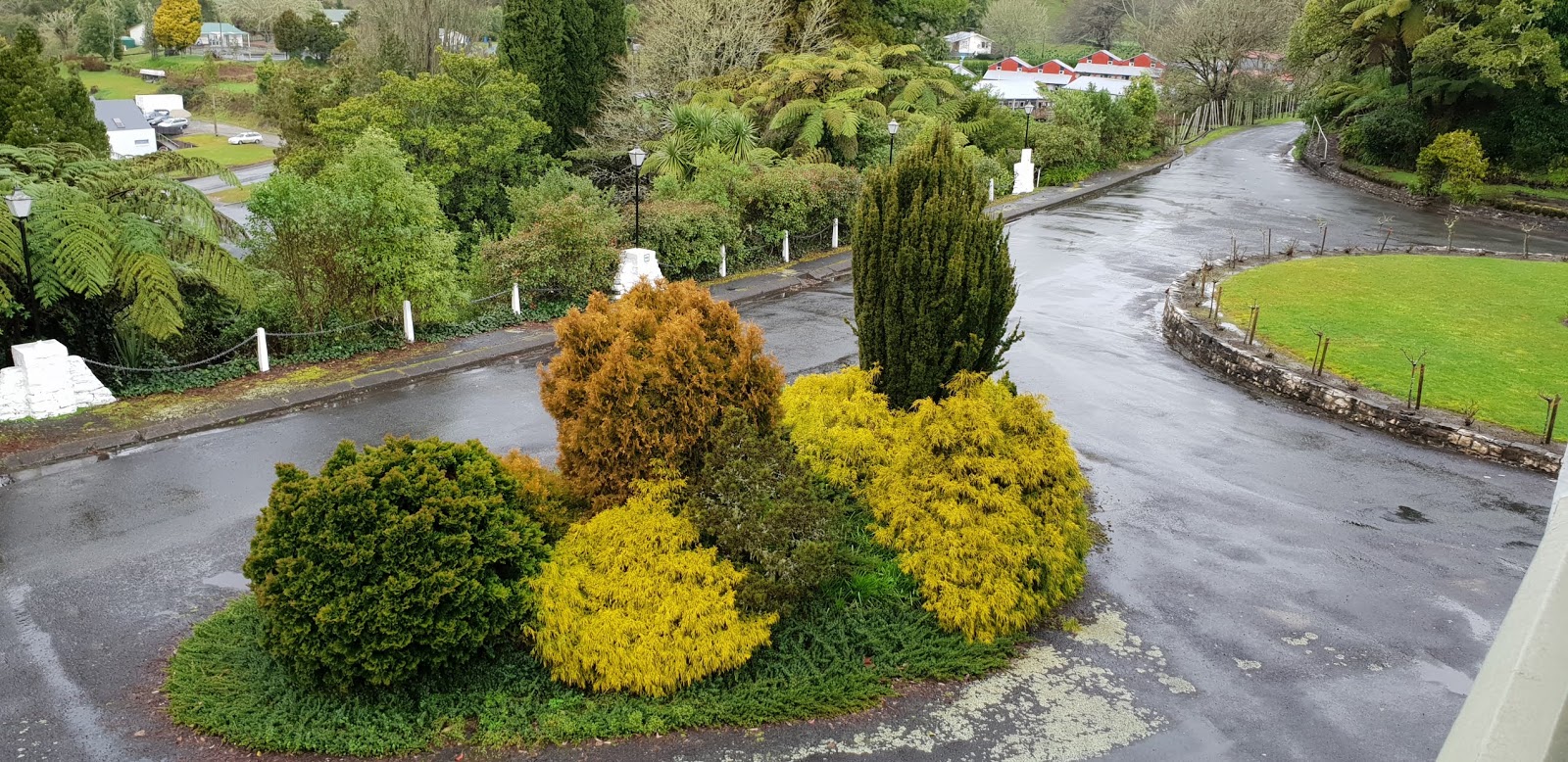
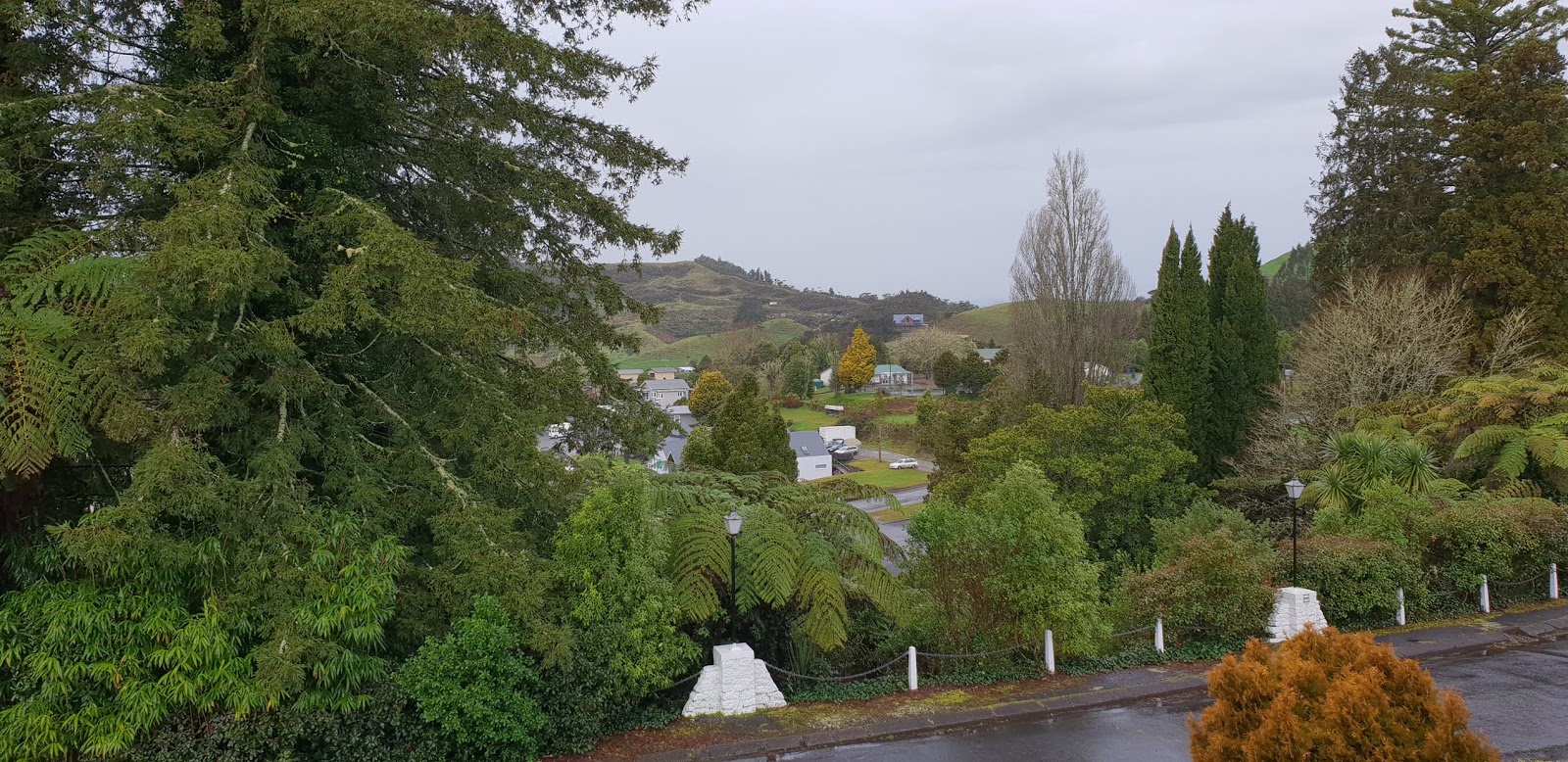
A relatively unassuming lane leads to what could be described as a grand hotel, called Waitomo Caves Hotel.
The original hotel was built in 1908, and it was later extended in 1928. Part of it is ‘Victorian’, based on an eastern Europe mountain chalet, and part of it is ‘Art Deco’, the concrete wing, and a feature, if it could be called that, is none of the four corners are the same.
Views from the balcony show part of the surrounding gardens
and the town of Waitomo in the distance.
In gloomy weather, it does look rather spooky, and I suspect there may be a ghost or two lurking somewhere in the buildings.
But…
This a a very interesting, and the words of one of my younger grand daughters, a very creepy place. It would make an excellent base for paranormal activity, and there could very well be ghosts walking the corridors of this hotel.
It has the long darkish passageways that lead in all directions and to almost hidden rooms, a creepy nighttime aspect, and the creaky woodwork.
I know when we were exploring, it was easy to lose your bearings, if not get lost, trying to find certain places, and once found, hard to find your way back.
All in all, it was one of the best stays in a very old place going through the throes of modernisation.
And looking at it from the outside at night, I’ll leave you with that thought…
50 photographs, 50 stories, of which there is one of the 50 below.
They all start with –
A picture paints … well, as many words as you like. For instance:
And, the story:
Have you ever watched your hopes and dreams simply just fly away?
Everything I thought I wanted and needed had just left in an aeroplane, and although I said I was not going to, i came to the airport to see the plane leave. Not the person on it, that would have been far too difficult and emotional, but perhaps it was symbolic, the end of one life and the start of another.
But no matter what I thought or felt, we had both come to the right decision. She needed the opportunity to spread her wings. It was probably not the best idea for her to apply for the job without telling me, but I understood her reasons.
She was in a rut. Though her job was a very good one, it was not as demanding as she had expected, particularly after the last promotion, but with it came resentment from others on her level, that she, the youngest of the group would get the position.
It was something that had been weighing down of her for the last three months, and if noticed it, the late nights, the moodiness, sometimes a flash of temper. I knew she had one, no one could have such red hair and not, but she had always kept it in check.
And, then there was us, together, and after seven years, it felt like we were going nowhere. Perhaps that was down to my lack of ambition, and though she never said it, lack of sophistication. It hadn’t been an issue, well, not until her last promotion, and the fact she had to entertain more, and frankly I felt like an embarrassment to her.
So, there it was, three days ago, the beginning of the weekend, and we had planned to go away for a few days and take stock. We both acknowledged we needed to talk, but it never seemed the right time.
It was then she said she had quit her job and found a new one. Starting the following Monday.
Ok, that took me by surprise, not so much that it something I sort of guessed might happen, but that she would just blurt it out.
I think that right then, at that moment, I could feel her frustration with everything around her.
What surprised her was my reaction. None.
I simply asked where who, and when.
A world-class newspaper, in New York, and she had to be there in a week.
A week.
It was all the time I had left with her.
I remember I just shrugged and asked if the planned weekend away was off.
She stood on the other side of the kitchen counter, hands around a cup of coffee she had just poured, and that one thing I remembered was the lone tear that ran down her cheek.
Is that all you want to know?
I did, yes, but we had lost that intimacy we used to have when she would have told me what was happening, and we would have brainstormed solutions. I might be a cabinet maker but I still had a brain, was what I overheard her tell a friend once.
There’s not much to ask, I said. You’ve been desperately unhappy and haven’t been able to hide it all that well, you have been under a lot of pressure trying to deal with a group of troglodytes, and you’ve been leaning on Bentley’s shoulder instead of mine, and I get it, he’s got more experience in that place, and the politics that go with it, and is still an ally.
Her immediate superior and instrumental in her getting the position, but unlike some men in his position he had not taken advantage of a situation like some men would. And even if she had made a move, which I doubted, that was not the sort of woman she was, he would have politely declined.
One of the very few happily married men in that organisation, so I heard.
So, she said, you’re not just a pretty face.
Par for the course for a cabinet maker whose university degree is in psychology. It doesn’t take rocket science to see what was happening to you. I just didn’t think it was my place to jump in unless you asked me, and when you didn’t, well, that told me everything I needed to know.
Yes, our relationship had a use by date, and it was in the next few days.
I was thinking, she said, that you might come with me, you can make cabinets anywhere.
I could, but I think the real problem wasn’t just the job. It was everything around her and going with her, that would just be a constant reminder of what had been holding her back. I didn’t want that for her and said so.
Then the only question left was, what do we do now?
Go shopping for suitcases. Bags to pack, and places to go.
Getting on the roller coaster is easy. On the beginning, it’s a slow easy ride, followed by the slow climb to the top. It’s much like some relationships, they start out easy, they require a little work to get to the next level, follows by the adrenaline rush when it all comes together.
What most people forget is that what comes down must go back up, and life is pretty much a roller coaster with highs and lows.
Our roller coaster had just come or of the final turn and we were braking so that it stops at the station.
There was no question of going with her to New York. Yes, I promised I’d come over and visit her, but that was a promise with crossed fingers behind my back. After a few months in t the new job the last thing shed want was a reminder of what she left behind. New friends new life.
We packed her bags, three out everything she didn’t want, a free trips to the op shop with stiff she knew others would like to have, and basically, by the time she was ready to go, there was nothing left of her in the apartment, or anywhere.
Her friends would be seeing her off at the airport, and that’s when I told her I was not coming, that moment the taxi arrived to take her away forever. I remember standing there, watching the taxi go. It was going to be, and was, as hard as it was to watch the plane leave.
So, there I was, finally staring at the blank sky, around me a dozen other plane spotters, a rather motley crew of plane enthusiasts.
Already that morning there’s been 6 different types of plane depart, and I could hear another winding up its engines for take-off.
People coming, people going.
Maybe I would go to New York in a couple of months, not to see her, but just see what the attraction was. Or maybe I would drop in, just to see how she was.
As one of my friends told me when I gave him the news, the future is never written in stone, and it’s about time you broadened your horizons.
Is it possible to mix the two up? I don’t think so.
Great usually means: everything is great, or good, or excellent, whatever degree of goodness you want to put to it.
It could also mean something else, like: Well, you were a great help! when in fact you want to say how useless they were.
Large or little.
Like all creatures great and small, Why not say big or small. Big doesn’t quite have the same effect.
Of course, you could be a great person, well, what I really mean is distinguished. Besides, great could mean way above average, too. Or grand, or impressive, the list goes on.
And haven’t we all, at some time had a great-aunt. No not the good one, the ‘great’ one, denoting her seniority, not necessarily how nice she is.
As for the other grate, we can build a fire in it.
Or add an ‘un’ in front and ‘ful’ at the end, to denote what parents sometimes think of their children
Or get a block of cheese and ‘grate’ it into small shreds.
Or speak in a voice that grates on your nerves, possibly by that great-aunt.
We walked another umpteen miles from the exhibition to a Chinese restaurant that is going to serve us Chinese food again with a beer and a rather potent pomegranate wine that has a real kick. It was definitely value for money at 60 yuan per person.
But perhaps the biggest thrill, if it could be called that, was discovering downstairs, the man who discovered the original pieces of a terracotta soldier when digging a well. He was signing books bought in the souvenir store, but not those that had been bought elsewhere.
Some of is even got photographed with him. Fifteen minutes of fame moment? Maybe.
After lunch, it was off to the station for another high-speed train ride, this time for about two and a half hours, from X’ian to Zhangzhou dong.
It’s the standard high-speed train ride and the usual seat switching because of weird allocation issues, so a little confusion reigns until the train departs at 5:59.
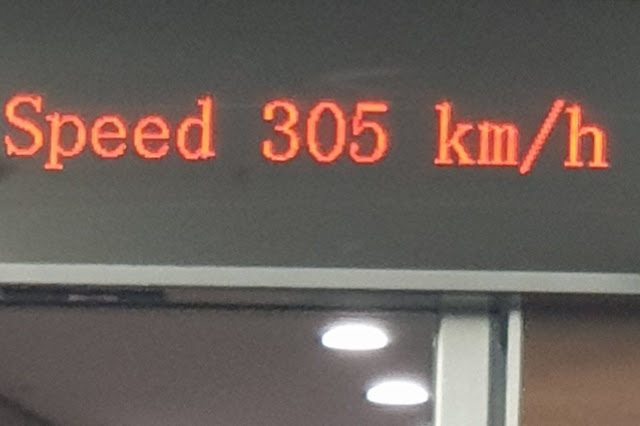
Once we were underway it didn’t take long before we hit the maximum speed
Twenty minutes before arrival, and knowing we only have three minutes to get off everyone is heading for the exit clogging up the passageway. It wasn’t panic but with the three-minute limit, perhaps organized panic would be a better description.
As it turned out, with all the cases near the door, the moment to door opened one of our group got off, and the other just started putting cases on the platform, and in doing so we were all off in 42 seconds with time to spare.
And this was despite the fact there were about twenty passengers just about up against the door trying to get in. I don’t think they expected to have cases flying off the train in their direction.
We find our way to the exit and our tour guide Dannie. It was another long walk to the bus, somewhat shabbier from the previous day, no leg room, no pocket, no USB charging point like the day before. Disappointing.
On the way from the station to the hotel, the tour guide usually gives us a short spiel on the next day’s activities, but instead, I think we got her life history and a song, delivered in high pitched and rapid Chinglish that was hard to understand.
Not at this hour of the night to an almost exhausted busload of people who’d had enough from the train. Oh, did I forgot the singing, no, it was an interesting rendition of ‘you are my sunshine’.
The drive was interesting in that it mostly in the dark. There was no street lighting and in comparison to X’ian which was very bright and cheerful, this was dark and gloomy.
Then close to the hotel our guide said that if we had any problems with the room, she would be in the lobby for half an hour.
That spoke volumes about the hotel they put us in.
I gave the order to my assistant to order the supplies we needed in order to maintain stock levels.
Oh, yes, the word order is one of my favourites, because it can confuse the hell out of many people in its simplicity and yet complexity.
I gave the order, it’s what happens in the armed forces, and a lot of other places, but mostly we would associate it with organisations that have hierarchical authority.
The military, for one, cut orders, the means of sending one of its minions to another place, or to do a specific job.
Order supplies, well, just about anyone can order something from somewhere, usually on the internet, and sometimes require or are given an order number so it can be tracked.
In order to maintain, in order to get what I want, in order to get elected, this is just another way of using the word, with the aim of achieving something, though I’m sure there’s probably a better way of expressing these sentiments.
Law and order, well, doesn’t everyone want this, and doesn’t it always turn up in an election campaign, and seems to be the first thing sacrificed after the election. The thing is, no one can guarantee law and order.
There is the law and there is administering it. There is no order that comes with it, we just hope that order is maintained, and deplore the situation when it isn’t.
Perhaps in order to maintain law and order, we might need more police.
Then, of course, there is alphabetical order, and numerical order, where things can be designated from A to Z, like this challenge, or from 1 to 10, or more. We can sort words alphabetically, numbers numerically and data items by keys or an index.
This is naturally called a sort order.
Then there is my car, or bike, or washing machine, or mixmaster. They are currently in good working order, though that might not last.
And lastly, in deference to all those out there who are thinking of becoming dictators, it’s always possible, one day, there will be a new world order. They might actually be in their own particular order, whose intellect might be (?) of the highest order.
For a story that was conceived during those long boring hours flying in a steel cocoon, striving to keep away the thoughts that the plane and everyone in it could just simply disappear as planes have in the past, it has come a long way.
Whilst I have always had a fascination with what happened during the Second world war, not the battles or fighting, but in the more obscure events that took place, I decided to pen my own little sidebar to what was a long and bitter war.
And, so, it continues…
…
We were not leaving the castle the way we had found it, but we would blame the Germans. Carlo understood because he was the one who had selectively destroyed parts of it, but I knew after we’d gone, he would blame us.
When Carlo discovered the empty cells below in the dungeons, he and the boy went back outside and looked for them. I didn’t have the heart to tell him that Wallace would have ordered them removed and executed because Meyer had been the objective and everything else was a distraction.
Two of Blinky’s soldiers were assigned to bring back Chiara.
Blinky and the rest of his men moved into better quarters and had their first real meal in a week. We posted sentries, but I didn’t think any Germans would be coming to see what happened. The sentries were more to tell us when Meyer and his escort arrived.
Blinky would then be the official escort for Meyer back to England. A plane was on standby waiting for our signal.
Several hours after Carlo left, he returned with Martina and Johanneson, the latter looking very worse for wear.
The last of the traitors.
Carlo shoved him into a chair and bound him very tightly.
“We found the prisoners, all shot. Fernando’s remnants killed them. I will make it my business to find every last one of them. What do you want to do with this traitor?” He nodded in Johannesen’s direction.
Martina had slumped into a chair. She still wore the very recent scars of a severe beating and was out on her feet. Despite that, I got the impression she was glad to be alive.
“Was he responsible for anything that happened while you were in the cells?” I asked her.
“He saved me if that could be called an act of kindness. He did nothing to save the others.”
“If you had a choice?”
“I’d shoot him.”
“Now hang on. Since when did good Samaritans get punished?” Johannesen was outraged.
I shrugged. “You will be judged on past sins.”
Martina looked up. “He was the leader of the group that destroyed the church. It was our original headquarters, down in the basement. We managed to get away, with a few injuries, but it took out our equipment and radio.”
“There,” he said. “My intention was destroying infrastructure not lives.”
“Coincidental.”
I got up and walked over to Martina and gave her my gun. “I’ve done enough killing for today. Perhaps a small token of retribution for those lost.”
“Chiara?”
“She will be here shortly. We found her just in time.”
“Thank God for that.”
I don’t think she had it in her to enjoy themoment she executed Johannesen, I don’t think it was worth celebrating a death, more lamenting the loss of yet another person in a war that seemed to be dragging on.
At least he accepted his fate and didn’t plead for his life.
It was mission accomplished.
Blinky’s radioman finally reconnected with Thompson and told him that we were awaiting the arrival of Meyer and that he could tell those up the pipeline it was safe to bring him to the village. He would then signal when the plane was in the air. Thompson was pleased enough to give me a ticket back to London. All we had to do was collect Meyer.
That was Carlo and my job, and for the last time, I went back down into the village and waited.
I was not sure who was more relieved, Meyer or myself. I’d met him once before the war, at a University in Hamburg where he was working on a top-secret project, and I was studying the archaeology of some old castles nearby.
I’d been tasked to find out what he was doing, my rather bright future in archaeology was never going to take off in those dark months that followed Chamberlain’s peace treaty. Everyone but him seemed to know that war was inevitable.
He’d spent time telling me about the stars and planets, and how wonderful it would be to visit them one day in the not-too-distant future. From that, we inferred that the Germans were working on space travel, though you never really could tell what they were up to.
It simply meant if things went bad, we needed to touch base every now and then with Meyer, which I did, in a friendly manner and never directly asking what he was up to. That contact had paid off, and he had made contact asking me if it was possible to come live in England.
Thompson had been very pleased.
“Herr Atherton,” he said, rather relieved to see me.
“Herr Meyer.”
We shook hands, and then he hugged me like an old friend would. “You came.”
“You asked. I do my best?”
“We leave now?’
“We very definitely leave now.”
I left Carlo with the escorts to explain the new arrangements, far away from the castle, and I took Meyer back to the castle. Along the way we talked, not of rockets and death, but of old times in Berlin, and how Germany used to be before this crazy person called Hitler had sent them down the path to self-destruction.
Perhaps, he said, one day he might be able to return.
I hoped I would not, not until the war ended, but that being a forlorn hope, not until I had a very long, well-earned rest.
But this was Thompson we were talking about, and his favourite saying was ‘There’s no rest for the wicked’.
We walked another umpteen miles from the exhibition to a Chinese restaurant that is going to serve us Chinese food again with a beer and a rather potent pomegranate wine that has a real kick. It was definitely value for money at 60 yuan per person.
But perhaps the biggest thrill, if it could be called that, was discovering downstairs, the man who discovered the original pieces of a terracotta soldier when digging a well. He was signing books bought in the souvenir store, but not those that had been bought elsewhere.
Some of is even got photographed with him. Fifteen minutes of fame moment? Maybe.
After lunch, it was off to the station for another high-speed train ride, this time for about two and a half hours, from X’ian to Zhangzhou dong.
It’s the standard high-speed train ride and the usual seat switching because of weird allocation issues, so a little confusion reigns until the train departs at 5:59.
Once we were underway it didn’t take long before we hit the maximum speed
Twenty minutes before arrival, and knowing we only have three minutes to get off everyone is heading for the exit clogging up the passageway. It wasn’t panic but with the three-minute limit, perhaps organized panic would be a better description.
As it turned out, with all the cases near the door, the moment to door opened one of our group got off, and the other just started putting cases on the platform, and in doing so we were all off in 42 seconds with time to spare.
And this was despite the fact there were about twenty passengers just about up against the door trying to get in. I don’t think they expected to have cases flying off the train in their direction.
We find our way to the exit and our tour guide Dannie. It was another long walk to the bus, somewhat shabbier from the previous day, no leg room, no pocket, no USB charging point like the day before. Disappointing.
On the way from the station to the hotel, the tour guide usually gives us a short spiel on the next day’s activities, but instead, I think we got her life history and a song, delivered in high pitched and rapid Chinglish that was hard to understand.
Not at this hour of the night to an almost exhausted busload of people who’d had enough from the train. Oh, did I forgot the singing, no, it was an interesting rendition of ‘you are my sunshine’.
The drive was interesting in that it mostly in the dark. There was no street lighting and in comparison to X’ian which was very bright and cheerful, this was dark and gloomy.
Then close to the hotel our guide said that if we had any problems with the room, she would be in the lobby for half an hour.
That spoke volumes about the hotel they put us in.
50 photographs, 50 stories, of which there is one of the 50 below.
They all start with –
A picture paints … well, as many words as you like. For instance:
And, the story:
Have you ever watched your hopes and dreams simply just fly away?
Everything I thought I wanted and needed had just left in an aeroplane, and although I said I was not going to, i came to the airport to see the plane leave. Not the person on it, that would have been far too difficult and emotional, but perhaps it was symbolic, the end of one life and the start of another.
But no matter what I thought or felt, we had both come to the right decision. She needed the opportunity to spread her wings. It was probably not the best idea for her to apply for the job without telling me, but I understood her reasons.
She was in a rut. Though her job was a very good one, it was not as demanding as she had expected, particularly after the last promotion, but with it came resentment from others on her level, that she, the youngest of the group would get the position.
It was something that had been weighing down of her for the last three months, and if noticed it, the late nights, the moodiness, sometimes a flash of temper. I knew she had one, no one could have such red hair and not, but she had always kept it in check.
And, then there was us, together, and after seven years, it felt like we were going nowhere. Perhaps that was down to my lack of ambition, and though she never said it, lack of sophistication. It hadn’t been an issue, well, not until her last promotion, and the fact she had to entertain more, and frankly I felt like an embarrassment to her.
So, there it was, three days ago, the beginning of the weekend, and we had planned to go away for a few days and take stock. We both acknowledged we needed to talk, but it never seemed the right time.
It was then she said she had quit her job and found a new one. Starting the following Monday.
Ok, that took me by surprise, not so much that it something I sort of guessed might happen, but that she would just blurt it out.
I think that right then, at that moment, I could feel her frustration with everything around her.
What surprised her was my reaction. None.
I simply asked where who, and when.
A world-class newspaper, in New York, and she had to be there in a week.
A week.
It was all the time I had left with her.
I remember I just shrugged and asked if the planned weekend away was off.
She stood on the other side of the kitchen counter, hands around a cup of coffee she had just poured, and that one thing I remembered was the lone tear that ran down her cheek.
Is that all you want to know?
I did, yes, but we had lost that intimacy we used to have when she would have told me what was happening, and we would have brainstormed solutions. I might be a cabinet maker but I still had a brain, was what I overheard her tell a friend once.
There’s not much to ask, I said. You’ve been desperately unhappy and haven’t been able to hide it all that well, you have been under a lot of pressure trying to deal with a group of troglodytes, and you’ve been leaning on Bentley’s shoulder instead of mine, and I get it, he’s got more experience in that place, and the politics that go with it, and is still an ally.
Her immediate superior and instrumental in her getting the position, but unlike some men in his position he had not taken advantage of a situation like some men would. And even if she had made a move, which I doubted, that was not the sort of woman she was, he would have politely declined.
One of the very few happily married men in that organisation, so I heard.
So, she said, you’re not just a pretty face.
Par for the course for a cabinet maker whose university degree is in psychology. It doesn’t take rocket science to see what was happening to you. I just didn’t think it was my place to jump in unless you asked me, and when you didn’t, well, that told me everything I needed to know.
Yes, our relationship had a use by date, and it was in the next few days.
I was thinking, she said, that you might come with me, you can make cabinets anywhere.
I could, but I think the real problem wasn’t just the job. It was everything around her and going with her, that would just be a constant reminder of what had been holding her back. I didn’t want that for her and said so.
Then the only question left was, what do we do now?
Go shopping for suitcases. Bags to pack, and places to go.
Getting on the roller coaster is easy. On the beginning, it’s a slow easy ride, followed by the slow climb to the top. It’s much like some relationships, they start out easy, they require a little work to get to the next level, follows by the adrenaline rush when it all comes together.
What most people forget is that what comes down must go back up, and life is pretty much a roller coaster with highs and lows.
Our roller coaster had just come or of the final turn and we were braking so that it stops at the station.
There was no question of going with her to New York. Yes, I promised I’d come over and visit her, but that was a promise with crossed fingers behind my back. After a few months in t the new job the last thing shed want was a reminder of what she left behind. New friends new life.
We packed her bags, three out everything she didn’t want, a free trips to the op shop with stiff she knew others would like to have, and basically, by the time she was ready to go, there was nothing left of her in the apartment, or anywhere.
Her friends would be seeing her off at the airport, and that’s when I told her I was not coming, that moment the taxi arrived to take her away forever. I remember standing there, watching the taxi go. It was going to be, and was, as hard as it was to watch the plane leave.
So, there I was, finally staring at the blank sky, around me a dozen other plane spotters, a rather motley crew of plane enthusiasts.
Already that morning there’s been 6 different types of plane depart, and I could hear another winding up its engines for take-off.
People coming, people going.
Maybe I would go to New York in a couple of months, not to see her, but just see what the attraction was. Or maybe I would drop in, just to see how she was.
As one of my friends told me when I gave him the news, the future is never written in stone, and it’s about time you broadened your horizons.
For a story that was conceived during those long boring hours flying in a steel cocoon, striving to keep away the thoughts that the plane and everyone in it could just simply disappear as planes have in the past, it has come a long way.
Whilst I have always had a fascination with what happened during the Second world war, not the battles or fighting, but in the more obscure events that took place, I decided to pen my own little sidebar to what was a long and bitter war.
And, so, it continues…
…
When Carlo stopped, I was out of breath and gasping. We all were. The smoke was getting more intense. At times it had made navigation almost impossible.
In front of us were more trees, but these looked different to those we had passed through. I watched Carlo walk back and forth a few yards each way, then disappear into the bushes. A minute later he put his head out and said, “This way.”
We followed him. It was a hidden entrance down to a drain that was quite deep and headed back towards the castle one way and into the forest the other.
If the fire kept up by tomorrow the cover would be gone.
It was still a hard walk through the bushes, but we made it to a wireframeand door with a lock on it. It looked ancient as if it hadn’t been used in decades, even longer.
Carlo produced a rather odd looking key and unlocked it. I would have thought it was rusted shut, but appearances were deceptive. The lock was almost new.
But the gate had not been used for a long time and it took Carlo a few minutes to force it to open. It had rusted shut. When it did finally move, it was with a very loud screeching sound.
We filed in and he relocked it. Anyone thinking they heard something and came to investigate; it would end up on the other side of the gate.
So far so good.
For a moment I was back in my element, the archaeologist exploring caves, a wooden fire torch lighting the way, dampness underfoot, and the trickling of water down the walls. All around the dankness from continual dampness.
It was easy the pretend if only for a few minutes I had not been caught up in the war, that I was on a quest for lost treasure, hidden away at the end of a labyrinth.
The reality was we were quite literally in an ancient sewer and the original builders of the castle had used an underground waterway to tap into to remove waste. It was far more effective than modern systems and used the earth’s own ecology.
Inside the castle, the places where the waste used to drop down into the waterway had been covered over by trapdoors that were still there, and that was how we were going to gain access, through rooms that were no longer used.
We were going in via four access points, two men at each door, and mine with one of Blinkys men would be going into the area where the soldiers were camping to mop up whatever the bombs left behind, before closing off an exit.
Carlo had reserved the last one for himself and the boy, where he hoped to find Wallace and the new German commander.
Our cue to move: the bombs going off.
We just had time to get to the point and lower the trapdoors. Then climb up onto the floor and wait by the door. From the other side, Carlo said, anyone in the castle would only see a continuation of the wall panelling.
We made it with seconds to spare.
We were closest to the bombs and the percussive effect was disorientating for a few seconds before we pushed through the door and into the smoke and dust raised by the explosions.
As the dust settled, we could see dead soldiers, and mess everywhere. If a soldier was still alive, we shot them, systematically picking our way through the debris. I counted thirty-one dead by the time we reached the other side, the other exit from the space.
In the distance, we could hear sporadic gunfire coming from other parts of the castle, and then, after taking up our position, near the tank, we waited.
Three soldiers came bursting out of the exit and we shot them too..
Ten minutes later Carlo yelled out, “It’s me, don’t shoot.” Then he stepped out the door. “It is done.”
The castle was ours.
“You wish to speak to your old commander before I execute him?
“Wallace?”
He nodded.
“Sure”
I followed him into the castle and walked through familiar passageways and rooms, much had not changed in a long time.
Wallace and the new commander were tied up in the dining room. The remnants of a meal and several empty bottles of wine were on the table.
Wallace watched me from the doorway until I stood before him.
“I knew it was a mistake letting you go. Jackerby was convinced you were a stupid fool who would unwittingly lead us directly to the resistance. I told him you were cleverer than you looked.”
“And yet…”
“Perhaps I was tired of people like you being killed needlessly. What just happened, that was a waste of human life.”
“I didn’t start the war, and for the record, I didn’t want any part of it. Unfortunately, higher authorities deemed otherwise, and here I am. This is not a victory to savour.”
“A victory nonetheless.”
I shrugged. “It didn’t have to be like this, but at least we’ve weeded out a few more traitors.”