The cinema of my dreams – I always wanted to write a war story – Episode 53

For a story that was conceived during those long boring hours flying in a steel cocoon, striving to keep away the thoughts that the plane and everyone in it could just simply disappear as planes have in the past, it has come a long way.

Whilst I have always had a fascination with what happened during the Second world war, not the battles or fighting, but in the more obscure events that took place, I decided to pen my own little sidebar to what was a long and bitter war.

And, so, it continues…

War is hell. 

I remembered an old Sargeant Major was telling us that going to war was not fun, that the very real possibility of getting killed should be the only thing on our minds.

Along with keeping your head down and being very aware of your surroundings.

Apparently, he had been at a place called Gallipoli, and from what I had read, that was a special kind of hell.

He had also said fifty per cent of us wouldn’t return.  I hoped to be in the fifty per cent that did.  Just to spite the old bastard.

I knew it was going to get problematical sooner than we thought, I could smell the aroma of burning bush on the air, and as we got closer to the castle, the smoke got denser.

Wallace had a cunning plan, he’d used flame throwers to set the bush on fire so we couldn’t get to the castle under the cover of the forest.  It was a plan he hadn’t me about.

Carlo had stopped, also understanding what Wallace had done.  Would this interfere with us getting to the external entrances, or if the other three were unattainable, could we get to the secret entrance?

I caught up to him.  “Not exactly what we envisaged.  I had no idea Wallace was planning this?”

“It is a logical move.  He can’t leave the castle, and as it was, he knew the forest would give us cover until the very last moment.”

“And now?”

“Now we use another entrance.  Take longer, but we’ll get there.  Only problem, they will be expecting us, and waiting.”

The others joined me, just as Carlo did an about-face and started going back the way we came.

“Where is he going?” Blinky asked.

“Another way.  Wallace is burning our cover.”

He shrugged.  “I suppose it would be too much to ask for some rain?”

“Sadly no.  Fine and clear with a touch of fog, well, smoke maybe.”

He didn’t think it was funny.  War I guess could do that to you.

When Thompson and company were planning the operation that was set up primarily to get defecting Germans out of the country, there was only so much research that could be done.

It was one of the reasons I got a seat at the table, my exploits in Italy looking at ancient buildings suddenly became a red-hot reason to be included.  The war had all but petered out in that part of the country, the Germans were shoring up the Italians, and the Allies had bigger plans to invade via Sicily, or one of those islands.

Someone mentioned something hush-hush about Italy and the road back to peace, but at that point in time, the end of the war was not in sight.

The point was, the castle was in a strategic location, it was only being held by a small garrison, according to the resistance, ideal for what Thompson wanted.  Approvals gained, he sent in a team of German-speaking soldiers to replace those there, as if nothing had happened and then set up the pipeline.

It worked.

For a while anyway.  Several months after the new team had set themselves up and the personnel was moving through, it all stopped.

First thought was the Germans had discovered what was going on and switched the team again.  Until Thompson noted we were still getting reports from Wallace, one of his men on the ground.

That’s when Thompson decided to send me.

And. No, it was not just a matter of saying, great, I always wanted to holiday in Italy, and particularly Tuscany.  My excuse, I was not trained to be a commando or a secret agent.

Of course, I made that one fatal mistake, I had enlisted to fight in the war, and it was not my decision where they sent me.

So, I was on the next plane to Tuscany.

The trouble was, Thompson and I both agreed that it was more likely the men we selected had not changed their allegiances, they just went back to what they were before.  Wallace, Johannesen and Jackerby had all been extricated from blown missions, and Thompson had been left scratching his head as to who the mole was in his office.

Too many coincidences proved it wasn’t.

Except coincidentally, Thompson had teamed up all the traitors in one place.

So, my mission was twofold, first to ascertain if they were traitors, and, if they were, to execute them.

The next problem, the mission was almost over before it started, because even though Thompson had told Wallace the wrong pick-up point where my plane would be landing, cloud cover made it impossible to guarantee I’d be jumping at the correct spot.

As it turned out, the resistance had planned a huge ambush in exactly the same place my plane landed, and I was in the middle of it.  The rest as they say is history.

The thing is, ever since I landed, I had the benefit of a huge amount of good luck.

That couldn’t last.

Carlo seemed unfazed about the fire, perhaps he had expected it, but his only concern was time.  We had to be in the castle just as the explosions started.

With 23 minutes to go, Carlo stepped up the pace.  For a big man, he didn’t make much noise.  I wished I could say the same for myself.

© Charles Heath 2021-2023

The cinema of my dreams – I always wanted to write a war story – Episode 52

For a story that was conceived during those long boring hours flying in a steel cocoon, striving to keep away the thoughts that the plane and everyone in it could just simply disappear as planes have in the past, it has come a long way.

Whilst I have always had a fascination with what happened during the Second world war, not the battles or fighting, but in the more obscure events that took place, I decided to pen my own little sidebar to what was a long and bitter war.

And, so, it continues…

Carlo had returned, as promised, just over an hour later, and over the map, he showed where the explosives had been placed, under the tank, and where the men were camped.

They were set to go off in the early morning, giving them several hours before they had to assemble for the assault.  According to Carlo, the explosives would neutralise the tank and immobilise about 30 of the enemy.

That was only one problem.

The other was the men that the new commandant had sent out of the castle to presumably hunt down Atherton and whatever resistance was left.  They were noisy and failed to see Carlo following them, listening to their conversation.

It was obvious they were not trained for stealth.

The first mission was to take those men out of the equation.

Then there was a third problem, the last of the resistance in the castle, those left behind by Fernando, had taken all the prisoners out of the castle and executed them.

Carlo had then killed those men and left them with the bodies of the murdered defectors, and, unlike his German counterparts, he had undertaken it swiftly and silently.

Our force of eight moved quietly in the direction Carlo last saw the soldiers heading, he assumed towards the underground wine cellar where Martina had taken me after I had been captured.

We managed to hide Chiara in a spot where the enemy if they came to the church, would not find her.  The plan was to find them before they got to or left the cellar.

Of course, like any plan, it could always be guaranteed to go wrong.

The last time I went from the cellar to the church, it had been by an old truck, and by my estimation, it would take us about half an hour by foot.  It might, by the time we got there, and found them missing, make us late for the main event.

I looked at my watch about a dozen times on that trek, fretting about time which for some odd reason seemed to be passing faster than usual.

Then, Carlo was waving his hands, a signal I assumed was to tell us to stop.  We were not far from the cellar.  I recognised the landmark used to find it.  We formed up in a line just inside the thicket line, a bunch of overgrown bushes providing excellent cover.

Beyond that, we could see intermittent flashes of light from torches.  The soldiers were making no attempt to hide their presence.

Blinky was beside me.  “What the hell are they playing at?”

“Perhaps they thought if they made a bold attack we’d wilt under the surprise.”

“Or just shoot them.  Why are we waiting?”

“Carlo is ascertaining their position.”

“You trust this Carlo.  He could be leading us into a trap up at the castle.”

I was surprised he’d taken this long to express his reservations.  “Don’t be surprised if he kills everyone in the German squad himself.  His home was in that castle.  It was his life.  They killed his friends.  He is not forgiving.”

Jack chose that moment to return from wherever he’d gone soon after we reached the thicket.  He had come with me from the church, and I wondered if he knew just how dangerous it could be.  He flopped down beside me, waiting.

“What’s with the dog?”

“We found each other at an ambush.  Been with me ever since.  I have no idea if he’s German, or Italian, or if he understands English.  But there’s no questioning his loyalty, he helped me take down Jackerby.

“Well, just as long as I don’t trip over him in the fray of battle.”

We watched the German soldiers who remained on sentry duty when I thought the entrance to the cellar was, and I assumed the others were down in the cellar.

It was what Carlo said was the case when he returned.

Ten in the cellar, two on guard, though I would not call what they were doing sentry duty.  They were smoking and talking, guns leaning up against a tree.

Easy shots for our sniper who at this moment had both in his sights.

Carlo kneeled beside me and said, “Cover your ears, pass it on.”

I did, and thirty seconds later there was a huge explosion followed by a storm of soil particles falling on his.  The sniper, in the instance following the boom, shot the two sentries.

German forces were eliminated.

The only issue was the castle was now alerted to our presence, so our arrival at the castle was going to be a little more difficult.

© Charles Heath 2021-2023

The cinema of my dreams – I always wanted to write a war story – Episode 51

For a story that was conceived during those long boring hours flying in a steel cocoon, striving to keep away the thoughts that the plane and everyone in it could just simply disappear as planes have in the past, it has come a long way.

Whilst I have always had a fascination in what happened during the second worlds war, not the battles or fighting, but in the more obscure events that took place, I decided to pen my own little sidebar to what was a long and bitter war.

And, so, it continues…

Wallace had not returned upstairs by the normal stairs, but the one by the radio room, far removed from the basement area where the prisoners were kept.

If he had, he might have realised that something was very, very wrong.

There were no more prisoners, except for Martina.  The other defectors that had been captured had, on Johannsen’s orders, taken away by the three remaining resistance fighters, to be executed in the woods not far from the castle.

They had gone an hour before Schmidt’s men had departed, but in a different path, and would avoid running into the others.  Johannesen had given Fernando’s second-in-command a silenced luger and told him to only use that gun for the execution.  And to make as little noise as possible.

When they had left an eerie silence fell over the cellar.

Johannsen passed by Martina’s cell and looked in.  She was lying on the ground, still badly injured from the beating Fernando had given her.  She let him look at her for a minute, then said, “When is this going to be over.  I’m not going to tell you anything.”

“I don’t doubt that for a moment?”

“Where did you send the rest of the prisoners?”

“Back to Germany.  Someone else can deal with them.”

She didn’t believe him for one moment, but let it pass. “Why betray your country?”

“England?  England wasn’t my country, it’s just where I ended up before the war.  Then it seemed a good idea to become a double agent.”

“Germany isn’t winning the war, you know, despite what the fools in Berlin keep telling you.”

“I could have you shot for saying that.”

“Then get on with it.  I’m over waiting for whatever you’re going to do to me.”

“All in good time.  The new people have brought some very good interrogators and they promise they’ll have you singing like a canary in no time.”

She shrugged, and it hurt.

“Fools.”

“Actually, I’m inclined to agree with you.  So much so, I believe, if I can get you out of here, you might put in a good word for me.  Atherton is out there, and he’s coming, isn’t he?”

“Atherton is just a boy pretending to be a soldier.”

He smiled.  “That’s what he wants everyone to think, but Thompson, the man you take orders from, he thinks Atherton is one of his best agents.  And he will have a plan, and being the archaeological major that he was, he’ll know how to breach this place.”

And the fact she didn’t argue or deny what he was suggesting told him she was waiting.

“You expect too much, there are no more resistance fighters except for a few young lads, and that dog of his.”  She laughed.  “Rescued by three children and a dog.  I wonder if Germany will record that piece of history if it comes to pass.  Go away, whoever you are, and leave me to die in peace.”

“When the time comes, I’ll be back.”

She ignored him, and rolled over to face the wall.

The two guards had been watching him, though they had not been following the conversation.  The officer in charge, Wallace, had told them to keep an eye on everyone who came and went, and though Johannesen was on that watch list because he treated them better than Jackerby or the commandant did, they simply ignored him.

At their peril.

Johannesen wandered up to them, bade them a good evening, and then shot them.  He dragged the bodies to a place where no one would look and then headed along to the radio room.  The guards and radio men would not be changed for another eight hours, so no one was going to miss them.  Unless someone came down top check, but Johannesen had done several nights observation, and no one had.

The two radio men disposed of, it was time to block off the entrances to the basement so no one could come down.  These exits or entrances were large iron gates bolted and locked with ancient locks.  There was only one key to each, and Johannsen had the key ring with them on it.  He’d taken that of one of the dead guards.

Once the entrances were locked, he went back to Martina’s cell and unlocked the door.

At the sound of the key, she turned back.

“Time to go,” he said.  “We have a very small wind to escape before they find out upstairs.”

“I cannot save you, if Atherton thinks you are a traitor.”

“Atherton is probably the only level headed person in this area.  He’ll appreciate what I;ve done and give me a second chance.”

She shook her head.

“Once a traitor, always a traitor.”

“Be that as it may, just hold that thought.  I’m giving you a gun, and I’m hoping you won’t use it on me.”

He went into the cell and assisted her to stand.  She was weak, but the thought of escaping death put a little life into her limbs.

“It will not be a quick getaway,” she said.

“Just as long as it is a getaway,” he said, as they headed for the exit.

At the same time, there was a very large explosion from above, the percussive sound almost deafening them.

“What the hell was that?” Johannesen muttered.

“Most likely the diversion we needed, that you forgot to arrange.”

© Charles Heath 2021-2023

The cinema of my dreams – I always wanted to write a war story – Episode 50

For a story that was conceived during those long boring hours flying in a steel cocoon, striving to keep away the thoughts that the plane and everyone in it could just simply disappear as planes have in the past, it has come a long way.

Whilst I have always had a fascination in what happened during the second worlds war, not the battles or fighting, but in the more obscure events that took place, I decided to pen my own little sidebar to what was a long and bitter war.

And, so, it continues…

Meyer was cramping, having been confined to a relatively small space in the box car for far too long.

He had considered when the train was moving to come out to stretch, but then the train had stopped several times for lengthy periods when soldiers had searched all of the cars.

There had been one time when he had almost been discovered, a soldier getting a little too close for comfort, and had been called away a few moments before he lifted the palings that covered his hiding spot.

Then, at another siding, the soldiers brought dogs, and one had stopped near the carriage sniffing and making moaning sounds before then doing what dogs do against the wheels.

Expletives and laughter from the soldiers, relief from Meyer.  He knew if he was caught, the chances were he’d be shot.

Now, it was night, very, very late and the train had arrived at Florence and some time was spent unconnected the wagons then reconnecting to a shunting engine and pushed into a siding one across from the last.  From the crack in the back wall, he could see the station platforms in the distance, where only a few lights were on.

Next to where the boxcar sat was a wall, or houses or warehouses he didn’t know, but safety was just 30 meters away.  All he had to do was get from the car, and through or over that wall.

He waited, and during the next hour there was a train arrival, where the lights were turned on just before, during and after it left, back the way it had come, most of the time taken putting the locomotive on the other end.

It was going to be a problem if he chose to leave, and a train was arriving.  All the advance notice was the whistle.

The other problem was the sporadic nature of the patrols, two German soldiers wandering up and down the tracks, aiming their torches at walls and windows, loading telling each other war stories and crude stories.  They were bored, which would work in his favour.

There was, he noted, about an hour between each one.

Figuring it was about three in the morning after the second patrol had returned to the station, he came out of his hiding spot.  He tried not to make any noise which meant the harder he tried, the more it happened.

Once out he peered through the rear guard’s window at the station and it was deserted.  There were no lights up the lines where the wagons were parked.  There was no sign of the shunting locomotive.

He went over to the door and pulled.  It was stiff and at first, didn’t move.  A harder tug loosened the track and the door slid sideways about 30 centimetres.  He put his head out to check.  The moon was out, and it was quite light, light enough to see up and down the track.

There were about 20 wagons on the siding.  The wall ran for most of that distance, with what appeared to be an opening opposite the tenth or eleventh wagon.  That’s where he would go.

He pushed the door open wide enough to squeeze through and climbed down onto the tracks.  Once down he closed the door.  If anyone had checked, it had been closed before.  Keeping close to the side of the wagons, he headed away from the station.

About three wagons along, a light came on almost opposite him, illuminating the tracks,, the wagons and him.  Several seconds later, a whistle sounded, not a train whistle but one like a guard.

Then a man yelled out “Halt!”

He looked back towards the station and could see two soldiers running awkwardly in the middle of the tracks towards him.

Meyer started running for the gap in the wall, keeping as close to the wagons as he could.

When he looked back over his shoulder, he could see they were gaining on him.  He was still stiff and sore from being in that confined space for so long.

Another light came on further along.

He stopped and looked around.  The soldiers were raising their guns.

He saw only one way out, and climbed under the train and over to the other side of the train, away from his objective.

He ran harder and was nearly at the end of the wagons when a man stepped out in front of him.  He was not in a uniform.

Meyer almost stumbled and fell trying to stop crashing into him.

“Meyer?”

The man knew his name.  He looked Italian, was he from the resistance?

“Who are you?” he asked in halting Italian.

“What is the doe word?”

Code word?  What code word?  The piece of paper in his pocket, given to him by the British officer.  He pulled it out.  “Winston.”

“Right, you’re the one I’m here for.  Follow me if you want to live.”

The man then ran across the tracks to the opposite side, and Meyer followed as quickly as he could.  Then just short of the stone wall, there was an opening in the ground where another man was half in, half out.

“This way,” he said, then disappeared down the hole.

The soldiers had been held up crossing under the train to follow and were now so far behind they were out of sight. 

Meyer saw the hold, with a ladder and climbed down.  The man who had led him there followed and put the lid back over the top.

“Where are we?” Meyer asked.

“The sewers.  A little smelly, but you’re safe.  For the moment.”

© Charles Heath 2021-2023

A story inspired by Castello di Briolio – Episode 49

For a story that was conceived during those long boring hours flying in a steel cocoon, striving to keep away the thoughts that the plane and everyone in it could just simply disappear as planes have in the past, it has come a long way.

Whilst I have always had a fascination with what happened during the second world war, not the battles or fighting, but in the more obscure events that took place, I decided to pen my own little sidebar to what was a long and bitter war.

And, so, it continues…

——

SS Standartenfuhrer Wilhelm Schmidt and his men were looking forward to some rest and recreation, after they completed one small but vitally important job for the Reichsfuhrer: retrieve a traitor named Meyer and bring him back to Berlin so an example could be made of him to deter others.

A simple job, several days at best, very much a holiday in itself after several long years in various campaigns.

He always wanted to visit Italy and particularly Tuscany, and they would be staying in a castle, with, he had been told, a very refined wine cellar.

He had also been told there was a possibility that the column might be attacked on its way to the castle, and he had all of his men on high alert.  He was almost disappointed nothing happened.  He didn’t think it would.  Few resistance fighters would hardly go up against the might of a panzer, and his crack troops.

He’d said as much to the castle commander, a double agent by the name of Wallace, known as British to the British and German to the high command.  Schmidt had no interest in double agents, or agents of any kind, along with the intelligence services or the Gestapo for that matter.  He was here for the traitor and then gone.

They made it without incident, the main gates opened for their arrival, then closed after the panzer and trucks were parked inside.

Wallace was waiting for him.

Salutes, then, “No trouble along the way?”

“No.  Should there be?  I know we were warned, but all we saw were war-weary Italian women and children, and a few old men.”

“The resistance is out there, led by an Englishman by the name of Atherton.  I wouldn’t underestimate him and the few resistance left.”

Schmidt thought Wallace looked rattled, a man at the end of his tether.  He’d seen quite a few like him, too long at the front, jumping at shadows.

“It won’t be a problem.  I’ll send out a squad of 10 and they’ll mop up anyone left.  They’re probably hiding in the woods, or, if they saw the tank, shaking in their boots.  Chances are they will have left if they had any sense.”

Wallace hated arrogance, and Schmidt had it in spades.  There would be little point telling him that this wasn’t a battlefield, but guerilla warfare against an enemy on their home ground.  The fact Jackerby had not come back, or Fernando and his men told him Atherton was picking them off, one by one, if they left the castle.

If Schmidt wanted to go wandering around outside, that was his choice.  Wallace was staying inside and waiting until they mounted an attack.  Or for them to realise it was going to be a stalemate.  He was now no longer interested in Meyer, that was Schmidt’s problem.

Schmidt selected 9 soldiers and put his second in command in charge of them with very specific orders.  If anything, other than one of their men moved, shoot it.  He did not want prisoners.

The rest of the men were sent to the makeshift barracks, a building that was used as a chapel not far from where the tank and trucks were parked.  The rest of the castle’s men were also there, except for those on guard duty on the ramparts, and in the cellars where there were entrances from outside.

Not that anyone could get through the iron gates that were currently locked.  Atherton and whomever he had with him would not be gaining entrance to the castle from below, and those on the ramparts would pick them off long before they reached the main gate, or the walls.

At strategic points on the rampart, machine guns had been set up, and a box or two of hand grenades were available.  Wallace was fairly confident there was nowhere where Atherton could gain access, despite his clandestine exploration of the castle when he first arrived.

Wallace personally checked the sentry points and alertness of the guards.

Then he went down to the cellar and the gate where the soldiers involved in what was now called ‘operation mop-up’ were waiting for darkness to fall before leaving.

Wallace came down to see them leave, not surprised by the buoyed spirits and camaraderie of men who had been working together for a long time.  He envied them.  With the sort of work he and the few members of his team did, there was no time for any bonding, and each lived with the fact that they could not really trust anyone, even those they worked with.

Then, in a matter of minutes, in almost silence, they were gone, and the gate was locked.  With any luck, the area would be cleared of resistance and locked down in preparation for the arrival of Meyer.  His handler would be captured and would inform them of the pipeline further up the chain of command, and then he could put an end to the traitors escaping.

With any luck, he might still get back to Germany as a hero.

——-

© Charles Heath 2020-2023

A story inspired by Castello di Briolio – Episode 48

For a story that was conceived during those long boring hours flying in a steel cocoon, striving to keep away the thoughts that the plane and everyone in it could just simply disappear as planes have in the past, it has come a long way.

Whilst I have always had a fascination with what happened during the second world war, not the battles or fighting, but in the more obscure events that took place, I decided to pen my own little sidebar to what was a long and bitter war.

And, so, it continues…

——

One of the sentries came running into the church, out of breath and clearly agitated.

Blinky looked at him.  “What is it, man?”

“The reinforcements, sir.”

“Theirs or ours?”

“German.  Staff car, a panzer, and two trucks with soldiers.

He looked at me.  “That’s a little over the top, or have you been more of a pest than usual?”  He sighed.  “How many men are in the castle”

“Twenty-plus, but this is not unexpected, just a little sooner than I was told it might happen.  it simply means they know Meyer is coming.”

“This adds what, another twenty or thirty, and a tank.  I mean, seriously, a tank.  Why?”

“I think the target that we’re here to rescue is far more important than we’re being told.  If he’s part of the V2 rocket program or just rockets in general, what does that suggest to you?”

I had an idea, but I hadn’t really thought too much about it.  But somewhere in my subconscious there had been a movie, rather far-fetched when I saw it, Flash Gordon, a man who flies a rocket into outer space.

No one really believed it was possible, that it was akin to a modern-day fairy tale.  Could it be possible that this one man, Meyer, could make that fairy tale become true?

Was Hitler’s eventual plan to send rockets into space?  He had a chap called Von Braun, why would it matter about Meyer?  Perhaps he wasn’t willing to share this fantastic knowledge.

“You’re talking impossible stuff.  I’m guessing he knows where the rocket factories are, so we can bomb them.  I’d want to stop someone with that knowledge, at any cost.  I guess we’re now going to take out a panzer and kill a few more enemy soldiers.  It might be why we came with explosive.”

Why did it not surprise me that someone knew more than they were letting on?

“Where are they headed, Sarge?”

“The castle.”

“Then we’re going to have to move on them before they get out and about.  A panzer can do some serious damage.  They’ll no doubt park it in the castle walls, so we’re going to need a way in, and out.”

“Got just the man.  In the meantime, Sarge, follow them just to make sure they are going to the castle.”

“Sir.”

I searched the compound for Carlo but he had gone missing.  It didn’t take much to guess where he had gone.  I didn’t think he believed he could take on the whole German army on his own, but he would have heard about the new arrivals and gone to have a look where they ended up himself.

Since he knew the other entrances to the castle that none of us did. He would have much better access to the inside than any of us, and no doubt without the fear of being caught.

He was nowhere to be found, though one of Blinky’s soldiers said that he had seen Carlo leaving and thought it wise not to ask him where he was going.

It wasn’t until several hours later, as darkness fell, that both he and the soldier sent to follow the new arrivals, returned together.

Blinky called a conference, it was time to make a plan of attack.

The soldier reported the new arrivals had gone to the castle, in the main gate, and where to beyond that he couldn’t tell.  They closed the gate, and he wasn’t following them in.

Carlo had more information because he had managed to get inside.

He’d even drawn a rough map of the castle and surrounding grounds.  There were a series of lines drawn on that map, and it turned out, Carlo said, these were the drainage tunnels under the castle.

I was surprised to see that the tunnel I had tried to escape in however many days ago that was, was part of that drainage system.

As much as I was equally surprised that the drainage tunnels were big enough to have men walking in, and that they were a much more efficient manner to travel within the castle, via under the castle, useful no doubt in times of battles between the warring Italian cities.

The map also showed four underground entrances, three of which I knew about, the other I should have guessed because they would not have left one direction without an exit.  The reason why no one knew about it was because it looked like the tunnel had collapsed and blocked the way.

That, Carlo said, was just an illusion.

That was going t be our way in.

Our force was small, five soldiers, myself, Enrico and Carlo, and two Resistance defectors.  10 against fifty battle-hardened soldiers.  Of course, Carlo being Carlo said that would not be a problem,. A statement I took with a grain of salt until he said, “We have the means to even the odds.”

He had our undivided attention.

“We use the drains to create a diversion.  The fools have parked their tank and trucks over the drains.  You have brought explosives with timers?”  Carlo looked at Blinky.

“We did.  It was an afterthought.  Thompson thought you might find a use for them.”

“Good.  You have an expert?”

One of the soldiers, Corporal Spellman, put his hand up.  “Tell me where to put them and I’ll make them go boom.”

“You come with me now,” Carlo said to Spellman. “We come back in an hour, maybe a little more, so be ready to leave.”

——-

© Charles Heath 2020-2023

Writing about writing a book – Day 9

Blogging, Social  Media, and other stuff.


Aren’t there more important things to do like writing?

I think reading the 101 things to do to establish your author brand is finally getting to me.  I leave this to read the last thing before I go to bed and it’s beginning to give me nightmares.

So, for starters, I’ve created a twitter page but I’m not sure what to do with it.  Yet.

Then I created a Facebook page but there is one for authors and I think l have created the wrong one.  It’s very confusing.

And reading 10 things an author shouldn’t do, one of them was not to use Facebook.  Who to believe?

Now I’m lingering at WordPress after googling writer blogs and got a choice of so many, some free, others quite expensive, and I’m not sure what half the stuff is they’re offering.

There’s also Site blog, and there’s collaborative blogging.  Perhaps it’s time to get back to the easy stuff like plotting and writing my book!

That might have been easy if a little voice in my head wasn’t screaming ‘you need a website’.

Once again I’m googling my fingers to the bone trying to decide if I want a free one or pay.  At least if I pay there might not be ghastly ads for porn sites.  That’s one criticism I read that can be a problem.

I decided to pay a nominal amount but now I strike a new problem, I need to get a domain name such as ‘authorname.com’.

I put in my name and it is taken already so in order not to pay the person who snapped it up in the hope of making a million dollars, or perhaps because he has the same name as me and thought of it first, I have to accept one of the variations.

It then gives me the opportunity to buy right now that particular name because it is free, and I found myself working with a hyphen.  It could be worse, I suppose.

It also offers a few extra web domains with different endings such as .com,.info, etc.

What the hell it’s only a few extra dollars and I’ll worry about what to do with them in two years’ time except for the .com which I’ll use now.

The website started and a month paid for, got a .com to link it to, and now all I have to do something with it.  No, I’m not a web designer even after I picked a template that looked author like.

It can wait.

Social media investigated but looks like its going to suck up a lot of my time.

Better get back to the book and write my page, or 1000 words, or 2000 words for the day.


I look over at the rubbish bin and it is overflowing.  It looks like a scene out of a bad movie, where the writer pretends he’s a pro basketball player who can’t shoot.

It’s just not flowing.  I’m beginning to hate Bill as a name.  Perhaps I’ll change it to Tarquin.  No, that’s not quite a name that suits the character.  It leads to a mental debate about what is an appropriate name for a character and sends me off into Google land again to see what various names mean.

The name is Bill until I find something better.

I guess that leads to some introspection on how I see, or what I want, the character to be.  So far he’s been married, and divorced, not been much of a husband to his wife, or children, maybe because of what happened to him when he was in the army, something he knows about in a peripheral sense but is about to learn a whole lot more.

Being shot, ending up in a hospital, sparks a memory, in a dream, brought on by a particular type of painkiller, and he is about to remember who and what he was, stuff that he has previously not realized, or knew about.  Those last traumatic events in the war zone caused his memory to be wiped.

It’s not the sort of memories certain people want to be brought into the open.

OK, finally something to work with.

I need to work on the dream or nightmare sequence.

Pen in hand, I start writing…


© Charles Heath 2018-2020

Writing about writing a book – Day 8

I am painfully reminded that I need to have Social Media presence.

Marilyn told me that if I was on ‘Facebook’ I would have been able to follow her ‘adventures’.  If I was on Twitter I could acquire reading followers, and Instagram, to share photos of book covers and my travels.

I drag out the dusty laptop computer, the one that had an email account that goes back to the early days of the internet, and used a VT52 mainframe interface, or at least that was what I think it was called, and fire it up.  The operating system is out of date, error messages on top of error messages.  Thankfully the desktop works, but it too, is out of date, running Windows 97.

Even my mobile phone is more powerful and sophisticated than both my boat anchors.

Time to get into the ‘real’ world!

My writing is now on hold.  Shopping for a new computer, and updating operating system software, is a priority.


I am pleasantly surprised at just how inexpensive reasonable good laptop computers cost.  I looked at tablets from Apple, Samsung, and the Surface.  All very nice, but a computer, as big and cumbersome as it is, is still the cheapest option.

My afternoon is taken up with installing windows 10, setting up a Gmail email account, investigating, and signing up for Twitter, Instagram, and Facebook.  I also take out a cheap subscription to Microsoft Office.  I need Word for manuscripts, and Excel to budget, Powerpoint to dazzle.

I take to reading the information about ‘creating an author presence on the internet’ and see that perhaps I need to have a ‘blog’, whatever that is, and a website.

There’s free and there’s not so free.

Damn.  A day wasted in computer and social media land.  They even had something called the ‘cloud’.  I think I have been out of the computer world too long, having transferred into middle management just as the next phase of the computer technology started making an impact.

Tomorrow I tackle blogging.


I can’t sleep, not without writing something for the day.  My thoughts have been swirling around Bill and Jennifer, and it’s time to bring them together, and by, guess what, a calamity!


I start scribbling:


Hospitals were places I rarely visited.  Like others who shared my fear, it would take a rather compelling reason to get me there.  On this occasion, it had been a compelling reason.  If I hadn’t got to the hospital when I did, I would now be dead.

When I woke, it was to disorientation and confusion.  I didn’t remember much of anything that had happened after having lunch with Jennifer, and running into Aitchison.

When I finally came from the depths of unconsciousness and returned to whatever version of reality that was running at the time, I found myself in a position where any movement, including breathing, was painful.

It was dark, the shapes were blurry, and some moved.  As objects slowly came into focus, activity increased, and more people arrived.  My major concern at that time was the sensation of immobility, and of how difficult it was to breathe, or, more to the point, how painful.  Muffled voices spoke in a strange language.  After a short time, consciousness slipped away, as, mercifully, did the pain.

It was another week, though it seemed like a month before I realized where I was.  It had taken a while, but it was definitely a hospital.  One of the shadowy figures also became recognizable.

Jennifer.

She, too, had a number of bandages, and the black and blue look of a person who’d just survived a hit and run.

Then I remembered.

Aitchison.

Outside the restaurant.

When my eyes finally came into focus I looked at her and saw her smile.  Another realization, though it became clearer sometime later, was that my hand was in hers, and as she squeezed it gently, I felt it give me strength.

“Welcome back.”  She was quite close, close enough for her perfume to overpower the clinical disinfectant.

“Where did I go?”  My voice was barely above a whisper, my throat dry.

“We’re not sure.  You died once.  Now you only have eight lives left.”

It was odd that I’d heard it before, somewhere in the distant past, so I believed I had fewer lives to spare.  I looked at her.  “Aitchison?”

“He didn’t make it.”

“You?”

“I got caught in the crossfire.  So did you.  The police said Aitchison was the target.  We were in the wrong place at the wrong time.”

I’d heard that before, too.  I think that was Richardson’s problem, and he’d suffered the same fate, but his end result was terminal.

The conversation had exhausted me, and the pain returned.  It was still difficult to breathe, and I dared not look where most of the tubes were going.  Tears ran down my cheeks as the pain became unbearable.  I heard her call a nurse, and not long after the pain receded.  So did my consciousness.


Enough, it’s time for sleep.


© Charles Heath 2016-2020

Searching for Locations: Venice, Italy

Venice is definitely a city to explore.  It has an incredible number of canals and walkways, and each time we would start our exploration at St Marks square when it’s not underwater

Everyone I have spoken to about exploring Venice has told me how easy it is to get lost.  It has not happened to me, but with the infinite number of ways you can go, I guess it is possible.

We started our exploration of Venice in St Marks square, where, on one side there was the Museo di Palazzo Ducale and, next door, the Basilica di San Marco.  Early morning and/or at high tide, water can be seen bubbling up from under the square, partially flooding it.  I have seen this happen several times.  Each morning as we walked from the hotel (the time we stayed in the Savoia and Jolanda) we passed the Bridge of Sighs.

Around the other three sides of the square are archways and shops.  We have bought both confectionary and souvenirs from some of these stores, albeit relatively expensive.  Prices are cheaper in stores that are away from the square and we found some of these when we walked from St Marks square to the Railway station, through many walkways, and crossing many bridges, and passing through a number of small piazzas.

That day, after the trek, we caught the waterbus back to San Marco, and then went on the tour of the Museo di Palazzo Du which included the dungeons and the Bridge of Sighs from the inside.  It took a few hours, longer than I’d anticipated because there was so much to see.

The next day, we caught the waterbus from San Marco to the Ponte di Rialto bridge.  Just upstream from the wharf there was a very large passenger ship, and I noticed there were a number of passengers from the ship on the waterbus, one of whom spoke to us about visiting Venice.  I didn’t realize we looked like professional tourists who knew where we were going.

After a pleasant conversation, and taking in the views up and down the Grand Canal, we disembarked and headed for the bridge, looking at the shops, mostly selling upmarket and expensive gifts, and eventually crossing to the other side where there was a lot of small market type stalls selling souvenirs as well as clothes, and most importantly, it being a hot day, cold Limonata.  This was my first taste of Limonata and I was hooked.

Continuing on from there was a wide street at the end and a number of restaurants where we had lunch.  We had a map of Venice and I was going to plot a course back to the hotel, taking what would be a large circular route that would come out at the Accademia Bridge, and further on to the Terminal Fusina Venezia where there was another church to explore, the Santa Maria del Rosario.

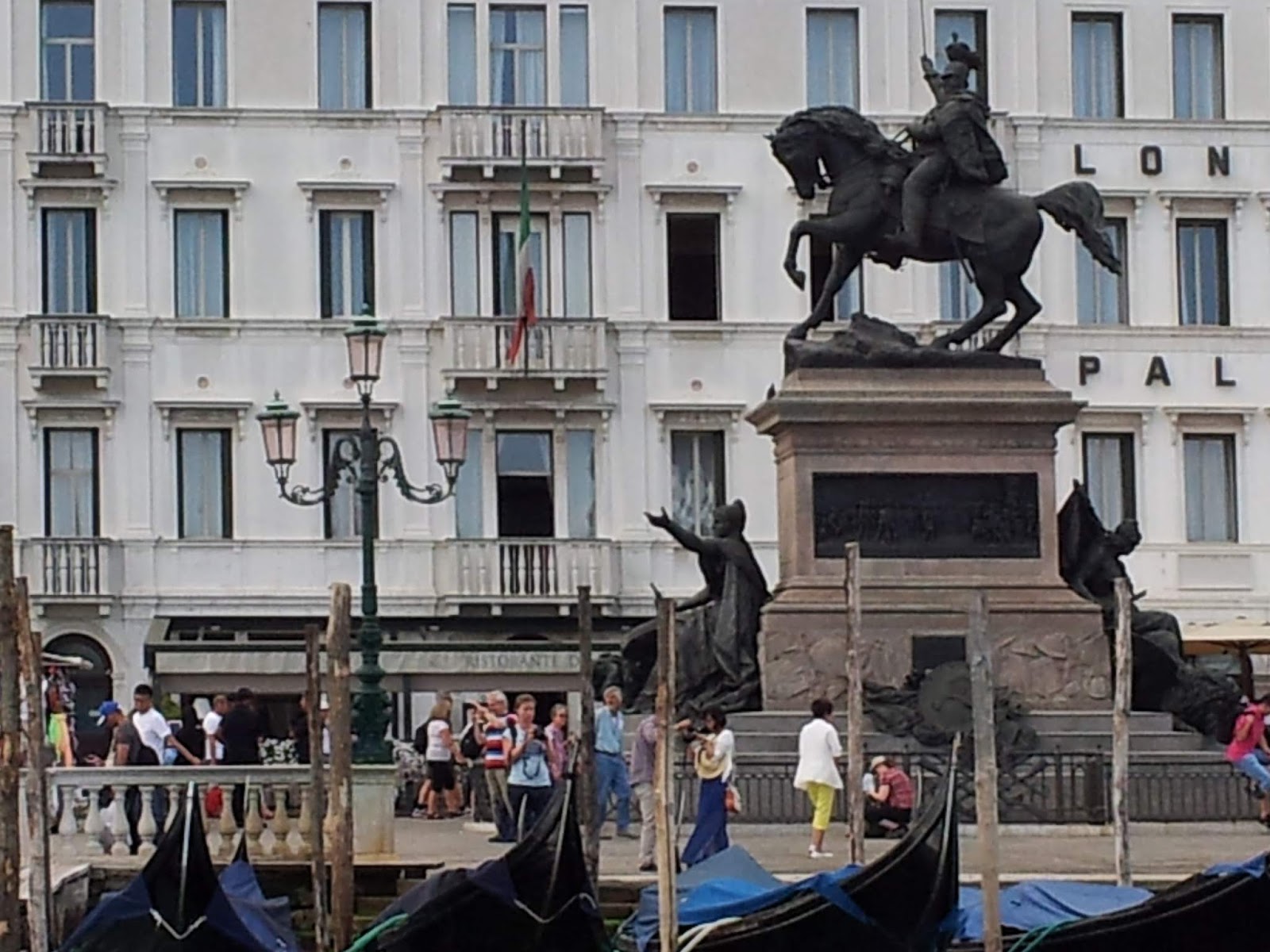
This is a photo of the Hilton Hotel from the other side of the canal.

It was useful knowledge for the second time we visited Venice because the waterbus from the Hilton hotel made its first stop, before San Marco, there.  We also discovered on that second visit a number of restaurants on the way from the terminal and church to the Accademia Bridge.

This is looking back towards San Marco from the Accademia Bridge:

And this, looking towards the docks:

Items to note:

Restaurants off the beaten track were much cheaper and the food a lot different to that in the middle of the tourist areas.

There are a lot of churches, big and small, tucked away in interesting spots where there are small piazza’s.  You can look in all of them, though some asked for a small fee.

Souvenirs, coffee, and confectionary are very expensive in St Marks square.

Searching for Locations: Venice, Italy

Venice is definitely a city to explore.  It has an incredible number of canals and walkways, and each time we would start our exploration at St Marks square when it’s not underwater

Everyone I have spoken to about exploring Venice has told me how easy it is to get lost.  It has not happened to me, but with the infinite number of ways you can go, I guess it is possible.

We started our exploration of Venice in St Marks square, where, on one side there was the Museo di Palazzo Ducale and, next door, the Basilica di San Marco.  Early morning and/or at high tide, water can be seen bubbling up from under the square, partially flooding it.  I have seen this happen several times.  Each morning as we walked from the hotel (the time we stayed in the Savoia and Jolanda) we passed the Bridge of Sighs.

Around the other three sides of the square are archways and shops.  We have bought both confectionary and souvenirs from some of these stores, albeit relatively expensive.  Prices are cheaper in stores that are away from the square and we found some of these when we walked from St Marks square to the Railway station, through many walkways, and crossing many bridges, and passing through a number of small piazzas.

That day, after the trek, we caught the waterbus back to San Marco, and then went on the tour of the Museo di Palazzo Du which included the dungeons and the Bridge of Sighs from the inside.  It took a few hours, longer than I’d anticipated because there was so much to see.

The next day, we caught the waterbus from San Marco to the Ponte di Rialto bridge.  Just upstream from the wharf there was a very large passenger ship, and I noticed there were a number of passengers from the ship on the waterbus, one of whom spoke to us about visiting Venice.  I didn’t realize we looked like professional tourists who knew where we were going.

After a pleasant conversation, and taking in the views up and down the Grand Canal, we disembarked and headed for the bridge, looking at the shops, mostly selling upmarket and expensive gifts, and eventually crossing to the other side where there was a lot of small market type stalls selling souvenirs as well as clothes, and most importantly, it being a hot day, cold Limonata.  This was my first taste of Limonata and I was hooked.

Continuing on from there was a wide street at the end and a number of restaurants where we had lunch.  We had a map of Venice and I was going to plot a course back to the hotel, taking what would be a large circular route that would come out at the Accademia Bridge, and further on to the Terminal Fusina Venezia where there was another church to explore, the Santa Maria del Rosario.

This is a photo of the Hilton Hotel from the other side of the canal.

It was useful knowledge for the second time we visited Venice because the waterbus from the Hilton hotel made its first stop, before San Marco, there.  We also discovered on that second visit a number of restaurants on the way from the terminal and church to the Accademia Bridge.

This is looking back towards San Marco from the Accademia Bridge:

And this, looking towards the docks:

Items to note:

Restaurants off the beaten track were much cheaper and the food a lot different to that in the middle of the tourist areas.

There are a lot of churches, big and small, tucked away in interesting spots where there are small piazza’s.  You can look in all of them, though some asked for a small fee.

Souvenirs, coffee, and confectionary are very expensive in St Marks square.