Searching for locations: Driving in ice and snow, Canada

This morning started with a visit to the car rental place in Vancouver.  It reinforced the notion that you can be given the address and still not find the place.  It happened in Washington where it was hiding in the back of the main railway station, and it happened again in Vancouver when it was hidden inside a hotel.

We simply walked straight past it.  Pity there wasn’t a sign to let people know.

However…

We went in expecting a Grand Jeep Cherokee and walked out with a Ford Flex, suitable for three people and four large suitcases.  It actually seats 7, but forget the baggage, you’d be lucky to get two large suitcases in that configuration.

It is more than adequate for our requirements.

Things to note, it was delivered with just over a quarter of a tank of gas, and it had only done about 11,000 km, so it’s relatively new.  It’s reasonably spacious, and when the extra seats are folded down, there is plenty of baggage space.

So far, so good.

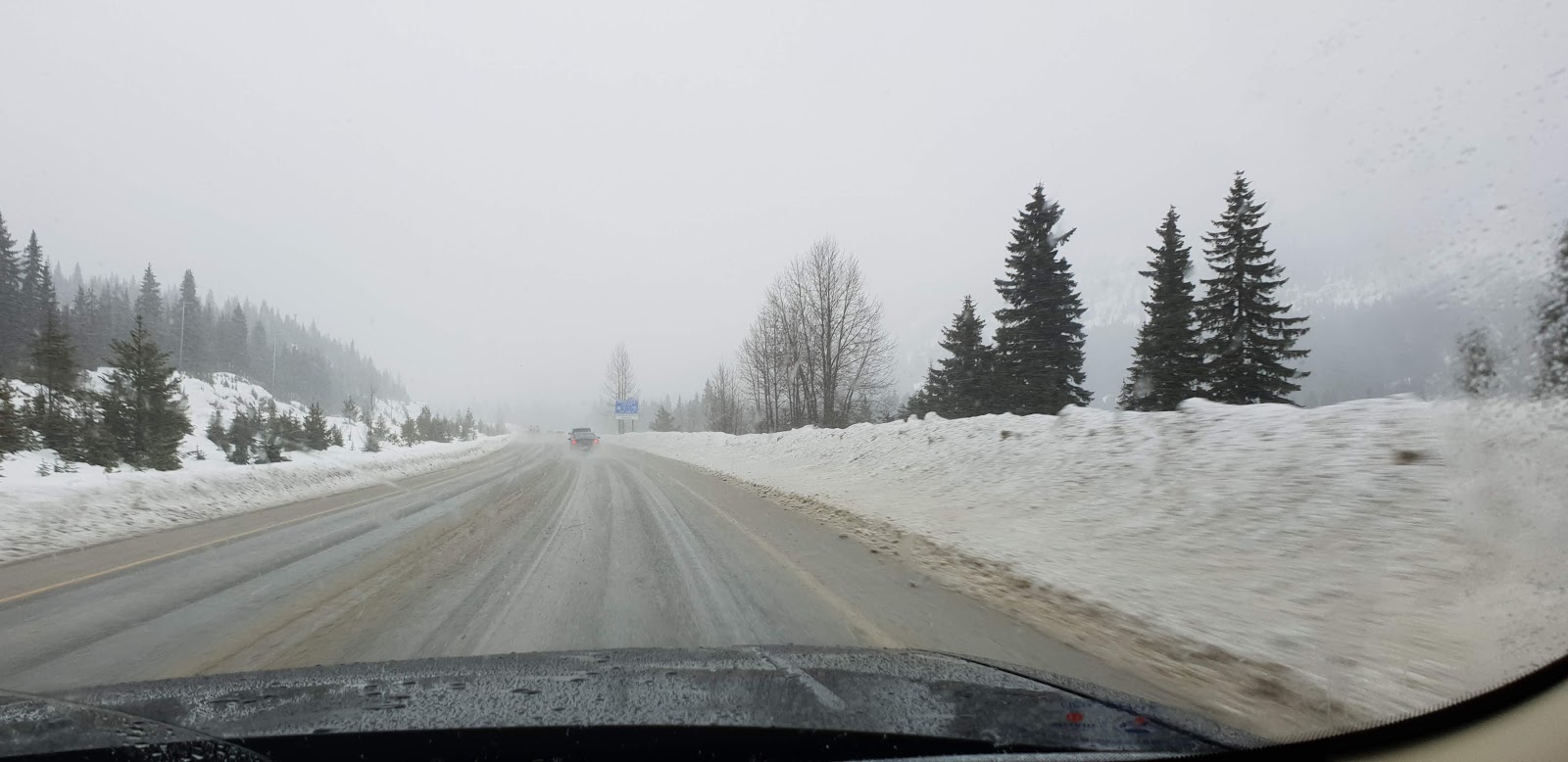
We finally leave the hotel at about half-past ten, and it is raining.  It is a simple task to get on Highway 1, the TransCanada Highway, initially, and then onto Highway 5, the Coquihalla Highway for the trip to Kamloops.

It rains all the way to the top of the mountain, progress hampered from time to time by water sprays from both vehicles and trucks.  The rain is relentless.  At the top of the mountain, the rain turns into snow and the road surface to slush.  It’s 0 degrees, but being the afternoon, I was not expecting it to turn to ice very quickly.

On the other side of the mountain, closer to Kamloops, there was sleet, then rain, then nothing, the last 100kms or so, in reasonably dry conditions.

Outside Kamloops, and in the town itself, there was evidence of snow recently cleared, and slushy roads.  Cars in various places were covered in snow, indicating the most recent falls had been the night before.

We’re staying at the Park Hotel, a heritage building, apparently built in the later 1920s.  In the style of the time, it is a little like a rabbit warren with passages turning off in a number of directions, and showing it is spread across a number of different buildings.

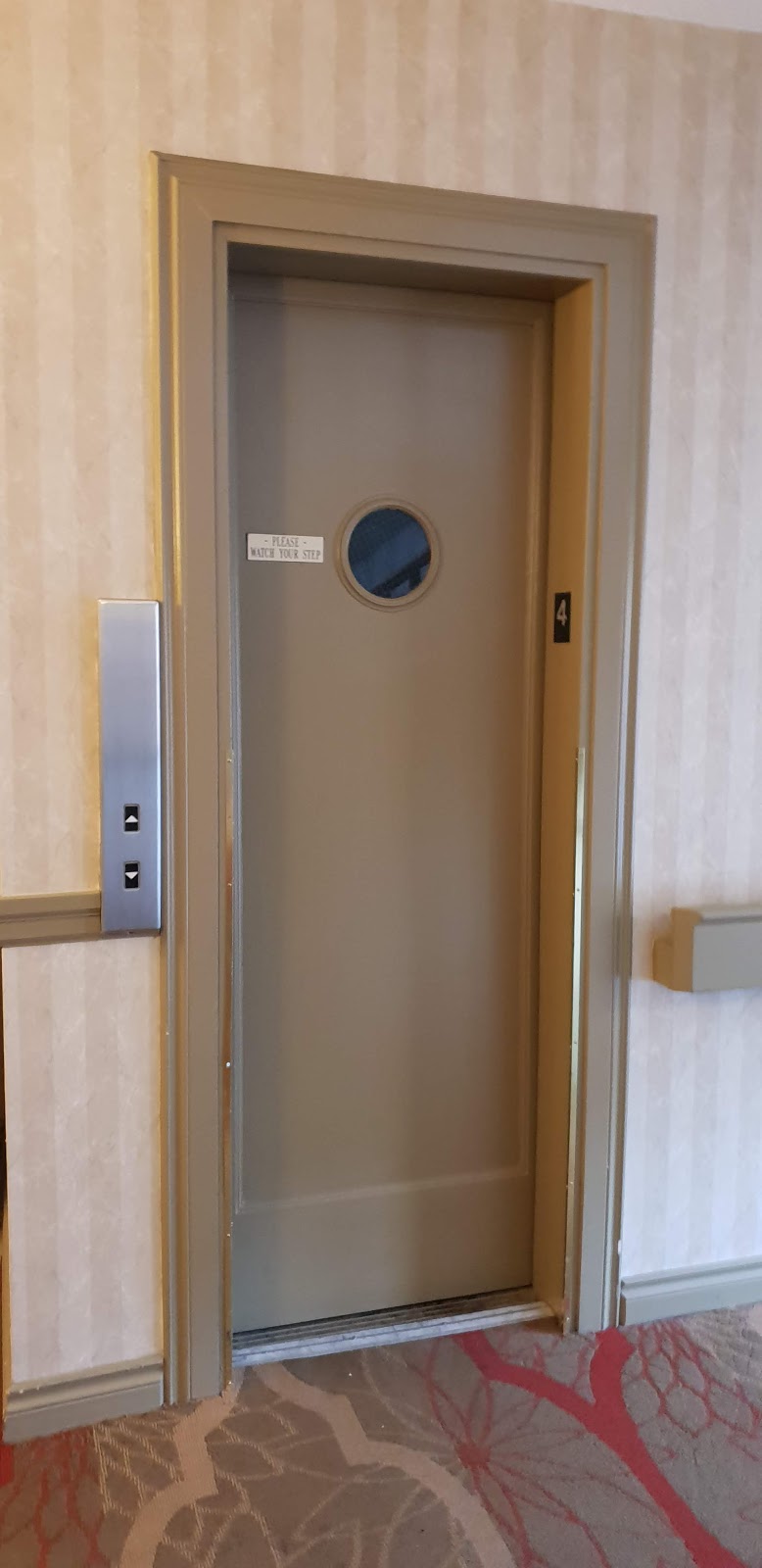
It has the original Otis elevator that can take a maximum of four passengers, and a sign on the wall that says “no horseplay inside the elevator” which is a rather interesting expression that only someone of my vintage would understand.  And, for those without a sense of humor, you definitely couldn’t fit a horse in it to play with.

The thing is, how do you find a balance between keeping the old world charm with modern-day expectations.  You can’t.  Some hotels try valiantly to get that balance.  Here, it is simply old world charm, which I guess we should be grateful for because sooner rather than later it’s going to disappear forever.

In my writer’s mind, given the importance of the railways, this was probably a thriving place for travelers, and once upon a time, there were a lot more hotels like this one.

That helicopter story that kept me awake – Episode 43

Our hero knows he’s in serious trouble.

The problem is, there are familiar faces and a question of who is a friend and who is foe made all the more difficult because of the enemy, if it was the enemy, simply because it didn’t look or sound or act like the enemy.

Now, it appears, his problems stem from another operation he participated in, and because of it, he has now been roped into what might be called a suicide mission.


The hut was a barracks, with bedding and ablutions for twenty men.  Since this was one of two, I assumed the other hut housed the twenty soldiers that the Colonel had alluded to.  There would be no more than one or two others including the Captain.

Hopefully, there were not more in Nagero.

The two hostages had been taken to the Captain’s office where I assumed there was probably a brig for them to be locked in.  Not quite what I was expecting, but no plan was ever perfect.

I went to the rear and sat down at a table that could accommodate about ten.

Davies and Shurl joined me.

I looked at Shurl.  “Good work, and glad they didn’t shoot you.”

“So am I.  Monroe had joined the others.  I had to make a lot of noise before they found me, so I don’t think this is a crack troop.”

“The Captain, or whatever he is, looks sharp,” Davies said.

“New command perhaps.  Can’t believe his luck, I’m guessing.  Did you get a look at the plane?”

“As much as I could without looking like I was looking at it.  It’s been well maintained, and I have no doubt we can get it off the ground.  It just depends if we need help to get the engines started.  It’s possible they don’t, though it’s not usual for this type of plane.  We shall see when the time comes.”

“Can you take off at night?”

“It’s a bit dangerous without lights.  I see they have a lighting system, so I suggest, if and when we break out of here you get someone to find the switch.”

“Noted.”

“Any idea when that’ll be?”

“I’m sure we have people working on that as we speak.”

The door at the entrance to the hut opened and the Captain stood next to his officer, with a gun pointed loosely in our direction, just in case we got the idea we could escape.

“Mr. James.  Time to tell me all about your escape plans.”

“I’m not so sure they could be called that, now.”

His tone hardened.  “Don’t keep me waiting.  I have people waiting for my report.”

I shrugged and got up.  “Just make sure everyone is ready to move when the time comes.  Tell Baines that I expect him to find the generator and get the lights working.”

The Captain’s impatient look told me not to keep him waiting any longer.

The Captain led the way, and his officer kept the gun pointed at me, just in case of what I’m not sure.  Inside his office, rather spacious, and with a door which likely led to some form of accommodation and the brig where the hostages were being held.  The door was closed so I couldn’t see, so it had to be an assumption.

The officer remained in the doorway, while the Captain sat behind a large desk, and gestured for me to sit the other side.  It didn’t look like a comfortable chair.

I thought I’d start the ball rolling.  “I’m assuming that there isn’t always an army guard on this airstrip?”

“No.  When we heard you were coming for the prisoners, a detachment was sent.  Fortuitous wouldn’t you say?”

“For who.”  Time to sow some seeds of discontent.

“What do you mean Mr. James?”

“Your mate back at the militia camp just pocketed two million US dollars’ worth of diamonds for those two men.  What was your cut?”

A shocked look, one that eased back into benign slowly.  No cut from that look, I’d say.

“We pride ourselves on being above bribery.  That was the old way of doing things.”

“Clearly the militia don’t agree.  Are you going to give them back to the commander so he can raffle them again?”

The Captain didn’t seem to understand the word ‘raffle’.

“Sell them back to us for another two million.  Maybe you should talk to your superiors and see what they think.  If you left us go, I can arrange for five million, for you and your friends to share.”

Disdain, or disappointment.

“What did I just say about bribery.”

“That it’s not the way things are done.  Maybe not in the capital, but this is the boondocks, and you’re the man in charge.  Five million can go a long way, but I suspect if you tell your superiors, you won’t get to see any of it.  Or perhaps you should take a few men over to the Militia commander’s camp and demand your share, or just take it.  After all, Captain, who is in charge of this sector, him or you?”

At least he was thinking about it.  Five million was a lot of money, but in US dollars, that could take him anywhere.

I remembered my old instructor saying, one, ‘every man has his price’.

I just had to find the Captains.

“Aside from trying to bribe me, Mr. James, what were you hoping to achieve here?”

“A rescue.  I know we tried once before and not succeeded, but you know how it is, if you at first don’t succeed, try, try, try again.”

“That it failed before should be a warning that we are not as weak as you might think we are.  The US Army is not necessarily the best in the world.”

“So I’m beginning to discover.  Did we train you?”

“No.  I spent some time in England, training with the British Army.”

So that was where he got his accent and ramrod stiff never a crease out of place posture.

“But,” he said, “this not about me, but you.  And your so-called film crew.  How did you expect top escape through this airstrip, flights are restricted, and you can’t possibly fly in a Hercules?  The runway is not long enough.

“No, we were hoping for something a bit smaller than that, but we’ll find out tomorrow what it is.  I’ll be standing on the patio looking as surprised as you are when it arrives.  Now, let me ask you a question.  Do you know who those men are that you have in detention?”

“Militia prisoners.”

“For doing what?”

“I don’t ask questions.  I obey orders.

“Then I’ll tell you.  They were trying to set up a trade agreement for some precious metal you have in abundance here.  Good for the country for income, and employment.  Might even help you get on better terms with the rest of the world.  Unless of course, you don’t want to.”

“I am a soldier, not a politician.  That’s their problem.  I was told to hold you until my superiors arrive.”

“Who told you?”

“The Colonel.  He’s based in Ada.”

So, we had a leak.  Surprising given the limited circulation of the plan.  It might be down to Jacobi, but somehow, I didn’t think it was him.  He had several opportunities to turn on us and he didn’t.

“So, you’re saying we basically drove into a trap?”

“Yes.  So much for the smart Americans who have all the technology and answers.

I could understand his contempt, especially when the attempt had failed so badly.  Pity then he didn’t understand what was about to happen to him.

© Charles Heath 2020

In a word: Blue

Of course we all know this word is a colour, or color depending on where you live.You know, blue sky, deep blue sea, blonde hair blue eyes.  Very descriptive.

But it can also mean you are down in the dumps, a rather strange, for some, expression that means you are sad or unhappy.

For others to have a blue means to have a fight with someone

And oddly, and I know this from first hand experience, that a red haired person will be called bluey, or less pleasing either carrot top or blood nut.  I used to ignore those people who used those expressions, except for my father in law.

You can do something until you are blue in the face, which means do it without result until exhaustion, another way of saying your wasting your time.

And if something comes out of the blue, it usually means its entirely unexpected.  For me, that’s always a bill I wasn’t expecting, for someone else an inheritance.

And in some parts of the world, blue is used as a synonym for conservative political party, for insistence, the Liberal party in Australia, and the Democrats in the United States

Blue should not be confused with the word blew, which is the past tense of blow, which is wind causing an air current, or blowing air through pursed lips.

That doesn’t mean that if something blew up it was just a giant air mass exploding because it can’t.  If a bomb blew up it means it detonated.

And if that sounds complicated:

What if something blew my mind?  Does that mean my head exploded?  No, it just means its incomprehensible, whether good or bad.

Or

What if I blew a fortune on a three legged horse?  We all throw good money after bad, but you can easily lose a fortune, or blew it.

Its the same thing with opportunities, for instance, he had a chance and he blew it.  Yes, obviously something better came along, not, or he just ignored a sterling opportunity.

Writing about writing a book – Day 24, a missing piece of the puzzle

There’s always the necessity for creating backstories so that the reader doesn’t come across a part of the story that doesn’t make sense.

Perhaps one of my failings is that I have to go over what I’ve already written, sometimes to make sure there is continuity and that what I’ve written makes sense.

This collection of memories our main character is having serves the purpose of setting up later plot points, but more importantly, is supposed to give the reader an idea of what the main character has gone through before arriving at the start of the story.

This part will serve to provide a little more information on the relationship between Bill and Barry, though I rather like the nickname I gave him.

“Bastards,” Killer muttered.

We called him ‘Killer’ because it was the nickname the Army had given him.  We were sharing the guard duty and had spoken briefly over the watch, but up till then, the silence had stretched over an hour or so.  It didn’t take long for anyone to realize he was a man of few words.

He’d been in the regular army for years and asked for the posting.  He’d made Sergeant several times, only to lose those same stripes for fighting, usually after R&R and a bout of heavy drinking.  Now assigned to our platoon to lend his experience, the conscripts were expecting him to ‘look after’ them.  Other than myself and the Lieutenant, he was the only other regular soldier.  Unfortunately for them, he hated both conscripts and the Viet Cong in varying degrees, and depending on his mood there was little tolerance left for the rest of us.

“The people who sent us here or the people trying to kill us?” I asked before I realized I’d spoken.

I didn’t hear the reply, the skies opening up with another torrential downpour that lasted for about five minutes, and going as fast as it came.  When the sun finally came up, it would make the atmosphere steamy, hot, and unbearable.  It was quite warm now, and I was feeling both uncomfortable, and fatigued.

Killer looked just as stoic as he had before the rain.  He looked at me.  “Damn weather.  Worse than home.”

“Scotland?”

“Scapa Flow, Kirkwall.  I should have been an engineer on ships like my father, but I was too stupid.  Joined the Army, finished up here.  What’s your excuse?”

“Square peg in a round hole.  The army seems to handle us in its stride.”  It was more or less the truth.  I joined the Army to get away from my parents.

“That it does.  That it does.”

The rain came and went, during which the rest of the camp roused and went about its business.  It had been a long night for some, still getting over the shock of the attack, and the ever-pervading thought the enemy was still out there, biding their time.  It would be, for them, a waiting game, waiting for the conditions to wear us down, and lose concentration as inevitably we would.

Certainly, by the time we were relieved from sentry duty, I felt I was in no condition to match wits with a donkey, let alone the enemy on his own home ground.  When I stumbled over to the mess area and looked at the tired and haggard looks on the faces of the platoon, I realized that went for all of us.

Killer and I managed to get about an hour’s rest before the call came to move out, rain or no rain, and after a breakfast to make anyone ill, we left.  For hours it rained.  No one spoke as we strained to listen over the rain spattering on the undergrowth, all the time expecting the unexpected.  That was the benefit of the surprise attack; we no longer took for granted we would be safe.

Water gathered in pools along the trail, hiding any chance of seeing landmines.  Rainwater and sweat ran into our eyes, making it difficult to see.  Water leaked everywhere, making it very uncomfortable.  This was not war.  This was utter stupidity.

I was about to remark on the futility of it all to the Lieutenant, who had taken the lead, when one second he was talking to me and the next he crashed to the ground, a sniper’s bullet killing him instantly.   Someone yelled “Contact” and we hit the ground, bullets flying all around us. 

Too late, I thought, as I felt the hit of what seemed to be a large rock, then the searing pain in my leg, just as I hit the ground…


© Charles Heath 2015-2021

“Call me!” – a short story

You know what it’s like on Monday morning, especially if it’s very cold and the double glazing is failing miserably to keep the cold out.

It was warm under three blankets thick sheets and a doona, and I didn’t want to get up.

It doesn’t help if in the last few months, the dream job you once had turned into a drudge, and there was any number of reasons to stay home rather than go into the office. Once, that was trying to find an excuse to stay home because you’d rather go to work.

That was a long time ago or felt like it.

My cell phone vibrated; an incoming message, or more likely a reminder. I reached out into the icy wasteland that was the distance from under the covers to my phone on the bedside table. It was very cold out there, and for a moment I regretted that impulse to check.

It was a reminder; I had a meeting at HR with the manager. I had thought I might be eligible for redundancy since the company was in the throes of a cost-cutting exercise. Once I might have been apprehensive, but now, given my recent change in department and responsibility, I was kind of hoping now that it was.

I felt a hand on my shoulder. “Time to get up sleepy head. You have a meeting to go to, not one to be late.”

It felt strange to wake up with someone else in the bed. My luck in that department hadn’t been all that hood lately, but something changed, and at the usual Friday night after-work drinks at the pub, I ran into one of the PA’s I’d seen around, one who was curious to meet me as much as I was to meet her.

One thing had led to another and when I asked her if she wanted to drop in on the way home, she did.

“I’d prefer not to. I can think of better things to do.”

“So, could I but that’s not the point. Five more minutes, then I’m pushing you out.”

She snuggled into my back, and I could feel the warmth of her body, and having the exact opposite effect than she intended. But she was right. It was important, and I had to go. But, in the meantime, it was four more minutes and counting.

When you get a call from the head of HR it usually means one of two things, a promotion, or those two dreaded words, ‘you’re fired’, though not usually said with the same dramatic effect.

This year had already been calamitous enough getting sidelined from Mergers and Acquisitions because I’d been usurped. That was the word I was going with, but it was to a certain extent, my fault. I took my eye off the ball and allowed someone else to make their case.

Of course, it helped that the person was connected to all the right people in the company, and, with the change in Chairman, it was also a matter of removing some of the people who were appointed by the previous incumbent.

I and four of my equivalent managers had been usurped and moved to places where they would have less impact. I had finished up in sales and marketing, and to be quite honest, it was such a step-down, I had already decided to leave when the opportunity presented itself.

My assistant manager, who had already put in his resignation, was working out his final two weeks. I told him to take leave until the contract expired, but he was more dedicated than that. He had got in before me and was sitting at his desk a cup of coffee in his hand and another on the desk.

“How many days?”

“Six and counting. What about you? You should be out canvassing. There are at least three other places I know would be waiting to hear from you.”

“It’s still in the consideration phase.”

“You’re likely to get the chop anyway, with this thing you have with Sharkey.”

Sharkey was the HR manager.

You know something I don’t?” I picked up the coffee, removed the lid, and took in the aroma.
“They’re downsizing. Broadham had decided to go on a cost-cutting exercise, and instead of the suggested efficiencies we put up last year, they’re going with people. I don’t think he quite gets it.”

“You mean my replacement doesn’t know anything about efficiency. He makes a good yes man though, telling Broadham exactly what he wants to hear.”

Broadham, the new Chairman, never did understand that people appointed to important positions needed to have the relevant qualifications and experience. My replacement had neither. That was when the employees loyal to the previous Chairman had started leaving.

We had called it death, whilst Broadham had called it natural attrition. He didn’t quite understand that so far, over 300 years of experience had left, and as much again was in the process of leaving.

“Are you going to tell Sharky you’re leaving?”

“I’ll wait and see what he has to say. I think he knows the ship is sinking.”

There wasn’t much I didn’t know about the current state of the company, and with the departures, I knew it was only a matter of time. Sharky was a good man, but he couldn’t stem the tide.

He also knew the vagaries of profits and share prices, and we had been watching the share price, and the market itself. It was teetering, and in the last few months, parcels of shares were being unloaded, not a lot at one time, but a steady trickle.

That told me that Broadham and his cronies were cashing in while the going was good, and quite possibly were about to steer the ship onto the rocks. The question was who was buying, and that, after some hard research I found to be certain board members. Why, I suspected, was to increase their holdings and leverage, but I don’t think they quite realized that there would be nothing left but worthless stock certificates.

It was evidence, when I finally left, that I would pass on to the relevant authorities.

In the meantime, I had a meeting to go to.

“Best of luck,” my assistant muttered as I passed his desk.

“If I don’t return, I will have been escorted from the building. If that happens, call me.”

It had happened before. When people were sacked, they were escorted to their office, allowed to pack their belongings, and were then escorted to the front door. It would be an ignominious end to an illustrious career, or so I’d been told by the girl who was no doubt still asleep in my bed.

She had heard the whispers.

The walk to the lift, the traversing of the four floors to the executive level, and then to the outer office where Sharkey’s PA sat took all of three minutes. I had hoped it would be longer.

“He’s waiting for you,” she said, “go on in.”

I knocked on the door, then went in, closing it behind me. “Now, sir, what on earth could you want to see me about?


© Charles Heath 2021

Writing about writing a book – Day 24

Time to put the team back together, well, sort of.

We’ve been given the introduction to who Barry McDougall is, or the man otherwise known as ‘Brainless’, and after three days of trying to get it straight, this is the first rough draft of his start in the story.

Barry, whose daring selfless deeds earned him the nickname Brainless because that was the only way to describe the motivation behind them, was one of the regular soldiers, and, for a long time, had been my only true friend.  His was a reputation both friends and foes alike considered awesome.  He’d been in Vietnam, and later just turned up at Davenport’s camp, reporting for duty.

Davenport was more surprised than I was at his arrival, but obviously, after checking his credentials, was impressed because he let him stay.  And it would be true to say, if he had not, I would not be here now.

So Barry was just the sort of person I needed to help me.

That was the good news.

The bad news was Barry, at the best of times, either on one of his ‘benders’ using drugs or alcohol, whatever was easier to get at the time, lost to everyone, or locked up in a mental institution, having admitted himself.  He had no interest in participating in life, hadn’t worked in years, and often said, in moments when he was at his lowest, that he did not care if he lived or died.  It had not always been that way, but his demons had all but taken him over, and despite the help, I tried to give him, nothing could shake him out of this lethargy.  He said once he envied me that I could not remember the dark days, and, now those memories had returned, I knew what he meant.

For a long time, I could not understand why he didn’t try harder to help himself, and I guess he humored me by accepting the jobs I’d found him, and the help I offered.  I owed him a great deal, but that was probably the one honorable thing about him, he never expected, nor wanted, anything in return.

He tried to make a go of being a police officer and lasted several years before he resigned over an incident that didn’t reach the papers.  There was, he said, no place for heroics in modern society.  I hadn’t got to the bottom of it, but I heard he shot some thieves at a time when the police were trying to promote a pacifist image.

He tried a few other occupations with an equal lack of success, so now he survived on whatever money I gave him.  He lived on the street, and when he was not there, I knew he could be found in a bar, in one of the more seedier parts of the city, a ubiquitous underground bar called Jackson’s, named after a man who had a salubrious reputation that hovered between load shark and saint, and who was reputed to be buried under the storeroom floor.  The present owner, or what I assumed to be the owner, was a large, gruff, ex-prizefighter, who had the proverbial heart of gold, most of the time, and who took my money and looked after Barry without making it look like he was.

I’d called the bartender in advance, and he said he was in his usual spot, and that it was at the start of the next cycle, having just discharged himself from the hospital after a bout of pneumonia.  It was, he said, getting worse, and taking longer to recover.

It was probably only a matter of time before it took him, so perhaps this time I would have to try harder to convince him to give up his nomadic lifestyle.

When I walked in, the aroma of spilled beer, stale sweat, and vomit, mingled with the industrial-strength carbolic cleaner almost took my breath away.  In the corner, two construction workers were sitting, quietly smoking and drinking large glasses of beer.  In the other, Barry was being held up by the table, an untouched double scotch sitting in front of him.  Sitting at the bar was a woman of indeterminate age, badly made up, and thin to the point of emaciation.  I was not sure what she was drinking, or what it was she was smoking, but I could smell it from the front doorway.

The bartender, Ogilvy, no first name given, was pretending to polish glasses, standing at the end of the bar, looking at the television, playing some daytime soap.  He didn’t look over when I came in, but I knew he didn’t miss anything.  I saw him flick a glance at Barry, and then shake his head.  I think he cared as much about Barry as I did, but could recognize the sadness within him.  As much as Ogilvy said, which wasn’t much, he too had seen service in Vietnam, and it had affected him too.

I ordered an orange juice, caught the glances from the construction workers, and a steely look from the woman then went over to Barry’s table and sat down.  Despite the loud scraping noise when I moved the chair, or the creaking as I sat in it, Barry didn’t move.

Whilst the bar had that seedy aroma, Barry was showing the signs of having spent the time on the street.  It was one of the disadvantages of having no permanent residence and though there was a shower at the bar which Ogilvy let Barry use from time to time, he obviously hadn’t for a few days.

A groan emanated from the table, and Barry moved his head slightly.

I shifted the drink in front of him, and then a hand went out and moved it back.  He lifted his head to look at me, and then lowered it again.

“I thought it was you.”

© Charles Heath 2016-2021

That helicopter story that kept me awake – Episode 41

Our hero knows he’s in serious trouble.

The problem is, there are familiar faces and a question of who is a friend and who is foe made all the more difficult because of the enemy, if it was the enemy, simply because it didn’t look or sound or act like the enemy.

Now, it appears, his problems stem from another operation he participated in, and because of it, he has now been roped into what might be called a suicide mission.

“That was far too bloody easy.”  I heard Monroe’s voice come over the radio, not long after we left the camp.

“It was a bit easier than I thought.  But I did make it quite clear if we didn’t all leave in one piece we’d reduce his camp to rubble with everyone in it.”

“He knows the territory.  Something’s waiting for us out here.”

Something indeed.

Back at the camp, not only had the commander’s men search for the hidden weapons, and, when everyone checked, were still there, they had also taken off the crates with the film equipment.  I was not sure what the commander was intending to do with the equipment, but what disappointed me was the fact we hadn’t taken the time to rescue the rocket launcher.

Now the commander had it.

If he bothered to search the crates properly.  I suspect he was yet to do so.  What we had rescued and successfully hidden were the C4 explosives and detonators.  They might come in useful at the airstrip.

Just before we reached the fork in the road, where we would be turning left to head towards the airfield, and surprisingly had not run into any of the commander’s men, we stopped and let Monroe and Shurl out to make a sweep towards the airstrip, not too far away.

I also called up Mobley to see how he was.

The Colonel answered.  “Everything is under control now.”

I didn’t like the sound of that.  “What happened?”

“The kidnappers send out a team to intercept us on the way to the airstrip.  It wasn’t a stretch to imagine they would know what we were planning because they’d know we would not be retracing out steps to Uganda.  Got them before they got a shot off.  I suspect there are Government troops at the airstrip, it’s too important to let anything happen to rich foreigners coming to see their wildlife reserve.  There are several troop carriers, and we’ve seen a few men on the outskirts patrolling.  There’s several at the gate if you could call it that.”

“Is there a plane there?”

“As it happens there is.  A grand old DC3.  It’s not a charter plane, so I’m guessing it belongs to an overentitled American big game hunter or the photographic variety.  At least I’m hoping that’s the case.”

“What do you recommend?”

“Not to storm the field.  You’re going to have to find another means of getting here, preferably without any fanfare.”

My first choice was to go in and get out, with as little firefight as possible, particularly in case they started shooting at the plane.  If I was reading between the lines properly, the Colonel was telling me there were more troops there than we could handle quickly and quietly.

“Very good.  Can you get sight on just how many troops are there, and if you can see who’s in charge?”

“Will try.”

Monroe had been standing next to me during the exchange.

“Three in place, two more on the perimeter, if we can cover as many as possible, you might be able to take the rest from the inside.”

Secreting the weapons again, maybe.  It was a possibility, but going in with hidden weapons, and then found by the guards at the gate, who would be more efficient and careful searchers than the kidnappers, it would create hostility and itchy trigger fingers.

“No.  We have to find some way of letting them feel as though they have complete control of the situation.  They know we’re coming; the commander would have told them.”  The only reason why he was still the cat who ate the canary.  He might even have told them he had some men waiting as the first line of defense.

The airstrip commander would then know we were armed and relatively dangerous.

It was time for yet another dangerous gambit.

I picked up the radio.  “Colonel?”

A second later, “Sergeant?”

“Whatever happens in the next twenty minutes or so, just ignore it.  It’s not much of a plan, but it will get us onto the field.”

“And then?”

“Hopefully some divine intervention.”

Monroe looked skeptical.  “You’re going to just drive up to the gate and surrender?”

“Not exactly.  It won’t be fait accompli until we reach the terminal, or hanger, or whatever the commander has set up as headquarters.  They’ll have most of our weapons, yes.  But they won’t have all of us.”

“No.  But they’ll know we have a sniper, so one of you are going to have to allow yourself to be captured, just to ease their minds.”

“Leaving one of us and Mobley and the Ugandans.  Can we trust them?”

“I hope so, otherwise this could go badly.  But, today, I’m an optimist.  We’ve got this far.”

Trying to show more confidence in the plan that I had.  It was always a worry when you had to trust people you didn’t know.  That had been the problem the last time.  At least this time we had managed to get the hostages.  It was always going to be a problem getting them out.

Monroe gave me one of her special, you’re a fool, looks.  “I hope you know what you’re doing.”  She then nodded in Shurl’s direction and they disappeared into the bush again.

I gestured to Davies to come over.

“Did you find out what sort of plane it is?”

“Hopefully.  The Colonel tells me there’s a DC3 off the airstrip.  I assume you can fly one.”

She smiled, the first time since this operation had started.  “Sure can.  I spent three summers putting one back together.  My dad has a sort of airplane museum.  A DC3, a DC4, and a Lancaster, a very sorry looking Lancaster at that.  Shouldn’t be a problem.”

“Then try to not get shot.”

“Do my very best not to.”

Once again, it was time to go.  Going into the unknown was getting to be the norm, but hopefully, this would be the last time.  I didn’t consider it wise to advise the hostages, they had their own problems to worry about.

© Charles Heath 2020

“Long time, no see…” – short story


You can pick your friends but you can’t pick your relatives.

So sayeth my sister, who for years refused to acknowledge I was her brother.

The point is, as I was trying to tell Nancy, the woman who had agreed to marry me, “my family has long been ashamed of me because I refused to become a doctor.”

“That’s no excuse, in fact, that’s the most ridiculous thing I’ve ever heard.”

To most people, it would. I agreed with her. But then, her family had not had a forebear who stood shoulder to shoulder with George Washington at the Siege of Yorktown.

It was a statement my mother had often pulled out of nowhere at dinner parties, and sometimes in general conversation, just to impress. I thought of trotting out as another example of ridiculous statements, but thought better of it.

It was a situation I had not bargained for, and probably why it took so long to find someone to share the rest of my life with.

Perhaps I hadn’t quite thought through what would happen once I asked the question, and it was a yes.

It was not as if Nancy and I hadn’t taken the long road with our relationship. She had been burned a few times, and I always had my family in the back of my mind as the biggest obstacle.

In fact, I always had considered it insurmountable, and because of that, rarely made a commitment. But Nancy was different. She was very forgiving and had the sort of temperament saints were blessed with.

Her family sounded like very reasonable people who lived upstate out of Yonkers on a farm she simply said had been in the family forever.

She didn’t have big city aspirations, was not impressed by wealth, travel, large houses, or a resume a mile long with achievements. It was everything I didn’t have and didn’t want, and my job as storeman and fork life driver was one where I could go to work and leave it there.

Nancy, on the other hand, was a checkout clerk at a large supermarket, with no aspirations to be a boss or run the place. She had a run-in with a tractor early on in life and could manage a lot of the farming basics.

Her parents sent her to the big city to learn a different trade, but she just wasn’t interested. She was a country girl and would never change.

We met when she was attending the same pre-wedding party that I was, both with different partners at the time, and both of whom were more party animals than we were.

A week later we ran into each other in the same bar, and it grew from there, and after a rather interesting six months or so, we had ended up making the ultimate commitment.

“I guess, now, we have to tell our parents,” she said, stating what was to her, the obvious.

Such a simple statement with so many connotations. I had deliberately steered the conversation away from all of them, and so, at this point in time, she knew I had parents, grandparents, and three other siblings. And that they lived on the other side of the country.

Asked why I had moved so far away, I told her that I’d failed to meet their expectations and preferred to be as far away as possible. My brothers more than made up for my failings, so it was not necessary I stay there.

It was only recently I’d told her those expectations were of me following the family tradition into medicine. It was when I told her my father was a pre-eminent thoracic heart surgeon, my brothers top of whatever field they’d chosen, and my sister, a well-regarded general practitioner.

When she asked in what way I’d failed, I said it was not in the education because like all Foresdale’s, we were always top of the class, and as much as I tried to fail, the teachers knew better.

I just refused to go to University. Instead, I tried to disappear, but my father had the best private detective at his disposal. It took a very long, loud, screaming match to sever that tie, get disinherited, and leave to make my own way in the world.

Perhaps, I said, it would be best to just say I was an orphan.

That, of course, to Nancy, was not an option. She came from practical people who always found a solution to any problem, and they had had a few really difficult ones over the years.

But, for the first time, there was a look of perplexment on her face. Maybe she was thinking that she should have asked more probing questions about my family before agreeing to be my wife.

“I think I can safely say that your parents will be more approachable than mine. Those expectations on me will also fall on you.”

And having said it aloud, it sounded so much more like a threat. The problem was, I knew what there were like, living in that rarefied air where the upper classes lived.

I might be a forklift driving storeman, but I was still a Foresdale, and my match had to be commensurate to the family values.

“Then we’re just going to have to go visit them and lower those expectations. I’m not afraid of them.”

No, I expect she was not. I’d seen her deal with all types of miscreants at the checkout counter, rich and poor alike. She had the sort of gumption I always had wanted but was too much of a coward to confront the problem.

Perhaps now, it would be the perfect opportunity.

“We should go next week. I’ve got some vacation days owing, and I’m sure the boss will let you go if you tell him the reason.”

Practical as ever. Confront the beast and get it over with.

“Sure. I’ll talk to the boss, arrange the tickers, and let someone know we’re coming. But I will not be staying at the house. That way if it gets too intense, we can leave.”

I saw her shrug. I’m not sure she agreed that was a good idea, but I didn’t want to see them corner her the way they had a habit of doing when any of us children brought anyone home. I did once, and never again.

“It will be fine.”

Famous last words.

I had the phone number of my sister Erica, stored on my phone, not that I’d ever intended to call her. It was there because she had called me, I had made the mistake of giving it to her when I left because she asked me for it.

I hadn’t spoken to her since I left home all those years ago, nearly ten by my reckoning, and perhaps it was a testament to my father that not one of them had called, or even reached out.

Being cut off literally meant that. But it was not something that irked me. I was glad not to see them. I could easily keep up with them in the newspapers and magazines, such was their visibility.

I was surprised Nancy hadn’t made the association.

I don’t know how long it was that I stared at that number, finger hovering over the green button. My first concern was whether I’d remain civil, or how long it would take before I disconnected the call.

Then, courage summoned, I pressed the button.

An anticlimax might occur if there was no answer, or the number had been disconnected, but such was not the case. It rang.

Almost for the full number of rings before a familiar voice answered. “Good morning, this is Erica speaking.”

If only I’d learned to answer a phone properly like that.

“It’s Perry.” Damn, I hated that name, and once I left home, I adopted my middle name, James.

“Now that’s a blast from the past. Never expected to hear from you again.”

“Believe me, if I had my way, you wouldn’t, but there’s a person who insists she meets the family. I tried to talk her out of it, but she’s a force to be reckoned with.”

“Good for her. I always knew you’d meet a sensible girl who wouldn’t put up with your nonsense. I’m assuming you asked her to marry you?”

“I’m beginning to wonder if I should have just outright lied and said I was an orphan.”

“Yes, and how would that have worked when we finally ran you to ground. Besides, your father has known where you’ve been hiding all along. You are still a Foresdale, and that will never change.”

“Even when I’ve been ex-communicated from the family.”

“That’s only your assumption. Everyone here might have expected you to change your minds somewhat earlier, but we never doubted you would return. Now, just who is this Nancy, and who does she belong to?”

© Charles Heath 2021

Writing about writing a book – Day 23

I’ve been thinking a lot about Bill’s service, and the characters he meets along the way, some of whom shape the man he became, others he remained friends with after he was discharged, and those that were killed.

Several have a direct bearing in the main story, for instance, Brainless, a rather ubiquitous nickname, given to him because of his actions, that is to say, he acts without thinking, sometimes when in great peril, a man who never quite recovered, but is, for all intents and purposes Bill’s friend and someone he feels responsible to look after, perhaps because of how many times he saved Bill from death, or worse.

There is also Manilow, but we’ll save him for later.

So, this is where ‘Brainless’ get’s his introduction:


It was the first time I’d been hit by a bullet, and it hurt.  It was a steep learning curve, realizing you have been hit, and then the brain going into overdrive to tell you first it going to hurt like hell, and then begin to assess the damage, running every scenario from ‘it’s a flesh wound’ to ‘Oh God, I’m going to die’.

At least, that was what had happened to me for my first time.

Seconds, or minutes, or hours later, a man who doubled as a Medic came scrabbling over to me and looked at the wound.  A silly thought, how did he know I’d been shot?  Had I screamed?  He made a quick assessment, told me I’d live, and dressed it as good and as quickly as he could.

There were other casualties.

I lasted until I was brought into a clearing some miles further on, after the enemy had been killed, or had retreated, and loaded onto a helicopter.  There I was told everything would be OK and then the lights went out.


My first visit to a mobile army hospital, after being hit, was a novelty.  It was nothing like a real hospital.  Nor was the staff.  It took a different sort of medical personnel to man a front-line hospital where you were just as likely to become a casualty yourself.

The doctor was quite jovial about the whole matter saying I would be back out again in no time, not exactly a prospect I was looking forward to.  It was almost a mend job without anesthetic and the memory of it remained with me for some time.  Facilities were not primitive, but they just appeared that way.

I was one of the less needy casualties that day.  After being stitched up, a nurse took me to a bed in a ward with a mixture of serious and not so seriously wounded.

The nurse, whose name was Wendy, had the same sense of humor I had.  She insisted we be on first name terms from the start.  How she kept her humor was a mystery, for most noticeable was her tired look as if she had been doing the same thing for too long.

The bed was comfortable, the temperature bearable, and the food edible.  Being, and remaining, injured had its good points.

I slept well the first night.  I presumed the injection she’d given me was to ensure I had a restful sleep.  It was long overdue and much needed.

The next morning the numbers had thinned.  Two men had died, several others returned to duty.  To my left was a sad and distant private, who, from time to time, would start moaning.  He’d been in the middle of a mortar attack and was both deaf and had serious psychological problems.

To my right, there was a large man who barely fit in the bed.  He was a perpetually unhappy person, with only minor injuries, a bullet wound to his upper leg.  Nothing serious, he said, and just wanted to leave as soon as possible.  Brainless, the nurse called him.  Always wanted to get back to the war and kill some more of the enemy.  An obsession, she said.

He was staring morosely at the ceiling when I woke.  It took a few minutes to regain full consciousness, a sign I’d been in a drugged sleep.

“What are you in for?” he asked.

“Leg wound.  Nothing serious.”  You?”

“Leg.  Bastards snuck up on me.  And the useless rearguard didn’t do his job properly.”

“Landmine?”

“Sniper.”

I’d seen both.  Tread in the wrong place, and you didn’t do it again.  Sniper’s fire came from almost anywhere, taking out soldiers and civilians indiscriminately.  You could never hear the bullet, just feel it.

“Mongrel,” I said with feeling.

“Yours?”

“Probably the same.  I didn’t see it coming.  I hate it when you can’t see the bastards.  There ought to be some law they send you a message first.  Give you a chance….”

“Chap other side killed himself.  Had enough.  It was written all over his face.  What kind of sooks are we bringing over here?”

“National service,” I said quietly.

“You?” he asked.

I could feel his contempt for ‘Nashos’ and to be glad I was not one.  “I believe I volunteered.”

He didn’t ask what I meant, and even if he had, I probably would have made up a lie.  I hardly thought if I said my father in law hated me that much he would send me here, would make any sense, particularly to this man beside me.

He snorted.  “More the fool you, then.”


We were both released on the same day.  His unit had suffered major casualties, and the story he gave me in the hospital was not quite true.  He’d gone down trying to save what men he could in an ambush.  Heroics came to mind, but his selfless actions were much more than that.  Without a unit, he joined ours.

Wendy remained in my mind for some time after that visit.  When I returned the next time, my injuries being more serious, I enquired as to her whereabouts, only to discover she was dead too, a victim of her own hand, simply because she could not cope with the death, mutilation, and waste.

There was no doubt it affected all of us in different ways.  Some didn’t like the idea of going back out into the jungle and found their own peace.  Others, like Wendy, needed something more, but all too often, no-one recognized what the solution was until it was too late.


Now that I have paved the way, I must get back to the main story and write the part where Brainless enters the picture.


© Charles Heath 2016-2020

That helicopter story that kept me awake – Episode 40

Our hero knows he’s in serious trouble.

The problem is, there are familiar faces and a question of who is a friend and who is foe made all the more difficult because of the enemy, if it was the enemy, simply because it didn’t look or sound or act like the enemy.

Now, it appears, his problems stem from another operation he participated in, and because of it, he has now been roped into what might be called a suicide mission.


I left the others out the front of the hut in Barnes charge, except for Williamson who stayed inside, feigning illness.  If everything went according to plan, a sketchy plan at best, Monroe would slip the diamonds to Williamson, and then melt back into the bush, heading back towards the fork in the road heading to the airstrip.  She would then report on what troops were between us and our objective.

I signaled for Davies to join me.

The commander and the man who’d reported to him earlier strode across the compound to a smaller building that might pass as a jail.  There was a guard out the front who jumped up and snapped to attention when the commander came up the steps.

“Open the door.”

The guard fumbled with a ring of keys, found the one for the door, and unlocked it.

The commander looked at me.  “You may speak to them for five minutes.”

“Alone.  You have my word we’ll not try anything.”

He nodded at the guard.  “Bottom of the steps.  Don’t let them out of your sight.”  To me, he pointed to another building about 50 yards away, “I’ll be there, don’t keep me waiting.”

We waited for him to come down the steps and start striding to his office, then went up the stairs, and I knocked on the door.  “My name is James, and I’m here with Davies to take you home.  We’re coming in.”

I opened the door slowly pulling it towards me, and the odor that came out of the room was that of people who had not been allowed to wash for several days, if not longer.  Once the door was fully open and the interior lit, I could see two stretchers and two men sitting up, struggling with the light in their eyes.

At least they were able to sit up.

Our information was they had been captive now for about seven months, and, looking at them, they didn’t seem to appear to badly off.  They showed signs of weight loss, and pallid skin, but not to the point of being maltreated or starved.

“Who did you say you were?”  The man on the left was about 50ish, grey thinning hair, and I suspect once a lot bulkier than he was now.  There was an air of brashness about him, but that would have been beaten out of him long ago.  Now he was just a shell of his former self.

“Sgt James, and Lieutenant Davies.  Part of the rescue team sent to bring you home.  A Colonel Bamfield sent us.”

“You took your time.”

Th either man spoke.  Younger, a military type, perhaps the other man’s bodyguard.  He had a few scars, so I expect he had offered some resistance and paid for it with the butt of a gun or two.

“We tried once, but it failed.  There were not the people who had been holding you at the time though, were they?”

“No.  If that was an attempt, they were the people who came to ‘rescue’ us, only it was a means for them to use us for ransom.  It’s taken them a while to find the right people.  Bamfield you say?  Who is he?”

“Runs the military’s operations that the military doesn’t want to acknowledge.  We’re here, but we’re not here if you know what I mean.”

The older man shook his head.  “It doesn’t matter.  What happens now?”

“I go and have another chat with the commander.  We exchange gifts, and we leave.”

“You do realize that’s not going to happen,” the military type said with a degree of despondency.

“How so?”

“There are about 50 men here, possibly more, all armed, and all waiting for you to arrive.  I expect they’ll take the ransom and then kill all of us.”

“Yes, I had thought that might be the case.  But, don’t worry.  We have a few tricks up our sleeve.  So, gather your belongings, if you have any, and wait for us to come back and get you.”

“Are you going to drive out of here?”  The military man spoke again.

“A short distance, yes.  There’s an airstrip not far from here, so all we have to do is get there, and we’re halfway home.”

“There’ll be government troops there.  It’s used for people coming in to visit the national park and they provide local security.  Boroko knows the Captain in charge there, and they have an arrangement.  He’ll know what your options are, and you’ll just be walking into a trap.”

That had always been a possibility, but Bamfield wouldn’t send us there unless there was a chance we could use it for our escape.  But, what the man was saying was just another wrinkle in a plan that had lots of wrinkles.

“Provided you get a mile from this place before being attacked.”

“All very interesting points,” I said.  “But, like I said, pack your stuff and let me worry about the details.  Feel free to take in some fresh air while we’re gone.  It won’t be long.”

“I’ll stay,” Davies said.

“OK.”

I took a last look at the two, both now struggling to their feet.  They might not be in as good a condition as the commander had said.  As long as they could cover about half a mile at best, everything would be fine.

I walked slowly back to the hut where Williamson had just emerged, and I went over to him.

He handed me a package that hardly made a dent in my pocket.  It was probably the reason why diamonds were used, small, and easily transportable.  Gold bars would have been a different, and far more difficult, proposition.

From there, I walked more briskly to the commander’s hut and as I approached he came out.

“Everything in order?”

“It is.”

I pulled the package out of my pocket and handed it to him.  “You can check the contents while I wait here.”

A smile, like a cat who swallowed the canary.  A nod to a soldier standing behind me, I could hear the weapon being trained on me.

“I guess this is where…”

A second later the soldier crumpled to the ground, a bloody mess where his head had just been.  A second raised his gun and suffered the same result.

“Call off your dogs’ commander.  I’m sure we both don’t want to see people die needlessly.”

Two hands for a signal to lower weapons.

“Your missing people.”

“Out there, strategically placed.  Excellent marksmen too.  At the moment they’re showing restraint.  It’s up to you how long that lasts.”

He motioned to the guard at the prisoner’s hut to take them to the cars, “Join them, Sargeant James, I’ll be along when I’ve checked the diamonds.”

By the time the two men had joined the rest of the team at the cars, the commander had come out of his office and was walking towards us.

“Three cars, we’ll keep the other.  I assume you’re heading towards the airstrip.”

“It’s one of our options.  I hear the government had a platoon of soldiers there under the command of a Captain.  You might want to warn him we’re coming.  You might also want to warn whoever you have in the field between here and there we’re coming.”

“I can’t guarantee your safety once you leave the compound.  If there is anyone out there, it will not be my men.  We have an agreement remember.”

“Good.”  

While we were talking the others had got themselves into the cars and started the engines.  Time was of the essence.

We walked down to the barrier, and once again he ordered his guards to remove it.

Once they had the cars drove past and then the last car stopped just the other side, waiting for me.

“I wish you good luck, Sargeant James.”

“Let’s hope the atmospherics don’t interfere with my call to my people.  I’d hate to see this place destroyed because of a misunderstanding.”

I hadn’t seen Jacobi since just after we arrived, and he had headed straight to the commander’s hut.  No doubt they had a lot to talk about.

I got in the car, and we drove off.

I was half expecting a hail of bullets, but all I could see was the two guards replacing the barrier and the commander standing behind it, arms crossed, still looking like the cat who swallowed the canary.


© Charles Heath 2020