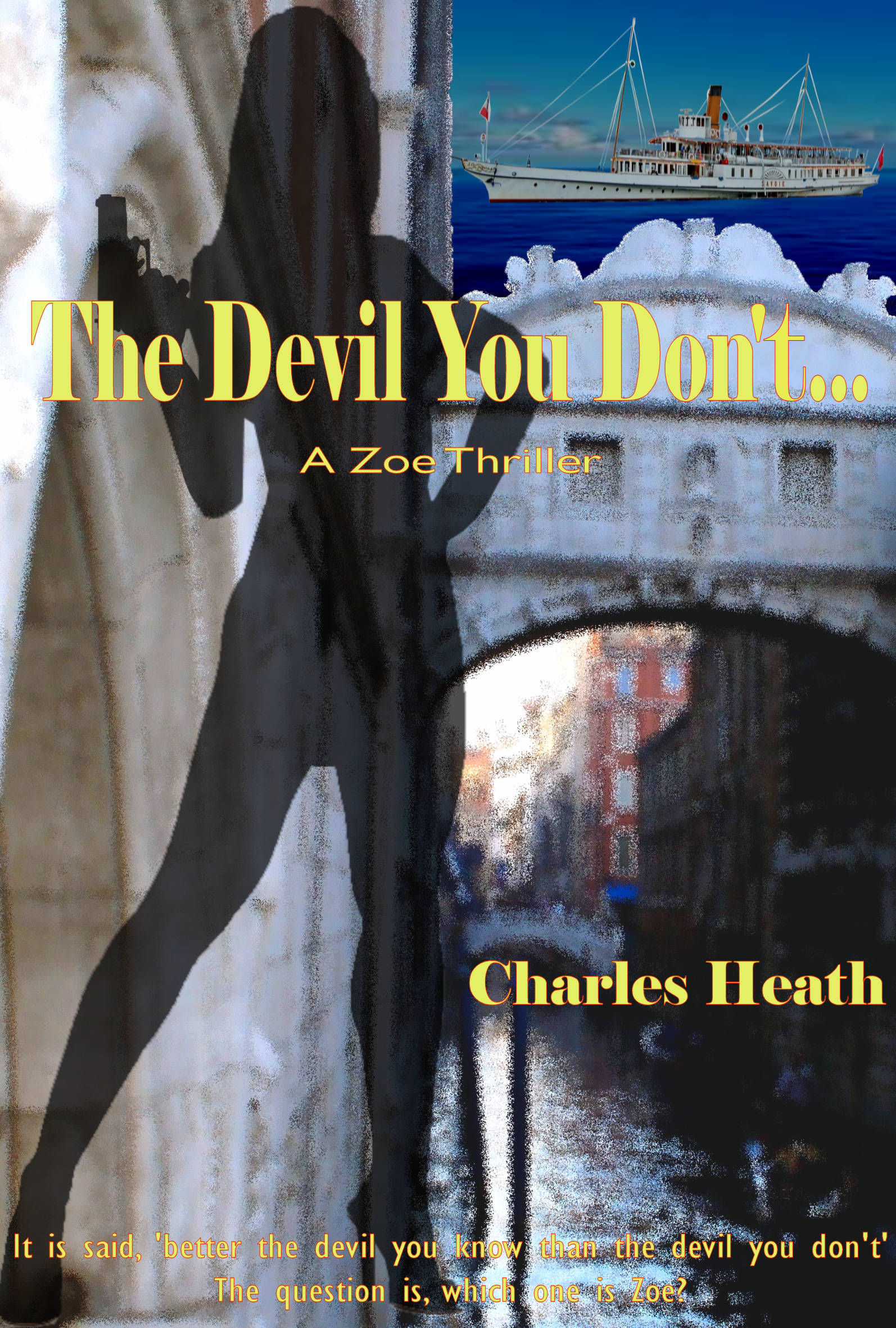
There’s a certain air of inevitability in the air, that the bad guys are going to succeed in tracking down Zoe, using the very person who wants to keep her safe.
IT’s not exactly the result of a sneaky plan using lies and deception to get what Worthington wants, it’s more a fact that the woman he is about to use had already made a bed for herself that others would hardly want to lie in.
Arabella was not a woman who understood or practiced monogamy. She was always a rebel, always had more than one man on the go, and had only married for the convenience, and the money and lifestyle that went with it.
Having children had been a bore, and once they were delivered, they were someone else’s problem. She was then able to go back to her jet-set lifestyle, touring and cruising the world.
It was also a world that which Worthington and his brother had moved in, and Worthington had been and still was, one of her lovers. It was what made it so easy for him to enlist her, though she was not really interested in what her son John was up to. He was too much like his father, and she needed little reminder of him.
For Worthington, he could not believe his luck, for a second time. It was as if the Gods were lining up the ducks all in a row for him.
But she agreed to a weekend in the best hotel eating the best food and going to a very exclusive concert, where they would be mingling with ‘almost’ royalty. She loved to drop names.
However, the secret was not a secret the moment she was seen with Worthington by Sebastian, all be it by chance. Sebastian would have to find John and alert him to the dangers that were about to present themselves in the benign form of his mother.
Could things get any more complicated?
…
Today’s writing, with Zoe languishing in a dungeon waiting for a white knight, 1,650 words, for a total of 52,769.
We were standing at the entrance of Aladdin’s cave. At least that was the name on the sign above the entrance.
Three days driving, the last 122 miles into the desert, or what was now desert, through three ghost towns, which looked like sets out of a movie, to what was once supposed to be a theme park.
In the middle of nowhere. Literally.
We’d parked in what was once a thousand car carpark now almost relatives by the sand, through a large gate that proclaimed the seven wonders of the world, through to a cliff face where there were several caves, where we were now.
“And remind me exactly why we are here?”
“We win the bidding war for this place. I mean, think of the potential.”
“I’m thinking, but not of the potential.”
Good thing then Lexie was not my wife or girlfriend, because if she was, she’d be questioning my sanity right about now.
She was a work friend, along for the ride.
Well, to begin either, this whole area was a storage facility for the nuclear weapons that were designated for destruction after the non-proliferation treaty. There are about a dozen caves around here, all with massive blast doors, of which Aladdin’s cave was the first. I can’t wait to see inside.”
“If it truly is Aladdin’s cave then should it not be riches beyond avarice. I want the lamp.”
There was only one small problem. I needed the code to open the doors, and that was only available once we had arrived. Once there, I was to give a person on the end of the phone a code, one that changed every day, once I proved my identity. It was a crazy system, but I had to admit, it made the cave secure.”
I made the call, once I could see the code. It was on the screen, behind a nuclear blast-proof window, rather apt considering. It was a code that changed every hour.
“The voice on the other end of the phone simply said, “Code please?”
I read it to them. As soon as the call was disconnected, the doors began to open.
Then behind me, another voice. “Thank you for that. Now, step away, or your friend here dies.”
I turned. I thought I recognized the voice of Joe Santiago, crime boss, a man who’d served his ten years, but never divulged where he had hidden the loot.
Another six months with guns were standing in a semi-circle, cutting off any exit I might try.
“So, this is where you hid the money, and key evidence.”
“And, as they say, it’s where the bodies are buried. This really wasn’t going to be a theme park.”
“O rather guessed that. I was expecting someone else, a lackey, but you did say one, you couldn’t trust any of those you worked with.”
With that said, six shots, six men down, and a seventh, at that moment when Santiago was disorientated by the first six shots. Not to kill but disable.
A well-planned and executed operation to catch Santiago, who had never suspected we had turned one of his gang and had known all along where his loot was.
Then it was just a matter of waiting until he got out of jail, after advertising the fact I’d won the auction to buy the Theme Park site, outbidding all of his people.
A visibly shaken Lexie said, “and when were you going to tell me we were going to be bait?”
“None of us were sure this was going to work.”
A swarm of agents moved in to take away the seven, including a cursing Santiago, who swore he’d been set up.
The doors were now open, and we were looking into a dark abyss. The light only went so far. I stepped inside and used the torch on the side wall, looking for the light switch.
It was about ten feet away, a large lever that had to be pushed up. I gave it a moment, then pushed it into the on position, and the lights came on.
I heard a gasp from Lexie and turned around.
It was huge, a cavern gouged out of the small mountain, all but empty except for a shipping container sitting about fifty yards from the entrance.
Yet another new voice came from behind us.
“We’ll take it from here.”
It belonged to an FBI agent, who was with three others. No guns were drawn, but I suspect if I objected, they might.
“Did you not get the memo that I am in charge here,” I said.
He handed me a phone, “Your commander would like a word.”.
I took it. “Sir?”
“We’ve been trumped by jurisdiction, just let them take over, but stay and let me know when they’ve gone.”
“There’s a shipping container right bang in the middle of the cave.”
“Let them take it “
He disconnected the call, and I returned the phone.
“Do as you wish.”
A forklift went past, and we watched as it picked up the container and took it to a waiting truck.
The FBI agent saluted, and he left with his team.
Lexie had watched the whole proceedings with an amused expression on her face. This was obviously not news to her. “Couldn’t have predicted that could we.”
I pulled out my phone and called the boss. “They’ve gone.”
“They went for the big shiny object. I’m surprised they didn’t realize Santiago is all about the show. I’m sure they’ll soon discover it’s booby-trapped, but that’s fine, they’ll take a while to realize they’ve been had. Now, you two go to work. The real evidence is hidden in there somewhere. Call me when you find it.”
Lexie looked over at me. “What did he say?”
“The evidence is still here, not in the container.”
She looked around at the wide, deep, open space where, if it was going to be Aladdin’s cave, there would be treasure stacked everywhere.
“I’m guessing we need yo do a sweep. You start on the other side, I’ll start here, and we’ll meet at the middle of the rear.”
I waited until she was in position, and then we moved towards the rear, studying the wall for hidden doors. It was possible that rooms or passages ran off this cave.
A few minutes later Lexie let out a triumphant “Ah-ha!”
I stopped. “What is it?”
She held up a small object that looked like the proverbial lamp.
“Aladdin’s lamp. Perhaps if I polish it.” She did so, with a flourish.
“Sunday in New York” is ultimately a story about trust, and what happens when a marriage is stretched to its limits.
When Harry Steele attends a lunch with his manager, Barclay, to discuss a promotion that any junior executive would accept in a heartbeat, it is the fact his wife, Alison, who previously professed her reservations about Barclay, also agreed to attend, that casts a small element of doubt in his mind.
From that moment, his life, in the company, in deciding what to do, his marriage, his very life, spirals out of control.
There is no one big factor that can prove Harry’s worst fears, that his marriage is over, just a number of small, interconnecting events, when piled on top of each other, points to a cataclysmic end to everything he had believed in.
Trust is lost firstly in his best friend and mentor, Andy, who only hints of impending disaster, Sasha, a woman whom he saved, and who appears to have motives of her own, and then in his wife, Alison, as he discovered piece by piece damning evidence she is about to leave him for another man.
Can we trust what we see with our eyes or trust what we hear?
Haven’t we all jumped to conclusions at least once in our lives?
Can Alison, a woman whose self-belief and confidence is about to be put to the ultimate test, find a way of proving their relationship is as strong as it has ever been?
John and Zoe are nowhere near Vienna, Zoe having gone to Bucharest and then Zurich on her way back to see John who was going to pick her up from the airport, then the both of them were going to Lucerne for a few days.
A reminiscing cruise on Lake Geneva had been on the cards, but there might not be time.
First, they had to do some work on charting who was trying to kill her, because she has finally come to the realization that there is more than one. Her visit to Bucharest yielded another name, quite possibly the person who was masquerading as Komarov.
Second, John was intending to introduce her to the new members of their team, the team he hasn’t quite got around to telling her about, who will be dedicated to research, investigation, and, via Isobel and the dark web, organizing the hits.
John had decided that she should not out there be distracted by finding work, just doing the work. He was going to take care of the rest.
Perhaps a good time would be over dinner?
Meanwhile, Sebastian and Rupert are on surveillance duties while Isobel is tracking down which hotel the lovebirds are staying in. As soon as she has the information, Rupert is on the job.
She then moved to track John, knowing Zoe will be with him because she has seen the passenger lists for flights from Bucharest to anywhere.
Both are thankful neither John nor Zoe was in Vienna, which then makes it a priority that neither Worthington of Arabella should leave, except to go back home. Although they hadn’t established it was the reason Worthington was in Vienna, it was too close to the bungled attempt on their lives for them not to draw the appropriate conclusion.
Sebastian has a plan B that no one was going to like, not even himself.
Plan A was yet to be formulated.
…
Today’s writing, with Zoe languishing in a dungeon waiting for a white knight, 1,566 words, for a total of 54,355.
This is rugged bushland not far from suburbia, though you wouldn’t know exactly where it is just by looking at the photograph
But, for the writer, this is an excellent setting.
For instance, once again we are out wandering in the bush, lost. It’s not hard to get lost, and stay lost if there are no recognizable landmarks, and given we all walk with a bias to one side or the other, and we have to avoid objects like trees, ravines, animals, and rocks, keeping a straight line is impossible.
But the question is, how did you get into the bush in the first place?
It’s not as if you would deliberately go there, just to if you can get lost.
No, my idea is that you have been kidnapped and drugged, then taken to a location either in the book of a car or just in the back seat with a hood, then dropped off and left to die
The criminals in this story are more efficient in getting rid of pesky witnesses.
Or maybe it’s something less sinister, like going out and counting the koalas in the bush, well, what’s left of the bush as the suburban spray takes more and more of the koala’s habitat.
And it could also be like the planet of the apes, the koalas start fighting back.
It could be said that of all the women one could meet, whether contrived or by sheer luck, what are the odds it would turn out to be the woman who was being paid a very large sum to kill you.
John Pennington is a man who may be lucky in business, but not so lucky in love. He has just broken up with Phillipa Sternhaven, the woman he thought was the one, but relatives and circumstances, and perhaps because she was a ‘princess’, may also have contributed to the end result.
So, what do you do when you are heartbroken?
That is a story that slowly unfolds, from the first meeting with his nemesis on Lake Geneva, all the way to a hotel room in Sorrento, where he learns the shattering truth.
What should have been a high turns out to be something else entirely, and from that point every thing goes to hell in a handbasket.
He suddenly realises his so-called friend Sebastian has not exactly told him the truth about a small job he asked him to do, the woman he is falling in love with is not quite who she says she is, and he is caught in the middle of a war between two men who consider people becoming collateral damage as part of their business.
The story paints the characters cleverly displaying all their flaws and weaknesses. The locations add to the story at times taking me back down memory lane, especially to Venice where in those back streets I confess it’s not all that hard to get lost.
All in all a thoroughly entertaining story with, for once, a satisfying end.
The problem is, there are familiar faces and a question of who is a friend and who is foe made all the more difficult because of the enemy, if it was the enemy, simply because it didn’t look or sound or act like the enemy.
Now, it appears, his problems stem from another operation he participated in, and because of it, he has now been roped into what might be called a suicide mission.
“That was far to bloody easy.” I heard Monroe’s voice come over the radio, not long after we left the camp.
“It was a bit easier than I thought. But I did make it quite clear if we didn’t all leave in one piece we’d reduce his camp to rubble with everyone in it.”
“He knows the territory. Something’s waiting for us out here.”
Something indeed.
Back at the camp, not only had the commander’s men search for the hidden weapons, and, when everyone checked, were still there, they had also taken off the crates with the film equipment. I was not sure what the commander was intending to do with the equipment, but what disappointed me was the fact we hadn’t taken the time to rescue the rocket launcher.
Now the commander had it.
If he bothered to search the crates properly. I suspect he was yet to do so. What we had rescued and successfully hidden were the C4 explosives and detonators. They might come in useful at the airstrip.
Just before we reached the fork in the road, where we would be turning left to head towards the airfield, and surprisingly had not run into any of the commander’s men, we stopped and let Monroe and Shurl out to make a sweep towards the airstrip, not too far away.
I also called up Mobley to see how he was.
The Colonel answered. “Everything is under control now.”
I didn’t like the sound of that. “What happened?”
“The kidnappers send out a team to intercept us on the way to the airstrip. It wasn’t a stretch to imagine they would know what we were planning because they’d know we would not be retracing out steps to Uganda. Got them before they got a shot off. I suspect there are Government troops at the airstrip, it’s too important to let anything happen to rich foreigners coming to see their wildlife reserve. There are several troop carriers, and we’ve seen a few men on the outskirts patrolling. There’s several at the gate if you could call it that.”
“Is there a plane there?”
“As it happens there is. A grand old DC3. It’s not a charter plane, so I’m guessing it belongs to an overentitled American big game hunter or the photographic variety. At least I’m hoping that’s the case.”
“What do you recommend?”
“Not to storm the field. You’re going to have to find another means of getting here, preferably without any fanfare.”
My first choice was to go in and get out, with as little firefight as possible, particularly in case they started shooting at the plane. If I was reading between the lines properly, the Colonel was telling me there were more troops there than we could handle quickly and quietly.
“Very good. Can you get sight on just how many troops are there, and if you can see who’s in charge?”
“Will try.”
Monroe had been standing next to me during the exchange.
“Three in place, two more on the perimeter, if we can cover as many as possible, you might be able to take the rest from the inside.”
Secreting the weapons again, maybe. It was a possibility, but going in with hidden weapons, and then found by the guards at the gate, who would be more efficient and careful searchers than the kidnappers, it would create hostility and itchy trigger fingers.
“No. We have to find some way of letting them feel as though they have complete control of the situation. They know we’re coming; the commander would have told them.” The only reason why he was still the cat who ate the canary. He might even have told them he had some men waiting as the first line of defense.
The airstrip commander would then know we were armed and relatively dangerous.
It was time for yet another dangerous gambit.
I picked up the radio. “Colonel?”
A second later, “Sergeant?”
“Whatever happens in the next twenty minutes or so, just ignore it. It’s not much of a plan, but it will get us onto the field.”
“And then?”
“Hopefully some divine intervention.”
Monroe looked skeptical. “You’re going to just drive up to the gate and surrender?”
“Not exactly. It won’t be fait accompli until we reach the terminal, or hanger, or whatever the commander has set up as headquarters. They’ll have most of our weapons, yes. But they won’t have all of us.”
“No. But they’ll know we have a sniper, so one of you are going to have to allow yourself to be captured, just to ease their minds.”
“Leaving one of us and Mobley and the Ugandans. Can we trust them?”
“I hope so, otherwise this could go badly. But, today, I’m an optimist. We’ve got this far.”
Trying to show more confidence in the plan that I had. It was always a worry when you had to trust people you didn’t know. That had been the problem the last time. At least this time we had managed to get the hostages. It was always going to be a problem getting them out.
Monroe gave me one of her special, you’re a fool, looks. “I hope you know what you’re doing.” She then nodded in Shurl’s direction and they disappeared into the bush again.
I gestured to Davies to come over.
“Did you find out what sort of plane it is?”
“Hopefully. The Colonel tells men there’s a DC3 off the airstrip. I assume you can fly one.”
She smiled, the first time since this operation had started. “Sure can. I spent three summers putting one back together. My dad has a sort of airplane museum. A DC3, a DC4, and a Lancaster, a very sorry looking Lancaster at that. Shouldn’t be a problem.”
“Then try to not get shot.”
“Do my very best not to.”
Once again, it was time to go. Going into the unknown was getting to be the norm, but hopefully, this would be the last time. I didn’t consider it wise to advise the hostages, they had their own problems to worry about.
It had been billed as the longest commercial flight in the world. London to Sydney.
Previous times it had been flown, it was devoid of passengers and cargo, except for a few reporters and airline staff; not more than about 20.
The plane, state of the art, was capable of flying twenty-one hours straight. We would only need Nineteen and a half. It was the first flight of its kind, and we were the first to participate in what was being touted as history-making.
I was on board only because I’d won a competition. To be honest, I couldn’t believe my luck.
I guess it was the same for the other 287 of us on board. With baggage and cargo included, oh, and not forgetting fuel, I guess our biggest concern was getting off the ground.
It wasn’t long before that fear had been dispelled, though for a moment more than one of us thought we might not get into the air. There were collective sighs of relief when we finally lurched into the air.
Once the seat belt sign went off, the First Officer spoke to the passengers, more or less telling us we were going to make history and to sit back and enjoy the in-flight service.
I guess it was ironic that as someone who didn’t like flying I was in this plane. The thing is, I didn’t expect to win the competition. But, I was on board for the experience and was going to make the most of it. I’d brought half a dozen crossword books.
I woke from an uneasy sleep about two hours before I e plane was due to land. The cabin lights had come on, and breakfast was about to be served.
Everyone else was in varying states of awareness. Some hadn’t slept at all, which was what usually happened to me, and they looked like I felt. Bleary-eyed and half awake.
I looked at the flight path in the headrest in front of me, and it said we had about an hour and fifty minutes, and from the outset, precisely on time. We’d had headwinds and tailwinds but neither had any lasting effect on our arrival time.
Something else did. After breakfast had been cleared away, and we were all getting ready for the last hour of the flight, word came through from the flight deck that we had to go into a holding pattern due to a problem on the ground.
The first question on everyone’s mind, did we have enough fuel. The Captain, this time, allayed that fear.
But, I was sitting over the wing where I could see the engine. I was not an expert but I thought I’d heard a murmur, the sort an engine made where the fuel supply was running out.
Perhaps not. Perhaps it was my overwrought imagination after not enough proper sleep.
Another half-hour passed, and I could feel a change in the plane’s flight. I was now listening and waiting and interpreting. The Captain said the problem was resolved and we were cleared to land.
That’s when the engine outside my window stuttered, if only for a fraction of a second.
Fortunately, we were well into our descent, and I could see the ground below. Now, going through some low cloud, the ride became bumpy, and I was sure it was covering the more frequent stuttering of the engine, and once, I was not the only one to hear it.
As the wheels went down and clunked into place, I think the engine stopped, though I couldn’t be sure, because there was little or no change in the plane’s flight other than a slight change in the plane’s speed but not its rate of descent, and none of us would have been any wiser had the pilot, in his usual calm manner, not told us there was a small problem with one of the engines but there was no problem with landing, and we would be on the ground in ten minutes.
In fact, the landing was, as any other I’d been on, flawless, even though I was sure I heard a slight stutter in the other ending, but by that time we were on the ground.
The only difference between this and any other landing was the accompaniment of several emergency services trucks, and the fact we were not going to a gate. Instead, we were taken to a bay not far from the runways, and then calmly taken off the plane.
From the ground, just before being loaded onto a bus, I could see the plane, and it looked the same as it had any other time.
What did bother me was several words spoken by what looked to be an engineer. He said, “That plane was literally flying on vapor. What you’re seeing is 228 of the luckiest people in the world.”
If ever there was an excuse to buy a lottery ticket…
One of the recurring memories I have of my childhood was the annual pilgrimage to Grand Marais, Minnesota, located on the North Shore of Lake Superior.
It was the place where my father grew up, along with three brothers and a sister, and where his parents had been born, lived, and eventually died.
The other memory, that his parents never came to visit us, we always had to go to them. That, and the fact my mother hated them, that animosity borne out of an event at their wedding that no one ever spoke about.
Not until a long, long time later, after my father had passed away.
We stopped going when I turned eighteen, though I don’t think that was the reason. Mt grandparents hadn’t died or gone anywhere, it was just the week before our pilgrimage was to begin, my father announced there would be no more visits.
You could see the relief on our mother’s face, much less ours because they were, to put it mildly, quirky. Steven, the youngest brother put it more succinctly, weird and creepy.
Perhaps it had been the house, a large sprawling two-story mansion that had been added to over the years, and reputed to have thirteen bedrooms. Thirteen.
They had a butler, a housekeeper, a chauffeur, and several housemaids. Odd, because I got the impression my grandfather didn’t work, and yet they were, reputedly, very wealthy. Equally odd, then, that wealth didn’t extend to my father.
Which, in the final analysis, was probably the reason why we stopped going. He had been cut out of the will.
…
Of course, none of this would have reached my consciousness if I had not received an email from one of the sones of my fathers, brother, and uncle who had never visited us, I’d seen probably three times in my life, and who had lived with his parents in the mansion.
I’d not seen, or heard of any children of any of the other brothers, or sisters, so this was a first, and aroused my curiosity. I had thought that our part of the family had been exorcised from all their collective memories.
Apparently not.
And, that curiosity would soon go into overdrive because with the email came an invitation to come and stay, and meet the other members of the family.
I had a sister, Molly, and called her once I got the email, and she said she had one too.
Was she going? Hell yes. It, for her, was going to be the unearthing of all the secrets.
What secrets, I asked, knowing full well there had been a few, but she had simply said I’d have to wait and see.
…
The drive brought back a lot of memories, and unconsciously I found myself listening to the same songs we did when Dad droves us.
Molly had come to my place, and we drove there together. In itself, it was a good reason for us to reunite after so long being apart. It was even more profound considering we did not live all that far apart, it was just life and family that got in the way.
She, like myself, found herself reliving the annual pilgrimages, her memories being hazier than mine, but that was because she was a lot younger.
She had been the one to leave home first, finding our restrictive parents unbearable. My departure took longer because my mother had implored me to stay, and not leave her with ‘that unbearable man’.
That final few miles from the outskirts of town, past the waterline, then inland was hushed with anticipation. I last remembered the house, although forbidding, as impeccably maintained, with gardens, I was sure, that featured in ‘Architectural Digest’.
This vision as we approached was so different than the last, in the last vestiges of the evening, a dark forbidding place still, only a lot more sinister. The gardens had been abandoned long ago, and everything was overgrown.
The fountain out front, the centerpiece of the gardens, was buried and gone.
The house had also fallen into disrepair, and I was surprised the local authorities hadn’t condemned it.
I parked the car in the driveway, and we sat there, staring at it.
“That motel back down the road is looking good,” Molly said.
The invitation also included staying in one of the thirteen rooms.
“Depends on how many ghosts there are.”
“The motel or here?”
I shrugged. “I guess we’d better get to the front door before it’s dark, just in case.”
Closer to the stairs leading up to a veranda, I could see the different shades of timber when rotten planks had been replaced. We made it to the front door, Molly hanging on to me just in case.
I pulled a ring dangling from a chain and heard a gong go off inside the house. A minute passed, two, then the door creaked open, and an old man in a dinner suit was standing there. “Mr. Garry, and Miss Molly, I presume.
He stood to one side before we answered, and we went in.
The inside was utterly different from the outside, having been renovated recently, much brighter than I remembered from the endless wood paneling. The old man ushered us into a large lounge room, on one side a huge log fire was burning, and around the walls, where there wasn’t a bookshelf full of books were family paintings.
“It’s like a mausoleum,” Molly said.
I recognized a lot of those faces in the paintings, including one of our father and mother together, probably not long after they were married. The men of that family all looked the same, except when it came to me, I looked more like my mother.
“Much better than it used to be.”
“I don’t remember much.”
To one side there was a large staircase that you could go up one side and down the other, and as children, we used to run up and down, and generally be annoying. Sliding down the banister was strictly forbidden, until after everyone went to bed.
I was half expecting to see the old man come from the depths of the house, but instead, a man that I could easily mistake as my father came through from the rear, where, I remembered, there was a room before the kitchens.
“Garry, I presume. And Molly. My God, it’s been too long.”
A shake of the hand for me, and a hug for Molly.
“David, or Jerry?”
“David. You remember. We used to run amok in this place.” He grinned.
He was the wild one, and all I did was follow. There were about seven of us, in the end, before we stopped coming.
“The others will be here tomorrow, and they’re dying to meet you. My dad was the last man standing, and he left the place to me, not that it was much by that time. I’ve spent years doing it up, but there’s a long way to go before it returns to its former glory. By the way, there are no ghosts in the bedrooms, and they are modernized with their own bathroom. I saw you out in the car before, looking horrified. Just a word to the wise, that motel does have ghosts. The jury is out on whether grandfather still roams the hallways, but I guess that’s something you’ll find out tonight. He was a horrid man by all accounts. Sorry, my wife says I babble when I’m nervous.”
“He does.” A woman, a few years older than Molly came out from the back.”
“Angelina?”
“You remember me.” She smiled.
I remembered her, had for a long time because back then, she was the first girl I thought I was madly in love with. The fact she was a cousin didn’t seem to matter. She just ignored me anyway.
And her beauty had not diminished over the years. “How could anyone forget you?”
“Yes, I had that effect on boys, didn’t I? It’s good to see you again.”
We both scored a hug, and yes, being close to her again did increase my heart rate just a little.
“Come,” David said, “sit and we’ll have a drink. Have you eaten?”
“Not for a while.”
“Then we were about to have a bite, I’m sure there’s plenty for everyone. Sit, and we’ll be back in a few minutes.”
“No wife, husband?”
“Yes on both accounts, but we would never bring them here. This family is difficult enough for us let alone outsiders. The rest of the group, well, you’ll see, are just plain quirky relatives. If you ever saw the Addams Family, TV series or movies, well, they’d fit right in here. But you’ll see. More on that soon.”
He and Angelina disappeared outback and silence fell over the room.
“Why do I get the feeling we might be murdered in our beds tonight?”
It was beginning to look like that was a possibility.
…
When David returned with the old man, Angelina, and what looked to be a maid with food and drinks, we sat down again, turning our fears of being murdered into a severe frightening of ghosts.
The old man was enough to think ghosts were alive in the house. It couldn’t possibly be the butler from the last time I saw him because he would have to be about 120 years old.
When all of us were settled, David began.
“There is another reason why I asked both of you here, along with all the others, by the way, there are around ten of us. Your father never told you the truth, or perhaps anything, of the situation when he stopped coming to visit his parents, did he?”
“He just said it was a difference of opinion, that his father would never see reason, didn’t like my mother or her family and gave up trying to be civil.”
“It was worse than that, he told him that if he didn’t give up your mother, he would cut him off from the family fortune, which eventually he did. It’s probably why you found life a little tougher for a few years.”
That was one way of putting it, we were taken out of our private schools and had just about all our leisure activities curtailed, and the worst, no more holidays. Mother even had to get a job, which disappointed her family, but they were not as rich as my father’s family was, so couldn’t help us financially.
“It was difficult.”
“Well, the good news is, your grandmother, our grandmother, was not as quirky or pedantic as her husband and never forgot the service your father did for her when he could. In that regard, she has left a bequest to both you and your sister, Molly. It’s been a long, hard battle to get it through the system, but it’s finally sorted.”
“I liked grandmother more than grandfather,” Molly said.
“Most of us did. He was a rebel himself, going against his family, a very interesting bunch themselves. Our quirkiness probably came from them, the last of the relatively unknown banking and railroad tycoons more famous in the 19th century than today where we are relatively forgotten. It is of course a blessing in disguise. But you ask, what is that quirkiness worth?”
“Not much I would imagine, after all this time. Our father taught us the value of money, so it’ll be nice to have some extra.”
“Some extra.” He smiled. “It’s about 125 million dollars, each. Enough I would say that you can now afford some quirks of your own.”
There’s a certain air of inevitability in the air, that the bad buys are going to succeed in tracking down Zoe, using the very person who wants to keep her safe.
IT’s not exactly the result of a sneaky plan using lies and deception to get what Worthington wants, it’s more a fact that the woman he is about to use had already made a bed for herself that others would hardly want to lie in.
Arabella was not a woman who understood or practiced monogamy. She was always a rebel, always had more than one man on the go, and had only married for the convenience, and the money and lifestyle that went with it.
Having children had been a bore, and once they were delivered, they were someone else’s problem. She was then able to go back to her jet-set lifestyle, touring and cruising the world.
It was also a world that which Worthington and his brother had moved in, and Worthington had been and still was, one of her lovers. It was what made it so easy for him to enlist her, though she was not really interested in what her son John was up to. He was too much like his father, and she needed little reminder of him.
For Worthington, he could not believe his luck, for a second time. It was as if the Gods were lining up the ducks all in a row for him.
But she agreed to a weekend in the best hotel eating the best food and going to a very exclusive concert, where they would be mingling with ‘almost’ royalty. She loved to drop names.
However, the secret was not a secret the moment she was seen with Worthington by Sebastian, all be it by chance. Sebastian would have to find John and alert him to the dangers that were about to present themselves in the benign form of his mother.
Could things get any more complicated?
…
Today’s writing, with Zoe languishing in a dungeon waiting for a white knight, 1,650 words, for a total of 52,769.