The cinema of my dreams – I always wanted to write a war story – Episode 34

For a story that was conceived during those long boring hours flying in a steel cocoon, striving to keep away the thoughts that the plane and everyone in it could just simply disappear as planes have in the past, it has come a long way.

Whilst I have always had a fascination with what happened during the second world war, not the battles or fighting, but in the more obscure events that took place, I decided to pen my own little sidebar to what was a long and bitter war.

And, so, it continues…


We gathered up what food there was to take with us.  There were no weapons left behind.  Leonardo had assumed correctly we would have used them if they’d been left there.

Carlo had changed slowly into an automaton, and I guess if I could read his mind, I’d know exactly what he was thinking.  Enrico had attached himself to Carlo, and I knew Carlo would look after him.

When I said that the burials would have to wait, Carlo agreed.

We had a short discussion on what we would be doing next, and in the first instance, we would be going back to the other soldiers and the church.  There, with both of our knowledge of the castle, its entrances, secret or otherwise, and the internal passageways which I knew Wallace and the others there were not too familiar with, we would formulate a plan to go in and pick them off one by one.

It seemed a good plan when we first talked about it, but on the way back to the church, and I had time to consider how it would work, it seemed we would only get an advantage once, and we would have to kill or capture as many as we could in the first raid.

Then it was going to be difficult.

Unless Carlo knew of more places we could enter the castle without being seen or heard.

I only knew of three.

And the first post we had to hit, and silence, the radio room.


My war had not been as start or as terrifying as most of those whom I’d known or worked with.  My part was more selective, finding and eliminating spies, informers, and enemy cells on home territory.  

Sometimes that would extend into enemy territory, particularly France where, as one who could speak French fluently, I found myself working with the resistance, using intelligence gathered by a network of spies we had, not only in France but in all parts of enemy territory.  That also meant, sometimes, accompanying weapons and other supplies into enemy territory.

It hadn’t included anything like what I’d just seen back at the underground cavern.

I’d been told, often, about the enemy executing whole villages, and large groups as retaliation for resistance operations that killed German soldiers, and particularly officers, but I’d not seen it first-hand.

Now I had.

I’d been told, along with the others who had been at the training camp way back at the start of the war, that we would inevitably see atrocities.  Those instructors, men who had survived the first war, were speaking from experience.  We were told it would make us angry.  It had.  I had this immediate thought of doing as much damage as I could to the perpetrators of that massacre.

But we had also been told that we had to harness that anger, and use it to drive our actions, bot in a reckless manner, but with a measured calm and with planning.  Blind rage, which had been predicted, would only get us killed.

I had left the cavern at the blind rage stage, but the walk to the church wore some of that off, and I began to piece together the seeds of a plan to get our revenge.  We were only a small group, but even so, we could work more efficiently than those at the castle. 

Leonardo was not going to tell Wallace that he hadn’t captured or killed me in his ambush, but it might make Wallace think that my ability to retaliate would be weakened.  Leonardo would know that Carlo and I were still alive.  He would not know about Blinky and his men.

It would be interesting to see if Wallace would commit any of his men to hunt us down, send Leonardo back out to finish the job, or just wait until Meyer turned up.  His contact in Gaole would know about the castle’s change of allegiance, but he would not know that Martina was not going to be there to greet them when they arrived in the village.

That was several days away.  We would have to be there, but it was going to be dangerous unless we found a way to neutralize the castle.  So far, in my head, we’d neutralized the radio and got as far as the dungeons before meeting enemy resistance.

The same had happened in the next six scenarios, after playing out the last we had arrived back at the church.


Chiara was resting as comfortably as the Sergeant could make her.

He had made a more thorough assessment of her injuries, and aside for the severe beating, she had sustained a few cracked ribs and several broken fingers.  The broken fingers were a surprise.  The sergeant had reset them as best he could.

Other than that, she would recover physically.  Mentally, he said, would be something else.  She was lucky, he said, her torturer was an amateur, and Italian.  Had it been the German Gestapo, she would be dead.

She was lucid and I told her we would make Leonardo pay for what he’d done.  I thought it best not to tell her about what had happened back at the cavern.  She had enough on her conscience without adding the senseless deaths of the villagers.

Then we had a meeting, where I asked Carlo to draw a plan of the castle and the places where we could breach their defenses and give us an element of surprise.

He had one that I hadn’t known about, one that might give us a fighting chance.

© Charles Heath 2020

An alternate A to Z Challenge – T is for – “This is getting interesting…”


The story below was the one that was supposed to be published under T, but the month got away from me and I was not able to get most of what I wanted to do done.

After all, it was the A to Z as well as NaNoWriMo for April, and the notion I could write 26 short stories and complete a 50,000 word novel at the same time…

What was I thinking?

Anyway, I had the bones of the story written, I just needed time to finish it. So, here it is, as will for the next few days, stories for U, V, W, X, Y and Z.

The email I received said:

“Go to Newark airport, go to the United booking desk and give them your name. Take proof of identity. Pack for five days, light.”

It was going to be, supposedly, a magical mystery tour. I read in a travel magazine, that a company offered five day inclusive trips to anywhere. You do not get the destination, just what to take. Then, just be prepared for anything.

I paid the money and waited, until last evening when the email came.

I was ready.

When I presented my credentials as requested, I found myself going to Venice, Italy, a place I had never been before.

When I looked it up, it said it took about 10 hours to get there with one stop in between. Enough time to read up on the many places to go and see, though according to the instructions, everything had been arranged in advance.

I could also take the time to brush up my schoolboy Italian.

When I got off the plane at Marco Polo airport, in Venice, it was mid-morning, but an hour or so was lost going through immigration and customs. A water taxi was waiting to take me to a hotel where I would receive further instructions. I was hoping it would on or overlooking the Grand Canal.

At the airport I wondered if there was going to be anyone else on this trip, or whether I would be doing it alone. I’d read sometimes likeminded people were put together for a shared experience.

We had to agree and then fill out an extensive profile so they could appropriately match people. Sometimes, people joined at different times along the way, you just never knew what was going to happen.

That random unpredictability was just what I needed having just gone through a breakup after a long period of peacefulness and stability, and frankly, I would not have chosen this type of tour if I had not.

It was a pleasant half hour or so winding our way through the canals, having paid the driver extra to take long route. I’d not been in Venice before, but I had read about it, and while some of the negative comments were true, it didn’t diminish the place in my eyes.

And the hotel, on its own island overlooking the main canal was stylish and elegant, and my room exactly where I’d hoped it would be. I think I spent the next hour just looking out at the city, and the boats going by, like a freeway or turnpike, a never-ending stream of traffic.

A knock on the door interrupted what might have been described as a reverie, by one of the concierge staff delivering an envelope with my name on it.

Perhaps more instructions.

“Tomorrow will be a free day in Venice. See attached suggested itinerary for ideas on what to do. Then, the following day you will be travelling from Venice to Florence by train departing Santa Maria Novella at 10:20 am.”

I looked at the list of suggested places to visit and a day would not be enough, but I could always come back. I’d always assumed this trip would give me some idea of what was on offer, and that if it was great, I could always come back.

A second reading of the instructions picked up something I’d almost missed. A dining party in the hotel where others like myself, with similar arrangements to mine might attend. It was underlined that it was not mandatory to attend, only if you wanted to.

The only provisor was that you do not talk about where you were going, only about yourselves, an opportunity to meet others and not dine alone. It was an interesting idea. All we had to do was give our name and the time of the booking.

I would think about it.

I arrived at the entrance to the restaurant at five minutes to eight, after a long deliberation on the merits of whether I wanted to see the other travellers.

At first, I thought what the point would be if you couldn’t talk about where you were going, but, after more thought, I wondered what it was that motivated those people who had also opted for a leap into the unknown.

These were not adventure holidays as such, just someone else planning the itinerary so you didn’t have to.

I gave the maitre’d my name and he escorted me to a table set for ten, of which four people were already seated. Were they expecting ten? Would anyone not turn up?

We exchanged greetings and I sat. Two men, two women, sitting together. My first thought, two couples, but I would not make any assumptions.

One of the women spoke first, “My name is Marina Delosa. I assume you are another intrepid traveller?”

“Ben Davis. I’m not so sure about the intrepid part, just lazy, I think, because I’m not very good at arranging my own travel.”

“I think you might say that applies to all of us,” she said.

The others introduced themselves as Angela and Harry Benson, and David Wilson.

“We were quite pleased they chose to start our tour in Italy. I have always wanted to visit Venice, so the travel Gods must be smiling on us,” Harry said.

“I must say I was surprised. I guess it’s one of the benefits of this type of travel, not knowing where you’re going to end up. I think my secret wish was to come here, too, or at least Italy. I think I have a relative or two that came from here.”

“That might be said for all of us,” Marina said. “One part Italian, one part Irish, and not quite sure what the other parts are.”

Another intrepid adventurer arrived at the table, another woman. She was older than the rest of us, but I would not think by more than ten years. She had the same look of trepidation I had felt before coming. And, at a guess, recently divorced, or separated.

“Anne Lebroski,” she said, leaving a seat between her and I. It was an interesting move. I had deliberately not tried to distance myself.

Only six of a possible ten arrived, and it turned out to be a very good evening. Whilst all of us had that battle within not to talk about where we were going, it seemed to force the issue of talking more about where we had been previously, and what we did with our lives.

And as quickly as it had begun it was over and everyone kept the conversation going until the elevator dropped us off, each to a different floor, as if we were deliberately being kept apart. Of course, it was simply my overactive imagination conjuring up different scenarios, perhaps in an effort to make a simple holiday seem more exciting

Suddenly, once back in my room, a great tiredness came over me and I barely made it into bed. Would we all run into each other the next morning over breakfast? It was a thought that kept me awake for all of a few minutes before slipping into an uneasy sleep.

When I woke up, I was confused and disorientated.

In those initial few seconds, and through the blurry eyes of just having woken, what I saw was unfamiliar.

I was definitely not in my room at home.

It took a few more seconds, in fact, almost a minute, before I realised that I was not at home. It was a hotel room, and quite unusual, light seeping through the thick curtains that covered what had to be a window.

Was in morning, afternoon, or evening? It had to be morning.

And, what was I doing in a hotel room?

When some of the fog had cleared away, I slipped out from under the sheet, and crossed over to the desk on the other side of the room. I pulled the curtain aside slightly and more light came in, splashing across the desk. On it was a piece of paper, a receipt, with the name Hilton Molino Stucky, Venice on it.

What was I doing in Venice?

I pulled the curtains further aside and looked out the window. It overlooked a body of water, and right then, a very large cruise liner was passing by. A very, very large cruise ship.

Then, behind me I heard a noise and turned.

There was someone else in the bed, a head appeared from under the sheet and looked over at me. A woman, messy blonde hair and a familiar face.

I didn’t remember coming to Venice or travelling with anyone. I was sorely tempted to say, “Who are you?” but stifled it. Instead, I asked, in what was a croaky voice, “What happened last night?”

The woman looked surprised. “You don’t remember?”

“To be honest, I’m having a hard time remembering where I am, let alone what I was doing?”

“Well, for starters, you were drinking copious quantities of champagne, which you well know you should not because of what it does to you.”

OK, that had a semblance of truth about it, not that I remember drinking champagne, but what it does to me. Exactly what was happening now. Last time, well, I couldn’t remember, but it wasn’t good.

Still, I didn’t know who this woman was, but I had enough sense to play along. The taste in my mouth reminded me of drinking too much wine, which was what I used to do.

“This much is true. When…” There I stopped, realising how it might sound.

Another look, not of surprise, but disdain perhaps?

“You don’t remember my arriving last night. Nor, I’m willing to bet, inviting me here. You rang two days ago, said you just arrived in Venice, and knowing I was on assignment in Rome, called me, asking if I wanted to come and see you, stay a day or two.”

It was not something I would have done, but for the simple reason I didn’t know anyone in Rome to call. But, oddly, she looked familiar. “Marina?” I said, almost under my breath.

The smile returned. “You do remember.”

“Barely, along with dinner the other night, with some other people. Tourists?”

“Yes. Two days ago, you said you’d asked some travel agents to pick your destination, and it ended up in Venice, along with several others. We’re supposed to be going to Florence this morning, but I was hesitant waking you in case you weren’t feeling well.”

Well, that part was true. I wasn’t. And that reference to Florence, it seemed likely. There was another piece of paper on the desk, an itinerary which said I was travelling to Florence by train.
I looked at the clock beside the bed.

6:17 am.

I looked at the itinerary, and the train was at 11 am.

The itinerary had two names on it. Ben and Marina Davis. I knew I was Ben, but I didn’t remember anything about having a wife, or friend, named Marina. More of the fog had lifted in my brain, and every instinct was telling me to play along. I don’t know why that message popped into my head at that exact moment, but it did.

“We’ve got five hours before the train leaves. I suspect it might be a good idea to start getting ready. I’ll call down for coffee, and, bearing in mind I’ve lost all sense of orientation and not exactly sure of everything going around me, as you say I should not be drinking wine in copious quantities, I’ll toss you the phone so you can order whatever you want. Sorry, but for the moment, I’ve forgotten everything.”

Let her counter that, or also play along. Her expression told me she was thinking about what I said, but then shrugged. “You don’t remember asking me, do you?”

“I do remember something, and it involves you because you are very familiar to me, so don’t be too upset. I am glad you’re here, because I was simply dreading travelling in Italy by myself, and you are almost a native. There, I knew there was a perfectly good reason why you’re here.”

She didn’t look quite so sure. “I’ll be in the bathroom,” she said. “Coffee will be fine. I think I had too much to drink last night too.”

After she disappeared into the bathroom and closed the door, odd, I thought, for a woman who had slept in the same bed as I, I called down for coffee and croissants. By that time, I was feeling better, and the queasy stomach was subsiding.

Twenty minutes later there was a knock on the door.

Room service.

“Ben.”

I did remember the person outside the door, dressed as the room service waiter. “Alan.”

“They took the bait?”

“Obviously. Too much booze…”

“Slipped you a mickey. Be careful. These two don’t play by the rules. Luigi is downstairs pacing like a cat ready to pounce. Thin short guy in a cheap black suit, pink shirt and grey tie.” Alan shook his head. “No dress sense whatsoever.”

“I don’t remember much.”

“Nothing happened, don’t worry. Had eyes on you the whole time like we promised. Now, you’ve a train to catch. Just be careful.”

He brought the tray in and put it on the desk.

Marina chose that moment to open the door.

“Room service,” I said. “Coffee for two. There’s a croissant too if you want one.”

“Sir,” Alan muttered, and headed for the door, remembering at the last second to produce a form for me to sign.

Then he was gone.

Fog cleared, everything came back in a rush. She was still standing in the doorway, the only think between her and modest, a large white towel wrapped around her. Beautiful but deadly, Alan had said.

Let the games commence.

© Charles Heath 2020-2021

An excerpt from “One Last Look”: Charlotte is no ordinary girl

This is currently available at Amazon herehttp://amzn.to/2CqUBcz


I’d read about out of body experiences, and like everyone else, thought it was nonsense.  Some people claimed to see themselves in the operating theatre, medical staff frantically trying to revive them, and being surrounded by white light.

I was definitely looking down, but it wasn’t me I was looking at.

It was two children, a boy and a girl, with their parents, in a park.

The boy was Alan.  He was about six or seven.  The girl was Louise, and she was five years old.  She had long red hair and looked the image of her mother.

I remember it now, it was Louise’s birthday and we went down to Bournemouth to visit our Grandmother, and it was the last time we were all together as a family.

We were flying homemade kites our father had made for us, and after we lay there looking up at the sky, making animals out of the clouds.  I saw an elephant, Louise saw a giraffe.

We were so happy then.

Before the tragedy.


When I looked again ten years had passed and we were living in hell.  Louise and I had become very adept at survival in a world we really didn’t understand, surrounded by people who wanted to crush our souls.

It was not a life a normal child had, our foster parents never quite the sort of people who were adequately equipped for two broken-hearted children.  They tried their best, but their best was not good enough.

Every day it was a battle, to avoid the Bannister’s and Archie in particular, every day he made advances towards Louise and every day she fended him off.

Until one day she couldn’t.

Now I was sitting in the hospital, holding Louise’s hand.  She was in a coma, and the doctors didn’t think she would wake from it.  The damage done to her was too severe.

The doctors were wrong.

She woke, briefly, to name her five assailants.  It was enough to have them arrested.  It was not enough to have them convicted.

Justice would have to be served by other means.


I was outside the Bannister’s home.

I’d made my way there without really thinking, after watching Louise die.  It was like being on autopilot, and I had no control over what I was doing.  I had murder in mind.  It was why I was holding an iron bar.

Skulking in the shadows.  It was not very different from the way the Bannister’s operated.

I waited till Archie came out.  I knew he eventually would.  The police had taken him to the station for questioning, and then let him go.  I didn’t understand why, nor did I care.

I followed him up the towpath, waiting till he stopped to light a cigarette, then came out of the shadows.

“Wotcha got there Alan?” he asked when he saw me.  He knew what it was, and what it was for.

It was the first time I’d seen the fear in his eyes.  He was alone.

“Justice.”

“For that slut of a sister of yours.  I had nuffing to do with it.”

“She said otherwise, Archie.”

“She never said nuffing, you just made it up.”  An attempt at bluster, but there was no confidence in his voice.

I held up the pipe.  It had blood on it.  Willy’s blood.  “She may or may not have Archie, but Willy didn’t make it up.  He sang like a bird.  That’s his blood, probably brains on the pipe too, Archie, and yours will be there soon enough.”

“He dunnit, not me.  Lyin’ bastard would say anything to save his own skin.”  Definitely scared now, he was looking to run away.

“No, Archie.  He didn’t.  I’m coming for you.  All of you Bannisters.  And everyone who touched my sister.”


It was the recurring nightmare I had for years afterwards.

I closed my eyes and tried to shut out the thoughts, the images of Louise, the phone call, the visit to the hospital and being there when she succumbed to her injuries.  Those were the very worst few hours of my life.

She had asked me to come to the railway station and walk home with her, and I was running late.  If I had left when I was supposed to, it would never have happened and for years afterwards, I blamed myself for her death.

If only I’d not been late…

When the police finally caught the rapists, I’d known all along who they’d be; antagonists from school, the ring leader, Archie Bannister, a spurned boyfriend, a boy whose parents, ubiquitously known to all as ‘the Bannister’s, dealt in violence and crime and who owned the neighbourhood.  The sins of the father had been very definitely passed onto the son.

At school, I used to be the whipping boy, Archie, a few grades ahead of me, made a point of belting me and a few of the other boys, to make sure the rest did as they were told.  He liked Louise, but she had no time for a bully like him, even when he promised he would ‘protect’ me.

I knew the gang members, the boys who tow-kowed to save getting beaten up, and after the police couldn’t get enough information to prosecute them because everyone was too afraid to speak out, I went after Willy.  There was always a weak link in a group, and he was it.

He worked in a factory, did long hours on a Wednesday and came home after dark alone.  It was a half mile walk, through a park.  The night I approached him, I smashed the lights and left it in darkness.  He nearly changed his mind and went the long way home.

He didn’t.

It took an hour and a half to get the names.  At first, when he saw me, he laughed.  He said I would be next, and that was four words more than he knew he should have said.

When I found him alone the next morning I showed him the iron bar and told him he was on the list.  I didn’t kill him then, he could wait his turn, and worry about what was going to happen to him.

When the police came to visit me shortly after that encounter, no doubt at the behest of the Bannister’s, the neighbourhood closed ranks and gave me an ironclad alibi.  The Bannister’s then came to visit me and threatened me.  I told them their days were numbered and showed them the door.

At the trial, he and his friends got off on a technicality.  The police had failed to do their job properly, but it was not the police, but a single policeman, corrupted by the Bannisters.

Archie could help but rub it in my face.  He was invincible.

Joe Collins took 12 bullets and six hours to bleed out.  He apologized, he pleaded, he cried, he begged.  I didn’t care.

Barry Mills, a strong lad with a mind to hurting people, Archie’s enforcer, almost got the better of me.  I had to hit him more times than I wanted to, and in the end, I had to be satisfied that he died a short but agonizing death.

I revisited Willy in the hospital.  He’d recovered enough to recognize me, and why I’d come.  Suffocation was too good for him.

David Williams, second in command of the gang, was as tough and nasty as the Bannisters.  His family were forging a partnership with the Bannister’s to make them even more powerful.  Outwardly David was a pleasant sort of chap, affable, polite, and well mannered.  A lot of people didn’t believe he could be like, or working with, the Bannisters.

He and I met in the pub.  We got along like old friends.  He said Willy had just named anyone he could think of, and that he was innocent of any charges.  We shook hands and parted as friends.

Three hours later he was sitting in a chair in the middle of a disused factory, blindfolded and scared.  I sat and watched him, listened to him, first threatening me, and then finally pleading with me.  He’d guessed who it was that had kidnapped him.

When it was dark, I took the blindfold off and shone a very bright light in his eyes.  I asked him if the violence he had visited upon my sister was worth it.  He told me he was just a spectator.

I’d read the coroner’s report.  They all had a turn.  He was a liar.

He took nineteen bullets to die.

Then came Archie.

The same factory only this time there were four seats.  Anna Bannister, brothel owner, Spike Bannister, head of the family, Emily Bannister, sister, and who had nothing to do with their criminal activities.  She just had the misfortune of sharing their name.

Archie’s father told me how he was going to destroy me, and everyone I knew.

A well-placed bullet between the eyes shut him up.

Archie’s mother cursed me.  I let her suffer for an hour before I put her out of her misery.

Archie remained stony-faced until I came to Emily.  The death of his parents meant he would become head of the family.  I guess their deaths meant as little to him as they did me.

He was a little more worried about his sister.

I told him it was confession time.

He told her it was little more than a forced confession and he had done nothing to deserve my retribution.

I shrugged and shot her, and we both watched her fall to the ground screaming in agony.  I told him if he wanted her to live, he had to genuinely confess to his crimes.  This time he did, it all poured out of him.

I went over to Emily.  He watched in horror as I untied her bindings and pulled her up off the floor, suffering only from a small wound in her arm.  Without saying a word she took the gun and walked over to stand behind him.

“Louise was my friend, Archie.  My friend.”

Then she shot him.  Six times.

To me, after saying what looked like a prayer, she said, “Killing them all will not bring her back, Alan, and I doubt she would approve of any of this.  May God have mercy on your soul.”


Now I was in jail.  I’d spent three hours detailing the deaths of the five boys, everything I’d done; a full confession.  Without my sister, my life was nothing.  I didn’t want to go back to the foster parents; I doubt they’d take back a murderer.

They were not allowed to.

For a month I lived in a small cell, in solitary, no visitors.  I believed I was in the queue to be executed, and I had mentally prepared myself for the end.

Then I was told I had a visitor, and I was expecting a priest.

Instead, it was a man called McTavish. Short, wiry, and with an accent that I could barely understand.

“You’ve been a bad boy, Alan.”

When I saw it was not the priest I told the jailers not to let him in, I didn’t want to speak to anyone.  They ignored me.  I’d expected he was a psychiatrist, come to see whether I should be shipped off to the asylum.

I was beginning to think I was going mad.

I ignored him.

“I am the difference between you living or dying Alan, it’s as simple as that.  You’d be a wise man to listen to what I have to offer.”

Death sounded good.  I told him to go away.

He didn’t.  Persistent bugger.

I was handcuffed to the table.  The prison officers thought I was dangerous.  Five, plus two, murders, I guess they had a right to think that.  McTavish sat opposite me, ignoring my request to leave.

“Why’d you do it?”

“You know why.”  Maybe if I spoke he’d go away.

“Your sister.  By all accounts, the scum that did for her deserved what they got.”

“It was murder just the same.  No difference between scum and proper people.”

“You like killing?”

“No-one does.”

“No, I dare say you’re right.  But you’re different, Alan.  As clean and merciless killing I’ve ever seen.  We can use a man like you.”

“We?”

“A group of individuals who clean up the scum.”

I looked up to see his expression, one of benevolence, totally out of character for a man like him.  It looked like I didn’t have a choice.


Trained, cleared, and ready to go.

I hadn’t realized there were so many people who were, for all intents and purposes, invisible.  People that came and went, in malls, in hotels, trains, buses, airports, everywhere, people no one gave a second glance.

People like me.

In a mall, I became a shopper.

In a hotel, I was just another guest heading to his room.

On a bus or a train, I was just another commuter.

At the airport, I became a pilot.  I didn’t need to know how to fly; everyone just accepted a pilot in a pilot suit was just what he looked like.

I had a passkey.

I had the correct documents to get me onto the plane.

That walk down the air bridge was the longest of my life.  Waiting for the call from the gate, waiting for one of the air bridge staff to challenge me, stepping onto the plane.

Two pilots and a steward.  A team.  On the plane early before the rest of the crew.  A group that was committing a crime, had committed a number of crimes and thought they’d got away with it.

Until the judge, the jury and their executioner arrived.

Me.

Quick, clean, merciless.  Done.

I was now an operational field agent.


I was older now, and I could see in the mirror I was starting to go grey at the sides.  It was far too early in my life for this, but I expect it had something to do with my employment.

I didn’t recognize the man who looked back at me.

It was certainly not Alan McKenzie, nor was there any part of that fifteen-year-old who had made the decision to exact revenge.

Given a choice; I would not have gone down this path.

Or so I kept telling myself each time a little more of my soul was sold to the devil.

I was Barry Gamble.

I was Lenny Buckman.

I was Jimmy Hosen.

I was anyone but the person I wanted to be.

That’s what I told Louise, standing in front of her grave, and trying to apologize for all the harm, all the people I’d killed for that one rash decision.  If she was still alive she would be horrified, and ashamed.

Head bowed, tears streamed down my face.

God had gone on holiday and wasn’t there to hand out any forgiveness.  Not that day.  Not any day.


New York, New Years Eve.

I was at the end of a long tour, dragged out of a holiday and back into the fray, chasing down another scumbag.  They were scumbags, and I’d become an automaton hunting them down and dispatching them to what McTavish called a better place.

This time I failed.

A few drinks to blot out the failure, a blonde woman who pushed my buttons, a room in a hotel, any hotel, it was like being on the merry-go-round, round and round and round…

Her name was Silvia or Sandra, or someone I’d met before, but couldn’t quite place her.  It could be an enemy agent for all I knew or all I cared right then.

I was done.

I’d had enough.

I gave her the gun.

I begged her to kill me.

She didn’t.

Instead, I simply cried, letting the pent up emotion loose after being suppressed for so long, and she stayed with me, holding me close, and saying I was safe, that she knew exactly how I felt.

How could she?  No one could know what I’d been through.

I remembered her name after she had gone.

Amanda.

I remembered she had an imperfection in her right eye.

Someone else had the same imperfection.

I couldn’t remember who that was.

Not then.


I had a dingy flat in Kensington, a place that I rarely stayed in if I could help it.  After five-star hotel rooms, it made me feel shabby.

The end of another mission, I was on my way home, the underground, a bus, and then a walk.

It was late.

People were spilling out of the pub after the last drinks.  Most in good spirits, others slightly more boisterous.

A loud-mouthed chap bumped into me, the sort who had one too many, and was ready to take on all comers.

He turned on me, “Watch where you’re going, you fool.”

Two of his friends dragged him away.  He shrugged them off, squared up.

I punched him hard, in the stomach, and he fell backwards onto the ground.  I looked at his two friends.  “Take him home before someone makes mincemeat out of him.”

They grabbed his arms, lifted him off the ground and took him away.

Out of the corner of my eye, I could see a woman, early thirties, quite attractive, but very, very drunk.  She staggered from the bar, bumped into me, and finished up sitting on the side of the road.

I looked around to see where her friends were.  The exodus from the pub was over and the few nearby were leaving to go home.

She was alone, drunk, and by the look of her, unable to move.

I sat beside her.  “Where are your friends?”

“Dunno.”

“You need help?”

She looked up, and sideways at me.  She didn’t look the sort who would get in this state.  Or maybe she was, I was a terrible judge of women.

“Who are you?” she asked.

“Nobody.”  I was exactly how I felt.

“Well Mr Nobody, I’m drunk, and I don’t care.  Just leave me here to rot.”

She put her head back between her knees, and it looked to me she was trying to stop the spinning sensation in her head.

Been there before, and it’s not a good feeling.

“Where are your friends?” I asked again.

“Got none.”

“Perhaps I should take you home.”

“I have no home.”

“You don’t look like a homeless person.  If I’m not mistaken, those shoes are worth more than my weekly salary.”  I’d seen them advertised, in the airline magazine, don’t ask me why the ad caught my attention.

She lifted her head and looked at me again.  “You a smart fucking arse are you?”

“I have my moments.”

“Have them somewhere else.”

She rested her head against my shoulder.  We were the only two left in the street, and suddenly in darkness when the proprietor turned off the outside lights.

“Take me home,” she said suddenly.

“Where is your place?”

“Don’t have one.  Take me to your place.”

“You won’t like it.”

“I’m drunk.  What’s not to like until tomorrow.”

I helped her to her feet.  “You have a name?”

“Charlotte.”


The wedding was in a small church.  We had been away for a weekend in the country, somewhere in the Cotswolds, and found this idyllic spot.  Graves going back to the dawn of time, a beautiful garden tended by the vicar and his wife, an astonishing vista over hills and down dales.

On a spring afternoon with the sun, the flowers, and the peacefulness of the country.

I had two people at the wedding, the best man, Bradley, and my boss, Watkins.

Charlotte had her sisters Melissa and Isobel, and Isobel’s husband Giovanni, and their daughter Felicity.

And one more person who was as mysterious as she was attractive, a rather interesting combination as she was well over retirement age.  She arrived late and left early.

Aunt Agatha.

She looked me up and down with what I’d call a withering look.  “There’s more to you than meets the eye,” she said enigmatically.

“Likewise I’m sure,” I said.  It earned me an elbow in the ribs from Charlotte.  It was clear she feared this woman.

“Why did you come,” Charlotte asked.

“You know why.”

Agatha looked at me.  “I like you.  Take care of my granddaughter.  You do not want me for an enemy.”

OK, now she officially scared me.

She thrust a cheque into my hand, smiled, and left.

“Who is she,” I asked after we watched her depart.

“Certainly not my fairy godmother.”

Charlotte never mentioned her again.


Zurich in summer, not exactly my favourite place.

Instead of going to visit her sister Isobel, we stayed at a hotel in Beethovenstrasse and Isobel and Felicity came to us.  Her husband was not with her this time.

Felicity was three or four and looked very much like her mother.  She also looked very much like Charlotte, and I’d remarked on it once before and it received a sharp rebuke.

We’d been twice before, and rather than talk to her sister, Charlotte spent her time with Felicity, and they were, together, like old friends.  For so few visits they had a remarkable rapport.

I had not broached the subject of children with Charlotte, not after one such discussion where she had said she had no desire to be a mother.  It had not been a subject before and wasn’t once since.

Perhaps like all Aunts, she liked the idea of playing with a child for a while and then give it back.

Felicity was curious as to who I was, but never ventured too close.  I believed a child could sense the evil in adults and had seen through my facade of friendliness.  We were never close.

But…

This time, when observing the two together, something quite out of left field popped into my head.  It was not possible, not by any stretch of the imagination, but I thought she looked like my mother.

And Charlotte had seen me looking in their direction.  “You seem distracted,” she said.

“I was just remembering my mother.  Odd moment, haven’t done so for a very long time.”

“Why now?”  I think she had a look of concern on her face.

“Her birthday, I guess,” I said, the first excuse I could think of.

Another look and I was wrong.  She looked like Isobel or Charlotte, or if I wanted to believe it possible, Melissa too.


I was crying, tears streaming down my face.

I was in pain, searing pain from my lower back stretching down into my legs, and I was barely able to breathe.

It was like coming up for air.

It was like Snow White bringing Prince Charming back to life.  I could feel what I thought was a gentle kiss and tears dropping on my cheeks, and when I opened my eyes, I saw Charlotte slowly lifting her head, a hand gently stroking the hair off my forehead.

And in a very soft voice, she said, “Hi.”

I could not speak, but I think I smiled.  It was the girl with the imperfection in her right eye.  Everything fell into place, and I knew, in that instant that we were irrevocably meant to be together.

“Welcome back.”


© Charles Heath 2016-2019

onelastlookcoverfinal2

A story inspired by Castello di Brolio – Episode 33

For a story that was conceived during those long boring hours flying in a steel cocoon, striving to keep away the thoughts that the plane and everyone in it could just simply disappear as planes have in the past, it has come a long way.

Whilst I have always had a fascination with what happened during the second world war, not the battles or fighting, but in the more obscure events that took place, I decided to pen my own little sidebar to what was a long and bitter war.

And, so, it continues…

Neither of us knew what to expect, and I had tried to steel myself for the worst. It was war, and I’d seen some awful things, but when it had happened to people you knew, and to a certain extent civilians that were nothing to do with the war, it was all that much harder to both understand why, and see.

There were dead, I counted at least ten, villagers who were innocent of any crime other than the fact they didn’t like Leonardo. They had no chance, shot and left to die in almost the same positions I’d seen them when I’d left earlier.

But, after checking everywhere, I could not find Martina.

Then Jack appeared. He came up to me and tugged on my trouser leg. “So this is where you got to?” I said. Why had he come back, though?

He headed back further into the cavern near where we had been earlier, a doorway I had not seen. It was ajar. Jack simply stood still, looking at it.

I pulled out my service pistol, not wanting to be caught unaware, and moved quietly towards the door, then slowly pulled it open.

At first, I saw nothing, then, looking down, I saw a figure on the floor. I knelt down to see who it was. The boy, Enrico. I’d seen his parents earlier, both dead. He must have escaped and hidden in the room, and, luckily, no one had followed him.

Except for Jack. Or had Jack come back, having sensed something awful had happened?

I checked him but there didn’t seem to be any wounds, and, when I shook his shoulder, he jolted, and jumped up ready to attack me, until he saw who it was, then grabbed hold of me. He was shaking, and suddenly sobbing. He had seen what had happened, and it was not something he was going to forget.

And he was going to want to exact revenge.

He was not the only one.

It took ten minutes before he had calmed, and managed to sit, leaning back against the wall. The room was where empty bottles were stored on wooden boxes, and he must have hidden among the crates. Anyone searching quickly wouldn’t venture much past the doorway.

It had saved his life.

Then, when I asked, he related what happened.

It was over very quickly. There had been a pounding on the door, and Martina had assumed it was Chiara returning. Chiara, he said, had said she had a small errand to run before locking herself in with the others.

When Martina opened the door, Leonardo was there, and they captured her, then set about killing everyone else. Enrico had been in the rear of the cavern looking for extra places for the others to camp when he heard the shots being fired.

Instead of going back to see what was happening, he hid in the bottle room, afraid for his life. Afraid for his parents and the others, but he had quickly realized there was nothing he could do. Leonardo had used the act of surprise.

One of Leonardo’s men had come back to where he was hiding, and just as he put his head in the door, Leonardo had called him back. They had to leave before Carlo and I returned. One of his men suggested they remain and capture us when we came back, but Leonardo said we’d come to him as soon as we saw what had happened.

He was right.

Carlo had made up a list of the dead and found that not only Martina was missing, so was Giuseppe and Francesco.

I told him Chiara was still alive, but barely, that Leonardo and his men had almost killed her, extracting the other’s whereabouts.

Martina and the others were most likely receiving the same punishment Chiara had received, up at the castle in one of the dungeons.

We were going to have to rescue them if they were still alive.

In fact, now that Thompson had sent reinforcements, the fight was going to be a little more in our favor with six of us, instead of two. Perhaps seven, if I could not persuade Enrico not to come, but that was going to be difficult. In his place, I would feel exactly the same.

When Enrico was ready, we went back out to the main cavern where Carlo was sitting, head in hands. It was probably the only time he would get to mourn his fellow villagers/

Jack was seeking forgiveness for deserting me, but I was not mad at him. That he was able to give some form of companionship to Enrico probably saved him from making a mistake thinking he could exact revenge on his own.

I told him Leonardo would pay for this, and, predictably, he told me that he would be coming with us. I promised myself that I would find some way of keeping him safe.
© Charles Heath 2020

The cinema of my dreams – I always wanted to write a war story – Episode 33

For a story that was conceived during those long boring hours flying in a steel cocoon, striving to keep away the thoughts that the plane and everyone in it could just simply disappear as planes have in the past, it has come a long way.

Whilst I have always had a fascination with what happened during the second world war, not the battles or fighting, but in the more obscure events that took place, I decided to pen my own little sidebar to what was a long and bitter war.

And, so, it continues…

Neither of us knew what to expect, and I had tried to steel myself for the worst. It was war, and I’d seen some awful things, but when it had happened to people you knew, and to a certain extent civilians that were nothing to do with the war, it was all that much harder to both understand why, and see.

There were dead, I counted at least ten, villagers who were innocent of any crime other than the fact they didn’t like Leonardo. They had no chance, shot and left to die in almost the same positions I’d seen them when I’d left earlier.

But, after checking everywhere, I could not find Martina.

Then Jack appeared. He came up to me and tugged on my trouser leg. “So this is where you got to?” I said. Why had he come back, though?

He headed back further into the cavern near where we had been earlier, a doorway I had not seen. It was ajar. Jack simply stood still, looking at it.

I pulled out my service pistol, not wanting to be caught unaware, and moved quietly towards the door, then slowly pulled it open.

At first, I saw nothing, then, looking down, I saw a figure on the floor. I knelt down to see who it was. The boy, Enrico. I’d seen his parents earlier, both dead. He must have escaped and hidden in the room, and, luckily, no one had followed him.

Except for Jack. Or had Jack come back, having sensed something awful had happened?

I checked him but there didn’t seem to be any wounds, and, when I shook his shoulder, he jolted, and jumped up ready to attack me, until he saw who it was, then grabbed hold of me. He was shaking, and suddenly sobbing. He had seen what had happened, and it was not something he was going to forget.

And he was going to want to exact revenge.

He was not the only one.

It took ten minutes before he had calmed, and managed to sit, leaning back against the wall. The room was where empty bottles were stored on wooden boxes, and he must have hidden among the crates. Anyone searching quickly wouldn’t venture much past the doorway.

It had saved his life.

Then, when I asked, he related what happened.

It was over very quickly. There had been a pounding on the door, and Martina had assumed it was Chiara returning. Chiara, he said, had said she had a small errand to run before locking herself in with the others.

When Martina opened the door, Leonardo was there, and they captured her, then set about killing everyone else. Enrico had been in the rear of the cavern looking for extra places for the others to camp when he heard the shots being fired.

Instead of going back to see what was happening, he hid in the bottle room, afraid for his life. Afraid for his parents and the others, but he had quickly realized there was nothing he could do. Leonardo had used the act of surprise.

One of Leonardo’s men had come back to where he was hiding, and just as he put his head in the door, Leonardo had called him back. They had to leave before Carlo and I returned. One of his men suggested they remain and capture us when we came back, but Leonardo said we’d come to him as soon as we saw what had happened.

He was right.

Carlo had made up a list of the dead and found that not only Martina was missing, so was Giuseppe and Francesco.

I told him Chiara was still alive, but barely, that Leonardo and his men had almost killed her, extracting the other’s whereabouts.

Martina and the others were most likely receiving the same punishment Chiara had received, up at the castle in one of the dungeons.

We were going to have to rescue them if they were still alive.

In fact, now that Thompson had sent reinforcements, the fight was going to be a little more in our favor with six of us, instead of two. Perhaps seven, if I could not persuade Enrico not to come, but that was going to be difficult. In his place, I would feel exactly the same.

When Enrico was ready, we went back out to the main cavern where Carlo was sitting, head in hands. It was probably the only time he would get to mourn his fellow villagers/

Jack was seeking forgiveness for deserting me, but I was not mad at him. That he was able to give some form of companionship to Enrico probably saved him from making a mistake thinking he could exact revenge on his own.

I told him Leonardo would pay for this, and, predictably, he told me that he would be coming with us. I promised myself that I would find some way of keeping him safe.
© Charles Heath 2020

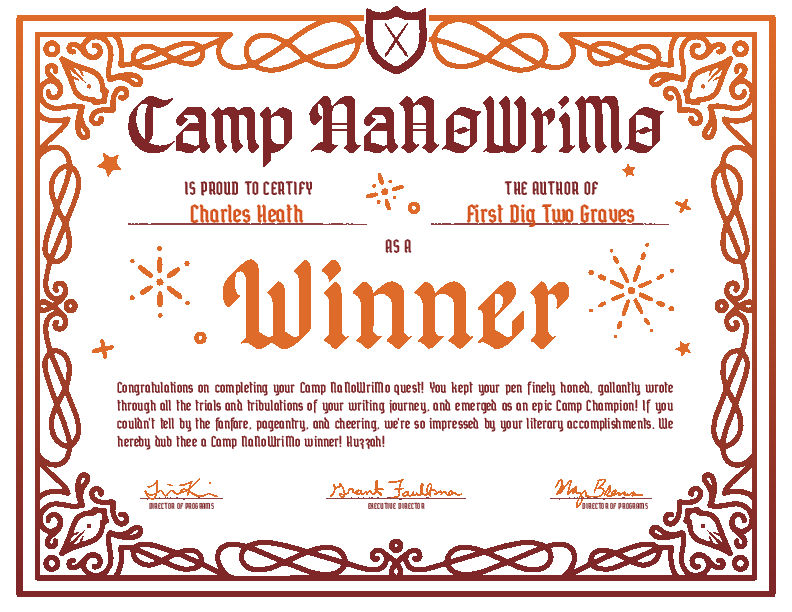
NaNoWriMo – April 2022 – Day 30

First Dig Two Graves, the second Zoe thriller.

The month is up, the hard work is done and the numbers are in.

I finished the first draft, as awful as it might be, with a total of 65,265

And this is the winner’s certificate:

That’s it for another April NaNoWriMo. Now I can rest!

The A to Z Challenge – S is for “Since when did you care?”


Don’t get me wrong, I loved my brothers and sister, but I can now only take them in small doses.

You know how it is growing up, always fighting for your own space, having to live with their idiosyncrasies, getting blamed for stuff you never did.

I never got to have a room of my own, always sharing with the other middle brother, James, whereas the eldest brother had his own room, and by necessity, our youngest sister.

They too got the first-class education where James and I were shuffled off to trade school, which James always said was a hop, step and jump from prison.

Coincidentally, James and I were the first to leave home as soon as it was possible. WE had to earn a living and pay rent, whereas the other two were being nurtured through school, and life.

It was the school of hard knocks for us.

Over the years we all drifted in and out of each other’s lives. We also drifted, at one time or another all over the world, and later, all over the country.

Because of this, only seminal events brought us back together, and even then, those moments were few and fleeting, and not looked upon with fondness. We were not the typical family.

When the time came for each to marry, at varying times of our lives, each would be there at the event. Keeping up with each other was a task for social media, and there we learned of children, divorces, affairs, and disasters.

But there was one defining event that finally shook up our collective trees of life; the death of our parents. Whilst none of the children were particularly close, it seemed to fall upon Janine, the daughter, to look after them.

And, when they were killed unexpectedly in a car crash, it was she who delivered the bad news, and issue the invitation to return home for the funerals.

It was sad, yes, but not as much as it should be for a child. For me, I had spent years hating them for perceived wrongs perpetrated, not getting the same treatment as eldest and youngest siblings, not getting the financial support when requested, and not getting a visit, even if it was only once a year.

So, when I read about their deaths, it saddened me, but I hadn’t seen them for a half dozen years, and had almost forgotten they existed. Yes, I should have made more of an effort to go see them, introduce them to their grandchildren, but I didn’t.

It was a completely different situation with Sally’s parents. There were a close-knit family who, whilst also had the monetary and space constraints as we had, and with more members of the family to contend with, they seemed to make it work without fear or favouritism.

She had only recently met each of my siblings in person, simply because of the fact we were getting older, and reasons for coming together more urgent, well, for the others, anyway. And that Sally had put her foot down and demanded we make an effort to see them.

“So, you are going to the funeral, all of us this time I hope.” I had just shown her the missive sent by my sister, Janine, proclaiming the sad news, not being surprised yet again at the coldness that ran between the members of my family.

She had been disappointed at my indifference, even when I explained the circumstances, and how that coldness had begun and festered throughout our lives. For one who had never been in that situation, it was hard to explain, or understand. Not when comparing it to her own situation.

“If you want.” I was going to make the excuse that my work would not allow the time off, but that would only be because of me, not them. I had used it before, and Sally had realised eventually what I was doing. It wouldn’t work this time.

“We should. They were, after all, your parents, and like it or not, they did give you your start in life. I’ve no doubt they did the best they could.”

Sally always saw the best in people, though with my parents, they did leave her somewhat perplexed at times. The same went for Jeremy, the eldest brother, and his indifference. He was our father reincarnated, and his wife, Lucy, was very much like our mother, perpetually suffering from disdain.

“You had to be there,” was all I would say in my defence.

It was a statement I used often to explain away their indifference. I wanted to believe they had done the best they could, but they could have done better. I hesitate to use the word selfish, but they had been, putting their needs before us.

Even in death, I could still feel the resentment.

“Do you want me to make the arrangements?” She always did, and if she had not, perhaps she might never meet my parents, or my brothers and sister.

“That might be best. You know what I’m like.”

I didn’t hear her reply, but I knew what it would be. A frown and muttering under her breath. She knew what I was like, and still married me, much to the disdain of my eldest brother, Jeremy, who had said to her, a day before the wedding, she still had time to change her mind.

He hadn’t endeared himself that day, or any of the days since.

For Alison and Ben, the two children that were never going to be anything like my siblings, it was an adventure. We rarely travelled far from home for holidays. Preferring to spend it with Sally’s parents at their summer house, big enough to fit everyone, what I would have called a boarding house. It was near a lake and was the closest thing to a summer camp as I would get.

Going over in the plane, Sally had banished me to an aisle seat one row behind them. I suspect that was to give me some mental preparation time, but more likely to consider the lecture she’d given me at the airport about me being more proactive in being nice to my family.

It was time to stop playing the forgotten child routine, and to start behaving like I had a family and simply accept them despite their idiosyncrasies. She was right, of course, as she always was, and todays, of all days, it made me wonder what is was she saw in me.

Off the plane, the first surprise was waiting in arrivals. Sally. Holding a sign much like a chauffeur would. Apparently, she had arranged transport. The second surprise was Sally and Janine together, like they were old friends. I was guessing Sally and Janine had had long conversations over the funeral arrangements.

She also liked Janine, even though she lived in a different world. Janine had never married, had a job that paid squillions of dollars, and lived in a mansion, one my children described as a castle, it had so many rooms.

Then, after the hugs, and the smiles, she saw me, the wet blanket.

“Tom.”

“Janine.”

“You can give me a hug you know.”

I could feel Sally’s eyes burning a hole in me. Hug it was. It was a first, and oddly, rather than consider it was waste of time, it gave me a strange set of emotions.

Then the moment passed.

“You look well.”

“That you can thank Sally for. Left to my own devices, I’d probably be a basket case now.”

“Who’s to say you not, still.” Sally gave me the critical eye, and it was a warning shot across the bows. Behave or else.

We followed Janine out of the terminal building to a parking lot where limousines were parked. She had got us a stretched limousine. Wherever we were going, it was going to be in style.

Sally told me at some point that when she had suggested we stay in a hotel, Janine would not hear of it. She said she lived in what was tantamount to a mausoleum, and there was plenty of room for us. And the rest of the family.

It seemed that she had been very successful in inventing something that everyone needed, and, when she described it, it made sense. Holding the patent and licensing people to manufacture it had made her very wealthy indeed.

Somehow, I’d missed that aspect of her life, though my impression of her, with her education and cleverness, she earned squillions. I was practically right.

What was also explained to me, because I had remarked on how well Sally and Janine got along, and that couldn’t have developed in the last few days while arranging thw funeral visit, it transpired the two had met once of twice when Sally was over this side of the country for seminars, and the two regularly emailed each other.

No sense, Sally said, for her to shun my sister as I had.

Once it might had annoyed me that she would do something like that, but it made sense that Sally would want to know Janine, at the very least, better despite how I painted her. She may have tried with the other two, but I knew Jeremy would strike out the first time she spoke to him, and James was hard enough for anyone to find, let alone his family. I’d tried, and he had disappeared. Not even Janine knew, at that moment in time, where he was.

Jeremy, unfortunately, we would see later.

It was also apparent that once we reached the mausoleum, that I was supposed to go and have a chat with Janine, family stuff she said, and Sally was happy to move into, and unpack, then get the cook to make the children a meal.

We went into a room that Janine called her office.

It was a large wood panelled room with a lot of shelving and a huge number of books. My only remark, that she could not have read them all. It was a little churlish and elicited a grimace.

Janine was not going to put up with my nonsense and was well aware of my attitude from discussions with Sally. It led to her first statement, soon after we sat in very comfortable leather chairs, in front of a window that looked out over a rose garden.

I was counting staff by then, a housekeeper, a cook, a young woman who was there as a waitress, a maid who showed Sally and the children to their rooms upstairs, and outside two gardeners. It was no surprise then the limousine was hers, and the man who drove it, ger chauffeur.

She lived a very different lifestyle than I did.

“I can see that look on your face where you are judging me, and you shouldn’t. You might think you were badly done by, but I’ll let you into a secret, you got the better deal. Not that I’ll defend Jeremy, but in my case, I had a hell of a lot of expectation dumped on my shoulders. You got to swan off and live your life without a care in the world, and I can see you have made all the right decisions, and got everything I could only have hoped for. I have no husband, nor boyfriend, and any I did didn’t last long because my focus was on work and success, instead of happiness. So, yes I have a big house and a lot of money, and people running around doing my bidding, but I have no one to share it with, and no one to pass it onto.”

“Yet.” It was a noble speech, and I’m sure she felt the loneliness of it all. I was going to say she had a choice, just as I had, but somehow it didn’t seem appropriate.

Certainly, I didn’t feel the same way about her as I had before I came of this odyssey, and that in itself may for some be something of a revelation. That hug she had given me at the airport, and the feelings it conveys almost confused me, and most likely would have frightened me if I had not had Sally.

For some reason, now, it was going to be impossible to have the same feelings, or feelings of resentment, I once had.

“There are things you need to know, Tom. The first is that I am not long for this earth. I have about a year, two at the most, the news of which I received about an hour after the police called to tell my our parents had been killed in a car crash.”

“I’m sorry to hear that.”

It was bad news for anyone to learn, but on top of the news of our parents, I couldn’t imagine what that was like.

“The second is that our mother had been diagnosed with the same condition, about two years ago, and didn’t tell anyone. Maybe she thought she was protecting me from the possibility it would happen to me, but we both know she was selfish and inconsiderate at the best of times. Believe me when I tell you we had some incredible rows over the years. And no, I was not a daddy’s girl so I got no support or help in dealing with her truculence.”

I could just imagine our mother giving Janine hell. And in that same thought, how sad it was to have saddled Janine with all of that responsibility. I knew Jeremy hadn’t been any sort of help in regard to both parents, and James was not to be found. I really had no excuse, and I had to admit that some of my father’s selfishness had rubbed off on me too.

“You should have told me, or told Sally to tell me.”

“You would not have been in a receptive frame of mind, not then. But now, I can see you’ve turned a corner, just being here. You could have declined to come, I know now of the hurt our mother and father in particular had inflicted on both you and James, because in their declining years, they eventually turned on both Jeremy and I. Jeremy didn’t cope very well, and did what you did, just went away, leaving me to deal with it. I’m not blaming you, not do I blame you for leaving, I truly understand why. It’s just a pity we didn’t have conversation years ago, because now we’re going to miss on so much in the little time we do have.”

The pity of it was there was nothing I could do now to get that back. But going forward, I was not sure what I could do to make it up to her. And I said as much, and it sounded a lot better in my head than out loud.

“Well, there is something you can do. It’s a funny story, though I believe you will not get a laugh out of it. The third thing is that I am the executor of their wills. Against my advice, and probably something our mother was not fully cognisant of, was a desire for my father to take her on one last road trip. The doctors had decreed due to her worsening condition she would have to go into managed care. He took her to Las Vegas, of all places. The thing is the day they left, mother decided to play this jackpot poker machine, and won the jackpot. I didn’t discover this until the Casino rang me, though how they got my phone number is still a mystery, to tell they hadn’t cashed the check. They were on the road out of Vegas when a truck hit them head on. It wasn’t really an accident, according to the police. They said the truck driver said our father had driven straight at him. I have no reason to disbelieve him.

“He deliberately wanted them both to die?”

“Yes. He had said more than once that he didn’t want to live without her, so I think it was his plan to spend a few days together while she was still cognizant, and then end it. I have no doubt she knew what he was planning to do, and had agreed it was the best way to end the pain and suffering.”

It certainly sounded something he would do. They never regarded the feelings of anyone else in any of the decisions they made. I was going to make a comment, but it seemed moot. They were dead now, and they had gone out on their own terms.

“The truck driver?” I had to spare a thought for him, because they would not have.

“Relatively unharmed, just shaken. And the shock that someone would do that. I met him and apologised, but it seemed not enough recompense for the suffering they caused him. Anyway, I asked the police if they had found a check in the remnants of the car, but given the state of it, it was not surprising they didn’t so I asked the casino to cancel it and write a new one.”

She reached out and picked up a folder on the table between he chairs, and took out a slip of paper and handed it to me.

A check made out to our parents.

For eighty-seven million dollars, and change.

I looked at her, quite literally astonished. “This is ridiculous.”

“What it is, is a sign from the heavens that will give me an opportunity I might not have been granted otherwise. I want you to come home, and spend the last months of my life here with me, and make up for the time we have lost. I know both you and Sally have jobs back home, but that check, your share of it, will make the decision a little easier to make.”

“Does Sally know about this?”

“Only that I’m going to die sooner rather than later, and that she was waiting until you came here before talking to you about what to do. She said it would be better coming from me, not her, because of how things are in the family. I’ll be honest with you, Tom, I was prepared to come to you to plead my case before our parents did what they did because there’s no one else I would want to spend what precious little time I have left.”

I knew now why I’d felt such intense feelings earlier at the airport. It had been a sixth sense, that something was terribly wrong. And she was right, what time she had should be spent with family, those values I had come to terms with being with Sally. It was the right thing to do, but it was not wholly my decision. There were ramifications of uprooting our lives back home, including the sacrifices Sally would have to make.

“Have you told Jeremy?”

“God, no. He’d be a total ass about it, saying I was trying to steal the limelight and making it all about me. We can tell him when it’s too late for him to make any comment at all.”

“And James?”

“We’ll find him. I have resources available that you can only imagine exist.”

I believed her.

“Then I guess I should go and find Sally and see what she has to say about it. And I guess I should apologise for being such an ass all these years.”

“No need. In a way I envy you, always have.”

“You have no reason to. I never made anything of myself, not like you have.”

“You’re wrong if you think that. You have an amazing partner, two beautiful children, and you have provided for them, and look after them in a manner in which I can only dream about. It’s not about money, or possessions, or anything like what you see I have, because when it comes down to it, all that matters is the people around you. That, unfortunately, was the legacy our parents gave us and it was wrong.”

She stood, “Let us not dwell on the past, but brace ourselves for the impending crash landing of the one and only Jeremy. I have some very good champagne chilling at the bar, and we’re going to need fortification, if not Dutch courage before the monster arrives.”

© Charles Heath 2021

The cinema of my dreams – I always wanted to write a war story – Episode 32

For a story that was conceived during those long boring hours flying in a steel cocoon, striving to keep away the thoughts that the plane and everyone in it could just simply disappear as planes have in the past, it has come a long way.

Whilst I have always had a fascination with what happened during the second world war, not the battles or fighting, but in the more obscure events that took place, I decided to pen my own little sidebar to what was a long and bitter war.

And, so, it continues…

It was about a mile by foot to the old church.  Carlo was waiting for us, and then led the way because I wasn’t sure where it was, even though I’d been there once, and hadn’t really been taking any notice.

It was enough time to ask Blinky a few questions about how things were going because he would have a better overall view of the war being involved in the operational side of things.  Thompson’s group of which I was a part, only had our part in a much larger war effort involving a number of covert operations.

It wasn’t going well, not that he put it in so many words, and it looked like it was going to drag on a while longer.  Beyond that, he was not saying anything more.  Perhaps he didn’t know, or perhaps he thought the trees had ears.

I know, loose lips sink ships.

Carlo was indifferent, though I could see he was not happy about Leonardo not turning up so we could kill him and his men.  For me, I had an awfully bad feeling we had missed something, and the end result of it was not going to be good.

And that feeling of foreboding only increased the closer we got to the church ruins.

Blinky was shocked to learn that the Germans would destroy a church and kill the priest.  I guess a lot of people would be if they knew.

When we were about 50 yards from the entrance, I saw one of Blinky’s men show his face, behind a gun raised just in case we were not friends.  When he saw Blinky with us, he lowered the gun and stepped out of the shadows so we could see him.

Closer again, I could see the soldier was looking quite distraught.

“What’s the matter?” Blinky asked him.  

“When we got here, we went inside the church.  God, it was awful.  There’s a woman in there, and…” 

A woman?

I almost ran, and at the end, lying on the ground was a woman, with the Sergeant trying to do what he could.

Carlo bustled past and was first to her side.

“Chiara,” he said hoarsely.

Chiara?  What was she doing here?  How did she get here?  What had happened?

I joined Carlo on the other side.  She was awake but in a terrible state.  Whoever inflicted punishment on her had been very brutal.  The sergeant had managed to cover her broken body with the remnants of her clothes and had tried to clean away some of the blood.

She had been beaten severely and she had the sort of wounds I’d seen before, a result of both fists and weapons.  Torture used to extract information, and, with a sinking feeling, I knew exactly what information Leonardo would be after.

And equally, I knew there would be no point getting to the underground hideout.  All I could hope for was that some, if not all who had been taken there for their safety, had escaped.  But, without forewarning…

She looked from Carlo to me.

“What happened,” I asked.

“Leonardo.  I went out to collect one of the family members and ran into Leonardo and his men.  

They brought me here, and…”  It was spoken haltingly, as each breath, each word, brought on new and sharp pain.  She was having trouble breathing, and the blood coming out her mouth told me it was possible she had broken ribs and a punctured lung.

I hoped not, but it was a forlorn hope.  There was little we would be able to do for her, and moving her, and finding proper medical help was going to be almost impossible.

At the end of that first speech, I saw her shudder, and then moan as waves of pain passed through her.

The Sargent had a field medical kit and had taken out a syringe which I assumed had morphine.  She was going to need it.

“This should take away the pain,” he said to no one in particular, then administered it.

For a moment I thought it had rendered her unconscious, but a minute or so later she opened her eyes again.  Glassy, but there was a shred of relief in them.

“You’re going to have to move her to somewhere better than this.  There’s a lot of damage, and it’s going to be difficult.”  The Sargent knew he was fighting a losing battle.

I got the impression it wasn’t the worst he’d seen.

I felt her hand touch mine, and she said, softly, “Tell Martina I’m sorry.”

“For what?”

“I’m not the brave person she thinks I am.  I couldn’t withstand the torture.  I tried, I tried very hard, but I couldn’t stop myself…”  Again, it was in dispersed with wheezing, breathlessness, and bouts of pain when she tried to breathe in.  I almost couldn’t quite understand her, because her English was not as good as Martina’s.

It confirmed my worst fear, that Leonardo knew where Martina and the others were hiding.

I jumped up.  “Blinky, stay here, do what you can for her.  Carlo…”

He was up and heading for the exit.  He heard, and he knew what it meant.

Blinky took my place, and said, “Go.  We’ll be here when you get back.”

For a big man, Carlo was fast, and it took until we’d almost reached the underground entrance before I caught up with him.

© Charles Heath 2020

NaNoWriMo – April 2022 – Day 29

First Dig Two Graves, the second Zoe thriller.

In a day of going over old ground and making it new again, I have revisited Zoe’s residence in Paris at the time John called, and found it empty, except for some kid who was all ‘get lost or suffer the consequences.’

Who is he?  We flesh that story out, and how it relates to Zoe and those early days in the story.

Similarly, I’m not happy still with how Worthington discovers Zoe, and this is going to need some more work, and definitely a rewrite.

In fact, I might have to revisit his whole appearance in the story and make it a little less bombastic and a little more subdued seething anger.

The whole Marseilles episode is good, it’s just the end and this discovery of who is behind Zoe’s abduction that needs a little work.  This is where we sow the enigmatic sees of Romanov and his purpose for wanting Zoe if it is not revenge like it is assumed.

Similarly, that whole thing with the Russian Minister and Anton needs a lot more work because there appears to be a connection between him and Romanov, but there’s not.  This is just Olga leaning on her connections to get a result.

Then Zoe takes off to find Romanov, or is it those seeking revenge, it’s not quite clear, and leaves John to contemplate his future.  Perhaps a piece here between them that sets the tone for the relationship over the coming months would be good, and the trigger that sets John off on a quest to find her.

His excuses at the moment are wishy-washy at best.

Phew!!!  Never knew self-criticism could be so harsh!

Today’s writing, with Zoe languishing in a dungeon waiting for a white knight, 0 words, for a total of 8,871.

The cinema of my dreams – I always wanted to go on a treasure hunt – Episode 40

Here’s the thing…

Every time I close my eyes, I see something different.

I’d like to think the cinema of my dreams is playing a double feature but it’s a bit like a comedy cartoon night on Fox.

But these dreams are nothing to laugh about.

Once again there’s a new installment of an old feature, and we’re back on the treasure hunt.


The passage heading towards the marina was littered with fallen rocks, timber beams, and roofing material. Much of the damage was in this wing, where the marina had started falling apart.

It was a problem with the foundations. A long and costly investigation had found that the marinas foundations had been inadequately built on a shifting base, made worse by the seasonal water flow.

It was interesting to learn that the event that caused the start of the problems had not occurred in a hundred years, but had been noted in an early newspaper report, and only that it was a phenomenon, 

No one at the time had any interest in building there, and it was understood when the navy built its marina, there was no mention of anything untoward happening that would preclude the construction.

And, over the life of the project, nothing had happened. It was why, when the mall was being touted, no one really knew anything about flooding because it hadn’t happened in living memory.  That only came later, after the damage was done.

We reached the end of the passageway and found the stairs leading up to the walkway around the marina was closed off. Someone had pulled a board away and we could peer through the crack.

There was daylight beyond, and we could see the large cracks in the staircase, and along the walls either side.  There were two sets of stairs up both at the end of a mall passageway, and, in between, there were steps down into the carpark.  To one side of that was an elevator lobby, but the elevators would not be working.

But, just out of curiosity, I pressed the button.  The light came on, but nothing happened, and, a second later, it went out again.

I looked up, but Boggs had not moved from the top of the stairs.

These steps were not blocked by a barricade, but there would be some difficulty stepping over masonry that had fallen from the roof, which now had a gaping crack and a few pieces of concrete missing.  I could see the steel reinforcing and it was rusting.

A few years, all of it would eventually come down.

“You sure this is safe,” I asked.

“Been here a few times.  I reckon it hasn’t changed much in years.”

He was looking at the map again, and I peered over his shoulder.  The stairs were there but looking down we could only see as far as the landing.  There were cracked and broken tiles everywhere, and the handrail had been bent severely out of shape by a boulder now wedged in the rail.

Boggs put the map in his back pocket and said, “Follow me.”  He started walking slowly down the stairs, flashing his cell phone light ahead so we could see if there were any hazards.

At the landing, we looked further down the stairs, and these were cleaner.  Also, the wall which kept the marina out had a crack in it, and it was damp which meant water was seeping in.  The smell was of mold, and I wondered if that could be good for our health.

I followed him down to the first level of the carpark.  In the distance, looking back towards the front entrance of the mall, way in the distance was the slatted entrance gates, light seeping in through the cracks. 

Between us and those gates were several cars, crushed by a huge concrete beam that had fallen on them.  I remembered, then, that there had been a husband and wife in one of the cars at the time and they’d been killed.  Their children had been luckier, the youngest had to go to the restroom, and that minute delay had saved them.

Still, it would not be good seeing your parents killed in front of your eyes.

“This place is giving me the creeps,” I said and shuddered. 

They said there were ghosts, and I now believed them.

“What are we looking for?: I asked.

“Evidence of the underground river.”

“That would be long gone by now, since they built this lot over it, and some of it falling into it.”

“We shall see.” 

He then went down the next flight of steps to the bottom carpark, and I followed.  There was less debris on this level, but it was much darker down here, and with only Boggs’ cell phone light, we couldn’t see much else.

“That’s strange,” Boggs said, having taken a dozen or so steps to the right.

“What is?”  I wondered what his definition of the word strange was.

“There’s supposed to be an open section here where the wall fell away, pushed by the water flow last time it flooded.  The report said that a section here wasn’t anchored properly with formwork, hence the ease in which it was moved.”

I looked at the wall.  It seemed to be still intact to me.

Boggs pulled out a pocketknife and tapped it against the surface.

The false concrete chipped and fell away, and a closer inspection showed stippled plaster over plywood, very damp plywood.  Boggs extracted a knife and worked on the wall, clearing a foot square, the damp plaster easily peeling away.

A false wall, one that no one would think twice about if they were not looking for it.

Boggs then scraped sideways until the blade hit metal, then he scraped around it until a gate-type bolt was exposed.  It didn’t have a lock.  It was rusted shut, so Boggs found a rock and hit it a few times, shaking it loose.  He opened it, then tugged on it.

Was he expecting a door to open?

“Give us some help here.”

We both pulled on it, and it gave way, showering us in plaster pieces.  At least we weren’t smothered in dust.

As it opened, light flooded in, almost blinding me.

I let Boggs open it the rest of the way while my eyes adjusted.

Then I tentatively looked out.

From where we were standing, we could see the two levels of the marina walkway, broken away at this end above the doorway, and a big hole in the side wall of what was the marina pool.  We could see, and smell the seawater, and beyond, the ocean.

Looking down, there was a sheer drop of about 30 feet, and under us, there was an opening.  At that 30 feet was flowing water, and through the water, I thought I could see clothes.

“Is that a body down there?”

It looked like one.

“No.  Don’t think so.  Someone probably threw a clothed dummy down there for fun, once when this was open.  I’d say it was closed up to make the place safer. Anyway, we’ll soon find out.  We’re going down to have a look.”

© Charles Heath 2020