The cinema of my dreams – I always wanted to see the planets – Episode 24

This is why we have technical people

It wasn’t such an outlandish idea, as much as it was hard to prove it was possible. That is, of course, traversing very long distances in a very short amount of time.

Yes, space is a vacuum, and stuff floats, and can be propelled quickly, just not quickly enough that it would not take a long time to get to the edge of our known universe, given our current technology.

And time wasn’t something we wanted to spend getting there and back

Now, out of thin air, a rather quaint but inapplicable expression to describe where we were now, we had two myths shattered, that we were alone in the universe, and that we were at the limit of how fast we could go.

I got the distinct impression the people we just met had the answers. We just had to find them, well, catch up with them first, and ask them if they would share.

Whilst we were standing by the ‘Ionosphere’, I summonsed both Chalmers and the duty scientist to my day room, to prepare for the update from number one, whom I had advised earlier to relay over the secure channel.

But before I got the time to brief them on my theory, number one reported in.

“Firstly, there had been only one casualty and as far as we can tell. Everyone was affected by what appears to be a short stoppage of the life support systems which virtually put everyone to sleep. All of the major systems are back on line, except for the propulsion unit, which, it seems the override cut in when the ship exceeded the maximum speed. The chief engineer is rebooting the controlling computer system which should fix the problem. No one, not even the designers of the propulsion unit, or the ship itself, expected it would ever exceed the maximum design speed, an error that the chief engineers will be taking up with the manufacturers if and when they get home.”

“We can assume then the ship will be able to resume its voyage.”

“Yes sir. I’ve advised the Captain we’ll be standing off until they advise everything is back online.”

“Any explanations as to what happened?”

The Captain of the ‘Ionosphere’ spoke, “One of the scientists discovered what could only be described as an anomaly, with the same sort of properties a black hole has, though it was not a black hole. We headed towards it and then suddenly we were being pulled into it, though there was no discernable hole on the viewer. We tried to escape it, and apparently failed. The last thing I remember, or anyone else for that matter, was the ship going dark, like everything had stopped. Until I was woken by your officer. I cannot explain how we got here, except to say that under normal circumstances, it would take many months to travel the same distance.”

“Did you see any other ships about?”

“We were the only people in that quadrant, as far as I was aware.”

Number one came back at that point, “The sensor log shows there might have been something out there, though it didn’t define what it was. I’m sending a download of the log over as we speak for analysis. One possibility though, based on the information we’ve been using to follow the ship that kidnapped the Captain, is that there is similar energy readings recorded just before the jump.”

Chalmers was first to speak, “When you say jump, what exactly does that mean?”

“We have been looking at the log, and it’s recorded a jump that started near Jupiter, to where we are now. Based on my understanding of astrophysics, and given the short time frame, the only logical explanation is that they were sucked into a sort of black hole, or a rupture in time/space. Whatever caused it, it’s in the realm of science fiction.”

“So was the notion that there was another intelligent life out here, and yet we have found that not to be the case. Whoever these people are, I suspect they have conquered the ability to travel long distances, very quickly, especially if they are, as they said, from another galaxy.”

“You have met other life?” The captain of the ‘Ionosphere’ seemed surprised.

“Yes. They attacked one of our freighters on its way to Venus and stole the plutonium rods needed to keep the base there going. They also kidnapped our Captain, and we were in pursuit of their vessel when we discovered your ship drifting. And it’s my theory your ship may have been dragged into a vortex left behind as they move from location to location. A theory my people will be working on, unless they come up with a better explanation.”

Number one came back, “I’ve just been advised by the Chief Engineer, everything is back online, and we’re no longer needed. I’ll make sure the data transfer is complete and we’ll depart. Anything else?”

“No.”

The transmission complete, I turned to the two scientists. “Soon as you get the data, find out what happened. When we run into these other people, I need to know the right questions to ask them.”

“The odds are we won’t understand,” Chalmers said.

“I thought it was universally acknowledged that if we did find intelligent life out here, the one universal language would be science.”

“That was true based on what we knew before today. Now we know there’s intelligent life out here, everything has changed.”

“Then buckle up for the ride of your life. I want answers sooner rather than later.”

© Charles Heath 2021-2023

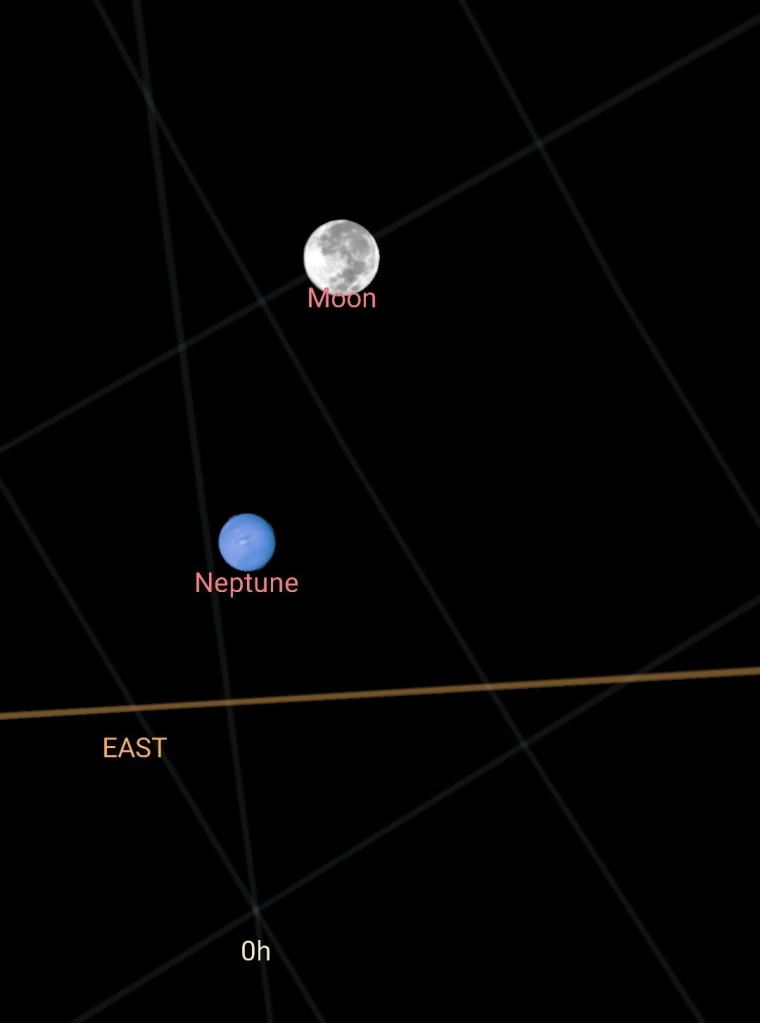
Another night of stargazing…

And this is what I found:

Neptune.

It got me thinking.

Why did we name the planets after mythological gods?

I did a little digging and found that the Romans named the five closest planets to the sun after their most important gods, this one, named after the god of the sea, which to the Romans was Poseidon, but in translation, Neptune, and matbe because it was ‘blue’.

Of course, we all know about King Neptune.

We also know about Poseidon, which was the fictional ship that got hit by a tidal wave, and was turned into a blockbuster movie.

But in terms of science fiction, which is not what I write, but I seem to spend a lot of time watching, it strikes me that seeing the moon, we could assume that the moon could be a stopping off point on a trip to the pouter planets.

I’m always surprised at the ingenuity of ‘Sci Fi’ writers in how they can turn what is scientifically impossible to live on but not necessarily impossible to get there (after a long sleep), into a place where we can destroy with equal rapaciousness as our own planet.

If I was going to write something, perhaps it would be about turning the planet into a holiday resort, staffed by robots…

Uh oh, that’s reminiscent of another ‘Sci Fi’ series. I’ll let you guess what it is.

I always wanted to see the planets – Episode 21

There’s no swashbuckling for the captain

I turned, and saw what appeared to be a relatively unkempt man standing behind me.

Jerome Kennedy. Astro physicist.  A man who was mocked rather than revered for his theories on space, and in particular, space travel.

And those theories were, to put it mildly, interesting.

It was probably why the Admiral conscripted him for this voyage into the unknown.

“I though that was only in the imagination of television script writers.”

“Possibly, but we just witnessed something that none of us can rationally explain.  One minute they were there, the next, poof.”

“That’s why you are along for the ride, to find explanations for the unexplainable.  I look forward to your report.”  Then, turning back to the navigator, “are we still in touch with the original alien vessel?”

“Just, and still heading towards Uranus.”

“Then let’s get after it, maximum speed when possible.”

I left the newly promoted number one in charge and went into the captains day room.  I was still getting used to the idea of actually bring captain, because the aura of previous inhabitant of this room was still there.  And it felt like he was in the room watching everything I did.

I shook my head, as if that would cast off the jitters I felt, and sat down behind the imposing desk, one thathad been made over a hundred years before, and from a vessel with the same name. 

I still didn’t have a lot to put in any report to the Admiral, but had a lot to think about.

I brought up the navigation screen and looked at the suggested path from where we were to Uranus, and the time it would take.

There was a buzzing sound, and a face appeared on my screen.  It was the Captain’s personal assistant for want of a better name, Louise Chalmers, an ex Lieutenant Colonel from the military, but not by much.  She had retired into this position, and, I suspect, another was for the military to keep up to date on the Captain’s decisions.

“Come in.”

The door opened, she came in, and it closed behind her.  There was no open door policy on this ship.

“Sir.”

“What can I do for you?”

“I’m not sure if you are aware, but I am here to serve whomever the current Captain is, and since Captain V is not here, that would be you in his stead.”

I had read that she was his choice for P A, and that it was a personal matter, as usually Captains didn’t have such staff members.

“I thought you were on board to serve only the previous captain “

“Not so.  If you read standing order 207615, you will realise my position was ratified as general crew member, serving the ship rather than an individual.  My job is to make your job easier.”

While she was speaking, I fetched the standing orders, and the one she referred, and a quick scan proved such to be the case.

“In what way?”

“Paperwork, the vane of any officers existence I’m told, and to organise all activities of a non urgent nature, like bring the daily reports to you.”

I knew that captain had to be appraised of everything that happened on board, just not every day.

“I take it you have the reports?”

“I have, and unfortunately, as per regulations, I have to make sure you have received them.  Your predecessor wanted me to summarise.  I can do the same for you.”

There would be no escaping it.  “Please.”

© Charles Heath 2021

Another night of stargazing…

And this is what I found:

Neptune.

It got me thinking.

Why did we name the planets after mythological gods?

I did a little digging and found that the Romans named the five closest planets to the sun after their most important gods, this one, named after the god of the sea, which to the Romans was Poseidon, but in translation, Neptune, and matbe because it was ‘blue’.

Of course, we all know about King Neptune.

We also know about Poseidon, which was the fictional ship that got hit by a tidal wave, and was turned into a blockbuster movie.

But in terms of science fiction, which is not what I write, but I seem to spend a lot of time watching, it strikes me that seeing the moon, we could assume that the moon could be a stopping off point on a trip to the pouter planets.

I’m always surprised at the ingenuity of ‘Sci Fi’ writers in how they can turn what is scientifically impossible to live on but not necessarily impossible to get there (after a long sleep), into a place where we can destroy with equal rapaciousness as our own planet.

If I was going to write something, perhaps it would be about turning the planet into a holiday resort, staffed by robots…

Uh oh, that’s reminiscent of another ‘Sci Fi’ series. I’ll let you guess what it is.