Searching for locations: Paris, France: Place de la Republique

Whilst a rather important place for the French, for us visitors, it has a convenient hotel located just behind the square, and an underground, or Metro station, underneath.

2014-01-07 11.43.05

Added to that was equally convenient cafes, one of which, The Cafe Republique, we had dinner every night.  The service and food were excellent, and we had no problems with the language barriers.

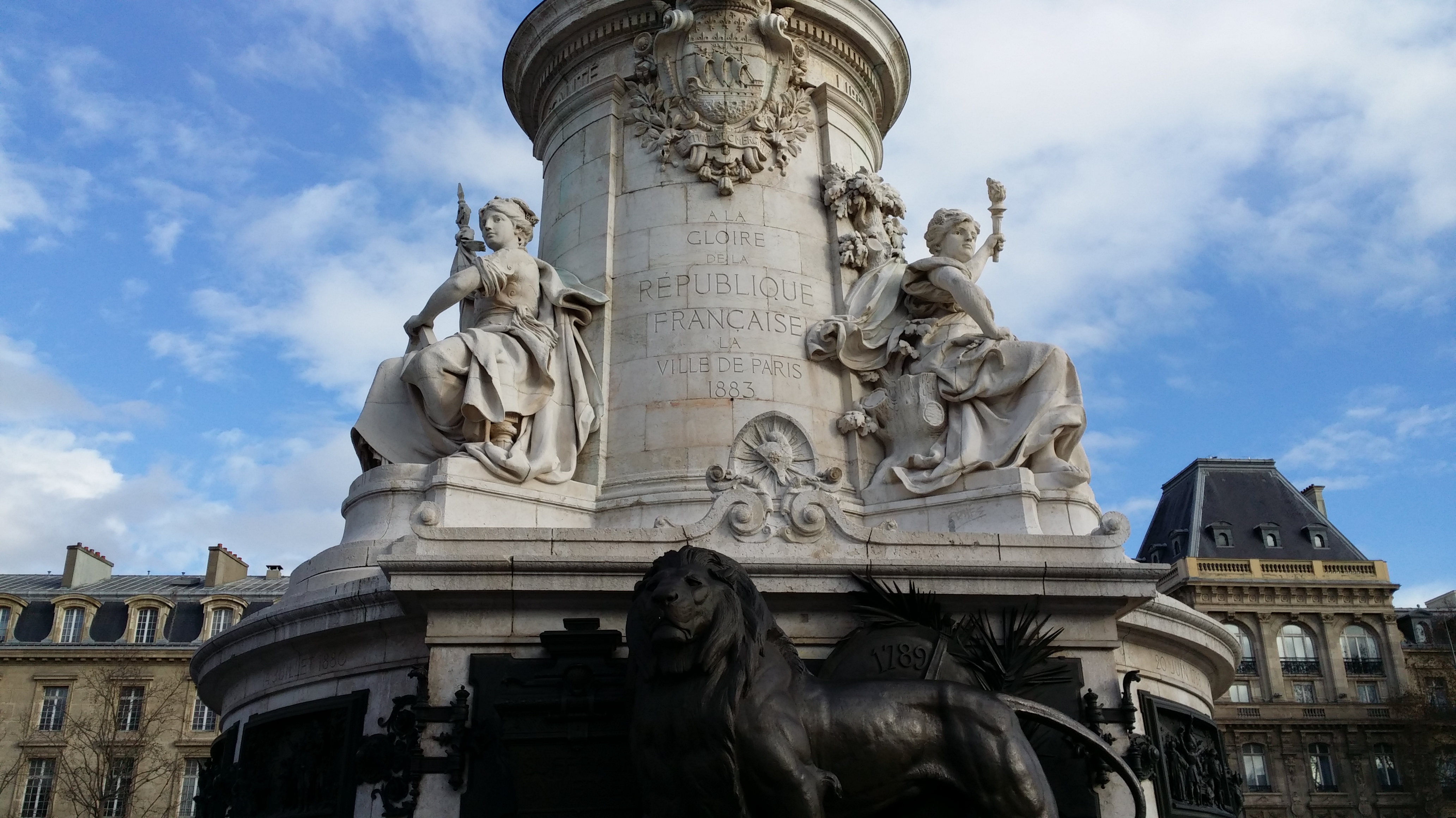
At the top of the monument is a bronze statue of Marianne, said to be the personification of France.

2014-01-07 11.43.41

Surrounding Marianne is three more statues, representing liberty, equality, and fraternity.

2014-01-07 11.43.32

At the base is a lion guarding what is said to be a ballot box.

Searching for locations: Paris, France: Place de la Republique

Whilst a rather important place for the French, for us visitors, it has a convenient hotel located just behind the square, and an underground, or Metro station, underneath.

2014-01-07 11.43.05

Added to that was equally convenient cafes, one of which, The Cafe Republique, we had dinner every night.  The service and food were excellent, and we had no problems with the language barriers.

At the top of the monument is a bronze statue of Marianne, said to be the personification of France.

2014-01-07 11.43.41

Surrounding Marianne is three more statues, representing liberty, equality, and fraternity.

2014-01-07 11.43.32

At the base is a lion guarding what is said to be a ballot box.

Sayings: Before you can say Jack Robinson

Once upon a time, you could have told me Jack Robinson was a jack in the box, the name meant nothing to me.

Not until Phryne Fisher came along, a rather brilliant 1920s private detective series set in the back streets of Melbourne, as well as more salubrious houses of the rich and famous.
In this series, there is a policeman, a foil for her detective moments, and a love interest that is always just beyond her grasp, a man by the name of Inspector Jack Robinson.

How coincidental.

But…

As for the saying, before you can say Jack Robinson…

It has nothing to do with Phryne Fishers Inspector.

Instead,

There is one story of a politician, Jack Robinson, in the late eighteenth century who was accused of bribery on the floor of the house of commons in England. His accuser was another MP who was asked to name the culprit, and thereby coined the term, ‘I could name him as soon as I could say Jack Robinson’.

The second was a Jack Robinson, the hero of a story written in the nineteenth century who came home to find his intended wife married to another, and to assuage the pain of it was back to the sea, ‘afore you could say Jack Robinson’.

I’m sure there’s a ton of other saying that could be attached to the name, but these seem to be the accepted reason for the term ‘before you can say Jack Robinson’.

Sayings: Before you can say Jack Robinson

Once upon a time, you could have told me Jack Robinson was a jack in the box, the name meant nothing to me.

Not until Phryne Fisher came along, a rather brilliant 1920s private detective series set in the back streets of Melbourne, as well as more salubrious houses of the rich and famous.
In this series, there is a policeman, a foil for her detective moments, and a love interest that is always just beyond her grasp, a man by the name of Inspector Jack Robinson.

How coincidental.

But…

As for the saying, before you can say Jack Robinson…

It has nothing to do with Phryne Fishers Inspector.

Instead,

There is one story of a politician, Jack Robinson, in the late eighteenth century who was accused of bribery on the floor of the house of commons in England. His accuser was another MP who was asked to name the culprit, and thereby coined the term, ‘I could name him as soon as I could say Jack Robinson’.

The second was a Jack Robinson, the hero of a story written in the nineteenth century who came home to find his intended wife married to another, and to assuage the pain of it was back to the sea, ‘afore you could say Jack Robinson’.

I’m sure there’s a ton of other saying that could be attached to the name, but these seem to be the accepted reason for the term ‘before you can say Jack Robinson’.

In a word: Bore, or is that boar

I’ve had the ubiquitous pleasure of being called one, and that is, a bore.

Probably because I spend so much time telling people about the joys and woes of being a writer.

You can be a tedious bore, cooking could be a bore, and then you could bore someone to death, and then you will bore the responsibility of, yes, doing just that.

Would it be murder or manslaughter?

But, of course, there are other meanings of the word, such as, on my farm I have a bore.

No, we’re not talking about the farmhand, but where artesian water is brought to the surface, in what would otherwise be very arid land.

Or, could be the size of a drill hole, and in a specific instance the measurement of the circular space that piston goes up and down.  And if you increase the size of the bore, the more powerful the engine.

Or it could refer to the size of a gun barrel, for all of you who are crime fiction writers.

But, let’s not after all of that, confuse it with another interpretation of the word, boar, which is basically a male pig.

It could also just as easily describe certain men.

Then there is another interpretation, boor, which is an extremely rude person, or a peasant, a country bumpkin or a yokel.

I’ve only seen the latter in old American movies.

There is one more, rather obscure interpretation, and that is boer, which is a Dutch South African, who at the turn of the last century found themselves embroiled in a war with the British.

You learn something new every day (2)

I got a call this morning from my brother who has been delving into the places we have lived over the years, including those before we were born.

My recollection, hazy at best, is that my father’s parents lived in Camberwell, a suburb of Melbourne, and the boys, those that survived the war, lived there too. He had three brothers, I think, and a sister. From what I’ve read, his older brother was a sensible chap and the peacemaker between him and his parents.

Later one of his brothers went to Sydney, his sister lived among orchards our Ringwood way, and another, much later, moved to Queensland. We very rarely, if ever, saw them, and the last time I did with most in one place, was after my Grandmother died. I do remember Dora, the site, visiting us once, and being young at the time, she seemed a very forbidding woman.

But, this is about where they lived.

My father, presumably before and immediately after the war, at home, and my mother at her home in Pakenham. There her father ran a service station and motor mechanic shop and was well known. Their house, at the time, was built over the road, just a short walk from home to work. The place, the first time I saw it, was a mechanics dream, with old cars and car parts outside and inside garages, and a woodworking shop with every tool imaginable.

Once the place had very elegant gardens, but by the time I got to stay there, in the 1960s, it was all overgrown, and the house was in disrepair. My mother’s brother lived there with my grandmother, and he was a fearsome, huge man who said little. All I knew about him was that, a) he was the one who found his father after he had killed himself, b) he liked fishing and went to a place called Corinella, and c) he was a mechanic like his father.

So, at some point in 1948, my father must have up and left, perhaps after an argument with his parents, and moved to Keiwa House, Bogong, where the Snowy River Hydro-Electric Scheme was being built, as a projectionist, bringing films to the workers in Town Halls.

As I’ve said, my mother stayed in a boarding house for ladies during the week and went home on weekends. I have the first letter that my father wrote to her and references the fact he went calling on her, and she was not there. We’ll never know what she thought, but there’s a second letter, after she wrote back, so a friendship was struck. He told her, almost in minute detail, what he was doing, and presumably, she told him about hers.

A year later, they married.

Now it gets interesting. We both thought that their first house, after getting married was in Carrum. It wasn’t. In the pile of letters were references to the family staying in a rented flat in Camberwell.

Sometime after that, there is a contract for a war service loan in relation to a property in Carrum, which turns out to be the first house they lived in, and where my brother, born in 1950) lived, and where I lived after I was born in 1953. I have interesting if vague memories of this house, and of the people who lived behind us because we could climb through the fence into their property. We knew them during, and after living in Carrum.

Now, today, some interesting new facts came to light about the Carrum house. We always assumed we owned it, but it seems that we didn’t. A copy of the title for that property never had the name Heath on it, so did we rent it? More information is required, and we need to dig deeper. Let’s hope there are no skeletons there.

And something else came out of a discussion with the daughter of my mothers sister, that it was believed my mother’s parents bought them a house in Chelsea, but my father, apparently, refused to live in it and sold it.

OK, I never claimed that my father was the sort that might have accepted charity, so perhaps in a moment of madness, he lost the plot. The question is, what happened to the money?
Recycle bin(0)Empty

You learn something new every day (1)

And it’s not necessarily something that might be good. To be honest, I didn’t know what to think, but in a strange sort of way it put a few things into perspective.

My brother and I have been delving into the family history, or at least my brother is throwing everything at it, and I’m along for the ride.

I did have a trove of stuff that we found when cleaning out my parent’s house when they moved into aged care, and at the time I didn’t think much of it. It was more about getting them settled than figuring out what was kept.

Now, four or so years later, and having finally received an interim output of the family tree, it’s not so much the forebears that interested me, as it was my parents.

It seems that our looking at our immediate family’s potted lives is like walking through a minefield, riddled with contradictions, rumors, and anecdotal evidence that doesn’t, for the moment, have any hard evidence to back it up. Or at least some have, but that’s not the interesting part.

So, picture this. The extent of my knowledge of my immediate family was that my father is Australian, his mother English, and I’m a second-generation Australian with an English grandparent. It doesn’t sound much, but not so long ago I could have applied for and got an English passport and had dual nationality. Unfortunately, that cannot happen anymore, you have to be one or the other.

My mother’s mother was of English descent and her husband of German descent. It was understood that my grandfather on this side died not long after I was born, though for a long time we were never told how. Only recently it came to light that he had committed suicide, and my brother has a copy of the suicide note he wrote. Morbid, eh? It turns out he thought he had cancer, but didn’t and mistakenly ended his life thinking he might have been a burden on my grandmother.

But now we started digging, getting dates of birth, easy, dates of death, easy, marriage certificates, and parents’ names for this limited dip into history, relatively simple.

But the story, the real aspects of genealogy, is where they went to school, their first job, what the did in the war, that fascinating the story of their lives at different times, that’s where I’m more interested. My brother has the facts, I want to give them a story entwining those facts.

Something that adds some flesh to the story is letters.

Another recent addition to the pile of family documents are the letters between my mother and father before they were married, and the fact my mother had another boyfriend, something we never knew until the great clean up. I have those letters, or some of them too.

Those letters, from him, unfortunately, we don’t have hers, are fascinating, as are those from my father. There is no indication of why there was a breakup with the first boyfriend, but I did learn that my father had gone to an introduction agent by the name of Mrs. J Phillips who gave him her name. What factors had led him down this path?

It was, to me, very Dolly Levi-ish.

I discovered my father worked as a projectionist at the Snowy River hydro-electric project after the war., around 1948. He had spoken of showing pictures at the Athenaeum Theatre in Flinders Street, and the King’s Theatre in Melbourne, but not exactly when, which accounted for his amazing knowledge of Hollywood movie stars. It was, however, as much as he had shared for a long time.

I also discovered that he was in Perth, Western Australia immediately after the war, and then went overseas to England by ship 13th August 1947, arriving in London on 12th September, and stayed at Middlesex with relatives.

Ok, now it gets a little weird because when in Bedfordshire he became engaged to an English girl that he had (apparently) known for 10 years. How this came to pass is still a mystery awaiting an answer. The wedding was supposed to be on 21st December 1947 but never happened, because the marriage was forbidden by her parents because they did not want their daughter to move to Australia, and equally forbidden by his parents because she was Catholic.

Yes. Religion was a breaking point in those days because he was a protestant. He returned, perhaps heartbroken, a year after he left, in April 1948.

I found that for a period of two years there would be enough speculative material to fuel a very lively account of their lives, and particularly his.

My mother, by the way, spent the war years attending Dandenong High School, a steam train ride down from Pakenham to Dandenong. After that, she gained employment in Melbourne, and spend the weekdays at a Ladies Boarding House called Chalmers Hall, in Parliament Place, and going home to Pakenham on the weekends. From a note or two, it seems she was something of a ‘wild’ child who craved doing something with her evenings other than ‘staying in’, with references to her going out with her friends.

My father confessed that he was the family’s black sheep, that he didn’t get along with any of the family, and which was why he was never home and always traveling. He wrote, in one letter of October 1948, that when he got into an argument he got mad and walked out on them, and came back when calm had returned. I assume that meant it might take days, weeks, or even months for the dist to settle.

There were disputes with my father with both his brothers and his parents over marrying my mother, and there were problems between my mother and her parents, to the extent they might not attend the wedding. For a few months of tense silence, there might not have been a wedding at all, but eventually, this happened at Trinity Church, Camberwell, on the 28th of June, 1949.

Wow! It shows that illusions of what might have been their happy day turning out to be moments of high dudgeon. Oh, to have been a fly on the wall.

I still have no idea what split her and the original boyfriend, a man she’d known since she was 14, and was from her hometown area, Pakenham. It might have been something she said because there are indications on one of two draft letters that she was prone to speaking her mind, and had a temper which would not have helped in using discretion. I’m guessing a few years of war would make a man lose interest in a high minded, and perhaps a sharp-tongued woman. I suspect we’ll never know.

She is now 93 and has Alzheimer’s and dementia, and unlikely to remember back then.

Similarly, my father is 97 and I doubt sitting down with him would elicit much on the way of a sensible discussion. He was always irascible at best and oddly suffers from PTSD from his war service if that’s still possible. Over the years he was never prone to sharing his past life, except in snippets, and that, some of it was about the war. I guess war did terrible things to the participants back them

And, as for his war service, we have the physical documentation of where and when, but only a potted history of his own account of his service. But even that is a story and a half in itself.

More on that later.

You learn something new every day (1)

And it’s not necessarily something that might be good. To be honest, I didn’t know what to think, but in a strange sort of way it put a few things into perspective.

My brother and I have been delving into the family history, or at least my brother is throwing everything at it, and I’m along for the ride.

I did have a trove of stuff that we found when cleaning out my parent’s house when they moved into aged care, and at the time I didn’t think much of it. It was more about getting them settled than figuring out what was kept.

Now, four or so years later, and having finally received an interim output of the family tree, it’s not so much the forebears that interested me, as it was my parents.

It seems that our looking at our immediate family’s potted lives is like walking through a minefield, riddled with contradictions, rumors, and anecdotal evidence that doesn’t, for the moment, have any hard evidence to back it up. Or at least some have, but that’s not the interesting part.

So, picture this. The extent of my knowledge of my immediate family was that my father is Australian, his mother English, and I’m a second-generation Australian with an English grandparent. It doesn’t sound much, but not so long ago I could have applied for and got an English passport and had dual nationality. Unfortunately, that cannot happen anymore, you have to be one or the other.

My mother’s mother was of English descent and her husband of German descent. It was understood that my grandfather on this side died not long after I was born, though for a long time we were never told how. Only recently it came to light that he had committed suicide, and my brother has a copy of the suicide note he wrote. Morbid, eh? It turns out he thought he had cancer, but didn’t and mistakenly ended his life thinking he might have been a burden on my grandmother.

But now we started digging, getting dates of birth, easy, dates of death, easy, marriage certificates, and parents’ names for this limited dip into history, relatively simple.

But the story, the real aspects of genealogy, is where they went to school, their first job, what the did in the war, that fascinating the story of their lives at different times, that’s where I’m more interested. My brother has the facts, I want to give them a story entwining those facts.

Something that adds some flesh to the story is letters.

Another recent addition to the pile of family documents are the letters between my mother and father before they were married, and the fact my mother had another boyfriend, something we never knew until the great clean up. I have those letters, or some of them too.

Those letters, from him, unfortunately, we don’t have hers, are fascinating, as are those from my father. There is no indication of why there was a breakup with the first boyfriend, but I did learn that my father had gone to an introduction agent by the name of Mrs. J Phillips who gave him her name. What factors had led him down this path?

It was, to me, very Dolly Levi-ish.

I discovered my father worked as a projectionist at the Snowy River hydro-electric project after the war., around 1948. He had spoken of showing pictures at the Athenaeum Theatre in Flinders Street, and the King’s Theatre in Melbourne, but not exactly when, which accounted for his amazing knowledge of Hollywood movie stars. It was, however, as much as he had shared for a long time.

I also discovered that he was in Perth, Western Australia immediately after the war, and then went overseas to England by ship 13th August 1947, arriving in London on 12th September, and stayed at Middlesex with relatives.

Ok, now it gets a little weird because when in Bedfordshire he became engaged to an English girl that he had (apparently) known for 10 years. How this came to pass is still a mystery awaiting an answer. The wedding was supposed to be on 21st December 1947 but never happened, because the marriage was forbidden by her parents because they did not want their daughter to move to Australia, and equally forbidden by his parents because she was Catholic.

Yes. Religion was a breaking point in those days because he was a protestant. He returned, perhaps heartbroken, a year after he left, in April 1948.

I found that for a period of two years there would be enough speculative material to fuel a very lively account of their lives, and particularly his.

My mother, by the way, spent the war years attending Dandenong High School, a steam train ride down from Pakenham to Dandenong. After that, she gained employment in Melbourne, and spend the weekdays at a Ladies Boarding House called Chalmers Hall, in Parliament Place, and going home to Pakenham on the weekends. From a note or two, it seems she was something of a ‘wild’ child who craved doing something with her evenings other than ‘staying in’, with references to her going out with her friends.

My father confessed that he was the family’s black sheep, that he didn’t get along with any of the family, and which was why he was never home and always traveling. He wrote, in one letter of October 1948, that when he got into an argument he got mad and walked out on them, and came back when calm had returned. I assume that meant it might take days, weeks, or even months for the dist to settle.

There were disputes with my father with both his brothers and his parents over marrying my mother, and there were problems between my mother and her parents, to the extent they might not attend the wedding. For a few months of tense silence, there might not have been a wedding at all, but eventually, this happened at Trinity Church, Camberwell, on the 28th of June, 1949.

Wow! It shows that illusions of what might have been their happy day turning out to be moments of high dudgeon. Oh, to have been a fly on the wall.

I still have no idea what split her and the original boyfriend, a man she’d known since she was 14, and was from her hometown area, Pakenham. It might have been something she said because there are indications on one of two draft letters that she was prone to speaking her mind, and had a temper which would not have helped in using discretion. I’m guessing a few years of war would make a man lose interest in a high minded, and perhaps a sharp-tongued woman. I suspect we’ll never know.

She is now 93 and has Alzheimer’s and dementia, and unlikely to remember back then.

Similarly, my father is 97 and I doubt sitting down with him would elicit much on the way of a sensible discussion. He was always irascible at best and oddly suffers from PTSD from his war service if that’s still possible. Over the years he was never prone to sharing his past life, except in snippets, and that, some of it was about the war. I guess war did terrible things to the participants back them

And, as for his war service, we have the physical documentation of where and when, but only a potted history of his own account of his service. But even that is a story and a half in itself.

More on that later.
I would not want to be a car salesman!

Buying a new car is an experience most of us would regard as a chore at best and a waste of valuable time at worst.

It would be a lot easier if the salespeople actually treated you with the respect you deserved. The problem is, while most of them are polite and affable, underneath that seemingly ‘I’m your best friend’ countenance, is the I’m uttered words ‘ how much can I make from this deal’.

And that’s the truth of it.

It all comes down to money.

How much your willing to pay, and how much they can screw out of you.

Sorry, but after years and years of dealing with these people, I have built up considerable cynicism

But, once again, it’s time to go out into the shady underworld of car sales to get a new car, or as the case will be this time, a new SUV.

We don’t have a lot of money to spend this time, so the choices are going to be limited, and unlike years past when I could used the business to pay for a lease, and therefore watch the salesman load the price of the car to make it seem like we were getting more for our trade in than it was worth, this time it’s a straight cash transaction.

First thing we notice is that all the advertised prices are loaded for people buying with finance. So, we said there’s no trade in, and we’re paying cash, and they say the price is the same.

Liars.

We haven’t event got out of the block, and they’re barefaced lying to us.

We have a short list of three. All three when approached with no trade in, pay by cash deal said it wouldn’t affect the price.

A good enough reason to just walk away, but that had the effect of getting, at the very least, their attention. Never seen a salesman yet who would let a customer just walk away.

OK, So now we know there is some movement on the price. Not much, but it’s a start.

First car is a Honda CRV. In reality there’s really only a few models truly equating to basic, better, best, and top of the range. Prices run from 28000 to 50000 before the dealer starts loading the price with imaginary costs like the ubiquitous dealer delivery charge, otherwise known as guaranteed profit.

Whatever else the salesman can bluff out of the customer adds to his commission and the unwritten profit margin per car that’s been set by the manager.

You can always tell who the manager is, he’s the one all the sales people go to when pretending to discuss any further allowances in the prices to the advantage of the customer.

Its more likely a discussion about the footy picking competition, if it’s winter, or the next cricket match if it’s summer.

Sometimes they’ll find a few dollars or thrown in a freebie, but most times there’s no change.

That’s when you walk.

It’s where you discover that their so-called best prices us nothing like what they can do if it means losing a sale. Or not.

You have to be prepared to walk away, especially if there’s no prospect of a better deal, and even if that’s the car you want. There are other dealers.

There are also other cars. I’ve found it’s not a good idea to get hooked on one particular car. It’s why we have a shortlist of three. I could live with any one of them.

The Honda people are affable, the salesman shows us the car, gives an little talk about the features, and we go for a test drive.

It fits the criteria, and has a few bells and whistles, like the screen, and safety features. The cost to get those bells and whistles might be too much.

We go then to see the Rav4.

First thing we learn, that Toyota is the biggest car company in the world, and the largest seller of vehicles in the world

Relevance?

Well I suppose that’s meant to make us feel better about the car, that Toyota wouldn’t be the biggest and best if they sold crummy cars.

Not buying it. Any car manufacturer can make a lemon, and happily sell it to an unsuspecting purchase.

We get a run down of the car on a large interactive t.v. screen. It certainly had the features were looking for, has the same 4 types of models, and roughly the same pricing.

The test drive proved that it met our on road requirements. Similar pricing to the Honda, a like the previous dealer, not a lot of room to move on price, surprise surprise, but one more advantage, fixed price servicing that doesn’t cost an arm and a leg.

The third contender is a Nissan X Trail. The same model structure but with a slight difference, there’s a special on, giving the second top model a little more incentive to buy. Still, at 40000 it’s more than we were expecting to pay.

But..

The first experience with sales is not only disappointing, it was unprofessional. Never have someone on the floor who apparently knows nothing about the products being sold.

I walk out.

My wife doesn’t, mainly because one of the real salesmen had noticed the problem, and wasn’t going to let a sale slip through his fingers.

He does know his stuff, and the sales experience is one of the best we’ve had.

But…

Still can’t get past the first impression.

So after spending about 4 hours on the road in the various cars, it’s time to made a decision.

Or not.

Perhaps it’s time to simply think about it.

My preference was for the Nissan X-trail but it’s remarkable how a bad experience in a car dealership can put you off. Now it’s back to one of the three.

In order to make an informed decision I think we need to look at the basic model and it’s bottom line features.

In that regard, The Rav4 wins hands down.

So, we’re going with the Rav4, and back to the dealership for round two.

In a word: Good

There is a TV show that was on the TV called ‘The Good Place’.

It’s really the bad place which makes you wonder if there really is a ‘good place’.

This started me thinking.

How many people do you know, when you ask them how they are, they say ‘good’?

Can we see behind the facade that is their expression of how they really feel?

And how many of us reveal our true feelings?

It seems to me there is an acceptable level of understanding that we take people at their word and move on from there.

And how many times when we suspect there is something wrong, we tend to overlook it in what is regarded as respect for that person?

What if something awful happened?

What if we could have prevented it?

What if we could have tried to gently probe deeper?

The problem is we seem to be too polite and there is nothing wrong with that.

But maybe, just maybe, the next time …

It’s just a thought.