This wouldn’t be so apt if it didn’t bring back a raft of bad memories, those days I used to go to the races, and back all of the wrong horses.
I had a knack, you see, of picking horses that fell over, or came dead last.
Perhaps that’s another of those sayings, dead last, with a very obvious meaning. Dead! Last!
But…
In the modern vernacular, flogging a dead horse is like spending further time on something in which the outcome is already classed as a complete waste of time.
However…
Back in the old days, the dead horse referred to the first month’s wages when working aboard a ship, usually paid for before you stepped on board the ship. At the end of the first month, the theoretical dead horse was tossed overboard symbolically, and thereafter you were paid.
It still didn’t make sense to me that someone would tell me I was flogging a dead horse, until I realized, one day, the lesson to be learned was never to get paid in advance.
In all of the goings-on, with Zoe chasing down old acquaintances in Bucharest, then moving on to Yuri, then Olga, we forget that Isobel and Rupert are on her trail, with Sebastian in tow.
It’s not so much Sebastian in charge anymore, not after going rogue and shooting his boss and John’s mother, an act that Rupert witnesses after following Sebastian on the hunch that he was up to something.
Rupert realizes that Worthington still presents a major problem, and on the basis that Worthington was going to realize it’s not Zoe shooting at him, Worthington had to be taken off the chessboard.
Unfortunately, he has to enlist Sebastian to get a crew together to kidnap him and take him to a safe house.
Meanwhile, Isobel, with a computer in hand, takes up vigil at the hospital with John’s mother, pretending she is her daughter. There she tracks Zoe via her cell phone to an address in Zurich.
Then, miraculously John’s cell phone reappears and is active long enough for her to get a location, and see that a 96-second phone call is made to a phone in Zurich, Zoe’s.
Then it disappears again.
Isobel then calls Zoe and gives her the address. It’s a short call.
Calls to Sebastian and Rupert mobilize them, and everyone is on their way to John’s location.
…
Today’s writing, with Zoe languishing in a dungeon waiting for a white knight, 2,011 words, for a total of 61,922.
This morning started with a visit to the car rental place in Vancouver. It reinforced the notion that you can be given the address and still not find the place. It happened in Washington where it was hiding in the back of the main railway station, and it happened again in Vancouver when it was hidden inside a hotel.
We simply walked straight past it. Pity there wasn’t a sign to let people know.
However…
We went in expecting a Grand Jeep Cherokee and walked out with a Ford Flex, suitable for three people and four large suitcases. It actually seats 7, but forget the baggage, you’d be lucky to get two large suitcases in that configuration.
It is more than adequate for our requirements.
Things to note, it was delivered with just over a quarter of a tank of gas, and it had only done about 11,000 km, so it’s relatively new. It’s reasonably spacious, and when the extra seats are folded down, there is plenty of baggage space.
So far, so good.
We finally leave the hotel at about half-past ten, and it is raining. It is a simple task to get on Highway 1, the TransCanada Highway, initially, and then onto Highway 5, the Coquihalla Highway for the trip to Kamloops.
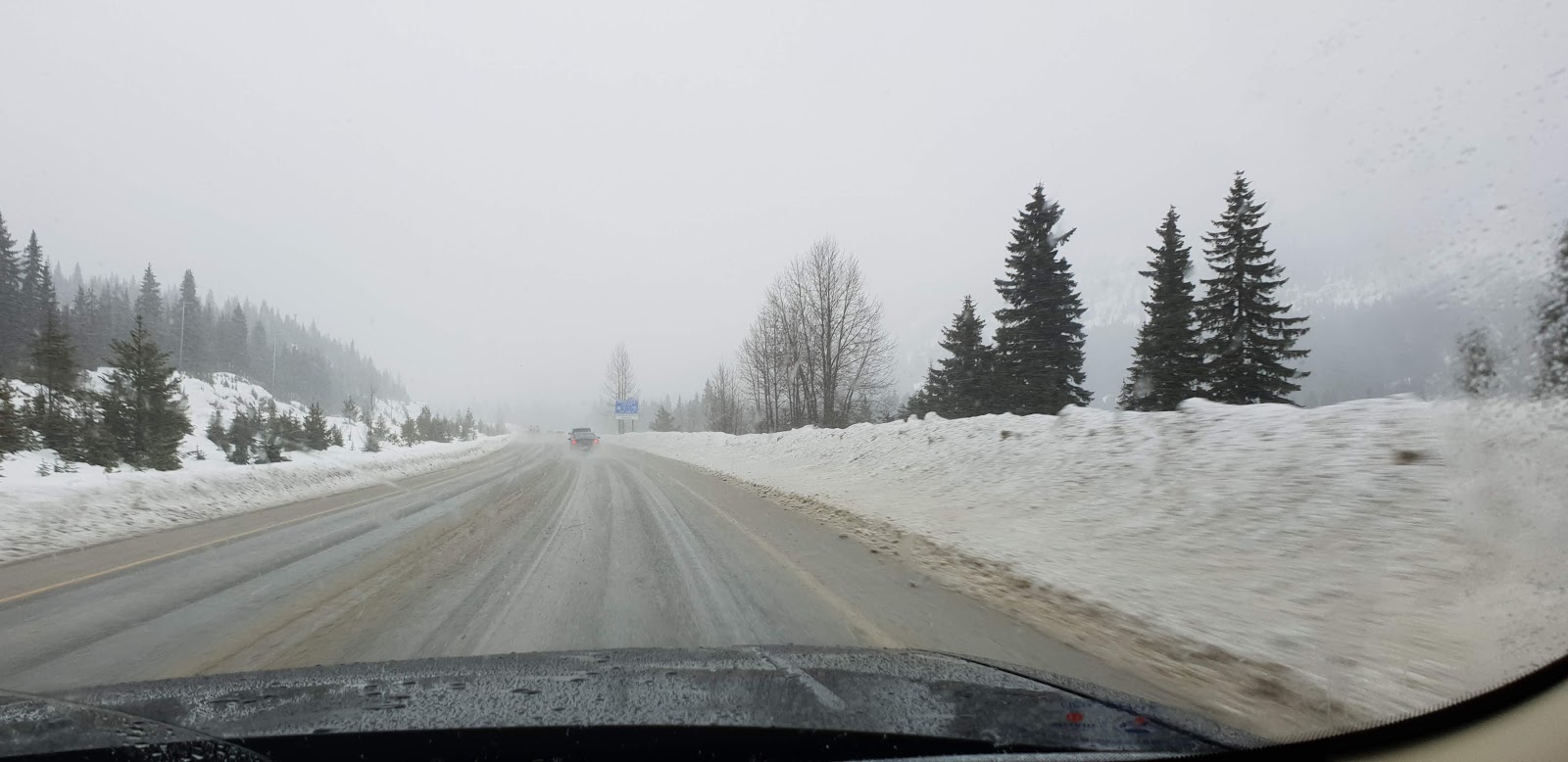
It rains all the way to the top of the mountain, progress hampered from time to time by water sprays from both vehicles and trucks. The rain is relentless. At the top of the mountain, the rain turns into snow and the road surface to slush. It’s 0 degrees, but being the afternoon, I was not expecting it to turn to ice very quickly.
On the other side of the mountain, closer to Kamloops, there was sleet, then rain, then nothing, the last 100kms or so, in reasonably dry conditions.
Outside Kamloops, and in the town itself, there was evidence of snow recently cleared, and slushy roads. Cars in various places were covered in snow, indicating the most recent falls had been the night before.
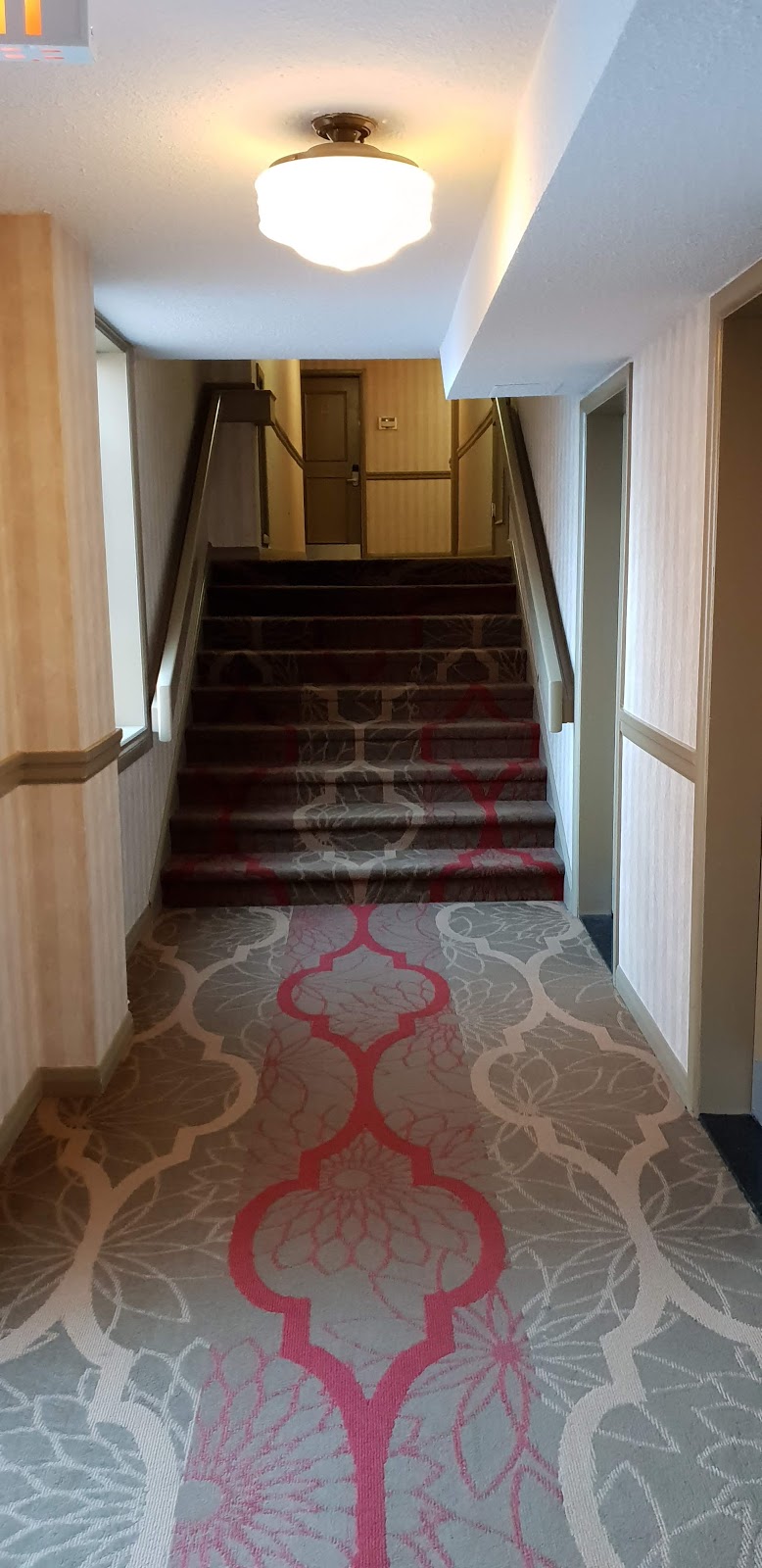
We’re staying at the Park Hotel, a heritage building, apparently built in the later 1920s. In the style of the time, it is a little like a rabbit warren with passages turning off in a number of directions, and showing it is spread across a number of different buildings.
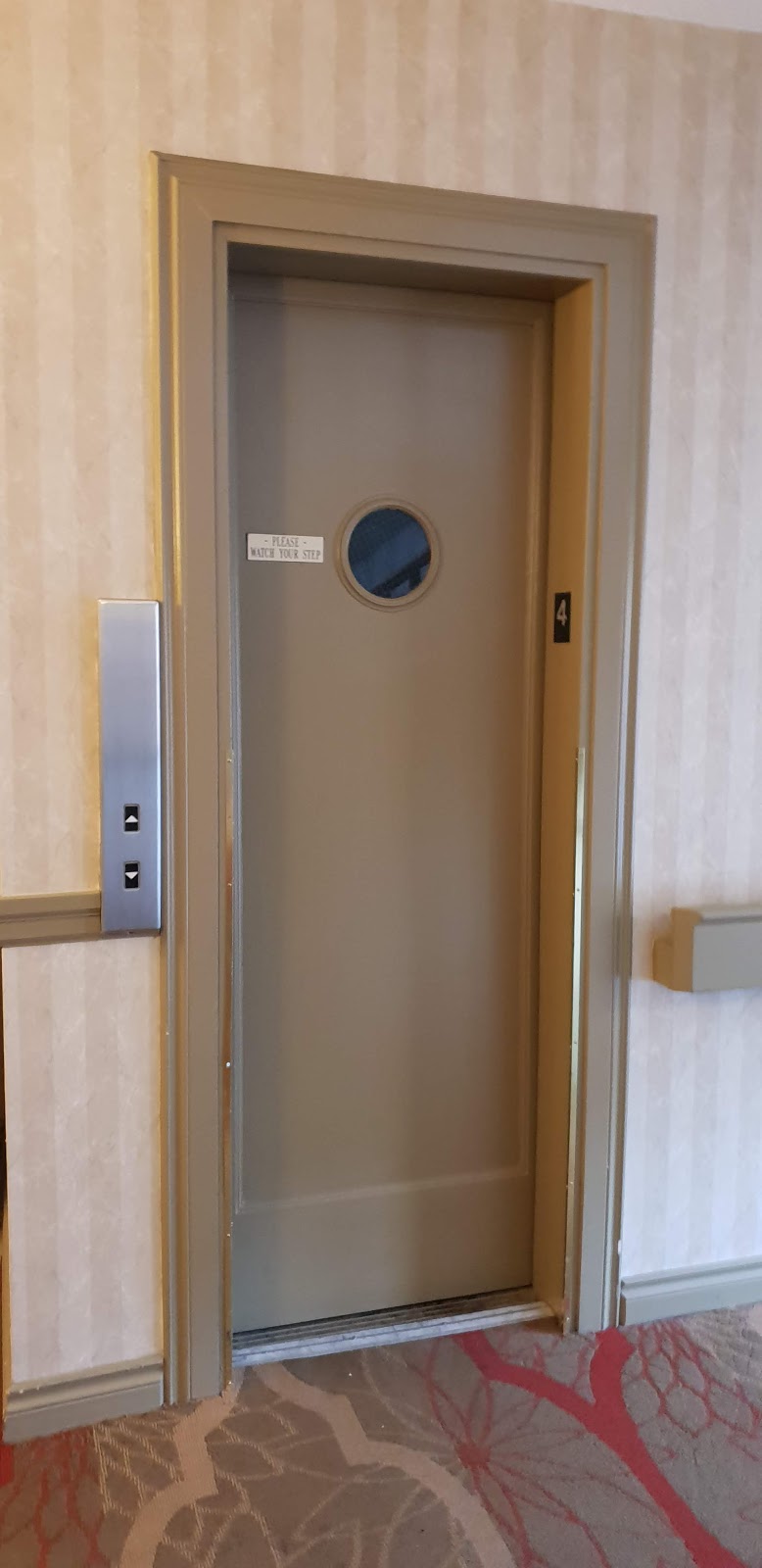
It has the original Otis elevator that can take a maximum of four passengers, and a sign on the wall that says “no horseplay inside the elevator” which is a rather interesting expression that only someone of my vintage would understand. And, for those without a sense of humor, you definitely couldn’t fit a horse in it to play with.
The thing is, how do you find a balance between keeping the old world charm with modern-day expectations. You can’t. Some hotels try valiantly to get that balance. Here, it is simply old world charm, which I guess we should be grateful for because sooner rather than later it’s going to disappear forever.
In my writer’s mind, given the importance of the railways, this was probably a thriving place for travelers, and once upon a time, there were a lot more hotels like this one.
For instance, I’ve heard someone mutter, “the devil you say…”
Or another, who was telling his friend, who, at the time was in a spot of bother, ‘You’re between the devil and the deep blue sea.”
Wrong. We all know the sea is green, not blue.
But whatever the circumstances, the devil seems to pop up a lot.
For instance,
Better the devil you know than the devil you don’t.
It seems I’ve heard that somewhere before, or at least a part of it. Hmmm.
Maybe you’ve “gone to the devil”. Can that be paired with “going downhill at a rapid rate of knots”?
OK, it’s impossible to go downhill using the speed measure of knots, that only applies to boats, so who came up with that saying, a landlubber sailor?
Hang on, isn’t there a team called the New Jersey Devils? Funny, I didn’t see if the players had horns or not, and they were using hockey sticks not tridents.
Maybe I misheard.
Neutral men are the devil’s allies, therefore there must be a lot of devils in Switzerland
The devil finds work for idle hands, oh yes, my grandmother used this often on me whenever she caught me doing nothing, or digging around in her magazine room … which was a lot
But my favorite,
When in hell, only the devil can show you the way out.
In all of the goings-on, with Zoe chasing down old acquaintances in Bucharest, then moving on to Yuri, then Olga, we forget that Isobel and Rupert are on her trail, with Sebastian in tow.
It’s not so much Sebastian in charge anymore, not after going rogue and shooting his boss and John’s mother, an act that Rupert witnesses after following Sebastian on the hunch that he was up to something.
Rupert realizes that Worthington still presents a major problem, and on the basis that Worthington was going to realize it’s not Zoe shooting at him, Worthington had to be taken off the chessboard.
Unfortunately, he has to enlist Sebastian to get a crew together to kidnap him and take him to a safe house.
Meanwhile, Isobel, with a computer in hand, takes up vigil at the hospital with John’s mother, pretending she is her daughter. There she tracks Zoe via her cell phone to an address in Zurich.
Then, miraculously John’s cell phone reappears and is active long enough for her to get a location, and see that a 96-second phone call is made to a phone in Zurich, Zoe’s.
Then it disappears again.
Isobel then calls Zoe and gives her the address. It’s a short call.
Calls to Sebastian and Rupert mobilize them, and everyone is on their way to John’s location.
…
Today’s writing, with Zoe languishing in a dungeon waiting for a white knight, 2,011 words, for a total of 61,922.
Aside from the fact it is one of those necessary items to walk with, and the fact we can have two or four for most humans and animals, there are a few other uses for the word ‘leg’.
Like…
‘You haven’t got a leg to stand on’, doesn’t necessarily mean you have no legs, but that you are in a precarious position.
“the table had ornate legs’, yes, even non-living objects can have legs, like tables and chairs.
“It was the fifth leg of the race’, meaning it can be a stage of a race.
“He was legless’, meaning that he was too drunk to stand up. Some might think being legless is a badge of honour, but I suspect those people have been drinking a long time and the alcohol has destroyed most of their brain cells.
“leg it!’, meaning get the hell out of here before you’re caught.
Then, finally, ‘he’s on his last legs’, meaning that he’s exhausted, or about to die.
I’m sure there’s more but that’ll do for now.
I have to use my legs to get some exercise, of which the first leg is to the tripod to check if its legs are stable, and the second leg is to come back to the table and replace one of the legs which is broken. Then I’ll leg it to the pub where hopefully I won’t become legless.
From the age of 23, my life had been a complete work of fiction, and I have been so wrapped up in that web of lies that I no longer knew what was true and what wasn’t.
23 years and 1 day to be exact, the day after my birthday. It was the last thing I remembered about who I might have been.
Before a truck nearly wiped me out, destroyed my car, and very neatly me with it.
My survival had been described as a miracle, a triumph for the bionic engineers who got a subject to implant their technology, overcoming the bans for creating and installing such technology in humans by simply not telling anyone.
It was why, when I work up, I was in a small room buried a long way from the surface of the planet, a sort of Frankenstein’s secret laboratory.
But I didn’t know any of this, not for a long time, not till things started to go wrong.
All I knew was what I was told, and that was that I was very lucky to be alive, that I had the best team of surgeons, and they had quite literally glued me back together.
Judging by the number of bandages, I could believe them. It took six months for all of the operations to be completed, and another few for the skin grafts and physical healing.
Not only they were impressed by the way I had recovered, but when I finally got to look at the new me, it was as if nothing had ever happened. Certainly, this time around, I was much better looking, physically fit, and tired, but mentally, I was still on a knife-edge.
That accident replayed in my head at least once every day, and that would probably never leave me. There were other jumbled memories in my head that I couldn’t make sense of, of people who looked like aliens, to be in what might call a laboratory.
And then one recurring, of a woman who might have been an angel or a doctor, or both. She never spoke, just remained by my side nearly all the time, sitting there observing me.
It felt strange, but it was not uncomfortable. And it was hard to tell if the memories were real or just my imagination because since I’d woken and returned to what they called the real world I had not seen her again.
…
I never understood what the expression red-letter day meant, other than in the current context, it was to be the day they sent me home.
There were moments when I never thought I’d see home again, and then moments where I knew no one would recognize me.
The reality is they wouldn’t. In saving me, they completely reconstructed me, from the face down. When I first looked in the mirror my face was bandages. Then I’d was scarred and almost bloody pulp. In the end, staring back at me was the face of someone I didn’t know.
It was the price of being saved, but somewhere behind the tonal inflection of the plastic surgeon was the real reason for the transformation, and perhaps it didn’t have to be that way.
But I was grateful and didn’t want to rock the boat. It just makes it that little bit more difficult to consider re-joining the world.
I’d been escorted to a large lounge that overlooked a snow-covered mountain range, where the sky was blue and the sun shone brightly, giving the whole scene a sort of shimmering effect.
A touch of the glass that separated outside from in was very, very cold to the touch. Was this a secret hideaway in the Swiss mountains, and had I been in a secret laboratory?
Or was this another planet?
Was it the drugs they’d been going me every day making me like this, unsure, uncertain, unsettled, and afraid?
I’d been brought to the room and left there, and for a half-hour I alternately sat, made coffee, stood and admired the scenery, checked all of the books in the bookcase, the bottles of alcohol in the bar, then sat again, trying to dispel the nerves.
Then the door opened, the one I tried and found locked, and to my surprise, the angel walked in, looking more beautiful than ever.
I watched her walk across the room, mesmerized.
She stopped in front of me, smiled, then sat in the chair opposite, or rather not so much sit as curl up into the contours of the seat, feet tucked under her, and arm outstretched across the back, almost as if she was inviting me to snuggle into her.
“How are you this morning Matthew?”
Her voice was equally mesmerizing, and I would be happy to listen to her reading a book or the definition of rocket science.
“Very well.”
“It’s been a long road, sometimes difficult, sometimes almost impossible, but we got there in the end. You are, according to the doctors, fully recovered, and it’s time for you to leave.”
“About that…”
“You have questions, I suspect, and a lot of them. They will be answered, all in good time. But for the present, we will not be casting you out to fend for yourself. I will be coming with you, your intermediary so to speak while you reassimilate. Of course, you cannot go back to the life you had before, that life, that person no longer exists. For all intents and purposes, you had died on the operating table after the accident.”
“That was not what I understood.”
What I had understood was very hazy, after they had brought me to the facility. Bits and pieces of that night, of the accident, and the aftermath, of being in the hospital, and what I thought was me looking down at me on an operating table, being declared dead.
And then being whisked away in an ambulance to somewhere else where there were more doctors and nurses, and a man in a suit saying ‘sign this if you want to live‘.
I was not sure what I signed, then, but now, it was to save my life, but at what cost?
“Things are not always as they seem. You have been treated with largely experimental treatments that otherwise could not be performed on people within the current medical regime. Your life, however, was never in any danger, and, as you can see, you have recovered remarkably. All we ask is that you accept the responsibility of being one of the few that have been granted a second life. I am also another such person, and it will be my honor to help you through what can be a difficult stage, reintegration. You are, for all intents and purposes, Andrew Tavener, but as he is no longer alive, your name will be Mathew Welles. I was once Mary Ballen, I’m now Felicity Welkinshaw. Names are only a part of who you are now.”
It was beginning to sound like I was one of a select group. That Felicity was like me, and she accepted who she was, now. Perhaps things were not so bad, a good job, and a girl like Felicity as a friend, perhaps that was only a small price to pay.
Except…
“So, I cannot go back to where I lived, where I worked, see those people I once knew, friends, family?”
“Not as Andrew, no. But, when we believe you can manage it, you will be able to see those people but only as an outsider who has forged a relationship with all or any of them. However, there is one exception, Wendy. You cannot see her, not even accidentally meet her. For that reason, your new life will be as a new junior executive for the company that oversees the medical research that you have been treated, in England. It is for the best, and you will come to realize that.”
I shrugged. It could be worse. But there was something else on my mind. Something borne out of a lot of fractured memories, after coming to the facility.
“This is going to sound very freakish, but I have to ask. Am I still human?”
Those odd memories, I thought I was being ‘assembled’.
“Yes, though a number of what may seem like robotic changes have been made, what we regard as the next step in human evolution. Now, I think it’s time for our going away party. Everyone will be there.”
She stood, and held out her hand.
I took it and had an immediate tingling sensation, such a human reaction.
Followed by a single memory that came back right at that moment, a snippet of a conversation I’d overheard.
“He’s the best god-damned robot we’ve made to date, even better than Felicity, and that’s saying something.”
And the face of the man was the first one I saw as I entered the room.
This morning started with a visit to the car rental place in Vancouver. It reinforced the notion that you can be given the address and still not find the place. It happened in Washington where it was hiding in the back of the main railway station, and it happened again in Vancouver when it was hidden inside a hotel.
We simply walked straight past it. Pity there wasn’t a sign to let people know.
However…
We went in expecting a Grand Jeep Cherokee and walked out with a Ford Flex, suitable for three people and four large suitcases. It actually seats 7, but forget the baggage, you’d be lucky to get two large suitcases in that configuration.
It is more than adequate for our requirements.
Things to note, it was delivered with just over a quarter of a tank of gas, and it had only done about 11,000 km, so it’s relatively new. It’s reasonably spacious, and when the extra seats are folded down, there is plenty of baggage space.
So far, so good.
We finally leave the hotel at about half-past ten, and it is raining. It is a simple task to get on Highway 1, the TransCanada Highway, initially, and then onto Highway 5, the Coquihalla Highway for the trip to Kamloops.
It rains all the way to the top of the mountain, progress hampered from time to time by water sprays from both vehicles and trucks. The rain is relentless. At the top of the mountain, the rain turns into snow and the road surface to slush. It’s 0 degrees, but being the afternoon, I was not expecting it to turn to ice very quickly.
On the other side of the mountain, closer to Kamloops, there was sleet, then rain, then nothing, the last 100kms or so, in reasonably dry conditions.
Outside Kamloops, and in the town itself, there was evidence of snow recently cleared, and slushy roads. Cars in various places were covered in snow, indicating the most recent falls had been the night before.
We’re staying at the Park Hotel, a heritage building, apparently built in the later 1920s. In the style of the time, it is a little like a rabbit warren with passages turning off in a number of directions, and showing it is spread across a number of different buildings.
It has the original Otis elevator that can take a maximum of four passengers, and a sign on the wall that says “no horseplay inside the elevator” which is a rather interesting expression that only someone of my vintage would understand. And, for those without a sense of humor, you definitely couldn’t fit a horse in it to play with.
The thing is, how do you find a balance between keeping the old world charm with modern-day expectations. You can’t. Some hotels try valiantly to get that balance. Here, it is simply old world charm, which I guess we should be grateful for because sooner rather than later it’s going to disappear forever.
In my writer’s mind, given the importance of the railways, this was probably a thriving place for travelers, and once upon a time, there were a lot more hotels like this one.
For instance, I’ve heard someone mutter, “the devil you say…”
Or another, who was telling his friend, who, at the time was in a spot of bother, ‘You’re between the devil and the deep blue sea.”
Wrong. We all know the sea is green, not blue.
But whatever the circumstances, the devil seems to pop up a lot.
For instance,
Better the devil you know than the devil you don’t.
It seems I’ve heard that somewhere before, or at least a part of it. Hmmm.
Maybe you’ve “gone to the devil”. Can that be paired with “going downhill at a rapid rate of knots”?
OK, it’s impossible to go downhill using the speed measure of knots, that only applies to boats, so who came up with that saying, a landlubber sailor?
Hang on, isn’t there a team called the New Jersey Devils? Funny, I didn’t see if the players had horns or not, and they were using hockey sticks not tridents.
Maybe I misheard.
Neutral men are the devil’s allies, therefore there must be a lot of devils in Switzerland
The devil finds work for idle hands, oh yes, my grandmother used this often on me whenever she caught me doing nothing, or digging around in her magazine room … which was a lot
But my favorite,
When in hell, only the devil can show you the way out.



 Thrills, Spills, and just a dash of Romance