A photograph from the inspirational bin – 46

What story does it inspire?

This is a photograph of the Leopoldskron Palace used for exterior shots in the movie “The Sound of Music”.

It was a very bleak day when we decided to go on the Sound of Music bus tour, and, yes, there was singing.

But…

It is a sombre setting and lends a great deal of inspiration to a story.

For instance…

There was a large uninhabited house on the edge of a lake where multiple fatalities occurred in the mid-1800s. The family was cursed from the moment the house was built because a gypsy family who had lived on the land before the building commenced were murdered because they would not leave.

The original owner died when falling from a ladder fetching a book from the top shelf in his library, the wife died when she accidentally slipped and fell on a knife in the kitchen, and the eldest son died when he fell from the roof. No one could explain how he got there.

The daughter left immediately after all of these events which happened in the first week of residence, and moved far away.

Move forward about 170 years and one of the ancestors discovered they are entitled to take ownership of the building that had not been lived in for a long, long time.

But…

It does not look any different from the day the last inhabitants died, and is in perfect condition.

How could this be after 170 years?

And what exactly is going on when the descendants come to live in the house?

Is it paranormal activity or is it just gold old fashioned scare tactics to send them away?

I’m trying to write a period piece

Televison is a great recorder of the past, and most channels, and especially cable tv have great libraries of films that go back more than a hundred years.

And, whilst it’s possible that modern day films and television series can try to recapture the past, the English as an exception being very good at it, often it is impossible to capture it correctly.

But, if you have a film shot in the moment, then you have a visual record of what life, and what was once part of our world before you in all it’s dated glory. The pity of it is that, then, we never appreciated it.

After all, in those particular times, who had the time to figuratively stop and smell the roses. Back then as life was going on, we were all tied up with just trying to get through each day.

Years later, often on reflection, we try to remember the old days, and, maybe, remember some of what it was like, but the chances are that change came far too rapidly, and often too radical, that it erases what we thought we knew existed before.

My grandmothers house is a case in point. In it’s place is a multi lane super highway, and there’s nothing left to remind us, or anyone of it, just some old sepia photographs.

I was reminded of how volatile history really is when watching an old documentary, in black and white, and how the city I grew up in used to look.

Then, even though it seemed large to me then, it was a smaller city, with suburbs that stretched about ten or so miles in every direction, and the outer suburbs were where people moved to get a larger block, and countrified atmosphere.

Now, those outer suburbs are no longer spacious properties, the acreage subdivided and the old owners now much richer for a decision made with profit not being the motivator, and the current suburban sprawl is now out to forty or fifty miles.

The reason for the distance is no longer the thought of open spaces and cleaner air, the reason for moving now is that land further out is cheaper, and can make buying that first house more affordable.

This is where I tip my hat to the writers of historical fiction. I myself am writing a story based in the 1970s, and its difficult to find what is and isn’t time specific.

If only I had a dollar for every time I went to write the character pulling out his or her mobile phone.

What I’ve found is the necessity to research, and this has amounted to finding old films, documentaries of the day, and a more fascinating source of information, the newspapers of the day.

The latter especially has provoked a lot of memories and a lot of stuff I thought I’d forgotten, some of it by choice, but others that were poignant.

Yes, and don’t get me started on the distractions.

If only I’d started this project earlier…

A photograph from the inspirational bin – 16

I thought since it is Winter here, we could do with a breath of fresh air and colour that comes with the change if season

Living in Queensland, Winter never quite seems to be as cold as it is in the southern states, which are closer to Antarctica.

We have had a relatively mild winter this year and I didn’t have to light the fire once, though we did use the reverse cycle sir conditioning.

But, from now the temperature will be rising as well as the humidity and will hang around until April next year.

Normally this would mean that a large proportion of the population would be planning their summer holidays, but with Covid restrictions, we may not be allowed to leave our state, or only visit states that have no or few cases like us, and definitely no overseas travel.

For people who like to travel, this is a bitter pill to swallow, and especially so for all those retirees who have worked all their lives, and decided to wait until retirement to see their own country and the world at large.

To me, the adage ‘don’t put off until tomorrow what you can do today’ seemed appropriate and we decided once the kids were old enough, we would travel far and wide while we could.  It was a wise decision because neither of us are as agile as we used to be.

Seems we were the lucky ones.

Now we are content to see our own country which no doubt will be able to manage Covid to the extent that life might return to a form if normal sooner rather that later.

And if it doesn’t, then I have enough to amuse myself at home. I’m sure we are all familiar with the expression ‘spring cleaning’. We have decided to clean house, and do some renovating.

And it’s a surprise when cleaning out those cupboards, drawers, and boxes, the stuff you’ve accumulated over many, many years. Last I heard, we were taking about getting a large skip, so I suspect this culling is going to be savage.

But, just to be clear, no books will be thrown out!

Short Story Writing – Don’t try this at home! – Part 4

This is not a treatise, but a tongue in cheek, discussion on how to write short stories.   Suffice to say this is not the definitive way of doing it, just mine.  It works for me – it might not work for you.

You’ve got the place, now you want the who.

My main characters are quite often me.

Not the real me, because I’m boring.  No, those characters are what I would like to be, that imaginary superhuman that can do everything.

Until, of course, reality sets in, and the bullets start flying.  When that happens, we should be looking to run or at the very least get under cover, not walk into a hail of bullets, with a huge grin, staring down the enemy.

Hang on, that never happens except in superman comics.

What’s really needed here is a little vulnerability, a little humility and a lot of understanding, qualities at times I don’t have.

So, in order to create a more believable character, I start dragging traits from others I’ve met, or know, or really don’t want to know.  

In a writer’s environment, there are a plethora of people out there that you can draw on for inspiration.  I once spent and afternoon at a railway station just observing people.  Even now, I make observations, some of which are true, and others, wildly off course. 

I once tried to convince my other half that I could pick people’s traits, and we sat at a café outside a church in Venice.  I was lucky, I got more than 75% correct.

Other characters in my stories I have met along the way.

Like a piano player in a restaurant.  It was not so much the playing was bad, it was the way he managed to draw people into his orbit and keep them there.  The man has charisma, but sadly no talent for the instrument.

Like an aunt I met only twice in a lifetime, and who left a lasting impression.  Severe, angry looking, speaking a language I didn’t understand, even though it was English.  It was where I learned we came from England, and she was the closest thing I came to as an example of nineteenth-century prim and proper.  And, no, she didn’t have a sense of humour or time for silly little boys.

Like one of my bosses, a man of indeterminate age, but it had to be over 100, or so it seemed to my sixteen-year-old brain, who spoke and dressed impeccably, and yes, he did once say that I would be the death of him.

I can only hope I wasn’t.

Like a Captain of a ship I once met, a man who didn’t seem to have time for the minions, and a man who reeked authority and respect.  I’ve always wanted to be like him, but unfortunately, it was not in the genes.

Those are only a few, there are thousands of others over the years, a built-in library, if you will, of characters waiting to be taken off the shelf and used where necessary or appropriate.  We all have one of these banks.

You just have to know when to use them.

Travelling after the pandemic – Destination Melbourne

Melbourne airport – an underwhelming experience

Let me sum up this experience at the start, in one word.

Terrible.

I know it’s not much past post-Covid, but tell me, what were the airport administrators doing for two years, other than lamenting the lack of plane traffic and sitting on their hands? Did they think no one was ever going to travel again?

Let me suggest what they should have been doing, getting onto every one of the retailers that had to close, and making sure that from day one of reopening, it was back to pre-Covid.

Instead, it’s a desolate nightmare.  There was only one dedicated Cafe and a bar and two bookshops down the Qantas end.

And the food was basically stale sandwiches and muffins. And if you don’t like muffins…

We had to walk a mile to get to the Cafe and get a decent cup of coffee and a toastie, which the Cafe itself and coffee and food scored a ten out of ten.

If you didn’t know it was there, God only knows what you would do if you wanted something decent.

Score out of ten for the Airport Administrators – minus 5 

Since scoring that I had the unhappy experience of going to the men’s restroom.  It was filthy.  How hard could be for someone to check every half hour to clean up the obvious mess?  I’ll let you imagine how that will affect their current score.

My other bugbear about airports is the scanning of bags before getting to the gate.

Melbourne for some reason has been the worst experience in quite literally the world because it is a complete mess, particularly if one thing goes wrong.

I hate it, and it was no better today and left me shaking, which only happens when I’m extremely stressed.

I can only hope it eventually gets better, but, sorry to say this but they’ve had nearly two years to get the process right and run much smoother, but it’s clear they’ve also just sat on their hands.

Maybe one day someone might do something about it, but we’re talking government here, and it takes them ten years just to create a green discussion paper.

So, not holding my breath.

Of course, in reading about the current parlous state of air travel throughout the world, it seems we are not the only ones having problems. I guess we should spare a thought for those going to Heathrow in London. The many times we’ve been there, it’s been borderline organized chaos, and yes, once, we had to wait an hour for our baggage, but now it seems it just disappears.

Glad I’m not going there any time soon.

But, soon, we’re taking the plunge again, and going to Hobart.

I’ll let you know how that goes.

Searching for locations: San Gimignano, Italy

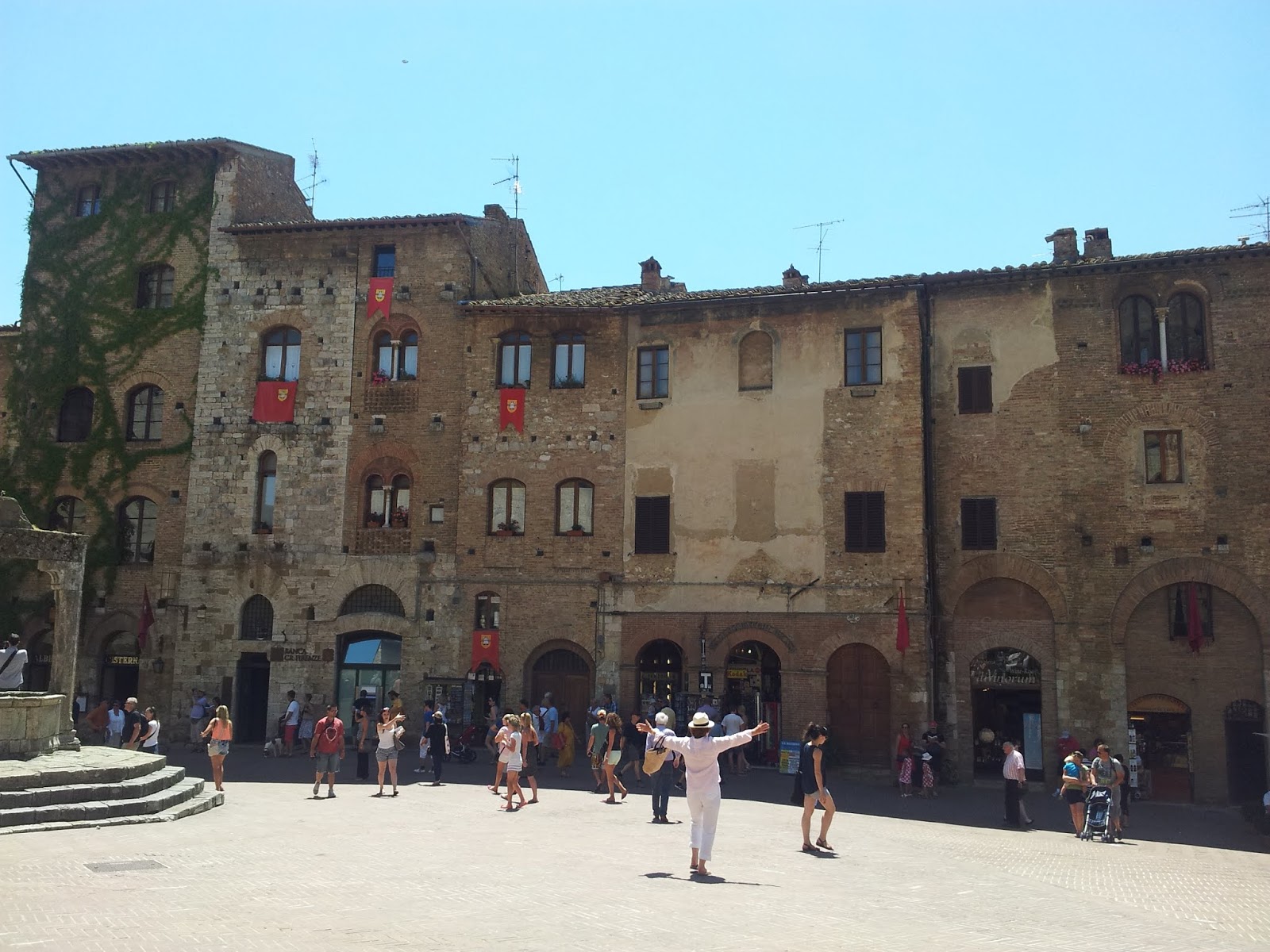
We have visited this town on a hill, famous for its fourteen towers, twice.  The first time we stayed in a hotel overlooking the main piazza, and the second time, for a day visit, and return to a little restaurant tucked away off the main piazza for its home cooking.

No cars are allowed inside the town and parking is provided outside the town walls.  You can drive up to the hotel to deliver your baggage, but the car must return to the carpark overnight.

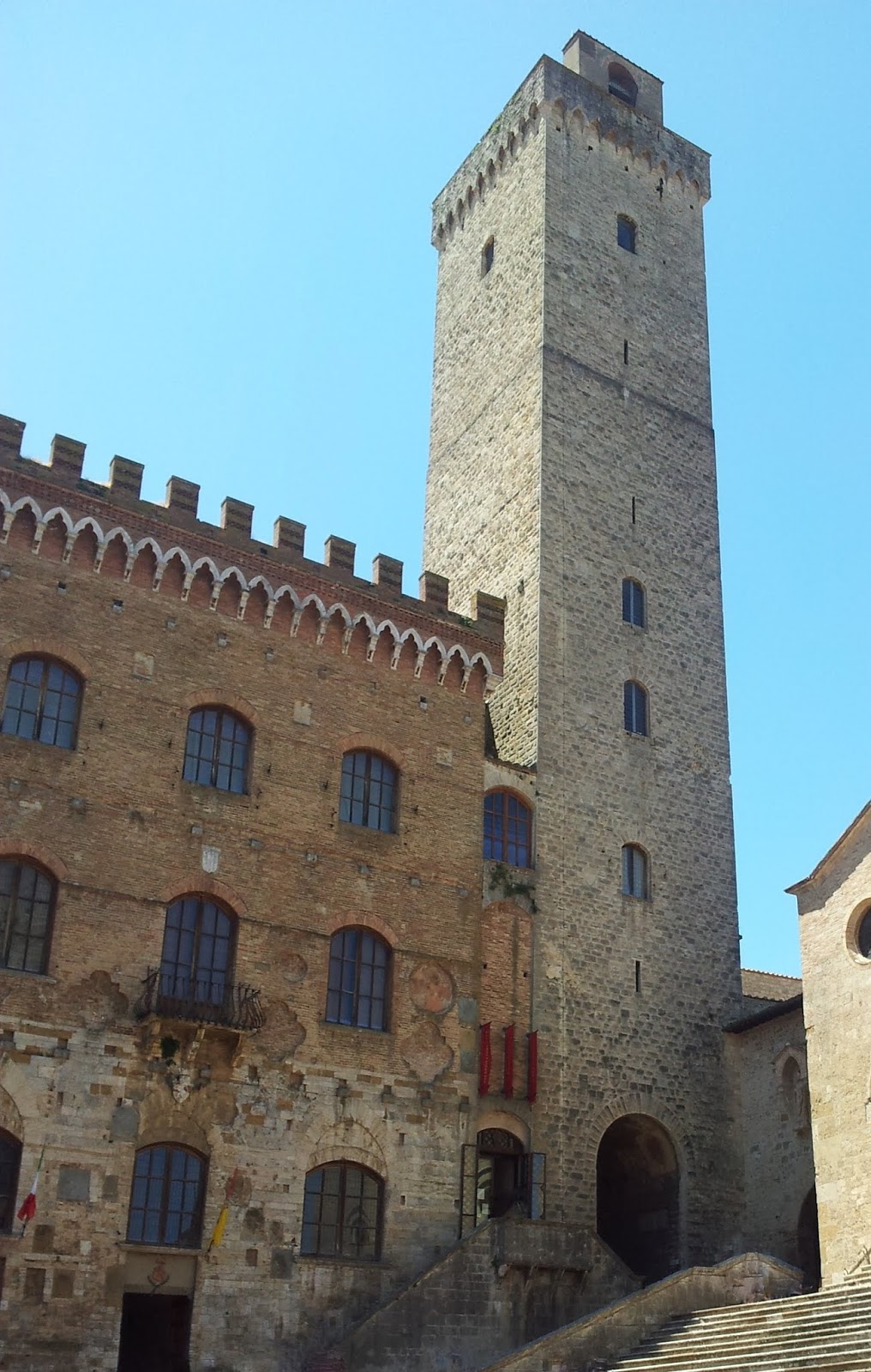
This is one of the fourteen towers

I didn’t attempt to climb to the tower, which you can do in some of them, just getting up the church steps was enough for me.  Inside the building was, if I remember correctly, a museum.

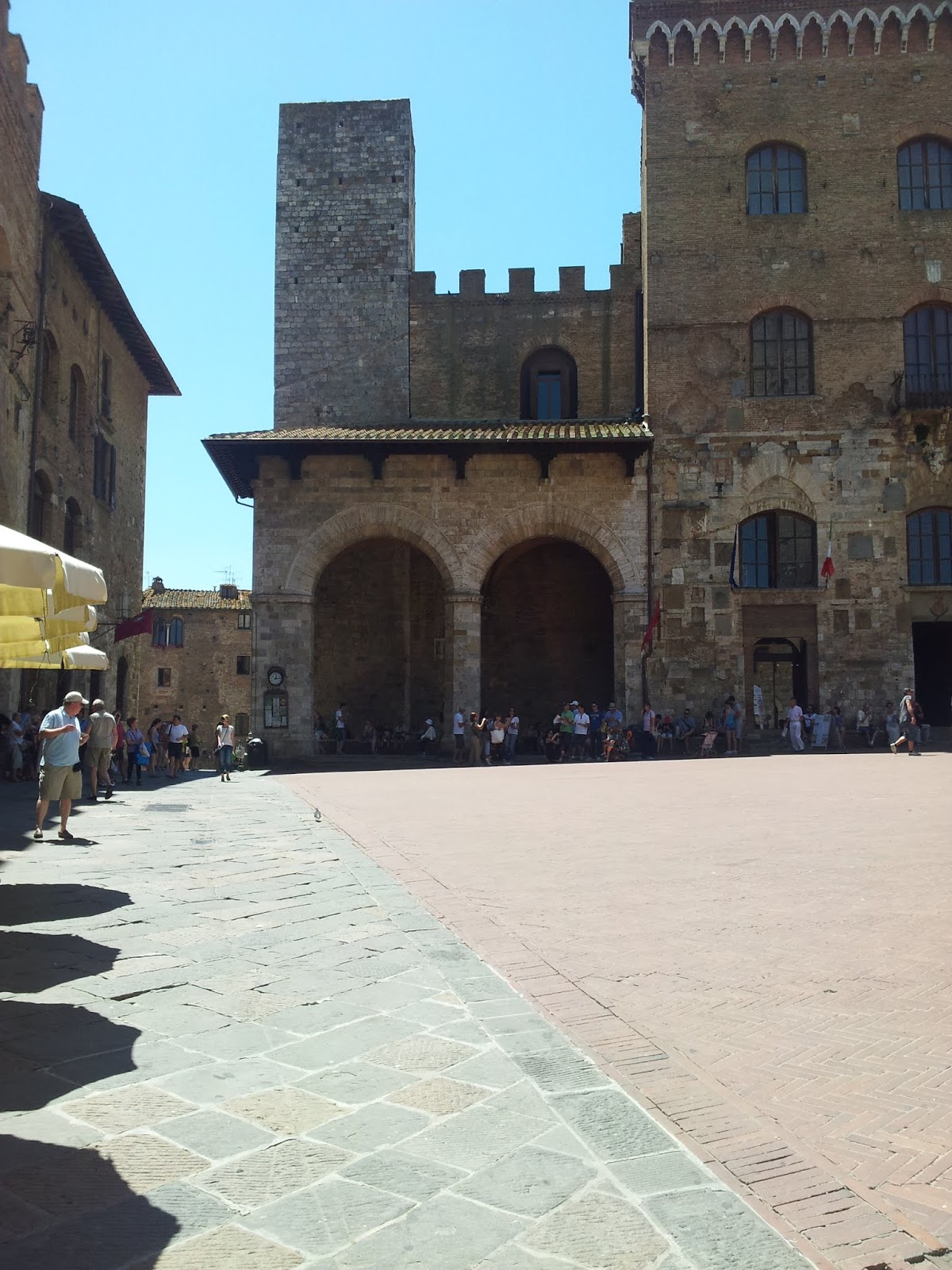
Looking up the piazza towards some battlements, and when you reach the top and turn left, there is a small restaurant on the right-hand side of the laneway that had the best wild boar pasta.

Another of the fourteen towers, and through the arch, down a lane to the gated fence that surrounds the town.  The fortifications are quite formidable and there are several places along the fence where you can stand and look down the hill at the oncoming enemy (if there was one).

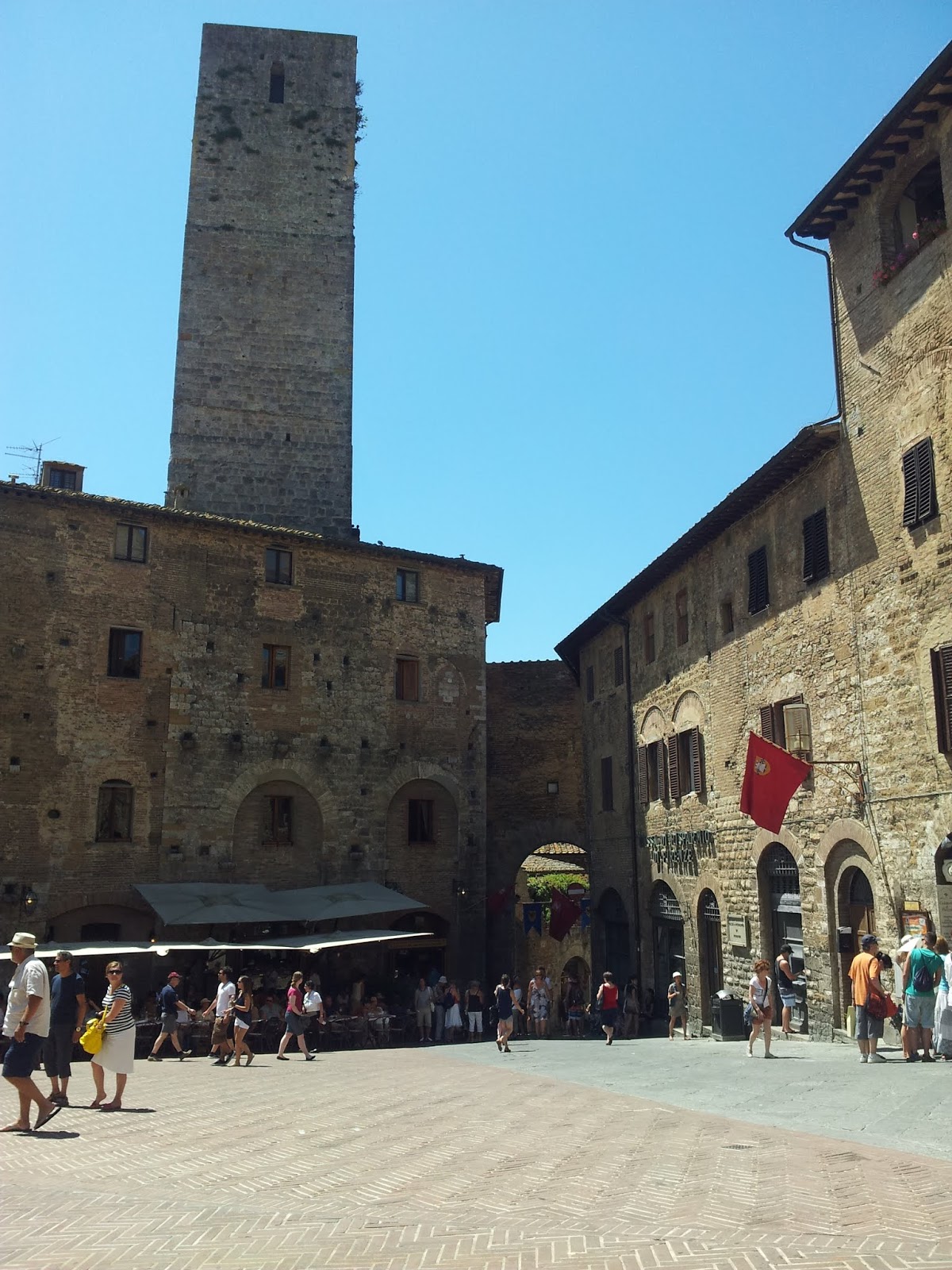
Part of the main piazza which is quite large, and on the right, the wishing well where my wish for a cooler day was not granted.

Officially, the Piazza della Cisterna is the most beautiful square of the town, San Gimignano.  The well was built in 1273 and enlarged in 1346 by Podestà Guccio dei Malavolti.

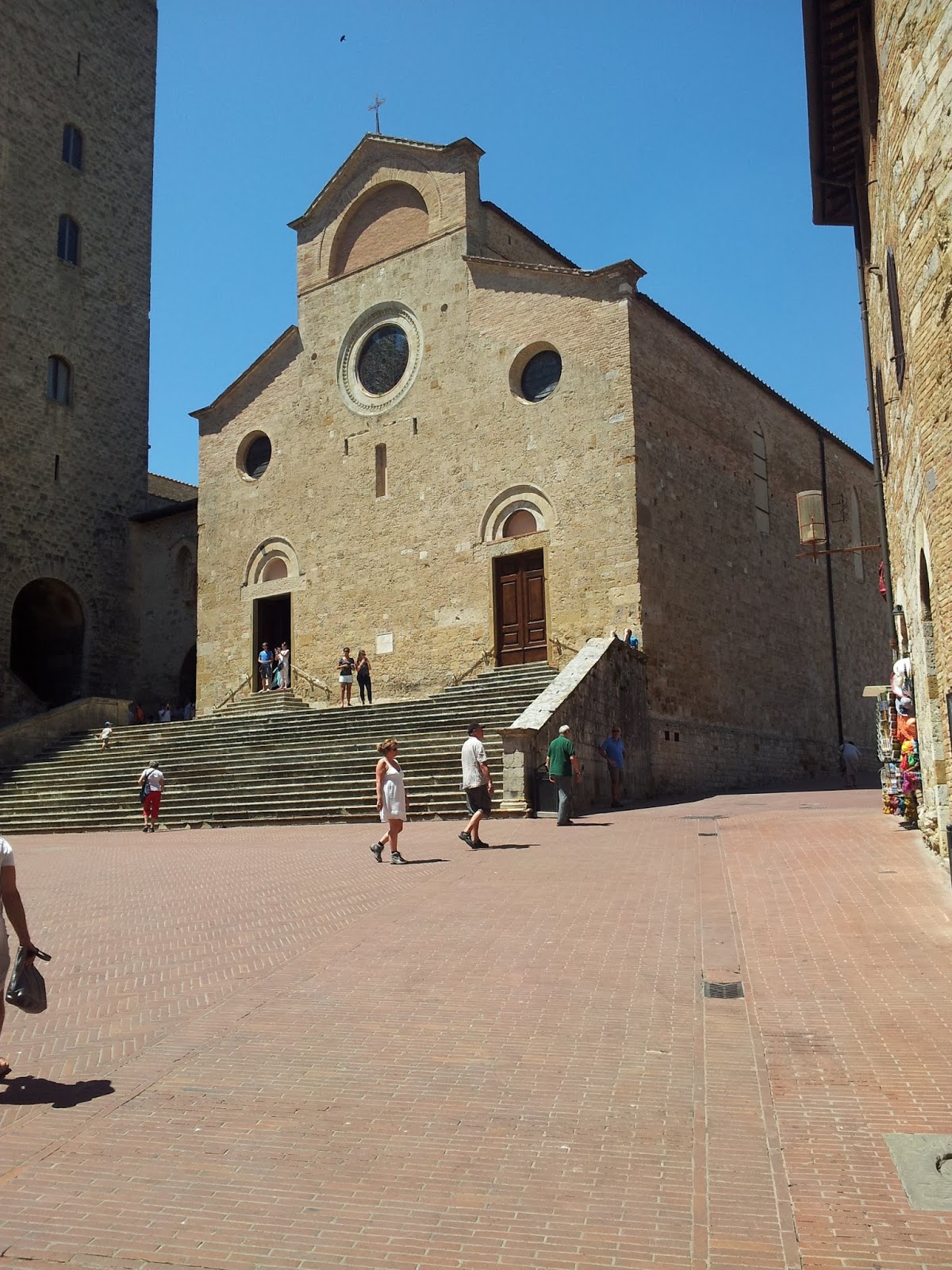
And not to be outdone by any other the other old towns, there is an old church, one of several.  It is the Collegiate Church or the Duomo di San Gimignano, a monument of Romanesque architecture built around 1000 and enlarged over time.

Next door is the Museum of Sacred Art.

And I guess it’s rather odd to see television aerials on top of houses that are quite literally about a thousand years old.  I wonder what they did back then for entertainment?

Searching for locations: Venice, Italy (Again)

We have visited Venice twice, in 2006 and not so long ago.

Not much had changed from visit to visit.

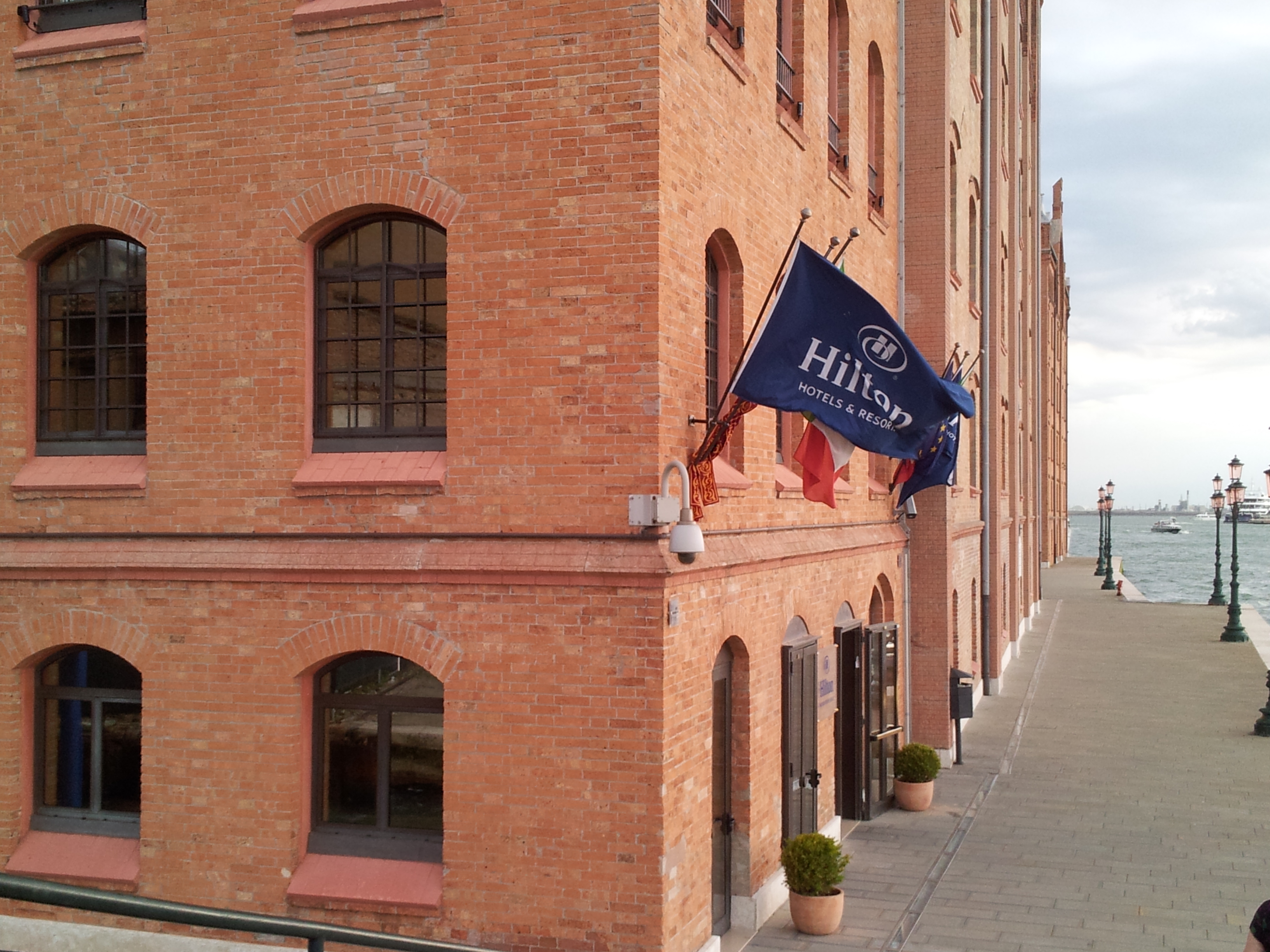
Instead of staying in a hotel selected by a travel agent, the Savoia and Jolanda on the waterfront of Riva Degli Schiavoni, because I’m a Hilton Honors member, more recently we stayed at the Hilton Molino Stucky.  It was located on an island, Giudecca, and had its own transport from the hotel to St Mark’s Square for a very reasonable one-off charge for the stay.

hiltonmolinostuckey2

On our first visit, we traveled from Florence to Venice.  We were advised to take a water taxi to the hotel, not only the most direct route but to see some of Venice from the water.  The only drawback, you have to negotiate a price with the driver.

We were not very good negotiators, and it cost 60 Euros.

But, despite the cost, it was worth every Euro because the taxi driver took us by the scenic route, directly from the Station to the doorstep of our hotel.  For a first time in Venice, and you want to see it from the water, a water taxi is the best option.

2013-06-25 17.09.16

The first time we stayed at the Savoia and Jolanda Hotel, which was at the time quite old, and the room we had, on the ground floor, was comfortable enough, but being November, they had just stopped using the air conditioning, it was still quite warm and at times uncomfortable.

There were better rooms, but this was beyond the knowledge of the travel agent, and one of the reasons we stopped using agents to book hotels.

The most recent visit we had driven down from Salzburg to Venice airport where we had to return the hire car.  From there we were intending to take a private water taxi from the airport to the hotel, for an estimated 120 Euros.

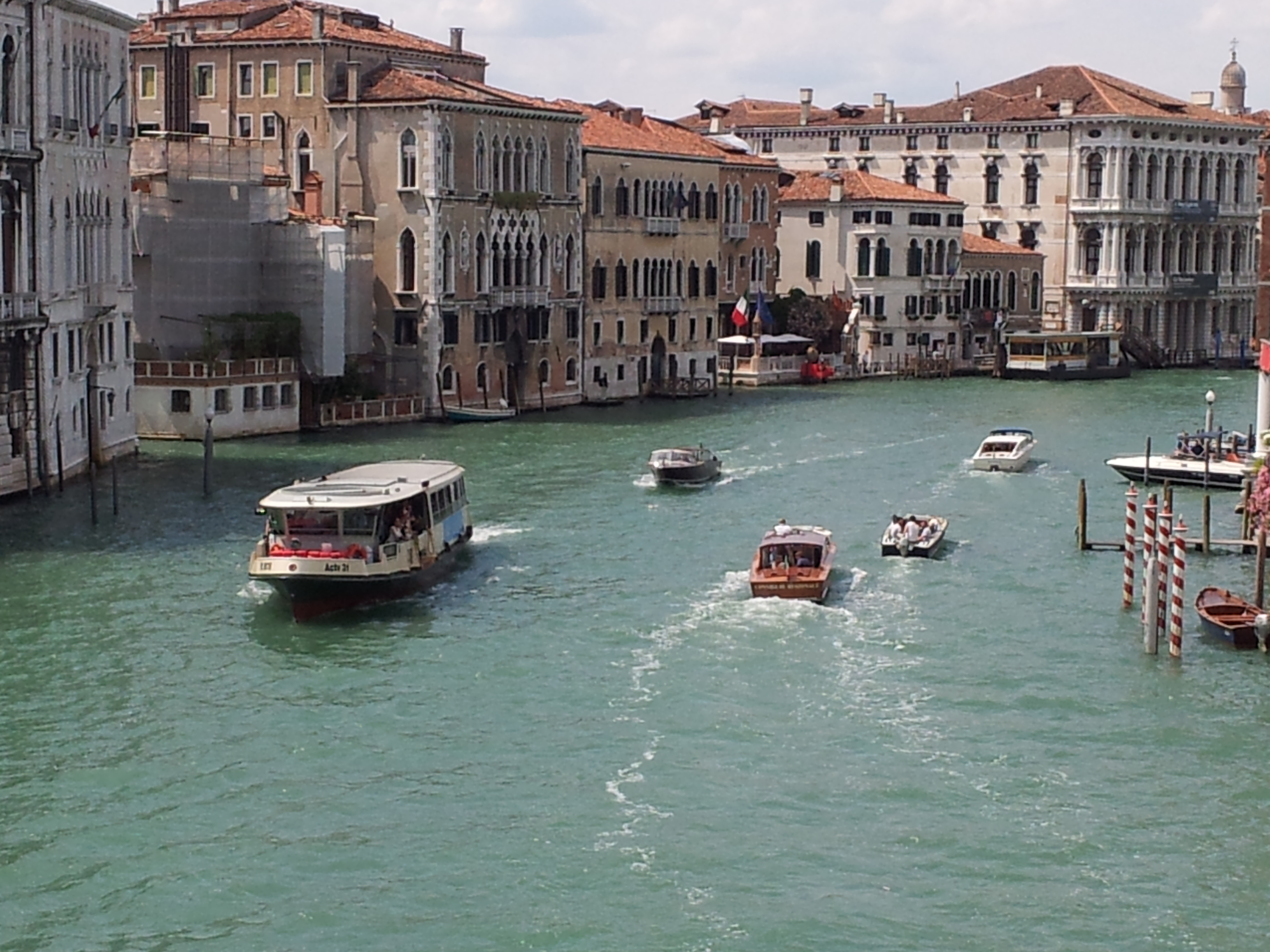
We saved our money and took the ACTV public waterbus, from the airport to the hotel, with one stop.  It took a little over an hour and was equally as scenic.

venicecanals1

Our room in the Hilton was on one of the upper levels, floor four, and had a view of the canal, the large passenger ships coming and going, as well as a remarkable view of Venice itself as far up the canal to St Marks Square in one direction, and the port for the passenger ships in the other.

20130627_081601

We got to see three or four very large passenger ships come and go, along with a lot of other craft.  I hadn’t realized how busy the waterways, and the Grand Canal, were.

20130627_174408

Each evening after a day’s exploring we would end up in the Executive Lounge, and then one of the many restaurants, usually Il Molino for breakfast, and the Rialto Lobby Bar and Lounge for dinner.  After that, it was a stroll down the waterfront taking in the night air, and perhaps to walk off the delicious dinner.

Searching for Locations: Venice, Italy

Venice is definitely a city to explore.  It has an incredible number of canals and walkways, and each time we would start our exploration at St Marks square when it’s not underwater

Everyone I have spoken to about exploring Venice has told me how easy it is to get lost.  It has not happened to me, but with the infinite number of ways you can go, I guess it is possible.

We started our exploration of Venice in St Marks square, where, on one side there was the Museo di Palazzo Ducale and, next door, the Basilica di San Marco.  Early morning and/or at high tide, water can be seen bubbling up from under the square, partially flooding it.  I have seen this happen several times.  Each morning as we walked from the hotel (the time we stayed in the Savoia and Jolanda) we passed the Bridge of Sighs.

Around the other three sides of the square are archways and shops.  We have bought both confectionary and souvenirs from some of these stores, albeit relatively expensive.  Prices are cheaper in stores that are away from the square and we found some of these when we walked from St Marks square to the Railway station, through many walkways, and crossing many bridges, and passing through a number of small piazzas.

That day, after the trek, we caught the waterbus back to San Marco, and then went on the tour of the Museo di Palazzo Du which included the dungeons and the Bridge of Sighs from the inside.  It took a few hours, longer than I’d anticipated because there was so much to see.

The next day, we caught the waterbus from San Marco to the Ponte di Rialto bridge.  Just upstream from the wharf there was a very large passenger ship, and I noticed there were a number of passengers from the ship on the waterbus, one of whom spoke to us about visiting Venice.  I didn’t realize we looked like professional tourists who knew where we were going.

After a pleasant conversation, and taking in the views up and down the Grand Canal, we disembarked and headed for the bridge, looking at the shops, mostly selling upmarket and expensive gifts, and eventually crossing to the other side where there was a lot of small market type stalls selling souvenirs as well as clothes, and most importantly, it being a hot day, cold Limonata.  This was my first taste of Limonata and I was hooked.

Continuing on from there was a wide street at the end and a number of restaurants where we had lunch.  We had a map of Venice and I was going to plot a course back to the hotel, taking what would be a large circular route that would come out at the Accademia Bridge, and further on to the Terminal Fusina Venezia where there was another church to explore, the Santa Maria del Rosario.

This is a photo of the Hilton Hotel from the other side of the canal.

It was useful knowledge for the second time we visited Venice because the waterbus from the Hilton hotel made its first stop, before San Marco, there.  We also discovered on that second visit a number of restaurants on the way from the terminal and church to the Accademia Bridge.

This is looking back towards San Marco from the Accademia Bridge:

And this, looking towards the docks:

Items to note:

Restaurants off the beaten track were much cheaper and the food a lot different to that in the middle of the tourist areas.

There are a lot of churches, big and small, tucked away in interesting spots where there are small piazza’s.  You can look in all of them, though some asked for a small fee.

Souvenirs, coffee, and confectionary are very expensive in St Marks square.

“Strangers We’ve Become” – Countdown to publishing in ??? Days

Here’s the thing…

It was down to the day before publishing.

Years of hard work were about to see the light of day…

Then the sky fell in.

Well, it wasn’t quite that dramatic but it came a close second.

My editor had been away and had forgotten to send an email to say that there were some last-minute changes that she wanted considered.

That email finally turned up in our inboxes the day before the book was about to be published.

Now I have a fortnight to read through the suggestions and then write the necessary changes, some of which have a more serious impact than just a localised rewrite.

The publication date is now moved back a month to a date in the first week of April, hopefully not April Fools Day.

I’ll let you know when the countdown restarts.

Searching for locations: Rome, Italy

We visited Rome in August

It was hot.

It was verrrry hot.

We flew into Rome’s Leonardo da Vinci-Fiumicino airport after a rather bumpy flight from London.  Unlike most other airports the plane parked at a satellite terminal and after we disembarked we had to catch a train to the main terminal.

The most notable memory of this airport was my daughter’s discovery of a salami shop.

We had booked a transfer to take us to the hotel the Roma Corso Trieste Mercure in Via Gradisca from the airport.  It was a white air-conditioned van and so far we had avoided the heat.

One of the rooms had faulty air conditioning an absolute must as the rooms were very hot without it and necessitated a room change which was done quickly and efficiently.

The hotel was in the suburbs and without a car we were dependent on public transport.  According to the reception staff, there was a bus stop nearby, and a longer walk to the tram or light railway.  The bus seemed to be the best option as it would take us to the central terminal near the railway station, where all tour buses also operated from, and particularly the open-top buses that went to all the major tourist attractions.

That first day basically was given over to travelling, arriving by plane and settling into the hotel, thus we didn’t get to feel the force of the heat.  That came the next day.

After a walk around the hotel precinct to get our bearings and see what shops and restaurants were available, on returning to the hotel we were faced with limited choices of room service or to go out for dinner.

My daughter and l go for a long walk up Via Nomentana to find several shops and a restaurant.  We went into the restaurant and sat down.   We waited for 10 minutes and got no service nor did anyone come and ask us if we wanted to order food so instead we left somewhat disappointed and go next door to what seemed to be the Italian version of a delicatessen and ordered sandwiches and beer.   I bought a half dozen cans of Moretti beer two of which I drank on the way home.

It was still very hot even at eight at night and the sandwiches are delicious.  It just might be by that time we were starving and anything would have tasted great.

The next morning we are up and ready to chance the weather and some history.  Breakfast at the hotel is limited but very good.

We were going to use public transport and I’d studied up on the Internet.

Travelling on the bus required pre-purchase of tickets which could be bought in certain shops and locally when exploring the area near the hotel, l found a tobacconist.

Next, we needed to understand how to use the tickets. There was no one on the bus who could help so when l tried to scan the tickets and it failed, l gave up.  We had the same issue each day and in the end, the tickets never got used.

The trip to central Rome by bus took about 15 minutes.  In the morning it was reasonably cool and showed us a little of suburban Rome.  We also saw the trams but we would not be able to use them because our hotel not on a direct route.

That first full day we decided to go and see the Vatican.

Not understanding buses and which one we needed to get to the Vatican, we took a taxi.

Wow.  It was the metaphorical equivalent of driving over the edge of a cliff with a daredevil.  It was quite literally terrifying.

Or maybe we just didn’t know that this was probably the way people drove in Rome.

Shaken but delivered in one piece we found ourselves in the square opposite St Peters Basilica.

The square is impressive, with the statues atop a circular colonnaded walkway.  The church is incredible and took a few hours to take in and to top off the day we did a tour of the Vatican museum which took the rest of the afternoon.

Then it was back to the delicatessen for more sandwiches and beer, and an interesting discussion with several elderly Italian ladies, of which I did not understand one word.

On the second full day we decided to use one of the open-top bus tours and eventually decided on the hop-on hop-off tour simply because the bus was at the central transport terminal for trains and buses and it was getting hotter.

Our first stop was the Colosseum.  There were other monuments nearby, such as the Arch of Constantine, but as the heat factor increased we joined the queue to go into the Colosseum and gladly welcomed the shade once we got inside.

The queue was long and the wait equally so, but it was worth the wait.  It would be more interesting if they could restore part of it to its former glory so we could get a sense of the place as it once was.  But alas that may never happen, but even so, it is still magnificent as a ruin.

Outside in the heat, it was off to the ruins which were a longish walk from the Colosseum, taking Via Sacra, not far from the Arch of Constantine.  This day in the walkway there were a number of illegal vendors, selling knockoff goods such as handbags and watches, and who, at the first sight of the police, packed up their wares in a blanket and ran.

Included in these ruins were The Roman Forum, or just a few columns remaining, the Palatine Hill, Imperial Fori, including the Forum of Augustus, the Forum of Caesar, and more specifically the Forum of Trajan.  It was, unfortunately very hot and dusty in the ruins the day we visited.

We walked all the way to the Foro Romano and the Septimus Severo Arch at the other end of the ruins, past the Temple of Caesar.  I found it very difficult to picture what it was like when the buildings were intact, so I bought a guide to the ruins which showed the buildings as ruins and an overlay of how they would have looked.  The buildings, then, would be as amazing as the Colosseum, and it would have been interesting to have lived back then, though perhaps not as a Christian.

I lost count of the number of bottles of water we bought, but the word ‘frizzante’ was ringing in my ears by the end of the day.  Fortunately, the water did not cost a lot to buy.

At the end of the day, we caught the hop on hop off the bus at the Colosseum and decided not to get off and see any more monuments but observe them from the bus.  The only one I remember seeing was Circo Massimo.  Perhaps if we’d known it was going to be twice as hot on the bus, yes, there was no air-conditioning; we may have chosen another form of transport to get back to the hotel.

On the third and last day in Rome, we decided to go to the Trevi Fountain, see the pantheon and walk up the Spanish Steps.  We spent most of the morning in the cool of a café watching the tourists at the fountain.  By the time we reached the top of the Spanish Steps, we were finished.