“What Sets Us Apart”, a mystery with a twist

David is a man troubled by a past he is trying to forget.

Susan is rebelling against a life of privilege and an exasperated mother who holds a secret that will determine her daughter’s destiny.

They are two people brought together by chance. Or was it?

When Susan discovers her mother’s secret, she goes in search of the truth that has been hidden from her since the day she was born.

When David realizes her absence is more than the usual cooling off after another heated argument, he finds himself being slowly drawn back into his former world of deceit and lies.

Then, back with his former employers, David quickly discovers nothing is what it seems as he embarks on a dangerous mission to find Susan before he loses her forever.

http://amzn.to/2Eryfth

whatsetscover

Being Inspired – the book

Over the past year or so I have been selecting photographs I’ve taken on many travels, and put a story to them.

When I reached a milestone of 50 stories, I decided to make them into a book, and, in doing so, I have gone through each and revised them, making some longer and into short stories.

50 photographs, 50 stories.  I’ve called it, “Inspiration, Maybe”

It will be available soon.

InspirationMaybe1v1

Was it just another surveillance job – Episode 18 – Revised

As we all know, writing by the seat of your pants is almost the same as flying by the seat of your pants, a hazardous occupation.

As it happens, I like writing this way because like the reader, I don’t know what to expect next.

And equally, at times, you can write your self into a corner, much like painting, and then have to go back, make a few changes and//or repairs and then move forward.

It’s part of the writing process, only in this case, the changes occur before you’ve finished the novel, if you finish.  Quite often a lot of writers get only so far, then the manuscript hits the bottom drawer, to be brought out on a distant rainy day.

Or your cat has mocked your writing ability one too many times.

Therefore, we’re winding back to Episode 16, and moving forward once again, from there.  This is episode 18 revised…


Ever had the heart-stopping feeling when you’re in the wrong place, and someone has interrupted you?  Especially if you shouldn’t be there, or that you have no right to be there.

I stood quietly on the inside of the door and hoped whoever the visitor was would go away.  No answer meant no one was home, didn’t it?

Unless…

I heard a key in the door, and it turn in the lock.

I moved quickly to the other side of the door so I would be shielded when the person came into the room.  Too late to get out, I was of two minds what to do.  Hit the visitor over the head and flee, or ask them what they were doing, before they asked me that same question.

Then nothing.

Until a few seconds later I heard a voice, a man, say, “Jan, you’re back.  How was the visit to Philadelphia?”

I heard the slight rattle of Jan taking her hand off the handle and moving away from the door.  “Sad, as all funerals are.  Now, we are left with the house, and my father’s stuff; a huge collection of mostly junk over a long period of time.  Seems he never threw anything out.”

Jan?  Did she live here, with O’Connell?

“Yes, “I’m a bit like that.”

Another tenant, or the building super?

“I made sure Herman was looked after while you were away.  I don’t think he missed you at all?”

She laughed.  “He’s a cat, Fred.  We belong to them, not the other way around.”

“True.  Your friend has not been in for a week or so.”

“I know.  The last message I got from him, he was in Prague, lucky bastard.  He was going to take me with him, but at the last moment, they changed his itinerary.  Perhaps next time.  I was just going to make sure everything was OK, before going home myself.”

“I could look in if you want?”

“No.  Thanks anyway, but last time I was here I left a jacket behind.  Thanks, Fred.”

A moment later I could hear his footsteps heading away, and Jan moved back to the door, and opened it.

I heard the light switch, and then, suddenly, the room was filled with bright light.

The girl was unassuming, stepped into the room, and closed the door behind her.  Before she could take a step, I put a hand over her mouth and an arm around her neck and started squeezing.

Instinctively she started to struggle and call out for help.

I whispered in her ear, “I mean you no harm, but if you struggle, or yell out, it could turn out very bad for you.”

We had been taught how to subdue people without killing them, but that always didn’t go to plan.  There was that instinct to fight back in everyone, and it was sometimes hard not to apply excessive pressure which could, depending on the severity of resistance, see the target asphyxiated, or end up with a broken neck.

She was still struggling, which mean I had to exert more force.

“Stop fighting me or you will harm yourself,” I said, this time in a more forceful whisper.

It had an immediate effect, but I don’t think it was her obedience that caused it.  I gently lowered her to the floor and felt for a pulse.  Unconscious, not dead.  I sighed in relief.  I took a good long look at her so that I would remember what she looked like.  At some point, I was going to have to talk to her.

Then footsteps outside the door.  What else could go wrong?

Then knocking on the door.  Short and sharp.  Followed by, “Jan, are you in there?”

Fred, whoever he was.  What did he want?”

Another knock on the door, this time more urgent.  Damn.  O’Connell’s flat was like a busy store.

I looked around for an escape now there would be no going out the front door.  Not unless I had to disable another person, and assuming if he was the building super, he would not be a small man, so it would take a greater, and noisier, effort to subdue him.

A fire escape, all buildings usually had one down the side of the building, in case of fire.  I went over and checked the windows and found it.  The window needed a little force to open it, but the sound of a key in the door motivated me.

Out the window, close the window again, I made it down the stairs far enough that when I looked up, no one was following me.

That was close.  Too close.


© Charles Heath 2019

In a word: Freeze

Yes, if the temperature was 20 degrees below zero and the forecast for the net week was the same, then that would be the big freeze.

In a more understandable way of putting it, to freeze something is to preserve it at a temperature below zero.

Some things don’t freeze, like petrol.

And you want to hope that you put antifreeze in your radiator otherwise you are going to have big problems with your car in winter.

It also means to stand still.

You can also isolate someone by freezing them out.

And freeze in fear, unable to move, like a deer in headlights.

But the worst example of a freeze is when your computer stops, and you forgot to save that 200-page novel, thereby being lost forever.

No.  That would never happen, you had autosave on, didn’t you?

Didn’t you??????????

Freeze is not to be confused with a frieze which is a broad horizontal band of sculpted or painted decoration, especially on a wall near the ceiling.

Or frees, which in some countries type of football described multiple free kicks, in one sense, and, in another, what you do when you let them go, e.g. he frees the dog.

It’s been an interesting day

Today we have been delving into the past in a way that makes history interesting.

Also, it’s another way to get young children to take an interest in the past, seeing that is often very difficult to part them from their ipads, smartphones and computer games.

It is part of a weekend devoted to history.

First up is a ride on an old steam train, the engine dating back to the 1950s, as is some of the carriages. Now, for someone like me who is only two years younger, it doesn’t seem that old, but to them, it’s a relic.

And for the youngest of our grandaughters who tells me that this will be her first ride in a train, any train, it’s going to be vastly different from her next ride on a train.

I don’t think it went faster than about 30, whether that’s miles an hour or kilometres, so we had time to take in the bushland, the river crossings and the smell of the coal-generated smoke.

And the biggest treat was for them to climb up into the engine cabin to see who drives it, and how it all works.

I try to tell them this is a far cry from the 300kph bullet trains in China that we recently travelled on. This ride was rattly, noisy, and we were barely able to sit still, whereas on the bullet trains you hardly knew you were moving and was so smooth and silent you didn’t know you were moving until you looked out the window.

Tomorrow we’re going to a historical township, built out of digging for gold in the area. It will be of significance to the elder granddaughter as she is working on a project on Eureka, where there was a watershed between the miners and the authorities.

History, in my opinion, cannot be taught entirely by books, there must be visual and active participation in simulated events for them to get a better understanding. That, and then writing about it in the way historical fiction often brings moments in history alive.

We are all looking forward to tomorrow!

Was it just another surveillance job – Episode 17 – Revised

As we all know, writing by the seat of your pants is almost the same as flying by the seat of your pants, a hazardous occupation.

As it happens, I like writing this way because like the reader, I don’t know what to expect next.

And equally, at times, you can write your self into a corner, much like painting, and then have to go back, make a few changes and//or repairs and then move forward.

It’s part of the writing process, only in this case, the changes occur before you’ve finished the novel, if you finish.  Quite often a lot of writers get only so far, then the manuscript hits the bottom drawer, to be brought out on a distant rainy day.

Or your cat has mocked your writing ability one too many times.

Therefore, we’re winding back to Episode 16, and moving forward once again, from there.


Why didn’t it surprise me that Nobbin was playing all ends against the middle if that was the expression?  What really bothered was that he wasn’t prepared to tell me the truth or trust me to help find the missing information.  But he had known I might become interested and do some investigating of my own.

Perhaps Nobbin feared Severin might track me down, as he had, and if I had found the USB, run the list of losing it to his foe.

Nor was it a surprise that someone else, namely Severin, was after the information, and he would have access to everything Nobbin did, and he was equally disadvantaged.  It was either Severin or one of his agents, that was caught in O’Connell’s flat and found ‘Josephine’ there.

I didn’t believe her name was Josephine, or that she lived in the flat next door.  And I didn’t think Severin had found anything going by the way the flat had been turned over, and the fact it looked like no one had lived there.

Having now dealt with both men, I was still on the fence about who was on the right side and who was on the wrong side, or whether they were both of questionable character.  What made it difficult to understand was how Severin could run an operation inside the organisation.  Surely someone knew about it, or from a high level, sanctioned it?

Knowing I would not be interrupted this time, I went back up to the third floor, and into O’Connell’s flat, a simple job since the front door was still unlocked.  The girl had assumed it was no value to them which told me she had already searched the place before being attacked.

Just in case anyone was likely to return, or there was another party interested in O’Connell, I locked the door from the inside.  At least no one had yet crashed through the door, smashing the lock and timber.

I stood in the middle of the main room, and did a slow 360-degree turn, looking at everything intently.  The thing with searches like this, it was more likely the object of any search was hidden in plain sight.  The usual places, such as the freezer, sections of fridges, stashed in bottles or packets in the pantry, under beds, inside mattresses, pillows, or under blankets, or with a form of glue on the inside of televisions or computers would prove fruitless.

We were taught to hide things such as USB sticks where they would be least expected to be found, such as a toy on a keyring, tossed in a bowl of pens, pins, clips, or other small insignificant items that all looked uninteresting.

My first thought was in the pocket of a coat in the closet, but all his clothes were strewn over the floor in the bedroom showing signs of being turned out.  Perhaps the searcher or searchers had thought like me.

There was no keyring in the kitchen or the bedroom, no was there any sort of stand inside the door, a place to put mail, and other items such as keys.  If there were any, they would have been on him when Severin had him killed.  I had not found, not felt, any in his pockets, not unusual for an agent in the field.  If you were captured or killed, you wanted nothing on you that could identify you or what you were doing.

Next I thought, a hidden compartment.  I was not going to predict he had a safe in the flat, but just in case, I did search thoroughly where one might be located.  The cheap watercolour on the wall hid nothing but some discoloured wallpaper.

I checked all the skirting boards, and inside walls of the robes, but there was nothing.  I also checked the robes thoroughly for false backs, or sides, or compartments hidden in the roof.  The floor was made from wood, so I checked to see if there were any loose boards, but in the end, considered that was a ruse used only in the movies and on television.

An hour later, I was no wiser as to where it could be, if at all, in the flat, but, looking around, it was certainly now a little more organised because in checking everything in case the previous searchers had missed anything, I’d put everything neatly in stacks.

And, no, there was nothing under the bed.  The previous searchers had thought of that too.

But, in one corner of the main room, there was a desk that had been completely turned out, papers were strewn everywhere.  There had been a computer, now missing, because there was a cable running from the printer, and a power cable in the wall, both running into thin air.

The papers yielded nothing of interest, other than he was researching a holiday to Russia and Poland. 

For two.

A break.  There was a significant other.  I made a more serious search of the papers that I’d gathered up off the floor and found a shred of a quickly torn up piece of paper, of which only this piece remained.  A name:  Jan, scribbled on it, with half another word ‘ord’.

Did this Jan also live in this block?  Did she work at the same place?  There were a hundred variations of that theme, but it was a start.  He might have trusted the USB to her safekeeping without telling her what it was, and it was possible she didn’t know he was dead.

I’d noticed that O’Connell’s death had been reported as a John Doe on the wrong end of an alleged mugging, the small dismissive paragraph on page seven reported the body was missing when police went to investigate a pool of blood in an alley, along with several other crimes of which police were seeking further information.  That alley hadn’t any CCTV cameras, so Severin knew he could easily shoot O’Connell without anyone knowing it was him.

There was nothing else of interest in the documents, other than the holiday, if it was a holiday, was to be in a month’s time.

My work was done.  I had a lead.  It was time to leave.

Except for one small problem.  Someone was knocking on the door.


© Charles Heath 2019

“One Last Look”, nothing is what it seems

A single event can have enormous consequences.

A single event driven by fate, after Ben told his wife Charlotte he would be late home one night, he left early, and by chance discovers his wife having dinner in their favourite restaurant with another man.

A single event where it could be said Ben was in the wrong place at the wrong time.

Who was this man?  Why was she having dinner with him?

A simple truth to explain the single event was all Ben required.  Instead, Charlotte told him a lie.

A single event that forces Ben to question everything he thought he knew about his wife, and the people who are around her.

After a near-death experience and forced retirement into a world he is unfamiliar with, Ben finds himself once again drawn back into that life of lies, violence, and intrigue.

From London to a small village in Tuscany, little by little Ben discovers who the woman he married is, and the real reason why fate had brought them together.

http://amzn.to/2CqUBcz

onelastlookcoverfinal2

Where does time go?

When did it suddenly become October?  I mean, just yesterday it felt like the start of a new year, and now it feels like it’s almost over.

Has anyone else over 65 got the feeling time is speeding up rather than slowing down?  It sounds weird doesn’t it, that as you slow down as old age approaches, time goes faster, and those things you wanted to get done seem further and further away.

when you’re young it always seems like you will have all the time in the world, and that seems to play out over the first forty or fifty years, putting this off, putting that off, while all the little details of life take more and more of your time.

And there’s that one huge thing that hangs over your head, the fact that you might never get to that time when you said you would have time for it.  People are dying younger again, of stress, bad habits and overexercising.

I’ll never be guilty of the last once.  It’ll probably be bad habits, something we are all guilty of.

That’s also a reason why I don’t have New Year’s resolution, and I try not to make plans for anything too far ahead.

It’s also the reason why we decided to travel and do all those things people say they’re going to do when they retire, only to discover they can’t for one reason or another, or they just simply died.

Stopping work after being so wrapped up in it, can kill you, and it’s not beyond the realms of possibility that you can quite literally die of boredom.

It’s why I write.  Keeps the mind active, gives me something to do, and believe me when I’m writing I’m never bored, and is a perfect fit between bouts of being a grandfather, a taxi service, and doing everything else that needs a not so handy handyman.

Time flying is the same reason why my granddaughters have grown so much because it seems like it was only yesterday they were babies, and now the eldest is 16.  When did she get so grown up?

Oh, well, back to childminding duties.  It’s school holidays and tomorrow we’re off the travel on a steam train, and indulge in a little history.

If we can get the kids off their computers and smartphones.

Was it just another surveillance job – Episode 16 – Revised

As we all know, writing by the seat of your pants is almost the same as flying by the seat of your pants, a hazardous occupation.

As it happens, I like writing this way because like the reader, I don’t know what to expect next.

And equally, at times, you can write your self into a corner, much like painting, and then have to go back, make a few changes and//or repairs and then move forward.

It’s part of the writing process, only in this case, the changes occur before you’ve finished the novel if you finish.  Quite often a lot of writers get only so far, then the manuscript hits the bottom drawer, to be brought out on a distant rainy day.

Or your cat has mocked your writing ability one too many times.

Therefore, we’re winding back to Episode 16, and moving forward once again, from there.


O’Connor seemed to be more affluent than I because he was living in a flat located in an upmarket building.  Getting into the ground floor required a passkey, one I suspect might also be needed to get in the front door of his flat, but I’d worry about that later.

My first problem was that front door, and it was not until a tradesman exited that I took the opportunity to appear to arrive at the same time, pretending to find my card, and brushing past him as he was exiting.  He ignored me, his hands full, being in a hurry.

It took a day and a half of watching the building, waiting for an opportunity.  His flat was on the third floor and although there was an elevator, I took the stairs, hoping that I wouldn’t run into anyone.

Quickly and quietly, and thankfully without seeing another resident, I came out into the passageway, and it was about ten steps to his front door.  Number 37.  Not far away, in one direction, the end of the passage, and numbers 38, 39, and 40.  In the other, four more flats and the end of the corridor.  Windows at either end, perhaps an escape route.  I would not use the elevator if I had to leave in a hurry.

There were two elevators and one staircase.  Both elevators were stationary on the ground floor.

I knocked lightly on the door to number 37.

No answer.

I knocked a little harder on the door.  It was quite solid, and I had to wonder if the knocking sound penetrated the solid wood.

I checked the lock.  Simple to open.  We’d been given instruction by a master locksmith, and I’d brought my tools.

I waited a minute, checked to see if the elevators were still on the ground floor, then picked the lock and was inside within a minute.

Silence.

I felt along the wall for a light switch, usually by the door, and found it, and flicked it on.  The sudden light was almost blinding, but then my eyes adjusted.

Trashed, much the same as my flat.

But, with a difference.

A woman was stretched out on the floor, unmoving.  I could see, from where I was standing, she had been hit on the back of the head and could see the wound, and a trickle of blood through her hair.

Five steps to reach her, I reached down to check for a pulse.

Yes, she was alive.

I shook her gently.  She didn’t react.  I shook her a little more roughly and she stirred, then, as expected, lashed out.

I caught her hands, saying, “I just found you.  I’m not your enemy.”

Of course, considering I was a stranger in what could be her flat without permission, I was not surprised she continued to struggle until I tried being reassuring.  Then she stopped and asked, “Who are you?”

“A friend of O’Connor.  I worked with him.  Something happened to him at work and he said if that happened, I was to come here.  He didn’t say anything about you, though.”

“I live here, in the flat next door.  I heard a noise and came to investigate.  That’s all I remember.”

I helped her up into a sitting position, and, holding her head in her hands, looked around.  “Did you do this?”

“No.  Just got here.  But it’s the same at my place.  The people who did this are looking for something.  By the look of it, they didn’t find it here either.”

“I’ll get a damp cloth for your head.  It doesn’t look serious but there might be a slight concussion that might need attention.”

She felt the back of her head, and, when she touched the wound, gasped, “It hurts though.”

I stood and went over to the kitchenette.  O’Connor was not much of a cook, the benches looked new, and there was nothing out.  I looked in a draw near the sink and found a cloth, still with the price tag on it.  So were several utensils in the drawer.  I ran it under the water, then went back to her, now off the floor and sitting on one of the two chairs.  I handed her the wet cloth and she put it against the injured part of her head.

I made a mental note, it didn’t look like O’Connor had been here long, if at all.  Something was not right here, and if that was the case, I should take care when saying anything to this woman.

“Who are you again?” she asked.

“I worked with him.  My name is irrelevant.  It’s unlikely that he mentioned me to you, or anyone.  It’s the nature of our work.”

“Why should I believe you?  You could be my attacker.”

“If that were the case, why would I still be here trying to be helpful.”

A good question that elicited a curious expression.

“What do you do, what did Oliver do?”

Alarm bells were going off.  Oliver was not O’Connor’s first name.

“Nothing very interesting, I can assure you, and definitely nothing that would warrant this happening.  If it had only been me, I would have not thought any more of it, but since we worked together, and this has also happened to him, it seems we are mixed up in something bad.”

“Where is he, by the way?”

“I was hoping you could tell me.  If you live next door and know him well enough to be here, he might have told you.”

“No.  He never spoke about work.”

She was trying to stand so I helped her up and held on when it looked like she was about to collapse.  Last time I had a knock to the head, I had dizziness for a minute of two.  Her knock had been a lot harder.”

“Are you alright?”  She didn’t look it.

“I will be, I’m sure.”

I let her go, and she took several steps, then gave me a rather hard look.  “Why are you here again?”

“Trying to find my friend.”

“How did you get in here?”

Rather than make her disorientated, the knock must have sharpened her senses.  Time to test a theory. 

“I think we should call the police now, and report the break-in.”

I pulled out my phone.

“Look, I don’t want to get mixed up in this.  You go, and I report this when I get back home.  And, if you find him, tell him Josephine is looking for him.”

As I thought.  She was not able to explain to the authorities why she was in this flat, as I’m sure she believed I couldn’t either.

She started walking towards the door.  My staying any longer would raise her suspicions about me, and any search I was going to do would have to wait.  I opened the door, she walked out, and I followed shutting the door after me.

I left her standing outside the door and headed for the stairs.  A last glance back showed her still where I left her.  I went down to the first landing, then stopped.  It was part of the training, to treat everyone as suspicious.

Then I heard her voice, as she passed the top of the staircase, on her way back to her flat.  “He was here, looking for the files.  No, he’s gone.”  A minute’s silence, then “On my way.”

Another minute, I heard the elevator car arrive on the third floor.

I quickly ran down the stairs to the ground floor and waited at the door until she came out of the elevator, heading for the door.

Then as she passed through the front door, I came out into the foyer just in time to see a car stop out the front, and a familiar face out through the rear window.

Nobbin.


© Charles Heath 2019

Conversations with my cat – 53

20160921_071443

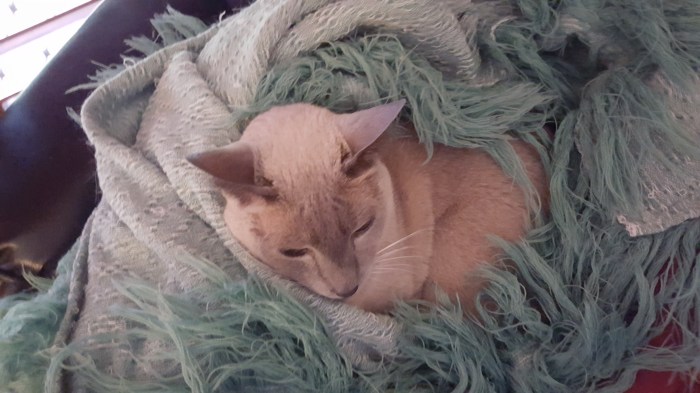
This is Chester.  He’s feeling poorly today.

When I used this expression, he looked at me quizzically, which is not bad for a cat with a constant poker face.

Where did you get that from?

It’s a favourite expression of my mother’s when she wasn’t feeling very well.  She had another, ‘not feeling elegant’ today.

It stops and makes me wonder where these expressions come from, and I suspect, because my mother’s mother was of German descent, that it was one of those translation to English things.

Chester seems disinterested.  I’m beginning to think there may be something wrong with him because he’s not his usual sardonic self.

Perhaps, I say, it’s time to go to the vet, get checked out.  You’re not getting any younger.

His head pops up at the mention of the vet.  He knows what this means.  The cat basket.

He leaps up with newfound energy and heads for the door.

I get out of my chair to follow, and he’s gone, moving quickly up the passage to one of his hiding spots.

Maybe he’s not that bad.  I’ll monitor the situation.

“You’re safe,” I yell out.  “For now.”