An excerpt from “What Sets Us Apart”, a mystery with a twist

See excerpt from the story below, just a taste of what’s in store…

http://amzn.to/2Eryfth

whatsetscover


McCallister was old school, a man who would most likely fit in perfectly campaigning on the battlefields of Europe during the Second World War.  He’d been like a fish out of water in the army, post-Falklands, and while he retired a hero, he still felt he’d more to give.

He’d applied and was accepted as head of a SWAT team, and, watching him now as he and his men disembarked from the truck in almost military precision, a look passed between Annette, the police liaison officer, and I that said she’d seen it all before.  I know I had.

There was a one in four chance his team would be selected for this operation, and she had been hoping it would be one of the other three.  While waiting for them to arrive she filled me in on the various teams.  His was the least co-operative, and the more likely to make ad-hoc decisions rather than adhere to the plan, or any orders that may come from the officer in charge.

This, she said quite bluntly, was going to end badly.

I still had no idea why Prendergast instructed me to attend the scene of what looked to be a normal domestic operation, but as the nominated expert in the field in these types of situations, it was fairly clear he wasn’t taking any chances.  It was always a matter of opinion between us, and generally I lost.

In this case, it was an anonymous report identifying what the authorities believed were explosives in one of the dockside sheds where explosives were not supposed to be.  The only reason why the report was given any credence was the man, while not identifying himself by name, said he’d been an explosive expert once and recognized the boxes.  That could mean anything, but the Chief Constable was a cautious man.

With his men settled and preparing their weapons, McCallister came over to the command post, not much more than the SUV my liaison and I arrived in, with weapons, bulletproof vests, and rolls of tape to cordon off the area afterward.  We both had coffee, steaming in the cold early morning air.  Dawn was slowly approaching and although rain had been forecast it had yet to arrive.

A man by the name of Benson was in charge.  He too had groaned when he saw McCallister.

“A fine morning for it.”  McCallister was the only enthusiastic one here.

He didn’t say what ‘it’ was, but I thought it might eventually be mayhem.

“Let’s hope the rain stays away.  It’s going to be difficult enough without it,” Benson said, rubbing his hands together.  We had been waiting for the SWAT team to arrive, and another team to take up their position under the wharf, and who was in the final stages of securing their position.

While we were waiting we drew up the plan.  I’d go in first to check on what we were dealing with, and what type of explosives.  The SWAT team, in the meantime, were to ensure all the exits to the shed were covered.  When I gave the signal, they were to enter and secure the building.  We were not expecting anyone inside or out, and no movement had been detected in the last hour since our arrival and deployment.

“What’s the current situation?”

“I’ve got eyes on the building, and a team coming in from the waterside, underneath.  Its slow progress, but they’re nearly there.  Once they’re in place, we’re sending McKenzie in.”

He looked in my direction.

“With due respect sir, shouldn’t it be one of us?”  McCallister glared at me with the contempt that only a decorated military officer could.

“No.  I have orders from above, much higher than I care to argue with, so, McCallister, no gung-ho heroics for the moment.  Just be ready to move on my command, and make sure you have three teams at the exit points, ready to secure the building.”

McCallister opened his mouth, no doubt to question those orders, but instead closed it again.  “Yes sir,” he muttered and turned away heading back to his men.

“You’re not going to have much time before he storms the battlements,” Benson quietly said to me, a hint of exasperation in his tone.  “I’m dreading the paperwork.”

It was exactly what my liaison officer said when she saw McCallister arriving.


The water team sent their ‘in position’ signal, and we were ready to go.

In the hour or so we’d been on site nothing had stirred, no arrivals, no departures, and no sign anyone was inside, but that didn’t mean we were alone.  Nor did it mean I was going to walk in and see immediately what was going on.  If it was a cache of explosives then it was possible the building was booby-trapped in any number of ways, there could be sentries or guards, and they had eyes on us, or it might be a false alarm.

I was hoping for the latter.

I put on the bulletproof vest, thinking it was a poor substitute for full battle armor against an exploding bomb, but we were still treating this as a ‘suspected’ case.  I noticed my liaison officer was pulling on her bulletproof vest too.

“You don’t have to go.  This is my party, not yours,” I said.

“The Chief Constable told me to stick to you like glue, sir.”

I looked at Benson.  “Talk some sense into her please, this is not a kindergarten outing.”

He shrugged.  Seeing McCallister had taken all the fight out of him.  “Orders are orders.  If that’s what the Chief Constable requested …”

Madness.  I glared at her, and she gave me a wan smile.  “Stay behind me then, and don’t do anything stupid.”

“Believe me, I won’t be.”  She pulled out and checked her weapon, chambering the first round.  It made a reassuring sound.

Suited up, weapons readied, a last sip of the coffee in a stomach that was already churning from nerves and tension, I looked at the target, one hundred yards distant and thought it was going to be the longest hundred yards I’d ever traversed.  At least for this week.


A swirling mist rolled in and caused a slight change in plans.

Because the front of the buildings was constantly illuminated by large overhead arc lamps, my intention had been to approach the building from the rear where there was less light and more cover.  Despite the lack of movement, if there were explosives in that building, there’d be ‘enemy’ surveillance somewhere, and, after making that assumption, I believed it was going to be easier and less noticeable to use the darkness as a cover.

It was a result of the consultation, and studying the plans of the warehouse, plans that showed three entrances, the main front hangar type doors, a side entrance for truck entry and exit and a small door in the rear, at the end of an internal passage leading to several offices.  I also assumed it was the exit used when smokers needed a break.  Our entry would be by the rear door or failing that, the side entrance where a door was built into the larger sliding doors.  In both cases, the locks would not present a problem.

The change in the weather made the approach shorter, and given the density of the mist now turning into a fog, we were able to approach by the front, hugging the walls, and moving quickly while there was cover.  I could feel the dampness of the mist and shivered more than once.

It was nerves more than the cold.

I could also feel rather than see the presence of Annette behind me, and once felt her breath on my neck when we stopped for a quick reconnaissance.

It was the same for McCallister’s men.  I could feel them following us, quickly and quietly, and expected, if I turned around, to see him breathing down my neck too.

It added to the tension.

My plan was still to enter by the back door.

We slipped up the alley between the two sheds to the rear corner and stopped.  I heard a noise coming from the rear of the building, and the light tap on the shoulder told me Annette had heard it too.  I put my hand up to signal her to wait, and as a swirl of mist rolled in, I slipped around the corner heading towards where I’d last seen the glow of a cigarette.

The mist cleared, and we saw each other at the same time.  He was a bearded man in battle fatigues, not the average dockside security guard.

He was quick, but my slight element of surprise was his undoing, and he was down and unconscious in less than a few seconds with barely a sound beyond the body hitting the ground.  Zip ties secured his hands and legs, and tape his mouth.  Annette joined me a minute after securing him.

A glance at the body then me, “I can see why they, whoever they are, sent you.”

She’d asked who I worked for, and I didn’t answer.  It was best she didn’t know.

“Stay behind me,” I said, more urgency in my tone.  If there was one, there’d be another.

Luck was with us so far.  A man outside smoking meant no booby traps on the back door, and quite possibly there’d be none inside.  But it indicated there were more men inside, and if so, it appeared they were very well trained.  If that were the case, they would be formidable opponents.

The fear factor increased exponentially.

I slowly opened the door and looked in.  A pale light shone from within the warehouse itself, one that was not bright enough to be detected from outside.  None of the offices had lights on, so it was possible they were vacant.  I realized then they had blacked out the windows.  Why hadn’t someone checked this?

Once inside, the door closed behind us, progress was slow and careful.  She remained directly behind me, gun ready to shoot anything that moved.  I had a momentary thought for McCallister and his men, securing the perimeter.

At the end of the corridor, the extent of the warehouse stretched before us.  The pale lighting made it seem like a vast empty cavern, except for a long trestle table along one side, and, behind it, stacks of wooden crates, some opened.  It looked like a production line.

To get to the table from where we were was a ten-yard walk in the open.  There was no cover.  If we stuck to the walls, there was equally no cover and a longer walk.

We needed a distraction.

As if on cue, the two main entrances disintegrated into flying shrapnel accompanied by a deafening explosion that momentarily disoriented both Annette and I.  Through the smoke and dust kicked up I saw three men appear from behind the wooden crates, each with what looked like machine guns, spraying bullets in the direction of the incoming SWAT members.

They never had a chance, cut down before they made ten steps into the building.

By the time I’d recovered, my head heavy, eyes watering and ears still ringing, I took several steps towards them, managing to take down two of the gunmen but not the third.

I heard a voice, Annette’s I think, yell out, “Oh, God, he’s got a trigger,” just before another explosion, though all I remember in that split second was a bright flash, the intense heat, something very heavy smashing into my chest knocking the wind out of me, and then the sensation of flying, just before I hit the wall.


I spent four weeks in an induced coma, three months being stitched back together and another six learning to do all those basic actions everyone took for granted.  It was twelve months almost to the day when I was released from the hospital, physically, except for a few alterations required after being hit by shrapnel, looking the same as I always had.

But mentally?  The document I’d signed on release said it all, ‘not fit for active duty; discharged’.

It was in the name of David Cheney.  For all intents and purposes, Alistair McKenzie was killed in that warehouse, and for the first time ever, an agent left the Department, the first to retire alive.

I was not sure I liked the idea of making history.
Going to the movies – not the apocalypse

What do you call going to the movies where the power goes out?

A complete disaster.

For starters, the first problem is living in a cashless society where not very many people carry cash.  When you fo to the movies, your mind is on the movie or elsewhere, so when they get to the box office and see the sign Cash Only. panic sets in.

Ugh. Now they have to go to the ATM and then get back in the queue.

By the way, this is the first time I’ve ever seen the box office open.

Of course, no power means the pre-purchased ticket dispenser is out of action, all those people who pre-purchased tickets now have to join the long queue that’s getting longer by the minute, at the box office.

Those people who got their tickets ahead of time on the internet, namely us, have to join that long since there are no instructions to do anything else, that long queue only to discover they just had to show the e-receipt to the attendant at the entrance to the cinemas.

Ugh again.  Thanks for not telling us earlier.  We could have been in the snack bar queue.

As for snacks, the queue there is ten times longer than the box office, apparently without cash registers, so everything ordered has to be written down and manually added.

Let’s hip the juniors they employ can actually add up numbers in their heads. It’s a miracle these days to find anyone under the age of 18 able to do any mental arithmetic because it seems no schools teach it because everything is electronic.

Hello.

What do we do when there no power to drive the electronic devices.

Ugh yet again.

Ok, what’s the lesson here?

We’re in big trouble if or when the power goes down.

Electricity is one of those commodities we all take for granted because it’s one of those everyday essentials that drives every aspect of our lives.  We might endlessly complain about how much it costs us, but what would we do if there weren’t any at all?

Could we live without it?

No. Emphatically.

I suppose the bigger question is how long before society falls into anarchy?

I hope someone somewhere is working on the problem.

Writing about writing a book – Day 19

I’m still working on the sequence of flashbacks for the story, filling out the back story to how Bill became associated with a man called Colonel Davenport.

It is important to remember that while Davenport may have begun with good intentions, it was not difficult to go slowly mad given the conditions.  This character, Davenport, runs a multitude of operations within the war zone, turning a huge profit and setting up a business for when the war ended.

Bill meets his Davenport’s cronies and then the man himself.  Life is not what it seems, and working for him is not a guarantee of safety, so Bill not only has to watch out for the enemy but also those with whom he also works.


Part 3 – In the Service of Davenport

Davenport and punishment

Busted mission, the first threat to Davenport

Manilow’s death – and how he got there

More on Manilow, the night before his death

Taken to rendezvous with Davenport’s boss

Identify Davenport by ‘sniveling morons’

Sniper – killing Ellen’s father – set up

Sniper – Killing Ellen’s father, execution

Planes and death


Bill gets to meet an interesting cast of characters, not the least of which is Davenport’s right-hand men, and a very unlucky lad who was supposed to see through his tour in the command station far from the war zone, and who is connected to a person close to him.

He was also unwittingly involved in a murder, one set up by Davenport, and one designed to keep his silence.


Part 4 – The Lead up to Capture, and in a POW camp

The object that Davenport is seeking

After R & R revoked, retrieved by Davenport for the last mission

Capture by Cho’s forces, delivered by Davenport’s men

In the POW Camp, and the arrival of Cho

Day of Rescue from Cho

Ellen and Jacobson after rescue in the hospital


Bill’s safety may have been assured had he simply toed the line, but, while on a secret mission with Davenport’s men, he sees an opportunity to take some evidence of Davenport’s activities, as an act of self-preservation.

Of course, he doesn’t reckon with the ruthlessness of Davenport and ends up in a camp where Bill is handed over to the chief interrogator, a friend of Davenport’s.  There is no doubt what Cho’s mission is.

But, like all seemingly simple plans, it doesn’t go the way Davenport wants, Bill does not talk, and is eventually rescued.


Part 5 – Post Rescue and Transworld

Employment at Transworld, then first interrogation via Collins

In hospital immediately after being shot

Davenport in my hospital room, post being shot

Recognize Jorgenson


Davenport discovers Bill was rescued, and that is has lost his memory of all the time in his service, so just in case Bill does, one day, remember, he will be there to get the answers, and the missing information.

It is almost a story within a story, and maybe one day will be published as such.

At least now I have some idea of how to work the much larger story into the flashbacks, as a prelude to what happens to Bill once he realizes who is behind everything that is happening at Transworld.


© Charles Heath 2015-2020

*** On special – $0.99 – On Special ***

Two novels are on special for $0.99 for the next two weeks.

They are

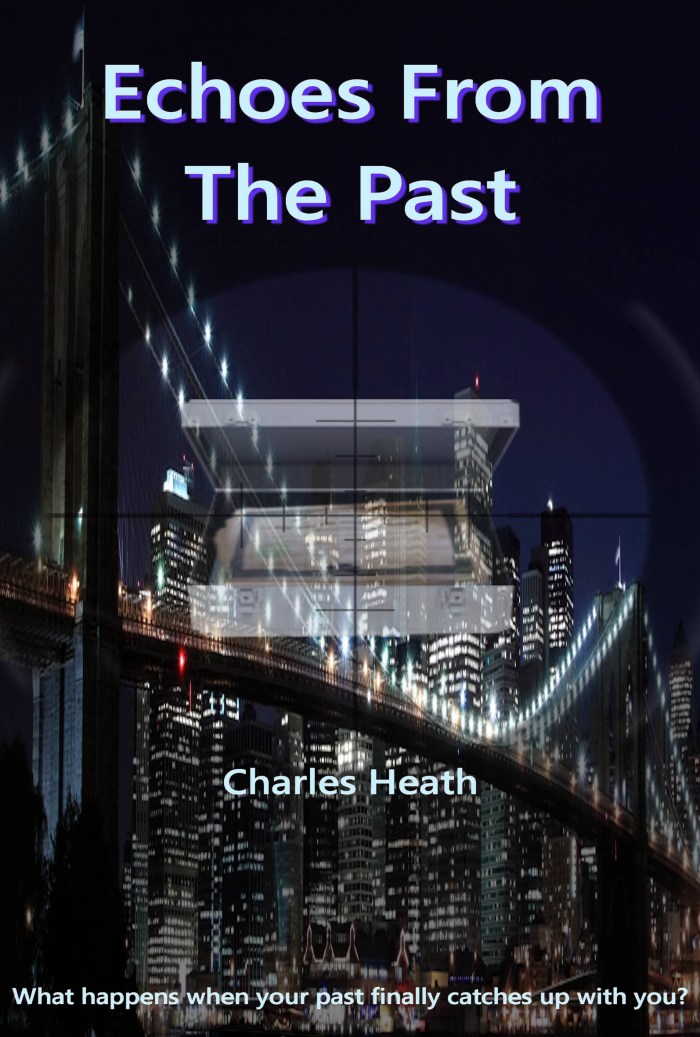
newechocover5rs

for “Echoes from the Past” go to  https://amzn.to/2CYKxu4

newdevilcvr3

for “The Devil You Don’t” go to  https://amzn.to/2Xyh1ow

A writer isn’t just a writer

Is he, or she?

No, we have any number of other functions, so the notion we can sit down all day every day and just write is a misnomer.

I know for a fact I can’t.

I have jobs to do around the house, and therein lies the problem.

I sit down, once the jobs for that part of the day are done, and fire up the computer, or sometimes sharpen the pencils.

Then, free to write, it’s like starting the lawnmower, wait till it settles into a steady rhythm, and then, as you begin to mow the lawn, it runs out of petrol.

Yes, that’s happened to me a few times, and only goes to highlight the other problems.

When you have to do something else, your mind is happily working on the book, story, article, piece, or whatever, and then, when you sit down, your mind is on the next lot of chores.

Only the most disciplined mind can separate the two so that each allotted timed time is allotted to the task.

Me, I suck at that.

Like now.  I want to get on with one of my longer stories, and my mind is telling me I have to write a blog post.

So, I’m writing the blog post.

I know that tomorrow I’m not going to get much writing time because the grandchildren are over for a mini stay and we’re going to see Doolittle.

But, can I get it done now?

No.  In the background, the Australia vs India one day cricket match is murmuring, and we’re not doing so good.  It’s a necessary distraction, but I still haven’t learned to multitask.

Perhaps it’s too late for that.

Anyway, I got to go.  We just got a wicket, and the tide is turning.

I hope!

In a word: Right

Am I right?  Or is that correct?

In the moral sense, or in answering a question?

Do I have a right to …

As an entitlement?

Maybe

But right means generally to be correct, but the word itself can be used, like many others in a variety of ways

Such as, do we have any rights any more, since the government is slowly shutting down our freedoms, and, you guessed it, rights.

What about a right angle, we know this as being an angle of 90 degrees

How about I right a wrong, returning a bad situation to a good one?

Are you left-handed or right-handed?

Are you one of those people who can’t tell their left from their right?

And who was it that decided what was your left or your right, ever thought about that?  I didn’t until just now.  Good luck finding an answer on Google.

And how many times have you wished you were in the right place at the right time???

Then, of course, if English is a second language, how about confusing right with write.

Means something quite different, doesn’t it?

How about rite?  Yes, I guess if we were in the habit of chopping chicken heads off and dancing around a fire, that might be its meaning,

But…

It too has a lot of different meanings

Are you confused yet?

“The Devil You Don’t”, be careful what you wish for

Now only $0.99 for a short time at  https://amzn.to/2Xyh1ow


John Pennington’s life is in the doldrums.  Looking for new opportunities, prevaricating about getting married, the only joy on the horizon was an upcoming visit to his grandmother in Sorrento, Italy.

Suddenly he is left at the check-in counter with a message on his phone telling him the marriage is off, and the relationship is over.

If only he hadn’t promised a friend he would do a favour for him in Rome.

At the first stop, Geneva, he has a chance encounter with Zoe, an intriguing woman who captures his imagination from the moment she boards the Savoire, and his life ventures into uncharted territory in more ways than one.

That ‘favour’ for his friend suddenly becomes a life-changing event, and when Zoe, the woman who he knows is too good to be true, reappears, danger and death follows.

Shot at, lied to, seduced, and drawn into a world where nothing is what it seems, John is dragged into an adrenaline-charged undertaking, where he may have been wiser to stay with the ‘devil you know’ rather than opt for the ‘devil you don’t’.

newdevilcvr3

In a word: Cell

For those who break the law, they will be very familiar with the eaning of the word cell.  It’s a room a jail, not very big, with an uncomfortable bed, and no sharp edges.

And I’m sure the prisoners are not supplied with knives so they can dig through the mortar and remove bricks on their way to the great escape.  That, I’m sure only happens at the movies.

A cell can also be a building block in the creation of humans, animals, fish, and plants.  No doubt there are a million other things that require cells.

Perhaps the most interesting aspect of this cellular activity is whether or not there is life, and therefore cells, on Mars.  I’m guessing we’ll have to wait a little longer to find out.

We can have a cell phone, which in some parts of the world is also the name of a mobile phone.

Don’t get me started on what I think of cell phones, or how intrusive they are on our everyday lives, the number of people who seem to be continually glued to the screen, or how many near misses there are in the street and crossing the road.

On the other hand cell phones in the hands of a writer are very useful because when we get flashes of story or plotlines in one of those once awkward moments, we can now jot it down on a cell phone scribbling pad.

A cell can also be used to describe a smaller unit within a larger organisation, or, if you are a thriller writer who dabbles in espionage, you will be very familiar with the concept of a sleeper cell.

Who knows, in reality, there might be some living next door to us and we would never know.  Oops, been watching too much television again.

Digging deeper into the more obscure definitions of the word cell, we come up with a single transparent sheet that has a single drawing on it, one of many that make up an animated film, or film.  If a film runs at 32 frames per second, that means there are 32 cells.

There are fuel cells

There are dry cell batteries

And as a general warning, don’t go too near cell towers or you will be a victim of radiation that might be extremely harmful to your health.

Digging into the past

It seems rather strange reading letters that were written by my parents before they were married.

They’re not love letters, but just words, words that knowing my father and mother as I do, seem so totally at odds with that knowledge.

The thing is, I never knew anything of that era existed, even though I knew my mother was a hoarder, and we didn’t discover the extent of that phobia until it was time to move them from their last residence to the retirement home.

There were cases and boxes filled with papers, letters, cuttings, and everything else in between.  Nothing had been thrown out.

And whilst I knew those letters existed, there was the yuk factor involved, such that I would never want to read them because, well, that was my parents’ stuff.

So, all of it was sorted, most of it thrown away, and only what we thought was of any intrinsic value was kept.  Those letters were part of the ‘keep’ pile and ended up in an old metal steamer trunk, and there they have lived for about ten years.

With the recent cleaning of my office, much to Chester’s disdain, the trunk suddenly looked out of place in a clean room.

My grandchildren ‘found’ this trunk and started looking through the contents and finished up with the letters.

And, being the curious people, they were, they started reading them, of course, stumbling over understanding the handwriting, which was based on what we learned in school, cursive script.  That meant I had to interpret the writing for them.

Talk about morbid curiosity!

And like I said, in reading them, formed the impression that these two correspondents were nothing like the people I knew growing up.

These letters dated from 1948 and 1949 when they were married in June of 1949.  There was no doubt it was a different time, and they were different people.  My mother came from a country town and went to work in Melbourne around that time.  I know that during the war, those years from 1939 to 1945 she was a student at Dandenong High School.

It was odd to realize that considering we eventually moved to Dandenong, and that may have had something to do with it.

My father served in the war till 1946, and then after being discharged from the army, worked as a projectionist until he went overseas for nearly a year, ostensibly to see how the war had affected Europe.  After that, he went back to being a projectionist at the Athenaeum in Melbourne, and later on, not knowing much of his work history, he would always tell us about the movies, especially those that came up on television.

There’s more I’m sure, like the fact my mother had another chap on the go at the same time, but it seems he was not interested in settling down.

Perhaps more will come to light in further reading, but like it said, it seems very strange to be reading those letters, much like walking over a grave; it gives me the odd shiver down the spine.

No doubt, the next time the grandchildren visit there will be another installment.

They, at least, think the story is fascinating.

Conversations with my cat – 80

20160907_135509

This is Chester. We’re back watching the Maple Leafs.

This isn’t going to be pretty. While they have won a few in the last week or so they have also lost, and by large numbers.

I know this is a mistake watching it with Chester, the eternal pessimist, because his initial statement, ‘You know Anderson’s going to let you down again’ even before the match started, is a sign of things to come.

Yep. There it is 21 seconds into the game the other side scores.

Damn.

He turns his head and gives me the look, “I told you so.”

Double damn.

Nothing worse than a smart-ass cat is there, and especially when he’s right.

The game progresses, and then the internet dies on me, leaving a frozen screen. Bigger fish to fry now, with the internet provider, where we are, the NBN, which is little more than a joke. Try streaming anything…

It’s the same result.

Pixellation, blank screens, endless loading signs and then a seized screen.

Good.

For once I don’t mind because I don’t have to listen to the negativity.

Yes, they score again. And again. And yes, once again we’re looking down the barrel of another huge loss.

“Just what is wrong with your goalie,” Chester asks.

“Too many games and not enough faith in the backup, I guess.”

It’s hard to explain wat’s going wrong. I don’t know the ins and outs of the Toronto team because we’re not there. It’s the lot of a supporter whose 12,000 miles away.

Perhaps our year will be next year.

Chester doesn’t think so. Halfway through the third period, he walks off, the internet giving up the ghost. We all know how this end, don’t we, he says.

Yes. We do. The food you hate the most is in your tray.

Revenge doesn’t sound as good as it did in my head a few minutes ago.

Triple Damn.