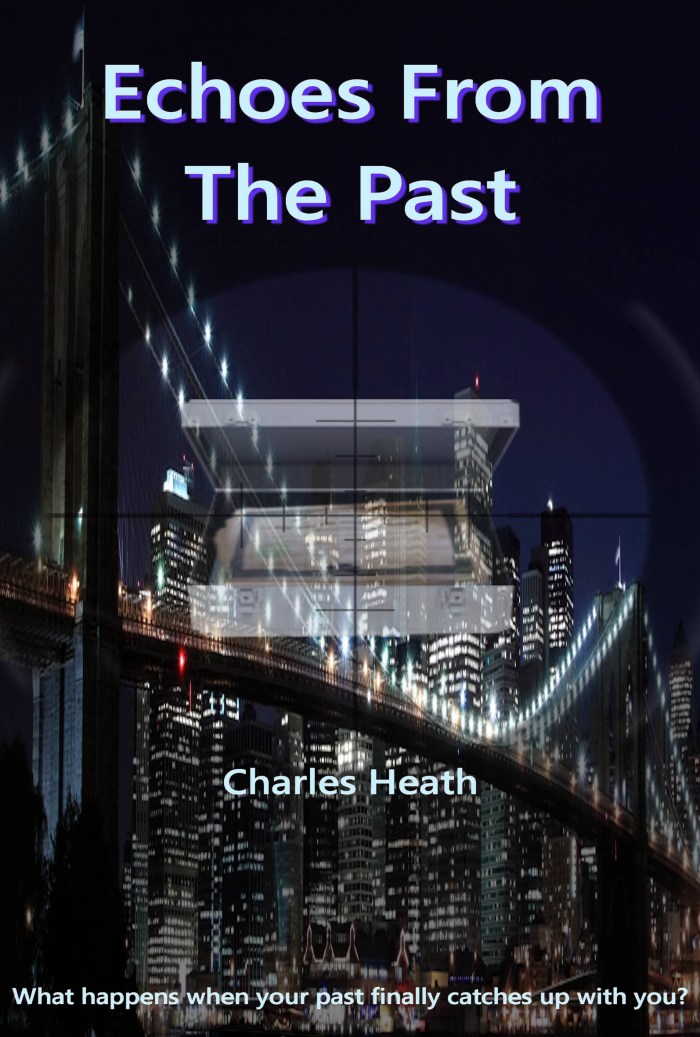
A Chapter from “Echoes from the Past”

Currently available from Amazon:  https://amzn.to/2CYKxu4


I looked down on 5th Avenue and could just see, in the distance, Saks, and opposite, the Rockefeller Center.  Recently I’d gone ice skating there with a woman I had begun to care for more than I should, and who liked spending time with me.

It was a relationship that had evolved slowly and was now moving into dangerous territory.  From the moment our eyes first met across the ice, I knew that outing had been a mistake.  Whatever I’d been thinking it couldn’t happen, but against better judgment, I had let it happen.

It was not her fault, it was mine.  I was not the person she thought I was, the person I wanted to be, and if the circumstances of my past were not as they were, the person she was most likely looking for.

It had happened before, and it would happen again, and the result would be the same.  I would move on, find a new city, a new job, a new life, and continue to hide in plain sight.

Waiting for an eventuality that may never happen, but if it did, it would happen to me alone, not the woman I loved.

I sighed inwardly, thinking of how unfair life could be.  And how much, this time, I wanted it to be different.

From my office window, high up in the sky, I could see several Fire Department vehicles going though yet another drill and could just hear the sound of the sirens floating up to the 32nd floor.  Darkness was closing in, and the fast-moving red strobing lights stood out against the neon signs, the street lighting, and the Christmas decorations.

It was that time of the year again, a time that brought back very sad memories.  For most people, it was when families came together to celebrate.  That was not possible for me.  I’d thought with the passing of time it would no longer hurt so much, but it did.  I felt a tear in my eye and pulled a tissue out of the box on my desk to wipe it away.

Enough with the sentimentality.

Behind me, I heard files being dropped on my desk.  It was Friday when Maria from Accounting brought me the latest customers who were overdue in paying their investment contributions.  The stack was getting bigger every week.

I turned to face her.  She was only three years younger than me but looked ten.  Italian parents, conservative dressed, reserved manner, but usually friendly and outgoing, she was well-liked by all.  What surprised me, out of all the people she could choose as a friend, and since our ice skating expedition something more than that, she chose me.

I was not exactly the easiest of people to get along with, for obvious reasons.

I soon discovered this was the only time she and I could meet in the office without the prying eyes of our workmates making more of it than it was.  Office romances, not that either of us would acknowledge we were having one, were frowned upon.  Worse, rumors were very easily started, and much harder to quash.

“To be honest, I’m glad I don’t have your job, Will.”

She looked at the stack and then gave me a special look, one I wanted to believe was reserved just for me.  Her smile always tugged at a heartstring or maybe two.  This night it did more than that.

I shrugged and tried to be casual.  “I was told I had a gift.”

“Ah, the statement of faith, just before the sucker punch.”

Everyone knew to call customers in distress was a difficult job at best.  It required tact and diplomacy, a trait I’d acquired over time because of my situation.  It had been a strange match of opportunity and unrealized talent when a disgruntled customer had come into the office and verbally attacked Mr. Bartleby, a senior partner.

I’d talked the customer down, and talked myself into the job.  I’d only agreed to do it because it came with the promise of a promotion.  Now I was considering an exit strategy, it probably didn’t matter.

“Doing anything for the weekend?”  She asked the same question every Friday.  The last time, I surprised her by asking if she skated on ice, not expecting she did.  She said yes.

It didn’t take long to realize she would have said yes to climbing Mount Everest.  It was her first time on skates, and we learned a lot about each other over the half-hour she managed to stay upright.

For her bravery, I took her to dinner and then took her home.  She asked me to stay for a while, to patch up her wounds, perhaps the modern-day equivalent of ‘would you like to come up and see my paintings’.

Whatever her intentions or my desires, we just talked over a bottle of wine and then coffee.  I didn’t have to leave, but it was better for both of us that I did.

I closed my eyes to break the connection.  I could feel it.  I was starting to fall in love with this girl, this woman, and I knew I had to be careful.  It would not be long before the questions started; questions I couldn’t answer.

“No.  I wasn’t intending to do much.”

“Then perhaps you might consider joining the rest of us monkeys for beer, wine and a lively discussion about anything but work.   Harry’s found a new bar, upon 6th Avenue.”

Harry was our social director, not a real one but self-appointed, and he organized most of the unofficial staff gatherings.  He was a bit too self-important for me, an ‘I am’ sort of guy, but he went to Harvard and had probably earned the right.  I wasn’t on his social radar so he rarely invited me to anything.  If he did, I generally declined.  Those gatherings were the hunting grounds of the go-getters, the rookies looking for an edge to climb the corporate ladder.  I was all about keeping a low profile.

“Is he asking, or you?”

A momentary frown settled on her face.  We’d had a similar discussion once before, and I’d realized then she tried only to see the good in people.  Perhaps that was why I was so lucky.

“Does it matter?”

I pretended to think about it for a minute, and then said, “No.”

Her smile returned.  “Do you want me to come to fetch you?”

“As appealing as that sounds, I have a couple of matters to tidy up.  You go, and I’ll drop in later.”

The expression on her face told me she didn’t believe me.  It was not without merit, because I had told her the same before and not followed through.  Then, it didn’t matter because I hadn’t known her all that well.  Now, it seemed everything had changed.

“You are not just saying that to get rid of me, are you?”  The tone matched the doubtful expression.

Blunt, but fairly accurate.  I didn’t want to underestimate this girl.  In normal circumstances, I might have considered something else, other than drinks.  Instead, I said, “I would have preferred a walk in Central Park, but I don’t think the weather is going to behave.”

Then I had a moment where I thought if I told her something closer to the truth, it might help me climb my way out of the deep hole I was digging for myself.  “To be honest, I’m not very good at these social gatherings.”

Another change in expression, she had many faces for many occasions.  This one was of surprise, or was it an agreement?

“Then you and I could go somewhere else if you like.”

Not exactly the result I was looking for.

“We could, but then you would miss out on being with your friends and most likely miss the next scandal to envelop us.”

The last one was about Bartleby junior and a certain socialite.  Everyone knew what he was like except one person, his current fiancée Katrina.

“True.”  She shrugged.  I had just become a lost cause.  “I will look out for you.  But remember, I will be disappointed if you don’t come.”

She gave me a last look, somewhat whimsical I thought, as I watched her walk across the floor to the elevator lobby.  It was like watching the love of my life leaving, without turning back.


I’d promised myself a long time ago that I would not get involved with a woman, but I soon learned how difficult a promise like that was to keep, especially when the woman’s name was Katrina.

I’d not known real love before, and it was not difficult to fall under her spell.  She was as beautiful as she was beguiling.

A long time ago, in what felt like another lifetime, Katrina Winslow and I worked together.  She taught me my first job at Bentley, Bowman and Bartleby, Accountants.  And, as with anyone with whom you work so closely, we became friends, and then something more than that.

By the time I realized what had happened, it was too late.  She was the daughter of parents who cared about their daughter, and the people with whom she associated.  They had me investigated.

I remember that Monday morning as if it was yesterday when she came into my office.  We had spent a perfect weekend together, and when I left her Sunday night, I was full of those starry-eyed dreams people in love had.

An hour later, all of those dreams had been shattered, not only for me but for her too.  I had no answers to her questions, answers the investigators could not find.  I knew from the first day I met her she was out of my league, but I honestly believed love could conquer all.

Her father didn’t.  It ended, and in time I realized it was for the best.  I had nothing to offer her, and I could never give answers to any of the questions she might ask.

Not long after, Maria told me about her engagement to Marcus Bartleby, son of the remaining live partner whose name graced the building, and signs throughout the city.  I told myself he would be the sort of man her father believed she deserved, but in my heart, I knew what sort of person Marcus was, and equally, there was nothing I could do about it.

I had a secret, one that I could never tell anyone.  And until I could find a way of reconciling my past I could never contemplate having a future, make any friends, or find any sort of peace or happiness.

With Katrina, with Maria, or anyone else.


The truth is my life was the equivalent of a metaphorical train wreck.  You wouldn’t know it, looking at me, but how I looked now, how I acted and reacted was a product of many years of practice.  From the moment I had seen my parents murdered at the age of fourteen, I’d been on the run.  Being that young, it was tough on the road, and I had to get street smart, and defensive, very quickly.  I’d learned the hard way, through the school of hard knocks.  By comparison, the Bartleby’s of this world had got it easy.

But, don’t get me wrong.  It was not something I was bitter about.  It was what it was.  I did what I had to do, and what I have to.  I accepted they had and always would have everything handed to them on a platter.  It was the way of the world.

On the upside, I had only myself to please.  I did not have to rely on anyone else, nor was I responsible for anyone but myself.  I had no family to speak of, or that I would acknowledge.

My father had been an orphan and had spent a relatively lonely life up to the point where he married my mother.

The family I had on my mother’s side was the reason I ran away and kept running, and fortunately, I had not seen any of them since the day I finally escaped.

On the downside, I’d never stayed in one place too long, and never had the time to get a good education, a prerequisite for a good job.  Instead, I had a lot of experience in jobs that didn’t have much of a career path.

I’d thought of night school, even tried it once, but it didn’t work out.  That was the catalyst for joining the army, the one place where people like me finished up.  It was a place to call home wherever they dumped you, and you made friends that didn’t care who or what you were, or cared too much about your past.

I was sent to Iraq, the first time around, with a great bunch of guys, until most of the platoon was killed in a suicide bombing, and the few that survived, including me, were physically repaired and discharged.

In the years since I’d stopped in ten cities.  New York was the most recent, and I’d been here the longest.  I’d carved a path across America from the Mid West, a place called Columbus, Nebraska, through to New York, with a lot of places in between.  It was an interesting way to see the country when in normal circumstances I would have little reason to leave my home town.

Now, after all the running, all the looking over my shoulder, there was a desire to stop.  The problem was I couldn’t.  I couldn’t afford to feel safe, because the moment I did, the moment I let down my guard, it would be when I’d make a mistake, a mistake that could have horrific consequences.  Not only for me but for others around me.

I’d learned that lesson well, soon after I had run away from home, but before I left my home town.  Escape was a relief, and when they had not caught up with me after a week, I started to feel safe.

I let down my guard.  I allowed my trust of the one person in that family I thought was my friend to influence my actions.  She had unwittingly led the family to me after being used as a decoy.  I hadn’t thought of that possibility.

They handed me to the man who murdered my parents.  He told me he’d been willing to track me to the ends of the earth, as long as it took.  He held me captive for a few hours until I escaped, and I had no intention of being caught again.

From that day, I never trusted anyone again.

I remembered the demonic look in his eyes when he told me he would never stop looking.  He was out there, somewhere, and I had to remain vigilant.  The passing of time, for this murderer, was irrelevant.

And, standing there, looking out the window and down 5th Avenue, I could feel the itch, the one I couldn’t scratch.  The one that told me my pursuer, a man who went by the name of Edward Jamieson, wasn’t very far away.


© Charles Heath 2015-2020
 

*** On special – $0.99 – On Special ***

Two novels are on special for $0.99 for the next two weeks.

They are

newechocover5rs

for “Echoes from the Past” go to  https://amzn.to/2CYKxu4

newdevilcvr3

for “The Devil You Don’t” go to  https://amzn.to/2Xyh1ow

As a matter of fact…

But, is it?

This oft used expression is one we pull out of our argument arsenal every now and then, but the problem is, are we quoting actual facts, or are we just trying to get a point of view across?

What are facts?

There seems to be a wide disparity of explanations on what facts are, depending on what purpose they’re used for.

We’re all familiar with a certain line of information being put forward as factual in defense of a particular wall, but are these facts?

Can we disprove these facts with other facts, and are these facts factual or otherwise.

The real facts may never be known because they may well be buried underneath a welter of auxiliary information that is factual but can be twisted any which way.

So…

Would we be better of with conjecture?

To be honest, I’m not quite sure what conjecture is, but at a guess, conjecture is a series of assumptions based on facts (oh no, here we go again!)

Over here we built a fence to keep out the rabbits.

Walls, fences, it didn’t work.  It cost a lot of money but didn’t achieve the intended result.

Humans are more inventive than rabbits.  We seem to be better keeping them in, rather than keeping them out.

And I’m off track yet again, distracted by current affairs.

I just wanted to say that any story can be based on fact, and then generally go down the path of conjecture.  Historically, we might keep people who have died alive, places that have disappeared in place, follow history accurately for a while and then make assumptions of what might have happened rather than what did.

Unfortunately, it involves a lot of studies, and, sometimes, the unearthing of a fact that no one really knew about.

Make of that what you will.

An excerpt from “What Sets Us Apart”, a mystery with a twist

See excerpt from the story below, just a taste of what’s in store…

http://amzn.to/2Eryfth

whatsetscover

McCallister was old school, a man who would most likely fit in perfectly campaigning on the battlefields of Europe during the Second World War. He’d been like a fish out of water in the army, post-Falklands, and while he retired a hero, he still felt he’d more to give.

He’d applied and was accepted as head of a SWAT team, and, watching him now as he and his men disembarked from the truck in almost military precision, a look passed between Annette, the police liaison officer, and I that said she’d seen it all before. I know I had.

There was a one in four chance his team would be selected for this operation, and she had been hoping it would be one of the other three. While waiting for them to arrive she filled me in on the various teams. His was the least co-operative, and the more likely to make ad-hoc decisions rather than adhere to the plan, or any orders that may come from the officer in charge.

This, she said quite bluntly, was going to end badly.

I still had no idea why Prendergast instructed me to attend the scene of what looked to be a normal domestic operation, but as the nominated expert in the field in these types of situations, it was fairly clear he wasn’t taking any chances. It was always a matter of opinion between us, and generally I lost.

In this case, it was an anonymous report identifying what the authorities believed were explosives in one of the dockside sheds where explosives were not supposed to be. The only reason why the report was given any credence was the man, while not identifying himself by name, said he’d been an explosive expert once and recognized the boxes. That could mean anything, but the Chief Constable was a cautious man.

With his men settled and preparing their weapons, McCallister came over to the command post, not much more than the SUV my liaison and I arrived in, with weapons, bulletproof vests, and rolls of tape to cordon off the area afterward. We both had coffee, steaming in the cold early morning air. Dawn was slowly approaching and although rain had been forecast it had yet to arrive.

A man by the name of Benson was in charge. He too had groaned when he saw McCallister.

“A fine morning for it.” McCallister was the only enthusiastic one here.

He didn’t say what ‘it’ was, but I thought it might eventually be mayhem.

“Let’s hope the rain stays away. It’s going to be difficult enough without it,” Benson said, rubbing his hands together. We had been waiting for the SWAT team to arrive, and another team to take up their position under the wharf, and who was in the final stages of securing their position.

While we were waiting we drew up the plan. I’d go in first to check on what we were dealing with, and what type of explosives. The SWAT team, in the meantime, were to ensure all the exits to the shed were covered. When I gave the signal, they were to enter and secure the building. We were not expecting anyone inside or out, and no movement had been detected in the last hour since our arrival and deployment.

“What’s the current situation?”

“I’ve got eyes on the building, and a team coming in from the waterside, underneath. Its slow progress, but they’re nearly there. Once they’re in place, we’re sending McKenzie in.”

He looked in my direction.

“With due respect sir, shouldn’t it be one of us?” McCallister glared at me with the contempt that only a decorated military officer could.

“No. I have orders from above, much higher than I care to argue with, so, McCallister, no gung-ho heroics for the moment. Just be ready to move on my command, and make sure you have three teams at the exit points, ready to secure the building.”

McCallister opened his mouth, no doubt to question those orders, but instead closed it again. “Yes sir,” he muttered and turned away heading back to his men.

“You’re not going to have much time before he storms the battlements,” Benson quietly said to me, a hint of exasperation in his tone. “I’m dreading the paperwork.”

It was exactly what my liaison officer said when she saw McCallister arriving.

The water team sent their ‘in position’ signal, and we were ready to go.

In the hour or so we’d been on site nothing had stirred, no arrivals, no departures, and no sign anyone was inside, but that didn’t mean we were alone. Nor did it mean I was going to walk in and see immediately what was going on. If it was a cache of explosives then it was possible the building was booby-trapped in any number of ways, there could be sentries or guards, and they had eyes on us, or it might be a false alarm.

I was hoping for the latter.

I put on the bulletproof vest, thinking it was a poor substitute for full battle armor against an exploding bomb, but we were still treating this as a ‘suspected’ case. I noticed my liaison officer was pulling on her bulletproof vest too.

“You don’t have to go. This is my party, not yours,” I said.

“The Chief Constable told me to stick to you like glue, sir.”

I looked at Benson. “Talk some sense into her please, this is not a kindergarten outing.”

He shrugged. Seeing McCallister had taken all the fight out of him. “Orders are orders. If that’s what the Chief Constable requested …”

Madness. I glared at her, and she gave me a wan smile. “Stay behind me then, and don’t do anything stupid.”

“Believe me, I won’t be.” She pulled out and checked her weapon, chambering the first round. It made a reassuring sound.

Suited up, weapons readied, a last sip of the coffee in a stomach that was already churning from nerves and tension, I looked at the target, one hundred yards distant and thought it was going to be the longest hundred yards I’d ever traversed. At least for this week.

A swirling mist rolled in and caused a slight change in plans.

Because the front of the buildings was constantly illuminated by large overhead arc lamps, my intention had been to approach the building from the rear where there was less light and more cover. Despite the lack of movement, if there were explosives in that building, there’d be ‘enemy’ surveillance somewhere, and, after making that assumption, I believed it was going to be easier and less noticeable to use the darkness as a cover.

It was a result of the consultation, and studying the plans of the warehouse, plans that showed three entrances, the main front hangar type doors, a side entrance for truck entry and exit and a small door in the rear, at the end of an internal passage leading to several offices. I also assumed it was the exit used when smokers needed a break. Our entry would be by the rear door or failing that, the side entrance where a door was built into the larger sliding doors. In both cases, the locks would not present a problem.

The change in the weather made the approach shorter, and given the density of the mist now turning into a fog, we were able to approach by the front, hugging the walls, and moving quickly while there was cover. I could feel the dampness of the mist and shivered more than once.

It was nerves more than the cold.

I could also feel rather than see the presence of Annette behind me, and once felt her breath on my neck when we stopped for a quick reconnaissance.

It was the same for McCallister’s men. I could feel them following us, quickly and quietly, and expected, if I turned around, to see him breathing down my neck too.

It added to the tension.

My plan was still to enter by the back door.

We slipped up the alley between the two sheds to the rear corner and stopped. I heard a noise coming from the rear of the building, and the light tap on the shoulder told me Annette had heard it too. I put my hand up to signal her to wait, and as a swirl of mist rolled in, I slipped around the corner heading towards where I’d last seen the glow of a cigarette.

The mist cleared, and we saw each other at the same time. He was a bearded man in battle fatigues, not the average dockside security guard.

He was quick, but my slight element of surprise was his undoing, and he was down and unconscious in less than a few seconds with barely a sound beyond the body hitting the ground. Zip ties secured his hands and legs, and tape his mouth. Annette joined me a minute after securing him.

A glance at the body then me, “I can see why they, whoever they are, sent you.”

She’d asked who I worked for, and I didn’t answer. It was best she didn’t know.

“Stay behind me,” I said, more urgency in my tone. If there was one, there’d be another.

Luck was with us so far. A man outside smoking meant no booby traps on the back door, and quite possibly there’d be none inside. But it indicated there were more men inside, and if so, it appeared they were very well trained. If that were the case, they would be formidable opponents.

The fear factor increased exponentially.

I slowly opened the door and looked in. A pale light shone from within the warehouse itself, one that was not bright enough to be detected from outside. None of the offices had lights on, so it was possible they were vacant. I realized then they had blacked out the windows. Why hadn’t someone checked this?

Once inside, the door closed behind us, progress was slow and careful. She remained directly behind me, gun ready to shoot anything that moved. I had a momentary thought for McCallister and his men, securing the perimeter.

At the end of the corridor, the extent of the warehouse stretched before us. The pale lighting made it seem like a vast empty cavern, except for a long trestle table along one side, and, behind it, stacks of wooden crates, some opened. It looked like a production line.

To get to the table from where we were was a ten-yard walk in the open. There was no cover. If we stuck to the walls, there was equally no cover and a longer walk.

We needed a distraction.

As if on cue, the two main entrances disintegrated into flying shrapnel accompanied by a deafening explosion that momentarily disoriented both Annette and I. Through the smoke and dust kicked up I saw three men appear from behind the wooden crates, each with what looked like machine guns, spraying bullets in the direction of the incoming SWAT members.

They never had a chance, cut down before they made ten steps into the building.

By the time I’d recovered, my head heavy, eyes watering and ears still ringing, I took several steps towards them, managing to take down two of the gunmen but not the third.

I heard a voice, Annette’s I think, yell out, “Oh, God, he’s got a trigger,” just before another explosion, though all I remember in that split second was a bright flash, the intense heat, something very heavy smashing into my chest knocking the wind out of me, and then the sensation of flying, just before I hit the wall.

I spent four weeks in an induced coma, three months being stitched back together and another six learning to do all those basic actions everyone took for granted. It was twelve months almost to the day when I was released from the hospital, physically, except for a few alterations required after being hit by shrapnel, looking the same as I always had.

But mentally? The document I’d signed on release said it all, ‘not fit for active duty; discharged’.

It was in the name of David Cheney. For all intents and purposes, Alistair McKenzie was killed in that warehouse, and for the first time ever, an agent left the Department, the first to retire alive.

I was not sure I liked the idea of making history.

Searching for locations: Washington DC, USA

Washington is a city with bright shiny buildings and endless monuments, each separated by a long walk or a taxi ride if you can find one.

We might have picked the wrong day, shortly after New Year’s Day when the crowds were missing along with everything else.  Or, conversely, it was probably the right time to go, when we didn’t have to battle the crowds.

Sunny but very cold, the walking warmed us up.

First stop was the Lincoln Memorial

DSC00833

It was built to honor the 16th President of the United States, Abraham Lincoln.

It is located on the western end of the National Mall in Washington, D.C., across from the Washington Monument.

DSC00834

The building is in the form of a Greek Doric temple and contains a large seated sculpture of Abraham Lincoln and inscriptions of two well-known speeches by Lincoln.

The next stop was the Washington Monument

DSC00840

The Washington Monument is an obelisk on the National Mall in Washington, D.C., built to commemorate George Washington. Construction of the monument began in 1848 and not completed until 1888.  It was officially opened October 9, 1888.


We then took a taxi ride to the Jefferson Memorial

DSC00851

This monument is dedicated to Thomas Jefferson (1743–1826), one of the most important of the American Founding Fathers as the main drafter and writer of the Declaration of Independence.

Construction of the building began in 1939 and was completed in 1943.

The bronze statue of Jefferson was added in 1947.

Conversations with my cat – 84


cat-1

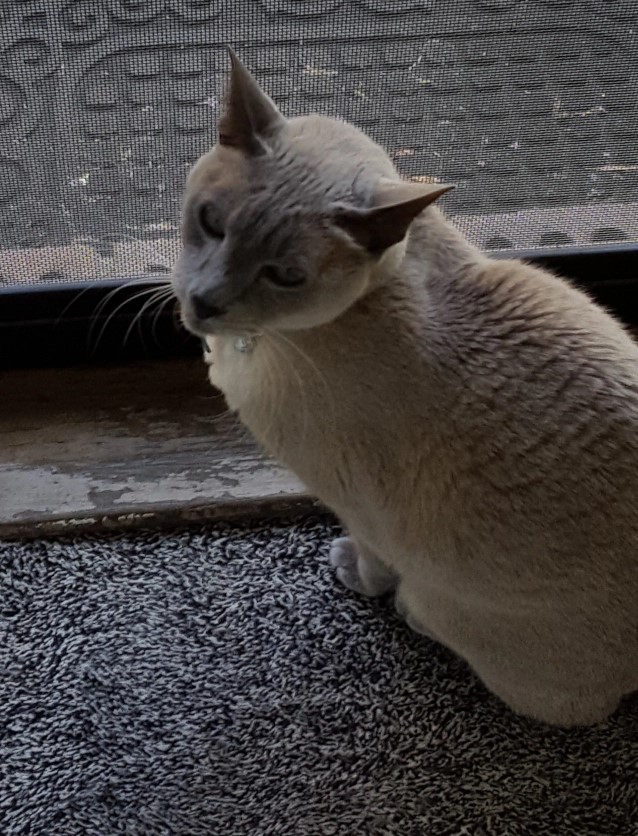
This is Chester.  He is looking out the door at the rain.

After a long spell of heat and humidity that was practically unbearable, we now have rain and cold.

I’m standing at the back door watching the near torrential downpour, and both of us are watching the river of water flowing from the back yard down the side of the house.

Chester looks at me.  Is that the look that’s asking me to let him outside.,

I’m toying with the idea.

He turns his head and looks up at me.  Is that an imploring look to stay in or go out.

The hell with it, I open the door.  If he wants to go out in the rain, that’s his business.

He stands up and turns his head to look at me.

OK, I get it.  When you know I can’t go out, you let me out.  That’s just not right.

What’s stopping you?

You know exactly what the problem is.  Water.  You know I hate water.

That’s every other cat.  A while back you convinced you were not like the other cats.  Fearless, you said, able to take on any challenge.

Open door, it’s an invitation to paradise.

He takes two tentative steps towards freedom.  The rain comes down harder as if someone up there is playing a mean joke on him.

Another step, just about through the door.

The wind blows and we both catch a spray of water.

He jumps and scuttles back inside so fast, and I’m left alone at the door.  I close it again.

We will be discussing invincibility sometime soon, I yell out.  But, he’s gone.

I shrug and go back inside.  I will savor this victory for the next few minutes.

Or for along as he’ll let me.

Inspiration, maybe

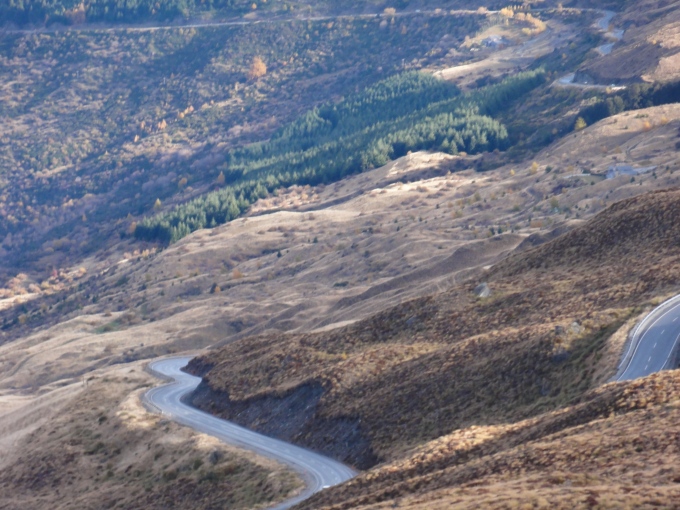
A picture paints … well, as many words as you like.  For instance:

lookingdownfromcoronetpeak

And the story:


It was once said that a desperate man has everything to lose.

The man I was chasing was desperate, but I, on the other hand, was more desperate to catch him.

He’d left a trail of dead people from one end of the island to the other.

The team had put in a lot of effort to locate him, and now his capture was imminent.  We were following the car he was in, from a discrete distance, and, at the appropriate time, we would catch up, pull him over, and make the arrest.

There was nowhere for him to go.

The road led to a dead-end, and the only way off the mountain was back down the road were now on.  Which was why I was somewhat surprised when we discovered where he was.

Where was he going?


“Damn,” I heard Alan mutter.  He was driving, being careful not to get too close, but not far enough away to lose sight of him.

“What?”

“I think he’s made us.”

“How?”

“Dumb bad luck, I’m guessing.  Or he expected we’d follow him up the mountain.  He’s just sped up.”

“How far away?”

“A half-mile.  We should see him higher up when we turn the next corner.”

It took an eternity to get there, and when we did, Alan was right, only he was further on than we thought.”

“Step on it.  Let’s catch him up before he gets to the top.”

Easy to say, not so easy to do.  The road was treacherous, and in places just gravel, and there were no guard rails to stop a three thousand footfall down the mountainside.

Good thing then I had the foresight to have three agents on the hill for just such a scenario.


Ten minutes later, we were in sight of the car, still moving quickly, but we were going slightly faster.  We’d catch up just short of the summit car park.

Or so we thought.

Coming quickly around another corner we almost slammed into the car we’d been chasing.

“What the hell…” Aland muttered.

I was out of the car, and over to see if he was in it, but I knew that it was only a slender possibility.  The car was empty, and no indication where he went.

Certainly not up the road.  It was relatively straightforward for the next mile, at which we would have reached the summit.  Up the mountainside from here, or down.

I looked up.  Nothing.

Alan yelled out, “He’s not going down, not that I can see, but if he did, there’s hardly a foothold and that’s a long fall.”

Then where did he go?

Then a man looking very much like our quarry came out from behind a rock embedded just a short distance up the hill.

“Sorry,” he said quite calmly.  “Had to go if you know what I mean.”


I’d lost him.

It was as simple as that.

I had been led a merry chase up the hill, and all the time he was getting away in a different direction.

I’d fallen for the oldest trick in the book, letting my desperation blind me to the disguise that anyone else would see through in an instant.

It was a lonely sight, looking down that road, knowing that I had to go all that way down again, only this time, without having to throw caution to the wind.

“Maybe next time,” Alan said.

“We’ll get him.  It’s just a matter of time.”


© Charles Heath 2019

Find this and other stories in “Inspiration, maybe”  available soon.

InspirationMaybe1v1


X marks the spot, X in general

In the wake of watching too much television, and in particular Indiana Jones and the Last Crusade, a very quaint but completely ambiguous statement was dismissed as something that would never happen in archeology, x marks the spot.

Of course, as we all know only too well, x really does mark the spot on treasure maps, and I’m sure there’s been quite a few of those over the last few centuries, what with the numbers of pirates on the high seas, well one known such as Blackbeard, and some not so well known.

And those treasure maps always seem to find their way into children’s stories for some reason, maybe because as children we’re likely to believe it possible, whereas an adult, the only place we’re likely to find an x is where someone who can’t write signs their name.

That might also include a lot of press-ganged sailors, who were virtually kidnapped into British naval service to chase down those pirates, all of whom seemed to have that same ubiquitous signature.

And, by the way, that x marks the spot was in that Indiana Jones movie, a rather large x making up a part of the marble flooring.

X doesn’t often find it’s way into mainstream English, even as a prefix, except in the case of x-rays which is electromagnetic radiation.

And in science fiction, the most interesting use of x-ray is for using x-ray vision, starting with superman, and ending with more sinister connotations.

Other than that the only word that I can remember that starts with an x is xenophobia, which seems to be raising its head around the world, the fear of people or objects from another country or culture

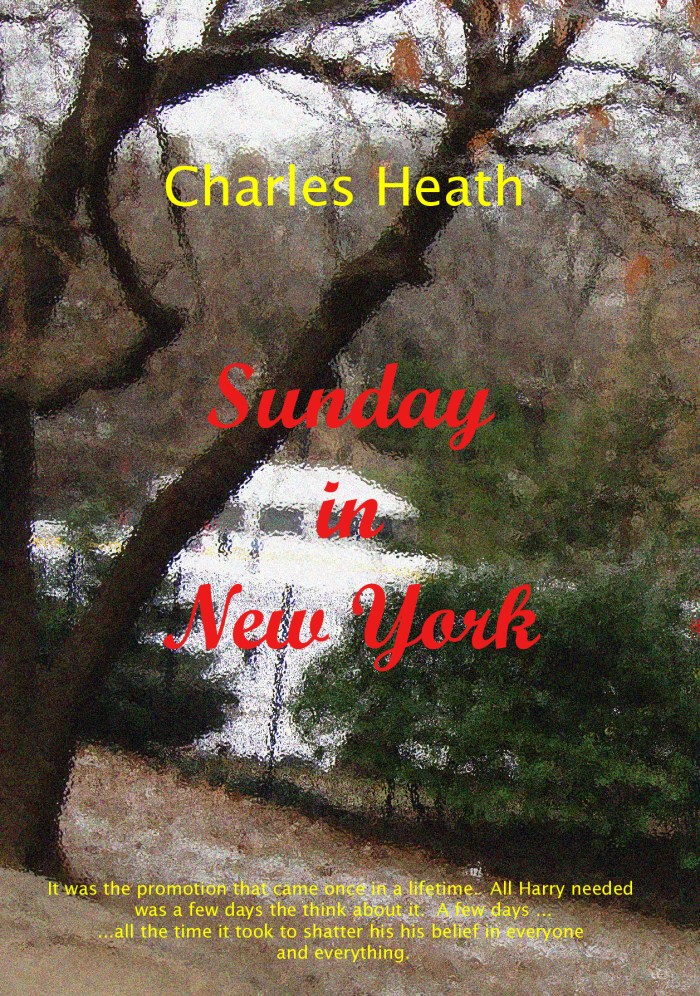
“Sunday in New York”, it’s a bumpy road to love

“Sunday in New York” is ultimately a story about trust, and what happens when a marriage is stretched to its limits.

When Harry Steele attends a lunch with his manager, Barclay, to discuss a promotion that any junior executive would accept in a heartbeat, it is the fact his wife, Alison, who previously professed her reservations about Barclay, also agreed to attend, that casts a small element of doubt in his mind.

From that moment, his life, in the company, in deciding what to do, his marriage, his very life, spirals out of control.

There is no one big factor that can prove Harry’s worst fears, that his marriage is over, just a number of small, interconnecting events, when piled on top of each other, points to a cataclysmic end to everything he had believed in.

Trust is lost firstly in his best friend and mentor, Andy, who only hints of impending disaster, Sasha, a woman whom he saved, and who appears to have motives of her own, and then in his wife, Alison, as he discovered piece by piece damning evidence she is about to leave him for another man.

Can we trust what we see with our eyes or trust what we hear?

Haven’t we all jumped to conclusions at least once in our lives?

Can Alison, a woman whose self-belief and confidence is about to be put to the ultimate test, find a way of proving their relationship is as strong as it has ever been?

As they say in the classics, read on!

Purchase:

http://tinyurl.com/Amazon-SundayInNewYork

Short stories my way: Setting the scene

I used to like writing short stories, somewhere between two and five thousand words, but, in the end, it was too much hard work.

No chance of getting into stride with a location description, no real chance of giving a background to a character, it was simply a case of diving straight in.

But …

I’ve been thinking about writing a short story, starting it with a short succinct sentence that will set the tone.

Something like:  “Jack was staring down the barrel of a gun”

What then?

Should he start analyzing what sort of gun it was, did it have a light trigger, was the person holding it shaking, a man or a woman, or a child?

Location, in a house, a disused factory, a shop, a petrol station, the side of the road.

So, where was Jack?

Something like:  “He had gone down to the corner shop to get a pack of cigarettes.”

For himself or someone else?  Is it day, is it night, or somewhere in between?

Something like:  “He had to hustle because he knew the shopkeeper, Alphonse, liked to close at 11:00 pm sharp, and came through the door, the sound of the bell ringing loudly and the door bashed into it.”

So, Jack’s state of mind, he is in a hurry, careless coming through the door, not expecting anything out of the ordinary.

How would you react when you saw a gun, pointed at Alphonse until the sound of the door warning bell attracted the gunman’s attention?

Is it a gunman?

Something like:  “It took a second, perhaps three, to sum up the situation.  Young girl, about 16 or 17, scared, looking sideways at a man on the ground, Alphonse, and then Jack.  A Luger, German, a relic of WW2, perhaps her father’s souvenir, now pointing at him.”

The punch line:  Cigarettes can kill in more ways than one.

The revelation:  The corner store also supplied the local drug addicts.

The revised start is now:


Jack was staring down the barrel of a gun.

He had gone down to the corner shop to get a pack of cigarettes.

He had to hustle because he knew the shopkeeper, Alphonse, liked to close at 11:00 pm sharp.  His momentum propelled him through the door, causing the customer warning bell to ring loudly as the door bashed into it, and before the sound had died away, he knew he was in trouble.

It took a second, perhaps three, to sum up the situation. 

Young girl, about 16 or 17, scared, looking sideways at a man on the ground, then Alphonse, and then Jack.  He recognized the gun, a Luger, German, relic of WW2, perhaps her father’s souvenir, now pointing at him then Alphonse, then back to him.

Jack to another second or two to consider if he could disarm her.  No, the distance was too great.  He put his hands out where she could see them.  No sudden movements, try to remain calm, his heart rate up to the point of cardiac arrest.

Pointing with the gun, she said, “Come in, close the door, and move towards the counter.”

Everything but her hand steady as a rock.  The only telltale sign of stress, the bead of perspiration on her brow.  It was 40 degrees Fahrenheit in the shop.

Jack shivered and then did as he was told.  She was in an unpredictable category.

“What’s wrong with your friend?”  Jack tried the friendly approach, as he took several slow steps sideways towards the counter.

The shopkeeper, Alphonse, seemed calmer than usual, or the exact opposite spoke instead, “I suspect he’s an addict, looking for a score.  At the end of his tether, my guess, and came to the wrong place.” 

Wrong time, wrong place, in more ways than one Jack thought, now realizing he had walked into a very dangerous situation.  She didn’t look like a user.  The boy on the ground, he did, and he looked like he was going through the beginnings of withdrawal.

 “Simmo said you sell shit.  You wanna live, ante up.”  She was glaring at Alphonse. 

The language was not her own, she had been to a better class of school, a good girl going through a bad boy phase.


Nest time, point of view.