In a word: Clip

It was in the news, and seemed odd to me, that a word such as clip would have any significance beyond that of having a haircut, but apparently, it does.

Maybe they’re referring to the clip of ammunition for a gun?

But for us, a clip can be part of a haircut, letting the scissors loose.

And for those children who had a father who was a hard taskmaster, you would be familiar with a clip around the ears.  It can just as easily be used, say when a car clips another car when the driver loses control.

There’s a horse that runs at a fast clip, and can be anything for that matter that moves quickly.

It can be a spring-loaded device that holds all your papers together.  Or just about anything else for that matter.

You can clip an item from a newspaper, aptly known as a news clipping.

it can be a portion of a larger film or television programme, but to me, sometimes, when a series has a clip show, an episode where someone reminisces and we see clips from previous episodes.

And last but not least, clip the wings of those so-called high flyers at the office.

Inspiration, maybe

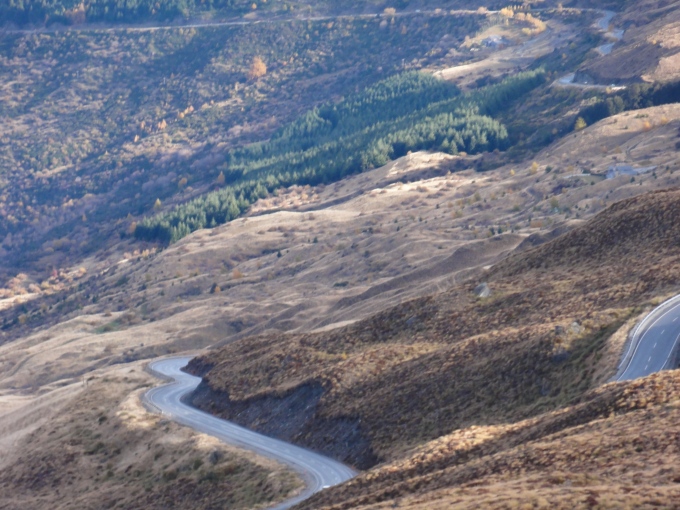
A picture paints … well, as many words as you like.  For instance:

lookingdownfromcoronetpeak

And the story:


It was once said that a desperate man has everything to lose.

The man I was chasing was desperate, but I, on the other hand, was more desperate to catch him.

He’d left a trail of dead people from one end of the island to the other.

The team had put in a lot of effort to locate him, and now his capture was imminent.  We were following the car he was in, from a discrete distance, and, at the appropriate time, we would catch up, pull him over, and make the arrest.

There was nowhere for him to go.

The road led to a dead-end, and the only way off the mountain was back down the road were now on.  Which was why I was somewhat surprised when we discovered where he was.

Where was he going?


“Damn,” I heard Alan mutter.  He was driving, being careful not to get too close, but not far enough away to lose sight of him.

“What?”

“I think he’s made us.”

“How?”

“Dumb bad luck, I’m guessing.  Or he expected we’d follow him up the mountain.  He’s just sped up.”

“How far away?”

“A half-mile.  We should see him higher up when we turn the next corner.”

It took an eternity to get there, and when we did, Alan was right, only he was further on than we thought.”

“Step on it.  Let’s catch him up before he gets to the top.”

Easy to say, not so easy to do.  The road was treacherous, and in places just gravel, and there were no guard rails to stop a three thousand footfall down the mountainside.

Good thing then I had the foresight to have three agents on the hill for just such a scenario.


Ten minutes later, we were in sight of the car, still moving quickly, but we were going slightly faster.  We’d catch up just short of the summit car park.

Or so we thought.

Coming quickly around another corner we almost slammed into the car we’d been chasing.

“What the hell…” Aland muttered.

I was out of the car, and over to see if he was in it, but I knew that it was only a slender possibility.  The car was empty, and no indication where he went.

Certainly not up the road.  It was relatively straightforward for the next mile, at which we would have reached the summit.  Up the mountainside from here, or down.

I looked up.  Nothing.

Alan yelled out, “He’s not going down, not that I can see, but if he did, there’s hardly a foothold and that’s a long fall.”

Then where did he go?

Then a man looking very much like our quarry came out from behind a rock embedded just a short distance up the hill.

“Sorry,” he said quite calmly.  “Had to go if you know what I mean.”


I’d lost him.

It was as simple as that.

I had been led a merry chase up the hill, and all the time he was getting away in a different direction.

I’d fallen for the oldest trick in the book, letting my desperation blind me to the disguise that anyone else would see through in an instant.

It was a lonely sight, looking down that road, knowing that I had to go all that way down again, only this time, without having to throw caution to the wind.

“Maybe next time,” Alan said.

“We’ll get him.  It’s just a matter of time.”


© Charles Heath 2019

Find this and other stories in “Inspiration, maybe”  available soon.

InspirationMaybe1v1


From typewriters to computers to distraction

I first started writing by longhand, still do, in fact, then graduated to my mother’s portable typewriter, right down to the sticking keys and overused ribbon, then moved upwards into the electric world having a pair of IBM electric typewriters I bought from one of the places I worked as second-hand cast-offs.

Just remembering those days gives me the shudders, from the tangled ribbons and messy hands to using carbon paper, how many times before they were useless?

Then the age of the electric typewriter went the same way as the manual ones, simply because I could no longer buy ribbons for my IBM Selectric, so it, too, had to go the way of the dinosaurs.

It was a good thing, then, that computers and word processing software started at about the same time.   Word Perfect, to begin with, and then, in the early days of Windows, Word, and others.  Sometimes it was easier just to use the text editor, and for convenience, it’s often by choice to get ideas down, quick and dirty.

This was before the days of the internet, where you physically had to do something about finding inspiration.  And that, sometimes, was more difficult that it seems.  I do not have a writing room with large windows looking out on a rural or urban panorama.  The window looks onto a fence, and the house next door.

So much for my dream of owning a castle and having a writing room on the second or third level, with astonishing views.

Which leads me to today.  Enough with the reminiscing.  I have all the tools I need to get on with the job, but that isn’t enough to switch on the brain and start typing perfect prose.  I have to go in search of some inspiration.

It’s just that in that short distance, from, say, the couch where you were reading the latest blog posts in the WordPress reader, and the writer’s chair, your preparation for writing ends up getting confused at some of the blogger’s points because it’s hard to find anything relevant that backs up their assertions, or how things work for them.

I guess success form anyone’s standpoint, is what worked for them.  In relaying that to others, two things come to mind.  It worked for them, but in telling a million others, and they all take the same approach, no, sorry, it ain’t going to work no how.  The other, there’s usually a fee attached to gain the knowledge, and, yes, the same proviso applies.  If everyone does it, it ain’t going to work no how.

But, there you are, my attention has been distracted, and unless I’m about to indulge in writing a version of how to achieve success myself, which I haven’t so I’m not, I’m off track, with an out of balance mindset, and therefore unable to write.

Perhaps I should not read blog posts, but the newspapers.

Or not, because they all have an editorial policy that leans either and one way or another, which means their views are not necessarily unbiased.

I was a journalist once and hated the idea of having to toe the editorial line.  Or as luck would have it, never let the truth get in the way of a good story.  It lends to the theory that you can never quite believe anything the media tells you, which is a very sorry place to be when there are no external influences you can trust.

I’m coming around to thinking that it’s probably best left to the dark hours of the night when you would think all the distractions are behind you.  After all, isn’t that what daytime is for?

Except that’s when the ghosts come out to play.

I think.

Was that the lounge room door opening?

An excerpt from “The Things We Do For Love”

In the distance he could hear the dinner bell ringing and roused himself.  Feeling the dampness of the pillow, and fearing the ravages of pent up emotion, he considered not going down but thought it best not to upset Mrs. Mac, especially after he said he would be dining.

In the event, he wished he had reneged, especially when he discovered he was not the only guest staying at the hotel.

Whilst he’d been reminiscing, another guest, a young lady, had arrived.  He’d heard her and Mrs. Mac coming up the stairs, and then shown to a room on the same floor, perhaps at the other end of the passage.

Henry caught his first glimpse of her when she appeared at the door to the dining room, waiting for Mrs. Mac to show her to a table.

She was about mid-twenties, slim, long brown hair, and the grace and elegance of a woman associated with countless fashion magazines.  She was, he thought, stunningly beautiful with not a hair out of place, and make-up flawlessly applied.  Her clothes were black, simple, elegant, and expensive, the sort an heiress or wife of a millionaire might condescend to wear to a lesser occasion than dinner.

Then there was her expression; cold, forbidding, almost frightening in its intensity.  And her eyes, piercingly blue and yet laced with pain.  Dracula’s daughter was his immediate description of her.

All in all, he considered, the only thing they had in common was, like him, she seemed totally out of place.

Mrs. Mac came out of the kitchen, wiping her hands on her apron.  She was, she informed him earlier, chef, waitress, hotelier, barmaid, and cleaner all rolled into one.  Coming up to the new arrival she said, “Ah, Miss Andrews, I’m glad you decided to have dinner.  Would you like to sit with Mr. Henshaw, or would you like to have a table of your own?”

Henry could feel her icy stare as she sized up his appeal as a dining companion, making the hair on the back on his neck stand up.  He purposely didn’t look back.  In his estimation, his appeal rating was minus six.  Out of a thousand!

“If Mr. Henshaw doesn’t mind….”  She looked at him, leaving the query in mid-air.

He didn’t mind and said so.  Perhaps he’d underestimated his rating.

“Good.”  Mrs. Mac promptly ushered her over.  Henry stood, made sure she was seated properly and sat.

“Thank you.  You are most kind.”  The way she said it suggested snobbish overtones.

“I try to be when I can.”  It was supposed to nullify her sarcastic tone but made him sound a little silly, and when she gave him another of her icy glares, he regretted it.

Mrs. Mac quickly intervened, asking, “Would you care for the soup?”

They did, and, after writing the order on her pad, she gave them each a look, imperceptibly shook her head, and returned to the kitchen.

Before Michelle spoke to him again, she had another quick look at him, trying to fathom who and what he might be.  There was something about him.

His eyes, they mirrored the same sadness she felt, and, yes, there was something else, that it looked like he had been crying?  There was a tinge of redness.

Perhaps, she thought, he was here for the same reason she was.

No.  That wasn’t possible.

Then she said, without thinking, “Do you have any particular reason for coming here?”  Seconds later she realized she’s spoken it out loud, had hadn’t meant to actually ask, it just came out.

It took him by surprise, obviously not the first question he was expecting her to ask of him.

“No, other than it is as far from civilization, and home, as I could get.”

At least we agree on that, she thought.

It was obvious he was running away from something as well.

Given the isolation of the village and lack of geographic hospitality, it was, from her point of view, ideal.  All she had to do was avoid him, and that wouldn’t be difficult.

After getting through this evening first.

“Yes,” she agreed.  “It is that.”

A few seconds passed, and she thought she could feel his eyes on her and wasn’t going to look up.

Until he asked, “What’s your reason?”

Slight abrupt in manner, perhaps as a result of her question, and the manner in which she asked it.

She looked up.  “Rest.  And have some time to myself.”

She hoped he would notice the emphasis she had placed on the word ‘herself’ and take due note.  No doubt, she thought,  she had completely different ideas of what constituted a holiday than he, not that she had actually said she was here for a holiday.

Mrs. Mac arrived at a fortuitous moment to save them from further conversation.


Over the entree, she wondered if she had made a mistake coming to the hotel.  Of course, there had been no possible way she could know than anyone else might have booked the same hotel, but realized it was foolish to think she might end up in it by herself.

Was that what she was expecting?

Not a mistake then, but an unfortunate set of circumstances, which could be overcome by being sensible.

Yet, there he was, and it made her curious, not that he was a man, by himself, in the middle of nowhere, hiding like she was, but for very different reasons.

On discreet observance whilst they ate, she gained the impression his air of light-heartedness was forced and he had no sense of humor.

This feeling was engendered by his looks, unruly dark hair, and permanent frown.  And then there was his abysmal taste in clothes on a tall, lanky frame.  They were quality but totally unsuited to the wearer.

Rebellion was written all over him.

The only other thought crossing her mind, and rather incongruously, was he could do with a decent feed.  In that respect, she knew now from the mountain of food in front of her, he had come to the right place.

“Mr. Henshaw?”

He looked up.  “Henshaw is too formal.  Henry sounds much better,” he said, with a slight hint of gruffness.

“Then my name is Michelle.”

Mrs. Mac came in to take their order for the only main course, gather up the entree dishes, then return to the kitchen.

“Staying long?” she asked.

“About three weeks.  Yourself?”

“About the same.”

The conversation dried up.

Neither looked at the other, rather at the walls, out the window, towards the kitchen, anywhere.  It was, she thought, almost unbearably awkward.


Mrs. Mac returned with a large tray with dishes on it, setting it down on the table next to theirs.

“Not as good as the usual cook,” she said, serving up the dinner expertly, “but it comes a good second, even if I do say so myself.  Care for some wine?”

Henry looked at Michelle.  “What do you think?”

“I’m used to my dining companions making the decision.”

You would, he thought.  He couldn’t help but notice the cutting edge of her tone.  Then, to Mrs. Mac, he named a particular White Burgundy he liked and she bustled off.

“I hope you like it,” he said, acknowledging her previous comment with a smile that had nothing to do with humor.

“Yes, so do I.”

Both made a start on the main course, a concoction of chicken and vegetables that were delicious, Henry thought, when compared to the bland food he received at home and sometimes aboard my ship.

It was five minutes before Mrs. Mac returned with the bottle and two glasses.  After opening it and pouring the drinks, she left them alone again.

Henry resumed the conversation.  “How did you arrive?  I came by train.”

“By car.”

“Did you drive yourself?”

And he thought, a few seconds later, that was a silly question, otherwise she would not be alone, and certainly not sitting at this table. With him.

“After a fashion.”

He could see that she was formulating a retort in her mind, then changed it, instead, smiling for the first time, and it served to lighten the atmosphere.

And in doing so, it showed him she had another more pleasant side despite the fact she was trying not to look happy.

“My father reckons I’m just another of ‘those’ women drivers,” she added.

“Whatever for?”

“The first and only time he came with me I had an accident.  I ran up the back of another car.  Of course, it didn’t matter to him the other driver was driving like a startled rabbit.”

“It doesn’t help,” he agreed.

“Do you drive?”

“Mostly people up the wall.”  His attempt at humor failed.  “Actually,” he added quickly, “I’ve got a very old Morris that manages to get me where I’m going.”

The apple pie and cream for dessert came and went and the rapport between them improved as the wine disappeared and the coffee came.  Both had found, after getting to know each other better, their first impressions were not necessarily correct.

“Enjoy the food?” Mrs. Mac asked, suddenly reappearing.

“Beautifully cooked and delicious to eat,” Michelle said, and Henry endorsed her remarks.

“Ah, it does my heart good to hear such genuine compliments,” she said, smiling.  She collected the last of the dishes and disappeared yet again.

“What do you do for a living,” Michelle asked in an off-hand manner.

He had a feeling she was not particularly interested and it was just making conversation.

“I’m a purser.”

“A what?”

“A purser.  I work on a ship doing the paperwork, that sort of thing.”

“I see.”

“And you?”

“I was a model.”

“Was?”

“Until I had an accident, a rather bad one.”

“Oh, I’m sorry.”

So that explained the odd feeling he had about her.

As the evening had worn on, he began to think there might be something wrong, seriously wrong with her because she didn’t look too well.  Even the carefully applied makeup, from close up, didn’t hide the very pale, and tired look, or the sunken, dark ringed eyes.

“I try not to think about it, but it doesn’t necessarily work.  I’ve come here for peace and quiet, away from doctors and parents.”

“Then you will not have to worry about me annoying you.  I’m one of those fall-asleep-reading-a-book types.”

Perhaps it would be like ships passing in the night and then smiled to himself about the analogy.

Dinner now over, they separated.

Henry went back to the lounge to read a few pages of his book before going to bed, and Michelle went up to her room to retire for the night.

But try as he might, he was unable to read, his mind dwelling on the unusual, yet the compellingly mysterious person he would be sharing the hotel with.

Overlaying that original blurred image of her standing in the doorway was another of her haunting expressions that had, he finally conceded, taken his breath away, and a look that had sent more than one tingle down his spine.

She may not have thought much of him, but she had certainly made an impression on him.


© Charles Heath 2015-2020
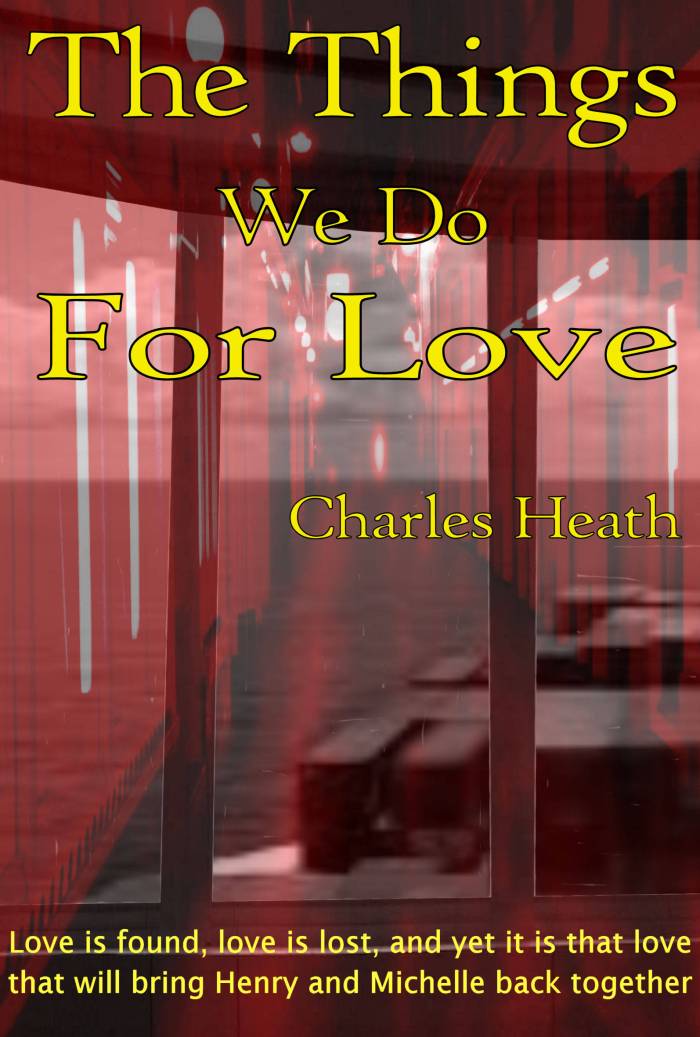
lovecoverfinal1

“The Devil You Don’t”, be careful what you wish for

Now only $0.99 at https://amzn.to/2Xyh1ow

John Pennington’s life is in the doldrums. Looking for new opportunities, prevaricating about getting married, the only joy on the horizon was an upcoming visit to his grandmother in Sorrento, Italy.

Suddenly he is left at the check-in counter with a message on his phone telling him the marriage is off, and the relationship is over.

If only he hadn’t promised a friend he would do a favor for him in Rome.

At the first stop, Geneva, he has a chance encounter with Zoe, an intriguing woman who captures his imagination from the moment she boards the Savoire, and his life ventures into uncharted territory in more ways than one.

That ‘favor’ for his friend suddenly becomes a life-changing event, and when Zoe, the woman who he knows is too good to be true, reappears, danger and death follow.

Shot at, lied to, seduced, and drawn into a world where nothing is what it seems, John is dragged into an adrenaline-charged undertaking, where he may have been wiser to stay with the ‘devil you know’ rather than opt for the ‘devil you don’t’.

newdevilcvr6

Are we in the midst of an apocalypse?

I never thought I’d be sitting down and thinking about mortality.

It comes up, of course, every time you go to a funeral, but it’s not like this, not when anyone you know can get a disease that has no cure, and it can kill you.

I’m looking at a continuous update of the destruction it’s doing to human life all over the planet, some 27,115,490 people have contracted the virus, and 885,600 people have died.

As a proportion of the earth’s population, it’s probably nothing, but to each and every family member of those who contract it and who eventually die, they are not a statistic, they are someone loved and cherished.

It horrifies me that some people can make light of it.

If doubly horrifies me when they start talking about acceptable losses, or worse, it didn’t kill as many people we thought it would.

The thing is, this virus hasn’t finished with us yet.  It’s still out there, there are people with it, and don’t know they’ve got it and they can spread it as easily as spreading soft butter on a slice of bread.

And yet, there are people out there who claim their freedom is more important than dying,  Tell that to those who have lost loved ones.  Tell that to a child who has lost a father, a mother, a bother, a sister, a friend, or as the virus is more selective, a grandparent, or someone whose health was tenuous for a variety of reasons.

They just don’t get it.

I’m guessing that in some countries where guns are a way of life, and the population is inured to the countless deaths caused by those guns, a virus doesn’t impact them.  They say they are more likely to be killed by the flu, or a cow falling out of the sky on them.

Perhaps the saner of us could pray for a rainstorm of cows when they gather to protest against gun control.  It would make a better headline that we see each morning, the ever-increasing infections, and worse, deaths.

There is no cure, despite what some people will say.  There won’t be a cure, because it’s not the virus we have to remove, it’s the practices that cause those viruses.  We have to find and remove the cause, whether it’s bats, exotic animals, of countries creating biological warfare weapons.

And here’s a tip from a thriller writer who’s been trying to wrap his head around all of the available conspiracy theories, the one I like the most is; the country that magically finding a cure in less than the accepted time-frame is more than likely the country was the one who created it.

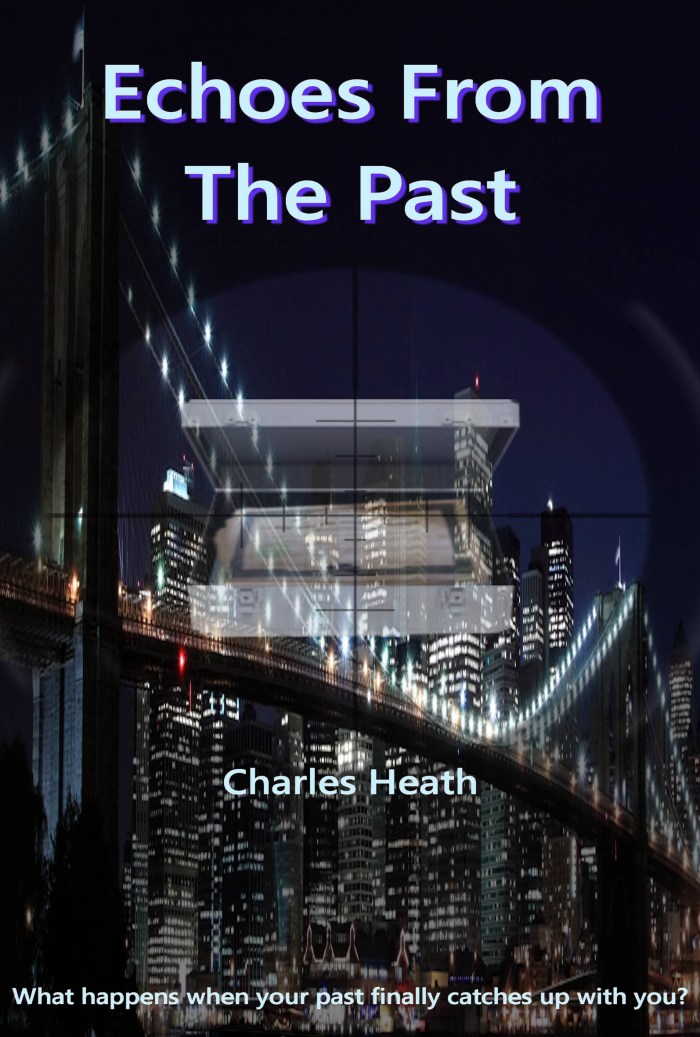
*** On special – $0.99 – On Special ***

Two novels are on special for $0.99

They are

newechocover5rs

for “Echoes from the Past” go to

https://amzn.to/2CYKxu4

newdevilcvr3

for “The Devil You Don’t” go to

https://amzn.to/2Xyh1ow

“One Last Look”, nothing is what it seems

A single event can have enormous consequences.

A single event driven by fate, after Ben told his wife Charlotte he would be late home one night, he left early, and by chance discovers his wife having dinner in their favourite restaurant with another man.

A single event where it could be said Ben was in the wrong place at the wrong time.

Who was this man? Why was she having dinner with him?

A simple truth to explain the single event was all Ben required. Instead, Charlotte told him a lie.

A single event that forces Ben to question everything he thought he knew about his wife, and the people who are around her.

After a near-death experience and forced retirement into a world he is unfamiliar with, Ben finds himself once again drawn back into that life of lies, violence, and intrigue.

From London to a small village in Tuscany, little by little Ben discovers who the woman he married is, and the real reason why fate had brought them together.

It is available on Amazon here:  http://amzn.to/2CqUBcz

“Sunday in New York”, it’s a bumpy road to love

“Sunday in New York” is ultimately a story about trust, and what happens when a marriage is stretched to its limits.

When Harry Steele attends a lunch with his manager, Barclay, to discuss a promotion that any junior executive would accept in a heartbeat, it is the fact his wife, Alison, who previously professed her reservations about Barclay, also agreed to attend, that casts a small element of doubt in his mind.

From that moment, his life, in the company, in deciding what to do, his marriage, his very life, spirals out of control.

There is no one big factor that can prove Harry’s worst fears, that his marriage is over, just a number of small, interconnecting events, when piled on top of each other, points to a cataclysmic end to everything he had believed in.

Trust is lost firstly in his best friend and mentor, Andy, who only hints of impending disaster, Sasha, a woman whom he saved, and who appears to have motives of her own, and then in his wife, Alison, as he discovered piece by piece damning evidence she is about to leave him for another man.

Can we trust what we see with our eyes or trust what we hear?

Haven’t we all jumped to conclusions at least once in our lives?

Can Alison, a woman whose self-belief and confidence is about to be put to the ultimate test, find a way of proving their relationship is as strong as it has ever been?

As they say in the classics, read on!

Purchase:

http://tinyurl.com/Amazon-SundayInNewYork

Searching for locations: Central Park, New York

It’s a place to go and spot the movie stars, or perhaps their dogs.

It’s a place to go for long walks on idyllic spring or autumn days

It’s a place to go to look at a zoo, though I didn’t realize there was one until I made a wrong turn.

It’s a place to go for a horse and carriage ride, although it does not last that long

It’s a place to go to look at statues, fountains, architecture, and in winter, an ice skating rink

I’m sure there’s a whole lot more there that I don’t know about.

I have to say I’ve only visited in winter, and the first time there was snow, the second, none.

Both times it was cold, but this didn’t seem to deter people.

But…

We decided to go visit another part of the park, this time walking to West 67th Street before crossing Central Park West and into the park where Sheep Meadow is.

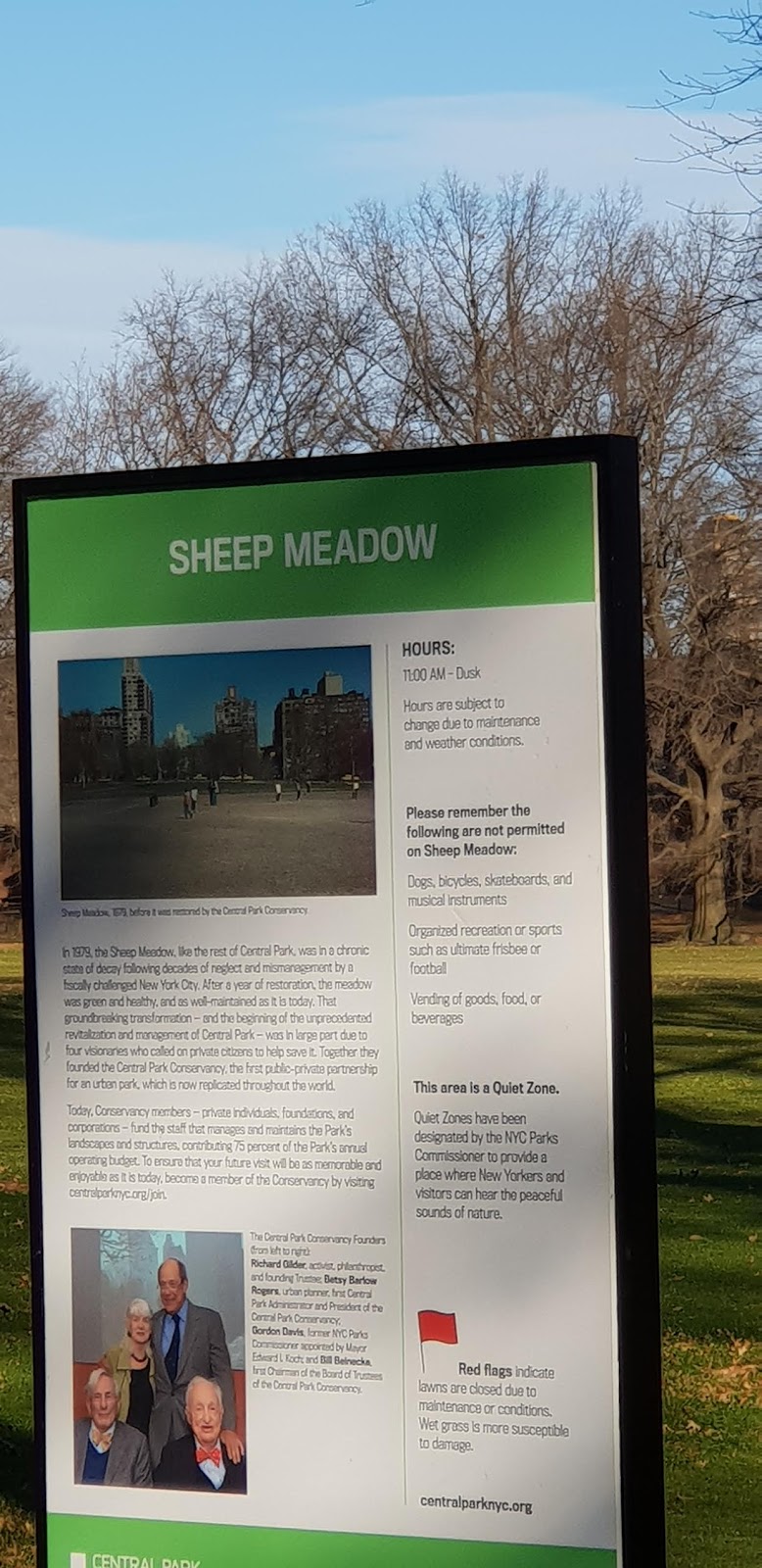
Once upon a time sheep did graze on the meadow, but these days it is designated a quiet area inspiring calm and refreshing thoughts, except for a period in the 1960s where there was more than one counter-culture protest, or love in, going on.

And, there’s the sign to say it was Sheep Meadow,

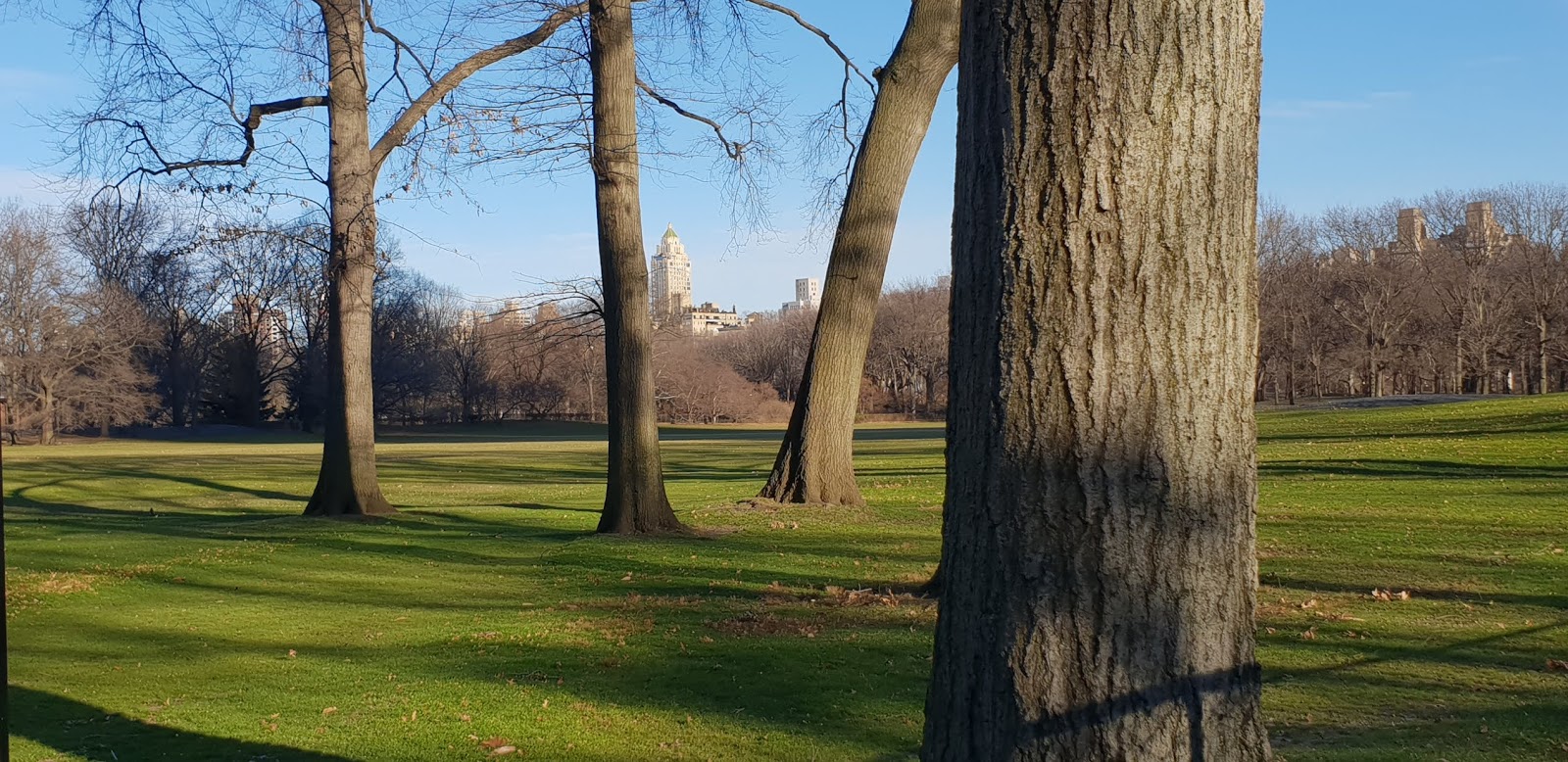
and that’s the meadow behind the sign,

Well, I don’t see any sheep, but of course, that’s not why the meadow is named or should there be any sheep on it.  That greenery that can be seen, restoring for the spring, was a very expensive addition to the park.

As a matter of fact, there is nothing was on it, because signs were up to say the meadow was closed for the winter, a new and interesting variation on the ‘Don’t Walk On The Grass’ signs.

I’m sure I could climb the fence, or, maybe not.  I’m a bit old to be climbing fences.

So, unable to walk on the grass, we tossed an imaginary coin, should we go towards West 110th Street, or back to West 59th Street.

West 59th Street won.

and, just in case we had any strange ideas about walking on the grass, the fence was there to deter us.  Perhaps if we had more determination…

One positive aspect of the park is that you could never get lost, and the tall buildings surrounding the park are nearly always visible through the trees, more so in winter because there is no foliage, maybe less so later in the year.

There is also a lot of very large rocky type hills, or outcrops where people seem to stand on, king of the mountain style, or sit to have a picnic lunch, quickly before it freezes.

Yes, it is cold outside and seems more so in the park.

I wondered briefly if it ever got foggy, then this place would be very spooky, particularly after the sun goes down.