Writing a book in 365 days – My Story 25

More about my story

The reason why this story has spent so much time on the back burner is that I have never quite captured the ending.  That is to say, I was not sure how it was going to end for all of the characters.

My trouble is, as it always is, is coming up with an idea that has a ripple effect going back in time and requiring changes to earlier material.

You can’t have things happening without the reader having at least one earlier hook to say, when he or she gets there, they had an inkling it was going to happen.

Whilst in stories, random events just turning up without explanation is not a good idea.  Making the character suddenly arrive, die or worse, can be confusing because there always had to be a backstory and that needs to be told.

Nothing worse than reading a story, and then asking, When did that happen?

The previous new ending to this story was about 45 pages long and didn’t quite make sense.  Now it is about 80 and does make sense, but it seems a bit long. 

Then I thought, why not have Book 1 and Book 2 and make them independent of each other, but loosely linked?

The point is, the end didn’t make sense because we didn’t really know who was aggrieved and who was causing all the problems.

Now, everyone’s side of the story is there, leading up to a single event after which who, what and why become clear.

Does anyone get revenge?

Is there really anything like revenge to get?

And is it true that when you seek revenge, first dig two graves?

You will only know when the book is published.  Soon.

Writing a book in 365 days – 178

Day 178

Trunk stories – those stories you never seem to finish

Yes, the ones that end up in a dark corner of the writing room, if you have one, simply because the ideas ran out, or the next move wasn’t clear.

I have stories like that, quite a few actually, and every now and then I rummage, find one, and make the centre of my next NaNoWriMo project. And since NaNoWriMo comes around twice a year, it means two have done stories come in from the cold.

But, this idea of picking up a story you wrote a long while ago but never finished, mainly because something was missing, is a good one, and recently while I was away, and trying not to work on a new project i found this story I write about thirty years ago, and actually did get to the end, but it wasn;t end I wanted.

So, each night I read a few chapters and made notes.

Then, at the end of the story, I could see what the problem was; it needed to have closure with another event that was overshadowing the life of the protagonist. I had at some point written in a new character, and hadn’t quite got the details right.

There was a hint of a resolution at the end, but it had been hastily put together, or if I knew the me back then, I had written the end long before I got to it, and failed to maintain the plotlines to support it.

Or maybe it just meant that the story had been running around inside my head for the intervening thirty years and now I knew what to write, or how I was going to get to that end.

It needed a lot of rewriting, and in the end, it virtually ends up as two stories, related but independent of each other.

Yes, I have piles of trunk stories, and yes, I do go back a little earlier than thirty years, and yes, some of them become projects that are completed to the first or second draft.

Searching for locations: Hutongs, Beijing, China

What are Hutongs?

In Beijing Hutongs are formed by lines of traditional courtyard residences, called siheyuan.  Neighborhoods were formed by joining many hutongs together. These siheyuan are the traditional residences, usually occupied by a single or extended family, signifying wealth, and prosperity. 

Over 500 of these still exist.Many of these hutongs have been demolished, but recently they have become protected places as a means of preserving some Chinese cultural history.  They were first established in the Yuan Dynasty (1279-1368)Many of these Hutongs had their main buildings and gates built facing south, and lanes connecting them to other hutongs also ran north to south.

Many hutongs, some several hundred years old, in the vicinity of the Bell Tower and Drum Tower and Shichahai Lake are preserved and abound with tourists, many of which tour the quarter in pedicabs.

The optional tour also includes a visit to Shichahai, a historic scenic area consisting of three lakes (Qianhai, meaning Front Sea; Houhai, meaning Back Sea and Xihai, meaning West Sea), surrounding places of historic interest and scenic beauty and remnants of old-style local residences, Hutong and Courtyard.  

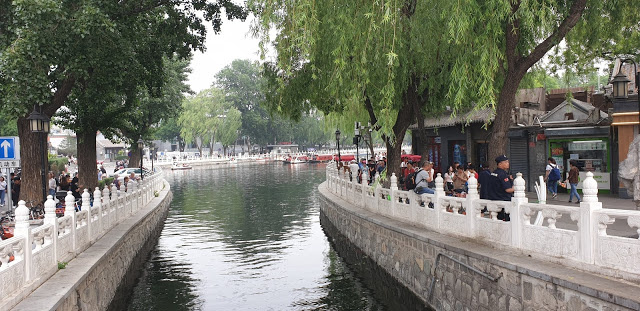
First, we had a short walk through the more modern part of the Hutong area and given some free time for shopping, but we prefer just to meander by the canal.  

There is a lake, and if we had the time, there were boats you could take.

With some time to spare, we take a quick walk down one of the alleyways where on the ground level are small shops, and above, living quarters.

Then we go to the bell and drum towers before walking through some more alleys was to where the rickshaws were waiting.
The Bell tower

And the Drum tower. Both still working today.

The rickshaw ride took us through some more back streets where it was clear renovations were being made so that the area could apply for world heritage listing.  Seeing inside some of the houses shows that they may look dumpy outside but that’s not the case inside.

The rickshaw ride ends outside the house where dinner will be served, and is a not so typical hose but does have all the elements of how the Chinese live, the boy’s room, the girl’s room, the parent’s room, the living area, and the North-south feng shui.

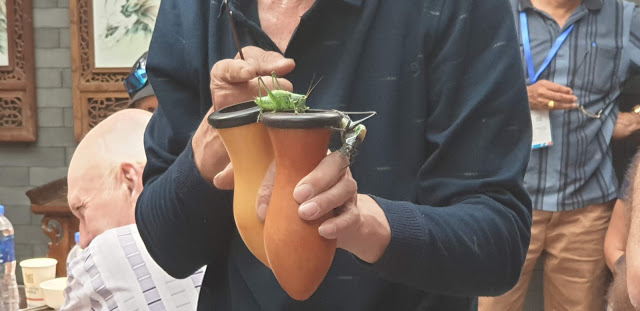
Shortly after we arrive, the cricket man, apparently someone quite famous in Beijing arrives and tells us all about crickets and then grasshoppers, then about cricket racing.  He is animated and clearly enjoys entertaining us westerners.

I’m sorry but the cricket stuff just didn’t interest me.  Or the grasshoppers.

As for dinner, it was finally a treat to eat what the typical Chinese family eats, and everything was delicious, and the endless beer was a nice touch.

And the last surprise, the food was cooked by a man.

Writing a book in 365 days – 178

Day 178

Trunk stories – those stories you never seem to finish

Yes, the ones that end up in a dark corner of the writing room, if you have one, simply because the ideas ran out, or the next move wasn’t clear.

I have stories like that, quite a few actually, and every now and then I rummage, find one, and make the centre of my next NaNoWriMo project. And since NaNoWriMo comes around twice a year, it means two have done stories come in from the cold.

But, this idea of picking up a story you wrote a long while ago but never finished, mainly because something was missing, is a good one, and recently while I was away, and trying not to work on a new project i found this story I write about thirty years ago, and actually did get to the end, but it wasn;t end I wanted.

So, each night I read a few chapters and made notes.

Then, at the end of the story, I could see what the problem was; it needed to have closure with another event that was overshadowing the life of the protagonist. I had at some point written in a new character, and hadn’t quite got the details right.

There was a hint of a resolution at the end, but it had been hastily put together, or if I knew the me back then, I had written the end long before I got to it, and failed to maintain the plotlines to support it.

Or maybe it just meant that the story had been running around inside my head for the intervening thirty years and now I knew what to write, or how I was going to get to that end.

It needed a lot of rewriting, and in the end, it virtually ends up as two stories, related but independent of each other.

Yes, I have piles of trunk stories, and yes, I do go back a little earlier than thirty years, and yes, some of them become projects that are completed to the first or second draft.

Writing a book in 365 days – 177

Day 177

Sharing your experiences

Whilst some of the experiences you have sometimes become parts of the stories about the protagonists, the places, and even sometimes the events, others are just experiences that you will want to share with others.

It is the reason why I have specific blogs, one that records almost like diary entries, the things that happen, like seeing a movie or going to a play, or just some event I got caught up in.

The other is a travel blog where, whenever we go away, I always take photos and record what it is we do if I think it would be useful for others. Sometimes these travel events appear as ‘Searching for Locations’, much like the movie makers do when setting up to film.

But, more often it is like keeping a diary, and these events record my writing progress, the problems with writing, and especially advertising for self-publishing authors. Certainly, the travel entries being time-based keep a record of any changes at a place we go to more than once.

That’s usually Coffs Harbour in northern New South Wales, where we get a timeshare.

We realised very early on the advantage of owning a timehare because it means we can go anywhere in the world, for a week, for a relatively low cost, and get a place with three bedrooms, two bathrooms, and plenty of living space, a kitchen and a laundry.

Major travels in the last few years include America, Canada, China, New Zealand, Austria, Italy and France. Writing about those places is mostly for my own benefit, as they all, at one time or another, end up in my stories.

I also hope that it helps other people with their plans.

Searching for locations: Hutongs, Beijing, China

What are Hutongs?

In Beijing Hutongs are formed by lines of traditional courtyard residences, called siheyuan.  Neighborhoods were formed by joining many hutongs together. These siheyuan are the traditional residences, usually occupied by a single or extended family, signifying wealth, and prosperity. 

Over 500 of these still exist.Many of these hutongs have been demolished, but recently they have become protected places as a means of preserving some Chinese cultural history.  They were first established in the Yuan Dynasty (1279-1368)Many of these Hutongs had their main buildings and gates built facing south, and lanes connecting them to other hutongs also ran north to south.

Many hutongs, some several hundred years old, in the vicinity of the Bell Tower and Drum Tower and Shichahai Lake are preserved and abound with tourists, many of which tour the quarter in pedicabs.

The optional tour also includes a visit to Shichahai, a historic scenic area consisting of three lakes (Qianhai, meaning Front Sea; Houhai, meaning Back Sea and Xihai, meaning West Sea), surrounding places of historic interest and scenic beauty and remnants of old-style local residences, Hutong and Courtyard.  

First, we had a short walk through the more modern part of the Hutong area and given some free time for shopping, but we prefer just to meander by the canal.  

There is a lake, and if we had the time, there were boats you could take.

With some time to spare, we take a quick walk down one of the alleyways where on the ground level are small shops, and above, living quarters.

Then we go to the bell and drum towers before walking through some more alleys was to where the rickshaws were waiting.
The Bell tower

And the Drum tower. Both still working today.

The rickshaw ride took us through some more back streets where it was clear renovations were being made so that the area could apply for world heritage listing.  Seeing inside some of the houses shows that they may look dumpy outside but that’s not the case inside.

The rickshaw ride ends outside the house where dinner will be served, and is a not so typical hose but does have all the elements of how the Chinese live, the boy’s room, the girl’s room, the parent’s room, the living area, and the North-south feng shui.

Shortly after we arrive, the cricket man, apparently someone quite famous in Beijing arrives and tells us all about crickets and then grasshoppers, then about cricket racing.  He is animated and clearly enjoys entertaining us westerners.

I’m sorry but the cricket stuff just didn’t interest me.  Or the grasshoppers.

As for dinner, it was finally a treat to eat what the typical Chinese family eats, and everything was delicious, and the endless beer was a nice touch.

And the last surprise, the food was cooked by a man.

Writing a book in 365 days – 177

Day 177

Sharing your experiences

Whilst some of the experiences you have sometimes become parts of the stories about the protagonists, the places, and even sometimes the events, others are just experiences that you will want to share with others.

It is the reason why I have specific blogs, one that records almost like diary entries, the things that happen, like seeing a movie or going to a play, or just some event I got caught up in.

The other is a travel blog where, whenever we go away, I always take photos and record what it is we do if I think it would be useful for others. Sometimes these travel events appear as ‘Searching for Locations’, much like the movie makers do when setting up to film.

But, more often it is like keeping a diary, and these events record my writing progress, the problems with writing, and especially advertising for self-publishing authors. Certainly, the travel entries being time-based keep a record of any changes at a place we go to more than once.

That’s usually Coffs Harbour in northern New South Wales, where we get a timeshare.

We realised very early on the advantage of owning a timehare because it means we can go anywhere in the world, for a week, for a relatively low cost, and get a place with three bedrooms, two bathrooms, and plenty of living space, a kitchen and a laundry.

Major travels in the last few years include America, Canada, China, New Zealand, Austria, Italy and France. Writing about those places is mostly for my own benefit, as they all, at one time or another, end up in my stories.

I also hope that it helps other people with their plans.

Writing a book in 365 days – 176

Day 176

Could you apply real-life work information to a story?

One of the how-to books I was reading once made several statements about what you could write about.

The first was to write about what you know. To me, that means if you were in the military, you would have the inside knowledge on how the army, navy or air force worked and you could apply that to the scenarios, the situations and the people.

Then there’s the idea that your work environment could provide you with enough inspiration and authentic information to make the story sound realistic.

I’m going with the latter because the place where I worked, in one instance, provided the detail to incorporate into a story. That workplace is a phosphate mining company, and the place where that mining took place, on a small Pacific Island.

I was also lucky enough to work on a history of the company for several years as the principal research officer. It wasn’t long before I began writing a parallel story, which I had tentatively called The phosphateers, and as each piece of research yielded yet another gem of information, so began the story.

It started in the aftermath of World War 1, and the first volume was to end when the island was evacuated, after several of the company’s ships were sunk by a German raider in World War 2.

But that was not the only story…

My acquiring of knowledge about computer systems, and in particular in those early days, the primitive sort of networking available with cables, connectors and network cards, was the basis for another story.

So, yes, a real-life job can be a gold mine of information.

Writing a book in 365 days – 176

Day 176

Could you apply real-life work information to a story?

One of the how-to books I was reading once made several statements about what you could write about.

The first was to write about what you know. To me, that means if you were in the military, you would have the inside knowledge on how the army, navy or air force worked and you could apply that to the scenarios, the situations and the people.

Then there’s the idea that your work environment could provide you with enough inspiration and authentic information to make the story sound realistic.

I’m going with the latter because the place where I worked, in one instance, provided the detail to incorporate into a story. That workplace is a phosphate mining company, and the place where that mining took place, on a small Pacific Island.

I was also lucky enough to work on a history of the company for several years as the principal research officer. It wasn’t long before I began writing a parallel story, which I had tentatively called The phosphateers, and as each piece of research yielded yet another gem of information, so began the story.

It started in the aftermath of World War 1, and the first volume was to end when the island was evacuated, after several of the company’s ships were sunk by a German raider in World War 2.

But that was not the only story…

My acquiring of knowledge about computer systems, and in particular in those early days, the primitive sort of networking available with cables, connectors and network cards, was the basis for another story.

So, yes, a real-life job can be a gold mine of information.

Writing a book in 365 days – 175

Day 175

Writing Exercise

Don’t ask me how I got in the middle of the family version or World War 3, but I just happened to call in at the family home on my way home to the residence I’d always wanted after finally moving out of the home.

Enough parental hints had been dropped that it was time to leave the ‘nest, and I agreed.

My older brother had moved out a long time ago and went overseas. I never understood why, and he never explained. He just didn’t come back, and oddly enough no one talked about it.

My younger sister was still at home, and she had hinted there was going to be some news if I decided to come to dinner, and since she was cooking, I agreed. She was a professional chef, and her cooking was not to be missed when on offer.

But…

When I let myself in and announced I’d arrived, there was … silence.

Very unusual, because the house was always a cacophony of noise for one reason or another. At the very least, Susannah and my mother would be exchanging ideas in what my father often called a robust discussion.

Then my mother came out of the dining room at the sound of my arrival, much like a spectre out of the darkness.

“You go talk to Sue. She’s under a great deal of strain and not thinking clearly.”

This meant if I interpreted the tone, my mother had tried to tell her, rather than suggest, what to do, and Sue didn’t take orders very well. She never had, and her last three years at high school had been fraught. Things had settled down after she left for college and cooking school, but it all started up again when she returned home.

Mother had a death wish, father said. He understood that Sussanah needed to find her own path, but Mother had always expected her to follow in her footsteps. She had started the family restaurant but was now getting on, as she called it, and wanted Sue to take over.

Sue said she would if she could modernise the menu. That was the proverbial red rag to the bull.

I went out to the kitchen, but it was empty, so that meant she would be upstairs in her room. I slowly climbed the stairs, thinking back on the last time I had been in the house, about a month before. Sue had just returned from a culinary tour of the south of France and was full of enthusiasm and new recipes.

I’d picked her up from the airport, and we had a discussion, whether mother would ever change her mind, or bring the restaurant into the modern era. I was sure then as I was now, the only way anything would change was if she were to retire or die. Neither option was a possibility.

The door was closed, a bad sign. Mother-daughter arguments had been the mainstay of my youth. She was too much like her mother. My brother and I just kept out of her way.

I knocked, then said, “It’s me.”

“What do you want?” It was not the most welcoming of tones.

“You did ask me to come around, with the offer of fine dining. And a revelation. I guess there’s not going to be a revelation.”

The door opened, and once again I noticed that the sister I once knew had gone, replaced by the new and more mature version of what had always been a brilliant chef. But it was the youthfulness, charm, and playful manner that made it hard to believe just how good she was.

She stood to one side and let me pass. It was probably the third time ever that I had been let into the inner sanctum. It was where she and Matilda, the girl I had always hoped to marry one day, plotted to make my life miserable.

She went back to the unmade, messy bed, and sat cross-legged in the middle, next to several stuffed animals. “How is Matty?”

Oh, by the way, I did marry her, despite the prank my sister pulled that almost made me miss the wedding.

“Wishing she didn’t have to work in New York, but it won’t be for much longer.”

“She told me.”

To further her career and make an impact back home, she had to dazzle the media moguls. That done, the prestigious award for her news coverage, which was recently presented, was enough to impress the local media people, and they finally offered her a job.

“And you? Mother says you are under a great deal of stress.”

“Who wouldn’t with her looking over your shoulder, micro-managing. I was cooking dinner until she decided I needed a hand. When is she ever going to realise I am not her clone or her lackey, that she is only partially responsible for the chef I am today?”

“Funny how she never says that about me.”

“You’re a short-order cook at the local diner. That is not fine dining, that is feeding slop to the pigs at the trough.” She said it with the exact tones and emphasis my mother did when she decried the fact I was wasting my talent in such a den of iniquity.

The truth was I had no talent. Just the ability to make slop look more appealing to the customers, at least better than what Harvey, the previous short-order chef, did. “That’s not what you said about my baseball legend hamburgers.”

She smiled. “OK. You have a knack for presenting edible food, which is a first for the diner. They’re lucky to have you. It’s better than being a busboy in our mother’s place.”

She was right. I did that every summer from the time I could wash dishes. Just because we were family didn’t mean we got privileges.

“True.” I sat down on the chair beside the makeup desk and saw, in the corner, a pile of clothes tossed in a suitcase, the one she had come home with. Hadn’t finished unpacking or getting ready to leave?

“So, silly question, but I’m guessing dinner is off?”

“Yes. She’s annoyed with me for the last time.”

“Meaning?”

“I got an offer to help update the dessert menu for a restaurant chain in LA. One of the instructors at cooking school heard there was an opening, and he always liked my desserts. I’m going to take it while my mother tries to decide what she wants to do.”

“You’re going to do a Jeremy?” My older brother, who’d stormed out after another ‘robust’ discussion with the matriarch.

“I’ve tried talking, olive branches, and common sense. She hasn’t any. That place is going downhill, and she can’t see it and can’t be told. Even father has given up. I know you’ve tried, but she is what she is.”

“When are you going?”

“I was just waiting to see you, ask you to take me to the airport. I’ll stay the night at the hotel and leave tomorrow.”

“You can stay with me, and I’ll take you.”

“Don’t you do the breakfast shift at the diner?”

“Fred can fill in. Pancakes, beans and eggs. Anyone can do that.”

She shrugged. “OK. Down in ten.”

By the time I got to the bottom of the stairs, I still didn’t have a clue how I was going to break the news. The one person who didn’t deserve this was my father, but he always knew life was going to be difficult. He’d accepted that years ago, and just got on with his own life.

Sometimes it seemed to me they were not even connected. I’d always got the impression he knew Jeremy was going to leave, and I also knew, quite by accident, that he frequently visited him in his new home. Being in sales for a company that dealt with a lot of overseas customers, he was able to travel without letting on.

I’d suspected getting me out of the house was so he could move forward with retirement plans, but that dream had been parked.

I went into the lounge room, or what was their TV room, where the TV was on CNN.

“Did you talk some sense into her?” Mother seemed agitated.

“No. But sadly, I have to agree with her. You should consider semi-retirement, and let her run the restaurant. She would be like a breath of fresh air.”

If I’d thought first, I might not have said it. It got the expected reaction.

“While there is still breath in me…”

“Yes, that’s all well and good, mother, but it’s going to be very painful when there are no customers. You know and I know what was great thirty years ago, is not any more, and you can’t deny business has dropped nearly fifty per cent. If you persist down this path, the doors will close in less than six months. You have to move with the times or close the doors. It’s that simple. Three other restaurants, like yours, have closed in the last four months.”

She glared at me. She knew as well as I did what was happening around her. Closing her eyes and hoping it would go away was never going to happen.

“This is coming from a cook at best at the local slophouse.”

“Call the diner whatever you like, mother, but it is always full. People want simple and affordable food. Families can’t afford the cost of dining out fancy any more. The diner isn’t fancy, but it’s homely, they can sit together in a booth, and it’s where their friends go.”

“So, I should turn my place into a slophouse?”

Sue had come down the stairs and left her case at the door.

“Maybe you should, if you want to still have a place.”

“You’ve been cooking for a week, what would you know about anything?”

“Only what you taught me, and if you’re denigrating your own talented mother, then I think it’s time you took a good, long, hard look at yourself. Let’s go, David. I don’t know who this woman is, but it’s not my mother.”

Then she turned and walked out. This was exactly how it ended with Jeremy. I shrugged. There was not going to be any resolution this night.

Mother looked at me, and I thought, perhaps for the first time, she realised what was happening.

“Where’s she going?”

“Away. She’s going to work in LA. At least others think she is a talented and innovative chef. By the time you realise that, it will be too late. Good night.”

I followed Susannah to where she was waiting for me at the front door. She took a long, last look around. “Pity,” she muttered.

I opened the door, and she went through, heading towards my car, parking in the street.

She didn’t look back.

©  Charles Heath 2025