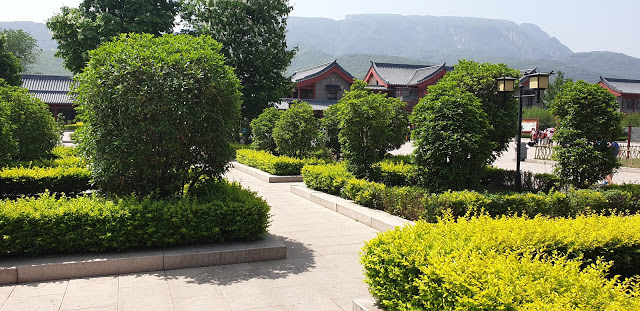
Searching for locations: From Zhengzhou to Suzhou by train, and the Snowy Sea Hotel, Suzhou, China

For the first time on this trip, we encounter problems with Chinese officialdom at the railway station, though we were warned that this might occur.

We had a major problem with the security staff when they pulled everyone over with aerosols and confiscated them. We lost styling mousse, others lost hair spray, and the men, their shaving cream.  But, to her credit, the tour guide did warn us they were stricter here, but her suggestion to be angry they were taking our stuff was probably not the right thing to do.

As with previous train bookings, the Chinese method of placing people in seats didn’t quite manage to keep couples traveling together, together on the train.  It was an odd peculiarity which few of the passengers understood, nor did they conform, swapping seat allocations.

This train ride did not seem the same as the last two and I don’t think we had the same type of high-speed train type that we had for the last two.  The carriages were different, there was only one toilet per carriage, and I don’t think we were going as fast.

But aside from that, we had 753 kilometers to travel with six stops before ours, two of which were very large cities, and then our stop, about four and a half hours later.  With two minutes this time, to get the baggage off the team managed it in 40 seconds, a new record.

After slight disorientation getting off the train, we locate our guide, easily found by looking for the Trip-A-Deal flag.  From there it’s a matter of getting into our respective groups and finding the bus.

As usual, the trip to the hotel was a long one, but we were traveling through a much brighter, and well lit, city.

As for our guide, we have him from now until the end of the tour.  There are no more train rides, we will be taking the bus from city to city until we reach Shanghai.  Good thing then that the bus is brand new, with that new car smell.  Only issue, no USB charging point.

The Snowy Sea hotel.  

It is finally a joy to get a room that is nothing short of great.  It has a bathroom and thus privacy.

Everyone had to go find a supermarket to purchase replacements for the confiscated items.  Luckily there was a huge supermarket just up from the hotel that had everything but the kitchen sink.

But, unlike where we live, the carpark is more of a scooter park!
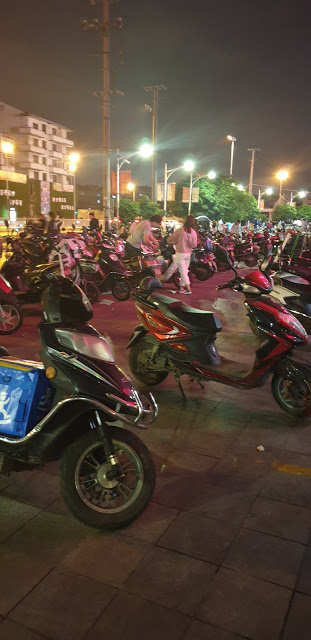
It is also a small microcosm of Chinese life for the new more capitalistic oriented Chinese.

The next morning we get some idea of the scope of high-density living, though here, the buildings are not 30 stories tall, but still just as impressive.
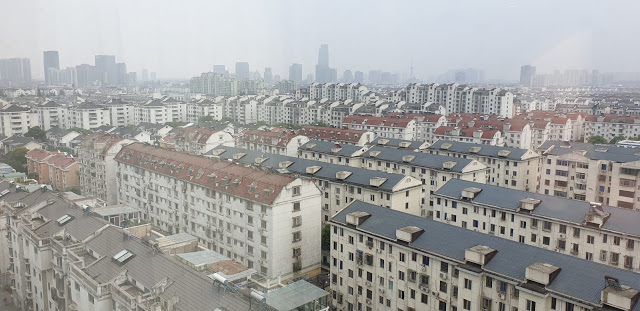
These look like the medium density houses, but to the right of these are much larger buildings

The remarkable thing about this is those buildings stretch as far as the eye can see.

Writing a book in 365 days – My Story 26

More about my story

Part two, if that’s what I’m going to call, it went from 46 pages to nearly 100.

Why.

The previous version didn’t have the reasons why, well, not exactly the reasons and what was behind the need to seek redress or take specific action.

So, I sat down and went through the six main protagonists.

Quinn, the one who has been sifting old records for blackmail material, finds it and puts it up for sale. There are three takers: Whitelaw, who needs it to destroy McConnell, FitzWalter, to retired sans scandal, and McConnell to get the goods on Whitelaw.

Thus,

Whitelaw, the one who seeks revenge on those who stopped him from fulfilling a dream.

FitzWalter, the one who ruined his own ambitions, but wanted to blame everyone else

Archibald, the one who reached the pinnacle, but has a bunch of warring minions to sort out

McConnell, the one who could never get his job done because of perceived wrongs that were caused by someone else.

Natasha, the fixer, the one who knew all of them bar McConnell, and also knows their innermost secrets.

Be that as it may, how does our main character fit into all of this?

That was the question I had to ask myself, because without a reason, why is there another part of this story?

You can’t just throw something out there and leave it hanging.

Willoughby was sent on a flawed operation, one of many, but in the end, it ultimately had the organisation shut down pending an investigation that was always going to have the same result. A permanent shutdown. 

He could have been out of a job, but was given a second chance. Was that second chance for a reason? So, here’s a premise: What if McConnell, seeing the writing on the wall, needs a scapegoat? He ropes Willoughby in for one last hurrah, the go-between between Quinn and himself.

 Before they get to the main dance, a reception to formally announce FitzWalters’ retirement, and in the backrooms, a deal for Quinn’s information, several of the protagonists show their hands, and it;’s not friendly.

And what usually happens at an auction where greed and murderous intent lurk?

Trouble.

Writing a book in 365 days – 185

Day 185

Let’s talk editing.

I’d rather not, but it’s a necessary part of the evolution of a story.

But, first, let’s get something quite clear right here, right now.  I will NEVER use AI to “improve” my writing.

My writing is my own.  It is me, imperfections and all.  I reluctantly allow a grammar checker to correct my work, but the reason is to address the offensive misuse of punctuation and outdated grammatical conventions based on age-old rules that AI can’t alter.

Because that’s the problem with AI.  It has its own set of rules and its own way of doing things, or more importantly, the creator’s way of doing things.

And it’s not simply because I watched Terminator and saw what could happen when machines get a mind of their own.

Or, sadly, the mind of the flawed human who created it.  I’ll let you ruminate on what could happen with AI created by the wrong people.  Of course, it opens a debate on who is or is not the wrong people, but that’s a topic for others to discuss.

So…

I write the story.

I re-read the story and make edits.

I re-read the story and made more edits.

I read the story and ensure that it reads properly and that there is continuity.  Names are correct. All people belong in the story, and their roles play out.

I have forgotten people before.

Then comes the spell checker, which shouldn’t find anything.

Then, the punctuation checker, which shouldn’t find anything.

Then the grammar checker, and this is the doozy.  There are usually between four and five hundred change requests, most quite simple and warranted, others a lot more complex and do not allow for writing style and people’s patterns of speech.

That takes the longest time to work through.

I actually run this checker a few times because it doesn’t pick everything up the first time.

Then, once that is done, I sent it off to the editor for one last read. 

Searching for locations: The Henan Museum, Zhengzhou, Henan Province, China

The Henan Museum is one of the oldest museums in China.  In June 1927, General Feng Yuxiang proposed that a museum be built, and it was completed the next year.  In 1961, along with the move of the provincial capital, Henan Museum moved from Kaifeng to Zhengzhou.

It currently holds about 130,000 individual pieces, more of which are mostly cultural relics, bronze vessels of the Shang and Zhou Dynasties, and pottery and porcelain wares of the various dynasties.

Eventually, we arrive at the museum and get off the bus adjacent to a scooter track and despite the efforts of the guide, there’s no stopping them from nearly running us over.

We arrive to find the museum has been moved to a different and somewhat smaller building nearby as the existing, and rather distinctively designed, building is being renovated.

While we are waiting for the tickets to enter, we are given another view of industrial life in that there is nothing that resembles proper health and safety on worksites in this country, and the workers are basically standing on what looks to be a flimsy bamboo ladder with nothing to stop them from falling off.

The museum itself has exhibits dating back a few thousand years and consist of bronze and ceramic items.  One of the highlights was a tortoiseshell with reportedly the oldest know writing ever found.

Other than that it was a series of cooking utensils, a table, and ceramic pots, some in very good condition considering their age.


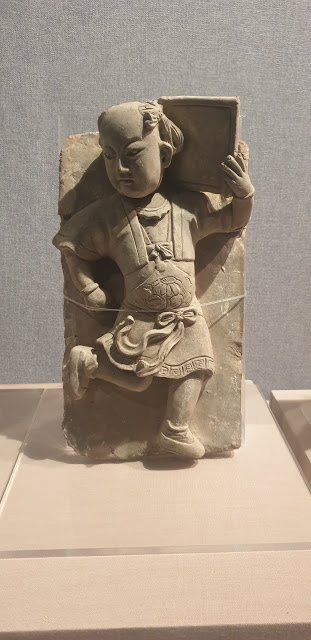
There were also small sculptures

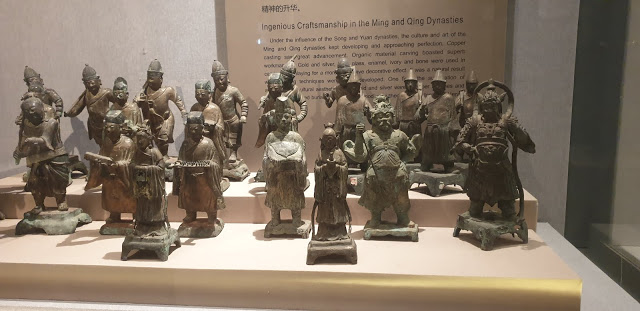
an array of small figures

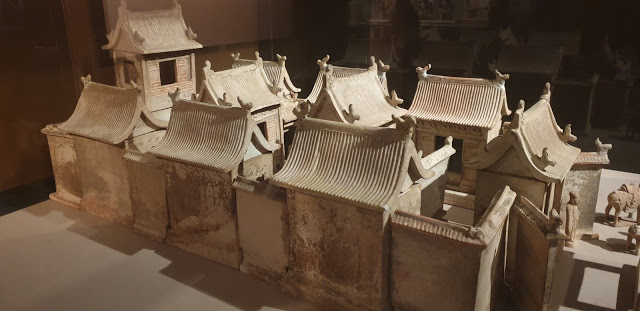
and a model of a settlement

20 minutes was long enough.

Writing a book in 365 days – 185

Day 185

Let’s talk editing.

I’d rather not, but it’s a necessary part of the evolution of a story.

But, first, let’s get something quite clear right here, right now.  I will NEVER use AI to “improve” my writing.

My writing is my own.  It is me, imperfections and all.  I reluctantly allow a grammar checker to correct my work, but the reason is to address the offensive misuse of punctuation and outdated grammatical conventions based on age-old rules that AI can’t alter.

Because that’s the problem with AI.  It has its own set of rules and its own way of doing things, or more importantly, the creator’s way of doing things.

And it’s not simply because I watched Terminator and saw what could happen when machines get a mind of their own.

Or, sadly, the mind of the flawed human who created it.  I’ll let you ruminate on what could happen with AI created by the wrong people.  Of course, it opens a debate on who is or is not the wrong people, but that’s a topic for others to discuss.

So…

I write the story.

I re-read the story and make edits.

I re-read the story and made more edits.

I read the story and ensure that it reads properly and that there is continuity.  Names are correct. All people belong in the story, and their roles play out.

I have forgotten people before.

Then comes the spell checker, which shouldn’t find anything.

Then, the punctuation checker, which shouldn’t find anything.

Then the grammar checker, and this is the doozy.  There are usually between four and five hundred change requests, most quite simple and warranted, others a lot more complex and do not allow for writing style and people’s patterns of speech.

That takes the longest time to work through.

I actually run this checker a few times because it doesn’t pick everything up the first time.

Then, once that is done, I sent it off to the editor for one last read. 

Writing a book in 365 days – 184

Day 184

My writing needs that outside world that is rich in characters, scenery, objects, and language. To sit at a table in an ordinary coffee shop is to observe the tapestries of life unfold before you.

Just the other night, I was sitting in a restaurant, rather pricey too, and it was packed. Had I not been a guest, would I have gone? Possibly, but at the prices for the menu items, as amazing as they sounded, it would have used up six months of my allowance for dining out.

It’s not the first time I have been to such a place, and I’ll be honest, I love these sorts of dining establishments, and the food, by and large, is absolutely delicious.

But there is another reason why these places hold such an interest for me. It’s the people who also go there, from those who can afford it to those who cannot, for those who want to impress, and for those who want to show they belong there, even though in a sense they do not.

In a sense, I did not belong, but in another, I know what is good and what is not, I know what goes with what, and I know that you don’t go there and look at the prices. You know there is not going to be any change out of a thousand dollars, and that’s before you look at a half-decent Cabernet.

But I can spot the people who don’t belong. I can see the people who do, but are not graceful with it, and I see the people who belong and are graceful and polite.

And then there are the people who pretend they belong and are just plain horrible. These are the people one often sees overseas who believe they are superior to those who live there. It’s something I can never understand.

But I digress…

Quite a few characters are borne out of my dining companions. Like the other night. The table across from me was attended by six university types, who looked to be lecturers, tutors, and family. There was the Queen Bee, the convenor, the one who sat while others deferred to her, and the hierarchy was very clear. She smiled, everyone relaxed, she perused the menu, everyone paused and deferred, the wine was her selection, where a suggestion was not to be debated, but a nod with ‘good choice’ was the response.

It simply made me glad I never have much to do with university types.

The table on the right side had three people who studied the menu intently. it was a dead giveaway that the cheap[est selections, which were not cheap, were the means by which they could say they dined there, and take the kudos from it.

They were polite, spoke quietly, enjoyed the food and the atmosphere, and were polite and accepted the very discreet assistance from the wait staff.

I suspect the wait staff have experienced all manner of diners, and we were lucky the more brash and annoying were not there that night.

Our waitress was French, with a voice that could melt ice, and had I been in a more flippant mood, I would have asked her to recite the menu in her native language. Naughty and probably annoying, I resisted the temptation. But I did ask questions about the food.

On the other side, there was a table of four, a birthday, which culminated in a very bad rendition of Happy Birthday, and the birthday girl looked somewhat embarrassed. It could have been a less enthusiastic rendition, but who does that on a birthday treat?

As it is an inner city restaurant, some of the clientele were people who lived in the nearby apartments, and a study of the menu meant that instead of spending a fortune in the supermarket, dining out could be affordable, and not have to cook every night. It was not the only restaurant in the precinct, and I guess there were enough that you could have a different type of meal every night for a month before you had to start again.

Certainly, by the time I left, I had at least another six character profiles I was going to use later in my stories. As well as the dining options, the wait staff, the wine types, and a few ideas about what I was going to try another time.

And the conversation? It’s always quite different when you’re eating and drinking in an expensive restaurant as distinct from when you go to McDonald’s. If you deign to go to McDonald’s.

Searching for locations: The Henan Museum, Zhengzhou, Henan Province, China

The Henan Museum is one of the oldest museums in China.  In June 1927, General Feng Yuxiang proposed that a museum be built, and it was completed the next year.  In 1961, along with the move of the provincial capital, Henan Museum moved from Kaifeng to Zhengzhou.

It currently holds about 130,000 individual pieces, more of which are mostly cultural relics, bronze vessels of the Shang and Zhou Dynasties, and pottery and porcelain wares of the various dynasties.

Eventually, we arrive at the museum and get off the bus adjacent to a scooter track and despite the efforts of the guide, there’s no stopping them from nearly running us over.

We arrive to find the museum has been moved to a different and somewhat smaller building nearby as the existing, and rather distinctively designed, building is being renovated.

While we are waiting for the tickets to enter, we are given another view of industrial life in that there is nothing that resembles proper health and safety on worksites in this country, and the workers are basically standing on what looks to be a flimsy bamboo ladder with nothing to stop them from falling off.

The museum itself has exhibits dating back a few thousand years and consist of bronze and ceramic items.  One of the highlights was a tortoiseshell with reportedly the oldest know writing ever found.

Other than that it was a series of cooking utensils, a table, and ceramic pots, some in very good condition considering their age.


There were also small sculptures

an array of small figures

and a model of a settlement

20 minutes was long enough.

Writing a book in 365 days – 184

Day 184

My writing needs that outside world that is rich in characters, scenery, objects, and language. To sit at a table in an ordinary coffee shop is to observe the tapestries of life unfold before you.

Just the other night, I was sitting in a restaurant, rather pricey too, and it was packed. Had I not been a guest, would I have gone? Possibly, but at the prices for the menu items, as amazing as they sounded, it would have used up six months of my allowance for dining out.

It’s not the first time I have been to such a place, and I’ll be honest, I love these sorts of dining establishments, and the food, by and large, is absolutely delicious.

But there is another reason why these places hold such an interest for me. It’s the people who also go there, from those who can afford it to those who cannot, for those who want to impress, and for those who want to show they belong there, even though in a sense they do not.

In a sense, I did not belong, but in another, I know what is good and what is not, I know what goes with what, and I know that you don’t go there and look at the prices. You know there is not going to be any change out of a thousand dollars, and that’s before you look at a half-decent Cabernet.

But I can spot the people who don’t belong. I can see the people who do, but are not graceful with it, and I see the people who belong and are graceful and polite.

And then there are the people who pretend they belong and are just plain horrible. These are the people one often sees overseas who believe they are superior to those who live there. It’s something I can never understand.

But I digress…

Quite a few characters are borne out of my dining companions. Like the other night. The table across from me was attended by six university types, who looked to be lecturers, tutors, and family. There was the Queen Bee, the convenor, the one who sat while others deferred to her, and the hierarchy was very clear. She smiled, everyone relaxed, she perused the menu, everyone paused and deferred, the wine was her selection, where a suggestion was not to be debated, but a nod with ‘good choice’ was the response.

It simply made me glad I never have much to do with university types.

The table on the right side had three people who studied the menu intently. it was a dead giveaway that the cheap[est selections, which were not cheap, were the means by which they could say they dined there, and take the kudos from it.

They were polite, spoke quietly, enjoyed the food and the atmosphere, and were polite and accepted the very discreet assistance from the wait staff.

I suspect the wait staff have experienced all manner of diners, and we were lucky the more brash and annoying were not there that night.

Our waitress was French, with a voice that could melt ice, and had I been in a more flippant mood, I would have asked her to recite the menu in her native language. Naughty and probably annoying, I resisted the temptation. But I did ask questions about the food.

On the other side, there was a table of four, a birthday, which culminated in a very bad rendition of Happy Birthday, and the birthday girl looked somewhat embarrassed. It could have been a less enthusiastic rendition, but who does that on a birthday treat?

As it is an inner city restaurant, some of the clientele were people who lived in the nearby apartments, and a study of the menu meant that instead of spending a fortune in the supermarket, dining out could be affordable, and not have to cook every night. It was not the only restaurant in the precinct, and I guess there were enough that you could have a different type of meal every night for a month before you had to start again.

Certainly, by the time I left, I had at least another six character profiles I was going to use later in my stories. As well as the dining options, the wait staff, the wine types, and a few ideas about what I was going to try another time.

And the conversation? It’s always quite different when you’re eating and drinking in an expensive restaurant as distinct from when you go to McDonald’s. If you deign to go to McDonald’s.

Writing a book in 365 days – 183

Day 183

Poetry – or my thoughts on it

I have often wondered what the interest in poetry is because I have read those same poems that people wax lyrical about, and it just doesn’t have the same effect.

But…

Then I did some digging…

Poetry requires words written in lines for a specified number of lines about almost anything.

Two, three, four, five lines, and more.

Words that rhyme, words that do not, there are rules and types, and then there is not.

It encompasses anything and everything. It can read at a fast or slow pace, professing undying love or utter hatred, and can describe something familiarly or make the familiar sound like something else.

Objects become feelings, and feelings become objects.

Some poets are famous; there are poets we like and poets we hate.  Some poets are just there.  There are poets we should read and poets we shouldn’t, though why is anyone’s guess.

There are poets we know, not because we have read them but because they are in the collective consciousness, poets like Burns, W B Yeats, Walter Whitman, Shakespeare, and Emily Dickinson.

I even know them because people who are in the TV shows and movies are always reciting them.

Perhaps I appreciate poetry more than I care to admit.

In writing this and taking a deep dive into the world of poems and what it is all about, I have come across some rather meaningful poetry.

Perhaps I might find one that encapsulated my life and ask for it to be read at my funeral.  At the very least, the attendees will be utterly surprised. 

Searching for locations: The Pagoda Forest, near Zhengzhou City, Henan Province, China

The pagoda forest

After another exhausting walk, by now the heat was beginning to take its toll on everyone, we arrived at the pagoda forest.

A little history first:

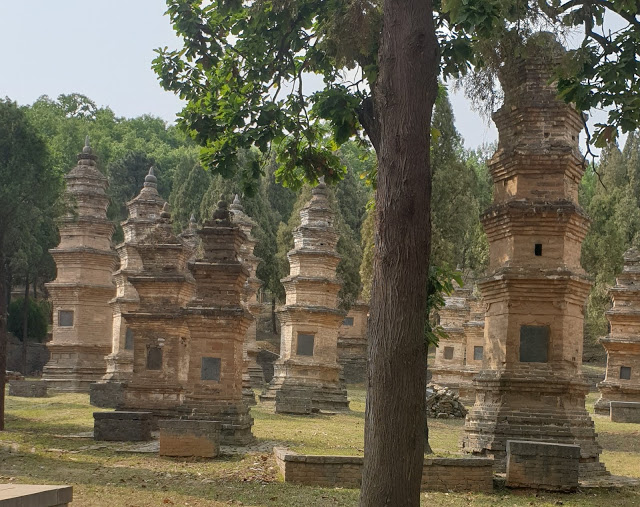
The pagoda forest is located west of the Shaolin Temple and the foot of a hill.  As the largest pagoda forest in China, it covers approximately 20,000 square meters and has about 230 pagodas build from the Tang Dynasty (618-907) to the Qing Dynasty (1644-1911).

Each pagoda is the tomb of an eminent monk from the Shaolin Temple.  Graceful and exquisite, they belong to different eras and constructed in different styles.  The first pagoda was thought to be built in 791.

It is now a world heritage site.

No, it’s not a forest with trees it’s a collection of over 200 pagodas, each a tribute to a head monk at the temple and it goes back a long time.  The tribute can have one, three, five, or a maximum of seven layers.  The ashes of the individual are buried under the base of the pagoda.

The size, height, and story of the pagoda indicate its accomplishments, prestige, merits, and virtues. Each pagoda was carved with the exact date of construction and brief inscriptions and has its own style with various shapes such as a polygonal, cylindrical, vase, conical and monolithic.

This is one of the more recently constructed pagodas

There are pagodas for eminent foreign monks also in the forest.

From there we get a ride back on the back of a large electric wagon

to the front entrance courtyard where drinks and ice creams can be bought, and a visit to the all-important happy place.

Then it’s back to the hotel.