When products are rushed to market

If it was a car, or plane, or something else, it would have the consumer protection agencies up in arms, but because we are in the middle of a pandemic, still, it seems anything goes.

But let’s be very clear about one very important point, I am not an anti vaxxer, nor do I think vaccines, and particularly those that save lives of potential Covid victims, should be ignored.

If anything, if a vaccine is available, take it.  The evidence overwhelmingly suggests it will save your life.

My commentary is mostly about the side effects, and the long term efficacy, and particularly in relation my own case.

I’m not a doctor, but I can read, and have a modicum of understanding statistics, and if the data we are being given is correct, there is a small area of concern for an even smaller percentage of the population.

Firstly, I don’t believe the vaccines have been properly, or sufficiently tested on people like me.  I can understand why the drug companies wouldn’t because if a large percentage of us were adversely affected, it would affect credibility.

Instead, there are ‘recommendations’, and in my case, it is to have the Astra Venica vaccine simply because I’m over 65.  Personally if anything can go wrong with me, it will, so I figure I’ll get the Phizer vaccine, only my age group cannot have it.

It’s for those under 65.

But even that’s not my real concern.

What bothers me is the number of Governments and people who believe once a certain percentage of the population is vaccinated, everything will go back to normal.

The evidence we are reading every day proves otherwise.

Vaccinated or not, you can carry the virus and pass it on. Sure, at the moment, if you are vaccinated, you should not be hospitalised, but even that does not seem to be the case. Vaccinated people are also getting very ill, and worse, dying.

Is it because they have not had it for long enough to build up an immunity, or is it because, and I heard this report the other day, because the vaccine does not stir up a immune response in certain people, and therefore leaves them vulnerable.

Or is it happening to those who’ve had the vaccine for over six months and it’s effectiveness is waning, hence the release of the news that drug companies are working on booster shots.

Or is it simply the case that everyone conveniently forgot to mention that viruses evolve, and only get worse, more intense, and more resistant to the anti viral vaccines over time. Look at our current anti biotic delimma where they are all but useless for certain bugs.

Someone said we pulled off a miracle creating a vaccine in such a short time, but that vaccine was for early versions of the virus. As the virus evolves, and why real vaccines take years to develop is the fact they have time to observe these changes and incorporate the remedy.

In this case we are playing catchup, and by the number of cases and outbreaks all over the world, we are losing the battle.

I’ll be getting the vaccine, my choice not theirs, when it’s available, but I fear that is not going to be enough.

I don’t know much about the Greek alphabet, but I do know Delta is bad. What then will be the situation by the time we reach Omega.

I earnestly suggest you do not watch the Charlton Heston movie version of ‘The Omega Man’. But if you wait long enough, it might just come true.
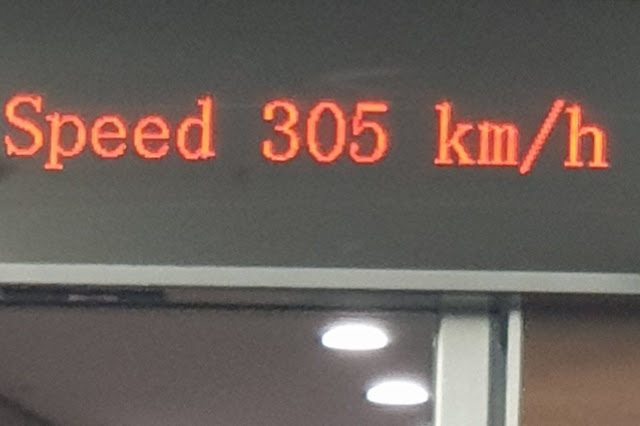
Searching for locations: From X’ian to Zhengzhou dong by bullet train, China

Lunch and then off on another high-speed train

We walked another umpteen miles from the exhibition to a Chinese restaurant that is going to serve us Chinese food again with a beer and a rather potent pomegranate wine that has a real kick.  It was definitely value for money at 60 yuan per person.

But perhaps the biggest thrill, if it could be called that, was discovering downstairs, the man who discovered the original pieces of a terracotta soldier when digging a well.  He was signing books bought in the souvenir store, but not those that had been bought elsewhere.

Some of is even got photographed with him.  Fifteen minutes of fame moment?  Maybe.

After lunch, it was off to the station for another high-speed train ride, this time for about two and a half hours, from X’ian to Zhangzhou dong.

It’s the standard high-speed train ride and the usual seat switching because of weird allocation issues, so a little confusion reigns until the train departs at 5:59.

Once we were underway it didn’t take long before we hit the maximum speed

Twenty minutes before arrival, and knowing we only have three minutes to get off everyone is heading for the exit clogging up the passageway.  It wasn’t panic but with the three-minute limit, perhaps organized panic would be a better description.

As it turned out, with all the cases near the door, the moment to door opened one of our group got off, and the other just started putting cases on the platform, and in doing so we were all off in 42 seconds with time to spare.

And this was despite the fact there were about twenty passengers just about up against the door trying to get in.  I don’t think they expected to have cases flying off the train in their direction.

We find our way to the exit and our tour guide Dannie.  It was another long walk to the bus, somewhat shabbier from the previous day, no leg room, no pocket, no USB charging point like the day before.  Disappointing.

On the way from the station to the hotel, the tour guide usually gives us a short spiel on the next day’s activities, but instead, I think we got her life history and a song, delivered in high pitched and rapid Chinglish that was hard to understand.

Not at this hour of the night to an almost exhausted busload of people who’d had enough from the train.  Oh, did I forgot the singing, no, it was an interesting rendition of ‘you are my sunshine’.

The drive was interesting in that it mostly in the dark.  There was no street lighting and in comparison to X’ian which was very bright and cheerful, this was dark and gloomy.

Then close to the hotel our guide said that if we had any problems with the room, she would be in the lobby for half an hour.

That spoke volumes about the hotel they put us in.

Searching for locations: West Lake, Hangzhou, China

West Lake is a freshwater lake in Hangzhou, China. It is divided into five sections by three causeways. There are numerous temples, pagodas, gardens, and artificial islands within the lake.

Measuring 3.2 kilometers (2 miles) in length, 2.8 kilometers (1.7 miles) in width, and 2.3 meters (7.5 feet) in average depth, the lake spreads itself in an area totaling 6.5 square kilometers (2.5 square miles).

The earliest recorded name for West Lake was the “Wu Forest River”, but over time it changed to two distinct names.  One is “Qiantang Lake”, due to the fact that Hangzhou was called “Qiantang” in ancient times.  The other, “West Lake”, due to the lake being west of the city

It’s about to get busy, with a number of activities planned, and the warmth of the day is starting to make an impact.

The tour starts in the car park about a kilometer away, but the moment we left the car park we were getting a taste of the park walking along a tree-lined avenue.
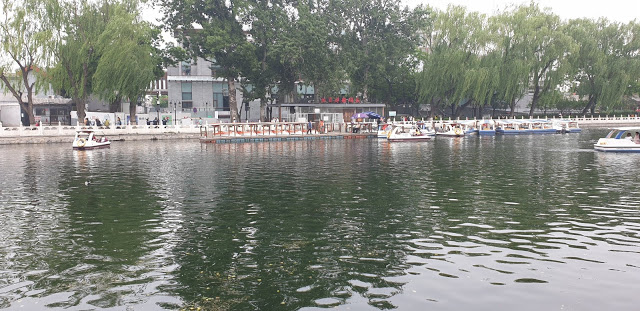
When we cross the road, once again dicing with death with the silent assassins on motor scooters.

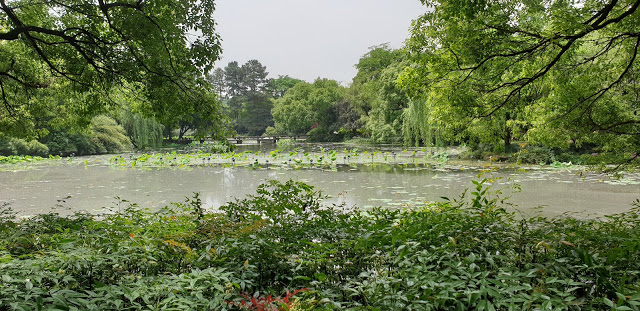
We are in the park proper, and it is magnificent, with flowers, mostly at the start hydrangeas and then any number of other trees and shrubs, some carved into other flower shapes like a lotus.

Then there was the lake and the backdrop of bridges and walkways.

.

And if you can tune out the background white noise the place would be great for serenity and relaxation.

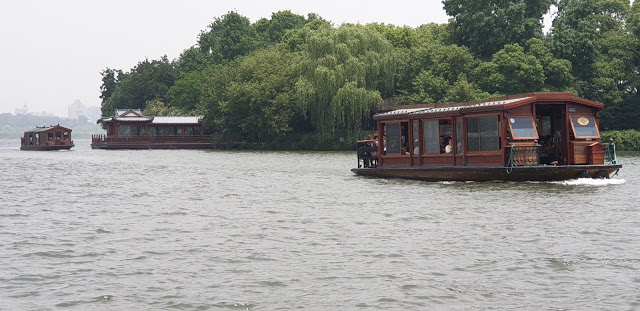
That, in fact, was how the boat ride panned out, about half an hour or more gliding across the lake in an almost silent boat, by an open window, with the air and the majestic scenery.

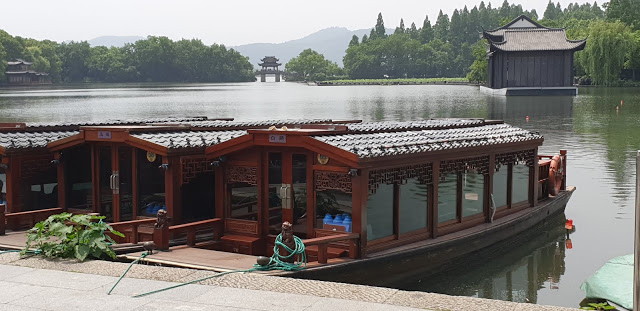
No, not that boat, which would be great to have lunch on while cruising, but the boat below:

Not quite in the same class, but all the same, very easy to tune out and soak it in.

It was peaceful, amazingly quiet, on a summery day

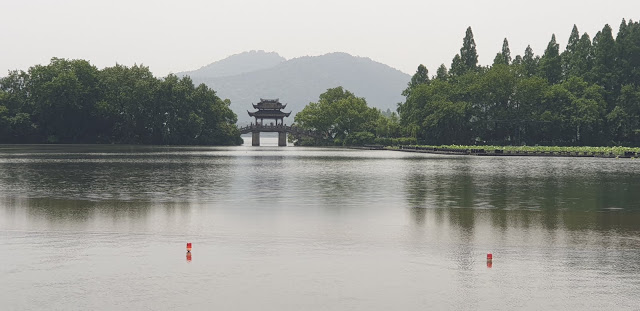
A pagoda in the hazy distance, an island we were about to circumnavigate.

Of all the legends, the most touching one is the love story between Bai Suzhen and Xu Xi’an. Bai Suzhen was a white snake spirit and Xu Xi’an was a mortal man.

They fell in love when they first met on a boat on the West Lake, and got married very soon after.

However, the evil monk Fa Hai attempted to separate the couple by imprisoning Xu Xi’an. Bai Suzhen fought against Fa Hai and tried her best to rescue her husband, but she failed and was imprisoned under the Leifeng Pagoda by the lake.

Years later the couple was rescued by Xiao Qing, the sister of Baisuzhen, and from then on, Bai Suzhen and Xu Xi’an lived together happily.

The retelling of the story varied between tour guides, and on the cruise boat, we had two.  Our guide kept to the legend, the other tour guide had a different ending.

Suffice to say it had relevance to the two pagodas on the far side of the lake.

There was a cafe or restaurant on the island, but that was not our lunch destination.

Nor were the buildings further along from where we disembarked.

All in all the whole cruise took about 45 minutes and was an interesting break from the hectic nature of the tour.

Oh yes, and the boat captain had postcards for sale.  We didn’t buy any.

Lunch

At the disembarkation point there was a mall that sold souvenirs and had a few ‘fast food’ shops, and a KFC, not exactly what we came to China for, but it seemed like the only place in town a food cautious Australian could eat at.

And when tried to get in the door, that’s where at least 3 busloads were, if they were not in the local Starbucks.  Apparently, these were the places of first choice wherever we went.

The chicken supply by the time we got to the head of the line amounted to pieces at 22.5 RMB a piece and nuggets.  Everything else had run out, and for me, there were only 5 pieces left.  Good thing there were chips.

And Starbucks with coffee and cheesecake.

At least the setting for what could have been a picnic lunch was idyllic.

Searching for locations: The Lingering Gardens, Suzhou, China

The Lingering Garden

These gardens are very tightly put together and are interspersed with buildings that you can go in and look at as distinct from just looking in from the outside.

There are lots of paths that wind around interspersed with rocks which may or may not be sculpted, and equally interspersed with trees, bushes, and small plants.  In the middle is a lake which usually has lotus plants in bloom, but they are not in season.

The gardens were built around a small lake that was filled with fish of all sizes and colours

The buildings were also a contrast for those built for the men

and those for the women

In the middle of the garden was a significant rock pillar

surrounded by certain areas of the garden that had smaller rock formations


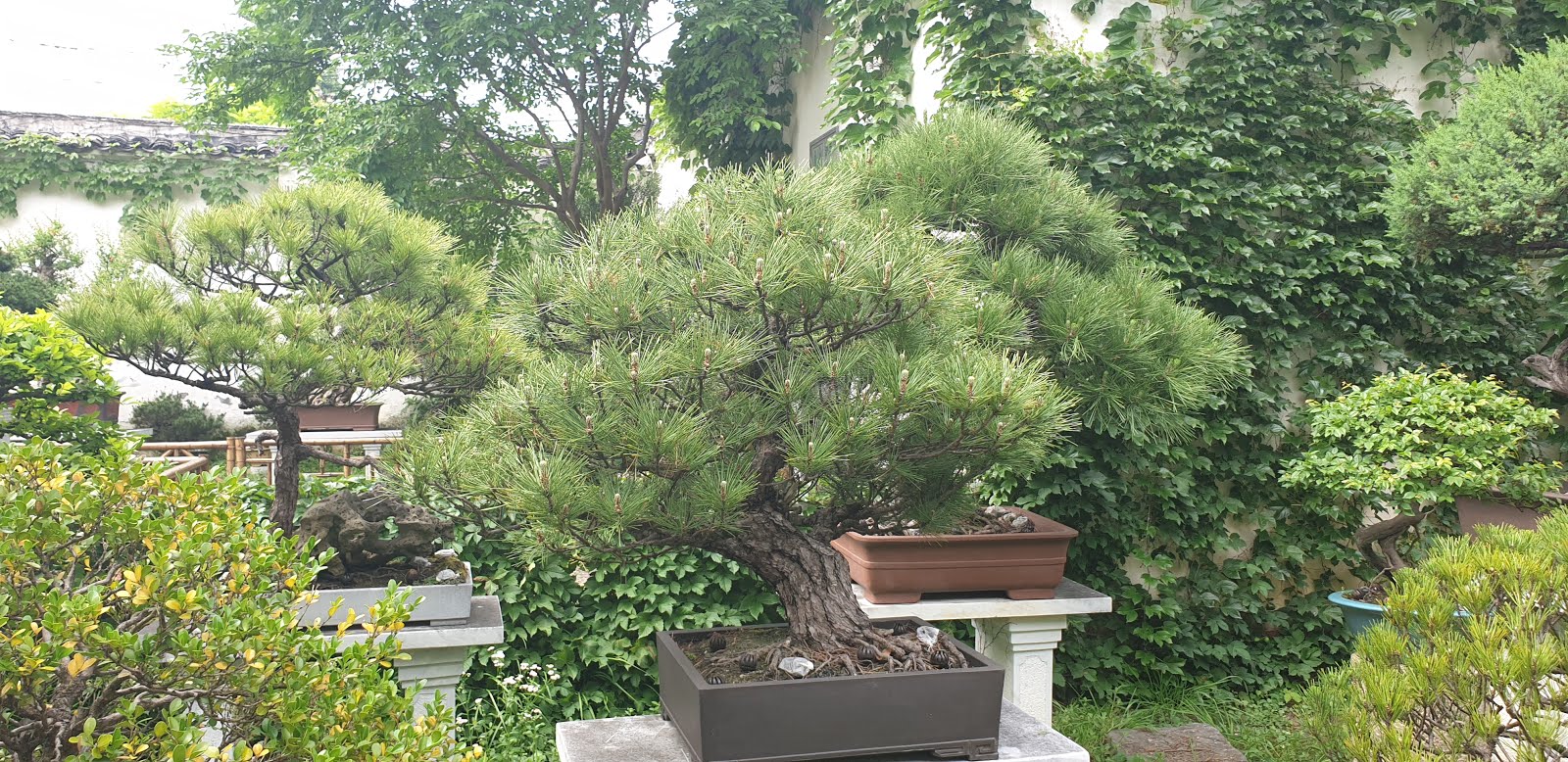
At the end of the garden is a large collection of bonsai trees, some of which are quite exquisite.

Figures of speech

I found this explanation on the internet: ‘a word or phrase used in a non-literal sense for rhetorical or vivid effect.’

We as writers should not use these in our writing because most people might not understand their use.  I think it sometimes adds a degree of whimsy to the story.

I remember some years ago when I working with a Russian chap who’d not been in the country very long, and though he had a reasonable use of English, it was not quite up with our figures of speech.

And made me realize when he kept asking me what they meant, just how many I used in everyday use.

Most of these figures of speech use descriptions that do not necessarily match the word being described, such as ‘I dance like I have two left feet’.

And that pretty much sums up how good I can dance.  But …

‘Like a bat out of hell’, not sure how this got into the vernacular

‘Like a bull in a china shop’, describes a toddler let loose, no, you had the securely in their pram but somehow they got loose while you weren’t looking

‘More front than Myers’, as my mother used to say, but in context, Myers is the Australian version of the English Selfridges or Harrods or Paris Galleries Lafayette.  It refers to the width of street frontage of the stores, which in fact stretched for a whole block

‘As mad as a hatter’, though not necessarily of the millinery kind, but, well, you can guess, it’s from Alice in Wonderland

‘As nutty as a fruitcake’, provided your fruitcake has nuts in it

And, ‘I haven’t heard from him in donkey’s years’ which means you haven’t heard from someone for a long time, or perhaps as long as it takes donkey’s ears to fully grow.

Yes, someone made a minor adjustment and added a y to ears, because it used to be ‘donkey’s ears’, believe it or not.

You can see, if you get the references, they are somewhat apt, and, yes, they sometimes creep into my stories.


In a word: Piece

Aside from the fact that it really means part of something else, we’ve got to remember that it is one of those ‘i before e except after c’ things.

I have a piece of the puzzle.  Well, maybe not.  You know what it’s like when you’re assembling a 1,000 piece jigsaw puzzle.  Yes, you get to the end and one piece is missing.

You’re so angry you want to give someone a piece of your mind.

Just remember not to give too many people pieces or you will become mindless.

We might be listening to a musical piece, which can be a movement, I think, in a symphony

Or we might piece together the parts of a child’s toy, especially on that night before Christmas when everything can and will go wrong.  I’ve been there and done that far too many times.

I’ve been known to move a chess piece incorrectly, no, come think of it, I’m always doing that

Some people call a gun a piece.

This is not to be confused with the word peace, which means something else, and hopefully, everyone will put away their pieces (guns) and declare peace.

And, every Sunday, at the church, there’s always an opportunity to say to the people around you ‘peace be with you’.

I wonder if that works very well if the person standing next to you is your enemy?

Searching for locations: The canals of Suzhou, China

This morning is a boat ride that will take us along a small portion of the main canal, and we head through a number of back streets, to a landing where there are a number of boats all vying with each other to get us passengers on boats.

But…

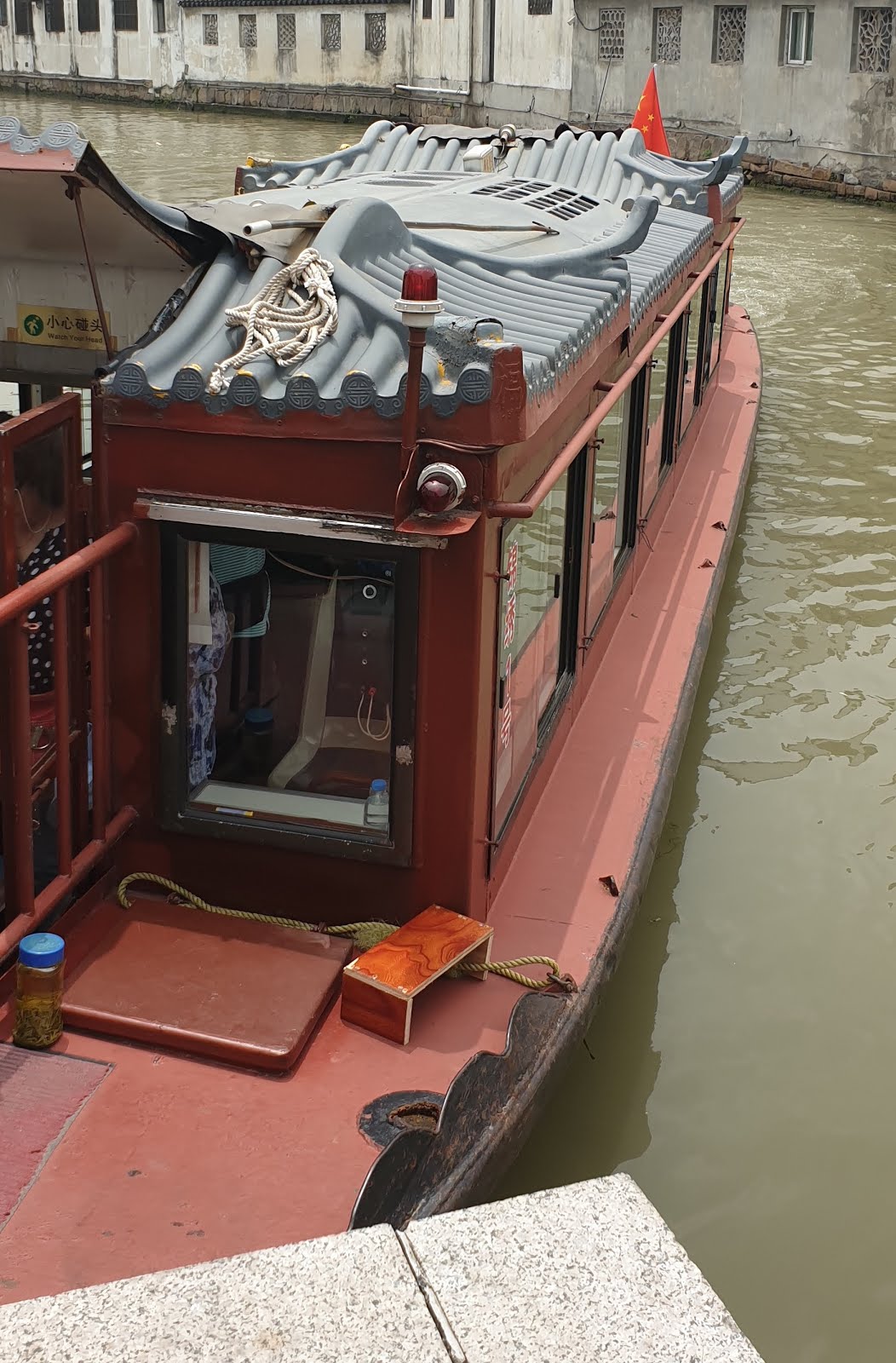
These boats don’t have a wharf to tie up to and then put out a stable gangplank.  No.  They just more into a concrete step and you take your life in your hands getting on.  One wrong step and you’re in the canal.  And not a very clean one at that.

That’s if another boat doesn’t come along and bumps you, knocking you off balance.  We managed not to lose anyone in boarding the vessel.

This is where we get on the boat

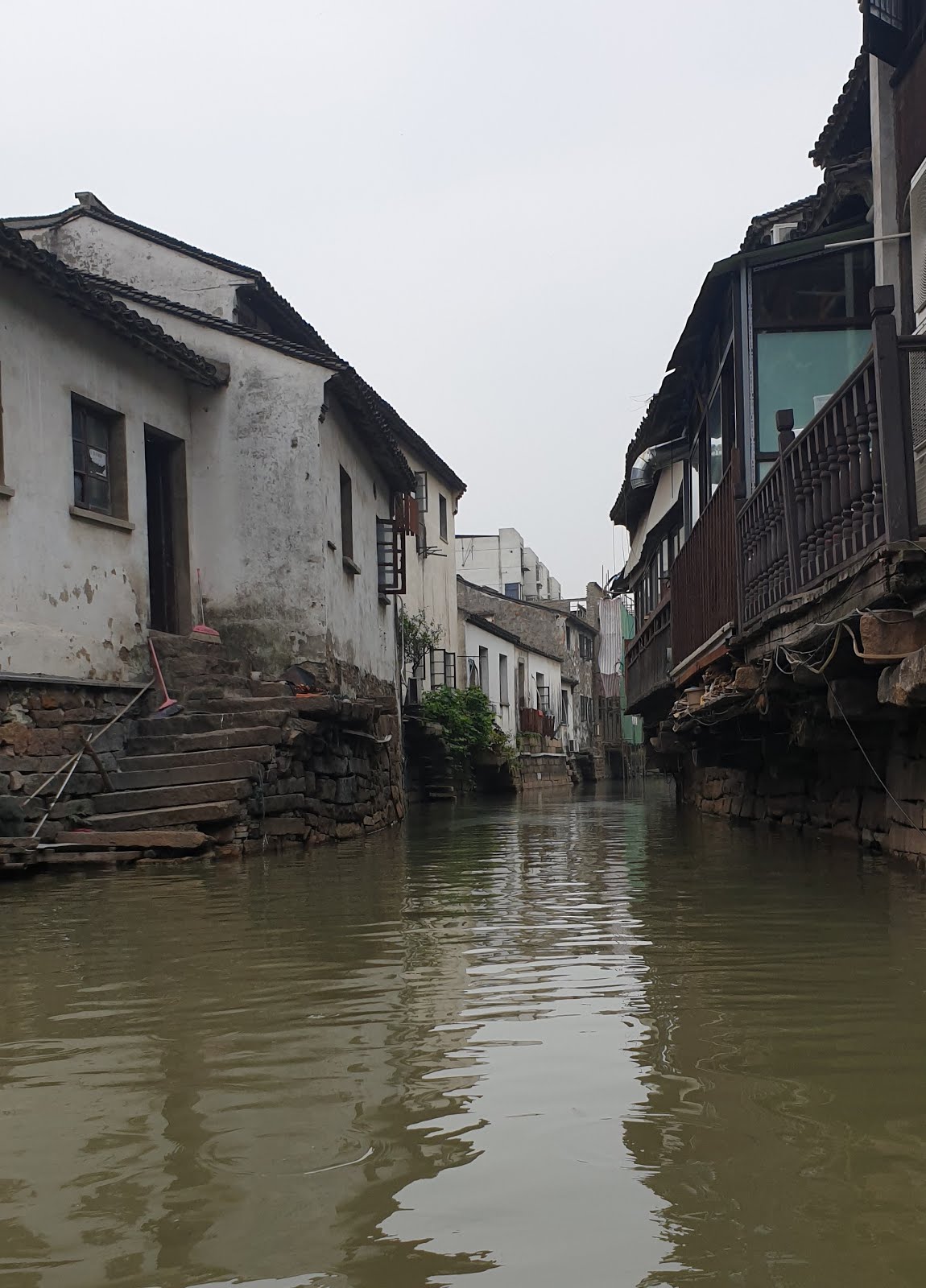
We go along what appears to be downstream towards another larger canal, past tree-lined streets until the canal narrows and we’re looking at the backs of houses, which look very dilapidated.

And the canals?  Well, it’s not quite like it is in Venice

Though some parts of the canal look better than others

What doesn’t bear thinking about is the electrical wiring which is a nightmarish spider web of cables going off in all directions.  How anyone could troubleshoot problems is beyond me.

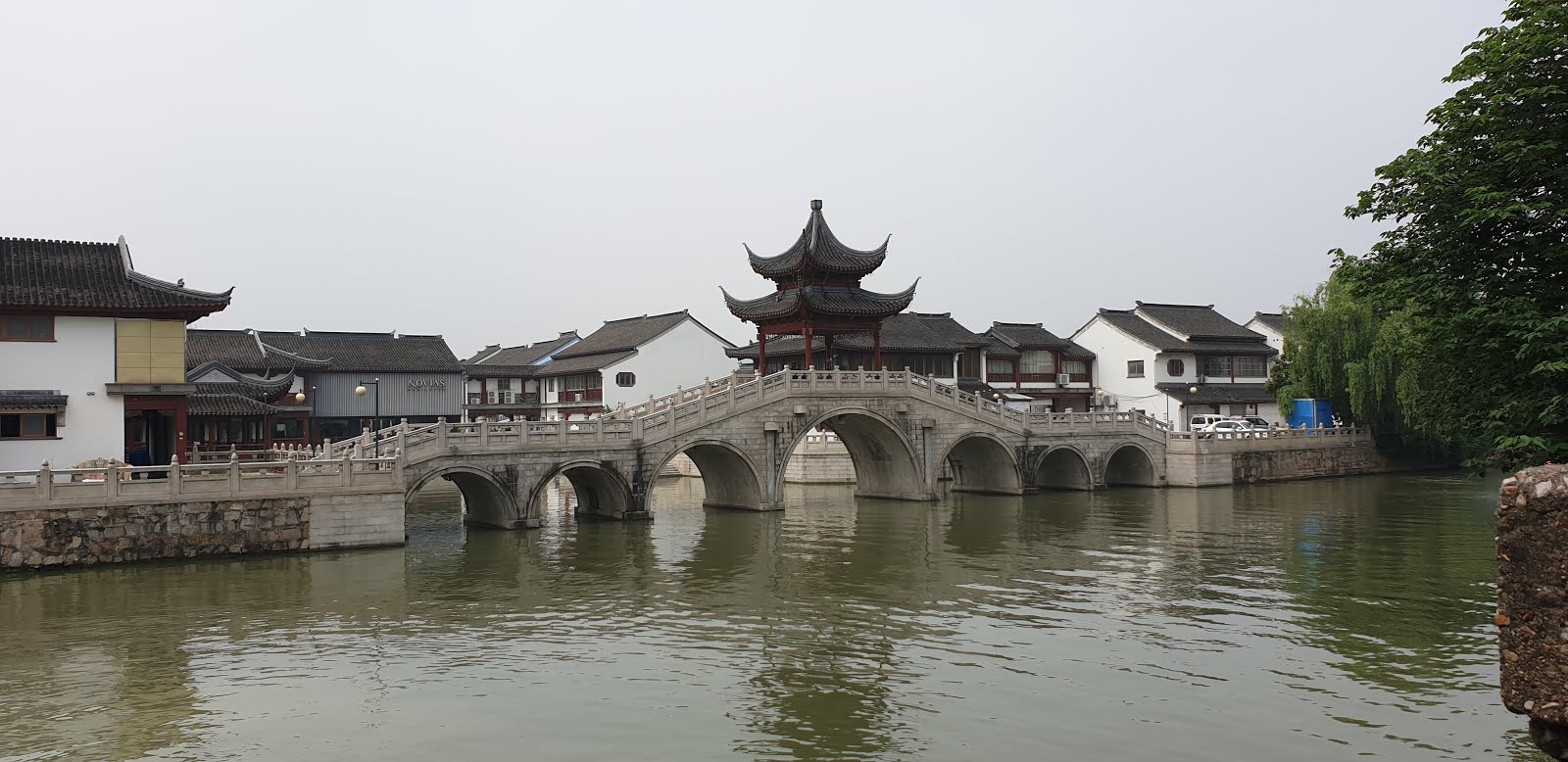
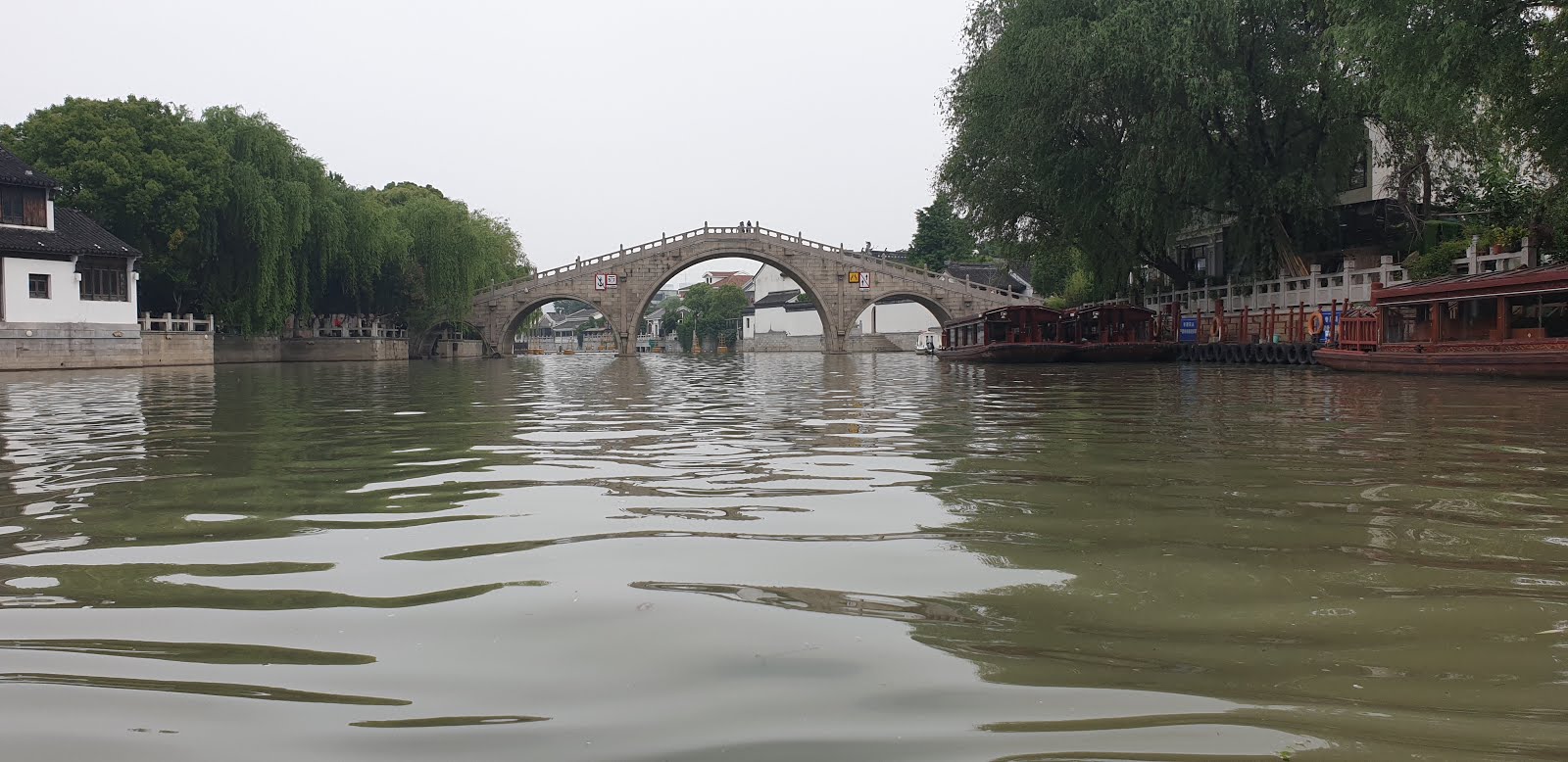
We pass under a number of bridges, and then, about 30 minutes after leaving, we reach a larger canal and do a 180-degree turn, and head back to a drop off point the will enable us to walk through a typical everyday Chinese market for food and the other items.

This drop off point is much the same as the starting point, a concrete step which is as hazardous as the first.  At least we don’t have to compete with other boats for the landing spot.

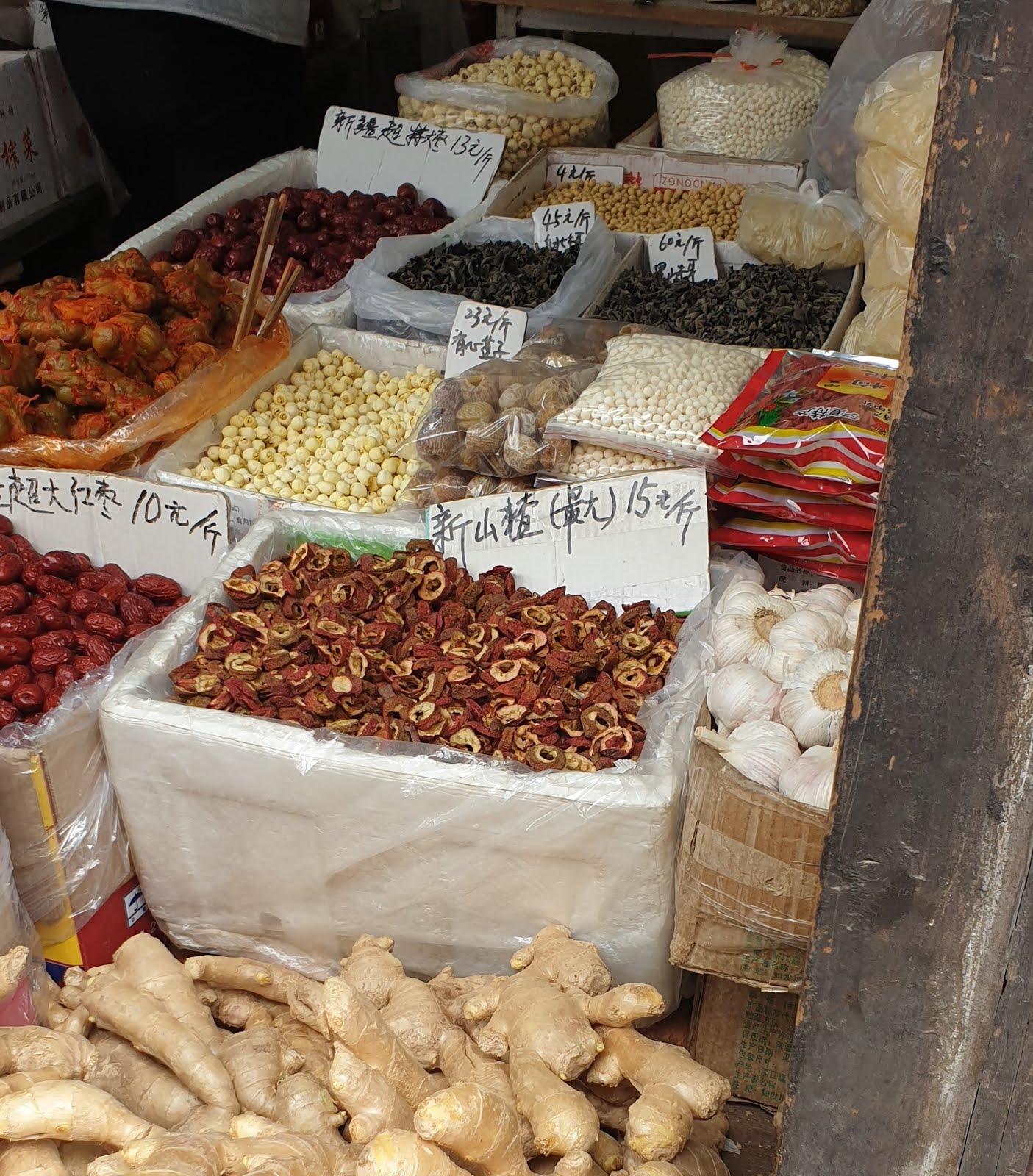
We take a leisurely stroll down a small section of Pingjiang Road with small shops on either side, selling all manner of goods

but my interest is in the food and the prices, which at times seem quite expensive for so-called local people, so maybe because the tourists go down this street every day, the prices have been inflated accordingly.

I find it rather disappointing.

We walk to the bridge, go under to the other side crossing the canal and find the coffee shop which is also the meeting place.

So…

When is a coffee shop not a coffee shop, when it takes an eternity to make a cup of coffee, we waited 25 minutes?

We also ordered beef black pepper rice and it took 20 minutes before it arrived, but it was well worth the wait.  Strands of perfectly cooked beef with onion, carrot, and capsicum, with a very peppery and spicy sauce, with a side of boiled rice.

A pizza was ordered too but it did not arrive at all before we left.

Searching for locations: Hutongs, Beijing, China

What are Hutongs?

In Beijing Hutongs are formed by lines of traditional courtyard residences, called siheyuan.  Neighborhoods were formed by joining many hutongs together. These siheyuan are the traditional residences, usually occupied by a single or extended family, signifying wealth, and prosperity. 

Over 500 of these still exist.Many of these hutongs have been demolished, but recently they have become protected places as a means of preserving some Chinese cultural history.  They were first established in the Yuan Dynasty (1279-1368)Many of these Hutongs had their main buildings and gates built facing south, and lanes connecting them to other hutongs also ran north to south.

Many hutongs, some several hundred years old, in the vicinity of the Bell Tower and Drum Tower and Shichahai Lake are preserved and abound with tourists, many of which tour the quarter in pedicabs.

The optional tour also includes a visit to Shichahai, a historic scenic area consisting of three lakes (Qianhai, meaning Front Sea; Houhai, meaning Back Sea and Xihai, meaning West Sea), surrounding places of historic interest and scenic beauty and remnants of old-style local residences, Hutong and Courtyard.  

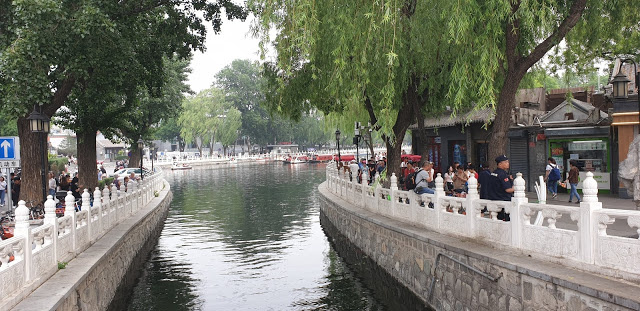
First, we had a short walk through the more modern part of the Hutong area and given some free time for shopping, but we prefer just to meander by the canal.  

There is a lake, and if we had the time, there were boats you could take.

With some time to spare, we take a quick walk down one of the alleyways where on the ground level are small shops, and above, living quarters.

Then we go to the bell and drum towers before walking through some more alleys was to where the rickshaws were waiting.
The Bell tower

And the Drum tower. Both still working today.

The rickshaw ride took us through some more back streets where it was clear renovations were being made so that the area could apply for world heritage listing.  Seeing inside some of the houses shows that they may look dumpy outside but that’s not the case inside.

The rickshaw ride ends outside the house where dinner will be served, and is a not so typical hose but does have all the elements of how the Chinese live, the boy’s room, the girl’s room, the parent’s room, the living area, and the North-south feng shui.

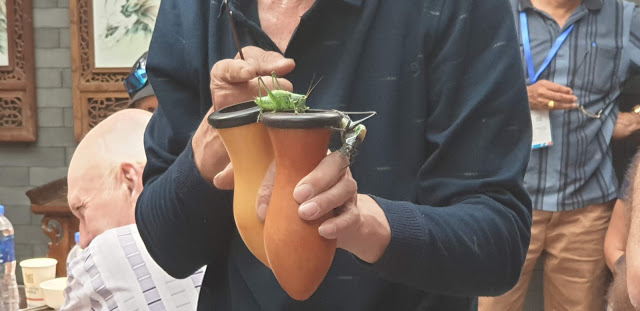
Shortly after we arrive, the cricket man, apparently someone quite famous in Beijing arrives and tells us all about crickets and then grasshoppers, then about cricket racing.  He is animated and clearly enjoys entertaining us westerners.

I’m sorry but the cricket stuff just didn’t interest me.  Or the grasshoppers.

As for dinner, it was finally a treat to eat what the typical Chinese family eats, and everything was delicious, and the endless beer was a nice touch.

And the last surprise, the food was cooked by a man.

Searching for locations: Terracotta Warriors and Horses Museum, X’ian, China

Terracotta Warriors and Horses Museum

A little history, and anecdotal advice first:

In 1974 a 26-year-old farmer, Yang Jide, was drilling a well and found fragments of the terracotta soldiers and bronze weapons.

What was discovered later was one of the biggest attended burial pits of China’s first feudal Emperor, Qin Shi Huang.  In the following years remains had been found in 3 pits, yielding at least 8,000 soldiers and horses, and over 100 chariots.  The soldiers were infantry, cavalry, and others.

Emperor Qin was born in 259 BC and died in 210 BC.  He began building a mausoleum for himself at the foot of Mount Li when he was 13.  Construction took 38 years, from 247 BC to 208 BC.  It was divided into 3 stages and involved 720,000 conscripts.

The pits of pottery figures are 1.5 km east of Emperor Qin’s mausoleum.  Pit 1 has about 6,000 terracotta armored warriors and horses and 40 wooden chariots.  Pit 2 is estimated to have over 900 terracotta warriors and 350 terracotta horses with about 90 wooden chariots.  Pit 3 had so far yielded only 66 pottery figures and one chariot drawn by four horses.

Official records say it was discovered later that it was likely Xiang Yu, a rebel, intentionally damaged the Mausoleum and the soldiers in the pits, by setting fire to the wooden roof rafters, and these fell on and broke the warriors into pieces.

However, we were told that after the terracotta warriors were completed, the Emperor ordered the builders to be killed so that they would not tell anyone about the warriors, and then of those that remained alive deliberately smashed all of the artifacts.

The thing is, all of the terracotta figures that have been found are in pieces, and they need computers to piece them back together again.

The visit:
The first impression is the size of the car park and the number of buses parked in the lot, and a hell of a lot more outside up the road an off on side streets.  Obviously, it costs money to park in the parking lot.

The other first impressions; the numbers waiting to get in were not as many as yesterday outside the forbidden city, in fact, a lot less.

Be warned there’s a long walk from the entrance gate where your bags are scanned and a body scan as well, before admittance.  This walk is through a landscaped area which it is expect might sometime in the future reveal more soldiers, or other artifacts.

At the end of the walk that takes about ten minutes, you can get a one-way ride to the second checkpoint, but we opted not to as no one else in our group did.

That walk is the warm-up exercise to an organized viewing of the exhibits after going through a second ticket checkpoint.  On the other side, we had to hand our tickets back to the tour guide which was disappointing not to end up with a memento of actually having been there.

So, on the other side in the courtyard, the guide told us the most important parts of the exhibition, that we should spend most of the time looking at pit 1, and then spent a little time in 2 which is only there in the first stages of excavation.  Then move onto the museum if only to see the replica chariots.

We do.

The chariots were small but interesting

The horses were better and intricately detailed

These are soldiers, perhaps complete examples of those types found in the end pit.

This is one of the archers.  You can tell by the way he wears his hair.

Pit 2

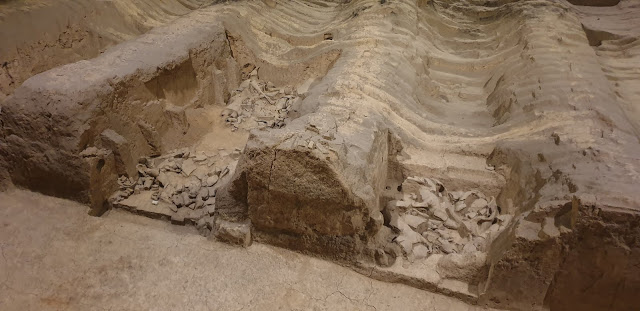
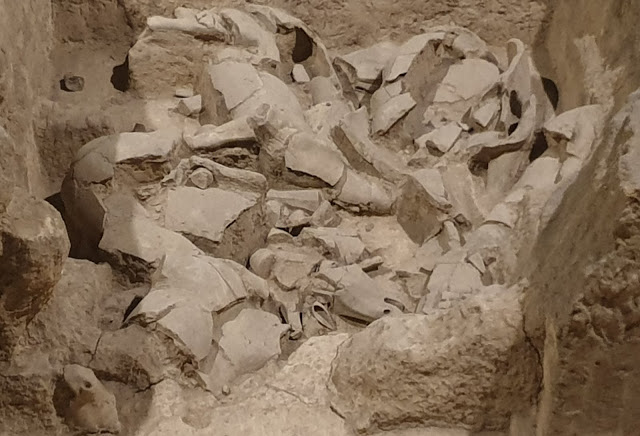
The excavation of this pit has only just begun, so it is possible to see where they have carefully removed the top cover, and you can see the broken parts of the warriors lying in a heap.

Some parts of the warriors are more discernible closer up

These parts are carefully extracted and taken to the ‘hospital’ where they are digitised and the computer will match each part with the warrior it belongs to.

Pit 1

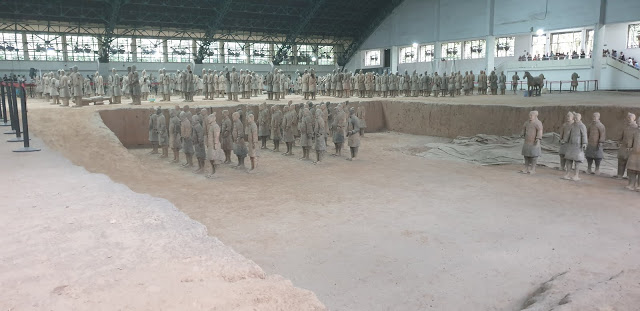
This has quite a number of standing soldiers that have been glued back together, but not necessarily complete and I notice a number if the statues were incomplete. And if they cannot find the missing pieces, then they are not added to or filled in.

The scale of the pit is enormous, and they have hardly scratched the surface in the restoration process.

What is there is a number of horses as well.

That’s at the front of the pit, a long line of statues, and what is clear is the location of the well where the first fragments were found by a farmer.

There are about eight lines of soldiers, and some lining the sides.

Midway down there is a large area currently under excavation

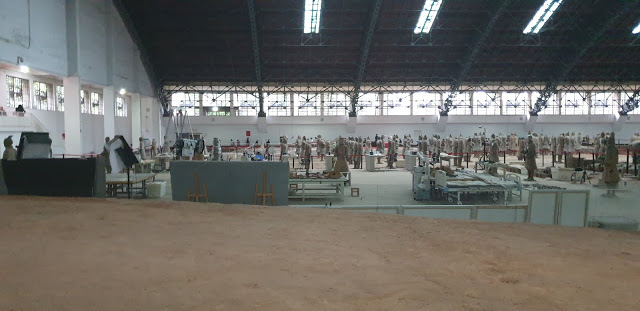
At the back is the hospital where the soldiers are reassembled.  There’s nearly a hundred in the various stages of rebuilding.  These days the soldiers are rebuilt using computer imaging.

The hospital area is where they are put back together

And these are some of the statues in various stages of reconstruction

Another two views of the size and scale of the reconstruction project

The coffee shop is also a sales centre, but there are too many people waiting for coffee and too few places to sit down.

Searching for locations: Smith Street, Fitzroy (Once part of what was known as Marvellous Melbourne)

Of course, it could easily be Collingwood depending on who you barrack for in the local football competition, as it is Fitzroy, but the map and my GPS tells me the street is, for all intents and purposes, in Fitzroy.

Not that there is a football team for Fitzroy any more, that moved north to Queensland a long, long time ago.

But…

Going for a wander up and down the street shows two or three very different sides to inner suburban living, and the effect that comes from a diverse range of cultures, the city has acquired over the past few decades.

Once viewed as almost the slums of Melbourne, these inner suburban areas have moved upscale to become havens for the more wealthy middle classes and a home for many diverse outlets, not the least of which are eateries.

And. In just this small section of Smith Street, there are a lot of eating establishments, from the Old Kingdom Peking duck restaurant to a small place selling Falafel, and then everything in between. It says a lot about how Australian eating habits have changed in a single generation, where back in those infamous old days you would be lucky to have a fish and chips/ hamburger shop and one or two Chinese restaurants.

Now, intermingled with gourmet bakeries and cozy coffee shops, there are a plethora of other eating establishments that cater to any cuisine you can imagine.  In fact, it’s possible to dine out on a different cuisine every night for a fortnight and only traverse about half a kilometre up and down the street.  It could be ideal if you lived in one of the small fronted houses just off the main carriageway in a leafy narrow side street or laneway.

And, as you would expect in an inner-city suburb,  the streets are narrow and made more hazardous for traffic because of the trams, a familiar sight in many of the streets in this area, and a much-used form of transport for workers making the short trip into the city.  It’s almost possible to take the extra half hour, and walk.

The street is lined with old buildings, some dating back to about 1868, there’s around the turn of the century, but most are not inhabited except for the street level where there is an eclectic mixture of furniture, haberdashery, and clothing stores catering to a particular group of people, what some call yuppies or upwardly mobile men and women who are between 25-35, with high paying jobs, and preferably no children.

Then there a subgroup walking there streets, homosexual men, some wheeling adopted children in pushers, others walking hand in hand out for a Saturday afternoon stroll where they can feel safe among many others.  It’s very different from other places I’ve been, but one can imagine there are places like this in every city all over the world.

But as a backdrop to the appearance of wealth, the shopfronts that cater to those upwardly mobile upper middle classes, there’s that exact opposite in full view, the homeless, and beggars, sitting on the ground outside the more run down shops soliciting alms, asking for a spare dollar, and even one asking for a cigarette.

Everyone walks past them, imagining no doubt there are not there, or that if they ignore them, they will go away.  I think not.  And, I suspect, more will come out of their daytime hiding places and take up residence in Smith Street itself.

The only surprise is that the local council has not asked the police to move them on. It’s an interesting juxtaposition of inhabitants in an area that no doubt can only attract the upper middle classes, as anything and everything is relatively expensive, particularly real estate, and permit driven parking spaces.

Would I live here?  No.

Would I come here to wine and dine?

Maybe, if I could get parking, which there appear to be very few spots or any other form of parking such as under the local supermarket which can be very expensive.  And if you are lucky enough to find a spot, who has the time or the memory if continually feeding a parking meter every two hours, particularly if you’re having a good time.

Equally, it’s a place I would not feel comfortable, even if it was once a safe haven, which up to a few years ago, I’d probably think it not.  In fact, at times I was not sure what to make of some of the people on the street, but I guess if I lived here, it would no doubt be the norm.

Would I recommend people to come here?

Of course.  One of the more interesting places in Melbourne to experience grassroots cuisine that is incredibly diverse in it range and price, and even from a place with tables and chairs that may have seen better days, but you haven’t come to see the furniture.

And to my mind, the dining is definitely better, here than perhaps Carlton, which in itself is Mecca to a plethora of university types, both teachers and students alike, and the coffee culture that pervade that area of Melbourne.

I have no doubt you will come and leave with a very good opinion of the place.

As for me, I came here for an engagement party held at the Hotelito de Jesus, a Mexican restaurant, serving a variety of Mexican dishes.  As I’m no expert of that particular cuisine, everything was going to be new.

It was.  It’s spicy but not too spicy, the pork belly excellent, the canapés delicious, and both the mushroom-based and shredded beef based mini tacos were equally scrumptious.

All of this was washed down with two particular Mexican beers, two of several available in bottles, cans, or by the glass.

Oh, and you can get sangria by the jug too if you like.  I would have, but my passion for trying different beers won out.