And then there those horrible things called crosswords.
There are antonyms and synonyms
Sometimes we use words we don’t know the meaning of because of their similarity with others we do
Then there one or more words that make other words as in anagrams
There are substitute words, words we use around children like fudge instead of, well you get what I mean
There’s no doubt we would be lost without words
Words are to be chosen carefully and thoughtfully
They need to be delivered in an appropriate manner, not in haste, and not in anger
We need to believe in what we’re saying before others will believe it
We need to learn how to express our feelings
We should take advantage of learning English (or any other native language) when at school
We need to start reading as soon as we can and keep up reading as we get older. One should never underestimate the power reading and writing gives us no matter who we are.
Always have a dictionary by your side. It is the most valuable book you can own.
And always remember the power of speech can at times move mountains
Staying at Hampton Inn and Suites downtown, whatever that means because it looks like we are in the middle of nowhere.
But, judging by the crowd in the breakfast room, it’s a popular hotel. Of course, it is Sunday morning so this could be the weekend escape people.
Two things I remember about staying in Hampton Inns is firstly the waffles and whipped butter. It’s been five years but nothing has changed, they are as delicious as ever. The other, its where I discovered vanilla flavored milk for coffee, and it, too, is addictive.
They also used to have flat burgers that were made out of sausage meat which was delicious, but on the first day, they were not on the menu.
Nevertheless, it was still a very yummy breakfast.
After some research into where we might find this pixmi unicorn, it appears that it is available at a ‘toys are us’ store in one of the suburbs of Vancouver. So, resuming the quest, we took a taxi to West Broadway, the street the store is located.
A quick search of the store finds where the toys we’re looking for are, after asking one of the sales staff, and we find there are at least a dozen of them. Apparently, they are not as popular in Canada as the might be in America. Cheaper too, because the exchange rate for Canadian dollars is much better than for American dollars. Still, 70 dollars for a stuffed toy is a lot of money.
We also get some slime, stuff that our middle granddaughter seems to like playing with.
After shopping we set off down West Broadway, the way we had come, looking for a taxi to return us to the hotel. There’s no question of walking back to the hotel.
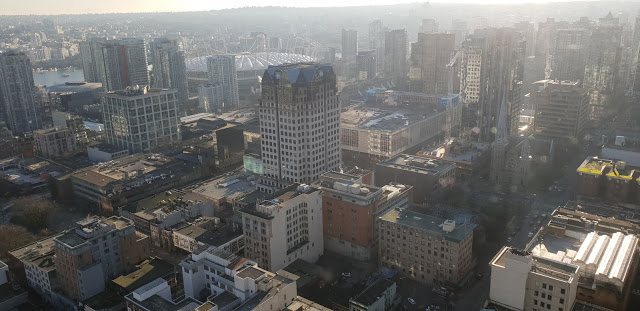
A few hours later we walk to the observation tower, which was not very far from the hotel,
a place where we could get a 360-degree view of the city of Vancouver although it was very difficult to see any of the old buildings because they were hidden by the newer buildings, nor could we see the distant mountains because of the haze.
After leaving the tower we walked down Water Street to see the steam clock and the old world charm of a cobbled street and old buildings
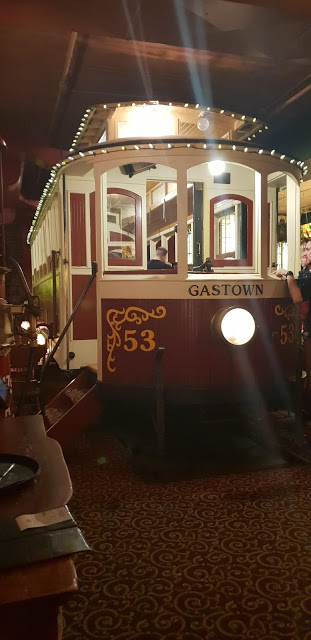
We stopped at the Spaghetti Factory Italian restaurant for dinner and is so popular that we have to wait, 10 minutes to start with. It doesn’t take all that long to order and have the food delivered to the table. Inside the restaurant, there is an actual cable car but we didn’t get to sit in it.
I have steak, rare, mushrooms, and spaghetti with marinara sauce. No, marinara doesn’t mean seafood sauce but a very tasty tomato-based sauce. The steak was absolutely delicious and extremely tender which made it more difficult to cut with a steak knife.
The write up for the marinara sauce is, ‘it tastes so fresh because it is made directly from vine-ripened tomatoes, not from concentrate, packed within 6 hours of harvest. We combine them with fresh, high-quality ingredients such as caramelised onions, roasted garlic and extra virgin olive oil’.
Oh, and did I mention they have a streetcar right there in the middle of the restaurant
I’m definitely going to try and make this when we get home.
After dinner, we return to the observation tower, the ticket allowing us to go back more than once, and see the sights at night time. I can’t say it was all that spectacular.
Another day has gone, we are heading home tomorrow.
And then there those horrible things called crosswords.
There are antonyms and synonyms
Sometimes we use words we don’t know the meaning of because of their similarity with others we do
Then there one or more words that make other words as in anagrams
There are substitute words, words we use around children like fudge instead of, well you get what I mean
There’s no doubt we would be lost without words
Words are to be chosen carefully and thoughtfully
They need to be delivered in an appropriate manner, not in haste, and not in anger
We need to believe in what we’re saying before others will believe it
We need to learn how to express our feelings
We should take advantage of learning English (or any other native language) when at school
We need to start reading as soon as we can and keep up reading as we get older. One should never underestimate the power reading and writing gives us no matter who we are.
Always have a dictionary by your side. It is the most valuable book you can own.
And always remember the power of speech can at times move mountains
It’s always a given that whatever city you stay in unless it’s overnight, you go on a tour and see the sights.
Even when you’re staying a short distance from the city, you may make the effort to catch a train or bus, then get on the hop on hop off tour. There’s always one in just about every city you visit.
Vancouver was no exception.
Except…
We arrived in the rain, went to sleep while the rain came down, woke up to the rain, and a heavy dose of jet lag or perhaps it was more that we had spent 24 and a half hours traveling from Brisbane to Vancouver via Shanghai.
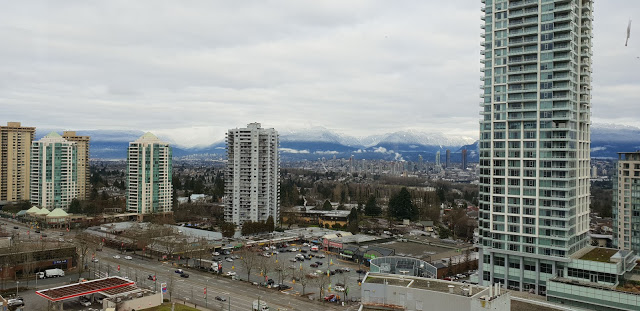
We had an excellent view out the window of our room looking towards the shopping mall, and the steady falling rain.
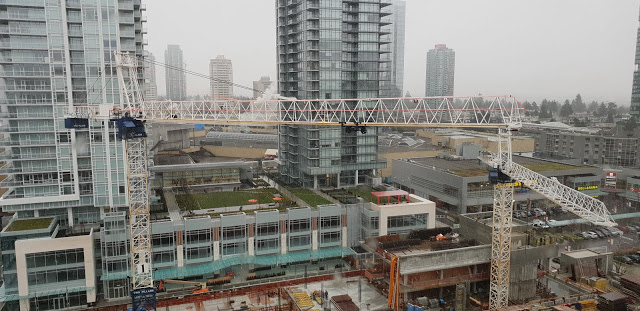
I felt sorry watching the construction workers on the building site that was the main vista we had to look at.
It could have been worse. Endless mountains with snow on them.
What to do. Venture out in the rain and go on the tour, on pop over to the shopping mall and pick up a few boxing day bargains, no, sorry, boxing week bargains.
We have had some experience going on hop on hop off tours in open-top buses in the rain. And the last time was not a pleasant experience, even though we learned a valuable lesson, not to stand in front of a cannon and yell ‘fire’. Apparently, that’s how Admiral Nelson lost his arm.
But…
The shopping mall won.
We’d wait and see if the weather improved. Hang on, isn’t Vancouver near Seattle and doesn’t it rain 300 days of the year?
Not holding my breath.
I feel sorry for the construction workers again. Still raining, still cold, and still no reason to get out of bed.
Day 2 in Vancouver turned out to be the same as day 1.
Hang on, there’s a development.
We’re on the 16th floor and up at those lofty heights, we can see not only the rain but intermingled with it a few flakes of snow.
Whilst we procrastinate about what we’re going to do, the snowflakes increase into small flurries.
Yep, we’re off to the mall again and go for a walk in the snow.
On the way back we drop into the Boston Pizza, which has a sports bar and there you can sit, drink, eat, and watch the ice hockey, or whatever sort is going at the time.
Today it’s a junior ice hockey tournament, but Canada was not playing. Just the same, a long cold beer and ice hockey? How close to heaven is that?
I can now cross that off the bucket list.
Day 3, we’re going on a great rail journey, well, we are going to get the train to the city and collect the rental car, a car on the booking form that was supposedly a Jeep Grand Cherokee or similar.
Of course, ‘or similar’ are the words to be feared here because in truth the rental company can throw anything at you, so long as it matches the brief, three people and three large suitcases.
And, you guessed it…
The ‘or similar’ got us a Fort Flex.
Sounded like some place where exhausted soldiers were fending of the Indians in a last ditch battle.
Perhaps one or two too many American movies I think.
It’s always a given that whatever city you stay in unless it’s overnight, you go on a tour and see the sights.
Even when you’re staying a short distance from the city, you may make the effort to catch a train or bus, then get on the hop on hop off tour. There’s always one in just about every city you visit.
Vancouver was no exception.
Except…
We arrived in the rain, went to sleep while the rain came down, woke up to the rain, and a heavy dose of jet lag or perhaps it was more that we had spent 24 and a half hours traveling from Brisbane to Vancouver via Shanghai.
We had an excellent view out the window of our room looking towards the shopping mall, and the steady falling rain.
I felt sorry watching the construction workers on the building site that was the main vista we had to look at.
It could have been worse. Endless mountains with snow on them.
What to do. Venture out in the rain and go on the tour, on pop over to the shopping mall and pick up a few boxing day bargains, no, sorry, boxing week bargains.
We have had some experience going on hop on hop off tours in open-top buses in the rain. And the last time was not a pleasant experience, even though we learned a valuable lesson, not to stand in front of a cannon and yell ‘fire’. Apparently, that’s how Admiral Nelson lost his arm.
But…
The shopping mall won.
We’d wait and see if the weather improved. Hang on, isn’t Vancouver near Seattle and doesn’t it rain 300 days of the year?
Not holding my breath.
I feel sorry for the construction workers again. Still raining, still cold, and still no reason to get out of bed.
Day 2 in Vancouver turned out to be the same as day 1.
Hang on, there’s a development.
We’re on the 16th floor and up at those lofty heights, we can see not only the rain but intermingled with it a few flakes of snow.
Whilst we procrastinate about what we’re going to do, the snowflakes increase into small flurries.
Yep, we’re off to the mall again and go for a walk in the snow.
On the way back we drop into the Boston Pizza, which has a sports bar and there you can sit, drink, eat, and watch the ice hockey, or whatever sort is going at the time.
Today it’s a junior ice hockey tournament, but Canada was not playing. Just the same, a long cold beer and ice hockey? How close to heaven is that?
I can now cross that off the bucket list.
Day 3, we’re going on a great rail journey, well, we are going to get the train to the city and collect the rental car, a car on the booking form that was supposedly a Jeep Grand Cherokee or similar.
Of course, ‘or similar’ are the words to be feared here because in truth the rental company can throw anything at you, so long as it matches the brief, three people and three large suitcases.
And, you guessed it…
The ‘or similar’ got us a Fort Flex.
Sounded like some place where exhausted soldiers were fending of the Indians in a last ditch battle.
Perhaps one or two too many American movies I think.
This morning we wake up to rain. Or so we thought. Taking a closer look out the window of our room on the 16th floor, we notice the rain is speckled with snowflakes. As the morning progressed the snow got harder until there were flurries.
Later we discover this is called wet snow by the local Vancouverians, and whilst they winge a lot over the endless rain, to them rain is infinitely better than snow.
To us, by the afternoon, it was almost blizzard conditions, with lots of snow. Then the only thing is that it does not accumulate on most of the ground so there are no drifts to play in.
Because the weather is so dismal we decided not to go into Vancouver to do some sightseeing because the clouds were down to the ground and then the snow set in.
Another interesting fact is that construction workers do not go off the job if it’s raining, or worse when it is snowing. Our room overlooks a new apartment complex under construction and the workers battled on through what seemed like appalling conditions.
At four in the afternoon, the Maple Leafs are playing the Ohio Blue Jackets, in Ohio. It is a game we expect they will win. Sparks is the goalkeeper, not Anderson, they’re playing back to back games and Anderson’s starting tomorrow.
They win, four goals to two.
Just before darkness falls, about four thirty, the snow stops and there is a little rain, which melts the snow.
Time to go up to the executive lounge to get some snacks and coffee, then sleep because the next day we’re taking on the Trans Canada highway from Vancouver to Kamloops.
The forecast is for snow, more snow, and just for a change, more snow.
This morning we wake up to rain. Or so we thought. Taking a closer look out the window of our room on the 16th floor, we notice the rain is speckled with snowflakes. As the morning progressed the snow got harder until there were flurries.
Later we discover this is called wet snow by the local Vancouverians, and whilst they winge a lot over the endless rain, to them rain is infinitely better than snow.
To us, by the afternoon, it was almost blizzard conditions, with lots of snow. Then the only thing is that it does not accumulate on most of the ground so there are no drifts to play in.
Because the weather is so dismal we decided not to go into Vancouver to do some sightseeing because the clouds were down to the ground and then the snow set in.
Another interesting fact is that construction workers do not go off the job if it’s raining, or worse when it is snowing. Our room overlooks a new apartment complex under construction and the workers battled on through what seemed like appalling conditions.
At four in the afternoon, the Maple Leafs are playing the Ohio Blue Jackets, in Ohio. It is a game we expect they will win. Sparks is the goalkeeper, not Anderson, they’re playing back to back games and Anderson’s starting tomorrow.
They win, four goals to two.
Just before darkness falls, about four thirty, the snow stops and there is a little rain, which melts the snow.
Time to go up to the executive lounge to get some snacks and coffee, then sleep because the next day we’re taking on the Trans Canada highway from Vancouver to Kamloops.
The forecast is for snow, more snow, and just for a change, more snow.
It’s raining. There should be no surprise there. And cold. It’s late December and well into winter.
Perhaps not as cold as it could be, somewhere between three and four degrees.
We are staying at the Hilton Metrotown, at Burnaby. Metrotown is also the largest shopping mall in British Columbia. I agree that it is large and found it a great way to get some exercise after being in and off planes for the previous 24 hours.
The first discovery for the day was a trolley bus, something that I thought didn’t exist anymore.
The second was to discover so many global brands, but how different the products are to what we can get back in Australia. This is particularly so for cars where we discover that GM-based vehicles and Mazdas are so much better than what is available for us.
The third was to discover it seems we are almost in the heart of Chinatown, where going out an exit on the second floor takes you to a Chinese food court, with all manner of food types, and, it seems, tea bars. It also explained why, in one supermarket we went in, signs were in both Chinese and English.
Being still tired from the travel, we don’t venture further than the mall where we have lunch, for me, the Canadian version of KFC, which seems to defeat the purpose of trying local food. It seems most of the food that I can see in the food shops does not seem that appetizing.
Later we go out and find a Boston Pizza with a sports bar where we indulge in a 21 ounce Molton on tap, and a lime mojito, while watching the ice hockey on the big and surrounding small screens. The ice hockey is some world junior championship (but mostly north hemisphere hockey playing nations) and seems as ferocious as the NHL.
But it does raise a question, why isn’t there a female NHL? I guess this wasn’t the time to canvass opinions in the bar.
Something else we discover is that alcohol is relatively cheap, and get a case of Molten Canadian ale, Bacardi Black label, and maple flavored whiskey, for about a third of what it would cost at home. Of course, it must be cheaper than firewood in keeping Canadians warm in the dead of winter.
We didn’t try the pizza, which kind of defeated the purpose of going there.
Meanwhile back at the room, we find the local ice hockey channel, and then to make sure we get to see the Maple Leafs, plug in the computer so that we can test it. Good to go.
That’s tomorrow, tonight we watching the Vancouver Canucks.
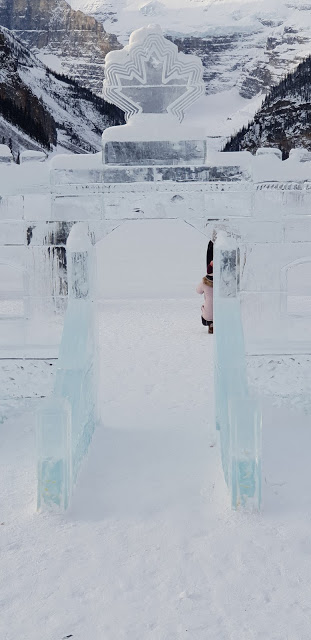
The Fairmont at Lake Louise, in Canada, is noted for its ice castle in winter. This has been created by the ice sculptor, Lee Ross since 2007, using about 150 blocks of ice, each weighing roughly 300 pounds.
When I first saw it, from a distance, looked like it was made out of plastic It’s not. Venturing out into the very, very cold, a close inspection showed it was made of ice.
And, it’s not likely to melt in a hurry given the temperature when I went down to look at it was hovering around minus 10 degrees Fahrenheit.
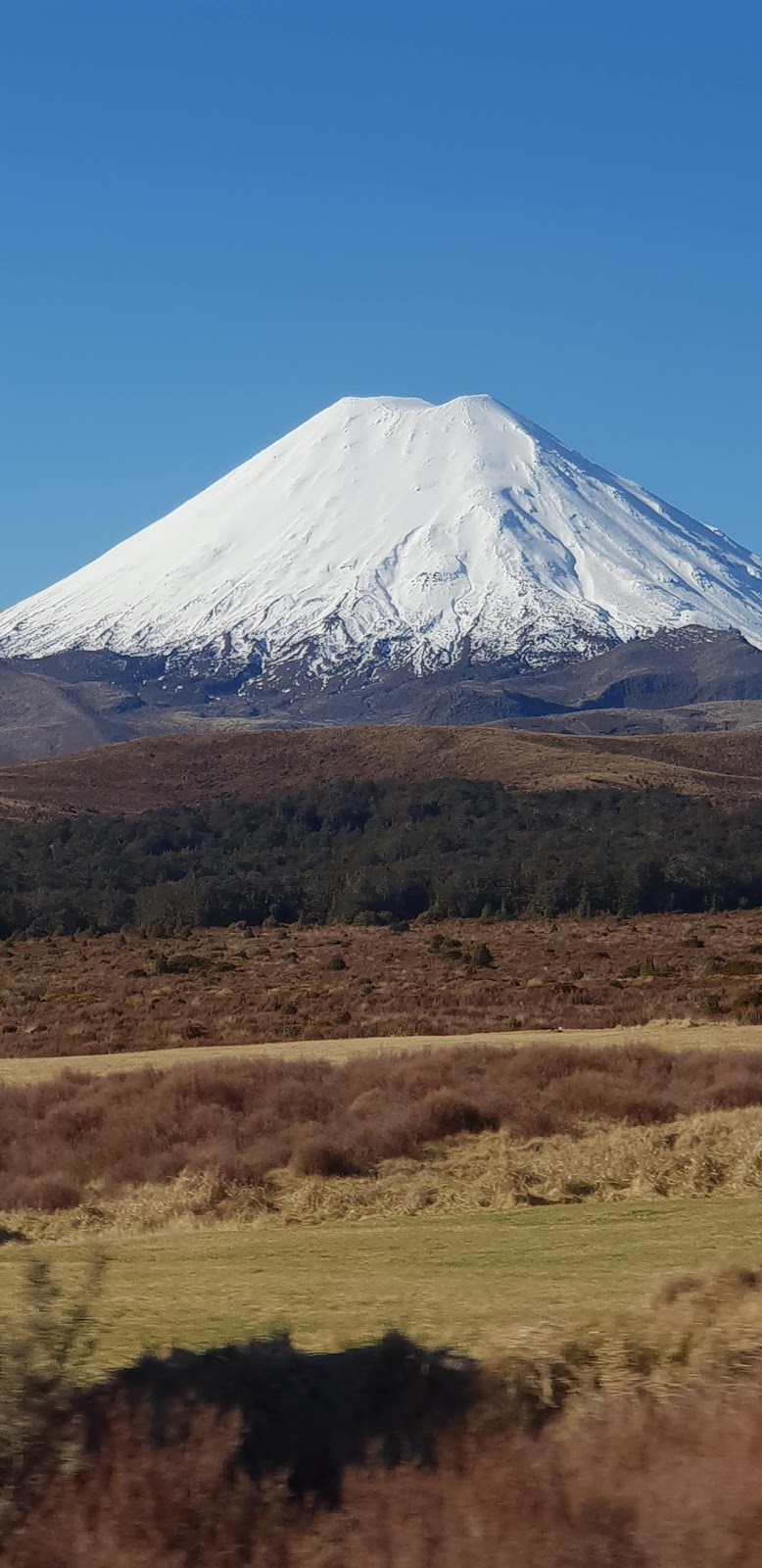
Mount Ngauruhoe is apparently still an active volcano, has been for 2,500 years or so, and last erupted on 19th February 1975, and reportedly has erupted around 70 times since 1839.
The mountain is usually climbed from the western side, from the Mangatepopo track.
This photo was taken in summer from the Chateau Tongariro carpark.
In late autumn, on one of our many visits to the area, the mountain was covered with a light sprinkling of snow and ice.
On our most recent visit, this year, in winter, it was fully covered in snow.