Searching for locations: The Golden Mask Dynasty Show, Beijing, China

The Golden Mask Dynasty Show was located at the OCT Theatre in Beijing’s Happy Valley. 

The theatre was quite full and the seats we had were directly behind the VIP area; as our guide told us, we had the best seats in the house. 

The play has 20 different dance scenes that depict war, royal banquets, and romance.  There are eight chapters and over 200 actors, and throughout the performance we were entertained by dancers, acrobats, costumes, lighting, and acoustics.

The story:

It is of romantic legend and historical memories, the Golden Mask Queen leads her army in defeating the invading Blue Mask King’s army, and afterwards the lands return to a leisurely pastoral life until the Queen forges a ‘mysterious tree’.  When the tree has grown, the Queen has a grand celebration, and releases the captured Blue soldiers, much to the admiration of the Blue Mask King.
This is followed by monstrous floods, and to save her people, and on the advice from the ‘mysterious tree’, the Queen sacrifices herself to save her people.  The Queen then turns into a golden sunbird flying in the sky blessing the people and that of the dynasty.

Billed as the best live show in China, described as a large scale dramatic musical, “The Golden Mask Dynasty” it lived up to its reputation and was thoroughly enjoyed by all.

It was not just singing dancing and acrobatics, it had a story and it was told so that language and cultural issues aside, it worked.  There was a narration of the story running beside the stage, but it was hard to divide attention between what was happening, and what was being related.

Then came the peacock dance, with live peacocks

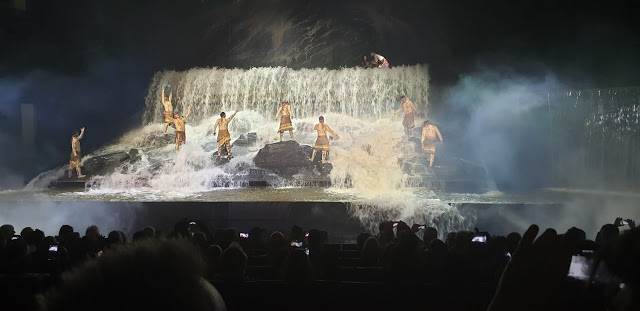
And this was followed by a waterfall, well, I don’t think anyone in that audience could believe what they were seeing.

I know I was both astonished and in awe of the performance.

What a way to finish off our first day in Beijing.

Oh, sorry, that high was dented slightly when we had to go back to our room.

Searching for locations: The Jade Factory, Beijing, China

The first stop is at a Jade Museum to learn the history of jade. In Chinese, jade is pronounced as “Yu” and it has a history in China of at least four thousand years.  On the way there, we are given a story about one of the guide’s relatives who had a jade bracelet, and how it has saved her from countless catastrophes.It is, quite literally ‘the’ good luck charm.  Chinese gamblers are known to have small pieces of jade in their hands when visiting the casinos, for good luck.  I’m not sure anything could provide a gambler with any sort of luck given how the odds are always slanted towards the house.

At any rate, this is neither the time of the place to debunk a ‘well-known fact’.

 On arrival, our guide hands us over to a local guide, a real staff member, and she begins with a discussion on jade while we watch a single worker working on an intricate piece, what looks to be a globe within a globe, sorry, there are two workers, and the second is working on a dragon.

At the end of the passage that passes by the workers, and before you enter the main showroom, you are dazzled by the ship and is nothing short of magnificent.

Then it’s into a small room just off the main showroom where we are taken through the colors, and the carving process in the various stages, without really being told how the magic happens.

Then it’s out into the main showroom where the sales are made, and before dispersing to look at the jade collection, she briefly tells us how to tell real and fake jade, and she does the usual trick of getting one of the tour group to model a piece.

Looks good, let’s move on.  To bigger and better examples.

What interested me, other than the small zodiac signs and other smallish pieces on the ‘promotion’ table, was the jade bangle our tour guide told us about on the bus.  If anyone needs one, it is my other half, with all the medical issues and her sometimes clumsiness, two particular maladies this object is supposed to prevent.
Jade to the Chinese is Diamonds to westerners, and the jade bangle is often handed down to the females of the family from generation to generation, often as an engagement present, to be worn on the left hand, the one closest to the heart.

There are literally thousands of them, but, they have to be specially fitted to your wrist because if it’s too large, you might lose it if it slips off and I didn’t think it could be too small.  
Nor is it cheap, and needing a larger size, it is reasonably expensive.  But it is jadeite, the more expensive of the types of jade, and it can only appreciate in value, not that we are interested in the monetary value, it’s more the good luck aspect.

We could use some of that.

But, just to touch on something that can be the bugbear of traveling overseas, is the subject of happy houses, a better name for toilets, and has become a recurrent theme on this tour.  It’s better than blurting out the word toilet and it seems there can be some not so happy houses given that the toilets in China are usually squat rather than sit, even for women.
And apparently, everyone has an unhappy house story, particularly the women, and generally in having to squat over a pit.  Why is this a discussion point, it seems the jade factory had what we have come to call happy, happy houses which have more proper toilets, and a stop here before going on the great wall was recommended, as the ‘happy house’ at the wall is deemed to be not such a happy house.

Not even this dragon was within my price range.  Thank heaven they had smaller more affordable models.  The object of having a dragon, large or small, is that it should be placed inside the main door to the house so that money can come in.

It also seems that stuffing the dragon’s mouth with money is also good luck.  We passed on doing that.

After spending a small fortune, there was a bonus, free Chinese tea.  Apparently, we will be coming back, after the Great Wall visit, to have lunch upstairs.


Searching for locations: The Jade Factory, Beijing, China

The first stop is at a Jade Museum to learn the history of jade. In Chinese, jade is pronounced as “Yu” and it has a history in China of at least four thousand years.  On the way there, we are given a story about one of the guide’s relatives who had a jade bracelet, and how it has saved her from countless catastrophes.It is, quite literally ‘the’ good luck charm.  Chinese gamblers are known to have small pieces of jade in their hands when visiting the casinos, for good luck.  I’m not sure anything could provide a gambler with any sort of luck given how the odds are always slanted towards the house.

At any rate, this is neither the time of the place to debunk a ‘well-known fact’.

 On arrival, our guide hands us over to a local guide, a real staff member, and she begins with a discussion on jade while we watch a single worker working on an intricate piece, what looks to be a globe within a globe, sorry, there are two workers, and the second is working on a dragon.

At the end of the passage that passes by the workers, and before you enter the main showroom, you are dazzled by the ship and is nothing short of magnificent.

Then it’s into a small room just off the main showroom where we are taken through the colors, and the carving process in the various stages, without really being told how the magic happens.

Then it’s out into the main showroom where the sales are made, and before dispersing to look at the jade collection, she briefly tells us how to tell real and fake jade, and she does the usual trick of getting one of the tour group to model a piece.

Looks good, let’s move on.  To bigger and better examples.

What interested me, other than the small zodiac signs and other smallish pieces on the ‘promotion’ table, was the jade bangle our tour guide told us about on the bus.  If anyone needs one, it is my other half, with all the medical issues and her sometimes clumsiness, two particular maladies this object is supposed to prevent.
Jade to the Chinese is Diamonds to westerners, and the jade bangle is often handed down to the females of the family from generation to generation, often as an engagement present, to be worn on the left hand, the one closest to the heart.

There are literally thousands of them, but, they have to be specially fitted to your wrist because if it’s too large, you might lose it if it slips off and I didn’t think it could be too small.  
Nor is it cheap, and needing a larger size, it is reasonably expensive.  But it is jadeite, the more expensive of the types of jade, and it can only appreciate in value, not that we are interested in the monetary value, it’s more the good luck aspect.

We could use some of that.

But, just to touch on something that can be the bugbear of traveling overseas, is the subject of happy houses, a better name for toilets, and has become a recurrent theme on this tour.  It’s better than blurting out the word toilet and it seems there can be some not so happy houses given that the toilets in China are usually squat rather than sit, even for women.
And apparently, everyone has an unhappy house story, particularly the women, and generally in having to squat over a pit.  Why is this a discussion point, it seems the jade factory had what we have come to call happy, happy houses which have more proper toilets, and a stop here before going on the great wall was recommended, as the ‘happy house’ at the wall is deemed to be not such a happy house.

Not even this dragon was within my price range.  Thank heaven they had smaller more affordable models.  The object of having a dragon, large or small, is that it should be placed inside the main door to the house so that money can come in.

It also seems that stuffing the dragon’s mouth with money is also good luck.  We passed on doing that.

After spending a small fortune, there was a bonus, free Chinese tea.  Apparently, we will be coming back, after the Great Wall visit, to have lunch upstairs.


In a word: Prize

What you win, first prize in a raffle, though I don’t think I’ve ever won first prize.  Second maybe.  But, aren’t all raffles rigged?  

But despite my unfortunate run of luck, a prize is generally give to someone who works hard, or wins a race

Or I could have been a prize fighter but lacked the size and the strength, and out of curiosity how many prize fighters didn’t win a prize?

And if I had been a pirate, I could have sailed the seven seas to find a prize, namely a ship to attack and take as my own.

And as a prime example, a Chelsea supporter walking into a bar full of Manchester United fans could be called a prize idiot.

This is not to be confused with the word prise

Don’t relatives prise the last dollar out of a dying man’s hand?

Or prise the truth out of a witness, or a perpetrator

Or prise a window open like thieves do when we forget to lock them properly?

Searching for locations: From Zhengzhou to Suzhou by train, and the Snowy Sea Hotel, Suzhou, China

For the first time on this trip, we encounter problems with Chinese officialdom at the railway station, though we were warned that this might occur.

We had a major problem with the security staff when they pulled everyone over with aerosols and confiscated them. We lost styling mousse, others lost hair spray, and the men, their shaving cream.  But, to her credit, the tour guide did warn us they were stricter here, but her suggestion to be angry they were taking our stuff was probably not the right thing to do.

As with previous train bookings, the Chinese method of placing people in seats didn’t quite manage to keep couples traveling together, together on the train.  It was an odd peculiarity which few of the passengers understood, nor did they conform, swapping seat allocations.

This train ride did not seem the same as the last two and I don’t think we had the same type of high-speed train type that we had for the last two.  The carriages were different, there was only one toilet per carriage, and I don’t think we were going as fast.

But aside from that, we had 753 kilometers to travel with six stops before ours, two of which were very large cities, and then our stop, about four and a half hours later.  With two minutes this time, to get the baggage off the team managed it in 40 seconds, a new record.

After slight disorientation getting off the train, we locate our guide, easily found by looking for the Trip-A-Deal flag.  From there it’s a matter of getting into our respective groups and finding the bus.

As usual, the trip to the hotel was a long one, but we were traveling through a much brighter, and well lit, city.

As for our guide, we have him from now until the end of the tour.  There are no more train rides, we will be taking the bus from city to city until we reach Shanghai.  Good thing then that the bus is brand new, with that new car smell.  Only issue, no USB charging point.

The Snowy Sea hotel.  

It is finally a joy to get a room that is nothing short of great.  It has a bathroom and thus privacy.

Everyone had to go find a supermarket to purchase replacements for the confiscated items.  Luckily there was a huge supermarket just up from the hotel that had everything but the kitchen sink.

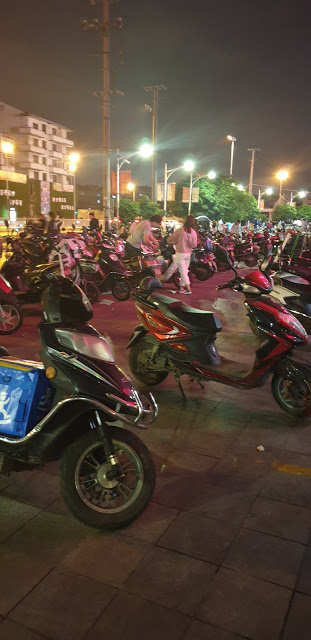
But, unlike where we live, the carpark is more of a scooter park!

It is also a small microcosm of Chinese life for the new more capitalistic oriented Chinese.

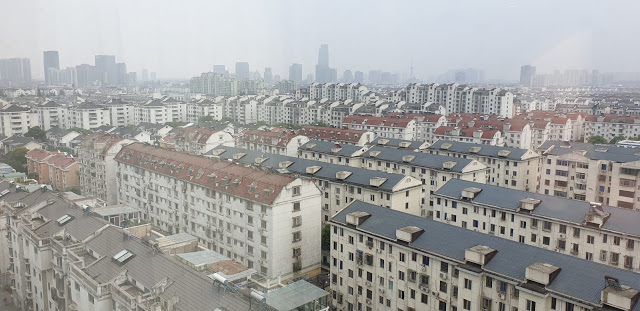
The next morning we get some idea of the scope of high-density living, though here, the buildings are not 30 stories tall, but still just as impressive.

These look like the medium density houses, but to the right of these are much larger buildings

The remarkable thing about this is those buildings stretch as far as the eye can see.

Searching for locations: From Zhengzhou to Suzhou by train, and the Snowy Sea Hotel, Suzhou, China

For the first time on this trip, we encounter problems with Chinese officialdom at the railway station, though we were warned that this might occur.

We had a major problem with the security staff when they pulled everyone over with aerosols and confiscated them. We lost styling mousse, others lost hair spray, and the men, their shaving cream.  But, to her credit, the tour guide did warn us they were stricter here, but her suggestion to be angry they were taking our stuff was probably not the right thing to do.

As with previous train bookings, the Chinese method of placing people in seats didn’t quite manage to keep couples traveling together, together on the train.  It was an odd peculiarity which few of the passengers understood, nor did they conform, swapping seat allocations.

This train ride did not seem the same as the last two and I don’t think we had the same type of high-speed train type that we had for the last two.  The carriages were different, there was only one toilet per carriage, and I don’t think we were going as fast.

But aside from that, we had 753 kilometers to travel with six stops before ours, two of which were very large cities, and then our stop, about four and a half hours later.  With two minutes this time, to get the baggage off the team managed it in 40 seconds, a new record.

After slight disorientation getting off the train, we locate our guide, easily found by looking for the Trip-A-Deal flag.  From there it’s a matter of getting into our respective groups and finding the bus.

As usual, the trip to the hotel was a long one, but we were traveling through a much brighter, and well lit, city.

As for our guide, we have him from now until the end of the tour.  There are no more train rides, we will be taking the bus from city to city until we reach Shanghai.  Good thing then that the bus is brand new, with that new car smell.  Only issue, no USB charging point.

The Snowy Sea hotel.  

It is finally a joy to get a room that is nothing short of great.  It has a bathroom and thus privacy.

Everyone had to go find a supermarket to purchase replacements for the confiscated items.  Luckily there was a huge supermarket just up from the hotel that had everything but the kitchen sink.

But, unlike where we live, the carpark is more of a scooter park!

It is also a small microcosm of Chinese life for the new more capitalistic oriented Chinese.

The next morning we get some idea of the scope of high-density living, though here, the buildings are not 30 stories tall, but still just as impressive.

These look like the medium density houses, but to the right of these are much larger buildings

The remarkable thing about this is those buildings stretch as far as the eye can see.

Searching for locations: The Henan Museum, Zhengzhou, Henan Province, China

The Henan Museum is one of the oldest museums in China.  In June 1927, General Feng Yuxiang proposed that a museum be built, and it was completed the next year.  In 1961, along with the move of the provincial capital, Henan Museum moved from Kaifeng to Zhengzhou.

It currently holds about 130,000 individual pieces, more of which are mostly cultural relics, bronze vessels of the Shang and Zhou Dynasties, and pottery and porcelain wares of the various dynasties.

Eventually, we arrive at the museum and get off the bus adjacent to a scooter track and despite the efforts of the guide, there’s no stopping them from nearly running us over.

We arrive to find the museum has been moved to a different and somewhat smaller building nearby as the existing, and rather distinctively designed, building is being renovated.

While we are waiting for the tickets to enter, we are given another view of industrial life in that there is nothing that resembles proper health and safety on worksites in this country, and the workers are basically standing on what looks to be a flimsy bamboo ladder with nothing to stop them from falling off.

The museum itself has exhibits dating back a few thousand years and consist of bronze and ceramic items.  One of the highlights was a tortoiseshell with reportedly the oldest know writing ever found.

Other than that it was a series of cooking utensils, a table, and ceramic pots, some in very good condition considering their age.


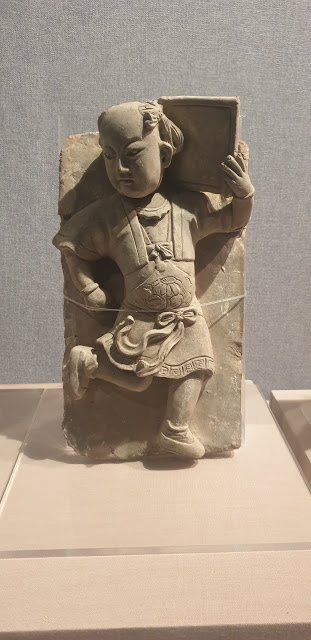
There were also small sculptures

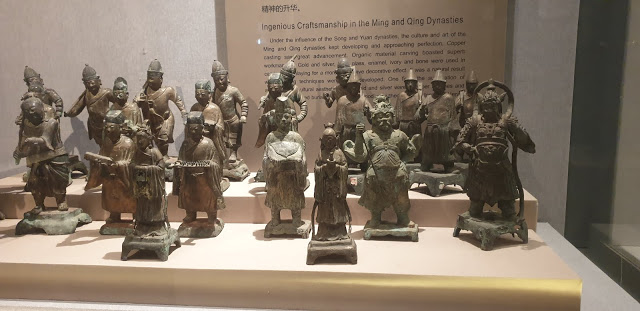
an array of small figures

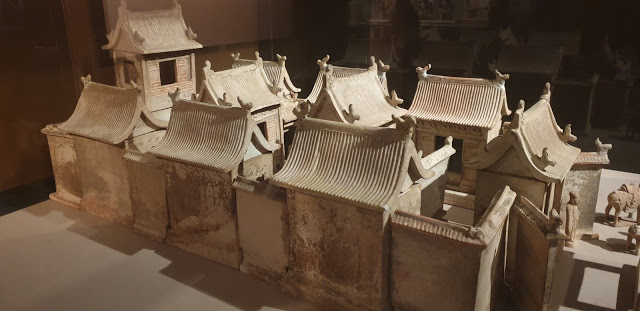
and a model of a settlement

20 minutes was long enough.

Searching for locations: The Henan Museum, Zhengzhou, Henan Province, China

The Henan Museum is one of the oldest museums in China.  In June 1927, General Feng Yuxiang proposed that a museum be built, and it was completed the next year.  In 1961, along with the move of the provincial capital, Henan Museum moved from Kaifeng to Zhengzhou.

It currently holds about 130,000 individual pieces, more of which are mostly cultural relics, bronze vessels of the Shang and Zhou Dynasties, and pottery and porcelain wares of the various dynasties.

Eventually, we arrive at the museum and get off the bus adjacent to a scooter track and despite the efforts of the guide, there’s no stopping them from nearly running us over.

We arrive to find the museum has been moved to a different and somewhat smaller building nearby as the existing, and rather distinctively designed, building is being renovated.

While we are waiting for the tickets to enter, we are given another view of industrial life in that there is nothing that resembles proper health and safety on worksites in this country, and the workers are basically standing on what looks to be a flimsy bamboo ladder with nothing to stop them from falling off.

The museum itself has exhibits dating back a few thousand years and consist of bronze and ceramic items.  One of the highlights was a tortoiseshell with reportedly the oldest know writing ever found.

Other than that it was a series of cooking utensils, a table, and ceramic pots, some in very good condition considering their age.


There were also small sculptures

an array of small figures

and a model of a settlement

20 minutes was long enough.

Searching for locations: The Pagoda Forest, near Zhengzhou City, Henan Province, China

The pagoda forest

After another exhausting walk, by now the heat was beginning to take its toll on everyone, we arrived at the pagoda forest.

A little history first:

The pagoda forest is located west of the Shaolin Temple and the foot of a hill.  As the largest pagoda forest in China, it covers approximately 20,000 square meters and has about 230 pagodas build from the Tang Dynasty (618-907) to the Qing Dynasty (1644-1911).

Each pagoda is the tomb of an eminent monk from the Shaolin Temple.  Graceful and exquisite, they belong to different eras and constructed in different styles.  The first pagoda was thought to be built in 791.

It is now a world heritage site.

No, it’s not a forest with trees it’s a collection of over 200 pagodas, each a tribute to a head monk at the temple and it goes back a long time.  The tribute can have one, three, five, or a maximum of seven layers.  The ashes of the individual are buried under the base of the pagoda.

The size, height, and story of the pagoda indicate its accomplishments, prestige, merits, and virtues. Each pagoda was carved with the exact date of construction and brief inscriptions and has its own style with various shapes such as a polygonal, cylindrical, vase, conical and monolithic.

This is one of the more recently constructed pagodas

There are pagodas for eminent foreign monks also in the forest.

From there we get a ride back on the back of a large electric wagon

to the front entrance courtyard where drinks and ice creams can be bought, and a visit to the all-important happy place.

Then it’s back to the hotel.

Searching for locations: The Pagoda Forest, near Zhengzhou City, Henan Province, China

The pagoda forest

After another exhausting walk, by now the heat was beginning to take its toll on everyone, we arrived at the pagoda forest.

A little history first:

The pagoda forest is located west of the Shaolin Temple and the foot of a hill.  As the largest pagoda forest in China, it covers approximately 20,000 square meters and has about 230 pagodas build from the Tang Dynasty (618-907) to the Qing Dynasty (1644-1911).

Each pagoda is the tomb of an eminent monk from the Shaolin Temple.  Graceful and exquisite, they belong to different eras and constructed in different styles.  The first pagoda was thought to be built in 791.

It is now a world heritage site.

No, it’s not a forest with trees it’s a collection of over 200 pagodas, each a tribute to a head monk at the temple and it goes back a long time.  The tribute can have one, three, five, or a maximum of seven layers.  The ashes of the individual are buried under the base of the pagoda.

The size, height, and story of the pagoda indicate its accomplishments, prestige, merits, and virtues. Each pagoda was carved with the exact date of construction and brief inscriptions and has its own style with various shapes such as a polygonal, cylindrical, vase, conical and monolithic.

This is one of the more recently constructed pagodas

There are pagodas for eminent foreign monks also in the forest.

From there we get a ride back on the back of a large electric wagon

to the front entrance courtyard where drinks and ice creams can be bought, and a visit to the all-important happy place.

Then it’s back to the hotel.