In a word: Right

Am I right?  Or is that correct?

In the moral sense, or in answering a question?

Do I have a right to …

As an entitlement?

Maybe

But right means generally to be correct, but the word itself can be used, like many others in a variety of ways

Such as, do we have any rights any more, since the government is slowly shutting down our freedoms, and, you guessed it, rights.

What about a right angle, we know this as being an angle of 90 degrees

How about I right a wrong, returning a bad situation to a good one?

Are you left-handed or right-handed?

Are you one of those people who can’t tell their left from their right?

And who was it that decided what was your left or your right, ever thought about that?  I didn’t until just now.  Good luck finding an answer on Google.

And how many times have you wished you were in the right place at the right time???

Then, of course, if English is a second language, how about confusing right with write.

Means something quite different, doesn’t it?

How about rite?  Yes, I guess if we were in the habit of chopping chicken heads off and dancing around a fire, that might be its meaning,

But…

It too has a lot of different meanings

Are you confused yet?

Searching for locations: Windsor Castle, London, England

A fine day, on this trip a rarity, we decided to take the train to Windsor and see the castle.

This is a real castle, and still in one piece, unlike a lot of castles.

Were we hoping to see the Queen, no, it was highly unlikely.

But there were a lot of planes flying overhead into Heathrow.  The wind must have been blowing the wrong day, and I’m sure, with one passing over every few minutes, it must annoy the Queen if she was looking for peace and quiet.

Good thing then, when it was built, it was an ideal spot, and not under the landing path.  I guess it was hard to predict what would happen 500 years in the future!

2013-06-30 12.09.56

I’m not sure if this was the front gate or back gate, but I was wary of any stray arrows coming out of those slits either side of the entrance.

You just never know!

2013-06-30 13.58.11

An excellent lawn for croquet.  This, I think, is the doorway, on the left, where dignitaries arrive by car.  The private apartments are across the back.

2013-06-30 13.58.00

The visitor’s apartments.  Not sure who that is on the horse.

2013-06-30 14.07.25

St George’s Chapel.  It’s a magnificent church for a private castle.  It’s been very busy the last few months with Royal weddings.

2013-06-30 12.12.29

The Round Tower, or the Keep.  It is the castle’s centerpiece.  Below it is the gardens.

2013-06-30 13.59.57

Those stairs are not for the faint-hearted, nor the Queen I suspect.  But I think quite a few royal children and their friends have been up and down them a few times.

2013-06-30 12.13.04

And well worth the effort to reach the bottom.

2013-06-30 14.00.40

Any faces peering out through the windows?

Searching for locations: The Peninsula Hotel, Hong Kong

The sight of the Peninsula Hotel is very familiar to all who visit Hong Kong, if not to stay but certainly if you want to see the last vestiges of British influence in what was once a far eastern colony.

That is, we’re talking about the front building, not the new tower at the back.  In the older days there would have been a great view of the harbor from the Veranda (that area with the blue striped canopy) where today, breakfast is taken.

We had breakfast, lunch, and the famous afternoon tea in the ground floor cafe.

These days you would mostly see taxis, buses, and Teslas, if not a flurry of Mercedes and green Rolls Royces in the small car park below.  There is no clear view of the harbor anymore.

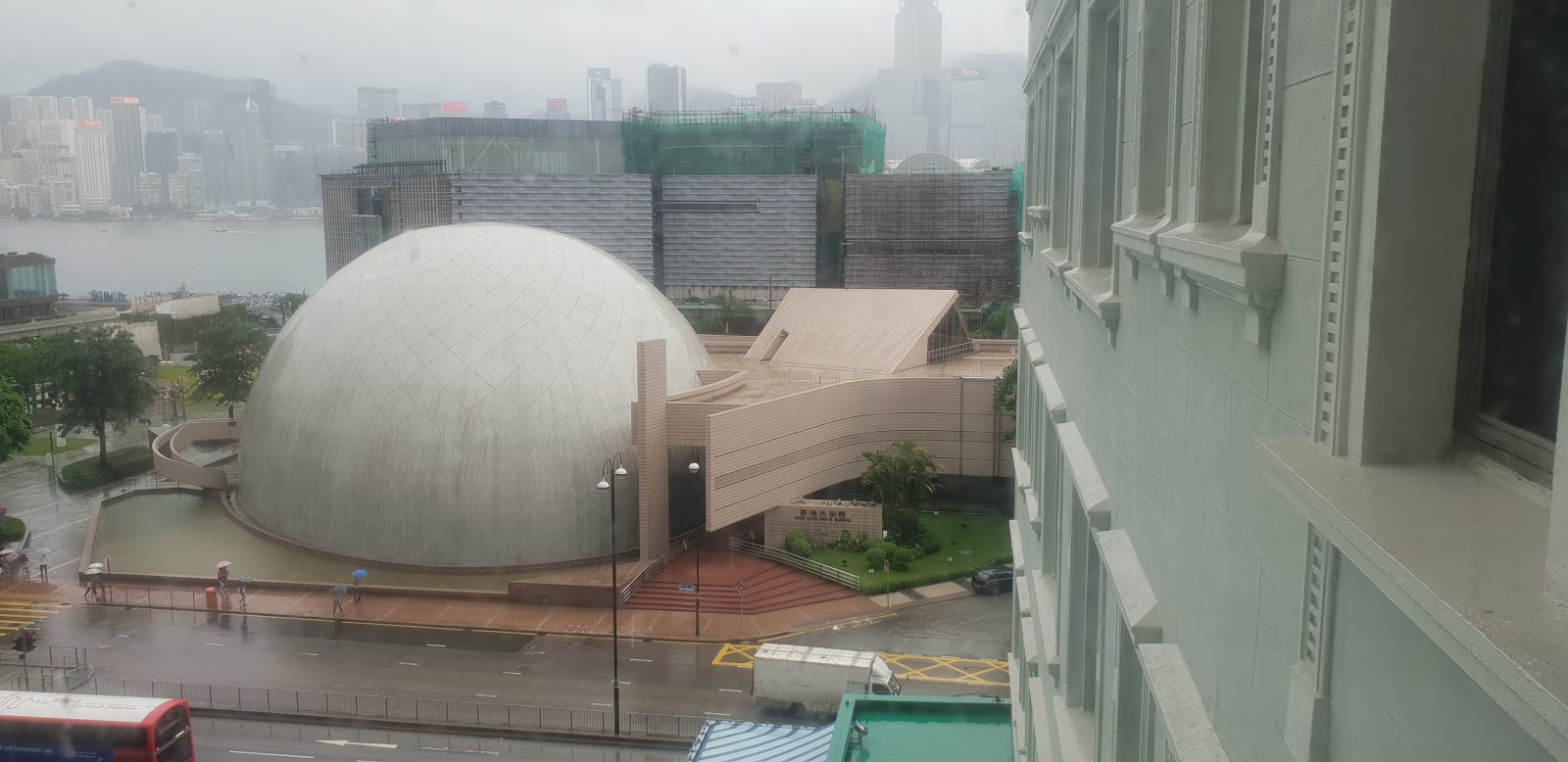
From our room, one facing the harbor we could see the space museum, and on the day we arrived, rain, at times, blotting out the harbor and Hong Kong Island barely discernable in the distance.

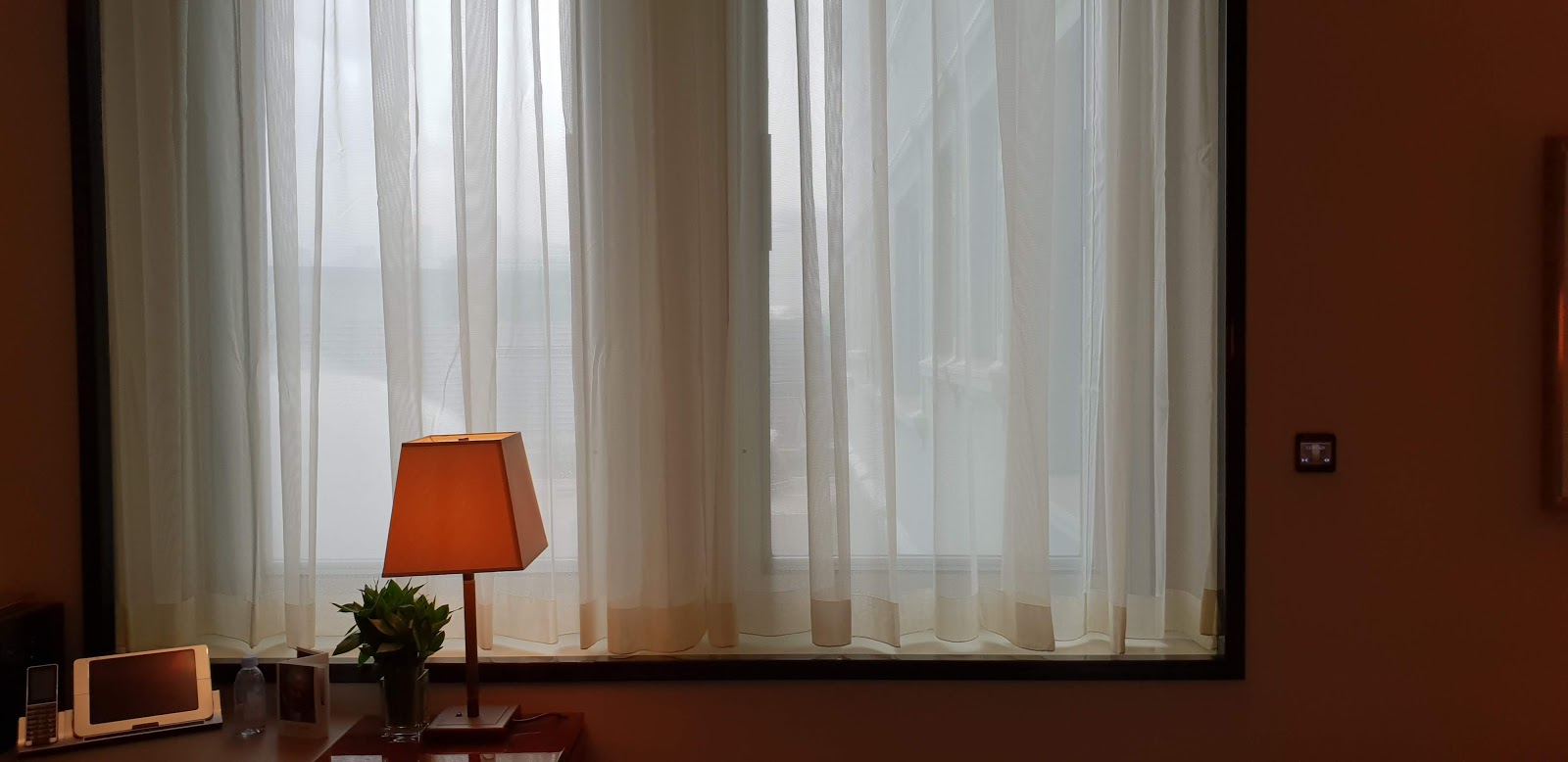
As for the room itself, it was excellent, a junior suite, I think, because it had two distinctive areas.  Everything was run from a tablet computer, blinds, lights, television, and most importantly, air conditioning.  This was the first hotel I’ve stayed in where it was neither too hot or too cold, but just rights.

The bed was very large and extremely comfortable, as were the pillows.  Pillows, I’m afraid, are a bugbear with me, as no hotel seems to be able to get it right.  They’re either too soft or too hard, too tall, or too shallow.  Here, they managed to get it right.

The windows were just the right size not to affect the air conditioning, ie. let too much heat in.

I’m not sure I could say the lounge chair was comfortable, but there was only one, which makes it difficult if there are two of you.  I wasn’t going to fight for it.

The desk had a surprise in the bottom drawer, a printer!

And the bathroom, though slightly smaller than expected, had some hint of what it may have been like in the early days.  It had both a shower and a bath.

Figures of speech

I found this explanation on the internet: ‘a word or phrase used in a non-literal sense for rhetorical or vivid effect.’

We as writers should not use these in our writing because most people might not understand their use.  I think it sometimes adds a degree of whimsy to the story.

I remember some years ago when I working with a Russian chap who’d not been in the country very long, and though he had a reasonable use of English, it was not quite up with our figures of speech.

And made me realize when he kept asking me what they meant, just how many I used in everyday use.

Most of these figures of speech use descriptions that do not necessarily match the word being described, such as ‘I dance like I have two left feet’.

And that pretty much sums up how good I can dance.  But …

‘Like a bat out of hell’, not sure how this got into the vernacular

‘Like a bull in a china shop’, describes a toddler let loose, no, you had the securely in their pram but somehow they got loose while you weren’t looking

‘More front than Myers’, as my mother used to say, but in context, Myers is the Australian version of the English Selfridges or Harrods or Paris Galleries Lafayette.  It refers to the width of street frontage of the stores, which in fact stretched for a whole block

‘As mad as a hatter’, though not necessarily of the millinery kind, but, well, you can guess, it’s from Alice in Wonderland

‘As nutty as a fruitcake’, provided your fruitcake has nuts in it

And, ‘I haven’t heard from him in donkey’s years’ which means you haven’t heard from someone for a long time, or perhaps as long as it takes donkey’s ears to fully grow.

Yes, someone made a minor adjustment and added a y to ears, because it used to be ‘donkey’s ears’, believe it or not.

You can see, if you get the references, they are somewhat apt, and, yes, they sometimes creep into my stories.


In a word: Under

Under by itself is a rather boring word, you know, under the moon, under the sea, under the influence, which is not hard to be if you’ve been hypnotised or after a few drinks.

Under is anything beneath something else.

But lts add it to some other words like,

Under rated, which means it is better that what others give it credit.

Under wear, what you would wear underneath your clothes.

Under study, the person who takes over a lead role when the lead is incapacitated. And how many understudys are guilty of harming the lead, in order to get a big break?

And not get away with it?

Under stood, an agreement that might or might not be in writing that something will happen, that is, it is understood that I will be the next president.

Or not. Who on earth would really want to be president of anything.

So in the spirit of trying to cionfuse everyone all of the time, I have a conundrum in thr form of a question, whar is the difference between under and underneath.

To me there is none, you can be under the sea or underneath the sea, or under the table or underneath the table, but then there’s another, you can be under the influence but not underneath the influence, though technically you could, if you wanted to used confusing English.

And, just to add to the confusion further, I can say that the submarine sailed under the sea, underneath the sea, but, in actual fact, it doesnt.

What is under the sea is the sand, or sea bed, and a submarine does not plow its way through the sand, does it.

What we really should be saying is that a submarine moves through water.

Just saying…

Searching for locations: Niagra Falls, Canada

We visited the falls in winter, just after Christmas when it was all but frozen.

The weather was freezing, it was snowing, and very icy to walk anywhere near the falls

DSC00755

Getting photos is a matter of how much you want to risk your safety.

I know I slipped and fell a number of times on the ice just below the snowy surface in pursuit of the perfect photograph.  Alas, I don’t think I succeeded.

DSC00754

DSC00758

DSC00767

DSC00768

DSC00761

The mist was generated from both the waterfall and the low cloud.  It was impossible not to get wet just watching the falls.

DSC00771

Of course, unlike the braver people, you could not get me into one of the boats that headed towards the falls.  I suspect there might be icebergs and wasn’t going to tempt the fate of another Titanic, even on a lesser scale.  The water would be freezing.

In a word: Flower

It’s what we expect to see when we walk past the front of some houses but instead sometimes see lawn, rocks, or a disaster.

They are what makes the difference between a delightful street and an ugly one, and by that I mean flowers.

By definition though, it means the state or period in which the plant’s flowers have developed and opened/

Just beware the man who turns up with a bunch of flowers that look vaguely familiar to those that grow in your neighbour’s gardens.

They are also in abundance in horticultural gardens, and in florist shops.

My favourites are roses.

And just a word of warning, look out for triffids.  If you read John Wyndham science fiction you’ll know what I mean.

Another mean for the word is to reach the optimum stage of development, though the word bloom could also be used to describe the same thing.

There is another similar-sounding word, flour, but this is the stuff used to make bread, scones, and puddings.

By definition, it is the result of grinding wheat or other grains to a powder.

If something is said to be floury, then it means it is bland.


We have this sport called Australian Rules Football

In Melbourne, it’s an institution even a religion.  Traditionally it is played on a Saturday afternoon and luckily for us, we were attending such a game.

Of course, this was last year.  This year, with the COVID 19 virus everything, including football has been called off.

Except now we have ‘flattened the curve’ football can start again, only without the spectators.  Social distancing means we can’t pack the stadium, or go to a game.  For now, it will just be from our lounge rooms, watching it on the TV.

But, below, is the atmosphere that we have been missing, and probably will for some time to come, a game we attended last year:

The stadium is the MSG, one of the biggest and best in Australia.  Shortly after the start, I’d estimate there are about 40,000, but eventually, we were told there was 53,000, spectators here for a clash between the two Melbourne based teams.  It is not unheard of to have in closer to 90,000 spectators, and the atmosphere is at times electric.

For the die-hards like me who can remember the days when there were only Victorian-based teams,  in the modern-day form of the game, to have two such teams is something of a rarity.

However, it’s not so much about the antics on the field as it is the spectators.  They are divided into three groups, the members, the private boxes, and the general public.

But in the end, there is no distinction between any of them because they all know the rules, well, their version of them, and it doesn’t matter who you are, If there is something that goes against your team, it is brings a huge roar of disapproval.

Then there are ebbs and flows in the crowd noise and reactions to events like holding the ball attracting a unified shout ‘ball, or a large collective groan when a free kick should have been paid or by the opposite team’s followers if it should have been.

It is this crowd reaction which makes going to a live game so much better than watching it televised live.  The times when players take marks, get the ball out of congestion, and when goals are scored when your team is behind and when one is needed to get in front.

This is particularly so when one of the stars goes near the ball and pulls off a miracle 1 percent movement of the ball.  These are what we come to see, the high flying marks, the handball threaded through a needle, a kick that reaches one of our players that looked like it would never get there, an intercept mark or steal that throws momentum the opposite way.

This game is not supposed to be a game of inches but fast yards, a kick, a mark, a handball, a run, and bounce.  You need to get the ball to your goal as quickly as possible.

That’s the objective.

But in this modern game, much to the dismay of spectators and commentators alike, there is this thing called flooding where all 36 players are basically in a clump around the ball and it moves basically in inches, not yards.

It is slow and it is ugly.

It is not the game envisioned by those who created it and there is a debate right now about fixing it.

Here, it is an example of the worst sort.  This game is played in four quarters and for the first two, it is ugly scrappy play with little skill on display.  The third shows improvement and it seems the respective coaches had told their players to open it up

They have and it becomes better to look at.

But this is the point where one team usually gets away with a handy lead, a third-quarter effort that almost puts the game out of reach.  The fourth quarter is where the losing team stages a comeback, and sometimes it works sometimes it does not.

The opposition gives it a red hot try but is unsuccessful.  Three goals in a row, it gave their fans a sniff of hope but as the commentators call it, a kick against the flow and my team prevails.

It is the moment to stay for when they play the winning teams song over the stadium’s loudspeaker system, and at least half the spectators sing along.  It is one of that hair raising on the back of your neck moments which for some can be far too few in a season

We have great hopes for our team this year, and it was worth the trek from Brisbane to Melbourne to see it live rather than on the TV

Leaving the ground with thousands of others heading towards the train station for the journey home there is a mixture of feelings, some lamenting their teams, and others jubilant their team won.  There is no rancor, everyone shuffles in an orderly manner, bearing the slow entry to the station, and the long lines to get on the train.

Others who perhaps came by car, or who have decided to wait for a later train or other transport, let their children kick the football around on the leaf-covered parkland surrounding the stadium.

It is an integral part of this game that children experience the football effect.  Kicking a ball with your father, brothers, and sisters, or friends on that late autumn afternoon is a memory that will be cherished for a long long time.

It’s where you pretend you are your favorite player and are every bit as good.  I know that’s what I used to do with my father, and that is what I did with my sons.

But no matter what the state of the game, it is the weekend the football fans look forward to and who turn out in their hundreds of thousands.  It is a game that ignites passions, it brings highs and it brings incredible lows.

And, through thick and thin, we never stop supporting them.

In a word: Mark

A teacher will mark a test in order to give the student a mark out of 100.  Yes, to mark a test means to ascertain right and wrong answers and score it accordingly, and getting a mark out of 100 could determine a great many different outcomes at school.

Whereas a mark on your clothes could mean you’ve been playing with fire, rolled in the mud or if much older having a salacious affair with an unexplainable lipstick mark on your collar.

A mark is someone that a con man believes will be easily deceived.

A mark is a catch in certain types of football.

You can have an identifying mark on some item of property.

it’s literally the x marks the spot for someone who cannot write, i.e. make your mark

There can be a mark on a rope that indicates the depth of water.

And many, many more…

But not to be confused with marque, which could be the make or model of a particular type of car

Or marc with is the refuse of grapes after being pressed


What’s in the news other than COVID 19

Other than the fact that the recent twitter storm of untruths and white lies is covering up something far more sinister that certain people don’t want you to find out about.

Well, we’re on the quest to find out what it is…

There’s the discovery of a perfectly preserved ancient Roman mosaic floor under vines near Verona in Italy that dates back to the 3rd century.  This is the same site that remains of a villa was found in 1922.

And thankfully there were very few people in Rome when a sinkhole appeared in front of the Pantheon where seven travertine slabs were found 2.5 meters beneath Piazza della Rotonda.

Hardly earth-shattering, but interesting none the less.

Also, I’m willing to bet you didn’t know that scientists were looking for a parallel universe in Antarctica, not that they found one, but it would have been interesting if they had.

For that matter, since there is nothing down there but ice and snow, would they have realized they had passed to another parallel universe that was exactly the same?

What they did find were neutrinos, which are tiny high energy cosmic particles that are often referred to as ghostly because they can pass through anything without changing.

Pity about the parallel universe.  I’m sure a lot of us tired of this one not working out so well, would like to go to another where we’re hoping things will be better.

Though, if you watched Stargate SG1, you’ll know parallel universes are not always good.

Lastly…

Today I discovered the humble light bulb was invented by Thomas Edison 129 odd years ago, and made at Edison General Electric Company (now better known as GE).  In 1935 the light bulbs had evolved so much they could light stadiums, a fluorescent bulb was created in 1938, and a halogen lamp in 1959.  LED lighting was invented in 1962.