There’s this affliction going about

It’s not new, it’s been around for a while.Everyone seems to be talking to themselves and I think it has something to do with smoking, perhaps a side effect.

You know how it is, you are walking along the sidewalk and someone near you starts talking.  You turn around thinking they are talking to you, but they are not.

And then they take a puff of a cigarette.

It’s not an uncommon assumption to think they are going mad.

But the thing is, if you take a closer look you notice they have a Bluetooth device in their ear and they are really talking to someone out there in cyberspace.

Or for the uninitiated, they’re talking on their mobile phone.

Not that many years ago, men in white suits would be collecting these people and taking them to an asylum typically called Bellevue.  It was the stuff of 1950’s horror films.  You really didn’t want to be caught talking to yourself.

It, of course, has a number of symptoms, this condition we’ll call cybersickness.

Like, for instance, wandering aimlessly.  Or bumping into people.  Or walking in front of cars on the street.  Or falling off the edges of sidewalks, which can result in very, very bad injuries.

You could be forgiven for thinking these people are hearing voices in their heads telling them what to do.

But, as a worst-case scenario, we could say we have just created a viable excuse for these people.

I suppose it’s better than locking them up because, at the end of the day, our jails would be full to overflowing.

One thing is for certain, I think a lot of them are already living in their own world, oblivious to everyone and everything about them.

Now, as for using phones in cars, just don’t get me started.

In a word: Bill

Yes, it is a name, short for William, though I’m not sure how Bill was derived from William.

But…

As you know, like many words this one has a number of other meanings, like,

A bird has a bill, particularly those birds with webbed feet

A bill is something you are sent to pay for goods or services, and often turn up when least expected, or when money is tight

And, sadly, they are neverending.

Then there’s fit the bill, which means it is suitable.

It could also be a list of people who appear in a programme.

It is used to describe banknotes, such as a twenty dollar bill.

It could be a waybill, used for the consignment of goods.

It could also be a piece of legislation introduced into parliament.

In some places in the world, it could be the peak of a cap

But the most obscure use of the word bill goes to:  the point of an anchor fluke.

We all change over time

The other day when visiting a friend I was asked if I would like some camomile tea. I said it was something I had tried once and didn’t like, which prompted the comment ‘you don’t seem to like very much’.

It was not a comment made in malice, we have known each other a long time, but I didn’t realize it until then that our individual tastes had changed over time, more particularly in my case.

I used to drink tea with milk and three, sometimes more, sugars once, drink the archetypal Australian beer like Fosters Lager and Carlton Draught, but in recent years found I could no longer drink it and had switched to European beers such as Peroni or Heineken.

It got me thinking about how our likes and dislikes change over time, sometimes through a bad experience (as is the case with a type of alcohol – mine is tequila), sometimes for other reasons, like for dietary or health reasons (one is having diabetes).

My steak preference has changed from medium to medium-rare to rare, I no longer have tea with milk and sugar, and drastically cut down on chocolate.

Another phenomenon I have noticed particularly in my and my wife’s case is how our tastes have changed together, so I’m assuming that is from familiarity.

In the case of friends, you do not necessarily see them all that often, so it would be possible for them to change and you do not know about it, and no doubt eventually prompt a comment.

There is also the case of external influences on each of us that bring changes, such as those who have children and those who do not, those who travel to particular places and those who travel to different places, even having a different job can affect our lives.

This is why, over time, our friends come and go, going off in different directions for one or many reasons.

I guess that’s why the saying ‘change is not always for the better’ came into being, but, there again, for some the exact opposite might be true.

In a word: Air

Yep, another of those interesting little words that mean more than it appears.

Aside from the fact it is the air that we breathe, it can also be used to describe music.

It can be a breath of fresh air, though it’s hard to say where in this ever increasingly polluted atmosphere than we could literally draw one, except on a mountain top, where conversely it would be hard to breathe at all.

Have the air sucked out of us, well, that literally isn’t possible unless some madman comes up with a weird sort of vacuum cleaner, but that might be an episode for the X-Files.

He had an air about him, or her, as the case might be, which might refer to a sort of deference or manner.   There again that air might be one of boredom, which is what a lot of students seem to have in class.

Sorry, been a teacher, and know well the expressions on their faces.  Had one myself once, and finished up on the end of a chalkboard eraser.  Yep, in the good old day’s teachers used to chuck stuff at us recalcitrant students to get our attention, and not undergo a storm of protest from irate parents.

These days those same parents would most likely air their grievance, opinion, or view to the headmaster.

I’m guessing that same headmaster would be wishing those same parents to vanish into thin air, though I’m not sure how that would be possible.

And lastly, television stations air shows.

Weird, eh, how such a simple word can be used in so many contexts.

Going home

Home has a great many different meanings, for me, and, I guess, a great many others.

Over a lifetime we have a lot of different homes, we tend not to stay in one place all our lives.

I know, for me, my first home was in Carrum, when I was very young, and I don’t remember much of it. My second home was Mordialloc, but, again, I don’t remember much of it either.

My next home was Dandenong, in not one house, but two, the first I spent my grade school years, the second, my secondary school years, and in between a short period in a country town called Berrigan.

Then, after getting married, I left that house where my parents continued to live for quite a few years, as we bounced around, from Burnley to North Dandenong, having been drawn back to where I used to live, then back home to my parents for a short period, and North Dandenong again.

It’s curious how we return to certain places to live, rather than consider another suburb say North or West.

Equally curious about how I tend to call going home, when traveling in Australia, not, as you would think, our home in Queensland, but where we used to live in Victoria. I guess that is because it’s my spiritual home.

People often ask if we would return to Victoria, and the answer, of course, is no. We might have most of our in-law families there, but it is not enough of a pull to return. We are content just to come back once or twice a year.

For us, Melbourne had become too large a city, with all the problems that go with it. Brisbane has and will be for the rest of my lifetime, have much fewer traffic problems and the feel of being less urbanized. One thing I don’t miss about being in Melbourne is the traffic. It is horrendous, any time of the day and night.

But what would be good in Brisbane is the markets like those at Queen Victoria and South Melbourne. We have nothing like it.

And something else, rather more frivolous, Brisbane doesn’t have the same fish and chips, donuts, or spring rolls and dim sims. Every time we come down, those are the first things we get, even if we have to go out of our way.

But if someone was to ask, off the cuff, where my home is, it always comes out as Melbourne, and I have no idea why.  When they ask where I live, which is supposedly the same, I tell them Brisbane.  I guess it has a lot to do with where you grow up, though I’m still trying to figure it out.

At least it’s easy when I’m overseas.  When they ask, the answer is, simply, Australia.

Past conversations with my cat – 91

20161008_135125_001

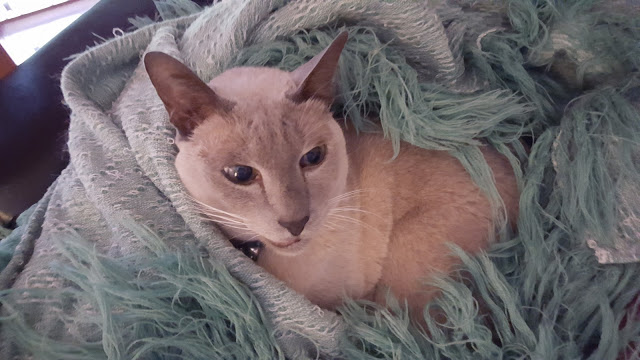
This is Chester.

We’re having an interesting time in the quest for self-isolation.

It seems he doesn’t like the idea that we are still going out, and coming back, potentially bringing the virus back.

This, of course, despite the fact that there are no confirmed cases of the virus attacking cats.

That doesn’t mean that Chester might be the first cat that does.

Out of curiosity, and perhaps against my better judgment, I have to ask what his reasoning is.

Old age, he says.  If you are telling me the truth then I’m about 18 cat years old, which means it’s about 126 of your years.

I can see where this is going.  It’s my fault because I’ve left the running count of Coronavirus patients worldwide on one of my computer screens.

As of this morning, there are 393,000 cases worldwide.  He was sitting next to me when I  was looking at the statistical data on the various ages and pre-existing conditions.

For him, apparently, there was only one statistic that mattered.  Anyone over 90 in human years had little chance of surviving.

I reiterate the virus doesn’t attack cats.

I also tell him that I have no intention of getting the virus.  But it raises a point I hadn’t considered.

Going out anywhere always has a risk, whether to the supermarket or the pharmacy which are basically the only places I go.  Then there is the situation of my wife, who is still working and has to go to work.  That is a bigger risk considering one of the staff will be coming back from overseas.

How successful the self-isolation rule is, and whether everyone complies, is a matter of conjecture, and one has to wonder if 14 days in isolation is long enough.

Chester has raised a legitimate point, not necessarily in relation to himself.

Perhaps he might be worried about us.

And if that is the case, will the specter of this virus finally become the catalyst for a change in the relationship between cats and people, where they might realize we are more important to them than they currently believe.

Let’s see what happens.

So where is hell?

When we are taught about religion, we are inevitably introduced to heaven and hell.

Heaven is the place we all aspire to go up to, though I’ve never really understood why it is up. Of course, all the pictures of heaven are in the clouds, with a set of pearly gates (just why are they called the pearly gates anyway?) and St Peter waiting to ask us the 20 questions that decides whether we pass through, or get the elevator down.

Yes, hell is down. Why? And, for that matter why is it always depicted a dark and full of fire and hot embers?

Now, just taking a step back and thinking about hell, there is a saying, “it is hell on earth’.

Was this saying coined by someone who had actually been to hell and been sent back? Imagine being a reject from hell … that would take some doing.

For those who saw ‘The Good Place’ which ended recently, the notion of hell takes on something of a different meaning.

But, we often say, when at the very bottom of despair that we are in hell. I gather this means that life couldn’t get any worse, which is quite possible on of the universal definitions of what it might be like in the ‘real’ hell.

Or was hell invented by some clergy a long time ago to frighten the parishioners into being good, because the ‘prize’ if you didn’t was a one way trip to, you guessed it, hell.

Come to think of it, a lot of the religious ‘stuff’ is to keep us penitent parishioners on the straight and narrow, though we are allowed to stray every now and then so we have a reason to go to the confessional, where, after straying, we a forgiven for the price of a few hail Mary’s.

And perhaps the unforgiving stare of the parish priest.

So, when we tell someone to ‘go to hell’, what is it we are really wishing upon that person. A fiery end? A meeting with the devil?

Let’s hope that ‘hell’ is just an invention, and that when were finally make it to the afterlife (which is a whole other question that I take issue with) our lives have been such that we know the answers to the 20 questions St Peter puts to us, and we get the magic ticket into heaven.

And hopefully there will be a Red Lobster up there.

In a word: Tap

There is nothing worse than, when lying in bed unable to get to sleep, you hear every noise in the house and out, but none worse than a dripping tap.

Its often not because someone forgot to turn the tap off, but a washer is on its last legs.

There are taps for the fallen brave, but aside from the fact that is the name of a piece of music, I think it’s also the title of a film.  But taps itself is a bugle call at dusk, and also played at military funerals.

Then there’s that income stream that you can tap into, other than your next-door neighbours power supply.

But what would be far more interesting than to tap into a phone line and listen in?  Despite the fact that eavesdroppers never hear anything good about themselves, you could learn something you didn’t want to know.

Then we can go back to the 1930s and a series of films that starred one of my favourite actors Fred Astaire, who was, of course, a tap dancer, along with Ginger Rogers.

In fact, my middle granddaughter is quite a good tap dancer.

And, lastly, was that a tap on the door, or a tap in the window?

In a word: Nobody

This is sometimes how we must feel when overlooked or ignored, like a nobody.

And some people will treat you like a nobody, i.e someone who is just not important.

That’s just one use of the word.

Another might be…

Who did that to your room?

‘Nobody’ is the plaintiff reply.  The infamous Mr. Nobody.  We’ve never met him, but he’s always there.  And, what’s more, he seems to be able to be in more than one place at a time.

Then there’s that time when there’s nobody in the room, nobody agreed with me, hell, that happens all the time, and when I rang your phone nobody answered.

Nobody?  Was I expecting Mr. Nobody to answer?  Surely the response should have been, ‘and you didn’t answer’.

Of course, let’s not delve too deep here, lest we might find out something we didn’t want to know.

I went to your house last night, but nobody was home.

How is it we refer to the people whom we know live in that house as ‘nobody’.  Shouldn’t we be saying, ‘none of you was at home’?

It seems nobody is one of those words we often use in vain.

In a word: Keep

Yes, this is an easy one.

I want to keep the car.  Especially if it’s a Lamborghini and it didn’t cost $500,000.

This form of the word simply means to hang on to something, or up the proper definition, to have or retain possession of

Paring it with other words is where it gets complicated.

For instance,

Keepings off, make sure that the ball doesn’t get into someone else’s possession.

Keep it to yourself, yes, here’s your chance to become the harbinger of secrets and not tell anyone else.  Not unless a lot of money is involved, or a Lamborghini.

You guessed it, the car is the running joke on this post.

How about, keep a low profile, been there tried that, it’s a lot harder than you think.

What about keeping your cards close to your chest, yes, this had both a literal and figurative meaning which makes it sort of unique.

That might follow the second definition, to continue, or cause to continue a particular state.

Another way of using keep is by delaying or stopping someone from doing something or getting somewhere; ie, I was kept waiting at the doctor’s surgery because he was late.

There are any number of examples of using the word keep in tandem with other words

One that specifically doesn’t relate to all the former examples, is simply the word keep.

What is it?

Usually the strongest part of the castle, and the last to fall in an attack.

At least, that was the theory.