Just one of many reading lists – part 3

**Please don’t assume that you have to, nor would I ever expect you to,  read any or all of these books.  You don’t.**

Everyone, it seems, will publish what they call the top 100 books that you should read. Some are voted on, some belong to the opinion of the editor of the book review section of a newspaper, and, as you know, there are a lot of newspapers, a lot of editors, and a lot of opinions.

I’m not a newspaper, I’m not an editor, but I have a list, based on personal experience, and many, many years of reading.

It’s in no particular order.

41.  The Hound of the Baskervilles by Sir Arthur Conan Doyle, as well as a host of other Sherlock Holmes stories

42.  The Secret Agent by Joseph Conrad, one of Conrad’s later political novels, set in London in 1886 and deals with anarchism and espionage.  In those days spies were called anarchists.

43.  The Ipcress File by Len Deighton, introducing us to Harry Palmer, who was personified by Michael Caine and led to Horse Under Water, and Funeral in Berlin.  More of Len Deighton later on in the list

44.  The Remorseful Day by Colin Dexter introducing the somewhat enigmatic detective, Morse, his first name not revealed for a long time but oddly, Endeavour.  John Thaw brought him to life

45.  Crime and Punishment by Fyodor Dostoevsky, hard to pronounce and even harder to read, but perhaps worth it in the end.  By the time I read this I was wishing for a Russian writer had could use an economy of words

46.  Dr. Zhivago by Boris Pasternak wasn’t it.  A vast and lengthy dissertation on lost love, I felt very sad for Zhivago in the end.  I saw a stage play of the same name, and I’m sorry, but it’s a few hours of my life I will never get back

47.  Casino Royale, the first of the James Bond novels by Ian Fleming.  I have to say these are among my favorite spy books.  I must say I preferred the new James Bond in Casino Royale, though Sean Connery still rules!

48.  The Day of the Jackal by Frederick Forsythe, a fascinating story about an assassin

49.  Anything written by John Le Carre, but in particular, the George Smiley collection.  Finally unmasking his nemesis the Russian spymaster made it all so satisfying.

50.  The Bourne Identity by Robert Ludlam, inspiring a long series by both Ludlam and Eric Lustbader makes entertaining reading, but the first, the man who did not know who or what he really was, was excellent.  Matt Damon didn’t harm his persona either.

51.  Murder Must Advertise by Dorothy Sayers, whose detective is Lord Peter Whimsey, a 1933 mystery novel that’s eighth in the series

52.  Gorky Park by Martin Cruz Smith.  You have to admit that his Russian detective Arkady Renko is up against it when his investigation goes in a direction that uncovers corruption and dishonest in his superiors

53.  The Way of All Flesh by Samuel Butler, a semi-autobiographical novel written between 1987 and 1884, and published in 1903.  The story of the Pontifex family.

54.  Howards End by E. M. Forster, first published in 1910, is an interesting insight into the behavior of the, and between the classes, with the Schlegels acting as the catalyst.

55.  Washington Square by Henry James, originally published as a serial, and covers the conflict between daughter and father.  I must say I prefer The Ambassadors to Washington Square.

56.  Ulysses by James Joyce, a day in the life of an ordinary man, Leopold Bloom, why could it not be the 7th June rather than the 16th, for obvious reasons

57.  The Go-Between by L. P. Hartley is a view of society at the end of the Victorian period through the eyes of a young boy.  I read this while still at school and had no clue why, but later, when I read it again, I understood the meaning

58.  Atonement by Ian McEwan, I saw the film and then read the book.  Never a good idea.  Basically, a young girl makes a bad mistake and tries to atone for it.

59.  Gone With The Wind by Margaret Mitchell, the War and Peace of Americal novels, and as long by comparison.  The only book written by Mitchell, and the second most read book by Americans.  The film was interesting but awfully long.

60.  The English Patient by Michael Ondaatje, with a man with severe burns and the effect he had on three others.  Colin Firth is villain one day and hero the next, this time in the cinematic version, an out and out cad.

More to come…


A Long Day’s Journey into Night

That was the name of a play, the script of which I once took out of a library, but never got around to reading it.

It sparked a momentary interest in Eugene O’Neill’s work, but I found it a little hard to understand.  Of course, back then, when I knew little about anything, it was basically a mystery.

It did fuel a brief dalliance with books with a deeper meaning for a short time, one of which was Alan Sillitoe’s Saturday Night and Sunday Morning, but more intriguing of his works was called The Loneliness of the Long-Distance Runner.

While it could be said the literal meaning of that title was rather true, having done a little long-distance running mostly in the final years of school, and realizing it was a lonely sport, it was probably the first time I discovered allegory.

But aside from all that, it led to a foray into more salacious books such as The Postman Always Rings Twice.

And, don’t get me started on D H Lawrence’s Lady Chatterley’s Lover.

However, I’m doing my usual digression, so back to the point…

Taking it in the literal sense, you can do a long day’s work, not get finished by the time you are supposed to go home, and then decide to burn the midnight oil, i.e., work on into the night.

And some days, you know the ones, where time literally drags, and it feels like forever before it’s time to go home, sometimes in darkness, for a variety of reasons, not just the obvious!

Other times, like when reading a good book, you pick it up in the morning, and the next thing you know, it’s night, and the day is gone.  That was a ‘journey’ but a pleasant one.  Long ago, that used to happen to me a lot.

Now, I hardly get time to read, let alone write, and for some strange reason, retirement is much harder than being at work.

Perhaps I should have taken those time management courses when they were offered.

Searching for locations: Driving in ice and snow, Canada

This morning started with a visit to the car rental place in Vancouver.  It reinforced the notion that you can be given the address and still not find the place.  It happened in Washington where it was hiding in the back of the main railway station, and it happened again in Vancouver when it was hidden inside a hotel.

We simply walked straight past it.  Pity there wasn’t a sign to let people know.

However…

We went in expecting a Grand Jeep Cherokee and walked out with a Ford Flex, suitable for three people and four large suitcases.  It actually seats 7, but forget the baggage, you’d be lucky to get two large suitcases in that configuration.

It is more than adequate for our requirements.

Things to note, it was delivered with just over a quarter of a tank of gas, and it had only done about 11,000 km, so it’s relatively new.  It’s reasonably spacious, and when the extra seats are folded down, there is plenty of baggage space.

So far, so good.

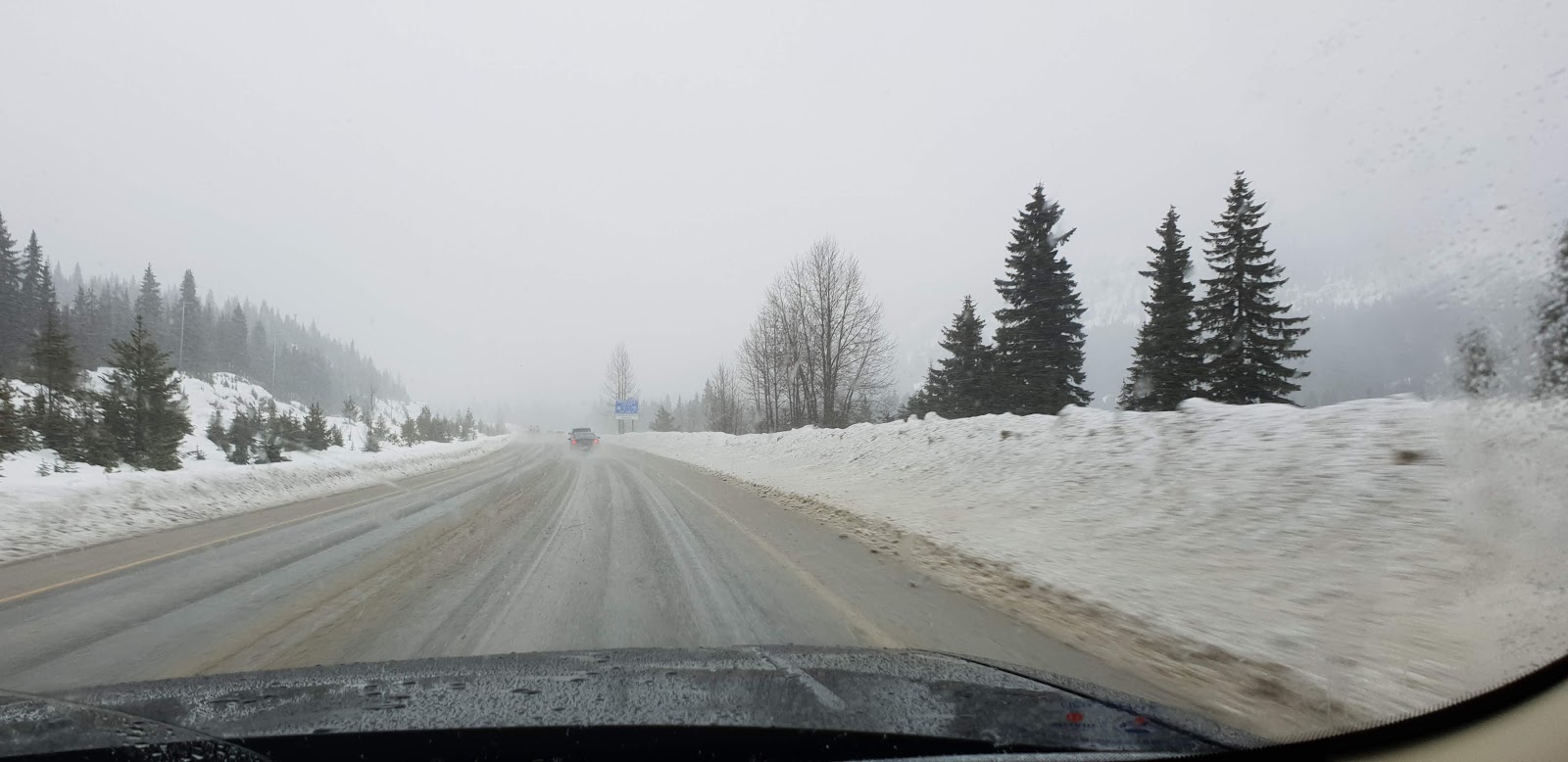
We finally leave the hotel at about half-past ten, and it is raining.  It is a simple task to get on Highway 1, the TransCanada Highway, initially, and then onto Highway 5, the Coquihalla Highway for the trip to Kamloops.

It rains all the way to the top of the mountain, progress hampered from time to time by water sprays from both vehicles and trucks.  The rain is relentless.  At the top of the mountain, the rain turns into snow and the road surface to slush.  It’s 0 degrees, but being the afternoon, I was not expecting it to turn to ice very quickly.

On the other side of the mountain, closer to Kamloops, there was sleet, then rain, then nothing, the last 100kms or so, in reasonably dry conditions.

Outside Kamloops, and in the town itself, there was evidence of snow recently cleared, and slushy roads.  Cars in various places were covered in snow, indicating the most recent falls had been the night before.

We’re staying at the Park Hotel, a heritage building, apparently built in the later 1920s.  In the style of the time, it is a little like a rabbit warren with passages turning off in a number of directions, and showing it is spread across a number of different buildings.

It has the original Otis elevator that can take a maximum of four passengers, and a sign on the wall that says “no horseplay inside the elevator” which is a rather interesting expression that only someone of my vintage would understand.  And, for those without a sense of humor, you definitely couldn’t fit a horse in it to play with.

The thing is, how do you find a balance between keeping the old world charm with modern-day expectations.  You can’t.  Some hotels try valiantly to get that balance.  Here, it is simply old world charm, which I guess we should be grateful for because sooner rather than later it’s going to disappear forever.

In my writer’s mind, given the importance of the railways, this was probably a thriving place for travelers, and once upon a time, there were a lot more hotels like this one.

A Movie Review – Emma

This is not the first time I have seen a movie about Jane Austen’s Emma. The last one starred Gwyneth Paltrow who did a reasonable job of being the self-appointed matchmaker. In this new edition, the role of Emma went to Anya Taylor-Joy whom I thought was the better of the two.

In every one of these period pieces, it is always a treat to see who’s been roped into an acting role from a long list of old and new British television and film stars.

I was particularly pleased with Bill Nighy’s rendition of Mr. Woodhouse’s role, the running gag of searching for those invisible draughts, and strategic use of the fireside panels.

Rupert Graves, as Mr. Weston, the recipient of Emma’s matchmaking prowess (or otherwise) was also a welcome addition to what was an almost flawless selection of cast members.

But, other than the familiar plotline that included attempted matchmaking and the exercise of privilege, two things stood out. Johnny Flynn’s rendition of Mr. Knightley didn’t sit well with me as I kept going back to previous actors who filled the role, and who were in my opinion, better, and the other, the treatment of the clergy.

It seems to me that Jane Austen didn’t have much time for them because both in this and in Pride and Prejudice, the role seemed to require a buffoon rather than someone sensible. Perhaps it was best portrayed as such as it added some comic light relief from some of the more stodgy moments.

I give it a three out of five stars.

A movie review – Call of the Wild

It’s always a pleasure to go and see a movie with Harrison Ford in it, whether beating off a hoard of crooked treasure hunters or just being a grumpy old man.

In this, he was playing his grumpy old man.

But it’s the dog, Buck, a cross between a St Bernard and a Scotch Collie that steals the show.

And rightly so.

Everyone else came to see Harrison Ford, who comes in and out of the picture until the end.  I came to see the dog, whom I think might well be nicknamed ‘the great galuka’ though I have no idea where that name originated.

Certainly, for sheer size and energy he bounds his way across the countryside, from his home in California to the wilds of the Yukon and Alaska, from being a spoilt household pet, then a sled dog and part of a group of other dogs, delivering mail, then a sled dog for a cruel gold seeker, to finally becoming a companion for an old man, yes, Harrison Ford, who saved him from a certain death, who seeks to get away from everyone and everything.

The end is sad in one sense but uplifting in another, nor did I find any part of it slow-moving or boring.

Solid performances all round.

I give it four stars out of five.

A Long Day’s Journey into Night

That was the name of a play, the script of which I once took out of a library, but never got around to reading it.

It sparked a momentary interest in Eugene O’Neill’s work, but I found it a little hard to understand.  Of course, back then, when I knew little about anything, it was basically a mystery.

It did fuel a brief dalliance with books with a deeper meaning for a short time, one of which was Alan Sillitoe’s Saturday Night and Sunday Morning, but more intriguing of his works was called The Loneliness of the Long-Distance Runner.

While it could be said the literal meaning of that title was rather true, having done a little long-distance running mostly in the final years of school, and realizing it was a lonely sport, it was probably the first time I discovered allegory.

But aside from all that, it led to a foray into more salacious books such as The Postman Always Rings Twice.

And, don’t get me started on D H Lawrence’s Lady Chatterley’s Lover.

However, I’m doing my usual digression, so back to the point…

Taking it in the literal sense, you can do a long day’s work, not get finished by the time you are supposed to go home, and then decide to burn the midnight oil, i.e., work on into the night.

And some days, you know the ones, where time literally drags, and it feels like forever before it’s time to go home, sometimes in darkness, for a variety of reasons, not just the obvious!

Other times, like when reading a good book, you pick it up in the morning, and the next thing you know, it’s night, and the day is gone.  That was a ‘journey’ but a pleasant one.  Long ago, that used to happen to me a lot.

Now, I hardly get time to read, let alone write, and for some strange reason, retirement is much harder than being at work.

Perhaps I should have taken those time management courses when they were offered.

Just one of many reading lists – part 3

**Please don’t assume that you have to, nor would I ever expect you to,  read any or all of these books.  You don’t.**

Everyone, it seems, will publish what they call the top 100 books that you should read. Some are voted on, some belong to the opinion of the editor of the book review section of a newspaper, and, as you know, there are a lot of newspapers, a lot of editors, and a lot of opinions.

I’m not a newspaper, I’m not an editor, but I have a list, based on personal experience, and many, many years of reading.

It’s in no particular order.

41.  The Hound of the Baskervilles by Sir Arthur Conan Doyle, as well as a host of other Sherlock Holmes stories

42.  The Secret Agent by Joseph Conrad, one of Conrad’s later political novels, set in London in 1886 and deals with anarchism and espionage.  In those days spies were called anarchists.

43.  The Ipcress File by Len Deighton, introducing us to Harry Palmer, who was personified by Michael Caine and led to Horse Under Water, and Funeral in Berlin.  More of Len Deighton later on in the list

44.  The Remorseful Day by Colin Dexter introducing the somewhat enigmatic detective, Morse, his first name not revealed for a long time but oddly, Endeavour.  John Thaw brought him to life

45.  Crime and Punishment by Fyodor Dostoevsky, hard to pronounce and even harder to read, but perhaps worth it in the end.  By the time I read this I was wishing for a Russian writer had could use an economy of words

46.  Dr. Zhivago by Boris Pasternak wasn’t it.  A vast and lengthy dissertation on lost love, I felt very sad for Zhivago in the end.  I saw a stage play of the same name, and I’m sorry, but it’s a few hours of my life I will never get back

47.  Casino Royale, the first of the James Bond novels by Ian Fleming.  I have to say these are among my favorite spy books.  I must say I preferred the new James Bond in Casino Royale, though Sean Connery still rules!

48.  The Day of the Jackal by Frederick Forsythe, a fascinating story about an assassin

49.  Anything written by John Le Carre, but in particular, the George Smiley collection.  Finally unmasking his nemesis the Russian spymaster made it all so satisfying.

50.  The Bourne Identity by Robert Ludlam, inspiring a long series by both Ludlam and Eric Lustbader makes entertaining reading, but the first, the man who did not know who or what he really was, was excellent.  Matt Damon didn’t harm his persona either.

51.  Murder Must Advertise by Dorothy Sayers, whose detective is Lord Peter Whimsey, a 1933 mystery novel that’s eighth in the series

52.  Gorky Park by Martin Cruz Smith.  You have to admit that his Russian detective Arkady Renko is up against it when his investigation goes in a direction that uncovers corruption and dishonest in his superiors

53.  The Way of All Flesh by Samuel Butler, a semi-autobiographical novel written between 1987 and 1884, and published in 1903.  The story of the Pontifex family.

54.  Howards End by E. M. Forster, first published in 1910, is an interesting insight into the behavior of the, and between the classes, with the Schlegels acting as the catalyst.

55.  Washington Square by Henry James, originally published as a serial, and covers the conflict between daughter and father.  I must say I prefer The Ambassadors to Washington Square.

56.  Ulysses by James Joyce, a day in the life of an ordinary man, Leopold Bloom, why could it not be the 7th June rather than the 16th, for obvious reasons

57.  The Go-Between by L. P. Hartley is a view of society at the end of the Victorian period through the eyes of a young boy.  I read this while still at school and had no clue why, but later, when I read it again, I understood the meaning

58.  Atonement by Ian McEwan, I saw the film and then read the book.  Never a good idea.  Basically, a young girl makes a bad mistake and tries to atone for it.

59.  Gone With The Wind by Margaret Mitchell, the War and Peace of Americal novels, and as long by comparison.  The only book written by Mitchell, and the second most read book by Americans.  The film was interesting but awfully long.

60.  The English Patient by Michael Ondaatje, with a man with severe burns and the effect he had on three others.  Colin Firth is villain one day and hero the next, this time in the cinematic version, an out and out cad.

More to come…
 

Just one of many reading lists – part 2

**Please don’t assume that you have to, nor would I ever expect you to,  read any or all of these books.  You don’t.**

Everyone, it seems, will publish what they call the top 100 books that you should read.  Some are voted on, some belong to the opinion of the editor of the book review section of a newspaper, and, as you know, there are a lot of newspapers, a lot of editors, and a lot of opinions.

I’m not a newspaper, I’m not an editor, but I have a list, based on personal experience, and many, many years of reading.

It’s in no particular order.

21.  Passage of Arms by Eric Ambler, I have to say I have read most of his novels and they are very good

22.  Jane Eyre by Charlotte Bronte, a very powerful story of a courageous, independent woman

23.  The Riddle of the Sands by Erskine Childers, a 1903 secret service story, and a good example of an early espionage novel

24.  The Father Brown stories by G. K. Chesterton, which features a Roman Catholic priest who is also an amateur detective

25.  The Grantchester Mysteries by James Runcie, similar to the above, but featuring an Anglican vicar Sidney Chambers and set in the 1950s.  Recently brought to life on television.

26.  The High Commissioner by Jon Cleary, an Australian author, this novel introduces Sargeant Scobie Malone, in the first of many adventures

27.  A Tale of Two Cities by Charles Dickens, the first Dickens book I read, possibly because it was one of the shortest, and paved the way to read all of his books.  Who could forget Madame Defarge

28.  Brideshead Revisited by Evelyn Waugh, another of those delightful but depressing stories of the 20s through to the 40s, perhaps for some, the golden age.  What could be said, in the end, about the Flytes?

29.  The Godfather by Mario Puzo, is the story of the Corleone mafia family, and for me, the most interesting part was that of the horse’s head, and of course, the death and mayhem

30.  The Shipping News by Annie Prouix, a Pulitzer Prize winner, and a story about a man, Quoyle, who against all odds puts his life slowly back together

31.  Detection Unlimited by Georgette Heyer, noted mostly for her Regency romances, she also wrote a series of detective novels.  This was her last detective novel published in 1953

32.  Poldark by Winston Graham, a series of stories about the Poldarks and Cornwall, and his arch-nemesis, George Warleggan

33.  Our Man in Havana by Graham Greene, one of many very interesting novels, this the first I read, followed by the Quiet American and Travels With My Aunt.  Seeing movies of some didn’t enhance the reading experience.

34.  The Mayor Of Casterbridge by Thomas Hardy, another of his interesting but sometimes hard to read novels of rural England.  This led to Jude the Obscure and others in the ‘series’.  It all started with Tess of the D’Urbervilles.

35.  A Farewell to Arms by Ernest Hemingway, set during the Italian campaign of World War 1.  He also wrote The Old Man of the Sea

36.  Lucky Jim by Kingsley Amis, I don’t think he was all that lucky

37.  Whiskey Galore by Compton MacKenzie, the story of the ‘rescue’ of several hundred cases of whiskey and the locals’ efforts to hide it.  Also famous for writing Monarch of the Glen, later a television series

38.  The Expedition of Humphry Clinker by Tobias Smollett, a collection of satirical observations of English life in the 1700s in spa towns and seaside resorts

39.  Barchester Towers by Anthony Trollope, part of the series known as The Chronicles of Barsetshire and features the unpopular Bishop Proudie and Mrs. Proudie

40. The Mysterious Affair at Styles by Agatha Christie, Christie’s first book published in 1920, and introduced Poirot, Arthur Hastings, and Inspector Japp.  Who knew so many books would follow

The list continues

Just one of many reading lists – part 1

**Please don’t assume that you have to, nor would I ever expect you to,  read any or all of these books.  You don’t.**

Everyone, it seems, will publish what they call the top 100 books that you should read.  Some are voted on, some belong to the opinion of the editor of the book review section of a newspaper, and, as you know, there are a lot of newspapers, a lot of editors, and a lot of opinions.

I’m not a newspaper, I’m not an editor, but I have a list, based on personal experience, and many, many years of reading.

It’s in no particular order.

  1.  The Life and Opinions of Tristram Shandy, Gentleman by Laurence Sterne.  Don’t ask me why but I found this an interesting slice of life in England in the 1700s
  2. Vanity Fair by William Thackeray.  I met a direct descendant of him in England on a research visit which fuelled an interest in the book.  Another large tome recently brought to life by the mini-series on television.
  3. The Moonstone by Wilkie Collins.  Arguably the first detective novel, it was fuel for the imagination of any budding detective novel author.  He also wrote The Woman in White.
  4. Middlemarch by George Eliot, a remarkable novel, and famous for the fact it was written by a woman who thought it was best to use a male name in order to get recognition.
  5. Any of the Sherlock Holmes stories by Arthur Conan Doyle
  6. New Grub Street by George Gissing, very, very gritty
  7. The Thirty-Nine Steps by John Buchan, another of those incredibly well-written spy stories
  8. A Passage to India by E.M. Forster, a novel that brings up the subject of the British Empire
  9. The Great Gatsby by F. Scott Fitgerald, a story from the jazz age and the mysterious Jay Gatsby whom no one could figure out
  10. The Maltese Falcon by Dashiell Hammett, one of the few books that opened up the world of the Private Detective, and fostered a brilliant movie with Humprey Bogart as Sam Spade.
  11. The Big Sleep by Raymond Chandler, the author who introduced us to Philip Marlowe, with two definitive characterizations by Humprey Bogart and Robert Mitchum
  12. The Grapes of Wrath by John Steinbeck, the classic about a family in the Great Depression, and my first introduction to Henry Fonda in the movie version of the book
  13. To Kill a Mockingbird by Harper Lee.  I had to read this when I was at school and probably a time when I didn’t understand it’s importance.  Seeing the film with Gregory Peck much later helped.
  14. Catch 22 by Joseph Heller.  A friend recommended this and after I read it, I wondered what the hell it was about.  Only now do I understand it’s anti-war undertones
  15. Far from the Madding Crowd by Thomas Hardy was the novel that introduced me to Hardy
  16. Rural Rides by William Cobbett is a slice of life in the southern English countryside in the 1800s
  17. Pride and Prejudice by Jane Austen, the first book of hers I read and found it fascinating.  Of course, when Mr. Darcy was brought to life in the television series, it found a whole new generation of readers
  18. Great Expectations by Charles Dickens, the remarkable story of Pip, Miss Havisham, and the mysterious benefactor
  19. Fahrenheit 451 by Ray Bradbury, apparently the temperature that paper burns, but this is more about Guy Montag and the saving of books rather than burning them
  20. Madame Bovary by Gustave Flaubert, probably the most depressing novel I’ve ever read, about a woman married to a mediocre doctor and seeks to escape to a fantasy world that leads to disappointment and devastating consequences

The list continues …

A Long Day’s Journey into Night

That was the name of a play, the script of which I once took out of a library, but never got around to reading it.

It sparked a momentary interest in Eugene O’Neill’s work, but I found it a little hard to understand.  Of course, back then, when I knew little about anything, it was basically a mystery.

It did fuel a brief dalliance with books with a deeper meaning for a short time, one of which was Alan Sillitoe’s Saturday Night and Sunday Morning, but more intriguing of his works was called The Loneliness of the Long-Distance Runner.

While it could be said the literal meaning of that title was rather true, having done a little long-distance running mostly in the final years of school, and realizing it was a lonely sport, it was probably the first time I discovered allegory.

But aside from all that, it led to a foray into more salacious books such as The Postman Always Rings Twice.

And, don’t get me started on D H Lawrence’s Lady Chatterley’s Lover.

However, I’m doing my usual digression, so back to the point…

Taking it in the literal sense, you can do a long day’s work, not get finished by the time you are supposed to go home, and then decide to burn the midnight oil, i.e., work on into the night.

And some days, you know the ones, where time literally drags, and it feels like forever before it’s time to go home, sometimes in darkness, for a variety of reasons, not just the obvious!

Other times, like when reading a good book, you pick it up in the morning, and the next thing you know, it’s night, and the day is gone.  That was a ‘journey’ but a pleasant one.  Long ago, that used to happen to me a lot.

Now, I hardly get time to read, let alone write, and for some strange reason, retirement is much harder than being at work.

Perhaps I should have taken those time management courses when they were offered.