“The Things We Do For Love” – Coming soon

Is love the metaphorical equivalent to ‘walking the plank’; a dive into uncharted waters?

For Henry the only romance he was interested in was a life at sea, and when away from it, he strived to find sanctuary from his family and perhaps life itself.  It takes him to a small village by the sea, s place he never expected to find another just like him, Michelle, whom he soon discovers is as mysterious as she is beautiful.

Henry had long since given up the notion of finding romance, and Michelle couldn’t get involved for reasons she could never explain, but in the end both acknowledge that something happened the moment they first met.  

Plans were made, plans were revised, and hopes were shattered.

A chance encounter causes Michelle’s past to catch up with her, and whatever hope she had of having a normal life with Henry, or anyone else, is gone.  To keep him alive she has to destroy her blossoming relationship, an act that breaks her heart and shatters his.

But can love conquer all?

It takes a few words of encouragement from an unlikely source to send Henry and his friend Radly on an odyssey into the darkest corners of the red light district in a race against time to find and rescue the woman he finally realizes is the love of his life.

The cover, at the moment, looks like this:

lovecoverfinal1

A matter of life and … what’s worse than death – Episode 8

This is a story inspired by a visit to an old castle in Italy. It was, of course, written while travelling on a plane, though I’m not sure if it was from Calgary to Toronto, or New York to Vancouver.

But, there’s more to come. Those were long flights…

And sadly when I read what I’d written, off the plane and in the cold hard light of dawn, there were problems, which now in the second draft, should provide the proper start.


A voice with a German accent, a male, middle-aged.  A scientist?  He sounded very frightened.

“Apparently I’m on the wrong side.”

“Englander?”  The voice sounded very close, perhaps the cell next to mine.

“Yes.  Seems the men upstairs are not, even though they look like my fellow soldiers, so you can imagine my surprise when I discovered they were German.  Did you come here looking for a better life away from the Reich?”

“I heard rumours of such a place in Italy where if you had certain information, they, the British and Americans would help you escape.  I thought it was another SS ruse, but a friend told me he believed it was true, and we came together.”

“Is he still here?”

“No.  He was granted safe passage with another group who left a week ago, or so I was told.”

“And why are you still here?”

“Waiting to be sent in the next group.”

I arrived a week ago, probably just after the last group had been dispatched, more than likely to their deaths, or back to the Reich.  No more had been processed since I’d arrived.  No one had come or gone.

“How did you specifically get here?”

“The Resistance.  We had a name to contact in the town not far from here.  He then arranged for us to be brought here.”

Not the resistance that may have originally been involved, but a collaborator.  I’d been having problems communicating with the resistance cells in this area, and now I think I knew why.  They’d been informed on by one of their own.  Because of the problems, we’d decided not to use the normal channels to get, and because they didn’t know I was coming it was the reason why there ‘d been the last minute botched attempt on my life in transit.

The problem was far worse than any of us had imagined.

And there was a lot less hope for a rescue by the local resistance.

“How many others are here?”

“Three.  There have been no new arrivals for several days.  And I think there are a few prisoners who are being tortured by the sound of it.”

And if Jackerby gets his way, I might be added to the list of suspects to be questioned.  I’m sure it wouldn’t be long before they realised I had usable information, especially about the resistance cells.  It certainly gave credence as to why Jackerby hadn’t been so rough with me.

It looked like it wasn’t going to be long before being asked a few sticky questions.


© Charles Heath 2019

What happens after the action packed start – Part 19

Our hero knows he’s in serious trouble.

The problem is, there are familiar faces and a question of who is a friend and who is foe made all the more difficult because of the enemy, if it was the enemy, simply because it didn’t look or sound or act like the enemy.


Now, it appears, his problems stem from another operation he participated in.

It didn’t take much effort to come to the only viable explanation of why a buried operation had been brought back to life.

Colonel Bamfield.

And it didn’t take much more effort to realise that operation had been one of his, not that any of us knew that at the time, but for whatever reason, it had gone badly and now he was looking for answers.

Answers to what though?

It was a simple extraction; two operatives had their cover blown and were in hiding.  A seven-man team in two choppers, get in, collect them, and get out.  Seven men were overkill, but they were important operatives with vital intelligence.

I was a last minute addition to the team, replacing one of the sergeants who had been injured in an accident.  It was a tight-knit team and I was not made to feel welcome.  It was the usual fate of outsiders and it didn’t bother me.

It was their leader that did.  Lieutenant Treen.  But that came later, all it was, at first, was a sense of unease with his informal manner of command, and somewhat edgy disposition.

When I landed at the airfield, I was met by the other Sergeant, Mason, and taken to the briefing, which had been delayed until my arrival.  Treen was there, pacing up and down like a caged tiger.  It was apparent there were still some details still being worked on.  Being so close to wheels up, I was not surprised at the tension among the group.

A Captain, a man named Worsefell, conducted the briefing, and it was patchy.  Not the worst I’d been to, but it appeared the situation on the ground had changed considerably in the last 12 hours, necessitating a change in plans.

 The operative had managed to get cover in an old abandoned building.  That was fine until a group of enemy soldiers arrived and set up camp in the field not 100 yards from their position.  Now, it was not possible to leave without being seen, day or night.

We now had to either distract or remove the enemy soldiers, an enemy we had no numbers or how heavily armed they were because our source on the ground had gone quiet.  To me, it was possible the source had been captured, and if that was the case, it was also possible the enemy knew we were coming.  But according to the Captain, this particular source had gone quiet before, in similar circumstances, so my suggestion was ignored.

Instead, the consensus was to go in and make an assessment on the ground.  It meant we had to land further away, and have a long journey by foot with all the problems that might involve, and then return.  That was the plan.  The Captain had left it in Treen’s hands.

And Treen was not one to back away from a fight, not even when it was clear to everyone in that room, with or without the necessary intelligence, that the odds were stacked against success.

I looked at Lallo who was waiting for an answer.  “I guess the brass didn’t know what to do with me, sir.”

My use of the word sir was noted.

“Be that as it may, I have a few questions about that operation.”

“I’m afraid it’s classified, and I’m under oath not to speak about it.”

Lallo took out a piece of folded paper from the inside pocket of his uniform jacket unfolded it and passed it to me.

From the very General who had ordered my silence.


© Charles Heath 2019

How does a story change in the retelling, and retelling, and …

I was reading an article about the bible the other day, and what I gathered to be the writers intent was that the end result was an accumulation of many times retold and translated stories.  Of course, it’s not quite as simple as that, but…

It sort of relates to another story I read years ago and re-enacted with a few friends to check its veracity.  What happens is the first person is given the correct story, then having memorized it, relates it to the second and then along a chain of ten people.

The story related by the tenth person, when compared to the original, had only part’s of the original story and for some reason new elements that somehow were misinterpretations of original story elements.

This perhaps could be put down to the individuals upbringing and background, which always gets used in the interpretation of what they are told.  We all use different methods to remember things and this will always impact how we interpret and relate information.

It’s also the same when three different eyewitnesses to an accident will rarely agree on the details.  Certain elements will be the same, but others will not.

A case in point, when individual family members recall events involving all of them, each will remember seminal events differently, and usually, from their perspective, it will revolve around where they perceive they fit in the family hierarchy.  A stronger brother or sister will always see it differently to a weaker one.

My childhood memories are basically different to my brothers, and I suspect those events that he fails to recall are deliberately cast away because either they didn’t affect him, or there were so horrible, he deliberately cast them out.

We all tend to do that.  Some memories he has of the so-called old days I have no recollection of.  But in saying that, sometimes I learn something new, that he had remembered, or I had forgotten, so there’s a slight shift in the narrative.

So it seems to me memories are, in one respect, a choice, and in another, what we can remember at the time.  We often choose to remember the good ones and cast out the bad.  Sometime we might embellish an incident, others we might gloss over it.

Was that the case of when it finally came to putting the biblical story down on paper (or in stone as the case may be), it was an amalgam of similar stories told a number of times, each relating it according to their memories and, perhaps, storytelling abilities?

However we look at it, remember it, or relate it, the old days, the days of yesteryear will always be different each time we speak about them.  Until, of course, until someone finally commits the story to paper.


I’ve always wanted to go on a Treasure Hunt – Part 13

Here’s the thing…

Every time I close my eyes, I see something different.

I’d like to think the cinema of my dreams is playing a double feature but it’s a bit like a comedy cartoon night on Fox.

But these dreams are nothing to laugh about.

Once again there’s a new instalment of an old feature, and we’re back on the treasure hunt.

I stood at the entrance and counted to ten, then pushed the door open and went in.

I was not sure what I was expecting, but it was not what I saw.  A country and western bar, with decorations that made you think you were in Texas, booths and tables elegantly set under subdued lighting, and well dressed serving staff serving customers.

Across the back was a long bar, and a bottle of every known drink known to mankind behind it, and two bartenders, looking busy.  Several people were sitting at the bar, including Nadia, who was by herself, having a shot glass, no doubt with tequila, and beer put in front of her.

No one even looked up to note my arrival.

It took a minute to scan the customers I could see, and not recognise any of them, except they were not of the scoundrel variety, and whether or not there was another exit if I needed one.

Always an emergency exit near the restrooms and I could see them in the distance.

Another look around, then I crossed the room, weaving through the tables, to where Nadia was sitting.  She hadn’t noticed my arrival.

“This seat taken?” I asked.

A quick turn of the head and I could see the rebuke on her lips.  Then surprise on her face.

“Smidge.  What are you doing here?”

“You keep asking me that question every time we meet.”

“Perhaps we should stop meeting like this.”  She turned back to the bar and downed the shot glass contents.  “Sit if you must.”

I had expected the back of her hand to slap me to the floor for daring to talk to her, but instead sat before she changed her mind.

“Same question,” she said, still not looking at me.

I’d try flippancy first and see how that went.  “Always wanted to come and see the famous Lantern Inn, but it doesn’t seem to be famous any more, well, not in that respect.”

She looked sideways at me.  “What if it had been?”

“Then I’m guessing this would have been a short encounter.”

“It still might be.”

OK, try not to be too brave, she could still beat me to a pulp with one hand tied behind her back.  “I doubt you want to cause a scene, and especially not with someone like me.”

She turned and looked at me.  Admittedly I was not the skinny assed punk I used to be, but still not her type.

“When did you go and grow up?”  At least, now, she didn’t tower over me, I could see eye to eye, literally and figuratively.

“While you were away.  Amazing what some sunshine and fertilizer will do.”

Was that a hint of a smile, or a grimace?

“Still a smart ass though.”

“You haven’t changed much either.”  Short skirt, low cut top, she’d been wearing a coat when she came in.  Hair was shorter and with a fringe.  Didn’t suit her.  “What happened to this place?”

“The last Mayor cleaned up the waterfront, most of it anyway.”

And died, rather ironically, in the crossfire between the two rival gangs in this very place.  Nothing like killing a public official, corrupt or not, to precipitate a cleanup.  It just sent the gangs into darker corners.

“Why are you here, then?”  I had to ask.

“I’m respectable.”  A nod to the bartended got another shot of tequila.

For me, a Budweiser.

“So does that mean you’re dating a Benderby?”  For her, it would be the only type of respectability she could have in a town like ours unless she moved away to somewhere no one knew who she was.

“Not if they were the last family on earth.”

“So, what’s he got on you?”

She turned much faster this time to look at me, sliding off the chair and standing over me.  There was not a pretty look on her face.

I tried not to exhibit signs of fear and failed.

“Who told you that?”

“No one.”  I took a deep breath to get the tremor out of my voice.  “They got the dirt on everyone, so why should you be an exception?”

I slipped of my chair and stood toe to toe with her.

For a person with an ugly soul, she had beautiful eyes.

Then she leaned forward those last six inches and kissed me briefly on the lips.  Hers was cold.

“What do you really want Smidge?”  She pulled back, and sat down again, picking up the beer and taking a sip.

“To get payback on Alex.”

“And you think I’ll help you?”

“Well, you need a map, and I don’t think you want to cosy up to Rico, do you?”

I had just put together a plan, shaky at best, highly dangerous at worst, but it might work.  It didn’t have to be the real map, just one that was close enough to the real thing.

She reached into her purse and pulled out a key, and slid it across the bar towards me.

Room 14 at the Shingle Hotel.   Where they used to have rooms to rent by the hour.  And cockroaches, people not the bugs, in every corner.

“One hour.  Now leave.”

I heard the door open and close and looked back through the mirror behind the bar.  A large man with a beard and dark glasses.  In a gloomy restaurant.

Her date?

I took the key and left, trying to look like I was not leaving in a hurry.


© Charles Heath 2019

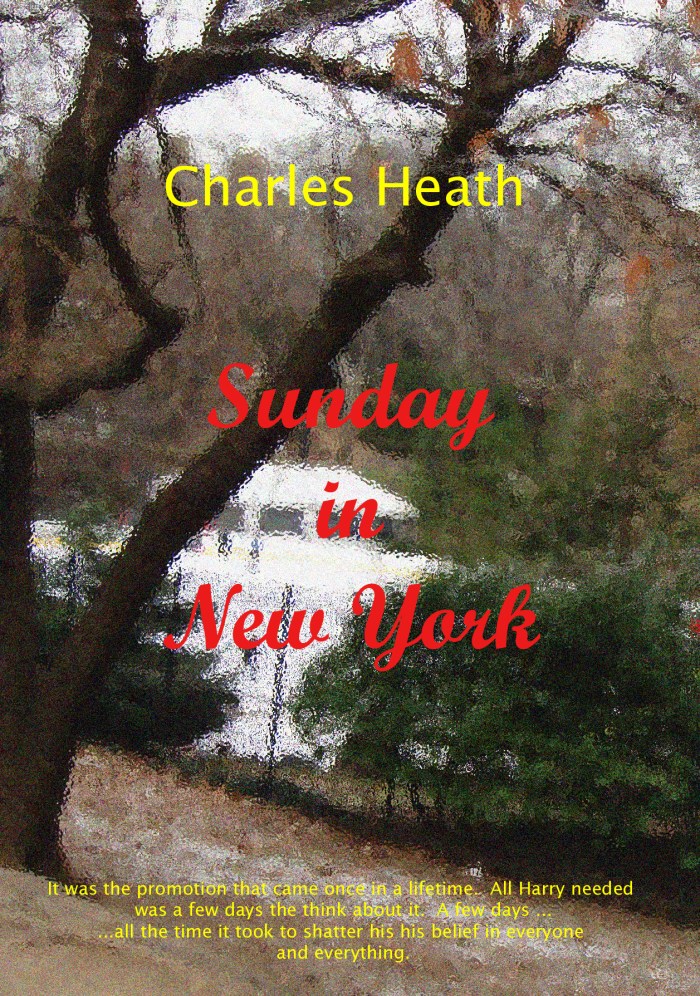
“Sunday in New York”, it’s a bumpy road to love

“Sunday in New York” is ultimately a story about trust, and what happens when a marriage is stretched to its limits.

When Harry Steele attends a lunch with his manager, Barclay, to discuss a promotion that any junior executive would accept in a heartbeat, it is the fact his wife, Alison, who previously professed her reservations about Barclay, also agreed to attend, that casts a small element of doubt in his mind.

From that moment, his life, in the company, in deciding what to do, his marriage, his very life, spirals out of control.

There is no one big factor that can prove Harry’s worst fears, that his marriage is over, just a number of small, interconnecting events, when piled on top of each other, points to a cataclysmic end to everything he had believed in.

Trust is lost firstly in his best friend and mentor, Andy, who only hints of impending disaster, Sasha, a woman whom he saved, and who appears to have motives of her own, and then in his wife, Alison, as he discovered piece by piece damning evidence she is about to leave him for another man.

Can we trust what we see with our eyes or trust what we hear?

Haven’t we all jumped to conclusions at least once in our lives?

Can Alison, a woman whose self-belief and confidence is about to be put to the ultimate test, find a way of proving their relationship is as strong as it has ever been?

As they say in the classics, read on!

Purchase:

http://tinyurl.com/Amazon-SundayInNewYork

Sunday In New York

Another start to another story, again

I have a stab at improving this starting piece every now and then, a project that started about a year or so ago, and I find myself rewriting the start over and over because I’m not satisfied with the characterization.

It’s not so much the storyline, as it is in trying to create sympathy for the character, and not find him as dull as ditchwater.  He’s improving with age.  As writers, we tend to create colourful characters and shy away from those who are dull and boring, because after all, as a reader, you want to become something or someone who is far from ordinary.  Well, Graham is starting out ordinary, but he will be anything but by the time I write those words ‘The End’.

I promise.


I am the master of my own destiny.

My father had drummed that into me, as well as my older brother and younger sister, over and over, until it became a mantra.

For them.

I could not say I didn’t have the same advantages afforded to them, afforded to me.  I did.

But somewhere lost in the translation, someone forgot to tell me that it was only advice, not an order, and mistaking it for the latter, I struck out on my own path.

And for the next ten years, it was a long and winding path that led me to this point in time, in a small room that held nothing to tell me where I came from, or who I really was.

My parents were very wealthy with an Upper Westside Apartment in Manhattan and a holiday house in Martha’s Vineyard, my sister had a successful medical career and married a most eligible bachelor, as expected, and my brother, he was a politician.

I’d not seen any of them in at least five years, and they hadn’t called me.

You see, I was the black sheep of the family.  I dropped out of college when it all became too much, and drifted.  Seasonal labourer, farm hand, factory worker, add job man, and night watchman. 

At least now I had a uniform, and a gun, and looked like I’d made something of myself.

It was hard to say why, just before I was about to head out of the factory to end my shift, that those thoughts about them came into my mind.   They might be gone, but I guess I would never forget about them.  I wondered briefly if any of them thought about me.


It was 3 a.m. and it was like standing on the exact epicentre of the South Pole.  I’d just stepped from the factory warehouse into the car park.

The car was covered in snow.  The weather was clear now, but I could feel more snow was coming.  A white Christmas?  That’s all I needed.  I hoped I remembered to put the antifreeze in my radiator this time.

As I approached my car, the light went on inside an SUV parked next to my car.  The door opened and what looked to be a woman was getting out of the car.

“Graham?”

It was a voice I was familiar with, though I hadn’t heard it for a long time.

I looked again and was shocked to see my ultra successful sister, Penelope.  She was leaning against the front fender, and from what I could see, didn’t look too well.

How on earth did she find me, after all the years that had passed?  Perhaps that sparked my un-conciliatory question, “What do you want?”

I could see the surprise and then hurt in her expression.  Perhaps I had been a little harsh.  Whatever she felt, it passed, and she said, “Help.”

My help?  Help with what? I was the last person who could help her, or anyone for that matter, with anything.   But curiosity got the better of me.  “Why?”

“I think my husband is trying to kill me.”

Then, with that said, she slid down the side of the car, and I could see, in the arc lamps lighting the car park, a trail of blood.

My first thought, she needed the help of a doctor, not a stupid brother, then a second thought, call 911, which I did, and hoped like hell they got here in time.

And, yes, there was a third thought that crossed my mind.  Whether or not I would be blamed for this event.


© Charles Heath 2019

Was it just another surveillance job – Episode 5

I’m back home and this story has been sitting on a back burner for a few months, waiting for some more to be written.

The trouble is, there are also other stories to write, and I’m not very good at prioritising.

But, here we are, a few minutes opened up and it didn’t take long to get back into the groove.

Is it going to be revenge or just plain bewilderment?


There were protocols to handle every situation.  It’s why I was stuck in a room with a dozen others for nearly six months, learning the ropes.

That’s what Alex called it.  He’d also said it was a waste of time because by the time we made it out into the field all the bad guys would be locked up.  Patience wasn’t one of his virtues.

That’s why Alex didn’t make it through the first cut.

It had been a long six months but it had been worth it when ten of us out of the original intake of 24 made it.  I considered myself lucky.

Now three of those men were missing, and I believed they were dead, or if not dead, incapacitated.  This was our first live mission.  We had been excited but held that in check.  We could celebrate our first mission together, and then if it was a success.

At this moment, in my mind, it was anything but a success.

And my anger was building.  I kept the target in sight, and once or twice he nearly slipped away, but I knew the area having studied the maps the day before.  I liked to know what it was like on the ground, and if it was the target’s home turf, then I didn’t want him to have the advantage.

It was those little things, our instructor said, that could make a difference.

It did.

I knew or thought I knew where he was going.

At some point, I was going to have to take a chance, and head him off.  It also meant I might lose him, but I had a point on the map where I believed if he didn’t go where I was anticipating, he’d still be within range to find him again.

Time.

He went right, I went straight ahead.

His most likely destination, the train station.  His training wasn’t much different from mine.  After a calamity, look to make an unexpected exit.  There were buses, but they led basically to the same place.

Five minutes, and I’d know.

I came out on the main street that ran alongside the train tracks, the station was behind me, and he would have to pass me to get there.

There was also a dead end lane between him and me, and that was where I would corral him.

Almost a minute passed, and it was too long.  Two.  The thought of possibly being wrong leapt into my mind, along with the sickening feeling in my stomach of failure.

Two and a half.  I took several steps in his possible direction, then I saw him turn the corner.  I stepped back and out of sight.  I needed him to get to the lane entrance before I made a move.

He was wary and looking around.  He knew I was on his tail.

As he approached the laneway, I stepped out and started walking slowly towards him.  It took a few steps before he realised it was me, and stopped.  Was he surprised at my enterprise, or shocked.

Predictably he turned into the lane.

I ran.

At the entrance to the lane, I stopped and saw him reach the dead end.  There was no climbing over the fence at the end,. Nor were there any ladders or climbable points either side.

He would have to get past me.

I had him, and he knew it.


© Charles Heath 2018-2019

An excerpt from “One Last Look”


I’d read about out of body experiences, and like everyone else, thought it was nonsense.  Some people claimed to see themselves in the operating theatre, medical staff frantically trying to revive them, and being surrounded by white light.

I was definitely looking down, but it wasn’t me I was looking at.

It was two children, a boy and a girl, with their parents, in a park.

The boy was Alan.  He was about six or seven.  The girl was Louise, and she was five years old.  She had long red hair and looked the image of her mother.

I remember it now, it was Louise’s birthday and we went down to Bournemouth to visit our Grandmother, and it was the last time we were all together as a family.

We were flying homemade kites our father had made for us, and after we lay there looking up at the sky, making animals out of the clouds.  I saw an elephant, Louise saw a giraffe.

We were so happy then.

Before the tragedy.


When I looked again ten years had passed and we were living in hell.  Louise and I had become very adept at survival in a world we really didn’t understand, surrounded by people who wanted to crush our souls.

It was not a life a normal child had, our foster parents never quite the sort of people who were adequately equipped for two broken-hearted children.  They tried their best, but their best was not good enough.

Every day it was a battle, to avoid the Bannister’s and Archie in particular, every day he made advances towards Louise and every day she fended him off.

Until one day she couldn’t.

Now I was sitting in the hospital, holding Louise’s hand.  She was in a coma, and the doctors didn’t think she would wake from it.  The damage done to her was too severe.

The doctors were wrong.

She woke, briefly, to name her five assailants.  It was enough to have them arrested.  It was not enough to have them convicted.

Justice would have to be served by other means.


I was outside the Bannister’s home.

I’d made my way there without really thinking, after watching Louise die.  It was like being on autopilot, and I had no control over what I was doing.  I had murder in mind.  It was why I was holding an iron bar.

Skulking in the shadows.  It was not very different from the way the Bannister’s operated.

I waited till Archie came out.  I knew he eventually would.  The police had taken him to the station for questioning, and then let him go.  I didn’t understand why, nor did I care.

I followed him up the towpath, waiting till he stopped to light a cigarette, then came out of the shadows.

“Wotcha got there Alan?” he asked when he saw me.  He knew what it was, and what it was for.

It was the first time I’d seen the fear in his eyes.  He was alone.

“Justice.”

“For that slut of a sister of yours.  I had nuffing to do with it.”

“She said otherwise, Archie.”

“She never said nuffing, you just made it up.”  An attempt at bluster, but there was no confidence in his voice.

I held up the pipe.  It had blood on it.  Willy’s blood.  “She may or may not have Archie, but Willy didn’t make it up.  He sang like a bird.  That’s his blood, probably brains on the pipe too, Archie, and yours will be there soon enough.”

“He dunnit, not me.  Lyin’ bastard would say anything to save his own skin.”  Definitely scared now, he was looking to run away.

“No, Archie.  He didn’t.  I’m coming for you.  All of you Bannisters.  And everyone who touched my sister.”


It was the recurring nightmare I had for years afterwards.

I closed my eyes and tried to shut out the thoughts, the images of Louise, the phone call, the visit to the hospital and being there when she succumbed to her injuries.  Those were the very worst few hours of my life.

She had asked me to come to the railway station and walk home with her, and I was running late.  If I had left when I was supposed to, it would never have happened and for years afterwards, I blamed myself for her death.

If only I’d not been late…

When the police finally caught the rapists, I’d known all along who they’d be; antagonists from school, the ring leader, Archie Bannister, a spurned boyfriend, a boy whose parents, ubiquitously known to all as ‘the Bannister’s, dealt in violence and crime and who owned the neighbourhood.  The sins of the father had been very definitely passed onto the son.

At school, I used to be the whipping boy, Archie, a few grades ahead of me, made a point of belting me and a few of the other boys, to make sure the rest did as they were told.  He liked Louise, but she had no time for a bully like him, even when he promised he would ‘protect’ me.

I knew the gang members, the boys who tow-kowed to save getting beaten up, and after the police couldn’t get enough information to prosecute them because everyone was too afraid to speak out, I went after Willy.  There was always a weak link in a group, and he was it.

He worked in a factory, did long hours on a Wednesday and came home after dark alone.  It was a half mile walk, through a park.  The night I approached him, I smashed the lights and left it in darkness.  He nearly changed his mind and went the long way home.

He didn’t.

It took an hour and a half to get the names.  At first, when he saw me, he laughed.  He said I would be next, and that was four words more than he knew he should have said.

When I found him alone the next morning I showed him the iron bar and told him he was on the list.  I didn’t kill him then, he could wait his turn, and worry about what was going to happen to him.

When the police came to visit me shortly after that encounter, no doubt at the behest of the Bannister’s, the neighbourhood closed ranks and gave me an ironclad alibi.  The Bannister’s then came to visit me and threatened me.  I told them their days were numbered and showed them the door.

At the trial, he and his friends got off on a technicality.  The police had failed to do their job properly, but it was not the police, but a single policeman, corrupted by the Bannisters.

Archie could help but rub it in my face.  He was invincible.

Joe Collins took 12 bullets and six hours to bleed out.  He apologized, he pleaded, he cried, he begged.  I didn’t care.

Barry Mills, a strong lad with a mind to hurting people, Archie’s enforcer, almost got the better of me.  I had to hit him more times than I wanted to, and in the end, I had to be satisfied that he died a short but agonizing death.

I revisited Willy in the hospital.  He’d recovered enough to recognize me, and why I’d come.  Suffocation was too good for him.

David Williams, second in command of the gang, was as tough and nasty as the Bannisters.  His family were forging a partnership with the Bannister’s to make them even more powerful.  Outwardly David was a pleasant sort of chap, affable, polite, and well mannered.  A lot of people didn’t believe he could be like, or working with, the Bannisters.

He and I met in the pub.  We got along like old friends.  He said Willy had just named anyone he could think of, and that he was innocent of any charges.  We shook hands and parted as friends.

Three hours later he was sitting in a chair in the middle of a disused factory, blindfolded and scared.  I sat and watched him, listened to him, first threatening me, and then finally pleading with me.  He’d guessed who it was that had kidnapped him.

When it was dark, I took the blindfold off and shone a very bright light in his eyes.  I asked him if the violence he had visited upon my sister was worth it.  He told me he was just a spectator.

I’d read the coroner’s report.  They all had a turn.  He was a liar.

He took nineteen bullets to die.

Then came Archie.

The same factory only this time there were four seats.  Anna Bannister, brothel owner, Spike Bannister, head of the family, Emily Bannister, sister, and who had nothing to do with their criminal activities.  She just had the misfortune of sharing their name.

Archie’s father told me how he was going to destroy me, and everyone I knew.

A well-placed bullet between the eyes shut him up.

Archie’s mother cursed me.  I let her suffer for an hour before I put her out of her misery.

Archie remained stony-faced until I came to Emily.  The death of his parents meant he would become head of the family.  I guess their deaths meant as little to him as they did me.

He was a little more worried about his sister.

I told him it was confession time.

He told her it was little more than a forced confession and he had done nothing to deserve my retribution.

I shrugged and shot her, and we both watched her fall to the ground screaming in agony.  I told him if he wanted her to live, he had to genuinely confess to his crimes.  This time he did, it all poured out of him.

I went over to Emily.  He watched in horror as I untied her bindings and pulled her up off the floor, suffering only from a small wound in her arm.  Without saying a word she took the gun and walked over to stand behind him.

“Louise was my friend, Archie.  My friend.”

Then she shot him.  Six times.

To me, after saying what looked like a prayer, she said, “Killing them all will not bring her back, Alan, and I doubt she would approve of any of this.  May God have mercy on your soul.”


Now I was in jail.  I’d spent three hours detailing the deaths of the five boys, everything I’d done; a full confession.  Without my sister, my life was nothing.  I didn’t want to go back to the foster parents; I doubt they’d take back a murderer.

They were not allowed to.

For a month I lived in a small cell, in solitary, no visitors.  I believed I was in the queue to be executed, and I had mentally prepared myself for the end.

Then I was told I had a visitor, and I was expecting a priest.

Instead, it was a man called McTavish. Short, wiry, and with an accent that I could barely understand.

“You’ve been a bad boy, Alan.”

When I saw it was not the priest I told the jailers not to let him in, I didn’t want to speak to anyone.  They ignored me.  I’d expected he was a psychiatrist, come to see whether I should be shipped off to the asylum.

I was beginning to think I was going mad.

I ignored him.

“I am the difference between you living or dying Alan, it’s as simple as that.  You’d be a wise man to listen to what I have to offer.”

Death sounded good.  I told him to go away.

He didn’t.  Persistent bugger.

I was handcuffed to the table.  The prison officers thought I was dangerous.  Five, plus two, murders, I guess they had a right to think that.  McTavish sat opposite me, ignoring my request to leave.

“Why’d you do it?”

“You know why.”  Maybe if I spoke he’d go away.

“Your sister.  By all accounts, the scum that did for her deserved what they got.”

“It was murder just the same.  No difference between scum and proper people.”

“You like killing?”

“No-one does.”

“No, I dare say you’re right.  But you’re different, Alan.  As clean and merciless killing I’ve ever seen.  We can use a man like you.”

“We?”

“A group of individuals who clean up the scum.”

I looked up to see his expression, one of benevolence, totally out of character for a man like him.  It looked like I didn’t have a choice.


Trained, cleared, and ready to go.

I hadn’t realized there were so many people who were, for all intents and purposes, invisible.  People that came and went, in malls, in hotels, trains, buses, airports, everywhere, people no one gave a second glance.

People like me.

In a mall, I became a shopper.

In a hotel, I was just another guest heading to his room.

On a bus or a train, I was just another commuter.

At the airport, I became a pilot.  I didn’t need to know how to fly; everyone just accepted a pilot in a pilot suit was just what he looked like.

I had a passkey.

I had the correct documents to get me onto the plane.

That walk down the air bridge was the longest of my life.  Waiting for the call from the gate, waiting for one of the air bridge staff to challenge me, stepping onto the plane.

Two pilots and a steward.  A team.  On the plane early before the rest of the crew.  A group that was committing a crime, had committed a number of crimes and thought they’d got away with it.

Until the judge, the jury and their executioner arrived.

Me.

Quick, clean, merciless.  Done.

I was now an operational field agent.


I was older now, and I could see in the mirror I was starting to go grey at the sides.  It was far too early in my life for this, but I expect it had something to do with my employment.

I didn’t recognize the man who looked back at me.

It was certainly not Alan McKenzie, nor was there any part of that fifteen-year-old who had made the decision to exact revenge.

Given a choice; I would not have gone down this path.

Or so I kept telling myself each time a little more of my soul was sold to the devil.

I was Barry Gamble.

I was Lenny Buckman.

I was Jimmy Hosen.

I was anyone but the person I wanted to be.

That’s what I told Louise, standing in front of her grave, and trying to apologize for all the harm, all the people I’d killed for that one rash decision.  If she was still alive she would be horrified, and ashamed.

Head bowed, tears streamed down my face.

God had gone on holiday and wasn’t there to hand out any forgiveness.  Not that day.  Not any day.


New York, New Years Eve.

I was at the end of a long tour, dragged out of a holiday and back into the fray, chasing down another scumbag.  They were scumbags, and I’d become an automaton hunting them down and dispatching them to what McTavish called a better place.

This time I failed.

A few drinks to blot out the failure, a blonde woman who pushed my buttons, a room in a hotel, any hotel, it was like being on the merry-go-round, round and round and round…

Her name was Silvia or Sandra, or someone I’d met before, but couldn’t quite place her.  It could be an enemy agent for all I knew or all I cared right then.

I was done.

I’d had enough.

I gave her the gun.

I begged her to kill me.

She didn’t.

Instead, I simply cried, letting the pent up emotion loose after being suppressed for so long, and she stayed with me, holding me close, and saying I was safe, that she knew exactly how I felt.

How could she?  No one could know what I’d been through.

I remembered her name after she had gone.

Amanda.

I remembered she had an imperfection in her right eye.

Someone else had the same imperfection.

I couldn’t remember who that was.

Not then.


I had a dingy flat in Kensington, a place that I rarely stayed in if I could help it.  After five-star hotel rooms, it made me feel shabby.

The end of another mission, I was on my way home, the underground, a bus, and then a walk.

It was late.

People were spilling out of the pub after the last drinks.  Most in good spirits, others slightly more boisterous.

A loud-mouthed chap bumped into me, the sort who had one too many, and was ready to take on all comers.

He turned on me, “Watch where you’re going, you fool.”

Two of his friends dragged him away.  He shrugged them off, squared up.

I punched him hard, in the stomach, and he fell backwards onto the ground.  I looked at his two friends.  “Take him home before someone makes mincemeat out of him.”

They grabbed his arms, lifted him off the ground and took him away.

Out of the corner of my eye, I could see a woman, early thirties, quite attractive, but very, very drunk.  She staggered from the bar, bumped into me, and finished up sitting on the side of the road.

I looked around to see where her friends were.  The exodus from the pub was over and the few nearby were leaving to go home.

She was alone, drunk, and by the look of her, unable to move.

I sat beside her.  “Where are your friends?”

“Dunno.”

“You need help?”

She looked up, and sideways at me.  She didn’t look the sort who would get in this state.  Or maybe she was, I was a terrible judge of women.

“Who are you?” she asked.

“Nobody.”  I was exactly how I felt.

“Well Mr Nobody, I’m drunk, and I don’t care.  Just leave me here to rot.”

She put her head back between her knees, and it looked to me she was trying to stop the spinning sensation in her head.

Been there before, and it’s not a good feeling.

“Where are your friends?” I asked again.

“Got none.”

“Perhaps I should take you home.”

“I have no home.”

“You don’t look like a homeless person.  If I’m not mistaken, those shoes are worth more than my weekly salary.”  I’d seen them advertised, in the airline magazine, don’t ask me why the ad caught my attention.

She lifted her head and looked at me again.  “You a smart fucking arse are you?”

“I have my moments.”

“Have them somewhere else.”

She rested her head against my shoulder.  We were the only two left in the street, and suddenly in darkness when the proprietor turned off the outside lights.

“Take me home,” she said suddenly.

“Where is your place?”

“Don’t have one.  Take me to your place.”

“You won’t like it.”

“I’m drunk.  What’s not to like until tomorrow.”

I helped her to her feet.  “You have a name?”

“Charlotte.”


The wedding was in a small church.  We had been away for a weekend in the country, somewhere in the Cotswolds, and found this idyllic spot.  Graves going back to the dawn of time, a beautiful garden tended by the vicar and his wife, an astonishing vista over hills and down dales.

On a spring afternoon with the sun, the flowers, and the peacefulness of the country.

I had two people at the wedding, the best man, Bradley, and my boss, Watkins.

Charlotte had her sisters Melissa and Isobel, and Isobel’s husband Giovanni, and their daughter Felicity.

And one more person who was as mysterious as she was attractive, a rather interesting combination as she was well over retirement age.  She arrived late and left early.

Aunt Agatha.

She looked me up and down with what I’d call a withering look.  “There’s more to you than meets the eye,” she said enigmatically.

“Likewise I’m sure,” I said.  It earned me an elbow in the ribs from Charlotte.  It was clear she feared this woman.

“Why did you come,” Charlotte asked.

“You know why.”

Agatha looked at me.  “I like you.  Take care of my granddaughter.  You do not want me for an enemy.”

OK, now she officially scared me.

She thrust a cheque into my hand, smiled, and left.

“Who is she,” I asked after we watched her depart.

“Certainly not my fairy godmother.”

Charlotte never mentioned her again.


Zurich in summer, not exactly my favourite place.

Instead of going to visit her sister Isobel, we stayed at a hotel in Beethovenstrasse and Isobel and Felicity came to us.  Her husband was not with her this time.

Felicity was three or four and looked very much like her mother.  She also looked very much like Charlotte, and I’d remarked on it once before and it received a sharp rebuke.

We’d been twice before, and rather than talk to her sister, Charlotte spent her time with Felicity, and they were, together, like old friends.  For so few visits they had a remarkable rapport.

I had not broached the subject of children with Charlotte, not after one such discussion where she had said she had no desire to be a mother.  It had not been a subject before and wasn’t once since.

Perhaps like all Aunts, she liked the idea of playing with a child for a while and then give it back.

Felicity was curious as to who I was, but never ventured too close.  I believed a child could sense the evil in adults and had seen through my facade of friendliness.  We were never close.

But…

This time, when observing the two together, something quite out of left field popped into my head.  It was not possible, not by any stretch of the imagination, but I thought she looked like my mother.

And Charlotte had seen me looking in their direction.  “You seem distracted,” she said.

“I was just remembering my mother.  Odd moment, haven’t done so for a very long time.”

“Why now?”  I think she had a look of concern on her face.

“Her birthday, I guess,” I said, the first excuse I could think of.

Another look and I was wrong.  She looked like Isobel or Charlotte, or if I wanted to believe it possible, Melissa too.


I was crying, tears streaming down my face.

I was in pain, searing pain from my lower back stretching down into my legs, and I was barely able to breathe.

It was like coming up for air.

It was like Snow White bringing Prince Charming back to life.  I could feel what I thought was a gentle kiss and tears dropping on my cheeks, and when I opened my eyes, I saw Charlotte slowly lifting her head, a hand gently stroking the hair off my forehead.

And in a very soft voice, she said, “Hi.”

I could not speak, but I think I smiled.  It was the girl with the imperfection in her right eye.  Everything fell into place, and I knew, in that instant that we were irrevocably meant to be together.

“Welcome back.”


© Charles Heath 2016-2019


“The Things We Do For Love” – Coming soon

Is love the metaphorical equivalent to ‘walking the plank’; a dive into uncharted waters?

For Henry the only romance he was interested in was a life at sea, and when away from it, he strived to find sanctuary from his family and perhaps life itself.  It takes him to a small village by the sea, s place he never expected to find another just like him, Michelle, whom he soon discovers is as mysterious as she is beautiful.

Henry had long since given up the notion of finding romance, and Michelle couldn’t get involved for reasons she could never explain, but in the end both acknowledge that something happened the moment they first met.  

Plans were made, plans were revised, and hopes were shattered.

A chance encounter causes Michelle’s past to catch up with her, and whatever hope she had of having a normal life with Henry, or anyone else, is gone.  To keep him alive she has to destroy her blossoming relationship, an act that breaks her heart and shatters his.

But can love conquer all?

It takes a few words of encouragement from an unlikely source to send Henry and his friend Radly on an odyssey into the darkest corners of the red light district in a race against time to find and rescue the woman he finally realizes is the love of his life.

The cover, at the moment, looks like this:

lovecoverfinal1