In a word: Maybe

This word, where I live, had taken on a new meaning.  We have telephone scammers who ask your name when you answer the phone, and when you say yes, they hang up.

It doesn’t take much imagination how they can use that recording.

So, I now answer the phone with maybe, which confuses the real callers who want to know if it is you.

Of course, maybe is one of those words that have so many meaning, but the best one is to use it while you have time to think of a proper answer.

For example, did you get the potatoes?  You haven’t been out, it slipped your mind, or you just plain forgot, but run with a ‘maybe’ so you can judge the reaction.

Angry face, you know no matter what, you’re in trouble.

Genial face, you know that it didn’t really matter and all is forgiven.

Then there’s the person who doesn’t know you and comes up to you in a crowded room.  Are you [put name here]?

Maybe.  We want to know if we’re in trouble, or if it for something good.

Using ‘maybe’ in writing probably isn’t the best word to us, but I like defying the experts.  You can always find a maybe or two in any of my books.

Was it just another surveillance job – Episode 40

I’m back home and this story has been sitting on a back burner for a few months, waiting for some more to be written.

The trouble is, there are also other stories to write, and I’m not very good at prioritizing.

But, here we are, a few minutes opened up and it didn’t take long to get back into the groove.

Chasing leads, maybe

…

Darkness fell in a noticeably short time, and we left the pub at about six. In the hour so we have been there I’d been keeping a close eye on the comings and goings, and in particular, if O’Connell came in, or someone else that might look like him.

He hadn’t, nor had any mythical family members.  Well, it had been a long shot.

Jennifer hadn’t volunteered anything more to the conversation and sat working her way through a piece of fried fish and a bowl of chips.  Neither had looked appetizing.  I would have bet she’d have the chicken, but I was wrong, and probably it wasn’t going to be the first time.

“Do you have a gun?”

It was after ten minutes of silence.  It worried me that she didn’t ask how far it was or how long it would take.  And then, out of nowhere, the gun question.

“No.  Why would I have a gun.?”

“We were issued with weapons.  I still have mine.”

“Did you bring it with you?”

“No.  Like I told you, I didn’t think I was still working for the Department.  They didn’t ask for it back, so I didn’t give it to them.”

“Or the identities?”

“No.  It was odd though; they didn’t ask about them either.”

“Maybe they were going to wait a while and then ask you back.”

This was a weird conversation to be having.  By this time we were in Peaslake Lane, and not far from the house I pulled over to the side of the road, under a tree.

The houses were set back in a rural setting.  Between the darkness and the undergrowth, the chances were we could get to the house without being seen.  From where I was sitting, no windows or doors were visible.

I made sure the car’s internal light didn’t go on the moment the door was open.

“Are you bringing your cell phone?”

“Why.  I’m not envisaging having to call anyone, nor am I expecting a call.”

I shrugged, and slipped mine into a pocket where I could easily reach it I needed to.

I got out of the car, and she followed.  She left he bag in the car.  The first sign of training kicking in; eave all un-necessary baggage behind.  Perhaps having a gun might have been a good option if we ran into trouble.

Oddly enough, now that I thought about it, Monica hadn’t asked for mine back either, but it was sitting at home in a safe, along with the five other identities Severin had issued each of us with.

I locked the car, equally as silent and invisible as she joined me.

“Which house?”

“Three along.  Follow me and keep your eyes and ears peeled.”

I didn’t have to tell her, but it didn’t hurt to emphasize the importance of stealth.  There were people home in other houses, lights in windows just discernible through the trees, one house a window without a curtain, a view into the dining room, but there was no one at the table.

If we were visiting them, perhaps we’d be in time for dinner.

The house we were looking for was in darkness from our approach.

“You keep an eye open this side, and I’ll go around the other, then come back.  I’ll see if there’s an easy entry point.”

“What if someone is home?”

“Doesn’t look like it from here, and I’ll be surprised if there is.”

A moment later she had disappeared into the shrub line and I was heading across the front of the house, heading for the other side.  I kept well away from the front door, just in case there was a motion light, or worse, a motion detector that might set off a silent alarm.

But, that might already have happened, and if it had, no one had made a move inside.

Down the side was walls and windows, no doors or French doors leading out into the garden.  None of the windows were at a decent height for us to clamber through, and if we had to, it was going to be difficult.

I continued on, around the back, where there was more success.  French doors leading onto a patio, and then the lawn.  In the corner was a greenhouse, and next to that a rose garden.  Or at least that was what both looked like in the dark.

The moon, for the moment, was hidden by dark clouds.

Perhaps it would rain, though it had not been in the forecast, but, this was England, and it could rain at any time, especially when you didn’t want or need it.  There was no light, or motion sensor over the French doors, so I crossed the patio and looked through the doors.

I had expected curtains, but these hadn’t been completely drawn.  No large light or lamp on, but there were indicator lights, several red and one a particularly bright blue, casting a rather long shadow over furniture and what looked to be a carpet square.

Out of curiosity, I tried the door.

It was open.

Then I had the blind panic moment of thinking it might be alarmed.

I shut it again and waited.

…

© Charles Heath 2020

An excerpt from “Strangers We’ve Become” – Coming Soon

I wandered back to my villa.

It was in darkness.  I was sure I had left several lights on, especially over the door so I could see to unlock it.

I looked up and saw the globe was broken.

Instant alert.

I went to the first hiding spot for the gun, and it wasn’t there.  I went to the backup and it wasn’t there either.  Someone had found my carefully hidden stash of weapons and removed them.

Who?

There were four hiding spots and all were empty.  Someone had removed the weapons.  That could only mean one possibility.

I had a visitor, not necessarily here for a social call.

But, of course, being the well-trained agent I’d once been and not one to be caught unawares, I crossed over to my neighbor and relieved him of a weapon that, if found, would require a lot of explaining.

Suitably armed, it was time to return the surprise.

There were three entrances to the villa, the front door, the back door, and a rather strange escape hatch.  One of the more interesting attractions of the villa I’d rented was its heritage.  It was built in the late 1700s, by a man who was, by all accounts, a thief.  It had a hidden underground room which had been in the past a vault but was now a wine cellar, and it had an escape hatch by which the man could come and go undetected, particularly if there was a mob outside the door baying for his blood.

It now gave me the means to enter the villa without my visitors being alerted, unless, of course, they were near the vicinity of the doorway inside the villa, but that possibility was unlikely.  It was not where anyone could anticipate or expect a doorway to be.

The secret entrance was at the rear of the villa behind a large copse, two camouflaged wooden doors built into the ground.  I move aside some of the branches that covered them and lifted one side.  After I’d discovered the doors and rusty hinges, I’d oiled and cleaned them, and cleared the passageway of cobwebs and fallen rocks.  It had a mildew smell, but nothing would get rid of that.  I’d left torches at either end so I could see.

I closed the door after me, and went quietly down the steps, enveloped in darkness till I switched on the torch.  I traversed the short passage which turned ninety degrees about halfway to the door at the other end.  I carried the key to this door on the keyring, found it and opened the door.  It too had been oiled and swung open soundlessly.

I stepped in the darkness and closed the door.

I was on the lower level under the kitchen, now the wine cellar, the ‘door’ doubling as a set of shelves which had very little on them, less to fall and alert anyone in the villa.

Silence, an eerie silence.

I took the steps up to the kitchen, stopping when my head was level with the floor, checking to see if anyone was waiting.  There wasn’t.  It seemed to me to be an unlikely spot for an ambush.

I’d already considered the possibility of someone coming after me, especially because it had been Bespalov I’d killed, and I was sure he had friends, all equally as mad as he was.  Equally, I’d also considered it nigh on impossible for anyone to find out it was me who killed him because the only people who knew that were Prendergast, Alisha, a few others in the Department, and Susan.

That raised the question of who told them where I was.

If I was the man I used to be, my first suspect would be Susan.  The departure this morning, and now this was too coincidental.  But I was not that man.

Or was I?

I reached the start of the passageway that led from the kitchen to the front door and peered into the semi-darkness.  My eyes had got used to the dark, and it was no longer an inky void.  Fragments of light leaked in around the door from outside and through the edge of the window curtains where they didn’t fit properly.  A bone of contention upstairs in the morning, when first light shone and invariably woke me up hours before I wanted to.

Still nothing.

I took a moment to consider how I would approach the visitor’s job.  I would get a plan of the villa in my head, all entrances, where a target could be led to or attacked where there would be no escape.

Coming in the front door.  If I was not expecting anything, I’d just open the door and walk-in.  One shot would be all that was required.

Contract complete.

I sidled quietly up the passage staying close to the wall, edging closer to the front door.  There was an alcove where the shooter could be waiting.  It was an ideal spot to wait.

Crunch.

I stepped on some nutshells.

Not my nutshells.

I felt it before I heard it.  The bullet with my name on it.

And how the shooter missed, from point-blank range, and hit me in the arm, I had no idea.  I fired off two shots before a second shot from the shooter went wide and hit the door with a loud thwack.

I saw a red dot wavering as it honed in on me and I fell to the floor, stretching out, looking up where the origin of the light was coming and pulled the trigger three times, evenly spaced, and a second later I heard the sound of a body falling down the stairs and stopping at the bottom, not very far from me.

Two assassins.

I’d not expected that.

The assassin by the door was dead, a lucky shot on my part.  The second was still breathing.

I checked the body for any weapons and found a second gun and two knives.  Armed to the teeth!

I pulled off the balaclava; a man, early thirties, definitely Italian.  I was expecting a Russian.

I slapped his face, waking him up.  Blood was leaking from several slashes on his face when his head had hit the stairs on the way down.  The awkward angle of his arms and legs told me there were broken bones, probably a lot worse internally.  He was not long for this earth.

“Who employed you?”

He looked at me with dead eyes, a pursed mouth, perhaps a smile.  “Not today my friend.  You have made a very bad enemy.”  He coughed and blood poured out of his mouth.  “There will be more …”

Friends of Bespalov, no doubt.

I would have to leave.  Two unexplainable bodies, I’d have a hard time explaining my way out of this mess.  I dragged the two bodies into the lounge, clearing the passageway just in case someone had heard anything.

Just in case anyone was outside at the time, I sat in the dark, at the foot of the stairs, and tried to breathe normally.  I was trying not to connect dots that led back to Susan, but the coincidence was worrying me.


A half-hour passed and I hadn’t moved.  Deep in thought, I’d forgotten about being shot, unaware that blood was running down my arm and dripping onto the floor.

Until I heard a knock on my front door.

Two thoughts, it was either the police, alerted by the neighbors, or it was the second wave, though why would they be knocking on the door?

I stood, and immediately felt a stabbing pain in my arm.  I took out a handkerchief and turned it into a makeshift tourniquet, then wrapped a kitchen towel around the wound.

If it was the police, this was going to be a difficult situation.  Holding the gun behind my back, I opened the door a fraction and looked out.

No police, just Maria.  I hoped she was not part of the next ‘wave’.

“You left your phone behind on the table.  I thought you might be looking for it.”  She held it out in front of her.

When I didn’t open the door any further, she looked at me quizzically, and then asked, “Is anything wrong?”

I was going to thank her for returning the phone, but I heard her breathe in sharply, and add, breathlessly, “You’re bleeding.”

I looked at my arm and realized it was visible through the door, and not only that, the towel was soaked in blood.

“You need to go away now.”

Should I tell her the truth?  It was probably too late, and if she was any sort of law-abiding citizen she would go straight to the police.

She showed no signs of leaving, just an unnerving curiosity.  “What happened?”

I ran through several explanations, but none seemed plausible.  I went with the truth.  “My past caught up with me.”

“You need someone to fix that before you pass out from blood loss.  It doesn’t look good.”

“I can fix it.  You need to leave.  It is not safe to be here with me.”

The pain in my arm was not getting any better, and the blood was starting to run down my arm again as the tourniquet loosened.  She was right, I needed it fixed sooner rather than later.

I opened the door and let her in.  It was a mistake, a huge mistake, and I would have to deal with the consequences.  Once inside, she turned on the light and saw the pool of blood just inside the door and the trail leading to the lounge.  She followed the trail and turned into the lounge, turned on the light, and no doubt saw the two dead men.

I expected her to scream.  She didn’t.

She gave me a good hard look, perhaps trying to see if I was dangerous.  Killing people wasn’t something you looked the other way about.  She would have to go to the police.

“What happened here?”

“I came home from the cafe and two men were waiting for me.  I used to work for the Government, but no longer.  I suspect these men were here to repay a debt.  I was lucky.”

“Not so much, looking at your arm.”

She came closer and inspected it.

“Sit down.”

She found another towel and wrapped it around the wound, retightening the tourniquet to stem the bleeding.

“Do you have medical supplies?”

I nodded.  “Upstairs.”  I had a medical kit, and on the road, I usually made my own running repairs.  Another old habit I hadn’t quite shaken off yet.

She went upstairs, rummaged, and then came back.  I wondered briefly what she would think of the unmade bed though I was not sure why it might interest her.

She helped me remove my shirt, and then cleaned the wound.  Fortunately, she didn’t have to remove a bullet.  It was a clean wound but it would require stitches.

When she’d finished she said, “Your friend said one day this might happen.”

No prizes for guessing who that friend was, and it didn’t please me that she had involved Maria.

“Alisha?”

“She didn’t tell me her name, but I think she cares a lot about you.  She said trouble has a way of finding you, gave me a phone and said to call her if something like this happened.”

“That was wrong of her to do that.”

“Perhaps, perhaps not.  Will you call her?”

“Yes.  I can’t stay here now.  You should go now.  Hopefully, by the time I leave in the morning, no one will ever know what happened here, especially you.”

She smiled.  “As you say, I was never here.”


© Charles Heath 2018-2020

“Sunday in New York”, it’s a bumpy road to love

“Sunday in New York” is ultimately a story about trust, and what happens when a marriage is stretched to its limits.

When Harry Steele attends a lunch with his manager, Barclay, to discuss a promotion that any junior executive would accept in a heartbeat, it is the fact his wife, Alison, who previously professed her reservations about Barclay, also agreed to attend, that casts a small element of doubt in his mind.

From that moment, his life, in the company, in deciding what to do, his marriage, his very life, spirals out of control.

There is no one big factor that can prove Harry’s worst fears, that his marriage is over, just a number of small, interconnecting events, when piled on top of each other, points to a cataclysmic end to everything he had believed in.

Trust is lost firstly in his best friend and mentor, Andy, who only hints of impending disaster, Sasha, a woman whom he saved, and who appears to have motives of her own, and then in his wife, Alison, as he discovered piece by piece damning evidence she is about to leave him for another man.

Can we trust what we see with our eyes or trust what we hear?

Haven’t we all jumped to conclusions at least once in our lives?

Can Alison, a woman whose self-belief and confidence is about to be put to the ultimate test, find a way of proving their relationship is as strong as it has ever been?

As they say in the classics, read on!

Purchase:

http://tinyurl.com/Amazon-SundayInNewYork

An excerpt from “Betrayal” – a work in progress

It could have been anywhere in the world, she thought, but it wasn’t.  It was in a city where if anything were to go wrong…

She sighed and came away from the window and looked around the room.  It was quite large and expensively furnished.  It was one of several she had been visiting in the last three months.

Quite elegant too, as the hotel had its origins dating back to before the revolution in 1917.  At least, currently, there would not be a team of KGB agents somewhere in the basement monitoring everything that happened in the room.

There was no such thing as the KGB anymore, though there was an FSB, but such organisations were of no interest to her.

She was here to meet with Vladimir.

She smiled to herself when she thought of him, such an interesting man whose command of English was as good as her command of Russian, though she had not told him of that ability.

All her knew of her was that she was American, worked in the Embassy as a clerk, nothing important, who life both at work and at home was boring.  Not that she had blurted that out the first tie she met, or even the second.

That first time, at a function in the Embassy, was a chance meeting, a catching of his eye as he looked around the room, looking, as he had told her later, for someone who might not be as boring as the function itself.

It was a celebration, honouring one of the Embassy officials on his service in Moscow, and the fact he was returning home after 10 years.  She had been there one, and still hadn’t met all the staff.

They had talked, Vladimir knew a great deal about England, having been stationed there for a year or two, and had politely asked questions about where she lived, her family, and of course what her role was, all questions she fended off with an air of disinterested interest.

It fascinated him, as she knew it would, a sort of mental sparring as one would do with swords, if this was a fencing match.

They had said they might or might not meet again when the party was over, but she suspected there would be another opportunity.  She knew the signs of a man who was interested in her, and Vladimir was interested.

The second time came in the form of an invitation to an art gallery, and a viewing of the works of a prominent Russian artist, an invitation she politely declined.  After all, invitations issued to Embassy staff held all sorts of connotations, or so she was told by the Security officer when she told him.

Then, it went quiet for a month.  There was a party at the American embassy and along with several other staff members, she was invited.  She had not expected to meet Vladimir, but it was a pleasant surprise when she saw him, on the other side of the room, talking to several military men.

A pleasant afternoon ensued.

And it was no surprise that they kept running into each other at the various events on the diplomatic schedule.

By the fifth meeting, they were like old friends.  She had broached the subject of being involved in a plutonic relationship with him with the head of security at the embassy.  Normally for a member of her rank it would not be allowed, but in this instance it was.

She did not work in any sensitive areas, and, as the security officer had said, she might just happen upon something that might be useful.  In that regard, she was to keep her eyes and ears open, and file a report each time she met him.

After that discussion she got the impression her superiors considered Vladimir more than just a casual visitor on the diplomatic circuit.  She also formed the impression the he might consider her an ‘asset’, a word that had been used at the meeting with security and the ambassador.

It was where the word ‘spy’ popped into her head and sent a tingle down her spine.  She was not a spy, but the thought of it, well, it would be fascinating to see what happened.

A Russian friend.  That’s what she would call him.

And over time, that relationship blossomed, until, after a visit to the ballet, late and snowing, he invited her to his apartment not far from the ballet venue.  It was like treading on thin ice, but after champagne and an introduction to caviar, she felt like a giddy schoolgirl.

Even so, she had made him promise that he remain on his best behaviour.  It could have been very easy to fall under the spell of a perfect evening, but he promised, showed her to a separate bedroom, and after a brief kiss, their first, she did not see him until the next morning.

So, it began.

It was an interesting report she filed after that encounter, one where she had expected to be reprimanded.

She wasn’t.

It wasn’t until six weeks had passed when he asked her if she would like to take a trip to the country.  It would involve staying in a hotel, that they would have separate rooms.  When she reported the invitation, no objection was raised, only a caution; keep her wits about her.

Perhaps, she had thought, they were looking forward to a more extensive report.  After all, her reports on the places, and the people, and the conversations she overheard, were no doubt entertaining reading for some.

But this visit was where the nature of the relationship changed, and it was one that she did not immediately report.  She had realised at some point before the weekend away, that she had feelings for him, and it was not that he was pushing her in that direction or manipulating her in any way.

It was just one of those moments where, after a grand dinner, a lot of champagne, and delightful company, things happen.  Standing at the door to her room, a lingering kiss, not intentional on her part, and it just happened.

And for not one moment did she believe she had been compromised, but for some reason she had not reported that subtle change in the relationship to the powers that be, and so far, no one had any inkling.

She took off her coat and placed it carefully of the back of one of the ornate chairs in the room.  She stopped for a moment to look at a framed photograph on the wall, one representing Red Square.

Then, after a minute or two, she went to the mini bar and took out the bottle of champagne that had been left there for them, a treat arranged by Vladimir for each encounter.

There were two champagne flutes set aside on the bar, next to a bowl of fruit.  She picked up the apple and thought how Eve must have felt in the garden of Eden, and the temptation.

Later perhaps, after…

She smiled at the thought and put the apple back.

A glance at her watch told her it was time for his arrival.  It was if anything, the one trait she didn’t like, and that was his punctuality.  A glance at the clock on the room wall was a minute slow.

The doorbell to the room rang, right on the appointed time.

She put the bottle down and walked over to the door.

A smile on her face, she opened the door.

It was not Vladimir.  It was her worst nightmare.

…

© Charles Heath 2020

In a word: Stern

It’s what I’d always expected of my teachers, having to stand up the front of the classroom and look like they were in control.

These days, not so much, but back in my day, teachers, and particularly the men, were to be feared, and stern expressions were the features of an effective teacher.

So, in this context, it means a hardness or severity of manner.

Whilst in a sense that was frightening to us kids, another form of the word also can be used to express a forbidding or gloomy appearance.

Grandfathers also have that stern look, but it’s more forbidding, more authoritarian, more severe, more austere, well, you get the picture.  A six-year-old would be trembling in his or her boots.

There again, in facing up to either possibility above, you could stand firm with a stern resolve not to buckle under the pressure.

Of course, not a good idea if you’re facing a tank (with a stern-looking tank master)

Then…

If you’re standing at the end of the boat, not the front, but the rear, you would be standing at the stern of the boat, or ship.

Oddly, when issuing instructions to go in reverse, not something you would say if you were on the bridge, you would instead say, or possibly yell, full speed astern, because you’re about to hit an iceberg.

Or some idiot in a jet ski who likes to think he or she can beat the bullet (or 65,000 tonnes of a ship that has very little mobility).

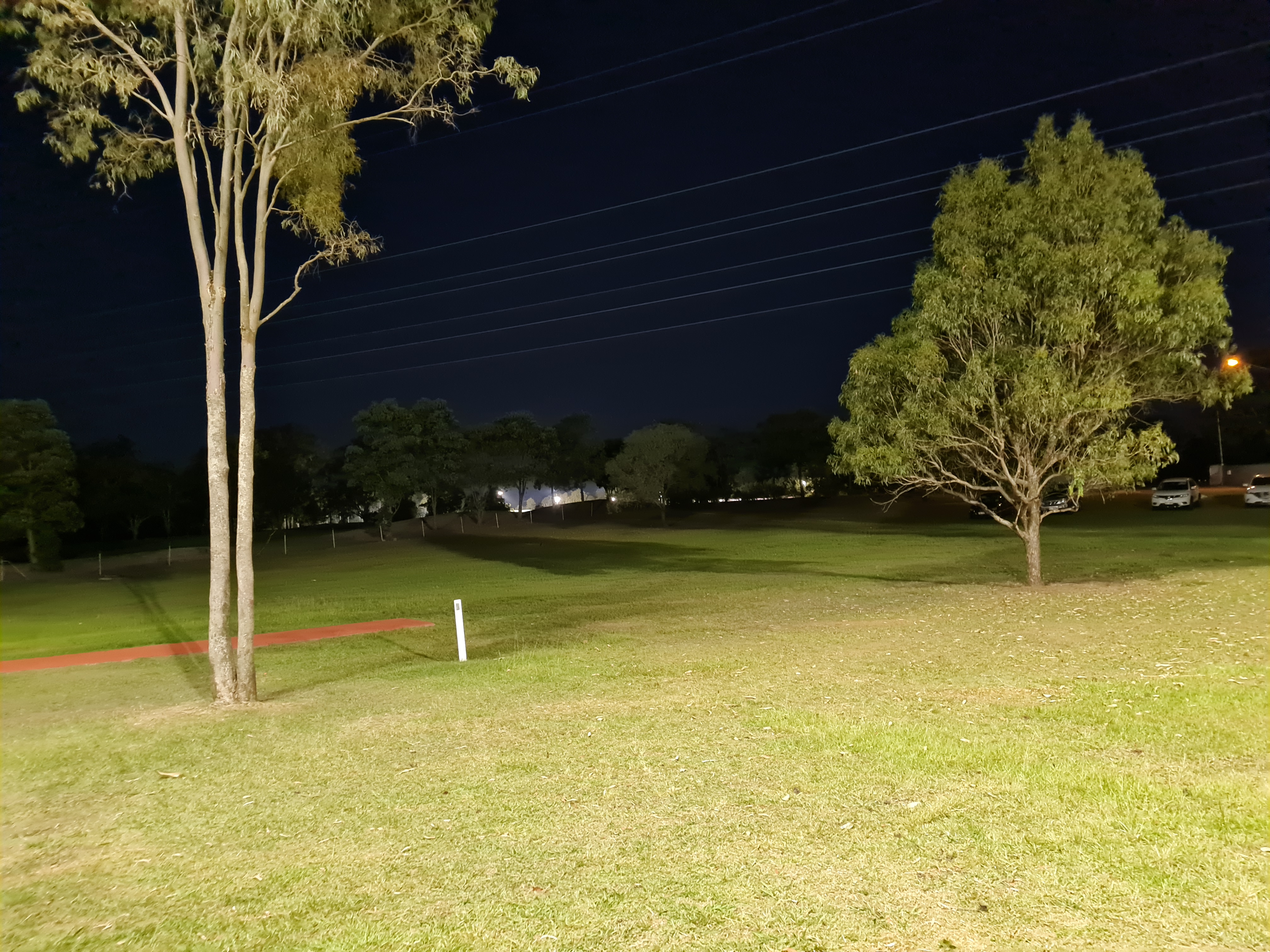
Back in the inspirational photo trove

A picture can paint a thousand words, or more, or less, but…

…

The interesting thing about a place in the dark, in the distance, and behind a chain wire fence usually means something. Especially when there are mysterious lights involved.

We were at a night sports event, watching over a thousand screaming and yelling kids from five to eighteen pretending to compete in a variety of athletic events.

I was there to nominally to support my granddaughter in her endeavours, but right at that moment, on the far side of the track, what I was really there to see was what was behind the wire fence

“Are you watching, Poppy?”

Well, at that moment I wasn’t, but I did turn just in time to see her clear a meter high high jump and execute an elegent backflip, a result no doubt of the ballet training she had since the age of four. Seven years later those lessons had transformed into a high jumper with a great future.

Except, she couldn’t really care less. It was more about the parents and athletic organisers expectations, than hers. I was there, she told me in a secretive tone, to tell everyone to back off.

if you think spying was a dangerous occupation, then let me tell you trying to navigate a safe path between child and parents, and then the rest of the word, forget it.

So, with my trusty phone camera, slightly modified, I was pretending to take pictures of surrounding trees in the high density lighting for the athletics oval, whilst zooming in on the real target.

And, about to take the money shot, I could feel a tugging on the side of my jacket.

I looked down to see the petulant face of a child not happy.

“You said you were coming to see me perform.”

I had. I looked over at the woman the boss had assigned as my ‘date’, Nancy, and whom I’d introduced as a long time friend who deigned to suffer my invitation so she could meet the girl I was always talking about.

“Yes, Poppy,” she said with an evil undertone. “You said you wanted to see her high jumps. You’d better get over there, while I take some pictures of the trees for you.”

“Why do you want pictures of dumb old trees?” That was a question I would have asked myself, and I didn’t quite have an answer for it.

Nancy did. “Because he’s odd like that. It’s one of the quirks I like about him.” She took the camera out of my hand and shooed us off.

And, heading back to the high jump, she asked, “What’s a quirk?”

“Just ask your father later. He knows all about quirks.”

…

© Charles Heath 2021

An excerpt from “If Only” – a work in progress

Investigation of crimes don’t always go according to plan, nor does the perpetrator get either found or punished.

That was particularly true in my case.  The murderer was very careful in not leaving any evidence behind, to the extent that the police could not rules out whether it was a male or a  female.

At one stage the police thought I had murdered my own wife though how I could be on a train at the time of the murder was beyond me.  I had witnesses and a cast-iron alibi.

The officer in charge was Detective Inspector Gabrielle Walters.  She came to me on the day after the murder seeking answers to the usual questions when was the last time you saw your wife, did you argue, the neighbors reckon there were heated discussions the day before.

Routine was the word she used.

Her Sargeant was a surly piece of work whose intention was to get answers or, more likely, a confession by any or all means possible.  I could sense the raging violence within him.  Fortunately, common sense prevailed.

Over the course of the next few weeks, once I’d been cleared of committing the crime, Gabrielle made a point of keeping me informed of the progress.

After three months the updates were more sporadic, and when, for lack of progress, it became a cold case, communication ceased.

But it was not the last I saw of Gabrielle.

The shock of finding Vanessa was more devastating than the fact she was now gone, and those images lived on in the same nightmare that came to visit me every night when I closed my eyes.

For months I was barely functioning, to the extent I had all but lost my job, and quite a few friends, particularly those who were more attached to Vanessa rather than me.

They didn’t understand how it could affect me so much, and since it had not happened to them, my tart replies of ‘you wouldn’t understand’ were met with equally short retorts.  Some questioned my sanity, even, for a time, so did I.

No one, it seemed, could understand what it was like, no one except Gabrielle.

She was by her own admission, damaged goods, having been the victim of a similar incident, a boyfriend who turned out to be a very bad boy.  Her story varied only in she had been made to witness his execution.  Her nightmare, in reliving that moment in time, was how she was still alive and, to this day, had no idea why she’d been spared.

It was a story she told me one night, some months after the investigation had been scaled down.  I was still looking for the bottom of a bottle and an emotional mess.  Perhaps it struck a resonance with her; she’d been there and managed to come out the other side.

What happened become our secret, a once-only night together that meant a great deal to me, and by mutual agreement, it was not spoken of again.  It was as if she knew exactly what was required to set me on the path to recovery.

And it had.

Since then we saw each about once a month in a cafe.   I had been surprised to hear from her again shortly after that eventful night when she called to set it up, ostensibly for her to provide me with any updates on the case, but perhaps we had, after that unspoken night, formed a closer bond than either of us wanted to admit.

We generally talked for hours over wine, then dinner and coffee.  It took a while for me to realize that all she had was her work, personal relationships were nigh on impossible in a job that left little or no spare time for anything else.

She’d always said that if I had any questions or problems about the case, or if there was anything that might come to me that might be relevant, even after all this time, all I had to do was call her.

I wondered if this text message was in that category.  I was certain it would interest the police and I had no doubt they could trace the message’s origin, but there was that tiny degree of doubt, whether or not I could trust her to tell me what the message meant.

I reached for the phone then put it back down again.  I’d think about it and decide tomorrow.

© Charles Heath 2018-2020

I’ve always wanted to go on a Treasure Hunt – Part 49

Here’s the thing…

Every time I close my eyes, I see something different.

I’d like to think the cinema of my dreams is playing a double feature but it’s a bit like a comedy cartoon night on Fox.

But these dreams are nothing to laugh about.

Once again there’s a new installment of an old feature, and we’re back on the treasure hunt.

…

A dark look crossed Boggs’ face telling me the name Ormiston wasn’t associated with anything good. I was still wondering how I had never heard anything about the family.

“How did you stumble across Fredrich Ormiston?”

“I told you I was keeping an eye on Alex. He and some chap who was, coincidentally, one of the guards we saw at the mall yesterday, they were talking about Ormiston. I’ve never heard of him.”

“That’s because the Ormiston’s disappeared from around here before the second world war. What did Alex have to say about him?”

“From what I overheard, he owned a large tract of land near Patterson’s Reach, that it stretched back to something called the fault line, that he sold the coastal area to the Navy and that’s where they put the dockyard, and other than that, not much. That guard had been doing some investigating for Alex and said he went to the library to ask Gwen. She’s still there by the way. She didn’t tell him very much, and even if she did know anything, she hates Alex and his friends as much as we do so she wouldn’t tell him.”

“She’d know of him. But she would be only one of a few, and those that do would be in the old folks’ home or dead.”

“And yet the name lights up your face, Boggs. How do you know about him?”

“Not me personally. My family. He and my grandfather were friends back in the day. He sold our family a large block near the river to run some cattle. My father wasn’t the first to have information about the treasure, and in fact, according to my dad’s diary, that original map we have was my grandfather’s.”

“How come you didn’t tell me about this before?”

“Not relevant. The map has always been in my family’s possession. My grandfather had made several attempts to find the treasure, and, one day, in a moment of forgetfulness, he told Ormiston about it. Well, you know how the thought of finding treasure can turn heads, Ormiston persuaded my grandfather to provide him with a copy of the map, and in return, he would fund a proper search party to see if they could find it. After all, he said, fifty percent of a trove was better than zero percent of nothing. By that time my grandfather was getting old, and the idea of finding the treasure was slipping through his fingers, so he agreed. Worst days work he ever did.”

“But Ormiston never found the treasure, did he?”

“That’s not the point. He did as he promised in the first instance, and they found nothing. It was a lot of money in pursuit of what could be compared to the holy grail. When my grandfather died, Ormiston decided he was no longer bound to any agreement, and mounted several more treasure hunts, and when my father tried to get him to adhere to the original agreement, Ormiston just brushed him off.”

“He still didn’t find anything. In the end, he lost his fortune and had to sell the land, hence the Naval Base. Do you know who got the rest?”

“Ormiston died on the last treasure hunt, and left massive debts behind, and a widow. They had several kids but no one knows where they went, and it was a long time ago. They had to sell the property to repay the debts. It went to property developers and then the Cossatino’s bought it. They moved in after Ormiston moved out. It’s why Patterson’s Reach is basically a no-go zone.”

I’d often wondered how the Cossatino’s came to town, and why it was they camped in Patterson’s Reach, away from the Benderby’s.

“Alex’s mate was talking about looking for relatives, though I’m not sure why.”

“There are no relatives, not according to my mother, but there were rumors that Ormiston had made extensive notes on all of his hunts, so from that perspective, if the documents existed, it would be useful to align what he knew with what my father says in his journal.”

A good point, and it might be still a possibility if the documents held at the library were to contain any journals. It also made sense, in my mind, why the Cossatino’s decided to run a map scam; had they come across Ormiston’s journals, and maps, and got Boggs father to base his fakes around those? It was starting to throw a giant cold shadow over the whole of this project, and that Boggs was simply missing the point.

If Ormiston couldn’t find anything, and he had money to burn when he mounted the searches, perhaps it was just a myth. And who’s to say that Boggs’s grandfather didn’t make the whole thing up himself?

Just the same, until I was certain, I was going to keep the existence of the papers in the library to myself for the time being.

But, something else just occurred to me. “Do you have anything from your grandfather, in particular about the searches he made, with or without Ormiston?”

“Only that one with Ormiston. In the end, he concluded that it was his belief that Ormiston had deliberately set the wrong course, which was why they never found anything. He had used two different river heads as his basis, to which my grandfather tried to convince him otherwise. Of course, there were considerable differences of opinion, and after they returned, never spoke to each other again.”

Not surprising.

“Well, that adds some more background to the quest. Are you sure you have the right rivers as markers? I mean there are quite a few rivers and streams as well as a few lakes up and down the coastline?”

“My father was certain, and his father was before him. As am I. Let me know when you free next so we can continue the quest.”

I should not have doubted him, but the more he talked about Ormiston, the darker he was looking. It was probably for the best I left him alone for the afternoon if only to calm down.

He didn’t even say goodbye.

I went inside and got ready for work.

…

© Charles Heath 2020-2021

An excerpt from “Echoes from the Past”

Available on Amazon Kindle here:  https://amzn.to/2CYKxu4


With my attention elsewhere, I walked into a man who was hurrying in the opposite direction.  He was a big man with a scar running down the left side of his face from eye socket to mouth, and who was also wearing a black shirt with a red tie.

That was all I remembered as my heart almost stopped.

He apologized as he stepped to one side, the same way I stepped, as I also muttered an apology.

I kept my eyes down.  He was not the sort of man I wanted to recognize later in a lineup.  I stepped to the other side and so did he.  It was one of those situations.  Finally getting out of sync, he kept going in his direction, and I towards the bus, which was now pulling away from the curb.

Getting my breath back, I just stood riveted to the spot watching it join the traffic.  I looked back over my shoulder, but the man I’d run into had gone.  I shrugged and looked at my watch.  It would be a few minutes before the next bus arrived.

Wait, or walk?  I could also go by subway, but it was a long walk to the station.  What the hell, I needed the exercise.

At the first intersection, the ‘Walk’ sign had just flashed to ‘Don’t Walk’.  I thought I’d save a few minutes by not waiting for the next green light.  As I stepped onto the road, I heard the screeching of tires.

A yellow car stopped inches from me.

It was a high powered sports car, perhaps a Lamborghini.  I knew what they looked like because Marcus Bartleby owned one, as did every other junior executive in the city with a rich father.

Everyone stopped to look at me, then the car.  It was that sort of car.  I could see the driver through the windscreen shaking his fist, and I could see he was yelling too, but I couldn’t hear him.  I stepped back onto the sidewalk, and he drove on.  The moment had passed and everyone went back to their business.

My heart rate hadn’t come down from the last encounter.   Now it was approaching cardiac arrest, so I took a few minutes and several sets of lights to regain composure.

At the next intersection, I waited for the green light, and then a few seconds more, just to be sure.  I was no longer in a hurry.

At the next, I heard what sounded like a gunshot.  A few people looked around, worried expressions on their faces, but when it happened again, I saw it was an old car backfiring.  I also saw another yellow car, much the same as the one before, stopped on the side of the road.  I thought nothing of it, other than it was the second yellow car I’d seen.

At the next intersection, I realized I was subconsciously heading towards Harry’s new bar.   It was somewhere on 6th Avenue, so I continued walking in what I thought was the right direction.

I don’t know why I looked behind me at the next intersection, but I did.  There was another yellow car on the side of the road, not far from me.  It, too, looked the same as the original Lamborghini, and I was starting to think it was not a coincidence.

Moments after crossing the road, I heard the roar of a sports car engine and saw the yellow car accelerate past me.  As it passed by, I saw there were two people in it, and the blurry image of the passenger; a large man with a red tie.

Now my imagination was playing tricks.

It could not be the same man.  He was going in a different direction.

In the few minutes I’d been standing on the pavement, it had started to snow; early for this time of year, and marking the start of what could be a long cold winter.  I shuddered, and it was not necessarily because of the temperature.

I looked up and saw a neon light advertising a bar, coincidentally the one Harry had ‘found’ and, looking once in the direction of the departing yellow car, I decided to go in.  I would have a few drinks and then leave by the back door if it had one.

Just in case.


© Charles Heath 2015-2020

newechocover5rs