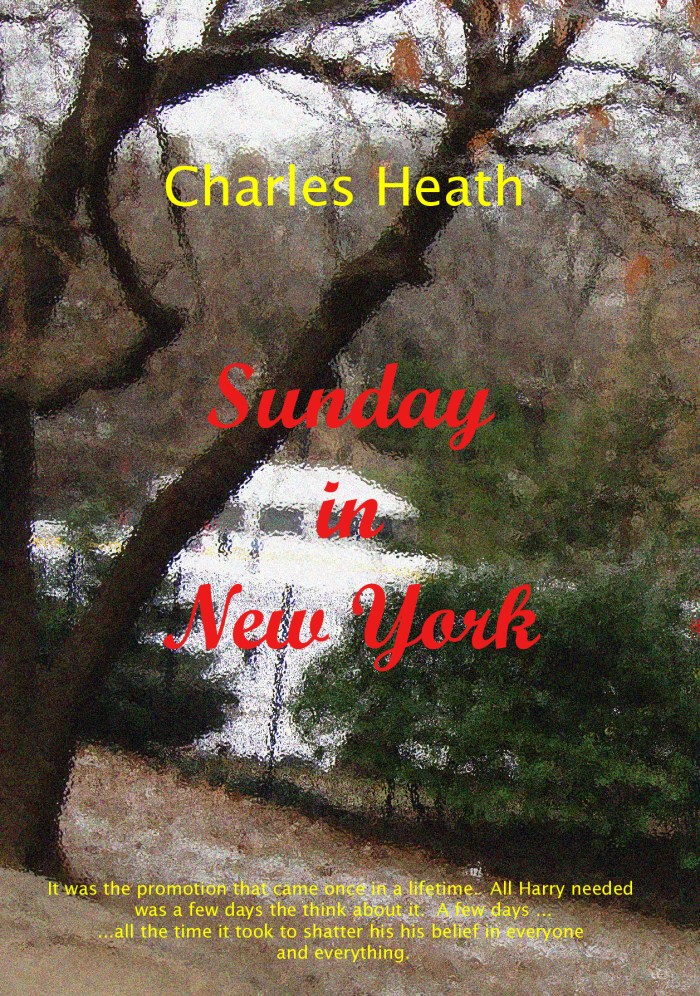
“Sunday in New York” is ultimately a story about trust, and what happens when a marriage is stretched to its limits.
When Harry Steele attends a lunch with his manager, Barclay, to discuss a promotion that any junior executive would accept in a heartbeat, it is the fact his wife, Alison, who previously professed her reservations about Barclay, also agreed to attend, that casts a small element of doubt in his mind.
From that moment, his life, in the company, in deciding what to do, his marriage, his very life, spirals out of control.
There is no one big factor that can prove Harry’s worst fears, that his marriage is over, just a number of small, interconnecting events, when piled on top of each other, points to a cataclysmic end to everything he had believed in.
Trust is lost firstly in his best friend and mentor, Andy, who only hints of impending disaster, Sasha, a woman whom he saved, and who appears to have motives of her own, and then in his wife, Alison, as he discovered piece by piece damning evidence she is about to leave him for another man.
Can we trust what we see with our eyes or trust what we hear?
Haven’t we all jumped to conclusions at least once in our lives?
Can Alison, a woman whose self-belief and confidence is about to be put to the ultimate test, find a way of proving their relationship is as strong as it has ever been?
It was in darkness. I was sure I had left several lights on, especially over the door so I could see to unlock it.
I looked up and saw the globe was broken.
Instant alert.
I went to the first hiding spot for the gun, and it wasn’t there. I went to the backup and it wasn’t there either. Someone had found my carefully hidden stash of weapons and removed them.
Who?
There were four hiding spots and all were empty. Someone had removed the weapons. That could only mean one possibility.
I had a visitor, not necessarily here for a social call.
But, of course, being the well-trained agent I’d once been and not one to be caught unawares, I crossed over to my neighbor and relieved him of a weapon that, if found, would require a lot of explaining.
Suitably armed, it was time to return the surprise.
There were three entrances to the villa, the front door, the back door, and a rather strange escape hatch. One of the more interesting attractions of the villa I’d rented was its heritage. It was built in the late 1700s, by a man who was, by all accounts, a thief. It had a hidden underground room which had been in the past a vault but was now a wine cellar, and it had an escape hatch by which the man could come and go undetected, particularly if there was a mob outside the door baying for his blood.
It now gave me the means to enter the villa without my visitors being alerted, unless, of course, they were near the vicinity of the doorway inside the villa, but that possibility was unlikely. It was not where anyone could anticipate or expect a doorway to be.
The secret entrance was at the rear of the villa behind a large copse, two camouflaged wooden doors built into the ground. I move aside some of the branches that covered them and lifted one side. After I’d discovered the doors and rusty hinges, I’d oiled and cleaned them, and cleared the passageway of cobwebs and fallen rocks. It had a mildew smell, but nothing would get rid of that. I’d left torches at either end so I could see.
I closed the door after me, and went quietly down the steps, enveloped in darkness till I switched on the torch. I traversed the short passage which turned ninety degrees about halfway to the door at the other end. I carried the key to this door on the keyring, found it and opened the door. It too had been oiled and swung open soundlessly.
I stepped in the darkness and closed the door.
I was on the lower level under the kitchen, now the wine cellar, the ‘door’ doubling as a set of shelves which had very little on them, less to fall and alert anyone in the villa.
Silence, an eerie silence.
I took the steps up to the kitchen, stopping when my head was level with the floor, checking to see if anyone was waiting. There wasn’t. It seemed to me to be an unlikely spot for an ambush.
I’d already considered the possibility of someone coming after me, especially because it had been Bespalov I’d killed, and I was sure he had friends, all equally as mad as he was. Equally, I’d also considered it nigh on impossible for anyone to find out it was me who killed him because the only people who knew that were Prendergast, Alisha, a few others in the Department, and Susan.
That raised the question of who told them where I was.
If I was the man I used to be, my first suspect would be Susan. The departure this morning, and now this was too coincidental. But I was not that man.
Or was I?
I reached the start of the passageway that led from the kitchen to the front door and peered into the semi-darkness. My eyes had got used to the dark, and it was no longer an inky void. Fragments of light leaked in around the door from outside and through the edge of the window curtains where they didn’t fit properly. A bone of contention upstairs in the morning, when first light shone and invariably woke me up hours before I wanted to.
Still nothing.
I took a moment to consider how I would approach the visitor’s job. I would get a plan of the villa in my head, all entrances, where a target could be led to or attacked where there would be no escape.
Coming in the front door. If I was not expecting anything, I’d just open the door and walk-in. One shot would be all that was required.
Contract complete.
I sidled quietly up the passage staying close to the wall, edging closer to the front door. There was an alcove where the shooter could be waiting. It was an ideal spot to wait.
Crunch.
I stepped on some nutshells.
Not my nutshells.
I felt it before I heard it. The bullet with my name on it.
And how the shooter missed, from point-blank range, and hit me in the arm, I had no idea. I fired off two shots before a second shot from the shooter went wide and hit the door with a loud thwack.
I saw a red dot wavering as it honed in on me and I fell to the floor, stretching out, looking up where the origin of the light was coming and pulled the trigger three times, evenly spaced, and a second later I heard the sound of a body falling down the stairs and stopping at the bottom, not very far from me.
Two assassins.
I’d not expected that.
The assassin by the door was dead, a lucky shot on my part. The second was still breathing.
I checked the body for any weapons and found a second gun and two knives. Armed to the teeth!
I pulled off the balaclava; a man, early thirties, definitely Italian. I was expecting a Russian.
I slapped his face, waking him up. Blood was leaking from several slashes on his face when his head had hit the stairs on the way down. The awkward angle of his arms and legs told me there were broken bones, probably a lot worse internally. He was not long for this earth.
“Who employed you?”
He looked at me with dead eyes, a pursed mouth, perhaps a smile. “Not today my friend. You have made a very bad enemy.” He coughed and blood poured out of his mouth. “There will be more …”
Friends of Bespalov, no doubt.
I would have to leave. Two unexplainable bodies, I’d have a hard time explaining my way out of this mess. I dragged the two bodies into the lounge, clearing the passageway just in case someone had heard anything.
Just in case anyone was outside at the time, I sat in the dark, at the foot of the stairs, and tried to breathe normally. I was trying not to connect dots that led back to Susan, but the coincidence was worrying me.
A half-hour passed and I hadn’t moved. Deep in thought, I’d forgotten about being shot, unaware that blood was running down my arm and dripping onto the floor.
Until I heard a knock on my front door.
Two thoughts, it was either the police, alerted by the neighbors, or it was the second wave, though why would they be knocking on the door?
I stood, and immediately felt a stabbing pain in my arm. I took out a handkerchief and turned it into a makeshift tourniquet, then wrapped a kitchen towel around the wound.
If it was the police, this was going to be a difficult situation. Holding the gun behind my back, I opened the door a fraction and looked out.
No police, just Maria. I hoped she was not part of the next ‘wave’.
“You left your phone behind on the table. I thought you might be looking for it.” She held it out in front of her.
When I didn’t open the door any further, she looked at me quizzically, and then asked, “Is anything wrong?”
I was going to thank her for returning the phone, but I heard her breathe in sharply, and add, breathlessly, “You’re bleeding.”
I looked at my arm and realized it was visible through the door, and not only that, the towel was soaked in blood.
“You need to go away now.”
Should I tell her the truth? It was probably too late, and if she was any sort of law-abiding citizen she would go straight to the police.
She showed no signs of leaving, just an unnerving curiosity. “What happened?”
I ran through several explanations, but none seemed plausible. I went with the truth. “My past caught up with me.”
“You need someone to fix that before you pass out from blood loss. It doesn’t look good.”
“I can fix it. You need to leave. It is not safe to be here with me.”
The pain in my arm was not getting any better, and the blood was starting to run down my arm again as the tourniquet loosened. She was right, I needed it fixed sooner rather than later.
I opened the door and let her in. It was a mistake, a huge mistake, and I would have to deal with the consequences. Once inside, she turned on the light and saw the pool of blood just inside the door and the trail leading to the lounge. She followed the trail and turned into the lounge, turned on the light, and no doubt saw the two dead men.
I expected her to scream. She didn’t.
She gave me a good hard look, perhaps trying to see if I was dangerous. Killing people wasn’t something you looked the other way about. She would have to go to the police.
“What happened here?”
“I came home from the cafe and two men were waiting for me. I used to work for the Government, but no longer. I suspect these men were here to repay a debt. I was lucky.”
“Not so much, looking at your arm.”
She came closer and inspected it.
“Sit down.”
She found another towel and wrapped it around the wound, retightening the tourniquet to stem the bleeding.
“Do you have medical supplies?”
I nodded. “Upstairs.” I had a medical kit, and on the road, I usually made my own running repairs. Another old habit I hadn’t quite shaken off yet.
She went upstairs, rummaged, and then came back. I wondered briefly what she would think of the unmade bed though I was not sure why it might interest her.
She helped me remove my shirt, and then cleaned the wound. Fortunately, she didn’t have to remove a bullet. It was a clean wound but it would require stitches.
When she’d finished she said, “Your friend said one day this might happen.”
No prizes for guessing who that friend was, and it didn’t please me that she had involved Maria.
“Alisha?”
“She didn’t tell me her name, but I think she cares a lot about you. She said trouble has a way of finding you, gave me a phone and said to call her if something like this happened.”
“That was wrong of her to do that.”
“Perhaps, perhaps not. Will you call her?”
“Yes. I can’t stay here now. You should go now. Hopefully, by the time I leave in the morning, no one will ever know what happened here, especially you.”
I want a high octane ending, and I’ve been trying to visualise it in my mind.
I’m sure it’s a lot like how a director of a movie sees the end product and then tries to translate that onto the screen.
I can see in in my head, but it’s not translating onto paper.
I’d also like to write it like that so the reader can almost be sitting in the front row seat as it all unfolds,
But in a matter of weeks our once happy travel agent has gone from dispensing advice to others on how to have a good holiday, to a man caught in the middle of storm.
People he’s only read about in papers and books had been appearing out of left field forcing him into making decisions he never thought he would have to.
He’s discovered his parents were not exactly the people he thought they were.
He’s discovered people can appear to be anything other than who they really are.
And he’s discovered he has the strength to overcome adversity.
Going back to the travel agency is going to be as boring a hell for him now.
…
Today’s effort amounts to 2,267 words, for a total, so far, of 64,343.
Investigation of crimes don’t always go according to plan, nor does the perpetrator get either found or punished.
That was particularly true in my case. The murderer was very careful in not leaving any evidence behind, to the extent that the police could not rules out whether it was a male or a female.
At one stage the police thought I had murdered my own wife though how I could be on a train at the time of the murder was beyond me. I had witnesses and a cast-iron alibi.
The officer in charge was Detective Inspector Gabrielle Walters. She came to me on the day after the murder seeking answers to the usual questions when was the last time you saw your wife, did you argue, the neighbors reckon there were heated discussions the day before.
Routine was the word she used.
Her Sargeant was a surly piece of work whose intention was to get answers or, more likely, a confession by any or all means possible. I could sense the raging violence within him. Fortunately, common sense prevailed.
Over the course of the next few weeks, once I’d been cleared of committing the crime, Gabrielle made a point of keeping me informed of the progress.
After three months the updates were more sporadic, and when, for lack of progress, it became a cold case, communication ceased.
But it was not the last I saw of Gabrielle.
The shock of finding Vanessa was more devastating than the fact she was now gone, and those images lived on in the same nightmare that came to visit me every night when I closed my eyes.
For months I was barely functioning, to the extent I had all but lost my job, and quite a few friends, particularly those who were more attached to Vanessa rather than me.
They didn’t understand how it could affect me so much, and since it had not happened to them, my tart replies of ‘you wouldn’t understand’ were met with equally short retorts. Some questioned my sanity, even, for a time, so did I.
No one, it seemed, could understand what it was like, no one except Gabrielle.
She was by her own admission, damaged goods, having been the victim of a similar incident, a boyfriend who turned out to be a very bad boy. Her story varied only in she had been made to witness his execution. Her nightmare, in reliving that moment in time, was how she was still alive and, to this day, had no idea why she’d been spared.
It was a story she told me one night, some months after the investigation had been scaled down. I was still looking for the bottom of a bottle and an emotional mess. Perhaps it struck a resonance with her; she’d been there and managed to come out the other side.
What happened become our secret, a once-only night together that meant a great deal to me, and by mutual agreement, it was not spoken of again. It was as if she knew exactly what was required to set me on the path to recovery.
And it had.
Since then we saw each about once a month in a cafe. I had been surprised to hear from her again shortly after that eventful night when she called to set it up, ostensibly for her to provide me with any updates on the case, but perhaps we had, after that unspoken night, formed a closer bond than either of us wanted to admit.
We generally talked for hours over wine, then dinner and coffee. It took a while for me to realize that all she had was her work, personal relationships were nigh on impossible in a job that left little or no spare time for anything else.
She’d always said that if I had any questions or problems about the case, or if there was anything that might come to me that might be relevant, even after all this time, all I had to do was call her.
I wondered if this text message was in that category. I was certain it would interest the police and I had no doubt they could trace the message’s origin, but there was that tiny degree of doubt, whether or not I could trust her to tell me what the message meant.
I reached for the phone then put it back down again. I’d think about it and decide tomorrow.
With my attention elsewhere, I walked into a man who was hurrying in the opposite direction. He was a big man with a scar running down the left side of his face from eye socket to mouth, and who was also wearing a black shirt with a red tie.
That was all I remembered as my heart almost stopped.
He apologized as he stepped to one side, the same way I stepped, as I also muttered an apology.
I kept my eyes down. He was not the sort of man I wanted to recognize later in a lineup. I stepped to the other side and so did he. It was one of those situations. Finally getting out of sync, he kept going in his direction, and I towards the bus, which was now pulling away from the curb.
Getting my breath back, I just stood riveted to the spot watching it join the traffic. I looked back over my shoulder, but the man I’d run into had gone. I shrugged and looked at my watch. It would be a few minutes before the next bus arrived.
Wait, or walk? I could also go by subway, but it was a long walk to the station. What the hell, I needed the exercise.
At the first intersection, the ‘Walk’ sign had just flashed to ‘Don’t Walk’. I thought I’d save a few minutes by not waiting for the next green light. As I stepped onto the road, I heard the screeching of tires.
A yellow car stopped inches from me.
It was a high powered sports car, perhaps a Lamborghini. I knew what they looked like because Marcus Bartleby owned one, as did every other junior executive in the city with a rich father.
Everyone stopped to look at me, then the car. It was that sort of car. I could see the driver through the windscreen shaking his fist, and I could see he was yelling too, but I couldn’t hear him. I stepped back onto the sidewalk, and he drove on. The moment had passed and everyone went back to their business.
My heart rate hadn’t come down from the last encounter. Now it was approaching cardiac arrest, so I took a few minutes and several sets of lights to regain composure.
At the next intersection, I waited for the green light, and then a few seconds more, just to be sure. I was no longer in a hurry.
At the next, I heard what sounded like a gunshot. A few people looked around, worried expressions on their faces, but when it happened again, I saw it was an old car backfiring. I also saw another yellow car, much the same as the one before, stopped on the side of the road. I thought nothing of it, other than it was the second yellow car I’d seen.
At the next intersection, I realized I was subconsciously heading towards Harry’s new bar. It was somewhere on 6th Avenue, so I continued walking in what I thought was the right direction.
I don’t know why I looked behind me at the next intersection, but I did. There was another yellow car on the side of the road, not far from me. It, too, looked the same as the original Lamborghini, and I was starting to think it was not a coincidence.
Moments after crossing the road, I heard the roar of a sports car engine and saw the yellow car accelerate past me. As it passed by, I saw there were two people in it, and the blurry image of the passenger; a large man with a red tie.
Now my imagination was playing tricks.
It could not be the same man. He was going in a different direction.
In the few minutes I’d been standing on the pavement, it had started to snow; early for this time of year, and marking the start of what could be a long cold winter. I shuddered, and it was not necessarily because of the temperature.
I looked up and saw a neon light advertising a bar, coincidentally the one Harry had ‘found’ and, looking once in the direction of the departing yellow car, I decided to go in. I would have a few drinks and then leave by the back door if it had one.
I’d been to the horse races a few times, but every time I backed a horse to win, it would come last, and if I backed it to place, it would come fourth.
Then, every time I bought a lottery ticket, my numbers never seemed to come out, as if they were heavier than the others.
You get the picture, gambling, and I didn’t get along.
That being said, Vernon, a friend from school days, and then, having made the graduate program for the same company, remained friends into adult life. He was a betting man, he bet me he would be married first, he picked horses that came first, and always walked out of a casino with more than he walked in with.
And he was right, he got married first, had children first, settled into a manager’s role, and was content.
I was not so eager to follow in his footsteps; I often said that I hadn’t found the right girl yet, but the truth was, I wasn’t exactly putting myself out there. A couple of bad experiences had put me off the whole idea.
He had a side bet with another of our friends that I would not get married before I was forty. He had mentioned it to me some time ago, and I’d agreed with him; it was a safe bet.
The thing was, Evie had learned about that bet, and it was, in her mind, a situation tailor-made for her, being Vernon’s very popular wife, and not one to pass up a romantic challenge. Not after Vernon had suddenly decided to make a bet with her, to find me a girlfriend. With a time limit, of course, of six weeks. Just to make it interesting.
Of course, I had no clue this challenge existed, not until much later.
What I did knew was that she had a vast array of both married and single girlfriends and acquaintances, and was known to throw memorable parties on a Friday night. She had issued me with a standing invitation a long time ago, one that kept promising to honor, but I never seemed to get there.
I knew some of her friends were singles, and that she had a reputation of being something of a matchmaker. Vernon told me that those Friday night affairs were where some of his other friends had found romance and that it wouldn’t surprise him if I was not a target.
I agreed with him, but coincidentally, right after he said this, I got a call from Evie who all but ordered me to attend this Friday’s festivities. I was going to decline, but she added it was Chloe’s fifth birthday, and as her Godfather, I was obligated to attend.
It had been an honor when Vernon first asked me, it still is, but it seemed to me it was going to be used for some other reason, so I was going to have to be on my guard.
Over the years I had met most of Evie’s girlfriends and they were fun, yes, I’d heard about the exploits on weekends in Vegas, but it was not for me. I was the quiet, shy type, and they, in a nutshell, were not. I’d met most of Evie’s family. She was one of five girls, the one in the middle. The two older sisters were professionals, one a doctor, the other, Geraldine, a lawyer. The two younger sisters were more hands-on, the second youngest, Zoe, was a home caterer, and the youngest, Yasmine, with no head for, or desire to own, a business, was more carefree. Like Evie, she was family orientated and still lived with her parents. The most level headed, and the one they all turned to for advice, was Melanie, the eldest.
She was the first person I saw after I arrived. I thought I would get there early because I never wanted to make an entrance.
“I haven’t seen you around for a while,” Melanie said, already a champagne flute filled, in her hand. Something else I knew, she liked to drink wine. She was also married, but I remembered her husband was away a lot.
“Part of the low profile I try to keep. How is Leonard, still the king of frequent flyer points?” His travels had finally earned him a special card reserved for very few.
“He’s in Paris, probably with his mistress.” She shrugged. “Husbands are like accessories these days. You can keep them or throw them out. I’m sure Genevieve will get tired of his soon and send him back.”
A unique attitude, for one who was supposed to give advice.
“You’re still not married, I see, Good choice. Marriage these days seems to be only good for a year or two, then sue the other for everything they’ve got. Sorry, I lost a case today, so I’m feeling a little cynical. Come back when I’ve had a dozen champagnes.”
She suddenly spotted on of Vernon’s neighbors and headed in his direction.
Zoe was walking past with a tray of canapes in her hand and stopped. “Ian? It is you. It’s so long since I’ve seen you.”
“Geraldine’s wedding. You catered that. A splendid feast I might add.”
Geraldine’s wedding had been a year ago, and after everyone had gone home, I found Zoe out the back in tears. She didn’t tell me then what had happened, but we talked for hours. Out of all the Wolverhampton’s, she was the most sensible, and the one I liked the most. But, like all those like her, she was spoken for.
“It was. How have you been?”
“Working, eating, sleeping, repeat.”
“It’s a bit like that, isn’t it? It gets to the point where all the days seem to run into each other, and in the end, you don’t know what day it is. That’s why I have a smartphone. It’s certainly smarter than I am.”
Something I had learned in that discussion was the fact she suffered from low self-esteem, perhaps from being a younger sister, perhaps because her parents had higher hopes for her than just being a caterer. Given her grades at school and later university, she could have been anything.
I was going to disagree with her and sing her praises, but one of her serving staff came up, told her there was a problem.
She sighed, handed the tray to the new girl, and a wan smile, disappeared towards the back of the house.
I thought then that I should leave because I doubted I would be missed. Whenever I had to go to a party, particularly like one of these, where no one was sitting, and everyone was mingling, I usually set myself a task, picking a focal point and then following it all night. This night it turned out to be Zoe. I was curious about how she managed, running staff, organizing food and drinks, organizing the waitstaff, and managing crises.
In between times, Evie was introducing me to various people, married and unmarried, without appearing to do her ‘magical’ thing. Vernon made sure I remained in the mainstream, and not ‘hiding’ as he called it, and the conversation centered on football and baseball when I with the men, and about vacations and children when I was with the married women and their husbands, and gossip when I was with the single and divorced women.
And all the while I kept an eye on Zoe, zipping in and out of the back rooms, in earnest discussion with what I assumed were prospective new clients, and occasionally on the phone. Not once did she take a spell, and relax for a few minutes.
It was, I had to admit by the end of the night, a pleasant way to spend a few hours, made all the more pleasant by not having to worry about Evie trying to ‘match; me to any of her single friends, though she made sure I knew who they were. Of course, as always, there was not one or another that fitted what was my subconscious selection test. There was one whom I agreed to call and have coffee, but that was an open-ended arrangement, done to please Evie more than anything else.
After the last guest left, I wandered out the back. Vernon had asked me to stay, sample a new after-dinner wine he had discovered.
I’d been there for about half an hour when, instead of Vernon, Zoe came out with two glasses in hand.
“Vernon has stood you up, I’m afraid. He’s getting to be an old married man who had to be in bed before midnight. You’ll just have to settle for my company.”
“So long as you are going to tell me how I should be married, have two and a half children, and be living in a grand house in the suburbs, your company will be fine.”
She handed me a glass and sat next to me on the swing seat. It was a clear, cool night, and I’d been spending the time searching the stars for constellations. Sorry, I was never very good at astronomy.
“You don’t want that?”
“I don’t know what I want. Wouldn’t that all fall into place when you found the perfect partner?”
“Is there such a thing as a perfect partner? We start out thinking that, think we’ve found it, then the bastard goes off and had an affair.”
There was a lot of anger in those last few words of her statement. It explained the few heated exchanges I’d seen her have in what she thought were private moments. I wasn’t prying, I just happened to be nearby at the time.
“Then perhaps my expectations have been set too high. I’m sorry.”
“Don’t be. Everyone told me what he was like.” She shrugged. “Another box ticked for life’s experiences.”
We drank wine and sat in silence. Unlike some others that evening, where it was kind of awkward, I didn’t feel that with Zoe. In fact, I was not sure what it felt like. Companionable?
“Look, I don’t have the best sort of shoulder to cry on, but if you need someone to listen, it’s one thing I’m good at.”
There were tears forming in her eyes and I’d only just noticed them in the moonlight.
“I could do with a hug. Are you any good at those?”
“I could try, and you could let me know. Always looking to add strings to that proverbial bow.”
She smiled. “What are you doing tomorrow?”
“Nothing in particular. Why?”
“I need someone to just take me away from all this, if only for an hour or two. Vernon said you have a cabin by the lake, and I’ve never been fishing. Is it too forward for me to ask, I mean, sorry, sometimes I just speak before I think.”
“One thing at a time. Hug first, then fishing. Maybe.” Upstairs, Evie rested her head on Vernon’s shoulder as they both looked out over the back garden, and, more specifically at Ian and Zoe on the swing chair.
“What are the odds, Eve. I told you he had a thing for her,” Vernon said.
“I would have said ten to one against. It’s so unlike her. I mean, he’s just so boring.”
“Is he now? That’s just the impression he gives everyone else. So much for your matchmaking.”
50 photographs, 50 stories, of which there is one of the 50 below.
They all start with –
A picture paints … well, as many words as you like. For instance:
And, the story:
Have you ever watched your hopes and dreams simply just fly away?
Everything I thought I wanted and needed had just left in an aeroplane, and although I said I was not going to, i came to the airport to see the plane leave. Not the person on it, that would have been far too difficult and emotional, but perhaps it was symbolic, the end of one life and the start of another.
But no matter what I thought or felt, we had both come to the right decision. She needed the opportunity to spread her wings. It was probably not the best idea for her to apply for the job without telling me, but I understood her reasons.
She was in a rut. Though her job was a very good one, it was not as demanding as she had expected, particularly after the last promotion, but with it came resentment from others on her level, that she, the youngest of the group would get the position.
It was something that had been weighing down of her for the last three months, and if noticed it, the late nights, the moodiness, sometimes a flash of temper. I knew she had one, no one could have such red hair and not, but she had always kept it in check.
And, then there was us, together, and after seven years, it felt like we were going nowhere. Perhaps that was down to my lack of ambition, and though she never said it, lack of sophistication. It hadn’t been an issue, well, not until her last promotion, and the fact she had to entertain more, and frankly I felt like an embarrassment to her.
So, there it was, three days ago, the beginning of the weekend, and we had planned to go away for a few days and take stock. We both acknowledged we needed to talk, but it never seemed the right time.
It was then she said she had quit her job and found a new one. Starting the following Monday.
Ok, that took me by surprise, not so much that it something I sort of guessed might happen, but that she would just blurt it out.
I think that right then, at that moment, I could feel her frustration with everything around her.
What surprised her was my reaction. None.
I simply asked where who, and when.
A world-class newspaper, in New York, and she had to be there in a week.
A week.
It was all the time I had left with her.
I remember I just shrugged and asked if the planned weekend away was off.
She stood on the other side of the kitchen counter, hands around a cup of coffee she had just poured, and that one thing I remembered was the lone tear that ran down her cheek.
Is that all you want to know?
I did, yes, but we had lost that intimacy we used to have when she would have told me what was happening, and we would have brainstormed solutions. I might be a cabinet maker but I still had a brain, was what I overheard her tell a friend once.
There’s not much to ask, I said. You’ve been desperately unhappy and haven’t been able to hide it all that well, you have been under a lot of pressure trying to deal with a group of troglodytes, and you’ve been leaning on Bentley’s shoulder instead of mine, and I get it, he’s got more experience in that place, and the politics that go with it, and is still an ally.
Her immediate superior and instrumental in her getting the position, but unlike some men in his position he had not taken advantage of a situation like some men would. And even if she had made a move, which I doubted, that was not the sort of woman she was, he would have politely declined.
One of the very few happily married men in that organisation, so I heard.
So, she said, you’re not just a pretty face.
Par for the course for a cabinet maker whose university degree is in psychology. It doesn’t take rocket science to see what was happening to you. I just didn’t think it was my place to jump in unless you asked me, and when you didn’t, well, that told me everything I needed to know.
Yes, our relationship had a use by date, and it was in the next few days.
I was thinking, she said, that you might come with me, you can make cabinets anywhere.
I could, but I think the real problem wasn’t just the job. It was everything around her and going with her, that would just be a constant reminder of what had been holding her back. I didn’t want that for her and said so.
Then the only question left was, what do we do now?
Go shopping for suitcases. Bags to pack, and places to go.
Getting on the roller coaster is easy. On the beginning, it’s a slow easy ride, followed by the slow climb to the top. It’s much like some relationships, they start out easy, they require a little work to get to the next level, follows by the adrenaline rush when it all comes together.
What most people forget is that what comes down must go back up, and life is pretty much a roller coaster with highs and lows.
Our roller coaster had just come or of the final turn and we were braking so that it stops at the station.
There was no question of going with her to New York. Yes, I promised I’d come over and visit her, but that was a promise with crossed fingers behind my back. After a few months in t the new job the last thing shed want was a reminder of what she left behind. New friends new life.
We packed her bags, three out everything she didn’t want, a free trips to the op shop with stiff she knew others would like to have, and basically, by the time she was ready to go, there was nothing left of her in the apartment, or anywhere.
Her friends would be seeing her off at the airport, and that’s when I told her I was not coming, that moment the taxi arrived to take her away forever. I remember standing there, watching the taxi go. It was going to be, and was, as hard as it was to watch the plane leave.
So, there I was, finally staring at the blank sky, around me a dozen other plane spotters, a rather motley crew of plane enthusiasts.
Already that morning there’s been 6 different types of plane depart, and I could hear another winding up its engines for take-off.
People coming, people going.
Maybe I would go to New York in a couple of months, not to see her, but just see what the attraction was. Or maybe I would drop in, just to see how she was.
As one of my friends told me when I gave him the news, the future is never written in stone, and it’s about time you broadened your horizons.
This month has been exhausting, because not only have I been trying to get the NaNoWriMo project completed, which involves writing about 1,800 words a day, every day, I have been keeping up the A to Z blogging challenge with a new story every day bar Sunday.
You have no idea how much I looked forward to each of the Sundays.
Of course, a plan is needed if anyone is contemplating to do something similar.
It also requires you to be able to come up with a new idea every day for the the story and try not to get caught up in a crossover.
And, try not to hit the wall.
Which is exactly what happened yesterday, when I got half way through the story, and the equivalent to deleting the file rather than saving it happened.
So few yards from the finishing line and kaput, I’m sitting there in front of a blank screen wondering where the next 2,5000 words for the story are coming from.
And questioning my sanity.
I missed the deadline, wrote zero words for the A to Z and went to bed.
Tomorrow, hopefully, will be a new day!
…
Today’s effort amounts to nnnn words, for a total, so far, of nnnn.
It was not for the first time, but this time was significant because he had basically agreed in principle to vote for both sides.
And, when he realized what had happened, he had, depending on how you looked at it, been tricked.
Not good for someone who was well respected by both sides, and whose vote would count towards picking up those who were undecided.
That was just pointed out to him by Amy, his personnel assistant, the moment he arrived back in the office.
He leaned back in his chair and stared at a point just past her head, a copy of a painting by one of the old masters, still an object of beauty.
“So, when did Cheney change sides?” He asked, dragging his attention back to the problem in hand.
He suddenly realized what had happened, and it was a well thought out scheme. Cheney had always been on board with the Board’s recommendation until he accepted Kane’s invitation to come to a meeting that would attempt to explain why the board’s recommendation was wrong.
He should have been skeptical of Cheney’s sudden change of mind, and then of the discussions he had attended with Cheney’s allies, with the objective of changing their minds too. In fact, he had left with the impression he had persuaded them, saying, in essence, they should all vote against.
Seeing Cheney that morning with the leader of the group agreeing to vote for the motion, should have set off alarm bells. The phone call from Williams, the head of the group voting for the board’s recommendation, saying he was pleased that Kane had finally seen ‘the light’ as he called it, had been interesting, to say the least, especially when he mentioned in passing, how very much the board appreciated Kane’s confidence in them.
He had done no such thing.
Instead, Cheney had put him on the spot, and his words were now being taken out of context.
“This morning. I just got word from Ellie, who told me he had a breakfast meeting with Jacobs and Meadows. She said he came back looking very pleased with himself.”
Jacobs was the chairman of the board and Meadows was the CEO who was pushing the new plan, which would break up, and sell-off, or disband, the underperforming divisions of the company. By having Meadows in attendance, Jacobs could basically offer Cheney anything he wanted.
And top of his list was my division.
“Yes, and I think we can guess why. He wants this division. Of course, if they gave it to him, it would not be the magic bullet he thinks it will be. Nor would it line the shareholders, and therefore the board members pockets as it has in the past.”
“Is this situation the proverbial double-edged sword?”
“It depends. I doubt you could quit out of dissatisfaction with a crappy board decision. I doubt anyone could in the current financial climate. But you won’t have to worry. It might mean going back to the pool for a while if you don’t want to work with Cheney.”
“No problem there. Ellie had already told me my days are numbered.”
Understandable. Ellie and Amy had put themselves forward for the role of Jake’s personal assistant, and Ellie had tried very hard to convince him Amy was not suitable for a variety of reasons, none of which he found valid, and appointed her. Ellie was not one who forgot or forgave easily.
Although he didn’t like denigrating anyone, he had said more than once to Amy, both Ellie and Cheney suited each other. Neither cared who or what they destroyed to get what they wanted.
“Then it looks like you and I are heading for the scrap heap.”
“Sounds like an excuse for a long lunch.” She smiled. For a woman who was about to lose a dream job, she was in remarkably good spirits.
“Ask me again in an hour. I have a few things to do.”
“Call in some favors, maybe?”
People didn’t rise in a company over several decades without making friends, making enemies, and stumbling over information which may or may not be used depending on circumstances at the time. He had a few interesting tidbits in his arsenal, but whether he would use them or not wasn’t uppermost in his mind.
“We’ll have to see.”
Jake watched her leave, and, not for the first time, he wondered what life with her might be like. He had never married, but had, for a number of years had a more or less relationship with the Chairman’s daughter, before she broke it off. He suspected the Chairman had instigated it given the number of times she had tried to contact him since parting.
That door had closed. As for Amy, she had a husband who was a member of the armed services and had been killed in Afghanistan. She had weathered that event and finally come out the other side of some very dark days, some of which he had witnessed personally, and tried to help where he could. But was she up to dipping her foot into the dating thing. He wasn’t prepared to ask. Not yet.
He sighed and picked up the phone. It was time to call Jacobs. It was the day I knew he would be in his office, not at the factory site where we all were housed, but in the top floor of a prestigious building in the city, twenty miles away You could call it an ivory tower, but the board did oversee the functioning of seven different and diversified companies.
Some time ago they had called for ideas on how to integrate a lot of the similar processes of those diversified companies, but in the end, they had paid a ‘crony’ a million dollars for an unworkable plan, and it had not gone any further. Now, the conglomerate was bleeding cash, someone had come up with a new, knee jerk, plan.
Jacobs was surprised to hear from him.
“I was told,” he said, “everyone is now on board.”
“They probably are. It’s just that it is no longer a problem for me. You’ll have my resignation on your desk by close of business.”
That statement was met with silence. Stunned, or was it smug satisfaction. He had always viewed Kane as a thorn in his side.
“Is that really necessary?”
“I think you know why, and whatever the plan was, it has backfired. I don’t need the job, nor do I need the aggravation of scheming and plotting.”
“I think you’re making a mistake, but let’s be very clear about this, you leave, there’s no coming back. If I were you, I would consider my position very carefully.”
Interesting reaction. The only conclusion from his reaction was that the thorn was now removed.
I expected just such a reaction.
Now, for the next job. Kane went down to the factory floor and called in all the production managers. Like himself, he knew most of them didn’t really have to stay, some could retire, some could go into business by themselves, most could walk into another job, even a better job, the next day.
Kane left that meeting a half-hour later, telling them the decision to stay and work under Cheney, a man none of them liked, was their decision but he was moving on.
He called Amy, asked if she had sent his resignation letter, which she had, and to pick the restaurant for lunch, the more expensive the better, and that he would pick her up outside the front of the office block.
For Kane, it was the 107th day of what he called the rest of his life. He was woken by the sun streaming in through the window of his hotel room. He had reached Singapore and had been told that Raffles Hotel was the place to stay.
He agreed. Old but new, the place just reeked of nostalgia.
The figure beside him stirred, opened her eyes, and smiled.
“Good morning, Amy.”
“It is a good morning, isn’t it Kane?”
Over lunch that fateful day 107 days ago, he took the chance of asking her if she would be interested in dating him. Nothing heavy, no strings, he would understand if she thought it inappropriate.
She didn’t think it was inappropriate, just wanted to know why it had taken him so long.
The had got married in Rome, 42 days ago, in a quaint little church, and after a week, moved to Venice for the honeymoon. They hadn’t set a limit on how long it should be. There was no reason to go back.
Of course, just when it’s least expected, the phone would ring. His cell phone. It was the first time in months.
“Hello?”
He was surprised it was Jacobs. He’d followed the fortunes of the company he had abruptly left, as it tried to implement the plan that Cheney and his ‘friends of the board’ had voted for. One problem after another; in three months the stock value of the parent company had lost 90% of its value. As Kane had expected, every one of his management team resigned the day after, knowing full well, once Cheney was installed as manager, the transition would fail.
Now, faced with hostile shareholders, a corporate watchdog investigation, someone had to turn around the company’s fortunes or it would slide into liquidation before the week was out.
“It seems that we have serious problems implementing the restructure. We have made some mistakes, but I think if I could tell the receivers that we have a plan and you would be heading up a new management team, we could save the company and all of the employees.”
The 2,500 left. They should have left well alone, and the whole 8,000 that had been there the day Kane left would still be employed.
The Board and upper management would do well out of the company going under. The staff, well, they always lost.
“I’m sorry to hear that. Now, if you don’t mind, I have business to attend to. Goodbye.”
I turned the phone off and put it back on the bedside table.
“Who was that?”
“Someone from another lifetime. Now, where were we?”
This month has been exhausting, because not only have I been trying to get the NaNoWriMo project completed, which involves writing about 1,800 words a day, every day, I have been keeping up the A to Z blogging challenge with a new story every day bar Sunday.
You have no idea how much I looked forward to each of the Sundays.
Of course, a plan is needed if anyone is contemplating to do something similar.
It also requires you to be able to come up with a new idea every day for the the story and try not to get caught up in a crossover.
And, try not to hit the wall.
Which is exactly what happened yesterday, when I got half way through the story, and the equivalent to deleting the file rather than saving it happened.
So few yards from the finishing line and kaput, I’m sitting there in front of a blank screen wondering where the next 2,5000 words for the story are coming from.
And questioning my sanity.
I missed the deadline, wrote zero words for the A to Z and went to bed.
Tomorrow, hopefully, will be a new day!
…
Today’s effort amounts to nnnn words, for a total, so far, of nnnn.





 Thrills, Spills, and just a dash of Romance