Writing a book in 365 days – 232

Day 232

Sometimes, the best books for writers bear little similarity to their medium

The Unconventional Muse: When Your Best Writing Lesson Comes From Anywhere But a ‘How-To’ Guide

We writers are always chasing that elusive spark, that deeper understanding of human nature and narrative that elevates our work from good to truly profound. We devour books on craft, attend workshops, and pore over articles dissecting plot points and character arcs. All valuable, of course.

But what if the most potent lessons for your writing don’t come from a book with “How To Write” in the title? What if your greatest storytelling mentor isn’t a famous novelist, but a philosopher, a historian, or even a scientist?

This isn’t just a quirky idea; it’s a fundamental truth for many successful writers. Sometimes, the best books for writers bear little similarity to their medium.

Why Look Beyond the Craft?

Writers are, at heart, observers and interpreters of the human condition. We craft worlds, yes, but those worlds gain their resonance from reflecting or distorting truths about our world. To truly understand the stories we tell, we need to understand the world itself – its history, its psychology, its moral dilemmas, its scientific wonders.

This is where seemingly unrelated disciplines become invaluable. They offer different lenses through which to view conflict, motivation, and the very fabric of reality.

The Playwright, the Philosopher, and the Clash of Two Rights

Let’s take a specific example that perfectly illustrates this premise: the playwright. Should a playwright read philosophy? An emphatic yes.

Consider the profound wisdom offered by thinkers like George Wilhelm Friedrich Hegel. His work, particularly his dialectical approach to history and conflict, provides an incredible framework for understanding the deepest dramatic tensions.

For Hegel, the true tragedy – and the most compelling drama – lies not in a clear-cut battle between good and evil, but in the irreconcilable clash of two rights.

Think about that for a moment. It’s not the simple Hollywood narrative where the hero is unequivocally good and the villain is purely evil. That kind of story, while sometimes entertaining, often lacks the true grit and complexity of human experience.

Instead, Hegel pointed to the underlying issues in Greek tragedy as a case in point. Take Sophocles’ Antigone. Here, the conflict isn’t between a righteous hero and an evil tyrant. It’s between Antigone’s undeniable moral right to bury her brother, honoring the divine laws and family duty, and Creon’s equally legitimate right to uphold the laws of the state, ensuring order and preventing further rebellion.

Both characters are, in their own frameworks, right. Both are acting out of deeply held convictions and duties. And it is precisely because both are “right” that their collision is so utterly devastating, leading to a profound, unavoidable tragedy. Neither can simply concede without betraying their core identity or belief system.

A Golden Key for Every Writer

This isn’t just an academic point for philosophers; it’s a golden key for anyone crafting a narrative, whether it’s a novel, a screenplay, a short story, or even a compelling blog post.

  • Complex Characters: When your antagonists aren’t just “bad” but are operating from their own deeply held, morally defensible (to them) positions, your characters instantly gain depth. Their motivations become understandable, even if you disagree with their actions.
  • Richer Conflict: The “two rights” dilemma elevates your plot beyond simplistic good vs. evil. It forces your characters, and your readers, to grapple with true moral ambiguity, making the stakes feel far higher and more authentic. Think of a nuanced political drama, a family saga fraught with misunderstanding, or even a personal internal struggle where the protagonist is torn between two equally valid, yet conflicting, desires.
  • Deeper Themes: This approach allows you to explore profound themes about ethics, justice, loyalty, and the inherent contradictions of human existence, without needing to preach. The conflict itself becomes the exploration.

When your characters operate from their own deeply held, morally defensible positions, the story becomes infinitely more resonant because it mirrors the complexities of real life.

Broaden Your Mind, Deepen Your Stories

So, what does this mean for your reading list?

Don’t limit yourself to books on plot structure or character arcs (though those are valuable!). Dive into history, neuroscience, poetry, economics, art criticism, and yes, philosophy. Seek out texts that grapple with ethics, existence, and the nature of reality. Read the great thinkers, not necessarily to agree with them, but to understand how they thought and what they wrestled with.

You’re not just reading to learn facts; you’re reading to broaden your understanding of the human experience itself. And that, my fellow writers, is the wellspring from which truly compelling stories flow. Expand your mind, expand your world, and watch your own narratives deepen and soar.

What unconventional books or fields of study have unexpectedly impacted your writing? Share your discoveries in the comments below!

Searching for Locations: Venice, Italy

Venice is definitely a city to explore.  It has an incredible number of canals and walkways, and each time we would start our exploration at St Marks square when it’s not underwater

Everyone I have spoken to about exploring Venice has told me how easy it is to get lost.  It has not happened to me, but with the infinite number of ways you can go, I guess it is possible.

We started our exploration of Venice in St Marks square, where, on one side there was the Museo di Palazzo Ducale and, next door, the Basilica di San Marco.  Early morning and/or at high tide, water can be seen bubbling up from under the square, partially flooding it.  I have seen this happen several times.  Each morning as we walked from the hotel (the time we stayed in the Savoia and Jolanda) we passed the Bridge of Sighs.

Around the other three sides of the square are archways and shops.  We have bought both confectionary and souvenirs from some of these stores, albeit relatively expensive.  Prices are cheaper in stores that are away from the square and we found some of these when we walked from St Marks square to the Railway station, through many walkways, and crossing many bridges, and passing through a number of small piazzas.

That day, after the trek, we caught the waterbus back to San Marco, and then went on the tour of the Museo di Palazzo Du which included the dungeons and the Bridge of Sighs from the inside.  It took a few hours, longer than I’d anticipated because there was so much to see.

The next day, we caught the waterbus from San Marco to the Ponte di Rialto bridge.  Just upstream from the wharf there was a very large passenger ship, and I noticed there were a number of passengers from the ship on the waterbus, one of whom spoke to us about visiting Venice.  I didn’t realize we looked like professional tourists who knew where we were going.

After a pleasant conversation, and taking in the views up and down the Grand Canal, we disembarked and headed for the bridge, looking at the shops, mostly selling upmarket and expensive gifts, and eventually crossing to the other side where there was a lot of small market type stalls selling souvenirs as well as clothes, and most importantly, it being a hot day, cold Limonata.  This was my first taste of Limonata and I was hooked.

Continuing on from there was a wide street at the end and a number of restaurants where we had lunch.  We had a map of Venice and I was going to plot a course back to the hotel, taking what would be a large circular route that would come out at the Accademia Bridge, and further on to the Terminal Fusina Venezia where there was another church to explore, the Santa Maria del Rosario.

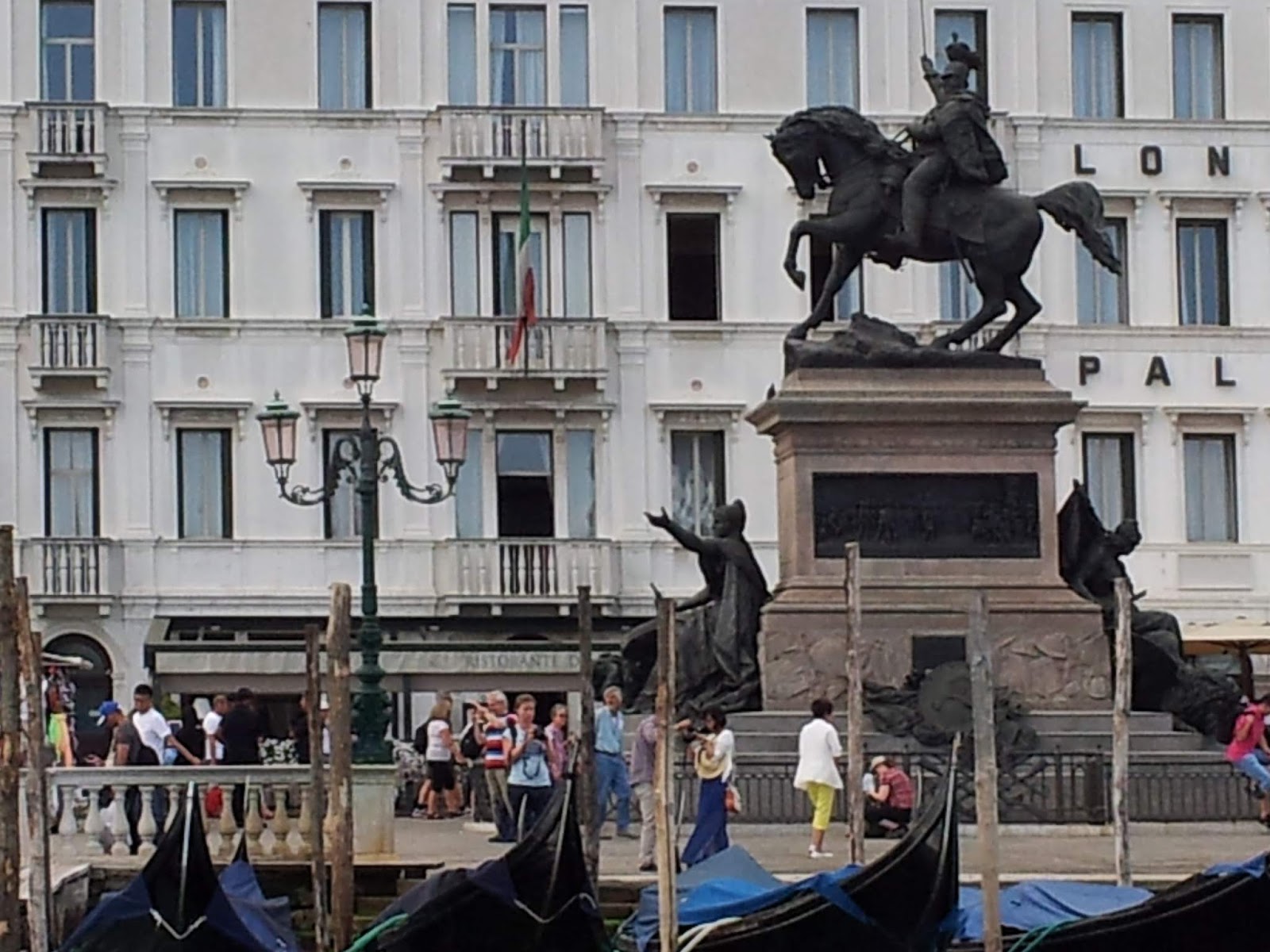
This is a photo of the Hilton Hotel from the other side of the canal.

It was useful knowledge for the second time we visited Venice because the waterbus from the Hilton hotel made its first stop, before San Marco, there.  We also discovered on that second visit a number of restaurants on the way from the terminal and church to the Accademia Bridge.

This is looking back towards San Marco from the Accademia Bridge:

And this, looking towards the docks:

Items to note:

Restaurants off the beaten track were much cheaper and the food a lot different to that in the middle of the tourist areas.

There are a lot of churches, big and small, tucked away in interesting spots where there are small piazza’s.  You can look in all of them, though some asked for a small fee.

Souvenirs, coffee, and confectionary are very expensive in St Marks square.

Writing a book in 365 days – 232

Day 232

Sometimes, the best books for writers bear little similarity to their medium

The Unconventional Muse: When Your Best Writing Lesson Comes From Anywhere But a ‘How-To’ Guide

We writers are always chasing that elusive spark, that deeper understanding of human nature and narrative that elevates our work from good to truly profound. We devour books on craft, attend workshops, and pore over articles dissecting plot points and character arcs. All valuable, of course.

But what if the most potent lessons for your writing don’t come from a book with “How To Write” in the title? What if your greatest storytelling mentor isn’t a famous novelist, but a philosopher, a historian, or even a scientist?

This isn’t just a quirky idea; it’s a fundamental truth for many successful writers. Sometimes, the best books for writers bear little similarity to their medium.

Why Look Beyond the Craft?

Writers are, at heart, observers and interpreters of the human condition. We craft worlds, yes, but those worlds gain their resonance from reflecting or distorting truths about our world. To truly understand the stories we tell, we need to understand the world itself – its history, its psychology, its moral dilemmas, its scientific wonders.

This is where seemingly unrelated disciplines become invaluable. They offer different lenses through which to view conflict, motivation, and the very fabric of reality.

The Playwright, the Philosopher, and the Clash of Two Rights

Let’s take a specific example that perfectly illustrates this premise: the playwright. Should a playwright read philosophy? An emphatic yes.

Consider the profound wisdom offered by thinkers like George Wilhelm Friedrich Hegel. His work, particularly his dialectical approach to history and conflict, provides an incredible framework for understanding the deepest dramatic tensions.

For Hegel, the true tragedy – and the most compelling drama – lies not in a clear-cut battle between good and evil, but in the irreconcilable clash of two rights.

Think about that for a moment. It’s not the simple Hollywood narrative where the hero is unequivocally good and the villain is purely evil. That kind of story, while sometimes entertaining, often lacks the true grit and complexity of human experience.

Instead, Hegel pointed to the underlying issues in Greek tragedy as a case in point. Take Sophocles’ Antigone. Here, the conflict isn’t between a righteous hero and an evil tyrant. It’s between Antigone’s undeniable moral right to bury her brother, honoring the divine laws and family duty, and Creon’s equally legitimate right to uphold the laws of the state, ensuring order and preventing further rebellion.

Both characters are, in their own frameworks, right. Both are acting out of deeply held convictions and duties. And it is precisely because both are “right” that their collision is so utterly devastating, leading to a profound, unavoidable tragedy. Neither can simply concede without betraying their core identity or belief system.

A Golden Key for Every Writer

This isn’t just an academic point for philosophers; it’s a golden key for anyone crafting a narrative, whether it’s a novel, a screenplay, a short story, or even a compelling blog post.

  • Complex Characters: When your antagonists aren’t just “bad” but are operating from their own deeply held, morally defensible (to them) positions, your characters instantly gain depth. Their motivations become understandable, even if you disagree with their actions.
  • Richer Conflict: The “two rights” dilemma elevates your plot beyond simplistic good vs. evil. It forces your characters, and your readers, to grapple with true moral ambiguity, making the stakes feel far higher and more authentic. Think of a nuanced political drama, a family saga fraught with misunderstanding, or even a personal internal struggle where the protagonist is torn between two equally valid, yet conflicting, desires.
  • Deeper Themes: This approach allows you to explore profound themes about ethics, justice, loyalty, and the inherent contradictions of human existence, without needing to preach. The conflict itself becomes the exploration.

When your characters operate from their own deeply held, morally defensible positions, the story becomes infinitely more resonant because it mirrors the complexities of real life.

Broaden Your Mind, Deepen Your Stories

So, what does this mean for your reading list?

Don’t limit yourself to books on plot structure or character arcs (though those are valuable!). Dive into history, neuroscience, poetry, economics, art criticism, and yes, philosophy. Seek out texts that grapple with ethics, existence, and the nature of reality. Read the great thinkers, not necessarily to agree with them, but to understand how they thought and what they wrestled with.

You’re not just reading to learn facts; you’re reading to broaden your understanding of the human experience itself. And that, my fellow writers, is the wellspring from which truly compelling stories flow. Expand your mind, expand your world, and watch your own narratives deepen and soar.

What unconventional books or fields of study have unexpectedly impacted your writing? Share your discoveries in the comments below!

Writing a book in 365 days – 231

Day 231

Write the first page of a story based on a strong memory of a trip you once took.

Nancy also had a ticket, but had complicated her situation with Corrigan, so it would be interesting to see if she could extricate herself without appearing to follow me to the ferry terminal.

But it was not a deal breaker if she couldn’t get away.

As I came out the front entrance, a short way down the road, I saw a flurry of flashing lights and a bevy of policemen, and among them was the man without glasses, gesturing and protesting his innocence.  One of the two Chinese that had been in the lobby watching him was there, on the side, observing.

Good.  Keith, the man without glasses or the Chinese, would be following me.  That didn’t rule out someone else I hadn’t seen, so I still needed to be careful.

At least I hadn’t tried to conceal where I was going, letting the concierge know and telling him that if anyone was looking for me, that’s where I’d be for the next few hours.

I figured it would be the first place anyone would go to, after the front desk, whom I’d also told, if they, whoever they were, wanted me.

The taxi driver drove past the group, and I could see a man without glasses was fighting a losing battle.  The only good thing about it, he was providing a very noticeable distraction for me.

When I arrived at the terminal, it was pandemonium.

Organised perhaps, but barely.  Buses were arriving every few minutes, dropping off another 50 or so tourists, adding to the throng of about a thousand, all either lining up or waiting on groups for the guide to tell them where to go.

The disembarkation area was about a mile long with terminal buildings for what must be quite a few boats going out that night.

I went into the first building I could see and found an office, and with the few Chinese words I glad, found myself directed to another office further along.

There, my ticket was taken, a stub ripped off by what seemed to be a harassed officer, then pointed to the door that exited onto the wharf. I was told the picture of the boat was the one I was looking for.

Found.

It was behind the office, so I went up the gangway and onto the boat.

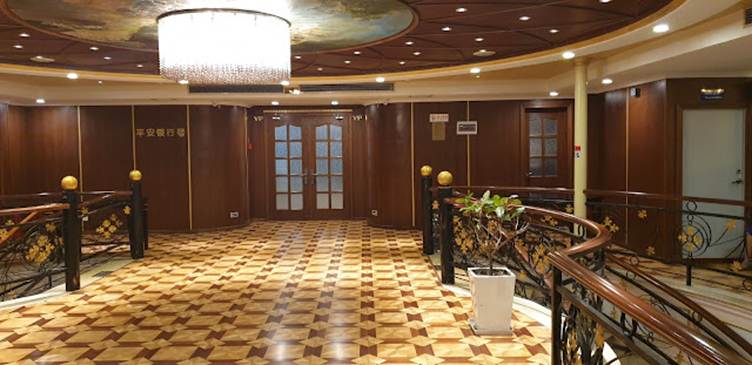
For a cruise vessel, it was, if anything, over the top.  Marble staircase, marble floors and the decor of a palace rather than a cruise vessel.

I went up the staircase to the middle level, just reaching the floor as a crowd of tourists streamed up behind me, some almost running.  Perhaps there were vantage points on each of the decks that I didn’t know about, but it seemed they considered the top deck the place to be for the best views and those all-important photographs.

I joined the throng; it was hard not to be caught up in the surging mass, to the rear of the ship and a small section of open space, where the throng was reduced to squeezing through a narrow doorway way and I found myself being jostled briefly until I reached the railing.

Still, the crowds came, and I realised this was the main way to get to the upper deck.  I was surprised the ferry didn’t have a staff member in place to make the process more orderly.

15 minutes later, the vessel cast off, everyone had found somewhere to stand or sit, and the flow of people going up had been reduced to a trickle more coming back down than going up.

I took a quick look myself, and the top deck was filled to capacity with every vantage point taken.

Downstairs again, I crossed the deck to the VIP room and showed the crew member my ticket, after which she opened the door and ushered me in.

A lot fewer people in there, perhaps due to the price of gaining entrance.  I ordered a drink then found a seat next to the window.

By this time, we were underway, moving out into the middle of the river, heading towards the Bund.  I could see the buildings on the nearest riverbank lit up, colourful enough to keep those around me and doubtless everywhere else on the boat, taking endless photographs.

They didn’t notice, and I had almost not, the arrival of the same two policemen who had been at the hotel watching the man now without his glasses.  I did a quick scan of the room, trying not to look like I was doing a quick scan of the room, and couldn’t see him.

Nor had I seen him earlier, before and during boarding.  That didn’t mean he wasn’t on board somewhere.

The two policemen seemed satisfied he was not in the room and went back out again.  They had not given me a second look, or perhaps they were that good.  It didn’t matter; they were gone.

When I sat down, another short, rotund Chinese man was sitting in the seat beside me.  I had no idea if this was the man I was sent to meet, or if he had just sneaked in while everyone’s attention was elsewhere.

I wasn’t going to ask.

He didn’t speak.  He simply sat there, not looking sideways but just straight ahead at the buildings on the Bund, all lit in what seemed to be a continuous line of lights.

And then, all of a sudden, the building lights went out, much to the dismay of all on board, and those in the room who’d been crowding all the available window space.

Then the lights in the room went out, and for a few seconds, there was confusion.  A minute in darkness, at the most, and the lights went back on, and the man was gone.

I’d neither seen nor heard him leave.  But I did feel a slight bump, and out of curiosity, I checked my jacket pocket.

Something small.  Most likely a USB memory stick.  The files I’d been sent to pick up.

Now, all I had to do was get off the boat, back to the hotel, act normal for the next two days, and then go home, acting as if nothing had happened.

Of course, if this weren’t China, that might happen.  But it was, and when I looked over at the door leading back to the exit, I saw the two policemen I’d seen earlier in the hotel escorting what looked to be the man who’d just been briefly sitting next to me out of the room.

That couldn’t be a coincidence, could it?

©  Charles Heath  2025

Searching for Locations: Venice, Italy

Venice is definitely a city to explore.  It has an incredible number of canals and walkways, and each time we would start our exploration at St Marks square when it’s not underwater

Everyone I have spoken to about exploring Venice has told me how easy it is to get lost.  It has not happened to me, but with the infinite number of ways you can go, I guess it is possible.

We started our exploration of Venice in St Marks square, where, on one side there was the Museo di Palazzo Ducale and, next door, the Basilica di San Marco.  Early morning and/or at high tide, water can be seen bubbling up from under the square, partially flooding it.  I have seen this happen several times.  Each morning as we walked from the hotel (the time we stayed in the Savoia and Jolanda) we passed the Bridge of Sighs.

Around the other three sides of the square are archways and shops.  We have bought both confectionary and souvenirs from some of these stores, albeit relatively expensive.  Prices are cheaper in stores that are away from the square and we found some of these when we walked from St Marks square to the Railway station, through many walkways, and crossing many bridges, and passing through a number of small piazzas.

That day, after the trek, we caught the waterbus back to San Marco, and then went on the tour of the Museo di Palazzo Du which included the dungeons and the Bridge of Sighs from the inside.  It took a few hours, longer than I’d anticipated because there was so much to see.

The next day, we caught the waterbus from San Marco to the Ponte di Rialto bridge.  Just upstream from the wharf there was a very large passenger ship, and I noticed there were a number of passengers from the ship on the waterbus, one of whom spoke to us about visiting Venice.  I didn’t realize we looked like professional tourists who knew where we were going.

After a pleasant conversation, and taking in the views up and down the Grand Canal, we disembarked and headed for the bridge, looking at the shops, mostly selling upmarket and expensive gifts, and eventually crossing to the other side where there was a lot of small market type stalls selling souvenirs as well as clothes, and most importantly, it being a hot day, cold Limonata.  This was my first taste of Limonata and I was hooked.

Continuing on from there was a wide street at the end and a number of restaurants where we had lunch.  We had a map of Venice and I was going to plot a course back to the hotel, taking what would be a large circular route that would come out at the Accademia Bridge, and further on to the Terminal Fusina Venezia where there was another church to explore, the Santa Maria del Rosario.

This is a photo of the Hilton Hotel from the other side of the canal.

It was useful knowledge for the second time we visited Venice because the waterbus from the Hilton hotel made its first stop, before San Marco, there.  We also discovered on that second visit a number of restaurants on the way from the terminal and church to the Accademia Bridge.

This is looking back towards San Marco from the Accademia Bridge:

And this, looking towards the docks:

Items to note:

Restaurants off the beaten track were much cheaper and the food a lot different to that in the middle of the tourist areas.

There are a lot of churches, big and small, tucked away in interesting spots where there are small piazza’s.  You can look in all of them, though some asked for a small fee.

Souvenirs, coffee, and confectionary are very expensive in St Marks square.

Writing a book in 365 days – 231

Day 231

Write the first page of a story based on a strong memory of a trip you once took.

Nancy also had a ticket, but had complicated her situation with Corrigan, so it would be interesting to see if she could extricate herself without appearing to follow me to the ferry terminal.

But it was not a deal breaker if she couldn’t get away.

As I came out the front entrance, a short way down the road, I saw a flurry of flashing lights and a bevy of policemen, and among them was the man without glasses, gesturing and protesting his innocence.  One of the two Chinese that had been in the lobby watching him was there, on the side, observing.

Good.  Keith, the man without glasses or the Chinese, would be following me.  That didn’t rule out someone else I hadn’t seen, so I still needed to be careful.

At least I hadn’t tried to conceal where I was going, letting the concierge know and telling him that if anyone was looking for me, that’s where I’d be for the next few hours.

I figured it would be the first place anyone would go to, after the front desk, whom I’d also told, if they, whoever they were, wanted me.

The taxi driver drove past the group, and I could see a man without glasses was fighting a losing battle.  The only good thing about it, he was providing a very noticeable distraction for me.

When I arrived at the terminal, it was pandemonium.

Organised perhaps, but barely.  Buses were arriving every few minutes, dropping off another 50 or so tourists, adding to the throng of about a thousand, all either lining up or waiting on groups for the guide to tell them where to go.

The disembarkation area was about a mile long with terminal buildings for what must be quite a few boats going out that night.

I went into the first building I could see and found an office, and with the few Chinese words I glad, found myself directed to another office further along.

There, my ticket was taken, a stub ripped off by what seemed to be a harassed officer, then pointed to the door that exited onto the wharf. I was told the picture of the boat was the one I was looking for.

Found.

It was behind the office, so I went up the gangway and onto the boat.

For a cruise vessel, it was, if anything, over the top.  Marble staircase, marble floors and the decor of a palace rather than a cruise vessel.

I went up the staircase to the middle level, just reaching the floor as a crowd of tourists streamed up behind me, some almost running.  Perhaps there were vantage points on each of the decks that I didn’t know about, but it seemed they considered the top deck the place to be for the best views and those all-important photographs.

I joined the throng; it was hard not to be caught up in the surging mass, to the rear of the ship and a small section of open space, where the throng was reduced to squeezing through a narrow doorway way and I found myself being jostled briefly until I reached the railing.

Still, the crowds came, and I realised this was the main way to get to the upper deck.  I was surprised the ferry didn’t have a staff member in place to make the process more orderly.

15 minutes later, the vessel cast off, everyone had found somewhere to stand or sit, and the flow of people going up had been reduced to a trickle more coming back down than going up.

I took a quick look myself, and the top deck was filled to capacity with every vantage point taken.

Downstairs again, I crossed the deck to the VIP room and showed the crew member my ticket, after which she opened the door and ushered me in.

A lot fewer people in there, perhaps due to the price of gaining entrance.  I ordered a drink then found a seat next to the window.

By this time, we were underway, moving out into the middle of the river, heading towards the Bund.  I could see the buildings on the nearest riverbank lit up, colourful enough to keep those around me and doubtless everywhere else on the boat, taking endless photographs.

They didn’t notice, and I had almost not, the arrival of the same two policemen who had been at the hotel watching the man now without his glasses.  I did a quick scan of the room, trying not to look like I was doing a quick scan of the room, and couldn’t see him.

Nor had I seen him earlier, before and during boarding.  That didn’t mean he wasn’t on board somewhere.

The two policemen seemed satisfied he was not in the room and went back out again.  They had not given me a second look, or perhaps they were that good.  It didn’t matter; they were gone.

When I sat down, another short, rotund Chinese man was sitting in the seat beside me.  I had no idea if this was the man I was sent to meet, or if he had just sneaked in while everyone’s attention was elsewhere.

I wasn’t going to ask.

He didn’t speak.  He simply sat there, not looking sideways but just straight ahead at the buildings on the Bund, all lit in what seemed to be a continuous line of lights.

And then, all of a sudden, the building lights went out, much to the dismay of all on board, and those in the room who’d been crowding all the available window space.

Then the lights in the room went out, and for a few seconds, there was confusion.  A minute in darkness, at the most, and the lights went back on, and the man was gone.

I’d neither seen nor heard him leave.  But I did feel a slight bump, and out of curiosity, I checked my jacket pocket.

Something small.  Most likely a USB memory stick.  The files I’d been sent to pick up.

Now, all I had to do was get off the boat, back to the hotel, act normal for the next two days, and then go home, acting as if nothing had happened.

Of course, if this weren’t China, that might happen.  But it was, and when I looked over at the door leading back to the exit, I saw the two policemen I’d seen earlier in the hotel escorting what looked to be the man who’d just been briefly sitting next to me out of the room.

That couldn’t be a coincidence, could it?

©  Charles Heath  2025

Writing a book in 365 days – 230

Day 230

Writing comedy

The Mirthful Art of Misunderstanding: Why Comedy Needs More Than Just Punchlines

What makes you laugh? Is it a clever turn of phrase? A perfectly timed pratfall? Or that specific, delicious moment when two realities collide in delightful chaos? For anyone who’s ever tried to craft a joke, a sketch, or an entire sitcom, you know that comedy is far more intricate than simply stringing together funny words. And at its heart, it requires one non-negotiable ingredient: a genuine sense of humor.

The Non-Negotiable: A Sense of Humor

It sounds obvious, doesn’t it? Writing comedy requires a sense of humor. Yet, you’d be surprised how often people try to reverse-engineer “funny” without that innate spark. You can learn comedic timing, structure, and even how to write a killer punchline, but if you don’t possess a fundamental understanding of what makes things absurd, ironic, or just plain ridiculous, your efforts will often fall flat.

A sense of humor isn’t just about telling jokes; it’s a way of seeing the world. It’s the ability to spot the unexpected juxtaposition, the human foibles, the inherent absurdity in everyday life. Without this lens, writing comedy becomes a technical exercise rather than an act of genuine creation. It’s like trying to be a chef without taste buds – you can follow the recipe, but you’ll never truly understand balance or flavor. So, if you’re venturing into comedy writing and find yourself consistently baffled by what causes laughter, that might be your first clue.

The Ingenious Engine: Creating the Misunderstanding

Once you have that internal funny bone, the next step is understanding comedy’s most powerful, enduring engine: the misunderstanding. This is the basic premise upon which so much successful comedy is built. It’s not about malice or cruelty, but about a delightful divergence of perception or information.

Think about it:

  • Mistaken Identity: Character A thinks Character B is someone else entirely.
  • Misinterpreted Intentions: Character C says something innocent, but Character D hears it in the worst possible way.
  • Conflicting Knowledge: The audience knows something the characters don’t, leading to dramatic (and comedic) irony.
  • Literal vs. Figurative: One character takes an idiom or figure of speech literally, while the other means it figuratively.

The brilliance of the misunderstanding lies in the tension it creates. We, the audience, are often in on the secret (or we quickly piece it together), and we squirm with anticipation as the characters dig themselves deeper into their respective holes. We see the train wreck coming, not with dread, but with a giddy excitement, knowing that the inevitable collision will be hilarious. The humor isn’t just in the individual lines; it’s in the gap between what is perceived and what is real.

The Satisfying Release: Clearing It Up

But the tension isn’t meant to last forever. The true comedic genius of the misunderstanding formula comes in the resolution. At the end, everything is cleared up. The mistaken identity is revealed, the intentions are clarified, the truth comes out.

Why is this so satisfying?

  • Relief: After the build-up of tension and absurdity, the release of understanding is a physical and emotional relief, often expressed through laughter.
  • The “Aha!” Moment: We see how all the threads connect, how the initial false premise led to all the hilarious subsequent events. It’s a puzzle solved, and often, the simple truth is funnier than the elaborate mistaken reality.
  • Catharsis: The characters (often) learn a lesson, or at least come to terms with the absurdity of what just transpired. And crucially, everyone is happy – not necessarily every character in the story (some might be embarrassed!), but the audience is left feeling satisfied, amused, and with a sense of completion. The world, briefly thrown into comical disarray, has been righted.

The Dance of Art and Instinct

So, for aspiring comedy writers, remember this dual approach. Cultivate that innate sense of humor – watch people, observe irony, find the funny in the everyday. But then, layer it with the powerful, proven structure of the misunderstanding. Build that tension, escalate the ridiculousness, and then, with a flourish, clear it all up, letting your audience bask in the delightful “aha!” of laughter.

Because ultimately, comedy isn’t just about telling jokes. It’s about taking us on a journey from confusion to clarity, from tension to release, and leaving us with that wonderful, unifying feeling of joy. And that, my friends, is no laughing matter. (Except, of course, when it is.)

Writing a book in 365 days – 230

Day 230

Writing comedy

The Mirthful Art of Misunderstanding: Why Comedy Needs More Than Just Punchlines

What makes you laugh? Is it a clever turn of phrase? A perfectly timed pratfall? Or that specific, delicious moment when two realities collide in delightful chaos? For anyone who’s ever tried to craft a joke, a sketch, or an entire sitcom, you know that comedy is far more intricate than simply stringing together funny words. And at its heart, it requires one non-negotiable ingredient: a genuine sense of humor.

The Non-Negotiable: A Sense of Humor

It sounds obvious, doesn’t it? Writing comedy requires a sense of humor. Yet, you’d be surprised how often people try to reverse-engineer “funny” without that innate spark. You can learn comedic timing, structure, and even how to write a killer punchline, but if you don’t possess a fundamental understanding of what makes things absurd, ironic, or just plain ridiculous, your efforts will often fall flat.

A sense of humor isn’t just about telling jokes; it’s a way of seeing the world. It’s the ability to spot the unexpected juxtaposition, the human foibles, the inherent absurdity in everyday life. Without this lens, writing comedy becomes a technical exercise rather than an act of genuine creation. It’s like trying to be a chef without taste buds – you can follow the recipe, but you’ll never truly understand balance or flavor. So, if you’re venturing into comedy writing and find yourself consistently baffled by what causes laughter, that might be your first clue.

The Ingenious Engine: Creating the Misunderstanding

Once you have that internal funny bone, the next step is understanding comedy’s most powerful, enduring engine: the misunderstanding. This is the basic premise upon which so much successful comedy is built. It’s not about malice or cruelty, but about a delightful divergence of perception or information.

Think about it:

  • Mistaken Identity: Character A thinks Character B is someone else entirely.
  • Misinterpreted Intentions: Character C says something innocent, but Character D hears it in the worst possible way.
  • Conflicting Knowledge: The audience knows something the characters don’t, leading to dramatic (and comedic) irony.
  • Literal vs. Figurative: One character takes an idiom or figure of speech literally, while the other means it figuratively.

The brilliance of the misunderstanding lies in the tension it creates. We, the audience, are often in on the secret (or we quickly piece it together), and we squirm with anticipation as the characters dig themselves deeper into their respective holes. We see the train wreck coming, not with dread, but with a giddy excitement, knowing that the inevitable collision will be hilarious. The humor isn’t just in the individual lines; it’s in the gap between what is perceived and what is real.

The Satisfying Release: Clearing It Up

But the tension isn’t meant to last forever. The true comedic genius of the misunderstanding formula comes in the resolution. At the end, everything is cleared up. The mistaken identity is revealed, the intentions are clarified, the truth comes out.

Why is this so satisfying?

  • Relief: After the build-up of tension and absurdity, the release of understanding is a physical and emotional relief, often expressed through laughter.
  • The “Aha!” Moment: We see how all the threads connect, how the initial false premise led to all the hilarious subsequent events. It’s a puzzle solved, and often, the simple truth is funnier than the elaborate mistaken reality.
  • Catharsis: The characters (often) learn a lesson, or at least come to terms with the absurdity of what just transpired. And crucially, everyone is happy – not necessarily every character in the story (some might be embarrassed!), but the audience is left feeling satisfied, amused, and with a sense of completion. The world, briefly thrown into comical disarray, has been righted.

The Dance of Art and Instinct

So, for aspiring comedy writers, remember this dual approach. Cultivate that innate sense of humor – watch people, observe irony, find the funny in the everyday. But then, layer it with the powerful, proven structure of the misunderstanding. Build that tension, escalate the ridiculousness, and then, with a flourish, clear it all up, letting your audience bask in the delightful “aha!” of laughter.

Because ultimately, comedy isn’t just about telling jokes. It’s about taking us on a journey from confusion to clarity, from tension to release, and leaving us with that wonderful, unifying feeling of joy. And that, my friends, is no laughing matter. (Except, of course, when it is.)

Writing a book in 365 days – 228/229

Days 228 and 229

Mortal danger and the story that saves you

The Scheherazade Challenge: If My Life (and Your Attention) Depended On It…

Let’s play a dangerous game, shall we?

Imagine, for a fleeting moment, that the weight of an ancient dynasty rests on your shoulders. The Sultan, broken by betrayal and consumed by cynicism, has vowed to take a new bride each night and execute her by dawn. And then, there’s you. A single, fragile life against the tide of his despair, with only one weapon: a story.

Not just any story. A story so compelling, so intricate, so profoundly human, that it can outwit the executioner, melt a frozen heart, and stretch the boundaries of time itself. Your very survival, the fate of all women in the kingdom, hinges on your ability to spin a tale that leaves the Sultan hanging on your every word, desperate for the next sunrise to reveal its continuation.

Now, take a deep breath. We’re not in a dusty, lamp-lit palace, and (thankfully) my head isn’t on a literal chopping block. But as a writer in this wild, wonderful, and wonderfully noisy digital age, there are still stakes. My “Sultan” is you, dear reader, scrolling through an endless bazaar of content. My “dawn” is the moment you might click away, drawn by the siren song of another tab. And my “life” (or at least, my creative soul and my ability to connect with you) depends on telling an amazing story.

So, if I were Scheherazade, faced with that impossible mandate, what tale would I weave?

It wouldn’t be a simple adventure, nor a flat romance. It would need layers, heart, and a message so subtle yet profound that it could soften the hardest of souls.

My Life-Saving Story: “The Loom of Whispers and the Cartographer of Hidden Threads”

My story would begin in a city unlike any other, not built of stone and mortar, but of stories themselves. Let’s call it Aethelgard, the City of Echoes. Its streets are paved with forgotten proverbs, its buildings rise from ancient legends, and the very air hums with the whispers of every life ever lived within its bounds.

Our protagonist would be Elara, not a warrior or a princess, but a reclusive Cartographer of Hidden Threads. Her unique gift (and burden) is that she can see the invisible, iridescent threads that connect every living being in Aethelgard. Each thread represents a shared experience, a glance exchanged, a kindness given, a betrayal suffered, a dream whispered in unison. Most people only see their own thread, a solitary line stretching from their heart. But Elara sees the entirety: a magnificent, terrifying, ever-shifting tapestry of countless lives interwoven.

The story would begin with a creeping malaise. Aethelgard, once vibrant, is losing its color. Its echoes are fading. People are growing isolated, suspicious, convinced their own struggles are unique and paramount. The threads, once brilliantly intertwined, are fraying, even breaking. Elara knows the city is dying because its people are forgetting how deeply they are connected.

Her quest is not to slay a monster, but to mend the tapestry. She must journey not across lands, but through the stories themselves.

Each night, I would begin one of Elara’s “thread-following” expeditions:

  • Night One: She follows a flickering, almost invisible thread from a lonely old baker who believes no one cares for him. The thread leads her back through generations, revealing how his great-grandmother, a woman he never knew, once saved a merchant’s fortune with a single, anonymous act of kindness, and how that merchant’s lineage later funded the very orphanage where the baker himself found refuge as a child. The baker’s life, he would discover, was built on an ancient, forgotten thread of generosity.
  • Night Two: Elara traces a taut, angry thread between two feuding families, their hatred centuries old. As she follows it, she uncovers the true origin: not a grand slight, but a misinterpreted joke, a stolen flower, and a series of escalating misunderstandings, each fueled by pride and a refusal to truly listen. But she also finds faint counter-threads – moments of shared joy, unspoken longing for peace, nearly-forgiven transgressions – that still hum beneath the surface.
  • Night Three: She investigates a vibrant thread of innovation and creativity, discovering it’s not the solitary genius of a famous artist, but the culmination of countless, unacknowledged inspirations: a child’s forgotten drawing, a beggar’s hummed tune, a weaver’s discarded pattern, each contributing a vital, invisible strand to the masterpiece.

Through Elara’s journey, the Sultan (and you, dear reader) would witness the profound irony of human existence: we are all singular, yet inextricably bound. Our greatest joys and deepest pains are rarely our own alone. Every act, every word, every silence sends ripples through the great tapestry.

The “cliffhanger” each night wouldn’t be a sword fight, but a dawning realization. Elara would be on the verge of revealing a crucial, heart-wrenching, or profoundly beautiful connection that implicates seemingly disparate characters, perhaps even hinting at the Sultan’s own lineage, his own perceived isolation, as being a part of this vast, interconnected web.

The story would be a mirror, reflecting the Sultan’s own life back at him – not judging, but revealing. It would show him that just as a breaking thread in the farthest corner of Aethelgard could unravel the entire city, so too did his own actions send tremors through the lives of everyone around him. It would demonstrate that true power comes not from severing connections, but from understanding and honoring them.

By the final night, the Sultan wouldn’t just be entertained; he would be transformed. He would see himself not as an isolated ruler, but as a vital, powerful weaver in the Loom of Whispers. And with that understanding, perhaps, the desire to cut threads would vanish, replaced by a profound respect for the intricate, beautiful, and utterly inescapable tapestry of life.

What about you? If your life depended on it, what story would you tell? And what hidden threads would you uncover?

Writing a book in 365 days – 228/229

Days 228 and 229

Mortal danger and the story that saves you

The Scheherazade Challenge: If My Life (and Your Attention) Depended On It…

Let’s play a dangerous game, shall we?

Imagine, for a fleeting moment, that the weight of an ancient dynasty rests on your shoulders. The Sultan, broken by betrayal and consumed by cynicism, has vowed to take a new bride each night and execute her by dawn. And then, there’s you. A single, fragile life against the tide of his despair, with only one weapon: a story.

Not just any story. A story so compelling, so intricate, so profoundly human, that it can outwit the executioner, melt a frozen heart, and stretch the boundaries of time itself. Your very survival, the fate of all women in the kingdom, hinges on your ability to spin a tale that leaves the Sultan hanging on your every word, desperate for the next sunrise to reveal its continuation.

Now, take a deep breath. We’re not in a dusty, lamp-lit palace, and (thankfully) my head isn’t on a literal chopping block. But as a writer in this wild, wonderful, and wonderfully noisy digital age, there are still stakes. My “Sultan” is you, dear reader, scrolling through an endless bazaar of content. My “dawn” is the moment you might click away, drawn by the siren song of another tab. And my “life” (or at least, my creative soul and my ability to connect with you) depends on telling an amazing story.

So, if I were Scheherazade, faced with that impossible mandate, what tale would I weave?

It wouldn’t be a simple adventure, nor a flat romance. It would need layers, heart, and a message so subtle yet profound that it could soften the hardest of souls.

My Life-Saving Story: “The Loom of Whispers and the Cartographer of Hidden Threads”

My story would begin in a city unlike any other, not built of stone and mortar, but of stories themselves. Let’s call it Aethelgard, the City of Echoes. Its streets are paved with forgotten proverbs, its buildings rise from ancient legends, and the very air hums with the whispers of every life ever lived within its bounds.

Our protagonist would be Elara, not a warrior or a princess, but a reclusive Cartographer of Hidden Threads. Her unique gift (and burden) is that she can see the invisible, iridescent threads that connect every living being in Aethelgard. Each thread represents a shared experience, a glance exchanged, a kindness given, a betrayal suffered, a dream whispered in unison. Most people only see their own thread, a solitary line stretching from their heart. But Elara sees the entirety: a magnificent, terrifying, ever-shifting tapestry of countless lives interwoven.

The story would begin with a creeping malaise. Aethelgard, once vibrant, is losing its color. Its echoes are fading. People are growing isolated, suspicious, convinced their own struggles are unique and paramount. The threads, once brilliantly intertwined, are fraying, even breaking. Elara knows the city is dying because its people are forgetting how deeply they are connected.

Her quest is not to slay a monster, but to mend the tapestry. She must journey not across lands, but through the stories themselves.

Each night, I would begin one of Elara’s “thread-following” expeditions:

  • Night One: She follows a flickering, almost invisible thread from a lonely old baker who believes no one cares for him. The thread leads her back through generations, revealing how his great-grandmother, a woman he never knew, once saved a merchant’s fortune with a single, anonymous act of kindness, and how that merchant’s lineage later funded the very orphanage where the baker himself found refuge as a child. The baker’s life, he would discover, was built on an ancient, forgotten thread of generosity.
  • Night Two: Elara traces a taut, angry thread between two feuding families, their hatred centuries old. As she follows it, she uncovers the true origin: not a grand slight, but a misinterpreted joke, a stolen flower, and a series of escalating misunderstandings, each fueled by pride and a refusal to truly listen. But she also finds faint counter-threads – moments of shared joy, unspoken longing for peace, nearly-forgiven transgressions – that still hum beneath the surface.
  • Night Three: She investigates a vibrant thread of innovation and creativity, discovering it’s not the solitary genius of a famous artist, but the culmination of countless, unacknowledged inspirations: a child’s forgotten drawing, a beggar’s hummed tune, a weaver’s discarded pattern, each contributing a vital, invisible strand to the masterpiece.

Through Elara’s journey, the Sultan (and you, dear reader) would witness the profound irony of human existence: we are all singular, yet inextricably bound. Our greatest joys and deepest pains are rarely our own alone. Every act, every word, every silence sends ripples through the great tapestry.

The “cliffhanger” each night wouldn’t be a sword fight, but a dawning realization. Elara would be on the verge of revealing a crucial, heart-wrenching, or profoundly beautiful connection that implicates seemingly disparate characters, perhaps even hinting at the Sultan’s own lineage, his own perceived isolation, as being a part of this vast, interconnected web.

The story would be a mirror, reflecting the Sultan’s own life back at him – not judging, but revealing. It would show him that just as a breaking thread in the farthest corner of Aethelgard could unravel the entire city, so too did his own actions send tremors through the lives of everyone around him. It would demonstrate that true power comes not from severing connections, but from understanding and honoring them.

By the final night, the Sultan wouldn’t just be entertained; he would be transformed. He would see himself not as an isolated ruler, but as a vital, powerful weaver in the Loom of Whispers. And with that understanding, perhaps, the desire to cut threads would vanish, replaced by a profound respect for the intricate, beautiful, and utterly inescapable tapestry of life.

What about you? If your life depended on it, what story would you tell? And what hidden threads would you uncover?