It is, but it isn’t. Oddly enough after two weeks in temperatures ranging from -21 to 7 degrees Fahrenheit, I think I’m finally used to it.
My early morning walk after leaving the hotel is both for exercise and exploring.
Looking for locations, observing people, watching and learning what it’s like to live, work, and hang out in a city like New York.
It’s so much more interesting than where I come from. There it would be impossible to spin a story in such a small city. You need to be able to hide in plain sight among millions of people over a very large area that encompasses Manhattan, Brooklyn, Queens, and everything else in-between and beyond.
I was looking at going to a Walmart in Secaucus, about three and a half miles from my hotel in Manhattan. Three and a half miles. In my city that’s way beyond the limits of the city and in the outer suburbs.
Here I can spin a tale that could live within the confines of 35th street, 85th street, 2nd Avenue and 10th Avenue, and have so much material, I could probably write a trilogy.
Pity is, I won’t be here long enough to gather enough background.
Still, it’s like being in literary seventh heaven.
I’ve written one book based in New York, I’m sure another is currently writing itself in my head and will be on paper over the next year.
As soon as I stepped off the shuttle in the cargo bay, the third officer was waiting for me.
“The captain asked me to escort you up to his day room.”
Unusual. The captain could have just called me on the private communicator if there was a need for secrecy, if that was what this was.
“Any reason why he would send you?”
“Didn’t want you getting lost, sir.”
I knew I should not have admitted to him that I had got a little confused finding my way around, but that was because the dockyard people had blocked off several passageways.
“No. I guess not.”
The Third was a man of little humour, and particularly didn’t think any of my jokes were funny. On station, he was all serious and unamused.
Now, he had his serious face on, and I thought it best not to ask what to expect.
He took a different route to the bridge than what I would have taken, a much shorter and more direct route. It was obvious he had studied the plans of the ship and knew it backwards. I on the other hand, was not that prepared, but it meant I would have to.
He went as far as the door to the day room, and left me there. I didn’t need to announce myself, the doors just opened, whisper quiet, showing me the room I could expect one day when I got my own ship.
Or at the very least, I could dream.
The doors closed behind me, and I walked forward into the room proper, and first saw the captain sitting at his desk, and then a figure standing beside and back a step, behind him.
There was a weapon in his hand, but it was by his side.
And something else I noticed, the figure looked just like the three I’d seen on the other ship.
The captain saw me looking at him.
“This is the captain from the vessel that just arrived as those assailants on the cargo ship were ‘rescued’.
He, or she, looked human under the clothes and helmet, but could be almost anything.
“Does he…”
“Speak our language, yes, and a lot of others. And he would like our help.”
Like everyone who was in that artificially silent environment that was the flight deck of a shuttle, unexpected sounds caused unexpected results.
The Engineer cursed.
The Pilot, Myrtle, hesitated for a moment, as if not quite sure what to do, highlighting the fact she had not been in such a situation before, but quickly recovered, and brought up the incoming object on screen.
Note to self: amend the training program to allow for random objects to come out of nowhere.
We all looked at the object. Myrtle should have been taking us into the freighter, but had got overawed by the not easily identifiable ship approaching.
“Our ship will take care of the problem,” I said. “Take us into the freighter.”
As if surprised that she should be asked to do so, she realised it was not her job to be staring at the screen, and muttered, “Oh, yes,” before resuming our passage.
Another note to self: Proper command structures and language should be used at all times.
A minute or so later we were in the cargo bay and the cargo doors were closing. Once closed and the atmosphere adjusted, the deck would become a hive of activity.
There was still a static picture of the craft on the screen, and it was one I’d seen before, an old vessel that dated back over a hundred years. I’d seen it in a space museum on the moon.
I was tempted to ask the Captain what was happening, but knew that to interrupt would not be worth the reprimand.
The engineer had seen one before too. “You don’t see those craft very often, if at all. Or this far out in space. They only had a limited trave distance, didn’t they?”
“Unless someone had been tinkering.” Several had been built as exploration ships, but the majority were freighters, used to build the outer colonies on the nearest planets.
A new drive would enable it to travel to the outer rim of our galaxy, but not much further if there were no readily available fuel supplies. Those that were available were tightly regulated by space command.
Cargo doors closed, deck pressurised, suddenly the whole deck was alive with people and machinery, our people meeting with the freighter crew and arranging for the cargo for Venus to be loaded. Myrtle was to stay with the shuttle, monitoring the loading.
I went down the ramp and was greeted by the first officer of the freighter, a chap I’d once served with, Jacko Miles. Jacko loved being in space, but no longer interested in the machinations of Space Command. The simple life of a freighter first officer was all he desired.
Except his face, right now, had the visual lines of worry.
“What happened?” We were past the usual introductions, and general bonhomie.
“Stopped, boarded, and a crate removed.”
“What was in the crate?”
“No one is saying, but whatever it was, it must have been important to attack us for it.”
My private communicator vibrated in my pocket. The captain was calling, and didn’t want anyone else listening in.
“Just give me a moment,” I said taking the communicator out of my pocket and answering the call. “Yes sir?”
“We have a problem.”
And in that moment, I had to agree with him. Jacko now had his hands in the air, and behind him were two people with handheld weapons trained on him, and me.
Captains invariably hated the word ‘problem’. I did too, because it conjured up so many different scenarios, each more scarier than the last, and maginified exponentially because we were in space.
We took a closer look, and it was the sort of damage if it was back on Earth, one would associate with weapons fire, lasers to be exact.
Yes, in the 24th century we had ray guns, handheld, and ship bound.
The only problem was, only the cruise class vessels, like the one I was now on, were allowed to have them, and using them, well, the paperwork alone could keep a complement of 20 working day and night for a month.
Test them, yes, less paperwork, use them, no. There had never been a reason to.
But someone had, and on a freighter, which only meant one possibility, that whatever the freighter had been carrying, had been worth violating a thousand regulations and rules.
And bring their ship and selves out into the light.
It was, of course, Space Command’s worst nightmare realised, that the ideal of space exploration as a united effort by everyone, had a member who had decided against unity.
Unless, of course, the improbably had happened, there was life outside our solar system, and we were dealing with a new planet, or people.
Except I would not expect them to use something as conventional as a laser.
Myrtle had put us very close to the damaged area and taken a number of photographs, and the engineer had analysed the damaged area.
Then, cleared to enter the freighter, she took us up to the cargo doors and waited as we watched them open.
It was the same time the engineer’s hand held computer started beeping.
And a warning light on the console in front of Myrtle started flashing, accompanied by a warning klaxon.
Another vessel had just entered our proximity zone.
It was a relic from the past, put back together by a dedicated group of volunteers who had not wanted the last vestiges of the past to disappear.
Train enthusiasts, the called themselves.
They’d put together a steam locomotive, five carriages, a restaurant car, and the conductor’s car. The original train might have been twice to three times as long, but these days, the tourist market rarely filled the train.
I was one of a group who made it their mission to visit and rate every vintage train, not only in this country, but all over the world. It was a sad state of affairs when I first began, with locomotives and carriages dropping out of the system due to lack of funds, but more disheartening, the lack of government assistance in keeping it’s heritage alive.
It seemed money was short, and there were better things to spend it on, like two brand new 737-800 jets just to ferry the prime minister and government officials around. Just think of what that quarter of a billion dollars could have bought in heritage.
But it is what it is.
What I had before me was one of the most recent restorations to check out, and on first glance, it was remarkable just how lifelike and true to age it was.
Of course, I was of an age that could remember the old railway carriages, what were called red rattlers because of the ill fitting windows that went up and down, allow fresh air, or in days gone by, smoke from the locomotive hauling the train. I had not travelled during the last glorious years of steam, but the carriages had lived on briefly before the advent of the sterile aluminum tin cans with uncomfortably hard seats.
These carriages were built for comfort, and my first experience had been a five hour trip from Melbourne to Wangaratta, in Victoria, on my way to Mt Buffalo Chalet, a guesthouse owned by the Railways.
That too had been a remarkable old chalet style guest house with a room and all the dining included. I always left after the week having put on weight. Breakfast, morning tea, lunch, afternoon tea, and dinner, every day, and high tea on Sunday.
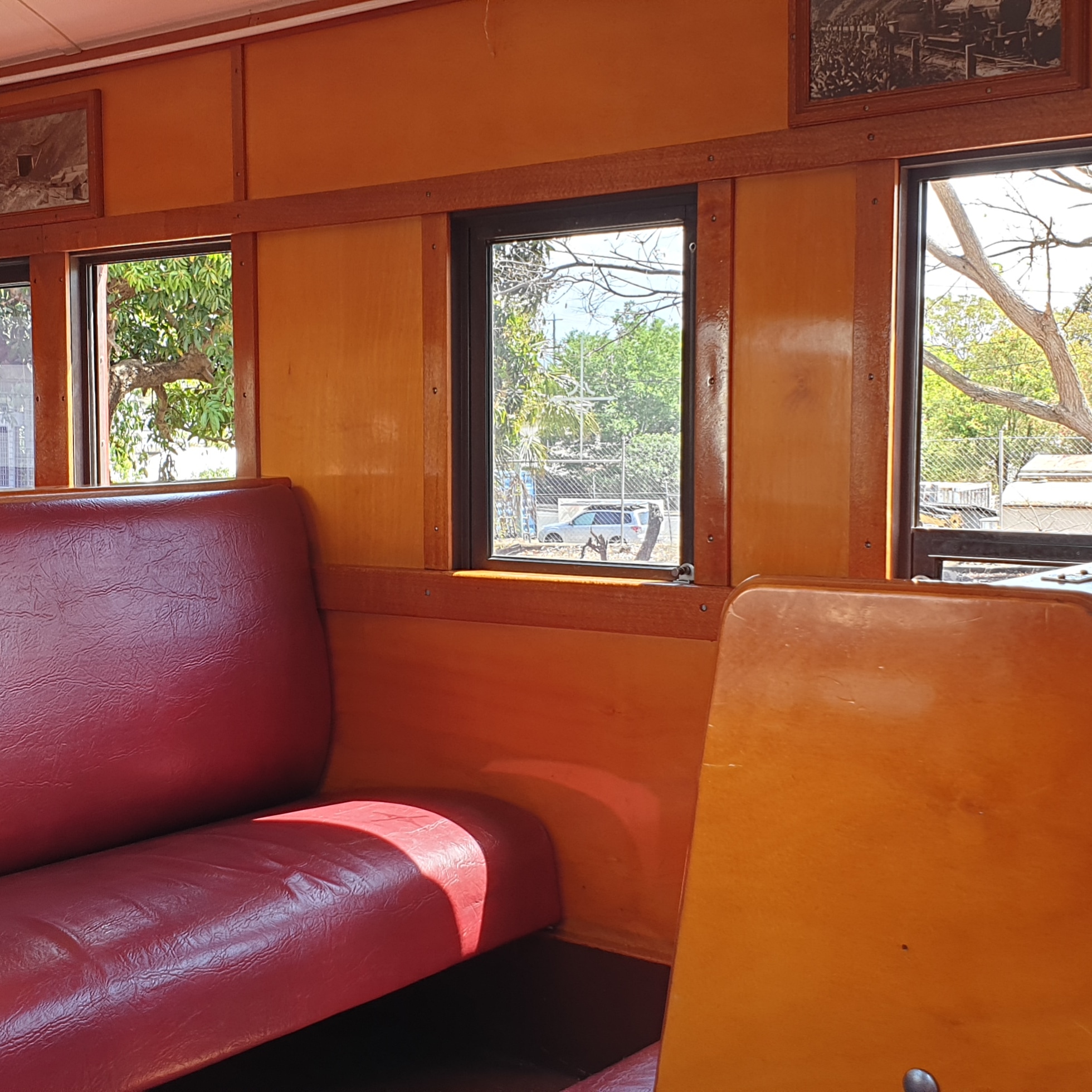
But this carriage, the polished wood that had shellac rather than varnish, highlighting the timber’s grain, the leather seats with generous padding, the curved ceilings with hanging lights, windows the could be opened and closed, allowing fresh air to circulate.
There was also a carriage with the passageway, and five or six separate compartments, each sitting six passengers. I remembered these well, having quite often ridden in one to work for some years when the country trains still ran.
It was always remarkable how a sight or a scent could trigger such memories.
For this carriage on this train, it used to ply the Gympie to Brooloo branch line from about 1915 onwards.
That was the history. It only went as far as Amamoor these days, it was still long enough to capture the sensation of riding the rails back in what is always referred to as the good old days, even if they were not.
I remeber once being told that if you shoot for the moon, you’ll land in the clouds, if you shoot for the tree tops, you’ll finish up back where you started from.
It was a silly analogy, but I always remembered it when I looked up at the sky and saw clouds.
That was back in those hazy carefree days just after you were finished with school and you had your whole life in front of you. Your parents were there as the safety net, and were still proud of your scholastic achievements, and were not in too much of a hurry to hustle you out of the house.
But what happened when there’s a recession that came upon everyone without any warning.
Stocks plummeted, people lost their life’s savings, those with mortgages and loans suddenly finding that along with unemployment came no income, no ability to pay the bills, and therefore lost everything.
Although I never said it, I was thinking what good was an education when the whole world had gone to hell in a handbasket.
Two things I remember from back then, which in the context of disaster, wasn’t all that long ago. Firstly, my father making us children go camping from before we could walk, and with it, to survive with nothing but the clothes on our backs, and our wits.
It had happened to him, as a member of am expedition in Africa in his younger days, thinking that he might become the next great explorer, or archeologist, and finishing up getting lost, even though he asserted the other members had deliberately left him behind.
And secondly, that it was essential that we forge working relationships with any and all those who were like minded, such as those who wanted to be saved, not those who expected everyone else to so the work. It was obvious he had met a lot of those type of people too.
It served us well.
When nations began turning on each other, when essential resources like electricity and fuel stopped being distributed and rationed, when food suddenly became scarce, that’s when the real trouble started. My father said, at the outset, what would happen, and was glad our mother was not there to see it.
Then, when neighbours attacked neighbours once food became scarce, it was time to leave. The pity of it was, he died defending us, even after offering up some of the food we had stored away, but that had not appeased a hungry or angry mob.
His last words, “Go to where we said we would go, and remember everything I’ve taught you” were etched in my brain, and my brother and I did as he asked.
But, even knowing where we had to go, and how to get there, a plan of action made many years before, and trialled in recent years with success, nothing in the past could have prepared us for the journey.
Down here, on the other side of the world, the one where Christmas day never sees snow and the temperature sometimes hovers around 38 degrees centigrade, we have neither the Hallmark nor the Lifetime channels.
OK, I can see that’s going to stop a lot of our American friends from moving here when things get a little too dangerous back home, ergo politics and guns, but there are other ways.
And having discovered how to get these movies, we’ve been watching a lot of Hallmark Movies and Mysteries, with an occasional side dish of Lifetime.
Romantic movies are good. Some might say they are soppy, but you know what? No violence, no guns, murders but only in mysteries, and endless happy endings.
I like a happy ending.
Of course, these romances fit a certain storyline as do the Christmas stories, the latter blending a romance and another element that reinforces the notion that Christmas is good.
But whatever the circumstances, I’m trying to convince myself that’s the case because a lot of the time we’re dealing with broken families, dead partners leaving still mourning children, people who work so hard they have no life, or worse, don’t have time to go home and share the joys of Christmas with family.
Oh, and then there are those who don’t want to go home for any number of reasons. I know if I had a choice I would not have gone home to see my parents, but that’s a whole other story.
And despite all of the trials and tribulations, and the obligatory misinterpretation, by the end, through a complicated series of manoeuvres and plot holes, either the broken family or the broken heart is mended.
How much more good feeling can you want in what is called the festive season?
Well, for me, it is the endless wide shots of rural America under a blanket of snow, the very epitome of a Christmas card scene. It’s the snow laying all about as you walk along people-filled streets, the Christmas decorations, both in the streets and in the houses, and they go all out to fill the house and every room with an abundance of decorations.
They have real trees, bought from a Christmas tree lot or farm, and not just any tree, one that fits the 50-foot ceilings that almost require a scissor lift to get the decorations on. And a tree in every room. We have a five feet tall artificial ‘lifelike’ tree that would not pass the movie test.
The only let down if it could be called that, is the fact that these movies are sometimes made in summer, and the town locations are dressed. And in all, I seriously doubt the falling snow is real, after all, no one can make it snow on cue.
So, now it’s time to take all if those movie experiences and write my own Christmas story. I’ll let you know how it goes.
Could there be a worse time to do the one thing that drives you bonkers?
Perhaps there is, but never a time when so many people are wandering aimlessly around looking for stuff that no one really needs.
And in the process, trash the shelves, and leave the store in such a mess that anyone who thinks shopping in the afternoon is a good idea, is left with little more than a dumpster dive.
Christmas shoppers are a very distinctive breed. First identified but the stultified manner in which they shuffle along the mall walkways, stopping to look vacantly at the wares in the windows, unable to figure out whether the sizes would fit their victims, sorry, giftees.
Or whether the sheer unadulterated inappropriateness would work, because we all know many of the gifts we receive are unwanted and even if they had a degree of acceptability, it was the wrong size, the wrong colour, for a different age group, or needs batteries.
It’s called grandparents revenge.
As for parents gifting their children as a surprise, well it’s a well-known fact they don’t have a clue about the younger generation and what they want.
We made a conscious decision years ago to only buy what the children wanted, no surprises, unfortunately, but never getting it wrong makes it worthwhile.
Of course, what the children want is something else and it took us a while to realise they were using us to buy stuff their parents had strictly banned. Yes, interesting lesson learned.
It only proved how desperately out of touch each generation is with the one below, and worse for those two generations adrift.
Two items of special note, are the number of parents who go shopping with their children, and the level of blackmail used to get their best behaviour, that overused phrase, ‘misbehave and you’re getting nothing for Christmas’ flogged mercilessly to death.
The other is the number of unwilling spouses who would prefer to mind six rotten little kids than brave the dumpster shelves, or worse, the endless racks of clothes that would be more suited to cleaning the house rather than being worn.
I say this out of experience, because in my day girls’ clothing did not have large chinks of material missing or whole swaths of exposed skin
I’ll be leaving the Christmas shopping to someone else from now on.
There is always something strange about certain photographs that is not evident when you take them.
For instance, the photograph above.
While this might look like some vegetation by the side of a river or stream, its that are of blackness behind what looks like steps up from the water level that adds a level of intrigue or mystery.
For instance:
…
We had spent two weeks slowly going upriver looking for a needle in a haystack. It was an apt description, because there had been quite a large number of likely spots, all of which after investigation, came to nothing.
I mean, the description Professor Bates had given is was as hazy as day is long in these parts.
His recollection: that it was what looked like a cave behind lush undergrowth, with steps fashioned out of stone.
It was all the more confuse. Because when we found him, he was drifting on a rough hewn and constructed raft, half dead from dehydration. We were told he’d been on the raft for nearly a week.
That meant the cave could be anywhere between where we found him at the 10 mile mark, and 200 miles further on based on river flow.
We were currently at the 150 mile mark and the river was losing depth and width, and soon there would not be enough water to continue in the boat.
It was dusk and too dark to continue. We’d been enthusiastic those first days, continuing on in the dark, on shifts, using the arc lamps.
Then after a week, having lights on made us target practise, and after sever brushes with death, and the loss of all the bulbs being shot out, we got the message.
There was the odd marauder during the day, but we had the width of the river for safety. Now that had gone too, and we had lookouts posted, but seeing into the dense jungle was difficult.
But we got through another night with no activity, and come morning, what looked like the entrance to a cave was not fifteen feet from us.
We managed to get out of the space dock without a scratch…
…
We’re moving slowly beyond the space dock, heading through clear space.
We had seen people inside the wings of the dock, lining the passage windows watching the big ship depart. In olden days, on earth, when a ship left port, people on the dock would remain connected to the passengers by streamers, until the ship started to move away.
It was impossible to do that in space.
But, it was a notable day, the first of its type, heading out into the known, and, later, the unknown if the shakedown worked out.
The captain had decided despite the success of the trials, that he wanted to have one more trial, this time putting the crew through their paces.
I looked sideways, one eye still on the screen, now showing three possible midrange destinations, and on the Captain, also looking at the screen.
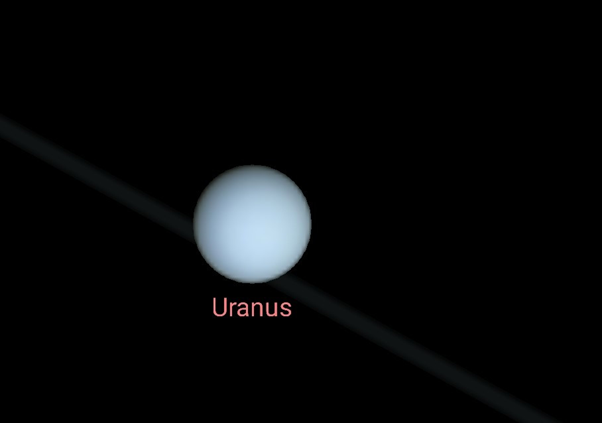
Uranus was about 2.8 billion kilometres.
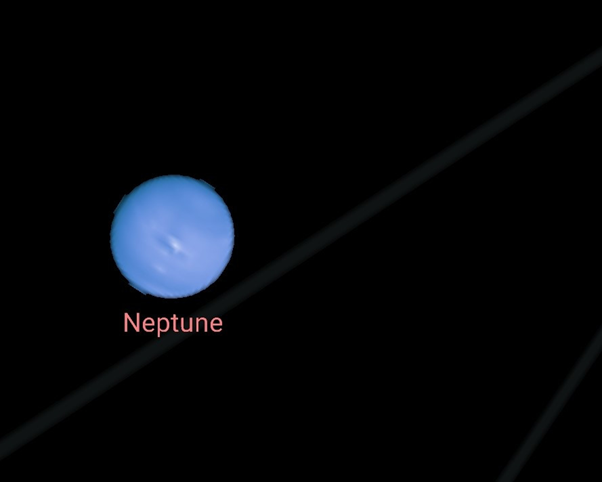
Neptune, where our orders were to go, was 4.5 billion kilometres.
I had done the rough calculations on time to destination, in round numbers, basing the speed of light, what we regarded as SSPD 1,000. That was in km’s about 1.8 billion kilometres an hour, give or take.
Our first ships were under SSPD 1, and the series before this ship had a maximum of SSPD 1.25, which in understandable numbers was about 1,349,063 km per hour. Our ship was capable of SSPD 5.
So, given that our previous fastest ship could move at a maximum of SSPD 1.25, the time it would take to the first destination at SSPD 2 (no one ever travelled at maximum) was a little over 86 days, and to Neptune about 139 days.
In this ship if we were to hit SSPD 4.5, the same time frames would be 24 days and just over 38.5 days.
“Check the co-ordinates for Neptune and once we’re clear of the dock and given clearance, let’s start her out slowly on SSPD 2.
The helmsman checked the co-ordinates and set the speed. “Co-ordinates and speed set, awaiting clearance.”
“Very good. Best have a seat Number One, just in case.”
“Yes, sir.” I took a last glance at the screen, now only showing Neptune on the long-range scanner, and sat.
“Adventurer, you’re cleared for departure.” The voice of the dock master came over the speakers.
No need for further orders, the helmsman pushed the button below his screen, there was a slight lurch, and we were under way.




 Thrills, Spills, and just a dash of Romance