The story behind the story – Echoes from the Past

The novel ‘Echoes from the past’ started out as a short story I wrote about 30 years ago, titled ‘The birthday’.

My idea was to take a normal person out of their comfort zone and led on a short but very frightening journey to a place where a surprise birthday party had been arranged.

Thus the very large man with a scar and a red tie was created.

So was the friend with the limousine who worked as a pilot.

So were the two women, Wendy and Angelina, who were Flight Attendants that the pilot friend asked to join the conspiracy.

I was going to rework the short story, then about ten pages long, into something a little more.

And like all re-writes, especially those I have anything to do with, it turned into a novel.

There was motivation.  I had told some colleagues at the place where I worked at the time that I liked writing, and they wanted a sample.  I was going to give them the re-worked short story.  Instead, I gave them ‘Echoes from the past’

Originally it was not set anywhere in particular.

But when considering a location, I had, at the time, recently been to New York in December, and visited Brooklyn and Queens, as well as a lot of New York itself.  We were there for New Years, and it was an experience I’ll never forget.

One evening we were out late, and finished up in Brooklyn Heights, near the waterfront, and there was rain and snow, it was cold and wet, and there were apartment buildings shimmering in the street light, and I thought, this is the place where my main character will live.

It had a very spooky atmosphere, the sort where ghosts would not be unexpected.  I felt more than one shiver go up and down my spine in the few minutes I was there.

I had taken notes, as I always do, of everywhere we went so I had a ready supply of locations I could use, changing the names in some cases.

Fifth Avenue near the Rockefeller center is amazing at first light, and late at night with the Seasonal decorations and lights.

The original main character was a shy and man of few friends, hence not expecting the surprise party.  I enhanced that shyness into purposely lonely because of an issue from his past that leaves him always looking over his shoulder and ready to move on at the slightest hint of trouble.  No friends, no relationships, just a very low profile.

Then I thought, what if he breaks the cardinal rule, and begins a relationship?

But it is also as much an exploration of a damaged soul, as it is the search for a normal life, without having any idea what normal was, and how the understanding of one person can sometimes make all the difference in what we may think or feel.

And, of course, I wanted a happy ending.

Except for the bad guys.

Get it here:  https://amzn.to/2CYKxu4
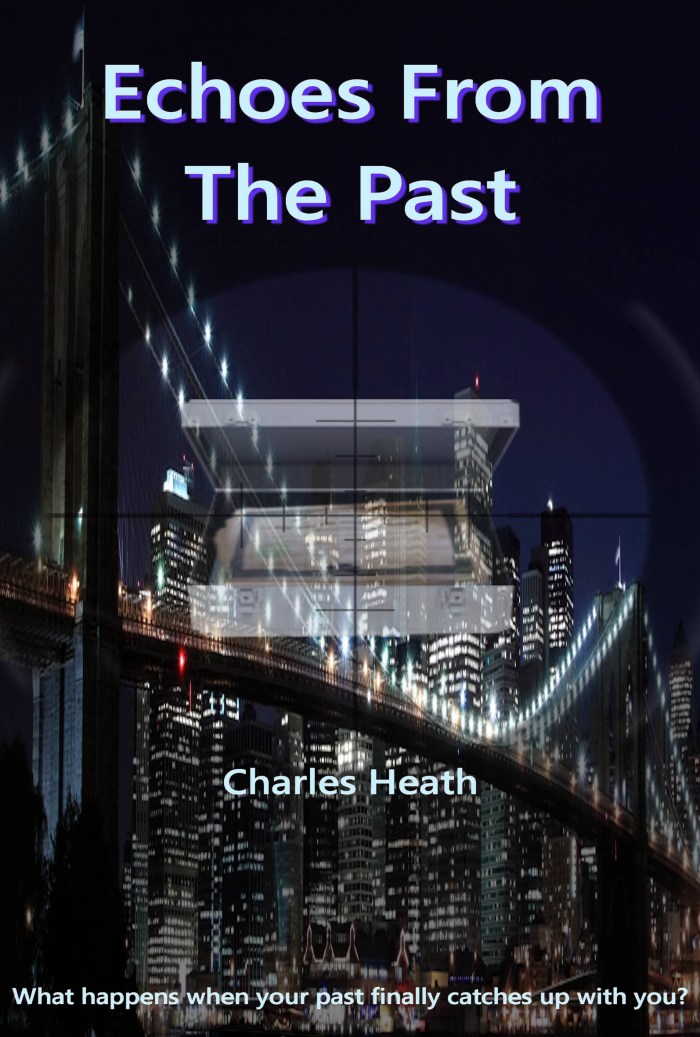
newechocover5rs

The cinema of my dreams – I always wanted to write a war story – Episode 54

For a story that was conceived during those long boring hours flying in a steel cocoon, striving to keep away the thoughts that the plane and everyone in it could just simply disappear as planes have in the past, it has come a long way.

Whilst I have always had a fascination with what happened during the Second world war, not the battles or fighting, but in the more obscure events that took place, I decided to pen my own little sidebar to what was a long and bitter war.

And, so, it continues…

When Carlo stopped, I was out of breath and gasping.  We all were.  The smoke was getting more intense.  At times it had made navigation almost impossible.

In front of us were more trees, but these looked different to those we had passed through.  I watched Carlo walk back and forth a few yards each way, then disappear into the bushes.  A minute later he put his head out and said, “This way.”

We followed him.  It was a hidden entrance down to a drain that was quite deep and headed back towards the castle one way and into the forest the other.

If the fire kept up by tomorrow the cover would be gone.

It was still a hard walk through the bushes, but we made it to a wireframe and door with a lock on it.  It looked ancient as if it hadn’t been used in decades, even longer.

Carlo produced a rather odd looking key and unlocked it.  I would have thought it was rusted shut, but appearances were deceptive.  The lock was almost new.

But the gate had not been used for a long time and it took Carlo a few minutes to force it to open.  It had rusted shut.  When it did finally move, it was with a very loud screeching sound.

We filed in and he relocked it.  Anyone thinking they heard something and came to investigate; it would end up on the other side of the gate.

So far so good.

For a moment I was back in my element, the archaeologist exploring caves, a wooden fire torch lighting the way, dampness underfoot, and the trickling of water down the walls.  All around the dankness from continual dampness.

It was easy the pretend if only for a few minutes I had not been caught up in the war, that I was on a quest for lost treasure, hidden away at the end of a labyrinth.

The reality was we were quite literally in an ancient sewer and the original builders of the castle had used an underground waterway to tap into to remove waste.  It was far more effective than modern systems and used the earth’s own ecology.

Inside the castle, the places where the waste used to drop down into the waterway had been covered over by trapdoors that were still there, and that was how we were going to gain access, through rooms that were no longer used.

We were going in via four access points, two men at each door, and mine with one of Blinkys men would be going into the area where the soldiers were camping to mop up whatever the bombs left behind, before closing off an exit.

Carlo had reserved the last one for himself and the boy, where he hoped to find Wallace and the new German commander.

Our cue to move: the bombs going off.

We just had time to get to the point and lower the trapdoors. Then climb up onto the floor and wait by the door.  From the other side, Carlo said, anyone in the castle would only see a continuation of the wall panelling.

We made it with seconds to spare.

We were closest to the bombs and the percussive effect was disorientating for a few seconds before we pushed through the door and into the smoke and dust raised by the explosions.

As the dust settled, we could see dead soldiers, and mess everywhere.  If a soldier was still alive, we shot them, systematically picking our way through the debris.  I counted thirty-one dead by the time we reached the other side, the other exit from the space.

In the distance, we could hear sporadic gunfire coming from other parts of the castle, and then, after taking up our position, near the tank, we waited.

Three soldiers came bursting out of the exit and we shot them too..

Ten minutes later Carlo yelled out, “It’s me, don’t shoot.”  Then he stepped out the door.  “It is done.”

The castle was ours.

“You wish to speak to your old commander before I execute him?

“Wallace?”

He nodded.

“Sure”

I followed him into the castle and walked through familiar passageways and rooms, much had not changed in a long time.

Wallace and the new commander were tied up in the dining room.  The remnants of a meal and several empty bottles of wine were on the table.

Wallace watched me from the doorway until I stood before him.

“I knew it was a mistake letting you go.  Jackerby was convinced you were a stupid fool who would unwittingly lead us directly to the resistance.  I told him you were cleverer than you looked.”

“And yet…”

“Perhaps I was tired of people like you being killed needlessly.  What just happened, that was a waste of human life.”

“I didn’t start the war, and for the record, I didn’t want any part of it.  Unfortunately, higher authorities deemed otherwise, and here I am.  This is not a victory to savour.”

“A victory nonetheless.”

I shrugged.  “It didn’t have to be like this, but at least we’ve weeded out a few more traitors.”

“Then no point asking for mercy?”

“No.”

With that said Carlo executed both men.

© Charles Heath 2021-2023

365 Days of writing, 2026 – My Second story 5

More about my second novel

Just when you think you’ve got a good start, it all comes crashing down.

Here’s the thing…

I’ve been planning the sequel for quite some time, and from time to time, I’ve been jotting down notes about how the story will go. I thought I had filed them all in the same place, so I missed a part.

This was confirmed when I found a synopsis, something I rarely make before writing a story, with details of several sections I obviously added when the thought came to me. Perhaps the idea of the synopsis was to consolidate all the ideas at a time when I thought I was going to sit down and write the story.

Dated a month or so before COVID came along, I suspect it all got set aside for the two or so years’ hiatus.

Now, the time has come, and today, I went on a detailed search of three computers, four phones, cloud storage, and the boxes that hold all the handwritten notes.

I have a reference to the section and several chapters, but no writing. In the back of my mind, I have a feeling I’d written the chapters, but the evidence says otherwise.

Damn!

I’ll move on and come back to it later. At the moment, it’s not relevant.

Oh, and Zoe has now become Mary-Anne. What is John going to think when he finally finds her?

What I learned about writing – Writing an autobiography

Who’s to say whose life would be more interesting than another’s?

Of course, we all think our lives are meaningful, and we have done many things that would interest someone else if we were to put them down on paper.

I have read a few, and some were quite good. They went on about a specific period, or periods, where they had a role that, at the time, would have been designated secret, but once that had passed, people could be told what really happened.

I speak of one person who was very involved in the machinations of World War II from the British standpoint, and I found it fascinating.

Someone else, however, would have found it very boring. It was not Winston Churchill, whose life I did read about, but someone else that very few would remember.

I like reading the life stories of other writers, and some of the material is quite fascinating, and sometimes blatant name-dropping. That period between the two world wars still fascinates me, and I would have loved to be involved with that group of writers.

Just to meet and talk to Ernest Hemingway, for one. Or F Scott Fitzgerald, as another. Then there is Agatha Christie, Ngaio Marsh, or Ian Fleming. The stories he must have to tell.

Going back in time, perhaps Wilkie Collins and very definitely Charles Dickens, Anthony Trollop and a quick trip over to Russia to drop in on Leo Tolstoy or even Boris Pasternak.

As for my story, it would be thirty-five shades of boring.

365 Days of writing, 2026 – My Second story 5

More about my second novel

Just when you think you’ve got a good start, it all comes crashing down.

Here’s the thing…

I’ve been planning the sequel for quite some time, and from time to time, I’ve been jotting down notes about how the story will go. I thought I had filed them all in the same place, so I missed a part.

This was confirmed when I found a synopsis, something I rarely make before writing a story, with details of several sections I obviously added when the thought came to me. Perhaps the idea of the synopsis was to consolidate all the ideas at a time when I thought I was going to sit down and write the story.

Dated a month or so before COVID came along, I suspect it all got set aside for the two or so years’ hiatus.

Now, the time has come, and today, I went on a detailed search of three computers, four phones, cloud storage, and the boxes that hold all the handwritten notes.

I have a reference to the section and several chapters, but no writing. In the back of my mind, I have a feeling I’d written the chapters, but the evidence says otherwise.

Damn!

I’ll move on and come back to it later. At the moment, it’s not relevant.

Oh, and Zoe has now become Mary-Anne. What is John going to think when he finally finds her?

The cinema of my dreams – I always wanted to write a war story – Episode 53

For a story that was conceived during those long boring hours flying in a steel cocoon, striving to keep away the thoughts that the plane and everyone in it could just simply disappear as planes have in the past, it has come a long way.

Whilst I have always had a fascination with what happened during the Second world war, not the battles or fighting, but in the more obscure events that took place, I decided to pen my own little sidebar to what was a long and bitter war.

And, so, it continues…

War is hell. 

I remembered an old Sargeant Major was telling us that going to war was not fun, that the very real possibility of getting killed should be the only thing on our minds.

Along with keeping your head down and being very aware of your surroundings.

Apparently, he had been at a place called Gallipoli, and from what I had read, that was a special kind of hell.

He had also said fifty per cent of us wouldn’t return.  I hoped to be in the fifty per cent that did.  Just to spite the old bastard.

I knew it was going to get problematical sooner than we thought, I could smell the aroma of burning bush on the air, and as we got closer to the castle, the smoke got denser.

Wallace had a cunning plan, he’d used flame throwers to set the bush on fire so we couldn’t get to the castle under the cover of the forest.  It was a plan he hadn’t me about.

Carlo had stopped, also understanding what Wallace had done.  Would this interfere with us getting to the external entrances, or if the other three were unattainable, could we get to the secret entrance?

I caught up to him.  “Not exactly what we envisaged.  I had no idea Wallace was planning this?”

“It is a logical move.  He can’t leave the castle, and as it was, he knew the forest would give us cover until the very last moment.”

“And now?”

“Now we use another entrance.  Take longer, but we’ll get there.  Only problem, they will be expecting us, and waiting.”

The others joined me, just as Carlo did an about-face and started going back the way we came.

“Where is he going?” Blinky asked.

“Another way.  Wallace is burning our cover.”

He shrugged.  “I suppose it would be too much to ask for some rain?”

“Sadly no.  Fine and clear with a touch of fog, well, smoke maybe.”

He didn’t think it was funny.  War I guess could do that to you.

When Thompson and company were planning the operation that was set up primarily to get defecting Germans out of the country, there was only so much research that could be done.

It was one of the reasons I got a seat at the table, my exploits in Italy looking at ancient buildings suddenly became a red-hot reason to be included.  The war had all but petered out in that part of the country, the Germans were shoring up the Italians, and the Allies had bigger plans to invade via Sicily, or one of those islands.

Someone mentioned something hush-hush about Italy and the road back to peace, but at that point in time, the end of the war was not in sight.

The point was, the castle was in a strategic location, it was only being held by a small garrison, according to the resistance, ideal for what Thompson wanted.  Approvals gained, he sent in a team of German-speaking soldiers to replace those there, as if nothing had happened and then set up the pipeline.

It worked.

For a while anyway.  Several months after the new team had set themselves up and the personnel was moving through, it all stopped.

First thought was the Germans had discovered what was going on and switched the team again.  Until Thompson noted we were still getting reports from Wallace, one of his men on the ground.

That’s when Thompson decided to send me.

And. No, it was not just a matter of saying, great, I always wanted to holiday in Italy, and particularly Tuscany.  My excuse, I was not trained to be a commando or a secret agent.

Of course, I made that one fatal mistake, I had enlisted to fight in the war, and it was not my decision where they sent me.

So, I was on the next plane to Tuscany.

The trouble was, Thompson and I both agreed that it was more likely the men we selected had not changed their allegiances, they just went back to what they were before.  Wallace, Johannesen and Jackerby had all been extricated from blown missions, and Thompson had been left scratching his head as to who the mole was in his office.

Too many coincidences proved it wasn’t.

Except coincidentally, Thompson had teamed up all the traitors in one place.

So, my mission was twofold, first to ascertain if they were traitors, and, if they were, to execute them.

The next problem, the mission was almost over before it started, because even though Thompson had told Wallace the wrong pick-up point where my plane would be landing, cloud cover made it impossible to guarantee I’d be jumping at the correct spot.

As it turned out, the resistance had planned a huge ambush in exactly the same place my plane landed, and I was in the middle of it.  The rest as they say is history.

The thing is, ever since I landed, I had the benefit of a huge amount of good luck.

That couldn’t last.

Carlo seemed unfazed about the fire, perhaps he had expected it, but his only concern was time.  We had to be in the castle just as the explosions started.

With 23 minutes to go, Carlo stepped up the pace.  For a big man, he didn’t make much noise.  I wished I could say the same for myself.

© Charles Heath 2021-2023

365 Days of writing, 2026 – 30

Day 30 – When is it time

The Never-Ending Research Cycle: What’s Holding You Back from Starting to Write?

As a writer, I’ve been there too many times. You start researching a topic, excited to dive into the world of knowledge and uncover new insights. But as the days turn into weeks, and the weeks turn into months, you find yourself stuck in a cycle of research, with no end in sight. The paper is mounting, the notes are piling up, and the excuses are starting to sound all too familiar.

“I just need to find one more source to support my argument.” “There’s a piece missing here, and I need to fill in the gap.” “I just stumbled upon something new, and I need to incorporate it into my plan.”

Sound familiar? You’re not alone. Many of us have been trapped in this never-ending cycle of research, where the pursuit of perfection becomes an excuse for not starting to write. But the truth is, perfection is the enemy of progress. And if you don’t start writing soon, you’ll never make progress on your project.

So, what’s holding you back from starting to write? Is it fear of not knowing enough? Fear of not being able to articulate your thoughts clearly? Or is it simply the fear of taking that first step into the unknown?

The Paralysis of Analysis

When you’re researching, it’s easy to get caught up in the excitement of discovery. You’re learning new things, uncovering new insights, and making connections between seemingly unrelated ideas. But as the research piles up, it can be overwhelming. You start to feel like you need to know everything about the topic before you can start writing. And that’s just not possible.

The truth is, you’ll never know everything about a topic. There’s always more to learn, more to discover, and more to explore. But that doesn’t mean you can’t start writing. In fact, starting to write is often the best way to clarify your thoughts, identify gaps in your knowledge, and develop a deeper understanding of the topic.

The Power of Imperfection

So, what’s the solution? How do you break free from the cycle of research and start writing? The answer is simple: give yourself permission to be imperfect. Recognise that your first draft won’t be perfect, and that’s okay. In fact, it’s more than okay – it’s necessary.

When you start writing, you’ll quickly realise that your ideas are not as fully formed as you thought they were. You’ll encounter gaps in your knowledge, inconsistencies in your argument, and areas where you need more research. But that’s all part of the process.

The First Step is the Hardest

So, what will convince you to start writing? For me, it’s the realisation that the first step is the hardest. Once you start writing, you’ll build momentum, develop a rhythm, and find your voice. You’ll start to see your ideas take shape, and your arguments will become clearer.

It’s time to stop researching and start writing. Give yourself a deadline, set a word count, and start typing. Don’t worry about perfection – worry about progress. Remember, the only way to get better at writing is to write. And the only way to finish your project is to start.

So, take a deep breath, put aside your excuses, and start writing. You got this!

What I learned about writing – Republishing public domain novels

Republishing Public Domain Books: A Modern Renaissance in Classic Literature

Introduction: The Resurgence of Public Domain Books
In an age dominated by streaming and digital content, curiosity in classic literature is experiencing a quiet revival. Public domain books—works whose copyrights have expired and are free for all to use—offer an untapped goldmine for publishers, authors, and creatives. From Pride and Prejudice to The Metamorphosis, these timeless tales are fertile ground for innovation. But is there a market for republishing them? How can you make your version stand out—and what pitfalls should you avoid? Let’s dive in.


Is There a Market in Republishing Public Domain Books?

Yes—especially when reimagined. While these books are freely available online, many readers seek curated, accessible, and enhanced editions tailored to modern tastes or niche audiences.

  • Digital Demand: E-books and audiobooks of public domain classics are thriving. Platforms like Project Gutenberg and LibriVox offer free versions, but readers are willing to pay for quality. For example, Dracula by Bram Stoker consistently ranks high on Amazon, with enhanced editions selling well.
  • Print Niche: Print-on-demand services (e.g., CreateSpace, Ingram Spark) enable affordable physical copies. Unique editions—like illustrated or annotated versions—cater to collectors, educators, and design-conscious readers.
  • Niche Opportunities: Focus on underrated authors or genres. A curated series of 19th-century adventure novels or a feminist reframe of Jane Eyre can attract specific audiences.

Example Success: Michael Crichton’s The Andromeda Strain (originally published in 1969) remains a bestseller in rebranded editions. Similarly, modern “Poe-etry” collections with contemporary themes show how timeless stories can be revitalised.


Adding Value to Stand Out: How to Make Your Edition Unique

Republishing isn’t just about printing a 200-year-old text. To justify a sale, you must add value that differentiates your version from the 20 free copies already online.

  1. Modern Illustrations & Design
    • Pairing classics with fresh artwork or period-accurate visuals can transform the experience. For instance, a version of Alice’s Adventures in Wonderland with Art Nouveau illustrations appeals to design lovers.
    • Invest in high-quality formatting, typography, and layouts that reflect modern reading standards.
  2. New Introductions and Annotations
    • Invite contemporary authors or scholars to write introductions. A feminist take on The Yellow Wallpaper or a sci-fi angle on Frankenstein can draw new readers.
    • Add footnotes explaining archaic language, historical context, or cultural relevance.
  3. Enhanced Formatting for Accessibility
    • Use dyslexia-friendly fonts, large print, or clean margins. For digital versions, include interactive elements like clickable footnotes or embedded multimedia.
  4. Audio and Multimedia Editions
    • Audiobooks narrated by skilled voice actors (e.g., a noir-style The Tell-Tale Heart) can attract new demographics.
    • Combine texts with QR codes linking to curated playlists, podcast interviews, or historical photographs.
  5. Themed Anthologies
    • Compile related works. A “Victorian Mystery Bundle” with The Hound of the BaskervillesDracula, and lesser-known tales creates value for genre fans.
    • Create study guides for students or discussion packs for book clubs.

Pro Tip: Offer multiple formats (e-book, print, audio) for broader reach, and consider subscription models for curated content.


Common Mistakes to Avoid

Even with a great idea, missteps can sink your project. Here’s what to watch for:

  1. Copyright Missteps
    • Verify the public domain status: A book’s copyright may vary by country. Use resources like Google Books’ public domain catalogue or HathiTrust.
    • Check for derivatives: Translations, specific editions, or forewords may still be copyrighted. Don’t reuse someone else’s work without permission.
  2. Neglecting Quality
    • Poor formatting and OCR errors: Use proofreaders and professional typesetting software. A shoddy version reflects poorly on your brand.
    • Inferior illustrations or design: Invest in artists or use free high-quality image sources like Unsplash.
  3. Pricing Errors
    • Overpriced editions: If your version costs $20 when a free PDF exists, you’ll lose sales. Research competitors and price accordingly (e.g., $10 for a paperback with added value).
    • Undervaluing premium editions: Limited editions with illustrations or signed copies can command higher prices if marketed right.
  4. Poor Marketing & Audience Ignorance
    • Assuming an audience exists: Market your unique angle! Promote your feminist Jane Austen edition to bookstagrammers or indie bookstore owners.
    • Ignoring keywords: For digital sales, optimise titles and descriptions with terms like “annotated,” “illustrated,” or “new introduction.”
  5. Underestimating Niche Markets
    • Don’t target “literature lovers” broadly. Instead, position Moby Dick as a “Guide for Entrepreneurs on Overcoming Ambition” or 1984 as a “Guide to Modern Privacy Risks.”

Case Study: A common error is releasing a bland replica of Hamlet. A successful version, however, might pair it with a modern psychological analysis, targeting mental health readers.


Conclusion: The Future of Public Domain Publishing

Republishing public domain books is more than a business—it’s a chance to rekindle classics for new generations. With the right blend of innovation, quality, and marketing, you can tap into a growing market while honouring literary history. Just remember: the key is to offer something no free version can—a version that sparks joy, curiosity, or insight in its readers.

Final Thoughts:

  • Research your audience and tailor value.
  • Proofread rigorously—quality is non-negotiable.
  • Be creative: Add illustrations, annotations, or modern twists.
  • Avoid copyright landmines—verify everything upfront.

Whether you’re a self-published author, a small press, or a literary enthusiast, the world of public domain publishing is yours to reimagine. Pick a book, add your magic, and bring its story to life in a fresh, unforgettable way.

What timeless tale will you revive next?


 💡📚

365 Days of writing, 2026 – 30

Day 30 – When is it time

The Never-Ending Research Cycle: What’s Holding You Back from Starting to Write?

As a writer, I’ve been there too many times. You start researching a topic, excited to dive into the world of knowledge and uncover new insights. But as the days turn into weeks, and the weeks turn into months, you find yourself stuck in a cycle of research, with no end in sight. The paper is mounting, the notes are piling up, and the excuses are starting to sound all too familiar.

“I just need to find one more source to support my argument.” “There’s a piece missing here, and I need to fill in the gap.” “I just stumbled upon something new, and I need to incorporate it into my plan.”

Sound familiar? You’re not alone. Many of us have been trapped in this never-ending cycle of research, where the pursuit of perfection becomes an excuse for not starting to write. But the truth is, perfection is the enemy of progress. And if you don’t start writing soon, you’ll never make progress on your project.

So, what’s holding you back from starting to write? Is it fear of not knowing enough? Fear of not being able to articulate your thoughts clearly? Or is it simply the fear of taking that first step into the unknown?

The Paralysis of Analysis

When you’re researching, it’s easy to get caught up in the excitement of discovery. You’re learning new things, uncovering new insights, and making connections between seemingly unrelated ideas. But as the research piles up, it can be overwhelming. You start to feel like you need to know everything about the topic before you can start writing. And that’s just not possible.

The truth is, you’ll never know everything about a topic. There’s always more to learn, more to discover, and more to explore. But that doesn’t mean you can’t start writing. In fact, starting to write is often the best way to clarify your thoughts, identify gaps in your knowledge, and develop a deeper understanding of the topic.

The Power of Imperfection

So, what’s the solution? How do you break free from the cycle of research and start writing? The answer is simple: give yourself permission to be imperfect. Recognise that your first draft won’t be perfect, and that’s okay. In fact, it’s more than okay – it’s necessary.

When you start writing, you’ll quickly realise that your ideas are not as fully formed as you thought they were. You’ll encounter gaps in your knowledge, inconsistencies in your argument, and areas where you need more research. But that’s all part of the process.

The First Step is the Hardest

So, what will convince you to start writing? For me, it’s the realisation that the first step is the hardest. Once you start writing, you’ll build momentum, develop a rhythm, and find your voice. You’ll start to see your ideas take shape, and your arguments will become clearer.

It’s time to stop researching and start writing. Give yourself a deadline, set a word count, and start typing. Don’t worry about perfection – worry about progress. Remember, the only way to get better at writing is to write. And the only way to finish your project is to start.

So, take a deep breath, put aside your excuses, and start writing. You got this!

365 Days of writing, 2026 – 29

Day 29 – Synopsis Tools

Crafting the Perfect Synopsis: Tools to Help You Succeed

As a writer, you’re likely no stranger to the daunting task of condensing your entire manuscript into a concise, compelling synopsis. A well-written synopsis is essential for capturing the attention of literary agents, publishers, and readers alike, but it can be a challenging and time-consuming process. Fortunately, there are several tools available to help you create the perfect synopsis.

In this post, we’ll explore some of the most effective tools and techniques for crafting a synopsis that showcases your work in the best possible light.

1. Synopsis Templates

One of the most useful tools for creating a synopsis is a template. A template provides a structured framework for organising your thoughts and ensuring that you include all the essential elements of a synopsis. You can find a variety of synopsis templates online, or create your own using a word processing program like Microsoft Word or Google Docs.

Some popular synopsis templates include:

  • The Snowflake Method: This template involves breaking down your story into smaller and smaller pieces, starting with a one-sentence summary and gradually expanding to a full synopsis.
  • The Three-Act Structure: This template is based on the traditional three-act structure of a story, with a setup, confrontation, and resolution.
  • The Hero’s Journey: This template is based on the classic hero’s journey narrative pattern, with stages like the call to adventure, the road of trials, and the return with the elixir.

2. Writing Software

There are many writing software programs available that can help you create a synopsis, including:

  • Scrivener: This popular writing program includes a synopsis feature that allows you to create an outline of your story and organise your thoughts.
  • Novelise: This writing software includes a built-in synopsis tool that helps you create a concise and compelling summary of your story.
  • Writing.com: This online writing community offers a variety of tools and resources for creating a synopsis, including templates, prompts, and writing exercises.

3. Online Synopsis Generators

If you’re struggling to come up with a synopsis on your own, you can try using an online synopsis generator. These tools use artificial intelligence to analyse your story and create a synopsis based on the characters, plot, and themes.

Some popular online synopsis generators include:

  • AutoCrit: This writing tool uses AI to analyse your manuscript and create a synopsis, as well as provide feedback on character development, pacing, and other elements of your story.
  • ProWritingAid: This writing software includes a synopsis generator that helps you create a concise and compelling summary of your story.
  • Synopsis Generator: This online tool uses a simple questionnaire to gather information about your story and create a synopsis.

4. Writing Guides and Resources

In addition to templates, software, and online generators, there are many writing guides and resources available that can help you create a synopsis. Some popular options include:

  • The Writer’s Digest Guide to Query Letters: This book provides comprehensive guidance on writing a query letter, including tips and examples for crafting a compelling synopsis.
  • The Synopsis Workshop: This online course offers in-depth instruction on writing a synopsis, including video lessons, writing exercises, and feedback from industry professionals.
  • Writing Excuses: This popular writing podcast often features episodes on writing a synopsis, with tips and advice from experienced authors and industry professionals.

Conclusion

Crafting the perfect synopsis is a challenging task, but with the right tools and techniques, you can create a compelling and effective summary of your story. Whether you prefer to use a template, writing software, online generator, or writing guide, there are many resources available to help you succeed. Remember to keep your synopsis concise, focused, and engaging, and don’t be afraid to seek feedback and revise your work until you’re satisfied with the result. With practice and patience, you can create a synopsis that showcases your work in the best possible light and helps you achieve your writing goals.