Top 5 sights on the road less travelled – Sardinia

Sardinia is famous for its glamorous coastlines, but the island truly shines when you venture inland or to its quieter corners. For a journey on the road less travelled, here are five of the best places and activities:

1. Hike the Gola Su Gorropu Gorge

  • What it is: Often called the “Grand Canyon of Europe,” this is one of the deepest gorges on the continent, carved by the Flumineddu River in the Supramonte mountain range.
  • Why it’s less travelled: It requires a moderate-to-challenging hike (or a 4×4 transfer) to access, keeping the crowds away. This activity takes you deep into Sardinia’s rugged, wild heart, offering a dramatic contrast to the beaches.
  • Activity: Trek through the immense canyon walls, navigating the huge boulders within the gorge floor.

2. Meet the Albino Donkeys of Asinara National Park

  • What it is: A protected, uninhabited island off the northwest coast, formerly a maximum-security prison and penal colony.
  • Why it’s less travelled: Access is restricted to preserve the environment. Its primary inhabitants are the rare wild albino donkeys (known as Asinara donkeys), horses, and other wildlife.
  • Activity: Take a ferry from Stintino or Porto Torres and explore the island by bike (or e-bike), following the paths that connect coves, ancient watchtowers, and abandoned prison infrastructure.

3. Explore the Dunes of Piscinas

  • What it is: Located in the Arbus area on the west coast, this is the largest desert in Europe, with vast, rolling golden dunes that stretch for miles and meet the sea.
  • Why it’s less travelled: It’s a remote area, part of the old mining region, far from the main tourist hubs. The landscape is unique, offering a “wild-west” feel.
  • Activity: Wander through the immense dunes, admire the rust-red lagoons, and spot the abandoned mining carts illuminated by the Milky Way at night.

4. Step Back in Time at Nuraghe Su Nuraxi

  • What it is: The largest and most complete example of the nuraghi, the massive stone defence structures erected by the ancient Nuragic civilisation (1800–700 BCE). It is a UNESCO World Heritage site located inland in the village of Barumini.
  • Why it’s less travelled: It’s located deep in the countryside, away from the coastal routes. While famous, it draws a different crowd focused on deep history and archaeology.
  • Activity: Take a mandatory guided tour to explore the ruins of the fortified complex, which has re-emerged in its entirety, offering a window into one of the oldest civilisations in the Mediterranean.

5. Walk the Streets of the Open-Air Museum of San Sperate

  • What it is: A small, vibrant agricultural village about 15 minutes from Cagliari, transformed into an open-air art gallery.
  • Why it’s less travelled: It’s often overlooked by tourists heading straight for the beaches. Since the 1960s, local and international artists have covered the exterior walls of homes and shops with colourful murals depicting social, political, and historical themes.
  • Activity: Get “lost” walking the quaint streets, admiring over 200 murals and the basalt sculptures by local artist Pinuccio Sciola, who started the town’s artistic renaissance.

Top 5 sights on the road less travelled – Sardinia

Sardinia is famous for its glamorous coastlines, but the island truly shines when you venture inland or to its quieter corners. For a journey on the road less travelled, here are five of the best places and activities:

1. Hike the Gola Su Gorropu Gorge

  • What it is: Often called the “Grand Canyon of Europe,” this is one of the deepest gorges on the continent, carved by the Flumineddu River in the Supramonte mountain range.
  • Why it’s less travelled: It requires a moderate-to-challenging hike (or a 4×4 transfer) to access, keeping the crowds away. This activity takes you deep into Sardinia’s rugged, wild heart, offering a dramatic contrast to the beaches.
  • Activity: Trek through the immense canyon walls, navigating the huge boulders within the gorge floor.

2. Meet the Albino Donkeys of Asinara National Park

  • What it is: A protected, uninhabited island off the northwest coast, formerly a maximum-security prison and penal colony.
  • Why it’s less travelled: Access is restricted to preserve the environment. Its primary inhabitants are the rare wild albino donkeys (known as Asinara donkeys), horses, and other wildlife.
  • Activity: Take a ferry from Stintino or Porto Torres and explore the island by bike (or e-bike), following the paths that connect coves, ancient watchtowers, and abandoned prison infrastructure.

3. Explore the Dunes of Piscinas

  • What it is: Located in the Arbus area on the west coast, this is the largest desert in Europe, with vast, rolling golden dunes that stretch for miles and meet the sea.
  • Why it’s less travelled: It’s a remote area, part of the old mining region, far from the main tourist hubs. The landscape is unique, offering a “wild-west” feel.
  • Activity: Wander through the immense dunes, admire the rust-red lagoons, and spot the abandoned mining carts illuminated by the Milky Way at night.

4. Step Back in Time at Nuraghe Su Nuraxi

  • What it is: The largest and most complete example of the nuraghi, the massive stone defence structures erected by the ancient Nuragic civilisation (1800–700 BCE). It is a UNESCO World Heritage site located inland in the village of Barumini.
  • Why it’s less travelled: It’s located deep in the countryside, away from the coastal routes. While famous, it draws a different crowd focused on deep history and archaeology.
  • Activity: Take a mandatory guided tour to explore the ruins of the fortified complex, which has re-emerged in its entirety, offering a window into one of the oldest civilisations in the Mediterranean.

5. Walk the Streets of the Open-Air Museum of San Sperate

  • What it is: A small, vibrant agricultural village about 15 minutes from Cagliari, transformed into an open-air art gallery.
  • Why it’s less travelled: It’s often overlooked by tourists heading straight for the beaches. Since the 1960s, local and international artists have covered the exterior walls of homes and shops with colourful murals depicting social, political, and historical themes.
  • Activity: Get “lost” walking the quaint streets, admiring over 200 murals and the basalt sculptures by local artist Pinuccio Sciola, who started the town’s artistic renaissance.

Searching for locations: Salzburg, Austria

Along with My Fair Lady, another of my favorite musicals was Sound of Music and having seen it a number of times over the years, it had conjured up a number of images of Salzburg in my mind, and with them a desire to go there.  We had been to Salzburg once before, an overnight train stop between Vienna and Innsbruck, an afterthought, but what we saw then was reason enough to come back later and spend several days.

A pity then the day we arrived, and for much of our stay, it rained.  But, like hardened travelers, very little stops us from doing anything, and particularly sightseeing.

We stayed at the Crowne Plaza – The Pitter in a very well-appointed room.  Breakfast included, it was a great way to start the day.  The afternoon we arrived we went for a short walk to the old city passing through the Mirabelle gardens with the Pegasus Fountain, Rose Garden, and Dwarves Garden.  Later we discovered that the archway had been used in part of the filming of Sound of Music.

We took the Festungsbahn funicular railway up to the Fortress Hohensalzburg, dating back to 1077, and the largest fortress still standing in Europe.  We spent a pleasant afternoon wandering through the rooms and exhibits and then had lunch at a café, the Salzburg Fortress Café, that overlooked the countryside.  This was where we were introduced to Mozart Gold Chocolate Cream added to our coffee.

It led us to search for the product which we eventually found in a confectionary store, Holzemayr in the Alter Markt.  Not only sis we find the Gold liqueur there was also a dark chocolate variety as well.  We bought a whole box to bring back with us, as well as a number of other chocolates including Victor Schmidt Austrian Mozart Balls, a delicious chocolate and marzipan combination.

With another afternoon to spare we visited the Salzburg Residence which previously housed Salzburg’s ruling prince-archbishops.  We visited the reception rooms and living quarters, as well as the Gallery.  It is as ornate as any of the palaces in Austria, resplendent with furnishings and paintings.  After that, the visit to Mozart’s birthplace was something of an anticlimax.

But, what we were in Salzburg for, the Sound of Music tour, and the places we visited:

The Mirabelle gardens, where Maria sang Do Re Mi in front of the gates to the gardens.  We spent some time here before and after the tour, and also has a look inside the Mirabelle Palace, which is not open to the public as it is the city administrative offices.

Leopoldskron Palace where the boating scene was filmed as well as exteriors.  They were not allowed to film inside the place and were only allowed to use the exterior.  An interesting tidbit of information, one of the children nearly drowned.

Heilbrunn palace is now home to the gazebo where Rolf and Leisl sang their song, ‘16 going on 17’.  The interesting part of this was the fact the Gazebo used to film the scene was much larger than the actual Gazebo on display.

The walkway from the fortress back to the old city passes Nonnberg Abbey where Maria was a novice, and where the opening scenes were filmed.  A number of scenes were filmed here, including the song ‘Maria’ in the courtyard.  The tour only showed the exterior of the Abbey.

Salzburg lake district where panorama and picnic scenes were filmed.  Even on the dullest of days, during which throughout our tour in continually rained, the scenery was still magnificent.

Mondsee church, where the wedding scenes were filmed.  It was surprising just how small the church really is.  It was also a stop to have afternoon tea or some ‘famous’ apple strudel.

Needless to say, we watched Sound of Music straight after the tour and managed to pick out all of the places we had been to.  The only downside to the tour, singing along to the songs.  I’m sorry, but I do not sing, and some of those that were, well, I say no more.

Searching for locations: Paris, France: Place de la Republique

Whilst a rather important place for the French, for us visitors, it has a convenient hotel located just behind the square, and an underground, or Metro station, underneath.

2014-01-07 11.43.05

Added to that was equally convenient cafes, one of which, The Cafe Republique, we had dinner every night.  The service and food were excellent, and we had no problems with the language barriers.

At the top of the monument is a bronze statue of Marianne, said to be the personification of France.

2014-01-07 11.43.41

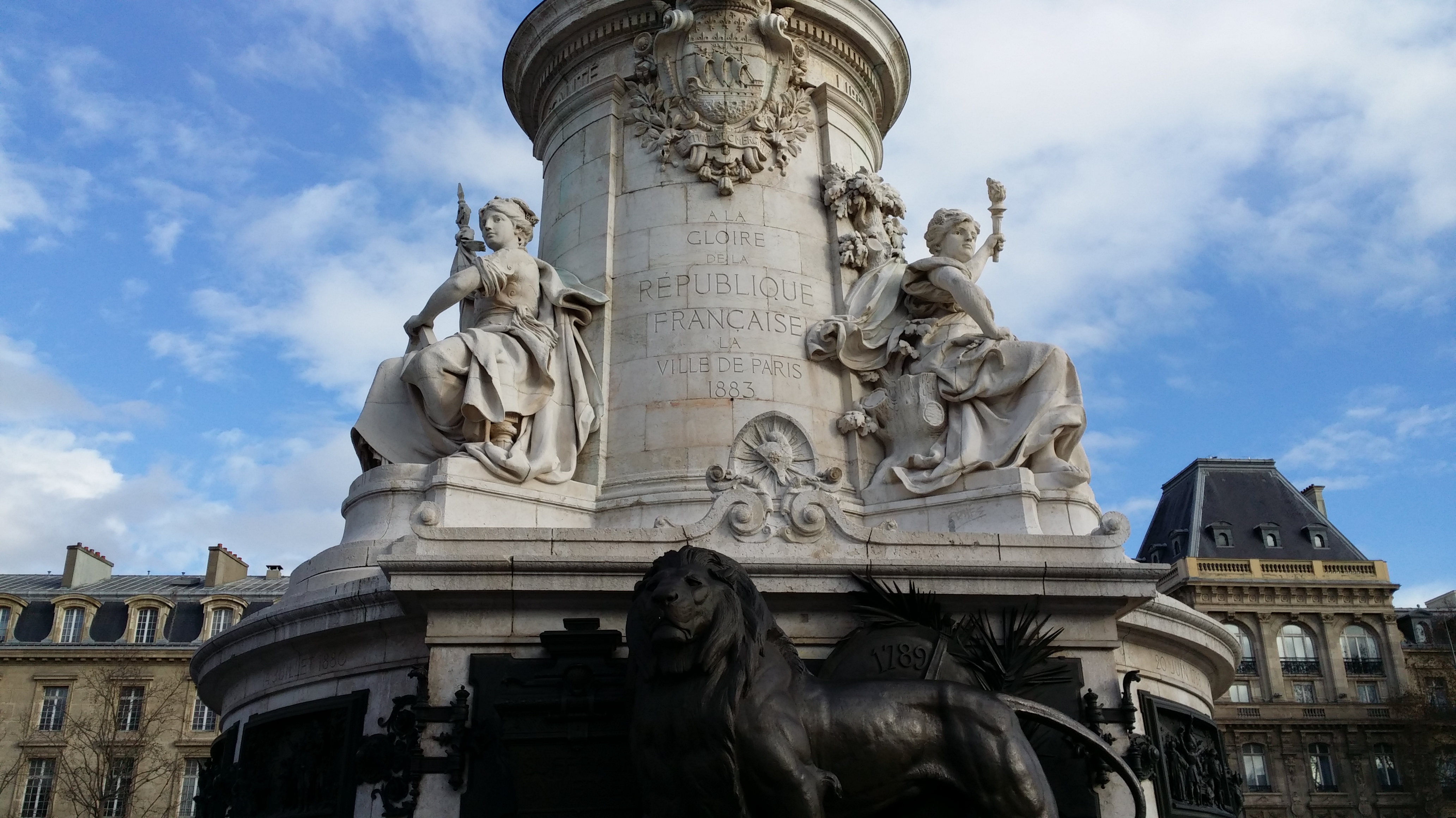
Surrounding Marianne is three more statues, representing liberty, equality, and fraternity.

2014-01-07 11.43.32

At the base is a lion guarding what is said to be a ballot box.

Searching for locations: Paris, France: Place de la Republique

Whilst a rather important place for the French, for us visitors, it has a convenient hotel located just behind the square, and an underground, or Metro station, underneath.

2014-01-07 11.43.05

Added to that was equally convenient cafes, one of which, The Cafe Republique, we had dinner every night.  The service and food were excellent, and we had no problems with the language barriers.

At the top of the monument is a bronze statue of Marianne, said to be the personification of France.

2014-01-07 11.43.41

Surrounding Marianne is three more statues, representing liberty, equality, and fraternity.

2014-01-07 11.43.32

At the base is a lion guarding what is said to be a ballot box.

Searching for locations: Paris, France: Place de la Republique

Whilst a rather important place for the French, for us visitors, it has a convenient hotel located just behind the square, and an underground, or Metro station, underneath.

2014-01-07 11.43.05

Added to that was equally convenient cafes, one of which, The Cafe Republique, we had dinner every night.  The service and food were excellent, and we had no problems with the language barriers.

At the top of the monument is a bronze statue of Marianne, said to be the personification of France.

2014-01-07 11.43.41

Surrounding Marianne is three more statues, representing liberty, equality, and fraternity.

2014-01-07 11.43.32

At the base is a lion guarding what is said to be a ballot box.