First Dig Two Graves – The Final Draft – Day 4

The second Zoe thriller.

John’s search for Zoe was at an impasse, simply because it was her job to disappear and reappear at will, and he knows he was no match for her in that regard.

So, having gone to her residence in Paris, not finding her there which was predictable, the place looked like it had not been visited in months, he concluded a short stay might help to clear his head.

Until he gets a phone call.

Kidnappers, other than the Russians, have captured Zoe, and they’re ringing him for a ransom.

Odd, because he was not the one who placed the kidnap order on her, so why would they be ringing him?

This was initiated by Zoe, no doubt playing the kidnapper by sending him to a bigger payday.

If that’s the case then John has to deduce she has faith in him to come and get her.

Which he’s going to do, but not on his own.

It’s time to call Sebastian, someone John knew would know what to do.

Or at least hope he does!

Today’s writing, with Zoe languishing in a dungeon waiting for a white knight, 3,270 words, for a total of 8,871.

The day is disappearing, and nothing is getting done


Do you have days when you feel like you’ve achieved nothing, even after getting through what might appear to be a lot?  It’s the ancillary stuff that’s the bugbear of anyone who simply wants to get on with what’s important, and that’s writing.

You know, sit down in front of a blank page on the computer, for on your writing desk, if you have one, ready for the words to come.

Except there’s the email to check.

Then there are ads to be sent out on Twitter and the general Twitter feed to look at just to keep up with what’s happening out there.

Then there’s the news usually that arrives on my desktop computer, the feed from the major papers around the world, for me, the New York Times, in the US, the Times in The UK and the Australian, in my country.

And, dammit, each has a challenging crossword that I really don’t have time to do, well, not in the morning.

Then there’s the stuff that has to be done around the house, I’m home but my wife still works so there’s washing, cooking, and domestics to be done which eats into the day.

Sometimes it’s not until mid-morning before I get to sit down with a cup of tea.

The point is, it’s not conducive to writing during the day because you can’t get a run at it, time enough to think about what you’re going to write before committing it to paper.

That is, before the phone rings with another scammer, and breaks your concentration.  Right, I hear you, cut the phone off.

So, three phone calls later, I’m about to give up.  It’s time to get the dinner on with family coming.  Perhaps I’ll have a few bottles of beer instead.

This is why I write at night, sometime after ten.  No phone calls, no distractions.  Well, that’s not necessarily true because what you didn’t get done earlier had a way of backing up if you don’t get through it in a timely manner.

Perhaps I’ll get a blog post or two done, another episode of the trip to China, upload another photo to Instagram and look at the current novel I’m in the middle of editing.

By that time it will be two am, way past anyone’s decent time to go to bed.  In fact, it’s ten past two, and I’ve got an early morning.

First Dig Two Graves – The Final Draft – Day 2

The second Zoe thriller.

Just when you think you’ve got a good start, it all comes crashing down.

Here’s the thing…

I’ve been planning the sequel for quite some time, and from time to time, I’ve been jotting down notes about how the story will go. I thought I had filed them all in the same place, and because I thought I had all of them, I missed a part.

This was confirmed when I found a synopsis, something I rarely make before writing a story, with details of several sections I obviously added when the thought came to me. Perhaps the idea of the synopsis was to consolidate all the ideas, at a time when I thought I was going to sit down and write the story.

Dated a month or so before covid came along, I suspect it all got set aside for the two or so year’s hiatus.

Now, the time has come, and today, I went n a detailed search of three computers, four phones, cloud storage, and the boxes that hold all the handwritten notes.

I have a reference to the section, and several chapters, but no writing. In the back of my mind, I have a feeling I’d written the chapters, but the evidence says otherwise.

Damn!

I’ll move on, and come back to it later. At the moment it doesn’t have relevance.

Oh, and Zoe has now become Mary-Anne. What is John going to think when he finally finds her.

Todays writing, introducing Mary Anne, 1,501 words, for a total of 3,610.

Inspiration, maybe – Volume 1

50 photographs, 50 stories, of which there is one of the 50 below.

They all start with –

A picture paints … well, as many words as you like.  For instance:
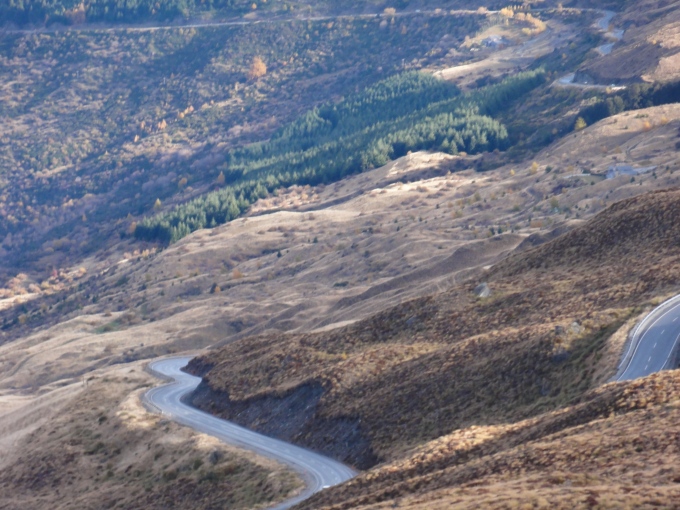
lookingdownfromcoronetpeak

And the story:

It was once said that a desperate man has everything to lose.

The man I was chasing was desperate, but I, on the other hand, was more desperate to catch him.

He’d left a trail of dead people from one end of the island to the other.

The team had put in a lot of effort to locate him, and now his capture was imminent.  We were following the car he was in, from a discrete distance, and, at the appropriate time, we would catch up, pull him over, and make the arrest.

There was nowhere for him to go.

The road led to a dead-end, and the only way off the mountain was back down the road were now on.  Which was why I was somewhat surprised when we discovered where he was.

Where was he going?

“Damn,” I heard Alan mutter.  He was driving, being careful not to get too close, but not far enough away to lose sight of him.

“What?”

“I think he’s made us.”

“How?”

“Dumb bad luck, I’m guessing.  Or he expected we’d follow him up the mountain.  He’s just sped up.”

“How far away?”

“A half-mile.  We should see him higher up when we turn the next corner.”

It took an eternity to get there, and when we did, Alan was right, only he was further on than we thought.”

“Step on it.  Let’s catch him up before he gets to the top.”

Easy to say, not so easy to do.  The road was treacherous, and in places just gravel, and there were no guard rails to stop a three thousand footfall down the mountainside.

Good thing then I had the foresight to have three agents on the hill for just such a scenario.

Ten minutes later, we were in sight of the car, still moving quickly, but we were going slightly faster.  We’d catch up just short of the summit car park.

Or so we thought.

Coming quickly around another corner we almost slammed into the car we’d been chasing.

“What the hell…” Aland muttered.

I was out of the car, and over to see if he was in it, but I knew that it was only a slender possibility.  The car was empty, and no indication where he went.

Certainly not up the road.  It was relatively straightforward for the next mile, at which we would have reached the summit.  Up the mountainside from here, or down.

I looked up.  Nothing.

Alan yelled out, “He’s not going down, not that I can see, but if he did, there’s hardly a foothold and that’s a long fall.”

Then where did he go?

Then a man looking very much like our quarry came out from behind a rock embedded just a short distance up the hill.

“Sorry,” he said quite calmly.  “Had to go if you know what I mean.”

I’d lost him.

It was as simple as that.

I had been led a merry chase up the hill, and all the time he was getting away in a different direction.

I’d fallen for the oldest trick in the book, letting my desperation blind me to the disguise that anyone else would see through in an instant.

It was a lonely sight, looking down that road, knowing that I had to go all that way down again, only this time, without having to throw caution to the wind.

“Maybe next time,” Alan said.

“We’ll get him.  It’s just a matter of time.”

© Charles Heath 2019-2021

Find this and other stories in “Inspiration, maybe”  available soon.

InspirationMaybe1v1

Motive, means, and opportunity – Episode 3

Worthey updates Detective Bryson

Bryson was glad to get out of the apartment building where he felt the air was so rarefied that it was beginning to strangle him.

The fact he let her snootiness get to him was almost unforgivable especially if she chose to make a complaint because everyone like her had a “friend” in the city administration, he would get into trouble.  Again.

He dialled Worthey’s cell number.

Six rings before he answered, dropping the file in his hands and reaching for the phone, papers spread over the floor.  “Yes,” he growled, angry at the interruption.

Bryson ignored it.  “Write this down.”  He gave Worthey the cell number and the business name.  “Get a request in for the cell records and track down where that business is.  I want to get there before they find out the boss is dead.  Text me the address the moment you get it.  Have you found any further evidence at the scene?”

“Not yet, but there’s an interesting wrinkle, the car was not his, it was a rental in the name of Phillip Magarry.”

“Who the hell is he?”

“As far as I can make out, Bergman.  I tracked the car to a rental outlet in Manhattan, took a photo of Bergman there, and the desk clerk said it was him, although he tried to hide his identity.  He didn’t try very hard, because I doubt, he expected anything would happen.  Always expect the unexpected I say.”

Anyone could be wise after the fact, so Bryson simply ignored that remark.  The real question was why Bergman needed to have an alternative identity.  Did his estranged wife know about it?  A note to ask her next time.

“Anything else on this Megarry?”

“There was a copy of his Megarry’s driver’s license hidden in Bergman’s wallet, and it shows Megarry’s from Nevada, and when I checked the address, it was for a vacant lot in Las Vegas.  Then I had the lab guys take a look at it, and it’s fake, but it’s a very good fake.”

Two possibilities Bryson considered that Bergman was trying to cover his movements for some reason, driving around in a car that could not, without some investigation, be associated with him, if at all.  The other, Bergman had more than one identity, possibly living more than one life.  Why couldn’t he just get a simple case for once?

“I take there was no sign of a phone at the scene, or in the car?”

“No.”

“Preliminary cause of death?”

“Like we thought, single gunshot at close range to the head.  Death was instantaneous, we’ll get the time of death when the medical examiner had done his preliminary report, but from early indications, sometime between ten last night and two this morning.  Also, it seems likely that the killer was known to the victim to get that close. We’ll find out what type of weapon was used before the afternoon is out.  I put a rush on it.”

It would be closer to 2 am, Bryson thought, having seen similar conditions before.  Being in a car and given the sub-zero temperature during the night would mess with the time of death, so they were going to have to wait until a proper examination of the body was completed.

“Something else the wife told me.  Bergman had a mistress or another woman.  She didn’t know her name but said she remembered him lining up a date at a hotel, one of the Hiltons in the city.  Get a man to take a photo of him and check the front desk, and the restaurant staff for identification, and a description or the name of this woman.”

He could hear Worthey scribbling notes, cursing once when the pen he had picked up ran out of ink.

“I’m going to get coffee.  Hopefully, by the time I’ve drunk it, you will have sent me the workplace address for our victim.”

© Charles Heath 2019-2023

The story behind the story – Echoes from the Past

The novel ‘Echoes from the past’ started out as a short story I wrote about 30 years ago, titled ‘The birthday’.

My idea was to take a normal person out of their comfort zone and led on a short but very frightening journey to a place where a surprise birthday party had been arranged.

Thus the very large man with a scar and a red tie was created.

So was the friend with the limousine who worked as a pilot.

So were the two women, Wendy and Angelina, who were Flight Attendants that the pilot friend asked to join the conspiracy.

I was going to rework the short story, then about ten pages long, into something a little more.

And like all re-writes, especially those I have anything to do with, it turned into a novel.

There was motivation.  I had told some colleagues at the place where I worked at the time that I liked writing, and they wanted a sample.  I was going to give them the re-worked short story.  Instead, I gave them ‘Echoes from the past’

Originally it was not set anywhere in particular.

But when considering a location, I had, at the time, recently been to New York in December, and visited Brooklyn and Queens, as well as a lot of New York itself.  We were there for New Years, and it was an experience I’ll never forget.

One evening we were out late, and finished up in Brooklyn Heights, near the waterfront, and there was rain and snow, it was cold and wet, and there were apartment buildings shimmering in the street light, and I thought, this is the place where my main character will live.

It had a very spooky atmosphere, the sort where ghosts would not be unexpected.  I felt more than one shiver go up and down my spine in the few minutes I was there.

I had taken notes, as I always do, of everywhere we went so I had a ready supply of locations I could use, changing the names in some cases.

Fifth Avenue near the Rockefeller center is amazing at first light, and late at night with the Seasonal decorations and lights.

The original main character was a shy and man of few friends, hence not expecting the surprise party.  I enhanced that shyness into purposely lonely because of an issue from his past that leaves him always looking over his shoulder and ready to move on at the slightest hint of trouble.  No friends, no relationships, just a very low profile.

Then I thought, what if he breaks the cardinal rule, and begins a relationship?

But it is also as much an exploration of a damaged soul, as it is the search for a normal life, without having any idea what normal was, and how the understanding of one person can sometimes make all the difference in what we may think or feel.

And, of course, I wanted a happy ending.

Except for the bad guys.


Get it here:  https://amzn.to/2CYKxu4

newechocover5rs


First Dig Two Graves – The Final Draft – Day 2

The second Zoe thriller.

Just when you think you’ve got a good start, it all comes crashing down.

Here’s the thing…

I’ve been planning the sequel for quite some time, and from time to time, I’ve been jotting down notes about how the story will go. I thought I had filed them all in the same place, and because I thought I had all of them, I missed a part.

This was confirmed when I found a synopsis, something I rarely make before writing a story, with details of several sections I obviously added when the thought came to me. Perhaps the idea of the synopsis was to consolidate all the ideas, at a time when I thought I was going to sit down and write the story.

Dated a month or so before covid came along, I suspect it all got set aside for the two or so year’s hiatus.

Now, the time has come, and today, I went n a detailed search of three computers, four phones, cloud storage, and the boxes that hold all the handwritten notes.

I have a reference to the section, and several chapters, but no writing. In the back of my mind, I have a feeling I’d written the chapters, but the evidence says otherwise.

Damn!

I’ll move on, and come back to it later. At the moment it doesn’t have relevance.

Oh, and Zoe has now become Mary-Anne. What is John going to think when he finally finds her.

Todays writing, introducing Mary Anne, 1,501 words, for a total of 3,610.

An excerpt from “Strangers We’ve Become” – Coming Soon

I wandered back to my villa.

It was in darkness.  I was sure I had left several lights on, especially over the door so I could see to unlock it.

I looked up and saw the globe was broken.

Instant alert.

I went to the first hiding spot for the gun, and it wasn’t there.  I went to the backup and it wasn’t there either.  Someone had found my carefully hidden stash of weapons and removed them.

Who?

There were four hiding spots and all were empty.  Someone had removed the weapons.  That could only mean one possibility.

I had a visitor, not necessarily here for a social call.

But, of course, being the well-trained agent I’d once been and not one to be caught unawares, I crossed over to my neighbor and relieved him of a weapon that, if found, would require a lot of explaining.

Suitably armed, it was time to return the surprise.

There were three entrances to the villa, the front door, the back door, and a rather strange escape hatch.  One of the more interesting attractions of the villa I’d rented was its heritage.  It was built in the late 1700s, by a man who was, by all accounts, a thief.  It had a hidden underground room which had been in the past a vault but was now a wine cellar, and it had an escape hatch by which the man could come and go undetected, particularly if there was a mob outside the door baying for his blood.

It now gave me the means to enter the villa without my visitors being alerted, unless, of course, they were near the vicinity of the doorway inside the villa, but that possibility was unlikely.  It was not where anyone could anticipate or expect a doorway to be.

The secret entrance was at the rear of the villa behind a large copse, two camouflaged wooden doors built into the ground.  I move aside some of the branches that covered them and lifted one side.  After I’d discovered the doors and rusty hinges, I’d oiled and cleaned them, and cleared the passageway of cobwebs and fallen rocks.  It had a mildew smell, but nothing would get rid of that.  I’d left torches at either end so I could see.

I closed the door after me, and went quietly down the steps, enveloped in darkness till I switched on the torch.  I traversed the short passage which turned ninety degrees about halfway to the door at the other end.  I carried the key to this door on the keyring, found it and opened the door.  It too had been oiled and swung open soundlessly.

I stepped in the darkness and closed the door.

I was on the lower level under the kitchen, now the wine cellar, the ‘door’ doubling as a set of shelves which had very little on them, less to fall and alert anyone in the villa.

Silence, an eerie silence.

I took the steps up to the kitchen, stopping when my head was level with the floor, checking to see if anyone was waiting.  There wasn’t.  It seemed to me to be an unlikely spot for an ambush.

I’d already considered the possibility of someone coming after me, especially because it had been Bespalov I’d killed, and I was sure he had friends, all equally as mad as he was.  Equally, I’d also considered it nigh on impossible for anyone to find out it was me who killed him because the only people who knew that were Prendergast, Alisha, a few others in the Department, and Susan.

That raised the question of who told them where I was.

If I was the man I used to be, my first suspect would be Susan.  The departure this morning, and now this was too coincidental.  But I was not that man.

Or was I?

I reached the start of the passageway that led from the kitchen to the front door and peered into the semi-darkness.  My eyes had got used to the dark, and it was no longer an inky void.  Fragments of light leaked in around the door from outside and through the edge of the window curtains where they didn’t fit properly.  A bone of contention upstairs in the morning, when first light shone and invariably woke me up hours before I wanted to.

Still nothing.

I took a moment to consider how I would approach the visitor’s job.  I would get a plan of the villa in my head, all entrances, where a target could be led to or attacked where there would be no escape.

Coming in the front door.  If I was not expecting anything, I’d just open the door and walk-in.  One shot would be all that was required.

Contract complete.

I sidled quietly up the passage staying close to the wall, edging closer to the front door.  There was an alcove where the shooter could be waiting.  It was an ideal spot to wait.

Crunch.

I stepped on some nutshells.

Not my nutshells.

I felt it before I heard it.  The bullet with my name on it.

And how the shooter missed, from point-blank range, and hit me in the arm, I had no idea.  I fired off two shots before a second shot from the shooter went wide and hit the door with a loud thwack.

I saw a red dot wavering as it honed in on me and I fell to the floor, stretching out, looking up where the origin of the light was coming and pulled the trigger three times, evenly spaced, and a second later I heard the sound of a body falling down the stairs and stopping at the bottom, not very far from me.

Two assassins.

I’d not expected that.

The assassin by the door was dead, a lucky shot on my part.  The second was still breathing.

I checked the body for any weapons and found a second gun and two knives.  Armed to the teeth!

I pulled off the balaclava; a man, early thirties, definitely Italian.  I was expecting a Russian.

I slapped his face, waking him up.  Blood was leaking from several slashes on his face when his head had hit the stairs on the way down.  The awkward angle of his arms and legs told me there were broken bones, probably a lot worse internally.  He was not long for this earth.

“Who employed you?”

He looked at me with dead eyes, a pursed mouth, perhaps a smile.  “Not today my friend.  You have made a very bad enemy.”  He coughed and blood poured out of his mouth.  “There will be more …”

Friends of Bespalov, no doubt.

I would have to leave.  Two unexplainable bodies, I’d have a hard time explaining my way out of this mess.  I dragged the two bodies into the lounge, clearing the passageway just in case someone had heard anything.

Just in case anyone was outside at the time, I sat in the dark, at the foot of the stairs, and tried to breathe normally.  I was trying not to connect dots that led back to Susan, but the coincidence was worrying me.


A half-hour passed and I hadn’t moved.  Deep in thought, I’d forgotten about being shot, unaware that blood was running down my arm and dripping onto the floor.

Until I heard a knock on my front door.

Two thoughts, it was either the police, alerted by the neighbors, or it was the second wave, though why would they be knocking on the door?

I stood, and immediately felt a stabbing pain in my arm.  I took out a handkerchief and turned it into a makeshift tourniquet, then wrapped a kitchen towel around the wound.

If it was the police, this was going to be a difficult situation.  Holding the gun behind my back, I opened the door a fraction and looked out.

No police, just Maria.  I hoped she was not part of the next ‘wave’.

“You left your phone behind on the table.  I thought you might be looking for it.”  She held it out in front of her.

When I didn’t open the door any further, she looked at me quizzically, and then asked, “Is anything wrong?”

I was going to thank her for returning the phone, but I heard her breathe in sharply, and add, breathlessly, “You’re bleeding.”

I looked at my arm and realized it was visible through the door, and not only that, the towel was soaked in blood.

“You need to go away now.”

Should I tell her the truth?  It was probably too late, and if she was any sort of law-abiding citizen she would go straight to the police.

She showed no signs of leaving, just an unnerving curiosity.  “What happened?”

I ran through several explanations, but none seemed plausible.  I went with the truth.  “My past caught up with me.”

“You need someone to fix that before you pass out from blood loss.  It doesn’t look good.”

“I can fix it.  You need to leave.  It is not safe to be here with me.”

The pain in my arm was not getting any better, and the blood was starting to run down my arm again as the tourniquet loosened.  She was right, I needed it fixed sooner rather than later.

I opened the door and let her in.  It was a mistake, a huge mistake, and I would have to deal with the consequences.  Once inside, she turned on the light and saw the pool of blood just inside the door and the trail leading to the lounge.  She followed the trail and turned into the lounge, turned on the light, and no doubt saw the two dead men.

I expected her to scream.  She didn’t.

She gave me a good hard look, perhaps trying to see if I was dangerous.  Killing people wasn’t something you looked the other way about.  She would have to go to the police.

“What happened here?”

“I came home from the cafe and two men were waiting for me.  I used to work for the Government, but no longer.  I suspect these men were here to repay a debt.  I was lucky.”

“Not so much, looking at your arm.”

She came closer and inspected it.

“Sit down.”

She found another towel and wrapped it around the wound, retightening the tourniquet to stem the bleeding.

“Do you have medical supplies?”

I nodded.  “Upstairs.”  I had a medical kit, and on the road, I usually made my own running repairs.  Another old habit I hadn’t quite shaken off yet.

She went upstairs, rummaged, and then came back.  I wondered briefly what she would think of the unmade bed though I was not sure why it might interest her.

She helped me remove my shirt, and then cleaned the wound.  Fortunately, she didn’t have to remove a bullet.  It was a clean wound but it would require stitches.

When she’d finished she said, “Your friend said one day this might happen.”

No prizes for guessing who that friend was, and it didn’t please me that she had involved Maria.

“Alisha?”

“She didn’t tell me her name, but I think she cares a lot about you.  She said trouble has a way of finding you, gave me a phone and said to call her if something like this happened.”

“That was wrong of her to do that.”

“Perhaps, perhaps not.  Will you call her?”

“Yes.  I can’t stay here now.  You should go now.  Hopefully, by the time I leave in the morning, no one will ever know what happened here, especially you.”

She smiled.  “As you say, I was never here.”


© Charles Heath 2018-2020

“The Things We Do For Love” – Coming soon

Is love the metaphorical equivalent to ‘walking the plank’; a dive into uncharted waters?

For Henry the only romance he was interested in was a life at sea, and when away from it, he strived to find sanctuary from his family and perhaps life itself.  It takes him to a small village by the sea, s place he never expected to find another just like him, Michelle, whom he soon discovers is as mysterious as she is beautiful.

Henry had long since given up the notion of finding romance, and Michelle couldn’t get involved for reasons she could never explain, but in the end both acknowledge that something happened the moment they first met.  

Plans were made, plans were revised, and hopes were shattered.

A chance encounter causes Michelle’s past to catch up with her, and whatever hope she had of having a normal life with Henry, or anyone else, is gone.  To keep him alive she has to destroy her blossoming relationship, an act that breaks her heart and shatters his.

But can love conquer all?

It takes a few words of encouragement from an unlikely source to send Henry and his friend Radly on an odyssey into the darkest corners of the red light district in a race against time to find and rescue the woman he finally realizes is the love of his life.

The cover, at the moment, looks like this:

lovecoverfinal1

In a word: Great

Or is it grate?

Is it possible to mix the two up?  I don’t think so.

Great usually means: everything is great, or good, or excellent, whatever degree of goodness you want to put to it.

It could also mean something else, like:  Well, you were a great help! when in fact you want to say how useless they were.

Large or little.

Like all creatures great and small,  Why not say big or small.  Big doesn’t quite have the same effect.

Of course, you could be a great person, well, what I really mean is distinguished.  Besides, great could mean way above average, too.  Or grand, or impressive, the list goes on.

And haven’t we all, at some time had a great-aunt.  No not the good one, the ‘great’ one, denoting her seniority, not necessarily how nice she is.


As for the other grate, we can build a fire in it.

Or add an ‘un’ in front and ‘ful’ at the end, to denote what parents sometimes think of their children

Or get a block of cheese and ‘grate’ it into small shreds.

Or speak in a voice that grates on your nerves, possibly by that great-aunt.