The cinema of my dreams – I always wanted to write a war story – Episode 55

For a story that was conceived during those long boring hours flying in a steel cocoon, striving to keep away the thoughts that the plane and everyone in it could just simply disappear as planes have in the past, it has come a long way.

Whilst I have always had a fascination with what happened during the Second world war, not the battles or fighting, but in the more obscure events that took place, I decided to pen my own little sidebar to what was a long and bitter war.

And, so, it continues…

We were not leaving the castle the way we had found it, but we would blame the Germans.  Carlo understood because he was the one who had selectively destroyed parts of it, but I knew after we’d gone, he would blame us.

When Carlo discovered the empty cells below in the dungeons, he and the boy went back outside and looked for them.  I didn’t have the heart to tell him that Wallace would have ordered them removed and executed because Meyer had been the objective and everything else was a distraction.

Two of Blinky’s soldiers were assigned to bring back Chiara.

Blinky and the rest of his men moved into better quarters and had their first real meal in a week.  We posted sentries, but I didn’t think any Germans would be coming to see what happened.  The sentries were more to tell us when Meyer and his escort arrived.

Blinky would then be the official escort for Meyer back to England.  A plane was on standby waiting for our signal.

Several hours after Carlo left, he returned with Martina and Johanneson, the latter looking very worse for wear.

The last of the traitors.

Carlo shoved him into a chair and bound him very tightly.

“We found the prisoners, all shot.  Fernando’s remnants killed them.  I will make it my business to find every last one of them.  What do you want to do with this traitor?”  He nodded in Johannesen’s direction.

Martina had slumped into a chair.  She still wore the very recent scars of a severe beating and was out on her feet.  Despite that, I got the impression she was glad to be alive.

“Was he responsible for anything that happened while you were in the cells?” I asked her.

“He saved me if that could be called an act of kindness.  He did nothing to save the others.”

“If you had a choice?”

“I’d shoot him.”

“Now hang on.  Since when did good Samaritans get punished?”  Johannesen was outraged.

I shrugged.  “You will be judged on past sins.”

Martina looked up.  “He was the leader of the group that destroyed the church.  It was our original headquarters, down in the basement.  We managed to get away, with a few injuries, but it took out our equipment and radio.”

“There,” he said.  “My intention was destroying infrastructure not lives.”

“Coincidental.”

I got up and walked over to Martina and gave her my gun.  “I’ve done enough killing for today.  Perhaps a small token of retribution for those lost.”

“Chiara?”

“She will be here shortly.  We found her just in time.”

“Thank God for that.”

I don’t think she had it in her to enjoy the moment she executed Johannesen, I don’t think it was worth celebrating a death, more lamenting the loss of yet another person in a war that seemed to be dragging on.

At least he accepted his fate and didn’t plead for his life.

It was mission accomplished.

Blinky’s radioman finally reconnected with Thompson and told him that we were awaiting the arrival of Meyer and that he could tell those up the pipeline it was safe to bring him to the village.  He would then signal when the plane was in the air.  Thompson was pleased enough to give me a ticket back to London.  All we had to do was collect Meyer.

That was Carlo and my job, and for the last time, I went back down into the village and waited.

I was not sure who was more relieved, Meyer or myself.  I’d met him once before the war, at a University in Hamburg where he was working on a top-secret project, and I was studying the archaeology of some old castles nearby.

I’d been tasked to find out what he was doing, my rather bright future in archaeology was never going to take off in those dark months that followed Chamberlain’s peace treaty.  Everyone but him seemed to know that war was inevitable.

He’d spent time telling me about the stars and planets, and how wonderful it would be to visit them one day in the not-too-distant future.  From that, we inferred that the Germans were working on space travel, though you never really could tell what they were up to.

It simply meant if things went bad, we needed to touch base every now and then with Meyer, which I did, in a friendly manner and never directly asking what he was up to.  That contact had paid off, and he had made contact asking me if it was possible to come live in England.

Thompson had been very pleased.

“Herr Atherton,” he said, rather relieved to see me.

“Herr Meyer.”

We shook hands, and then he hugged me like an old friend would.  “You came.”

“You asked.  I do my best?”

“We leave now?’

“We very definitely leave now.”

I left Carlo with the escorts to explain the new arrangements, far away from the castle, and I took Meyer back to the castle.  Along the way we talked, not of rockets and death, but of old times in Berlin, and how Germany used to be before this crazy person called Hitler had sent them down the path to self-destruction.

Perhaps, he said, one day he might be able to return.

I hoped I would not, not until the war ended, but that being a forlorn hope, not until I had a very long, well-earned rest.

But this was Thompson we were talking about, and his favourite saying was ‘There’s no rest for the wicked’.

© Charles Heath 2021-2023
The cinema of my dreams – I always wanted to write a war story – Episode 54

For a story that was conceived during those long boring hours flying in a steel cocoon, striving to keep away the thoughts that the plane and everyone in it could just simply disappear as planes have in the past, it has come a long way.

Whilst I have always had a fascination with what happened during the Second world war, not the battles or fighting, but in the more obscure events that took place, I decided to pen my own little sidebar to what was a long and bitter war.

And, so, it continues…

When Carlo stopped, I was out of breath and gasping.  We all were.  The smoke was getting more intense.  At times it had made navigation almost impossible.

In front of us were more trees, but these looked different to those we had passed through.  I watched Carlo walk back and forth a few yards each way, then disappear into the bushes.  A minute later he put his head out and said, “This way.”

We followed him.  It was a hidden entrance down to a drain that was quite deep and headed back towards the castle one way and into the forest the other.

If the fire kept up by tomorrow the cover would be gone.

It was still a hard walk through the bushes, but we made it to a wireframe and door with a lock on it.  It looked ancient as if it hadn’t been used in decades, even longer.

Carlo produced a rather odd looking key and unlocked it.  I would have thought it was rusted shut, but appearances were deceptive.  The lock was almost new.

But the gate had not been used for a long time and it took Carlo a few minutes to force it to open.  It had rusted shut.  When it did finally move, it was with a very loud screeching sound.

We filed in and he relocked it.  Anyone thinking they heard something and came to investigate; it would end up on the other side of the gate.

So far so good.

For a moment I was back in my element, the archaeologist exploring caves, a wooden fire torch lighting the way, dampness underfoot, and the trickling of water down the walls.  All around the dankness from continual dampness.

It was easy the pretend if only for a few minutes I had not been caught up in the war, that I was on a quest for lost treasure, hidden away at the end of a labyrinth.

The reality was we were quite literally in an ancient sewer and the original builders of the castle had used an underground waterway to tap into to remove waste.  It was far more effective than modern systems and used the earth’s own ecology.

Inside the castle, the places where the waste used to drop down into the waterway had been covered over by trapdoors that were still there, and that was how we were going to gain access, through rooms that were no longer used.

We were going in via four access points, two men at each door, and mine with one of Blinkys men would be going into the area where the soldiers were camping to mop up whatever the bombs left behind, before closing off an exit.

Carlo had reserved the last one for himself and the boy, where he hoped to find Wallace and the new German commander.

Our cue to move: the bombs going off.

We just had time to get to the point and lower the trapdoors. Then climb up onto the floor and wait by the door.  From the other side, Carlo said, anyone in the castle would only see a continuation of the wall panelling.

We made it with seconds to spare.

We were closest to the bombs and the percussive effect was disorientating for a few seconds before we pushed through the door and into the smoke and dust raised by the explosions.

As the dust settled, we could see dead soldiers, and mess everywhere.  If a soldier was still alive, we shot them, systematically picking our way through the debris.  I counted thirty-one dead by the time we reached the other side, the other exit from the space.

In the distance, we could hear sporadic gunfire coming from other parts of the castle, and then, after taking up our position, near the tank, we waited.

Three soldiers came bursting out of the exit and we shot them too..

Ten minutes later Carlo yelled out, “It’s me, don’t shoot.”  Then he stepped out the door.  “It is done.”

The castle was ours.

“You wish to speak to your old commander before I execute him?

“Wallace?”

He nodded.

“Sure”

I followed him into the castle and walked through familiar passageways and rooms, much had not changed in a long time.

Wallace and the new commander were tied up in the dining room.  The remnants of a meal and several empty bottles of wine were on the table.

Wallace watched me from the doorway until I stood before him.

“I knew it was a mistake letting you go.  Jackerby was convinced you were a stupid fool who would unwittingly lead us directly to the resistance.  I told him you were cleverer than you looked.”

“And yet…”

“Perhaps I was tired of people like you being killed needlessly.  What just happened, that was a waste of human life.”

“I didn’t start the war, and for the record, I didn’t want any part of it.  Unfortunately, higher authorities deemed otherwise, and here I am.  This is not a victory to savour.”

“A victory nonetheless.”

I shrugged.  “It didn’t have to be like this, but at least we’ve weeded out a few more traitors.”

“Then no point asking for mercy?”

“No.”

With that said Carlo executed both men.

© Charles Heath 2021-2023
The cinema of my dreams – I always wanted to write a war story – Episode 53

For a story that was conceived during those long boring hours flying in a steel cocoon, striving to keep away the thoughts that the plane and everyone in it could just simply disappear as planes have in the past, it has come a long way.

Whilst I have always had a fascination with what happened during the Second world war, not the battles or fighting, but in the more obscure events that took place, I decided to pen my own little sidebar to what was a long and bitter war.

And, so, it continues…

War is hell. 

I remembered an old Sargeant Major was telling us that going to war was not fun, that the very real possibility of getting killed should be the only thing on our minds.

Along with keeping your head down and being very aware of your surroundings.

Apparently, he had been at a place called Gallipoli, and from what I had read, that was a special kind of hell.

He had also said fifty per cent of us wouldn’t return.  I hoped to be in the fifty per cent that did.  Just to spite the old bastard.

I knew it was going to get problematical sooner than we thought, I could smell the aroma of burning bush on the air, and as we got closer to the castle, the smoke got denser.

Wallace had a cunning plan, he’d used flame throwers to set the bush on fire so we couldn’t get to the castle under the cover of the forest.  It was a plan he hadn’t me about.

Carlo had stopped, also understanding what Wallace had done.  Would this interfere with us getting to the external entrances, or if the other three were unattainable, could we get to the secret entrance?

I caught up to him.  “Not exactly what we envisaged.  I had no idea Wallace was planning this?”

“It is a logical move.  He can’t leave the castle, and as it was, he knew the forest would give us cover until the very last moment.”

“And now?”

“Now we use another entrance.  Take longer, but we’ll get there.  Only problem, they will be expecting us, and waiting.”

The others joined me, just as Carlo did an about-face and started going back the way we came.

“Where is he going?” Blinky asked.

“Another way.  Wallace is burning our cover.”

He shrugged.  “I suppose it would be too much to ask for some rain?”

“Sadly no.  Fine and clear with a touch of fog, well, smoke maybe.”

He didn’t think it was funny.  War I guess could do that to you.

When Thompson and company were planning the operation that was set up primarily to get defecting Germans out of the country, there was only so much research that could be done.

It was one of the reasons I got a seat at the table, my exploits in Italy looking at ancient buildings suddenly became a red-hot reason to be included.  The war had all but petered out in that part of the country, the Germans were shoring up the Italians, and the Allies had bigger plans to invade via Sicily, or one of those islands.

Someone mentioned something hush-hush about Italy and the road back to peace, but at that point in time, the end of the war was not in sight.

The point was, the castle was in a strategic location, it was only being held by a small garrison, according to the resistance, ideal for what Thompson wanted.  Approvals gained, he sent in a team of German-speaking soldiers to replace those there, as if nothing had happened and then set up the pipeline.

It worked.

For a while anyway.  Several months after the new team had set themselves up and the personnel was moving through, it all stopped.

First thought was the Germans had discovered what was going on and switched the team again.  Until Thompson noted we were still getting reports from Wallace, one of his men on the ground.

That’s when Thompson decided to send me.

And. No, it was not just a matter of saying, great, I always wanted to holiday in Italy, and particularly Tuscany.  My excuse, I was not trained to be a commando or a secret agent.

Of course, I made that one fatal mistake, I had enlisted to fight in the war, and it was not my decision where they sent me.

So, I was on the next plane to Tuscany.

The trouble was, Thompson and I both agreed that it was more likely the men we selected had not changed their allegiances, they just went back to what they were before.  Wallace, Johannesen and Jackerby had all been extricated from blown missions, and Thompson had been left scratching his head as to who the mole was in his office.

Too many coincidences proved it wasn’t.

Except coincidentally, Thompson had teamed up all the traitors in one place.

So, my mission was twofold, first to ascertain if they were traitors, and, if they were, to execute them.

The next problem, the mission was almost over before it started, because even though Thompson had told Wallace the wrong pick-up point where my plane would be landing, cloud cover made it impossible to guarantee I’d be jumping at the correct spot.

As it turned out, the resistance had planned a huge ambush in exactly the same place my plane landed, and I was in the middle of it.  The rest as they say is history.

The thing is, ever since I landed, I had the benefit of a huge amount of good luck.

That couldn’t last.

Carlo seemed unfazed about the fire, perhaps he had expected it, but his only concern was time.  We had to be in the castle just as the explosions started.

With 23 minutes to go, Carlo stepped up the pace.  For a big man, he didn’t make much noise.  I wished I could say the same for myself.

© Charles Heath 2021-2023
Searching for locations: From Zhengzhou to Suzhou by train, and the Snowy Sea Hotel, Suzhou, China

For the first time on this trip, we encounter problems with Chinese officialdom at the railway station, though we were warned that this might occur.

We had a major problem with the security staff when they pulled everyone over with aerosols and confiscated them. We lost styling mousse, others lost hair spray, and the men, their shaving cream.  But, to her credit, the tour guide did warn us they were stricter here, but her suggestion to be angry they were taking our stuff was probably not the right thing to do.

As with previous train bookings, the Chinese method of placing people in seats didn’t quite manage to keep couples traveling together, together on the train.  It was an odd peculiarity which few of the passengers understood, nor did they conform, swapping seat allocations.

This train ride did not seem the same as the last two and I don’t think we had the same type of high-speed train type that we had for the last two.  The carriages were different, there was only one toilet per carriage, and I don’t think we were going as fast.

But aside from that, we had 753 kilometers to travel with six stops before ours, two of which were very large cities, and then our stop, about four and a half hours later.  With two minutes this time, to get the baggage off the team managed it in 40 seconds, a new record.

After slight disorientation getting off the train, we locate our guide, easily found by looking for the Trip-A-Deal flag.  From there it’s a matter of getting into our respective groups and finding the bus.

As usual, the trip to the hotel was a long one, but we were traveling through a much brighter, and well lit, city.

As for our guide, we have him from now until the end of the tour.  There are no more train rides, we will be taking the bus from city to city until we reach Shanghai.  Good thing then that the bus is brand new, with that new car smell.  Only issue, no USB charging point.

The Snowy Sea hotel.  

It is finally a joy to get a room that is nothing short of great.  It has a bathroom and thus privacy.

Everyone had to go find a supermarket to purchase replacements for the confiscated items.  Luckily there was a huge supermarket just up from the hotel that had everything but the kitchen sink.

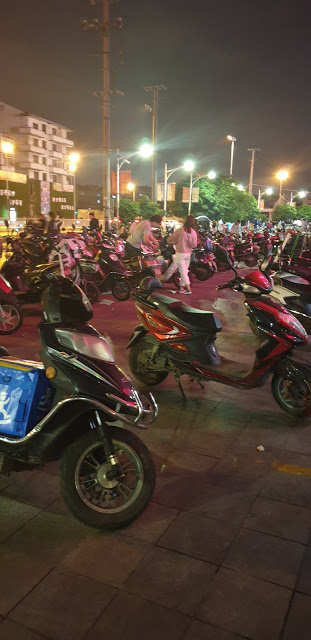
But, unlike where we live, the carpark is more of a scooter park!

It is also a small microcosm of Chinese life for the new more capitalistic oriented Chinese.

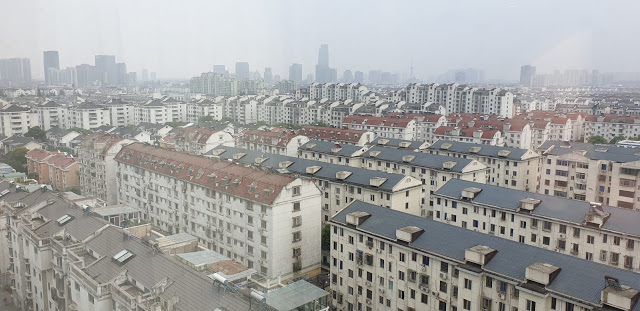
The next morning we get some idea of the scope of high-density living, though here, the buildings are not 30 stories tall, but still just as impressive.

These look like the medium density houses, but to the right of these are much larger buildings

The remarkable thing about this is those buildings stretch as far as the eye can see.

Searching for locations: From Zhengzhou to Suzhou by train, and the Snowy Sea Hotel, Suzhou, China

For the first time on this trip, we encounter problems with Chinese officialdom at the railway station, though we were warned that this might occur.

We had a major problem with the security staff when they pulled everyone over with aerosols and confiscated them. We lost styling mousse, others lost hair spray, and the men, their shaving cream.  But, to her credit, the tour guide did warn us they were stricter here, but her suggestion to be angry they were taking our stuff was probably not the right thing to do.

As with previous train bookings, the Chinese method of placing people in seats didn’t quite manage to keep couples traveling together, together on the train.  It was an odd peculiarity which few of the passengers understood, nor did they conform, swapping seat allocations.

This train ride did not seem the same as the last two and I don’t think we had the same type of high-speed train type that we had for the last two.  The carriages were different, there was only one toilet per carriage, and I don’t think we were going as fast.

But aside from that, we had 753 kilometers to travel with six stops before ours, two of which were very large cities, and then our stop, about four and a half hours later.  With two minutes this time, to get the baggage off the team managed it in 40 seconds, a new record.

After slight disorientation getting off the train, we locate our guide, easily found by looking for the Trip-A-Deal flag.  From there it’s a matter of getting into our respective groups and finding the bus.

As usual, the trip to the hotel was a long one, but we were traveling through a much brighter, and well lit, city.

As for our guide, we have him from now until the end of the tour.  There are no more train rides, we will be taking the bus from city to city until we reach Shanghai.  Good thing then that the bus is brand new, with that new car smell.  Only issue, no USB charging point.

The Snowy Sea hotel.  

It is finally a joy to get a room that is nothing short of great.  It has a bathroom and thus privacy.

Everyone had to go find a supermarket to purchase replacements for the confiscated items.  Luckily there was a huge supermarket just up from the hotel that had everything but the kitchen sink.

But, unlike where we live, the carpark is more of a scooter park!

It is also a small microcosm of Chinese life for the new more capitalistic oriented Chinese.

The next morning we get some idea of the scope of high-density living, though here, the buildings are not 30 stories tall, but still just as impressive.

These look like the medium density houses, but to the right of these are much larger buildings

The remarkable thing about this is those buildings stretch as far as the eye can see.

Searching for locations: The Henan Museum, Zhengzhou, Henan Province, China

The Henan Museum is one of the oldest museums in China.  In June 1927, General Feng Yuxiang proposed that a museum be built, and it was completed the next year.  In 1961, along with the move of the provincial capital, Henan Museum moved from Kaifeng to Zhengzhou.

It currently holds about 130,000 individual pieces, more of which are mostly cultural relics, bronze vessels of the Shang and Zhou Dynasties, and pottery and porcelain wares of the various dynasties.

Eventually, we arrive at the museum and get off the bus adjacent to a scooter track and despite the efforts of the guide, there’s no stopping them from nearly running us over.

We arrive to find the museum has been moved to a different and somewhat smaller building nearby as the existing, and rather distinctively designed, building is being renovated.

While we are waiting for the tickets to enter, we are given another view of industrial life in that there is nothing that resembles proper health and safety on worksites in this country, and the workers are basically standing on what looks to be a flimsy bamboo ladder with nothing to stop them from falling off.

The museum itself has exhibits dating back a few thousand years and consist of bronze and ceramic items.  One of the highlights was a tortoiseshell with reportedly the oldest know writing ever found.

Other than that it was a series of cooking utensils, a table, and ceramic pots, some in very good condition considering their age.


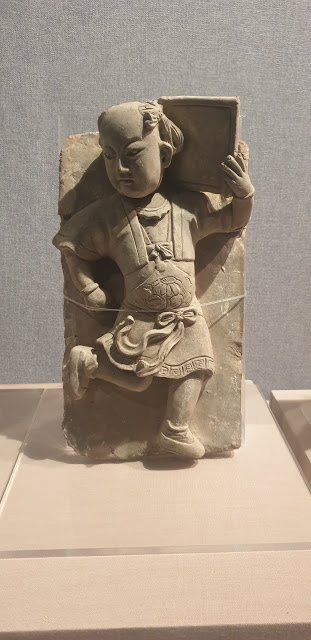
There were also small sculptures

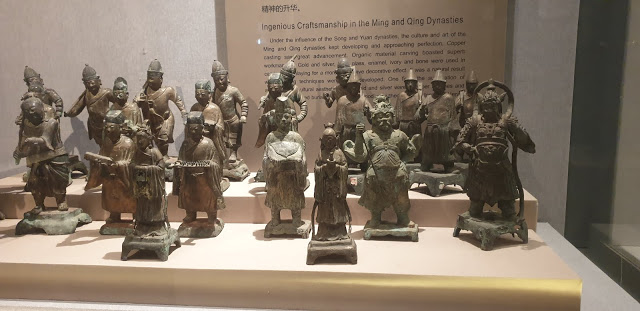
an array of small figures

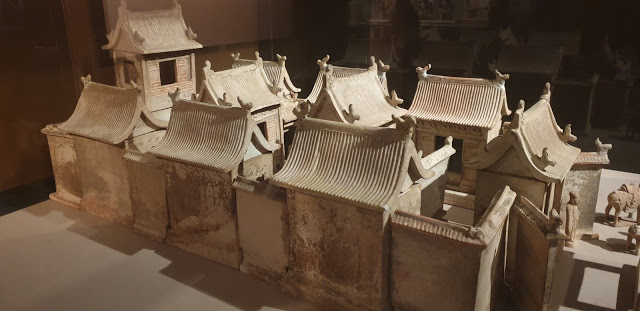
and a model of a settlement

20 minutes was long enough.

Searching for locations: The Henan Museum, Zhengzhou, Henan Province, China

The Henan Museum is one of the oldest museums in China.  In June 1927, General Feng Yuxiang proposed that a museum be built, and it was completed the next year.  In 1961, along with the move of the provincial capital, Henan Museum moved from Kaifeng to Zhengzhou.

It currently holds about 130,000 individual pieces, more of which are mostly cultural relics, bronze vessels of the Shang and Zhou Dynasties, and pottery and porcelain wares of the various dynasties.

Eventually, we arrive at the museum and get off the bus adjacent to a scooter track and despite the efforts of the guide, there’s no stopping them from nearly running us over.

We arrive to find the museum has been moved to a different and somewhat smaller building nearby as the existing, and rather distinctively designed, building is being renovated.

While we are waiting for the tickets to enter, we are given another view of industrial life in that there is nothing that resembles proper health and safety on worksites in this country, and the workers are basically standing on what looks to be a flimsy bamboo ladder with nothing to stop them from falling off.

The museum itself has exhibits dating back a few thousand years and consist of bronze and ceramic items.  One of the highlights was a tortoiseshell with reportedly the oldest know writing ever found.

Other than that it was a series of cooking utensils, a table, and ceramic pots, some in very good condition considering their age.


There were also small sculptures

an array of small figures

and a model of a settlement

20 minutes was long enough.

Searching for locations: The Pagoda Forest, near Zhengzhou City, Henan Province, China

The pagoda forest

After another exhausting walk, by now the heat was beginning to take its toll on everyone, we arrived at the pagoda forest.

A little history first:

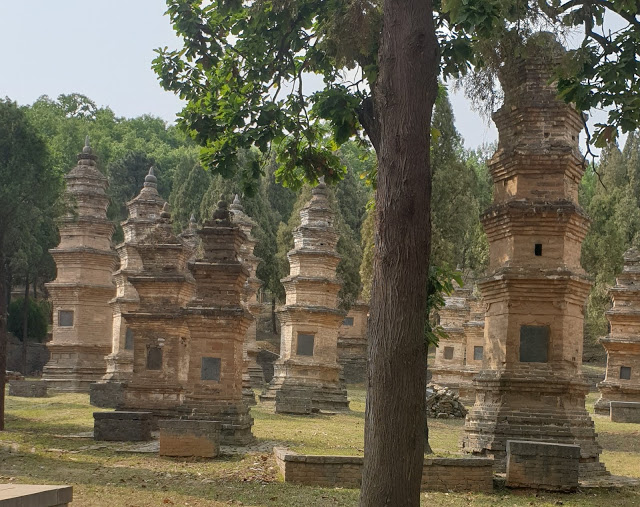
The pagoda forest is located west of the Shaolin Temple and the foot of a hill.  As the largest pagoda forest in China, it covers approximately 20,000 square meters and has about 230 pagodas build from the Tang Dynasty (618-907) to the Qing Dynasty (1644-1911).

Each pagoda is the tomb of an eminent monk from the Shaolin Temple.  Graceful and exquisite, they belong to different eras and constructed in different styles.  The first pagoda was thought to be built in 791.

It is now a world heritage site.

No, it’s not a forest with trees it’s a collection of over 200 pagodas, each a tribute to a head monk at the temple and it goes back a long time.  The tribute can have one, three, five, or a maximum of seven layers.  The ashes of the individual are buried under the base of the pagoda.

The size, height, and story of the pagoda indicate its accomplishments, prestige, merits, and virtues. Each pagoda was carved with the exact date of construction and brief inscriptions and has its own style with various shapes such as a polygonal, cylindrical, vase, conical and monolithic.

This is one of the more recently constructed pagodas

There are pagodas for eminent foreign monks also in the forest.

From there we get a ride back on the back of a large electric wagon

to the front entrance courtyard where drinks and ice creams can be bought, and a visit to the all-important happy place.

Then it’s back to the hotel.

Searching for locations: The Pagoda Forest, near Zhengzhou City, Henan Province, China

The pagoda forest

After another exhausting walk, by now the heat was beginning to take its toll on everyone, we arrived at the pagoda forest.

A little history first:

The pagoda forest is located west of the Shaolin Temple and the foot of a hill.  As the largest pagoda forest in China, it covers approximately 20,000 square meters and has about 230 pagodas build from the Tang Dynasty (618-907) to the Qing Dynasty (1644-1911).

Each pagoda is the tomb of an eminent monk from the Shaolin Temple.  Graceful and exquisite, they belong to different eras and constructed in different styles.  The first pagoda was thought to be built in 791.

It is now a world heritage site.

No, it’s not a forest with trees it’s a collection of over 200 pagodas, each a tribute to a head monk at the temple and it goes back a long time.  The tribute can have one, three, five, or a maximum of seven layers.  The ashes of the individual are buried under the base of the pagoda.

The size, height, and story of the pagoda indicate its accomplishments, prestige, merits, and virtues. Each pagoda was carved with the exact date of construction and brief inscriptions and has its own style with various shapes such as a polygonal, cylindrical, vase, conical and monolithic.

This is one of the more recently constructed pagodas

There are pagodas for eminent foreign monks also in the forest.

From there we get a ride back on the back of a large electric wagon

to the front entrance courtyard where drinks and ice creams can be bought, and a visit to the all-important happy place.

Then it’s back to the hotel.

Searching for locations: Hutongs, Beijing, China

What are Hutongs?

In Beijing Hutongs are formed by lines of traditional courtyard residences, called siheyuan.  Neighborhoods were formed by joining many hutongs together. These siheyuan are the traditional residences, usually occupied by a single or extended family, signifying wealth, and prosperity. 

Over 500 of these still exist.Many of these hutongs have been demolished, but recently they have become protected places as a means of preserving some Chinese cultural history.  They were first established in the Yuan Dynasty (1279-1368)Many of these Hutongs had their main buildings and gates built facing south, and lanes connecting them to other hutongs also ran north to south.

Many hutongs, some several hundred years old, in the vicinity of the Bell Tower and Drum Tower and Shichahai Lake are preserved and abound with tourists, many of which tour the quarter in pedicabs.

The optional tour also includes a visit to Shichahai, a historic scenic area consisting of three lakes (Qianhai, meaning Front Sea; Houhai, meaning Back Sea and Xihai, meaning West Sea), surrounding places of historic interest and scenic beauty and remnants of old-style local residences, Hutong and Courtyard.  

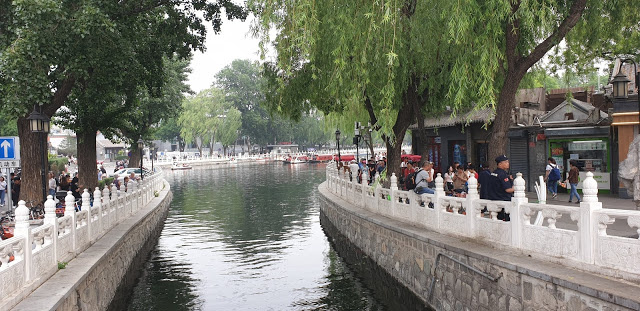
First, we had a short walk through the more modern part of the Hutong area and given some free time for shopping, but we prefer just to meander by the canal.  

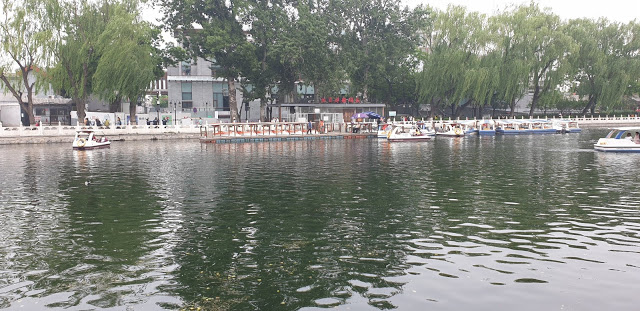
There is a lake, and if we had the time, there were boats you could take.

With some time to spare, we take a quick walk down one of the alleyways where on the ground level are small shops, and above, living quarters.

Then we go to the bell and drum towers before walking through some more alleys was to where the rickshaws were waiting.
The Bell tower

And the Drum tower. Both still working today.

The rickshaw ride took us through some more back streets where it was clear renovations were being made so that the area could apply for world heritage listing.  Seeing inside some of the houses shows that they may look dumpy outside but that’s not the case inside.

The rickshaw ride ends outside the house where dinner will be served, and is a not so typical hose but does have all the elements of how the Chinese live, the boy’s room, the girl’s room, the parent’s room, the living area, and the North-south feng shui.

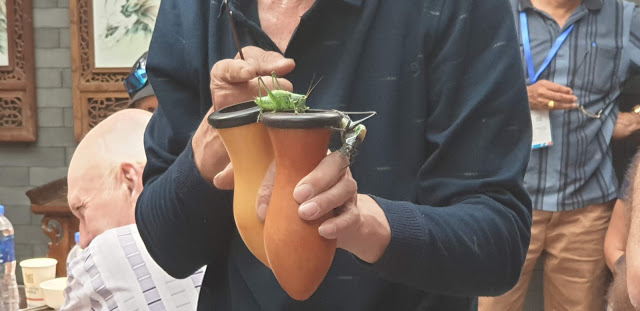
Shortly after we arrive, the cricket man, apparently someone quite famous in Beijing arrives and tells us all about crickets and then grasshoppers, then about cricket racing.  He is animated and clearly enjoys entertaining us westerners.

I’m sorry but the cricket stuff just didn’t interest me.  Or the grasshoppers.

As for dinner, it was finally a treat to eat what the typical Chinese family eats, and everything was delicious, and the endless beer was a nice touch.

And the last surprise, the food was cooked by a man.