This book has been written for some time and the manuscript was sitting in a box with half a dozen others gathering dust and not quite as complete, so this month it is going to get the makeover, a first draft for the editor.
And so it begins…
…
Coping without technology
…
There are no more surprises at least for today.
We have no internet, the power company came along and removed an old pole and that was the end of it.
It’s amazing what you can’t do when there’s no internet and then all the things you said you would do one day if only you had the time.
This morning’s word count accumulates quickly without the distractions so I had the afternoon to finally clean up my workspace.
50 photographs, 50 stories, of which there is one of the 50 below.
They all start with –
A picture paints … well, as many words as you like. For instance:
And, the story:
Have you ever watched your hopes and dreams simply just fly away?
Everything I thought I wanted and needed had just left in an aeroplane, and although I said I was not going to, i came to the airport to see the plane leave. Not the person on it, that would have been far too difficult and emotional, but perhaps it was symbolic, the end of one life and the start of another.
But no matter what I thought or felt, we had both come to the right decision. She needed the opportunity to spread her wings. It was probably not the best idea for her to apply for the job without telling me, but I understood her reasons.
She was in a rut. Though her job was a very good one, it was not as demanding as she had expected, particularly after the last promotion, but with it came resentment from others on her level, that she, the youngest of the group would get the position.
It was something that had been weighing down of her for the last three months, and if noticed it, the late nights, the moodiness, sometimes a flash of temper. I knew she had one, no one could have such red hair and not, but she had always kept it in check.
And, then there was us, together, and after seven years, it felt like we were going nowhere. Perhaps that was down to my lack of ambition, and though she never said it, lack of sophistication. It hadn’t been an issue, well, not until her last promotion, and the fact she had to entertain more, and frankly I felt like an embarrassment to her.
So, there it was, three days ago, the beginning of the weekend, and we had planned to go away for a few days and take stock. We both acknowledged we needed to talk, but it never seemed the right time.
It was then she said she had quit her job and found a new one. Starting the following Monday.
Ok, that took me by surprise, not so much that it something I sort of guessed might happen, but that she would just blurt it out.
I think that right then, at that moment, I could feel her frustration with everything around her.
What surprised her was my reaction. None.
I simply asked where who, and when.
A world-class newspaper, in New York, and she had to be there in a week.
A week.
It was all the time I had left with her.
I remember I just shrugged and asked if the planned weekend away was off.
She stood on the other side of the kitchen counter, hands around a cup of coffee she had just poured, and that one thing I remembered was the lone tear that ran down her cheek.
Is that all you want to know?
I did, yes, but we had lost that intimacy we used to have when she would have told me what was happening, and we would have brainstormed solutions. I might be a cabinet maker but I still had a brain, was what I overheard her tell a friend once.
There’s not much to ask, I said. You’ve been desperately unhappy and haven’t been able to hide it all that well, you have been under a lot of pressure trying to deal with a group of troglodytes, and you’ve been leaning on Bentley’s shoulder instead of mine, and I get it, he’s got more experience in that place, and the politics that go with it, and is still an ally.
Her immediate superior and instrumental in her getting the position, but unlike some men in his position he had not taken advantage of a situation like some men would. And even if she had made a move, which I doubted, that was not the sort of woman she was, he would have politely declined.
One of the very few happily married men in that organisation, so I heard.
So, she said, you’re not just a pretty face.
Par for the course for a cabinet maker whose university degree is in psychology. It doesn’t take rocket science to see what was happening to you. I just didn’t think it was my place to jump in unless you asked me, and when you didn’t, well, that told me everything I needed to know.
Yes, our relationship had a use by date, and it was in the next few days.
I was thinking, she said, that you might come with me, you can make cabinets anywhere.
I could, but I think the real problem wasn’t just the job. It was everything around her and going with her, that would just be a constant reminder of what had been holding her back. I didn’t want that for her and said so.
Then the only question left was, what do we do now?
Go shopping for suitcases. Bags to pack, and places to go.
Getting on the roller coaster is easy. On the beginning, it’s a slow easy ride, followed by the slow climb to the top. It’s much like some relationships, they start out easy, they require a little work to get to the next level, follows by the adrenaline rush when it all comes together.
What most people forget is that what comes down must go back up, and life is pretty much a roller coaster with highs and lows.
Our roller coaster had just come or of the final turn and we were braking so that it stops at the station.
There was no question of going with her to New York. Yes, I promised I’d come over and visit her, but that was a promise with crossed fingers behind my back. After a few months in t the new job the last thing shed want was a reminder of what she left behind. New friends new life.
We packed her bags, three out everything she didn’t want, a free trips to the op shop with stiff she knew others would like to have, and basically, by the time she was ready to go, there was nothing left of her in the apartment, or anywhere.
Her friends would be seeing her off at the airport, and that’s when I told her I was not coming, that moment the taxi arrived to take her away forever. I remember standing there, watching the taxi go. It was going to be, and was, as hard as it was to watch the plane leave.
So, there I was, finally staring at the blank sky, around me a dozen other plane spotters, a rather motley crew of plane enthusiasts.
Already that morning there’s been 6 different types of plane depart, and I could hear another winding up its engines for take-off.
People coming, people going.
Maybe I would go to New York in a couple of months, not to see her, but just see what the attraction was. Or maybe I would drop in, just to see how she was.
As one of my friends told me when I gave him the news, the future is never written in stone, and it’s about time you broadened your horizons.
This book has been written for some time and the manuscript was sitting in a box with half a dozen others gathering dust and not quite as complete, so this month it is going to get the makeover, a first draft for the editor.
And so it begins…
…
Coping without technology
…
There are no more surprises at least for today.
We have no internet, the power company came along and removed an old pole and that was the end of it.
It’s amazing what you can’t do when there’s no internet and then all the things you said you would do one day if only you had the time.
This morning’s word count accumulates quickly without the distractions so I had the afternoon to finally clean up my workspace.
For a story that was conceived during those long boring hours flying in a steel cocoon, striving to keep away the thoughts that the plane and everyone in it could just simply disappear as planes have in the past, it has come a long way.
Whilst I have always had a fascination with what happened during the Second world war, not the battles or fighting, but in the more obscure events that took place, I decided to pen my own little sidebar to what was a long and bitter war.
And, so, it continues…
…
When Carlo stopped, I was out of breath and gasping. We all were. The smoke was getting more intense. At times it had made navigation almost impossible.
In front of us were more trees, but these looked different to those we had passed through. I watched Carlo walk back and forth a few yards each way, then disappear into the bushes. A minute later he put his head out and said, “This way.”
We followed him. It was a hidden entrance down to a drain that was quite deep and headed back towards the castle one way and into the forest the other.
If the fire kept up by tomorrow the cover would be gone.
It was still a hard walk through the bushes, but we made it to a wireframeand door with a lock on it. It looked ancient as if it hadn’t been used in decades, even longer.
Carlo produced a rather odd looking key and unlocked it. I would have thought it was rusted shut, but appearances were deceptive. The lock was almost new.
But the gate had not been used for a long time and it took Carlo a few minutes to force it to open. It had rusted shut. When it did finally move, it was with a very loud screeching sound.
We filed in and he relocked it. Anyone thinking they heard something and came to investigate; it would end up on the other side of the gate.
So far so good.
For a moment I was back in my element, the archaeologist exploring caves, a wooden fire torch lighting the way, dampness underfoot, and the trickling of water down the walls. All around the dankness from continual dampness.
It was easy the pretend if only for a few minutes I had not been caught up in the war, that I was on a quest for lost treasure, hidden away at the end of a labyrinth.
The reality was we were quite literally in an ancient sewer and the original builders of the castle had used an underground waterway to tap into to remove waste. It was far more effective than modern systems and used the earth’s own ecology.
Inside the castle, the places where the waste used to drop down into the waterway had been covered over by trapdoors that were still there, and that was how we were going to gain access, through rooms that were no longer used.
We were going in via four access points, two men at each door, and mine with one of Blinkys men would be going into the area where the soldiers were camping to mop up whatever the bombs left behind, before closing off an exit.
Carlo had reserved the last one for himself and the boy, where he hoped to find Wallace and the new German commander.
Our cue to move: the bombs going off.
We just had time to get to the point and lower the trapdoors. Then climb up onto the floor and wait by the door. From the other side, Carlo said, anyone in the castle would only see a continuation of the wall panelling.
We made it with seconds to spare.
We were closest to the bombs and the percussive effect was disorientating for a few seconds before we pushed through the door and into the smoke and dust raised by the explosions.
As the dust settled, we could see dead soldiers, and mess everywhere. If a soldier was still alive, we shot them, systematically picking our way through the debris. I counted thirty-one dead by the time we reached the other side, the other exit from the space.
In the distance, we could hear sporadic gunfire coming from other parts of the castle, and then, after taking up our position, near the tank, we waited.
Three soldiers came bursting out of the exit and we shot them too..
Ten minutes later Carlo yelled out, “It’s me, don’t shoot.” Then he stepped out the door. “It is done.”
The castle was ours.
“You wish to speak to your old commander before I execute him?
“Wallace?”
He nodded.
“Sure”
I followed him into the castle and walked through familiar passageways and rooms, much had not changed in a long time.
Wallace and the new commander were tied up in the dining room. The remnants of a meal and several empty bottles of wine were on the table.
Wallace watched me from the doorway until I stood before him.
“I knew it was a mistake letting you go. Jackerby was convinced you were a stupid fool who would unwittingly lead us directly to the resistance. I told him you were cleverer than you looked.”
“And yet…”
“Perhaps I was tired of people like you being killed needlessly. What just happened, that was a waste of human life.”
“I didn’t start the war, and for the record, I didn’t want any part of it. Unfortunately, higher authorities deemed otherwise, and here I am. This is not a victory to savour.”
“A victory nonetheless.”
I shrugged. “It didn’t have to be like this, but at least we’ve weeded out a few more traitors.”
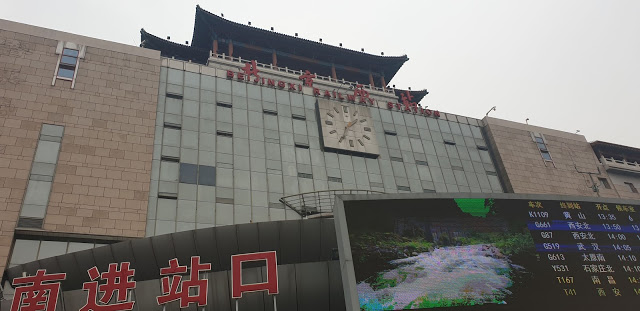
Beijing west railway station is about eight kilometers from the Forbidden City, located at East Lianhuachi Road, Fengtai District. Most trains traveling between south central, southwest, northwest, and south China are boarded here.
This place is huge and there are so many people here, perhaps the other half of Beijing’s population that wasn’t in the forbidden city.
Getting into the station looked like it was going to be fraught with danger but the tour guide got us into the right queue and then arranged for a separate scanner for the group to help keep us all together
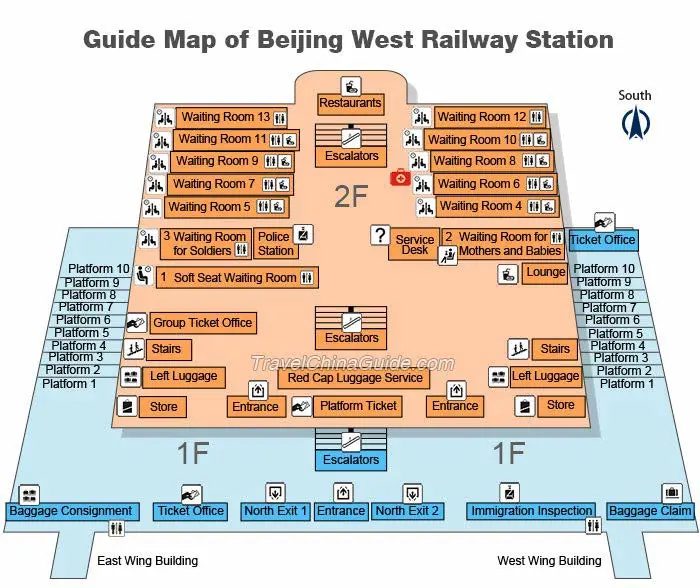
Then we decided to take the VIP service and got to waiting room no 13, the VIP service waiting room which was full to overflowing. Everyone today was a VIP. We got the red hat guy to lead us to a special area away from the crowd.
Actually, it was on the other side of the gate, away from the hoards sitting or standing patiently in the waiting room. It gave us a chance to get something to eat before the long train ride.
The departure is at 4 pm, the train number was G655, and we were told the trains leave on time. As it is a high-speed train, stops are far and few between, but we’re lucky, this time, in that we don’t have to count stations to know where to get off.
We’re going to the end of the line.
However, it was interesting to note the stops which, in each case, were brief, and you had to be ready to get off in a hurry.
These stops were Shijiazhuang, Zhengzhou East, Luoyang Longmen, Huashan North, and Weinan North. At night, you could see the lights of these cities from a distance and were like oases in the middle of a desert. During the day, the most prominent features were high rise apartment blocks and power stations.
A train ride with a difference
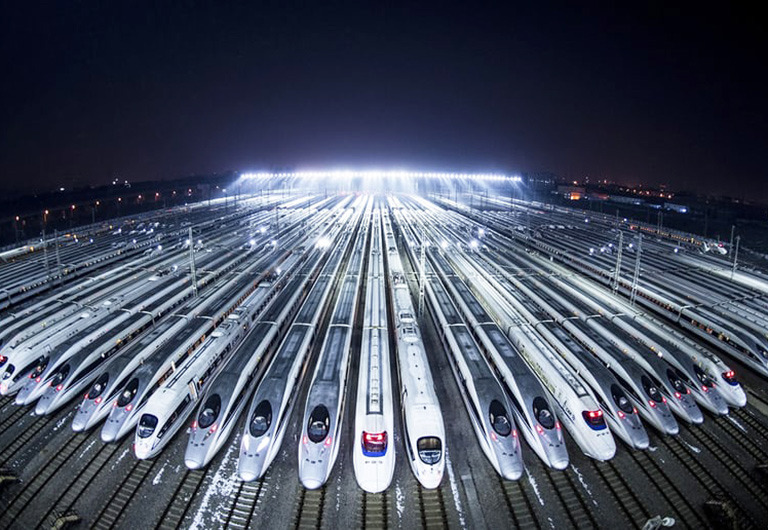
China’s high-speed trains, also known as bullet or fast trains, can reach a top speed of 350 km/h (217 mph).
Over 2,800 pairs of bullet trains numbered by G, D or C run daily connecting over 550 cities in China and covering 33 of the country’s 34 provinces. Beijing-Shanghai high-speed train link the two megacities 1,318 km (819 mi) away in just 4.5 hours.
By 2019, China keeps the world’s largest high-speed rail (HSR) network with a length totaling over 35,000 km (21,750 mi).
To make the five and a half hours go quicker we keep an eye on the speed which hovers between 290 and 305 kph, and sitting there with our camera waiting for the speed to hit 305 which is a rare occurrence, and then, for 306 and then for 307, which happened when we all took a stroll up to the restaurant car to find there had nothing to eat.
I got a strange flavored drink for 20 yuan.
There was a lady manning a trolley that had some food, and fresh, maybe, fruit on it, and she had a sense of humor if not much English.
We didn’t but anything but the barrel of caramel popcorn looked good.
The good thing was, after hovering around 298, and 299 kph, it finally hit 300.
We get to the end of the line, and there is an announcement in Chinese that we don’t understand and attempts to find out if it is the last station fall on deaf ears, probably more to do with the language barrier than anything else.
Then, suddenly the train conductor, the lady with the red hat, comes and tells us it is, and we have fifteen minutes, so we’re now hurrying to get off.
As the group was are scattered up and down the platform, we all come together and we go down the escalator, and, at the bottom, we see the trip-a-deal flags.
X’ian,and the Xi’an North Railway Station
Xi’an North Railway Station is one of the most important transportation hubs of the Chinese high-speed rail network. It is about 8.7 miles (14 km) from Bell Tower (city center) and is located at the intersection of the Weiyang Road and Wenjing Road in Weiyang District.
This time we have a male guide, Sam, who meets us at the end of the platform after we have disembarked. We have a few hiccups before we head to the bus. Some of our travelers are not on his list, but with the other group. Apparently a trip-a-deal mix-up or miscommunication perhaps.
Then it’s another long walk with bags to the bus. Good thing its a nicely air-conditioned newish bus, and there’s water, and beer for 10 yuan. How could you pass up a tsing tao for that price?
Xi’an is a very brightly lit up city at night with wide roads. It is very welcoming, and a surprise for a city of 10 million out in the middle of China.
As with all hotels, it’s about a 50-minute drive from the railway station and we are all tired by the time we get there.
Tomorrow’s program will be up at 6, on the bus 8.40 and off to the soldiers, 2.00 late lunch, then train station to catch the 4.00 train, that will arrive 2 hours later at the next stop. A not so late night this time.
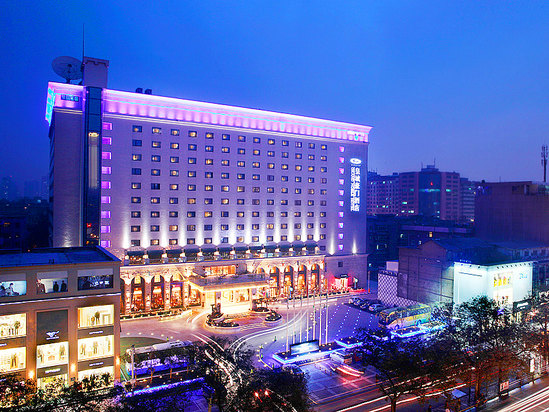
The Grand Noble Hotel
Grand Noble Hotel Xi’an is located in the most prosperous business district within the ancient city wall in the center of Xi’an.
The Grand Noble Hotel, like the Friendship Hotel, had a very flash foyer with tons of polished marble. It sent out warning signals, but when we got to our room, we found it to be absolutely stunning. More room, a large bathroom, air conditioning the works.
Only one small problem, as in Beijing the lighting is inadequate. Other than that it’s what I would call a five-star hotel. This one is definitely better than the Friendship Hotel.
In the center of the city, very close to the bell tower, one of the few ancient buildings left in Xi’an. It is also in the middle of a larger roundabout and had a guard with a machine gun.
Sadly there was no time for city center sightseeing.
This book has been written for some time and the manuscript was sitting in a box with half a dozen others gathering dust and not quite as complete, so this month it is going to get the makeover, a first draft for the editor.
And so it begins…
…
A twist I didn’t see coming
…
Yes.
I had worked out who the murderer was going to be.
Don’t you just hate it when the story unfolds in a different manner? The current person tapped for the murder is looking very guilty, except for one piece of evidence that was not taken into account.
I can’t say what it is.
And I can’t tell you who the likely suspect is, because now I’m not quite sure myself. I feel this is like a true-life murder crime. plodding through the leads and clues one at a time.
Once again I’m still writing a story even in the first edit that unfolds for me just as it would for the reader.
For a story that was conceived during those long boring hours flying in a steel cocoon, striving to keep away the thoughts that the plane and everyone in it could just simply disappear as planes have in the past, it has come a long way.
Whilst I have always had a fascination with what happened during the Second world war, not the battles or fighting, but in the more obscure events that took place, I decided to pen my own little sidebar to what was a long and bitter war.
And, so, it continues…
…
War is hell.
I remembered an old Sargeant Major was telling us that going to war was not fun, that the very real possibility of getting killed should be the only thing on our minds.
Along with keeping your head down and being very aware of your surroundings.
Apparently, he had been at a place called Gallipoli, and from what I had read, that was a special kind of hell.
He had also said fifty per cent of us wouldn’t return. I hoped to be in the fifty per cent that did. Just to spite the old bastard.
I knew it was going to get problematical sooner than we thought, I could smell the aroma of burning bush on the air, and as we got closer to the castle, the smoke got denser.
Wallace had a cunning plan, he’d used flame throwers to set the bush on fire so we couldn’t get to the castle under the cover of the forest. It was a plan he hadn’t me about.
Carlo had stopped, also understanding what Wallace had done. Would this interfere with us getting to the external entrances, or if the other three were unattainable, could we get to the secret entrance?
I caught up to him. “Not exactly what we envisaged. I had no idea Wallace was planning this?”
“It is a logical move. He can’t leave the castle, and as it was, he knew the forest would give us cover until the very last moment.”
“And now?”
“Now we use another entrance. Take longer, but we’ll get there. Only problem, they will be expecting us, and waiting.”
The others joined me, just as Carlo did an about-face and started going back the way we came.
“Where is he going?” Blinky asked.
“Another way. Wallace is burning our cover.”
He shrugged. “I suppose it would be too much to ask for some rain?”
“Sadly no. Fine and clear with a touch of fog, well, smoke maybe.”
He didn’t think it was funny. War I guess could do that to you.
When Thompson and company were planning the operation that was set up primarily to get defecting Germans out of the country, there was only so much research that could be done.
It was one of the reasons I got a seat at the table, my exploits in Italy looking at ancient buildings suddenly became a red-hot reason to be included. The war had all but petered out in that part of the country, the Germans were shoring up the Italians, and the Allies had bigger plans to invade via Sicily, or one of those islands.
Someone mentioned something hush-hush about Italy and the road back to peace, but at that point in time, the end of the war was not in sight.
The point was, the castle was in a strategic location, it was only being held by a small garrison, according to the resistance, ideal for what Thompson wanted. Approvals gained, he sent in a team of German-speaking soldiers to replace those there, as if nothing had happened and then set up the pipeline.
It worked.
For a while anyway. Several months after the new team had set themselves up and the personnel was moving through, it all stopped.
First thought was the Germans had discovered what was going on and switched the team again. Until Thompson noted we were still getting reports from Wallace, one of his men on the ground.
That’s when Thompson decided to send me.
And. No, it was not just a matter of saying, great, I always wanted to holiday in Italy, and particularly Tuscany. My excuse, I was not trained to be a commando or a secret agent.
Of course, I made that one fatal mistake, I had enlisted to fight in the war, and it was not my decision where they sent me.
So, I was on the next plane to Tuscany.
The trouble was, Thompson and I both agreed that it was more likely the men we selected had not changed their allegiances, they just went back to what they were before. Wallace, Johannesen and Jackerby had all been extricated from blown missions, and Thompson had been left scratching his head as to who the mole was in his office.
Too many coincidences proved it wasn’t.
Except coincidentally, Thompson had teamed up all the traitors in one place.
So, my mission was twofold, first to ascertain if they were traitors, and, if they were, to execute them.
The next problem, the mission was almost over before it started, because even though Thompson had told Wallace the wrong pick-up point where my plane would be landing, cloud cover made it impossible to guarantee I’d be jumping at the correct spot.
As it turned out, the resistance had planned a huge ambush in exactly the same place my plane landed, and I was in the middle of it. The rest as they say is history.
The thing is, ever since I landed, I had the benefit of a huge amount of good luck.
That couldn’t last.
Carlo seemed unfazed about the fire, perhaps he had expected it, but his only concern was time. We had to be in the castle just as the explosions started.
With 23 minutes to go, Carlo stepped up the pace. For a big man, he didn’t make much noise. I wished I could say the same for myself.
This book has been written for some time and the manuscript was sitting in a box with half a dozen others gathering dust and not quite as complete, so this month it is going to get the makeover, a first draft for the editor.
And so it begins…
…
A twist I didn’t see coming
…
Yes.
I had worked out who the murderer was going to be.
Don’t you just hate it when the story unfolds in a different manner? The current person tapped for the murder is looking very guilty, except for one piece of evidence that was not taken into account.
I can’t say what it is.
And I can’t tell you who the likely suspect is, because now I’m not quite sure myself. I feel this is like a true-life murder crime. plodding through the leads and clues one at a time.
Once again I’m still writing a story even in the first edit that unfolds for me just as it would for the reader.
Beijing west railway station is about eight kilometers from the Forbidden City, located at East Lianhuachi Road, Fengtai District. Most trains traveling between south central, southwest, northwest, and south China are boarded here.
This place is huge and there are so many people here, perhaps the other half of Beijing’s population that wasn’t in the forbidden city.
Getting into the station looked like it was going to be fraught with danger but the tour guide got us into the right queue and then arranged for a separate scanner for the group to help keep us all together
Then we decided to take the VIP service and got to waiting room no 13, the VIP service waiting room which was full to overflowing. Everyone today was a VIP. We got the red hat guy to lead us to a special area away from the crowd.
Actually, it was on the other side of the gate, away from the hoards sitting or standing patiently in the waiting room. It gave us a chance to get something to eat before the long train ride.
The departure is at 4 pm, the train number was G655, and we were told the trains leave on time. As it is a high-speed train, stops are far and few between, but we’re lucky, this time, in that we don’t have to count stations to know where to get off.
We’re going to the end of the line.
However, it was interesting to note the stops which, in each case, were brief, and you had to be ready to get off in a hurry.
These stops were Shijiazhuang, Zhengzhou East, Luoyang Longmen, Huashan North, and Weinan North. At night, you could see the lights of these cities from a distance and were like oases in the middle of a desert. During the day, the most prominent features were high rise apartment blocks and power stations.
A train ride with a difference
China’s high-speed trains, also known as bullet or fast trains, can reach a top speed of 350 km/h (217 mph).
Over 2,800 pairs of bullet trains numbered by G, D or C run daily connecting over 550 cities in China and covering 33 of the country’s 34 provinces. Beijing-Shanghai high-speed train link the two megacities 1,318 km (819 mi) away in just 4.5 hours.
By 2019, China keeps the world’s largest high-speed rail (HSR) network with a length totaling over 35,000 km (21,750 mi).
To make the five and a half hours go quicker we keep an eye on the speed which hovers between 290 and 305 kph, and sitting there with our camera waiting for the speed to hit 305 which is a rare occurrence, and then, for 306 and then for 307, which happened when we all took a stroll up to the restaurant car to find there had nothing to eat.
I got a strange flavored drink for 20 yuan.
There was a lady manning a trolley that had some food, and fresh, maybe, fruit on it, and she had a sense of humor if not much English.
We didn’t but anything but the barrel of caramel popcorn looked good.
The good thing was, after hovering around 298, and 299 kph, it finally hit 300.
We get to the end of the line, and there is an announcement in Chinese that we don’t understand and attempts to find out if it is the last station fall on deaf ears, probably more to do with the language barrier than anything else.
Then, suddenly the train conductor, the lady with the red hat, comes and tells us it is, and we have fifteen minutes, so we’re now hurrying to get off.
As the group was are scattered up and down the platform, we all come together and we go down the escalator, and, at the bottom, we see the trip-a-deal flags.
X’ian,and the Xi’an North Railway Station
Xi’an North Railway Station is one of the most important transportation hubs of the Chinese high-speed rail network. It is about 8.7 miles (14 km) from Bell Tower (city center) and is located at the intersection of the Weiyang Road and Wenjing Road in Weiyang District.
This time we have a male guide, Sam, who meets us at the end of the platform after we have disembarked. We have a few hiccups before we head to the bus. Some of our travelers are not on his list, but with the other group. Apparently a trip-a-deal mix-up or miscommunication perhaps.
Then it’s another long walk with bags to the bus. Good thing its a nicely air-conditioned newish bus, and there’s water, and beer for 10 yuan. How could you pass up a tsing tao for that price?
Xi’an is a very brightly lit up city at night with wide roads. It is very welcoming, and a surprise for a city of 10 million out in the middle of China.
As with all hotels, it’s about a 50-minute drive from the railway station and we are all tired by the time we get there.
Tomorrow’s program will be up at 6, on the bus 8.40 and off to the soldiers, 2.00 late lunch, then train station to catch the 4.00 train, that will arrive 2 hours later at the next stop. A not so late night this time.
The Grand Noble Hotel
Grand Noble Hotel Xi’an is located in the most prosperous business district within the ancient city wall in the center of Xi’an.
The Grand Noble Hotel, like the Friendship Hotel, had a very flash foyer with tons of polished marble. It sent out warning signals, but when we got to our room, we found it to be absolutely stunning. More room, a large bathroom, air conditioning the works.
Only one small problem, as in Beijing the lighting is inadequate. Other than that it’s what I would call a five-star hotel. This one is definitely better than the Friendship Hotel.
In the center of the city, very close to the bell tower, one of the few ancient buildings left in Xi’an. It is also in the middle of a larger roundabout and had a guard with a machine gun.
Sadly there was no time for city center sightseeing.
In Beijing, Hutongs are formed by lines of traditional courtyard residences, called siheyuan. Neighbourhoods were formed by joining many hutongs together. These siheyuan are the traditional residences, usually occupied by a single or extended family, signifying wealth, and prosperity.
Over 500 of these still exist. Many of these hutongs have been demolished, but recently they have become protected places as a means of preserving some Chinese cultural history. They were first established in the Yuan Dynasty (1279-1368)Many of these Hutongs had their main buildings and gates built facing south, and lanes connecting them to other hutongs also ran north to south.
Many hutongs, some several hundred years old, in the vicinity of the Bell Tower and Drum Tower and Shichahai Lake are preserved and abound with tourists, many of which tour the quarter in pedicabs.
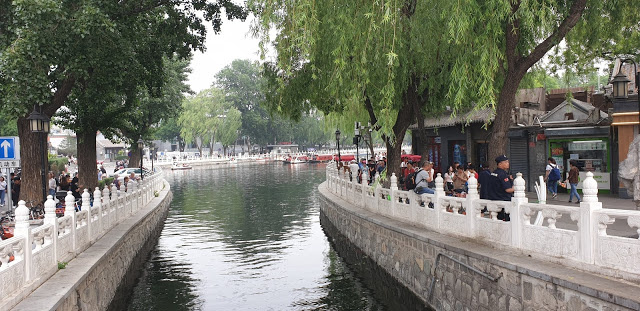
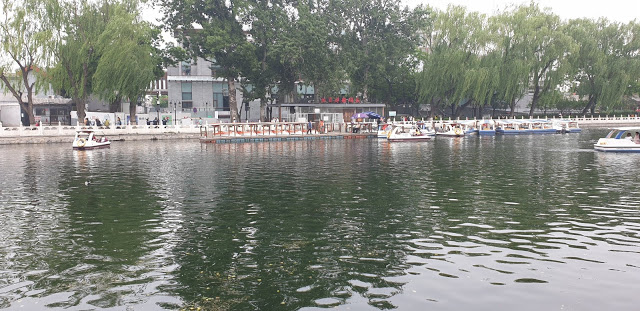
The optional tour also includes a visit to Shichahai, a historic scenic area consisting of three lakes (Qianhai, meaning Front Sea; Houhai, meaning Back Sea and Xihai, meaning West Sea), surrounding places of historic interest and scenic beauty and remnants of old-style local residences, Hutong and Courtyard.
First, we had a short walk through the more modern part of the Hutong area and given some free time for shopping, but we prefer just to meander by the canal.
There is a lake, and if we had the time, there were boats you could take.
With some time to spare, we take a quick walk down one of the alleyways where on the ground level are small shops, and above, living quarters.
Then we go to the bell and drum towers before walking through some more alleys was to where the rickshaws were waiting. The Bell tower
And the Drum tower. Both still working today.
The rickshaw ride took us through some more back streets where it was clear renovations were being made so that the area could apply for world heritage listing. Seeing inside some of the houses shows that they may look dumpy outside but that’s not the case inside.
The rickshaw ride ends outside the house where dinner will be served, and is a not so typical hose but does have all the elements of how the Chinese live, the boy’s room, the girl’s room, the parent’s room, the living area, and the North-south feng shui.
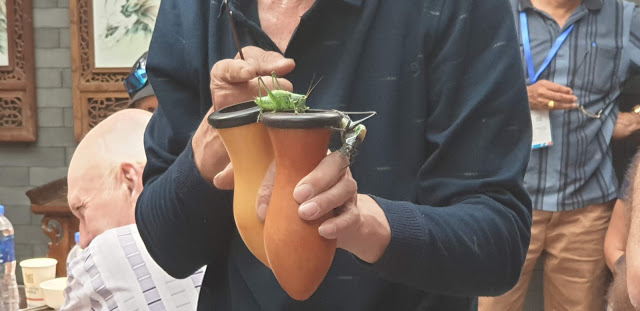
Shortly after we arrive, the cricket man, apparently someone quite famous in Beijing arrives and tells us all about crickets and then grasshoppers, then about cricket racing. He is animated and clearly enjoys entertaining us westerners.
I’m sorry but the cricket stuff just didn’t interest me. Or the grasshoppers.
As for dinner, it was finally a treat to eat what the typical Chinese family eats, and everything was delicious, and the endless beer was a nice touch.
And the last surprise, the food was cooked by a man.





 Thrills, Spills, and just a dash of Romance