In a word: Light

Yes, I see the lighthouse, what’s it doing all the way out there?  The thing is, these places are sometimes so remote, I start thinking I should rent one for 6 months and then, without any distractions, I’ll get the blasted book finished.

Until there’s a shipwreck, of course!

Light is of course light, duh.  Turn on the switch and let there be light.

Hang on, didn’t someone else say that, millennia ago?  Someone famous?  It’s on the tip of my tongue.

No! It’s not cyanide…

So, whilst we need it to see everything, it has another meaning…

My, that’s a light load your carrying today, which means not very heavy.

Or, that’s a light-coloured jumper, which means pale.

Oh, and did you light the fire?

And, after you light the fire, do you light out to a safe haven in light traffic because really it was arson, and you got a light sentence the last time enabling you to do it again.

If you are trying to rob someone, then it was a kilo light.

And after a long hard struggle, did you light upon the correct answer?

This is not to be confused with another similar word, lite.

It seems this is only used for describing low-calorie drinks and food, such as lite beer, which seems to me to be a lazy way of not using light

Still, there’s not much other use of the word except as a suffix -lite, but then you’d have to mention -lyte as well.

The message here – just use the damn word light and be done with it.


“Trouble in Store” – Short stories my way: Setting the scene

I used to like writing short stories, somewhere between two and five thousand words, but, in the end, it was too much hard work.

No chance of getting into stride with a location description, no real chance of giving a background to a character, it was simply a case of diving straight in.

But …

I’ve been thinking about writing a short story, starting it with a short succinct sentence that will set the tone.

Something like:  “Jack was staring down the barrel of a gun”

What then?

Should he start analyzing what sort of gun it was, did it have a light trigger, was the person holding it shaking, a man or a woman, or a child?

Location, in a house, a disused factory, a shop, a petrol station, the side of the road.

So, where was Jack?

Something like:  “He had gone down to the corner shop to get a pack of cigarettes.”

For himself or someone else?  Is it day, is it night, or somewhere in between?

Something like:  “He had to hustle because he knew the shopkeeper, Alphonse, liked to close at 11:00 pm sharp, and came through the door, the sound of the bell ringing loudly and the door bashed into it.”

So, Jack’s state of mind, he is in a hurry, careless coming through the door, not expecting anything out of the ordinary.

How would you react when you saw a gun, pointed at Alphonse until the sound of the door warning bell attracted the gunman’s attention?

Is it a gunman?

Something like:  “It took a second, perhaps three, to sum up the situation.  Young girl, about 16 or 17, scared, looking sideways at a man on the ground, Alphonse, and then Jack.  A Luger, German, a relic of WW2, perhaps her father’s souvenir, now pointing at him.”

The punch line:  Cigarettes can kill in more ways than one.

The revelation:  The corner store also supplied the local drug addicts.

The revised start is now:

Jack was staring down the barrel of a gun.

He had gone down to the corner shop to get a pack of cigarettes.

He had to hustle because he knew the shopkeeper, Alphonse, liked to close at 11:00 pm sharp.  His momentum propelled him through the door, causing the customer warning bell to ring loudly as the door bashed into it, and before the sound had died away, he knew he was in trouble.

It took a second, perhaps three, to sum up the situation. 

Young girl, about 16 or 17, scared, looking sideways at a man on the ground, then Alphonse, and then Jack.  He recognized the gun, a Luger, German, relic of WW2, perhaps her father’s souvenir, now pointing at him then Alphonse, then back to him.

Jack to another second or two to consider if he could disarm her.  No, the distance was too great.  He put his hands out where she could see them.  No sudden movements, try to remain calm, his heart rate up to the point of cardiac arrest.

Pointing with the gun, she said, “Come in, close the door, and move towards the counter.”

Everything but her hand steady as a rock.  The only telltale sign of stress, the bead of perspiration on her brow.  It was 40 degrees Fahrenheit in the shop.

Jack shivered and then did as he was told.  She was in an unpredictable category.

“What’s wrong with your friend?”  Jack tried the friendly approach, as he took several slow steps sideways towards the counter.

The shopkeeper, Alphonse, seemed calmer than usual, or the exact opposite spoke instead, “I suspect he’s an addict, looking for a score.  At the end of his tether, my guess, and came to the wrong place.” 

Wrong time, wrong place, in more ways than one Jack thought, now realizing he had walked into a very dangerous situation.  She didn’t look like a user.  The boy on the ground, he did, and he looked like he was going through the beginnings of withdrawal.

 “Simmo said you sell shit.  You wanna live, ante up.”  She was glaring at Alphonse. 

The language was not her own, she had been to a better class of school, a good girl going through a bad boy phase.

Nest time, point of view.

…

© Charles Heath 2016-2021

Writing about writing a book – Day 5 continues – The complications of life

I hate it when other characters are drawn in, and without a proper introduction, the reader gets confused.

Well, let me tell you, the writer can get confused too.

The introduction of Jennifer cannot go without the introduction of Ellen Bill’s ex-wife, and we have talked a little about her background before.

She has a role, one that will have a major impact later on, but every now and then she is going to appear, adding to the backstory between her and Bill.  There is no real animosity between them, their parting amicable because both knew it was time to end.

Bill’s problems were brought about his military service, and her father has a part to play in the story, though I’m not sure how to weave this in yet.  But it’s not so much what Bill remembers of his service, but of what he has forgotten, or more to the point buried.

That will eventually rise to the surface.

However, at this time, it’s still at the part where the narrator has to introduce Jennifer.

There are three distinct stages to this relationship between the two most important characters, and as it happens it’s Ellen unknowingly that brings Bill and Jennifer together,


Then Ellen, my estranged, and sometimes difficult wife decided she wanted a divorce.  I had no objection, and that was most likely the problem.  Perhaps she had expected me to fight for her, but she had made it clear, many years before, that she was no longer interested in preserving the marriage and was only keeping it up until our two daughters were old enough to fend for themselves.

That time had come.

I found myself in a situation where I needed someone to talk to.  I was not one of those people who made friends easily, nor did I spend much time seeking the company of other women.  I had my work, and it had been enough.

But Ellen’s request for a divorce, for some reason, had shaken me, and the day I got the phone call, Jennifer has bustled into my office as she always did, dumping the pile of log file printouts on my desk, and instead of leaving, perhaps she had seen my look of dismay, or more to the point, utter shock, and stayed.

It caused a slight change in our relationship.


I’m still working on it, but there will be more.

Or fewer words perhaps, after all, it’s only meant to be a brief introduction.

See how simple things become complicated, very quickly.


© Charles Heath 2019

That helicopter story that kept me awake – Episode 13

It’s still a battle of wits, but our hero knows he’s in serious trouble.

The problem is, there are familiar faces and a question of who is a friend and who is foe made all the more difficult because the enemy if it is the enemy, doesn’t look or sound or act like the enemy.

If at first, you don’t succeed, try a few threats, or leverage.

Or just get rid of the problem


Back in my cell, delivered more forcibly than when they escorted me to the interrogation room, I had time to consider his words.

A tactic, I told myself.  Classic divide and conquer.

It was obvious that he wanted me to corroborate his suspicion that Breeman had sent the helicopter out to find his operation.  Did it sound like something she would do or any other commanding officer whose jurisdiction this operation fell under?

Why hadn’t they told her?  If t was military and being run by our side, why would they keep it secret from their own people, especially when something like what just happened, could happen?

It didn’t make sense.

Unless, of course, it was the CIA.  They seemed to be a law unto themselves, except in this case they needed something to incriminate her with in order to have her removed, and replaced with a more sympathetic commanding officer.

It was all too much for a gunnery sergeant like me to understand.

At least I didn’t know anything so I couldn’t tell them anything.  A little solace perhaps, but the trouble was, they’d never believe me.

I sighed.  Perhaps some sleep before they returned for the next round.

They came in the middle of the night.  Or day, I had no idea what it was outside because there were no windows in my cave cell.

They had no intention of being polite, I was dragged up by the scruff of the next and tossed in the direction of the door.  When I stumbled, still half asleep and unable to see properly, one of the guards kicked me and said he would do it again if I didn’t get up.

He did anyway because I took too long.

My ribs were hurting when I breathed, as I staggered in front of them, one behind me giving me a shove every two or three steps, perhaps hoping I’d stumble again so he could kick me.

At the interrogation room, a different one this time, he shoved me in and shut the door.  I didn’t hear a key in the lock, so perhaps they were hoping I’d try to escape.

There was only one chair in the room, and I sat in it.  I couldn’t sit up straight because it hurt, so I had to slump over.

A half hour later a man and a woman, both with white coats like a doctor would wear, came in.  Nothing was said.  The man took up a position behind me, then held me so I couldn’t move.

The woman then joined him, produced as a syringe, and jabbed it in my neck.

The man let me go, and a few seconds later I fell off the chair onto the floor hitting my head in the process, and a few more after that, it was lights out.

At least there was no more pain.


© Charles Heath 2019

In a word: Light

Yes, I see the lighthouse, what’s it doing all the way out there?  The thing is, these places are sometimes so remote, I start thinking I should rent one for 6 months and then, without any distractions, I’ll get the blasted book finished.

Until there’s a shipwreck, of course!

Light is of course light, duh.  Turn on the switch and let there be light.

Hang on, didn’t someone else say that, millennia ago?  Someone famous?  It’s on the tip of my tongue.

No! It’s not cyanide…

So, whilst we need it to see everything, it has another meaning…

My, that’s a light load your carrying today, which means not very heavy.

Or, that’s a light-coloured jumper, which means pale.

Oh, and did you light the fire?

And, after you light the fire, do you light out to a safe haven in light traffic because really it was arson, and you got a light sentence the last time enabling you to do it again.

If you are trying to rob someone, then it was a kilo light.

And after a long hard struggle, did you light upon the correct answer?

This is not to be confused with another similar word, lite.

It seems this is only used for describing low-calorie drinks and food, such as lite beer, which seems to me to be a lazy way of not using light

Still, there’s not much other use of the word except as a suffix -lite, but then you’d have to mention -lyte as well.

The message here – just use the damn word light and be done with it.


Writing about writing a book – Day 5 continues – Those annoying people called characters

Whilst it is always an idea to sit down and write and keep going, not worrying too much about the narrative, there’s always the problem of ideas about characters, and relationships that come back and need to be addressed.

I have issues with Jennifer in that we will need to know something about her, and need a little backstory.

Jennifer is the second most important character in this novel and one that has more talents than what my main character, or anyone else for that matter, thinks she has.  Of course, that is deliberate on her part for a number of reasons that will be introduced at the appropriate time.

But, at the start, all we will have to work with, is the introduction provided by the narrator.

It may go something like this:


Jennifer Pennington Smythe was, as you might expect, very English, very reserved, and very private.  She was the definitive ‘don’t judge a book by its cover’, and I was guilty, at first, of suspecting she had once been a schoolmistress due to the severity of dress, demeanor, and expression.

HR had sent her to me when I’d requested an IT Specialist, though of what particular discipline it was never divulged, neither by HR nor by her.  She arrived one morning, told me she was to ‘help resolve our technical difficulties’, moved into an office that had been used as a storeroom, and worked hard to prove her worthiness in the role.

My first attempt at conversation was rebuffed, the second met with a very cold stare.  Everyone, including me, learned very quickly that any other topic of conversation than work would be ignored.  At the time it suited me, there was trouble in paradise and I didn’t want anything more on my plate to deal with.


So, what is this trouble?

There are three distinct stages of this relationship between the two most important characters, and it is the actions of one of the protagonists that brings them together.  This particular protagonist, of course, is the main character’s wife, a woman that is on the periphery for the period the novel covers, but a little background will be needed at some point before we reach this part of the narrative.

This now means that I will have to put together a back story for Bill and his ex-wife Ellen, not too much yet but enough to explain the next part of the evolving relationship between Bill and Jennifer.


I’m sure this topic is going to raise it’s head again and again…

NaNoWriMo 2021 – Day 7

A score to settle

…

Starting a project with half the plan and a sense of where the story is going to go sometimes leaves you in much the same position as painting yourself into a corner.

I’ve been there a few times, which is why I prefer to start the story with no firm ending in sight, and ad lib.

Yes, at the end of this story I want the revulsion to succeed, but like all good intentions, sometimes it doesn’t quite work out that way.

Taking on a military dictatorship, no matter how benevolent it’s leader tries to portray it, and themselves, you may discover the intelligence you’re working with is not quite the case.

So, I need to invent a little background, more for me, so that I can get my head around what will be needed.

For instance, this country, in northern Africa, was once one of several old French colonies, among those that were once British, or German. These countries were poor, had leaders backed by their colonial masters and as Colonialism became a yolk rather than a benefit, the countries citizens found themselves inducted into the military as a means of giving the country employment and stability.

That in turn emboldened the military leaders to eventually oust the government propped up by the colonial masters and run the country themselves, usually because vested interests need a ‘friendly and corrupt regime to continue exploiting the country and its people.

Until the people fight back. Sometimes that ’cause’ centres itself one one person, or a group of people, and quite often these people can disappear, or be assassinated.

In this case, the county’s most outspoken critic has disappeared, and his deputy finds himself in a rather invidious position of working in the shadows and using suspects means to get a message across.

That means is going to be a human rights conference. There is a plan of sorts, but it’s not known whose involved among the delegates attending from many counties, or who the various intelligence services have on the ground.

Our main character, and his assistant are but two of many, and their mission, like others, is overtly one thing, but why they’re really there, that’s for Delacrat to find put, because he knowns he’s right in the middle of what could only be described as a nest of vipers.

More on this tomorrow

…

Today’s word count: 2,678 words, for the running total of 16.091.

That helicopter story that kept me awake – Episode 12

It’s still a battle of wits, but our hero knows he’s in serious trouble.

The problem is, there are familiar faces and a question of who is a friend and who is foe made all the more difficult because the enemy if it is the enemy, doesn’t look or sound or act like the enemy.

If at first, you don’t succeed, try a few threats, or leverage


He took a deep breath, gave me a look a parent would give a miscreant child, and started again.

“What’s the deal with you and Commander Breeman?”

Yes, he does know about her proclivities, but he was hardly in a position to condemn her.  He, too, had a ‘thing’ for the female trainees under his command, and one in particular.

“She has to eat, I have to eat, in the same mess as it happens.”

He gave me another of his penetrating glares.

“Nothing else?”

“That would be against regulations, as I think you are fully aware.”  I returned his glare but with more intensity.

“What did you discuss over the dinner table?”

Odd question.  Not operational matters, if that was what he wanted to hear.  But what we spoke about had little relevance to work.

“Cars.”

It was true.  She liked restoring old cars from the mid-war period, some of which had been used as props in period movies.  I had an old Cadillac, the sort that would fail any fuel economy test.

I could see it was not the answer he was looking for.  He would have to ask a specific question in order to get a specific answer one way or the other.

“Did she mention the no-fly zone?”

I thought about it for a moment, and then said, “No, there are no cars out there to speak of.”

“Flippancy doesn’t become you, Alan.”

Perhaps not, but it was all he was going to get.

And for added emphasis, I said, “Like I said to your predecessor, I don’t know how or why you would have to ask the pilot.”

He stood abruptly, nearly knocking the chair over.  Angry.

“You know something, Alan, otherwise you would not have been on that helo.  She threw you under the bus, and the quicker you realize that the better.”

Then he walked out, slamming the door behind him.


© Charles Heath 2019

Searching for locations: We’ve just arrived in Beijing International Airport, China

Instead of making a grand entrance, arriving in style and being greeted by important dignitaries, we are slinking in via an airplane, late at night. It’s hardly the entrance I’d envisaged. At 9:56 the plane touches down on the runway.  Outside the plane, it is dark and gloomy and from what I could see, it had been raining.  That could, of course, simply be condensation.

Once on the ground, everyone was frantically gathering together everything from seat pockets and sending pillows and blankets to the floor.  A few were turning their mobile phones back on, and checking for a signal, and, perhaps, looking for messages sent to them during the last 12 hours. Or perhaps they were just suffering from mobile phone deprivation.

It took 10 minutes for the plane to arrive at the gate. That’s when everyone moves into overdrive, unbuckling belts, some before the seatbelt sign goes off, and are first out of their seats and into the overhead lockers.  Most are not taking care that their luggage may have moved, but fortunately, no bags fall out onto someone’s head. The flight had been relatively turbulent free.

When as many people and bags have squeezed into that impossibly small aisle space, we wait for the door to open, and then the privileged few business and first-class passengers to depart before we can begin to leave. As we are somewhere near the middle of the plane, our wait will not be as long as it usually is.  This time we avoided being at the back of the plane.  Perhaps that privilege awaits us on the return trip.

Once off the plane, it is a matter of following the signs, some of which are not as clear as they could be.  It’s why it took another 30 odd minutes to get through immigration, but that was not necessarily without a few hiccups along the way. We got sidetracked at the fingerprint machines, which seemed to have a problem if your fingers were not straight, not in the center of the glass, and then if it was generally cranky, which ours were, continue to tell you to try again, and again, and again, and again…That took 10 to 15 minutes before we joined an incredibly long queue of other arrivals,

A glance at the time, and suddenly it’s nearly an hour from the moment we left the plane.

And…

That’s when we got to the immigration officer, and it became apparent we were going to have to do the fingerprints yet again.  Fortunately this time, it didn’t take as long.  Once that done, we collected our bags, cleared customs by putting our bags through a huge x-ray machine, and it was off to find our tour guide.


We found several tour guides with their trip-a-deal flags waiting for us to come out of the arrivals hall.  It wasn’t a difficult process in the end.  We were in the blue group.  Other people we had met on the plane were in the red group or the yellow group.  The tour guide found, or as it turned out she found us, it was simply a matter of waiting for the rest of the group, of which there were eventually 28.Gathered together we were told we would be taking the bags to one place and then ourselves to the bus in another.  A glance in the direction of the bus park, there were a lot of busses.

Here’s a thought, imagine being told your bus is the white one with blue writing on the side.

Yes, yours is, and 25 others because all of the tourist coaches are the same.  An early reminder, so that you do not get lost, or, God forbid, get on the wrong bus, for the three days in Beijing, is to get the last five numbers of the bus registration plate and commit them to memory.  It’s important.  Failing that, the guide’s name is in the front passenger window.

Also, don’t be alarmed if your baggage goes in one direction, and you go in another. In a rather peculiar set up the bags are taken to the hotel by what the guide called the baggage porter.  It is an opportunity to see how baggage handlers treat your luggage; much better than the airlines it appears.


That said, if you’re staying at the Beijing Friendship Hotel, be prepared for a long drive from the airport.  It took us nearly an hour, and bear in mind that it was very late on a Sunday night.

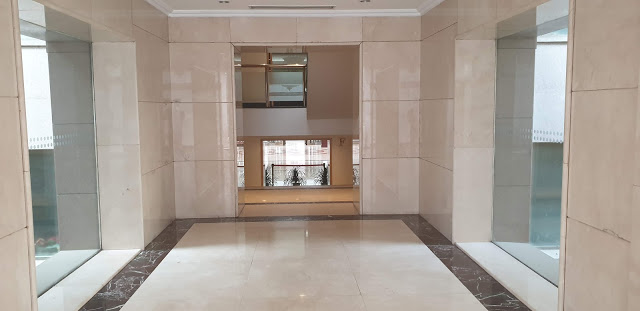
Climbing out of the bus after what seemed a convoluted drive through a park with buildings, we arrive at the building that will be our hotel for the next three days.  From the outside, it looks quite good, and once inside the foyer, that first impression is good.  Lots of space, marble, and glass.  If you are not already exhausted by the time you arrive, the next task is to get your room key, find your bags, get to your room, and try to get to be ready the next morning at a reasonable hour.

Sorry, that boat has sailed.

We were lucky, we were told, that our plane arrived on time, and we still arrived at the hotel at 12:52.  Imagine if the incoming plane is late.

This was taken the following morning.  It didn’t look half as bland late at night.

This is the back entrance to Building No 4 but is quite representative of the whole foyer, made completely of marble and glass.  It all looked very impressive under the artificial lights, but not so much in the cold hard light of early morning.

This the foyer of the floor our room was on.  Marble with interesting carpet designs.  Those first impressions of it being a plush hotel were slowly dissipating as we got nearer and nearer to the room.  From the elevator, it was a long, long walk.

So…Did I tell you about the bathroom in our room?

The shower and the toilet both share the same space with no divide and the shower curtain doesn’t reach to the floor.  Water pressure is phenomenal.  Having a shower floods the whole shower plus toilet area so when you go to the toilet you’re basically underwater.

Don’t leave your book or magazine on the floor or it will end up a watery mess.

And the water pressure is so hard that it could cut you in half.  Only a small turn of the tap is required to get that tingling sensation going.

It’s after 1:30 before we finally get to sleep.

As for the bed, well, that’s a whole other story.

NaNoWriMo 2021 – Day 6

A score to settle

…

Today I’m looking at planning a revolution.

Of course, we all know that it is the military forces of a small country that takes over the democratically elected government, or one that is propped up by a superpower.

This is going to be different, and the people are going to run the revolution.

And like those about to make the attempt, I still have to work out the details, and I have a bit of reading to do.

One thing I do know is that you have to take over the airports, military bases, which might take some doing, and the media outlets like radio and television.

Fortunately, the country does not have a large military force, or at least, those among the military that will back the current government when push comes to shove.

They will also need another country’s backing, like the USA, Britain, or Europe. Will there be the CIA, the Russians and the Chinese there? Quite possibly.

We’ll see how it pans out.

Next, I’ll be looking at the conference, the capital city, the lay of the land, and the people.

…

Today’s word count: 2,689 words, for the running total of 13,413.