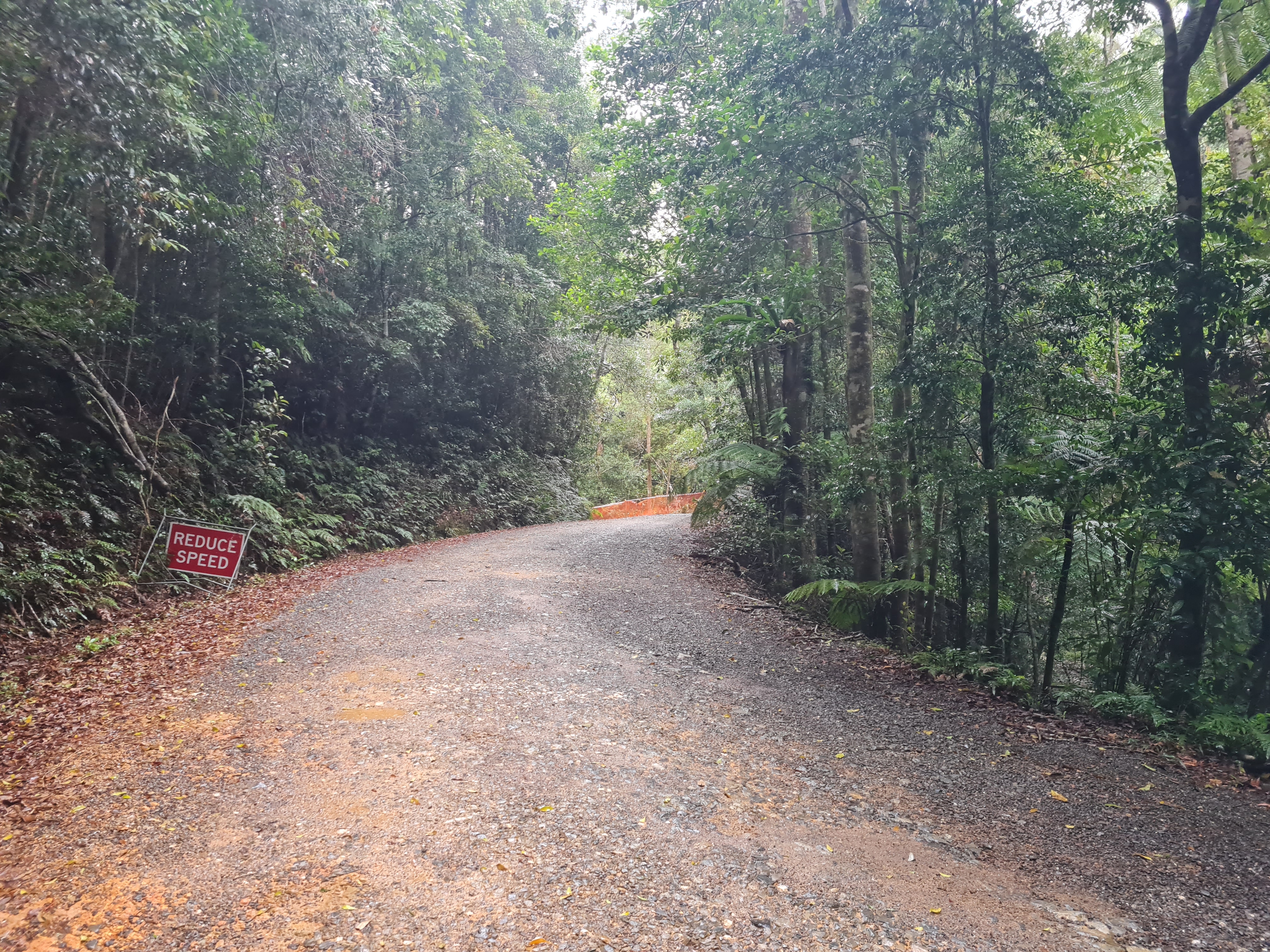
This is taken from a rather bleak part of the coast near Coffs Harbour in New South Wales, Australia.
There was something about the sea on a particularly bleak day and not the sort of weather anyone would want to be out doing the touristy things.
We, on the other hand, are ready to visit anywhere anytime in any condition.
We never quite got as far as the end of the cliffs, but the notion that there were caves, and once upon a time, pirates or smugglers makes for a good story.
Certainly, with our convict settlement beginnings, it’s not hard to imagine the convicts stealing a boat, and sailing south from Sydney, the only settlement at the time, and landing in a place like this.
There is always something not quite right when you literally reach the end of the road.
At the time we were looking for a place called Never Never.
Yes, you read that correctly, Never Never. It is a place on the map, and the GPS navigator knew where we were going, and took us to where it thought it was.
That place you can see is identified by the red plastic fencing across the road. The truth of the matter, we were not allowed to go to Never Never.
So, as for inspiration, it seems we have Never Never, the Americans have got Area 51.
And no, I’m not hanging around to see if spacemen and UFOs are coming to visit after darkness falls.
This photo was taken at a Castello in Tuscany, Italy, and was quite interesting.
I was fascinated as to what was behind the door in front, and up the stairs to the right. I was guessing, up the stairs was the exit from the ballroom, but it might be something else quite banal.
Behind me was the room that had all the names of the family who had lived at the castle.
More interesting was the fact there was the old castle, going back centuries, and the new castle, not so old.
But…
One could cast their minds back to the 1500s perhaps and imagine the castle, on a hill, overlooking what are now vineyards, but could once have been the forest.
Extensive gardens at the back could have been where the jousting and other games could have taken place.
There would be a feasting hall, the kitchens, the servants, and there was a keep.
Italy had a rich history of each of the towns launching raids on other towns, and these towns were walled in, like San Gimignano, with 14 watch towers around the perimeter, where the fortifications were such they kept out the oncoming marauders.
Siena is much the same, a walled town.
Each had a large central square, and Siena famously holds the Il Palio di Siena every year in theirs.
Just being in Tuscany is almost inspiration enough for any sort of story with Tuscany as the backdrop.
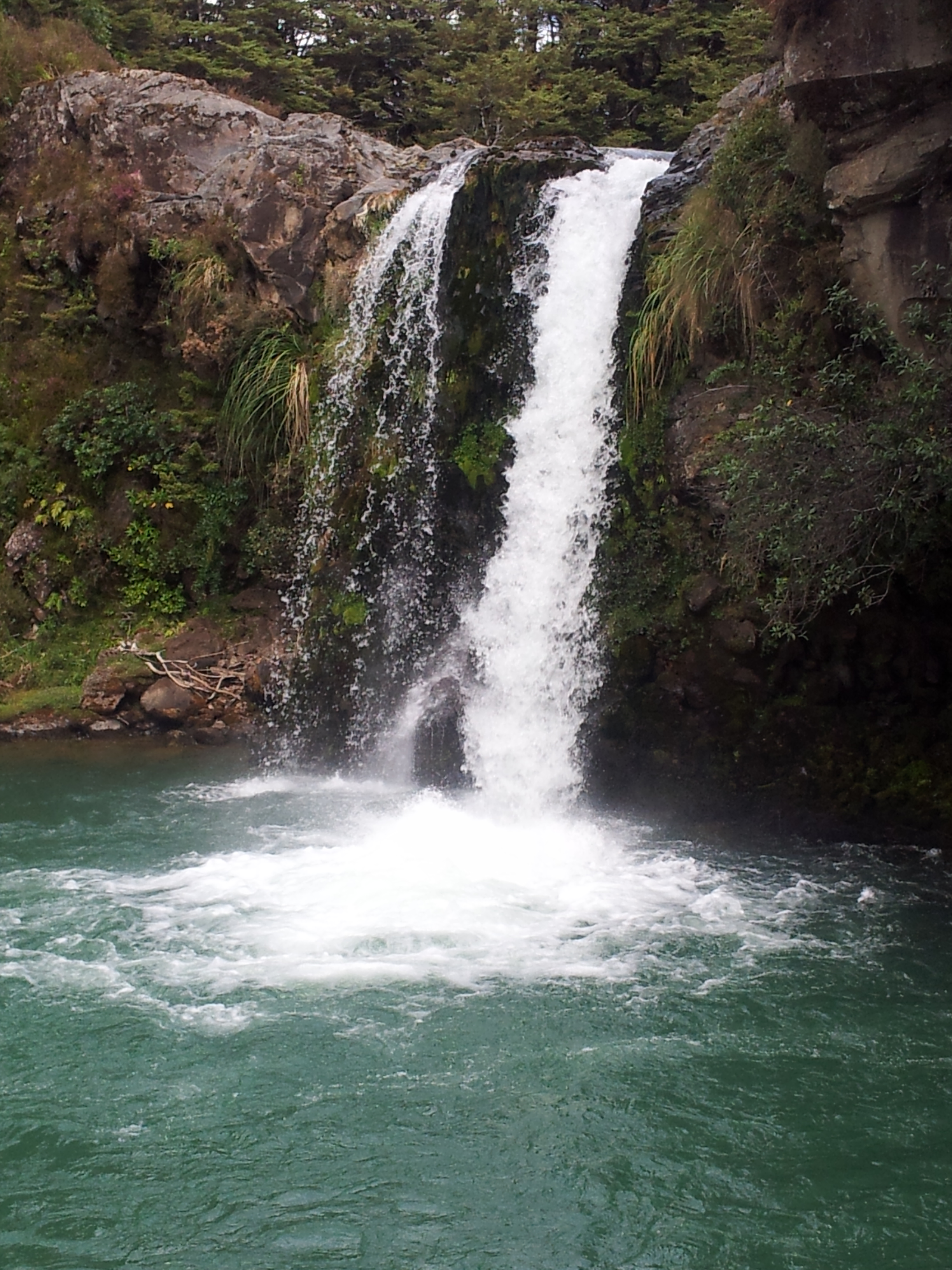
This photograph represents an idyllic scene, a pool at the bottom of a waterfall, which on a fine day would be perfect.
The fact it looks to be in the middle of nowhere is neither here nor there because…
That’s where the writer’s inventiveness kicks in.
So…
How do we get there? If it’s below the waterfall, then we came up the river, which is basically how you would go anyway, it’s just the depth of the river that determines how far you can go.
We had a situation like that where the depth of the river nearly stopped us from getting far enough up the river into the mountains to discover some amazing territory.
You could also go downriver, but since this river might start up in the mountains, it might be a long way.
Why would we be there?
The boring answer, we are on holiday.
The better answer, we’re searching for gold, and so are others who are trying to get us to move on, or we’re searching for something, just insert what you want to find. I was thinking: an intrepid brother or sister who has gone missing, and the waterfall was the last place they were seen.
And, what if there’s a secret entrance behind the waterfall, that opens into an underground complex with sophisticated, very strange and never seen before equipment, that hasn’t been used in a very long time.
Somehow I like the last one best.
And, just to add a new twist, you find a human-like body in a pod, and when someone accidentally leans on a button, it comes to life. Is it human, or is it a robot?
This book has finally come back from the Editor, so this month it is going to get a second revision, a second draft for the editor, and beta readers.
…
We are now up to the part where we introduce Isobel properly and find out why such a talented person is drifting in the doldrums of Rupert’s private detective agency.
Aside from being a once high-flying legal eagle, she is also a computer hacker, or perhaps that’s what she evolved into in a devil finds work for idle hands type person.
This hacking is going to be useful, but it’s also going to bring problems, especially when she starts tracking down Zoe.
And, it seemed she had struck up a dark online relationship with another hacker with the handle Tzar. What are the odds he is Russian?
She’s digging for information, and Tzar helps, and, suddenly it appears, briefly, then is gone, with a warning. Stop digging.
And if she doesn’t.
People were coming for her.
Meanwhile, in the basement, Zoe has had enough time to devise a mask that might stave of the effects of the gas long enough to affect an escape.
And, it almost works, the mask that is.
She manages to get past all of the guards, but Romanov is waiting.
He doesn’t kill her, but he does give her some information, then leaves. He knows how dangerous she can be, especially when wounded.
West Lake is a freshwater lake in Hangzhou, China. It is divided into five sections by three causeways. There are numerous temples, pagodas, gardens, and artificial islands within the lake.
Measuring 3.2 kilometers (2 miles) in length, 2.8 kilometers (1.7 miles) in width, and 2.3 meters (7.5 feet) in average depth, the lake spreads itself in an area totaling 6.5 square kilometers (2.5 square miles).
The earliest recorded name for West Lake was the “Wu Forest River”, but over time it changed to two distinct names. One is “Qiantang Lake”, due to the fact that Hangzhou was called “Qiantang” in ancient times. The other, “West Lake”, due to the lake being west of the city
It’s about to get busy, with a number of activities planned, and the warmth of the day is starting to make an impact.
The tour starts in the car park about a kilometer away, but the moment we left the car park we were getting a taste of the park walking along a tree-lined avenue.
When we cross the road, once again dicing with death with the silent assassins on motor scooters.
We are in the park proper, and it is magnificent, with flowers, mostly at the start hydrangeas and then any number of other trees and shrubs, some carved into other flower shapes like a lotus.
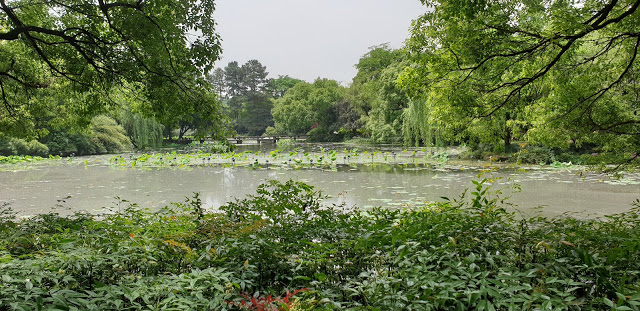
Then there was the lake and the backdrop of bridges and walkways.
.
And if you can tune out the background white noise the place would be great for serenity and relaxation.
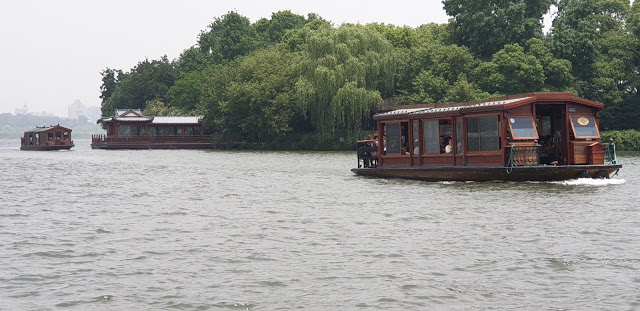
That, in fact, was how the boat ride panned out, about half an hour or more gliding across the lake in an almost silent boat, by an open window, with the air and the majestic scenery.
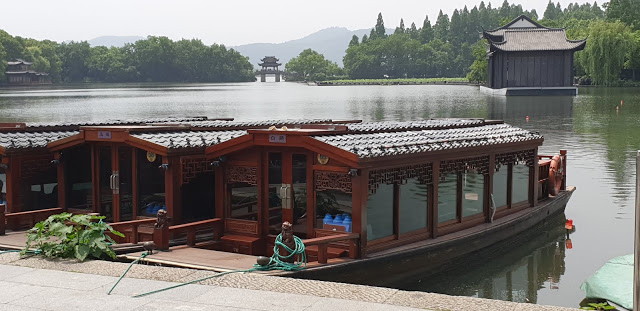
No, not that boat, which would be great to have lunch on while cruising, but the boat below:
Not quite in the same class, but all the same, very easy to tune out and soak it in.
It was peaceful, amazingly quiet, on a summery day
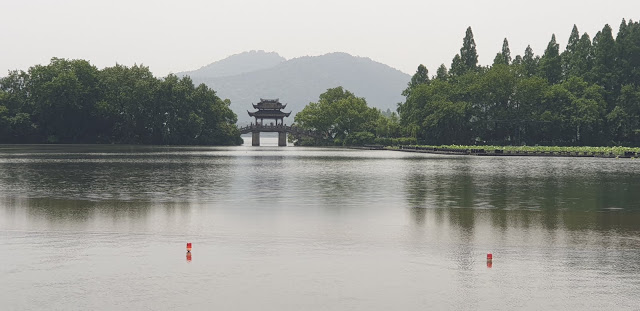
A pagoda in the hazy distance, an island we were about to circumnavigate.
Of all the legends, the most touching one is the love story between Bai Suzhen and Xu Xi’an. Bai Suzhen was a white snake spirit and Xu Xi’an was a mortal man.
They fell in love when they first met on a boat on the West Lake, and got married very soon after.
However, the evil monk Fa Hai attempted to separate the couple by imprisoning Xu Xi’an. Bai Suzhen fought against Fa Hai and tried her best to rescue her husband, but she failed and was imprisoned under the Leifeng Pagoda by the lake.
Years later the couple was rescued by Xiao Qing, the sister of Baisuzhen, and from then on, Bai Suzhen and Xu Xi’an lived together happily.
The retelling of the story varied between tour guides, and on the cruise boat, we had two. Our guide kept to the legend, the other tour guide had a different ending.
Suffice to say it had relevance to the two pagodas on the far side of the lake.
There was a cafe or restaurant on the island, but that was not our lunch destination.
Nor were the buildings further along from where we disembarked.
All in all the whole cruise took about 45 minutes and was an interesting break from the hectic nature of the tour.
Oh yes, and the boat captain had postcards for sale. We didn’t buy any.
Lunch
At the disembarkation point there was a mall that sold souvenirs and had a few ‘fast food’ shops, and a KFC, not exactly what we came to China for, but it seemed like the only place in town a food cautious Australian could eat at.
And when tried to get in the door, that’s where at least 3 busloads were, if they were not in the local Starbucks. Apparently, these were the places of first choice wherever we went.
The chicken supply by the time we got to the head of the line amounted to pieces at 22.5 RMB a piece and nuggets. Everything else had run out, and for me, there were only 5 pieces left. Good thing there were chips.
And Starbucks with coffee and cheesecake.
At least the setting for what could have been a picnic lunch was idyllic.
This book has finally come back from the Editor, so this month it is going to get a second revision, a second draft for the editor, and beta readers.
…
We are now up to the part where we introduce Isobel properly and find out why such a talented person is drifting in the doldrums of Rupert’s private detective agency.
Aside from being a once high-flying legal eagle, she is also a computer hacker, or perhaps that’s what she evolved into in a devil finds work for idle hands type person.
This hacking is going to be useful, but it’s also going to bring problems, especially when she starts tracking down Zoe.
And, it seemed she had struck up a dark online relationship with another hacker with the handle Tzar. What are the odds he is Russian?
She’s digging for information, and Tzar helps, and, suddenly it appears, briefly, then is gone, with a warning. Stop digging.
And if she doesn’t.
People were coming for her.
Meanwhile, in the basement, Zoe has had enough time to devise a mask that might stave of the effects of the gas long enough to affect an escape.
And, it almost works, the mask that is.
She manages to get past all of the guards, but Romanov is waiting.
He doesn’t kill her, but he does give her some information, then leaves. He knows how dangerous she can be, especially when wounded.
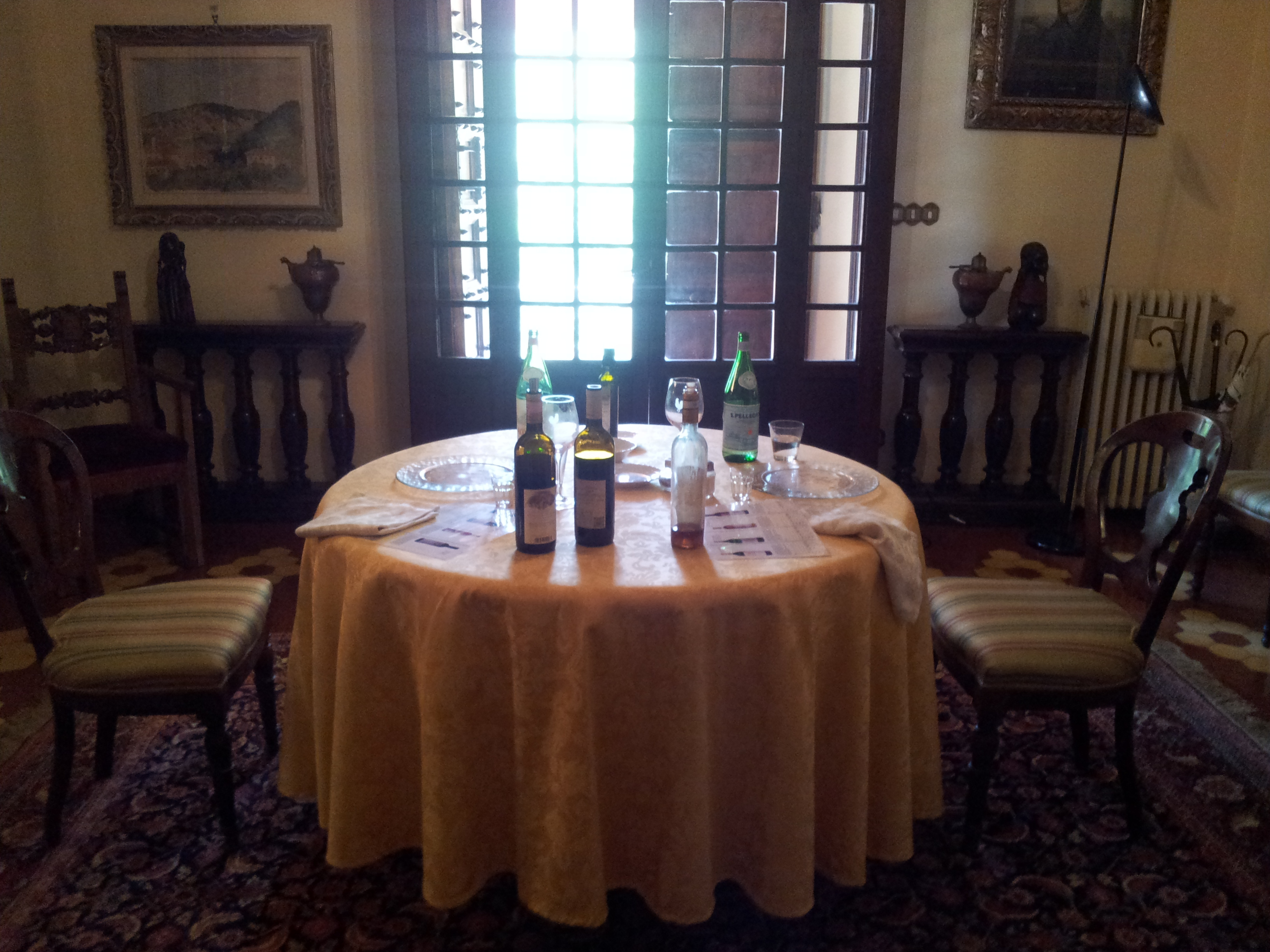
This was at a winery in Italy where, on the tour we took, we had lunch as part of the tour, after, of course, a tour of the winery.
It was a picturesque setting, and the food, and matching wines, were exquisite, and perhaps we may have had slightly more than we should have.
But, they did leave the wine behind…
However…
Inspirationally, we could base the story around a lunch or dinner, two people looking to get their relationship back on track, deciding to take time out alone to see if the part is still there.
How could it not in a setting like this?
It could be the setting for a chef, trying out his new menu, or working on a new menu, getting tourists to sample the courses and wines.
We’d have to make the chef a man, or woman, on the edge of disaster, and looking to recover from a disaster of some description – like a failed restaurant and the need for second chances…
Or…
A failing chateau, typified by the declining visitor number and warring family members, all of whom were left a share in the large but rapidly deteriorating mansion.
Should they renovate and turn it into a hotel with a 5 star restaurant, or should they sell to developers and see it bulldozed, or will one, secretly very wealthy, offer to buy them all out and preserve the ancestral home?
West Lake is a freshwater lake in Hangzhou, China. It is divided into five sections by three causeways. There are numerous temples, pagodas, gardens, and artificial islands within the lake.
Measuring 3.2 kilometers (2 miles) in length, 2.8 kilometers (1.7 miles) in width, and 2.3 meters (7.5 feet) in average depth, the lake spreads itself in an area totaling 6.5 square kilometers (2.5 square miles).
The earliest recorded name for West Lake was the “Wu Forest River”, but over time it changed to two distinct names. One is “Qiantang Lake”, due to the fact that Hangzhou was called “Qiantang” in ancient times. The other, “West Lake”, due to the lake being west of the city
It’s about to get busy, with a number of activities planned, and the warmth of the day is starting to make an impact.
The tour starts in the car park about a kilometer away, but the moment we left the car park we were getting a taste of the park walking along a tree-lined avenue.
When we cross the road, once again dicing with death with the silent assassins on motor scooters.
We are in the park proper, and it is magnificent, with flowers, mostly at the start hydrangeas and then any number of other trees and shrubs, some carved into other flower shapes like a lotus.
Then there was the lake and the backdrop of bridges and walkways.
.
And if you can tune out the background white noise the place would be great for serenity and relaxation.
That, in fact, was how the boat ride panned out, about half an hour or more gliding across the lake in an almost silent boat, by an open window, with the air and the majestic scenery.
No, not that boat, which would be great to have lunch on while cruising, but the boat below:
Not quite in the same class, but all the same, very easy to tune out and soak it in.
It was peaceful, amazingly quiet, on a summery day
A pagoda in the hazy distance, an island we were about to circumnavigate.
Of all the legends, the most touching one is the love story between Bai Suzhen and Xu Xi’an. Bai Suzhen was a white snake spirit and Xu Xi’an was a mortal man.
They fell in love when they first met on a boat on the West Lake, and got married very soon after.
However, the evil monk Fa Hai attempted to separate the couple by imprisoning Xu Xi’an. Bai Suzhen fought against Fa Hai and tried her best to rescue her husband, but she failed and was imprisoned under the Leifeng Pagoda by the lake.
Years later the couple was rescued by Xiao Qing, the sister of Baisuzhen, and from then on, Bai Suzhen and Xu Xi’an lived together happily.
The retelling of the story varied between tour guides, and on the cruise boat, we had two. Our guide kept to the legend, the other tour guide had a different ending.
Suffice to say it had relevance to the two pagodas on the far side of the lake.
There was a cafe or restaurant on the island, but that was not our lunch destination.
Nor were the buildings further along from where we disembarked.
All in all the whole cruise took about 45 minutes and was an interesting break from the hectic nature of the tour.
Oh yes, and the boat captain had postcards for sale. We didn’t buy any.
Lunch
At the disembarkation point there was a mall that sold souvenirs and had a few ‘fast food’ shops, and a KFC, not exactly what we came to China for, but it seemed like the only place in town a food cautious Australian could eat at.
And when tried to get in the door, that’s where at least 3 busloads were, if they were not in the local Starbucks. Apparently, these were the places of first choice wherever we went.
The chicken supply by the time we got to the head of the line amounted to pieces at 22.5 RMB a piece and nuggets. Everything else had run out, and for me, there were only 5 pieces left. Good thing there were chips.
And Starbucks with coffee and cheesecake.
At least the setting for what could have been a picnic lunch was idyllic.
For the first time on this trip, we encounter problems with Chinese officialdom at the railway station, though we were warned that this might occur.
We had a major problem with the security staff when they pulled everyone over with aerosols and confiscated them. We lost styling mousse, others lost hair spray, and the men, their shaving cream. But, to her credit, the tour guide did warn us they were stricter here, but her suggestion to be angry they were taking our stuff was probably not the right thing to do.
As with previous train bookings, the Chinese method of placing people in seats didn’t quite manage to keep couples traveling together, together on the train. It was an odd peculiarity which few of the passengers understood, nor did they conform, swapping seat allocations.
This train ride did not seem the same as the last two and I don’t think we had the same type of high-speed train type that we had for the last two. The carriages were different, there was only one toilet per carriage, and I don’t think we were going as fast.
But aside from that, we had 753 kilometers to travel with six stops before ours, two of which were very large cities, and then our stop, about four and a half hours later. With two minutes this time, to get the baggage off the team managed it in 40 seconds, a new record.
After slight disorientation getting off the train, we locate our guide, easily found by looking for the Trip-A-Deal flag. From there it’s a matter of getting into our respective groups and finding the bus.
As usual, the trip to the hotel was a long one, but we were traveling through a much brighter, and well lit, city.
As for our guide, we have him from now until the end of the tour. There are no more train rides, we will be taking the bus from city to city until we reach Shanghai. Good thing then that the bus is brand new, with that new car smell. Only issue, no USB charging point.
The Snowy Sea hotel.
It is finally a joy to get a room that is nothing short of great. It has a bathroom and thus privacy.
Everyone had to go find a supermarket to purchase replacements for the confiscated items. Luckily there was a huge supermarket just up from the hotel that had everything but the kitchen sink.
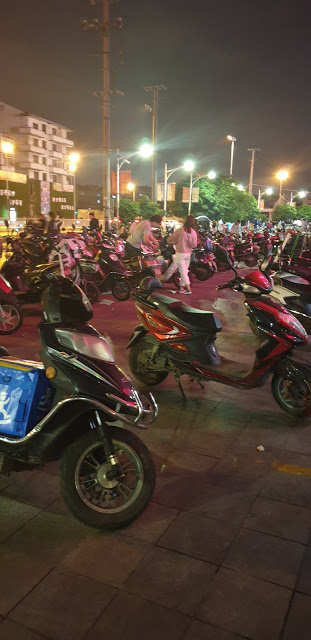
But, unlike where we live, the carpark is more of a scooter park!
It is also a small microcosm of Chinese life for the new more capitalistic oriented Chinese.
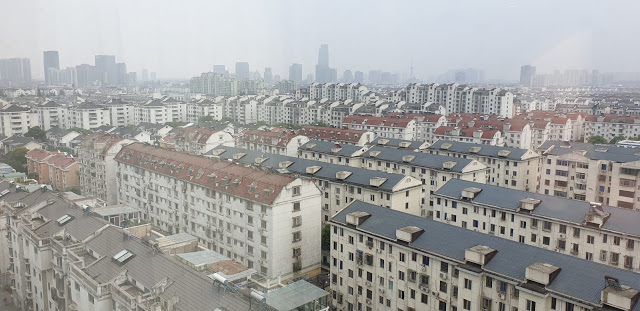
The next morning we get some idea of the scope of high-density living, though here, the buildings are not 30 stories tall, but still just as impressive.
These look like the medium density houses, but to the right of these are much larger buildings
The remarkable thing about this is those buildings stretch as far as the eye can see.











 Thrills, Spills, and just a dash of Romance