The A to Z Challenge – L is for “Long time, no see…”


You can pick your friends but you can’t pick your relatives.

So sayeth my sister, who for years refused to acknowledge I was her brother.

The point is, as I was trying to tell Nancy, the woman who had agreed to marry me, “my family has long been ashamed of me because I refused to become a doctor.”

“That’s no excuse, I’m fact that’s the most ridiculous thing I’ve ever heard.”

To most people, it would. I agreed with her. But then, her family had not had a forebear who stood shoulder to shoulder with George Washington at the Siege of Yorktown.

It was a statement my mother had often pulled out of nowhere at dinner parties, and sometimes in general conversation, just to impress. I thought of trotting out as another example of ridiculous statements, but though better of it.

It was a situation I had not bargained for, and probably why it took so long to find someone to share the rest of my life with.

Perhaps I hadn’t quite thought through what would happen once I asked the question, and it was a yes.

It was not as if Nancy and I hadn’t taken the long road with our relationship. She had been burned a few times, and I always had my family in the back of my mind as the biggest obstacle.

In fact, I always had considered it insurmountable, and because of that, rarely made a commitment. But Nancy was different. She was very forgiving and had the sort of temperament saints were blessed with.

Her family sounded like very reasonable people who lived up state out of Yonkers on a farm she simply said had been in the family forever.

She didn’t have big city aspirations, was not impressed by wealth, travel, large houses, or a resume a mile long with achievements. It was everything I didn’t have and didn’t want, and my job as storeman and fork life driver was one where I could go to work and leave it there.

Nancy on the other hand, was a checkout clerk at a large supermarket, with no aspirations to be a boss or run the place. She had a run in with a tractor early on in life and could manage a lot of the farming basics.

Her parents sent her to the big city to learn a different trade, but she just wasn’t interested. She was a country girl and would never change.

We met when she was attending the same pre wedding party that I was, both with different partners at the time, and both of whom were more party animals that we were.

A week later we ran into each other in the same bar, and it grew from there, and after a rather interesting six months or so, we had ended up making the ultimate commitment.

“I guess, now, we have to tell our parents,” she said, stating what was to her, the obvious.

Such a simple statement with so many connotations. I had deliberately steered the conversation away from all of them, and so, at this point in time, she knew I had parents, grandparents, and three other siblings. And that they lived on the other side of the country.

Asked why I had moved so far away, I told her that I’d failed to meet their expectations and preferred to be as far away as possible. My brothers more than made up for my failings, so it was not necessary I stay there.

It was only recently I’d told her those expectations were of me following the family tradition into medicine. It was when I told her my father was a pre-eminent thoracic heart surgeon, my brothers top of whatever field they’d chosen and my sister, a well-regarded general practitioner.

When she asked in what way I’d failed, I said it was not in the education because like all Foresdale’s, we were always top of the class, and as much as I tried to fail, the teachers knew better.

I just refused to go to University. Instead, I tried to disappear, but my father had the best private detective at his disposal. It took a very long, loud, screaming match to sever that tie, get disinherited, and leave to make my own way in the world.

Perhaps, I said, it would be best to just say I was an orphan.

That, of course, to Nancy, was not an option. She came from practical people who always found a solution to any problem, and they had had a few really difficult ones over the years.

But, for the first time, there was an look of perplexing on her face. Maybe she was thinking that she should have asked more probing questions about my family before agreeing to be my wife.

“I think I can safely say that your parents will be more approachable than mine. Those expectations on me will also fall on you.”

And having said it aloud, it sounded so much more like a threat. The problem was, I knew what there were like, living in that rarefied air where the upper classes lived.

I might be a forklift driving storeman, but I was still a Foresdale, and my match had to be commensurate to the family values.

“Then we’re just going to have to go visit them and lower those expectations. I’m not afraid of them.”

No, I expect she was not. I’d seen her deal with all types of miscreants at the checkout counter, rich and poor alike. She had the sort of gumption I always had wanted but was too much of a coward to confront the problem.

Perhaps now, it would be the perfect opportunity.

“We should go next week. I’ve got some vacation days owing, and I’m sure the boss will let you go if you tell him the reason.”

Practical as ever. Confront the beast and get it over with.

“Sure. I’ll talk to the boss, arrange the tickers, and let someone know we’re coming. But I will not be staying at the house. That way if it gets too intense, we can leave.”

I saw her shrug. I’m not sure she agreed that was a good idea, but I didn’t want to see them corner they way they had a habit of when any of us children brought anyone home. I did once, and never again.

“It will be fine.”

Famous last words.

I had the phone number of my sister Eric’s, stored on my phone, not that I’d ever intended to call her. It was there because she had called me, I had made the mistake of giving it to her when I left, because she asked me for it.

I hadn’t spoken to her since I left home all those years ago, nearly ten by my reckoning, and perhaps it was a testament to my father that not one of them had called, or even reached out.

Being cut off literally meant that. But it was not something that irked me. I was glad not to see them. I could easily keep up with them in the newspapers and magazines, such was their visibility.

I was surprised Nancy hadn’t made the association.

I don’t know how long it was that I stared at that number, finger hovering over the green button. My first concern was whether I’d remain civil, or how long it would take before I disconnected the call.

Then, courage summoned, I pressed the button.

An anticlimax might occur is there was no answer, or the number had been disconnected, but such was not the case. It rang.

Almost for the full number of rings before a familiar voice answered. “Good morning, this is Erica speaking.”

If only I’d learned to answer a phone properly like that.

“It’s Perry.” Damn, I hated that name, and once I left home, I adopted my middle name, James.

“Now that’s a blast from the past. Never expected to hear from you again.”

“Believe me, if I had my way, you wouldn’t, but there’s a person who insists she meets the family. I tried to talk her out of it, but she’s a force to be reckoned with.”

“Good for her. I always knew you’d meet a sensible girl who wouldn’t put up with your nonsense. I’m assuming you asked her to marry you?”

“I’m beginning to wonder if I should have just outright lied and said I was an orphan.”

“Yes, and how would that have worked when we finally ran you to ground. Besides, your father has known where you’ve been hiding all along. You are still a Foresdale, and that will never change.”

“Even when I’ve been ex-communicated from the family.”

“That’s only your assumption. Everyone here might have expected you to change your minds somewhat earlier, but we never doubted you would return. Now, just who is this Nancy, and who does she belong to?”

© Charles Heath 2021

It all started in Venice – Episode 7

A new team member

I had gone over a number of different ways I could run into Juliet, but most seemed staged, and I got the impression from her most recent conversation with Larry, that she was not silly.

In fact, in my mind, a second meeting, coincidental or not, would send up a red flag.  This was where spycraft bordered on Hollywood, we needed to set the stage, and for that, we needed extras.

And that meant a phone call to Alfie.  I told him what I needed, and he asked for 24 hours to set it up, and true to his word, I was in the arrival hall of Venice Airport, waiting for the newest member of the team.

Cecilia Walker was an aspiring actress, an ideal cover for her so-called part-time profession as an agent at large.  We all had cover stories, with both personal and legitimate reasons for being in places that we’d not normally be expected to be.  And in her case, she was never the same person twice, quite literally the master of disguise.

For Cecilia, there was a film festival in Venice she would be attending.  Timing in this case was everything.

As for me, I had a background in archaeology and journalism and was actually employed to write articles for a number of publications, a job I kept up after I left the service, along with the idea of writing a book, which became the object of a long-standing joke between Violetta and I.

One day I would finish it

But ironically, Cecilia had the perfect cover, being able to slip into any role without having to work too hard on the finer details. 

Alfie had sent a photo of her, and even though I did spend a few moments wondering if I might recognize her from some part she may have played, it didn’t stir up any recollection.  Of course, there was always a vast difference between studio poses and real life, and the woman that came out of the gate was quite different from the one I was expecting.

Although the few paparazzi that were loitering in the terminal just in case a celebrity did suddenly arrive, didn’t recognize her, that might be due to the fact she was dressed casually and had changed both hairstyle and color, and, as I had learned from the woman I’d spent a lot of time with, nuances in make-up could make all the difference.

But there was one photographer that was interested, perhaps he had seen her before, and I waited until she had spoken to him before wandering over.  She had scanned the gate area, both to familiarise herself with the layout and people there, as well as locate me, all without looking like she was doing anything other than immediately disembarking the plane.

It showed experience, and preparedness, not her first, as they say, rodeo.

She had been tracking me the whole time, so once I was in her direct line of sight, anyone observing us would assume we were old friends.

There was a hug before words were spoken, the sort that made me realize what I had been missing for some time, warm personal contact.

“You haven’t aged a bit,” she said, a smile lingering.

“It’s the wine, excellent preservative.  You, on the other hand, have grown up.” 

The script called for old friends who hadn’t seen each other for a year or so.

She performed a pirouette and then burst into giggles.  “Sorry, it’s just when I did that for one of my grandmothers, she said I was acting like a tart.”

“Grandmothers can be like that,” I said, remembering Violetta used to use the same word for her sister’s grandchildren.

“My house is a renovator’s disaster at the moment, so we’re staying in a quaint hotel on the edge of the main Canal, and some interesting restaurants.”

Alfie had booked us adjoining rooms on the same floor as Juliet, which, when she learned I would be staying there too, would give me the surprise element I was looking for.

“I am so looking forward to this week.  If we get the time, you’ll have to show me everything.”

In that short distance from the airport terminal to the water taxi berths, there was time enough to discover what had exactly been missing in my life since Violetta had died.

Yes, there was a period of mourning, a period where there had been no point in getting out of bed, a period where I felt completely lost without the one person who made my life make sense.

But in those few short minutes, there it was again, and with it the belief that perhaps there was someone else out there who could fill that gap, but never replace her because there would never be anyone else like her.  Cecilia was not the one, but she was part of the process.

I had to remember, also, she was a consummate actress, that she was playing a role, and it was totally believable.

Once we were on the water taxi and away from prying eyes and ears, I had to ask, “how did you end up on Rodby’s roster, especially in light of how good an actor you are?”

“You think so, why thank you.  But the duality, accidentally.  I got caught in the crossfire, and thinking at the time, someone had changed the script and forgot to tell me, sort of kicked some ass.  Delusions of becoming a female version of Liam Neeson.  Instead, I was offered a recurring female James Bond, in real life.”

Good to know I could depend on her in a scrap.

“This might not come to that, in fact, it might be quite boring.”

She smiled.  “A free trip to Venice, a film festival pass to everything, working with a legend, what’s not to like?”

What had Alfie told her?  Legend I was not, perhaps slightly more successful than the average agent, but I was just doing my job until I didn’t want to do it anymore.  How many of us could say we preferred to sacrifice everything for the love of the one?

“I assume you are up to speed with what’s required of you in the first instance?”

“A role is a role, Evan, and I love a good role.  This woman you’re supposed to be cozying up to, and the guy using her, it’s almost like a plotline in a B grade movie.”

I hadn’t thought of it like that, but now that she mentioned it, it felt a bit like exactly that.

“Should I make her jealous?”

“It’s not like that, or at least that’s the impression I got when I ran into her.  Depends on what Larry’s intentions are.  Chances are when we get to the hotel we might see her again, and you might get an idea.  I’m not the best person reading women’s minds.”

“No man ever is.  We have to have that element of surprise to keep you interested, but if I was in her position, and I saw you with a woman like me, and I was supposed to get close to you for whatever reason, I might be forced into making a move I didn’t want to.  The fact she’s here with you in her sights generally means one thing.”

The question was, how desperate would she be?  That would depend on the motivation, or what leverage he had.  Pushing the envelope might, as Cecilia said force her hand.

So much for a softly, softly approach.

And it might force Larry’s hand as well

“So, is it your first time in Venice?”

“No, I used to come here when younger with my mother who was I guess a Venetian.  After she died, not so much.”

“No other baggage?”  It had surprised me she had only one carrying bag.

It was always excess baggage when traveling anywhere with my ex.

“Only emotional.  I was told to pack light, anything I needed you’d get for me.” 

The accompanying wicked smile was enough.  I’d have to make sure the expense account was big enough.

After a pleasant forty-five-minute grand tour of the canals going the long way to the berths not far from St Mark’s Square, we jumped off as soon as the taxi came alongside.

The hotel wasn’t far from the bronze equestrian monument to Victor Emmanuel II statue, which she took a moment to look at, almost causing several strollers to walk into her.

That element of careless tourist didn’t make her stand-up as much as if she had purposefully walked from the berth to the hotel, a small detail in a studied persona, the role of an extra perhaps in a film.

It was the part of the day, for late summer that I liked the best, and in a week or so, the weather would slowly get colder until Christmas, and winter, was upon us.

Then, she did the complete 360-degree turn just taking it all in.  “Some things never change, I remember all of this.”

Perhaps living off and on for so long here had made me a little immune to the charm of the place, but it was hard not to get caught up in the moment.

“Your hotel awaits.”

For a few seconds the reality of the situation faded into the background, and I could push all the nastiness of Larry and his machinations aside, but then the reality came back, I remembered who I was and what I’d been, and how important it was not to lose sight of the objective.

It had not been easy while Violetta was still alive, nor was hiding the real truth of my past from her.  Yes, I had told her a version of my precious life, and the possible dangers it could present, which was why she suggested we live in a number of different places, never the same in a single location, but with Venice, it had been different.  It had a profound effect on her, and it was where she chose to spend her last days.

It had not held the same effect on me. Not since she passed, and I had been looking to leave, find somewhere new, and different to stay, more so since I learned of Larry’s plans.

Now it just made me angry.

“I’m sorry,” she said, suddenly next to me, “do we need to be someplace?”

“What, no, sorry.”

“You looked annoyed, I hope not with me.”

“No, never.  Just thinking about Larry. And Juliet, I guess I’m lamenting the nuisance the pair of them are in intruding on my solitude.  Something to note, you don’t ever get the luxury of retirement in this business, except in death.”

“Then let’s hope it doesn’t happen.”

© Charles Heath 2022

In a word: Leg

Aside from the fact it is one of those necessary items to walk with, and the fact we can have two or four for most humans and animals, there are a few other uses for the word ‘leg’.

Like…

‘You haven’t got a leg to stand on’, doesn’t necessarily mean you have no legs, but that you are in a precarious position.

“the table had ornate legs’, yes, even non-living objects can have legs, like tables and chairs.

“It was the fifth leg of the race’, meaning it can be a stage of a race.

“He was legless’, meaning that he was too drunk to stand up.  Some might think being legless is a badge of honour, but I suspect those people have been drinking a long time and the alcohol has destroyed most of their brain cells.

“leg it!’, meaning get the hell out of here before you’re caught.

Then, finally, ‘he’s on his last legs’, meaning that he’s exhausted, or about to die.

I’m sure there’s more but that’ll do for now.

I have to use my legs to get some exercise, of which the first leg is to the tripod to check if its legs are stable, and the second leg is to come back to the table and replace one of the legs which is broken.  Then I’ll leg it to the pub where hopefully I won’t become legless.

Hmm…

The cinema of my dreams – I always wanted to write a war story – Episode 27

For a story that was conceived during those long boring hours flying in a steel cocoon, striving to keep away the thoughts that the plane and everyone in it could just simply disappear as planes have in the past, it has come a long way.

Whilst I have always had a fascination with what happened during the second world war, not the battles or fighting, but in the more obscure events that took place, I decided to pen my own little sidebar to what was a long and bitter war.

And, so, it continues…

Rolf Mayer had only ever wanted to design and build rockets for exploration of space.

Somewhere between the germination of that desire, and where he was right now, in the back of a black Mercedes SS staff car heading south towards Nuremberg something had gone horribly wrong.

Back at Nordhausen, he may have been terrified most of the time from the demands of the Reich, and the horrors of how the Reich was achieving its goals, he was, at least, safe.

Now he was a traitor, with stolen plans, with two Britisher spies, heading for Italy and from there to, well it hadn’t quite been specified where he might end up, but he assumed it would be England.

As yet they had not asked him whether he had the answer to stop this new weapon, and, if he really thought about it, there wasn’t an answer.  Perhaps, with a sense of irony, he could say that in kidnapping him, they might not fix the gyro guidance system which caused a lot of the rockets to go off course and miss their intended targets, but still, a large number would still reach their destination with devasting effect.

As for stopping it, he doubted it could be done.  They were fired from mobile positions, there were no static launching sites so the enemy couldn’t bomb those sites, not could they stop the production of them because it was underground.  A lot of lessons had been learned since Pennemunde.

And that brought another thought to mind.  Who was the enemy now, if he was willing to go with these spies?  He was German, and he loved his country, but seeing what he had seen, it was hard to balance that patriotism with the means to achieve their goals.  Perhaps the blame lay with the Fuhrer, but no one ever spoke of what they really thought, only of their undying allegiance to the mother country and its heroic leader.

No doubt, when he reached his final destination he was going to hear a lot of things that may or may not be true about Reich and its leadership.

Mayer noticed the Standartenfuhrer had a map and at various times they would stop the car and consult the map, an older touring map that predated the war.

Listening to their conversations he had learned that the car had a 50-liter tank that was full at the start of their journey.  From Nordhausen to Weimar had been 120 kilometers and had used about 18 liters of petrol.  From that, he deduced that the car would go about 300 kilometers per tankful.  This means they would need more petrol before they reached Nurnberg.

It was one thing to say they were going to take care of the details but getting one of the most heavily rationed commodities in Germany, or anywhere within the sphere of the Reich was nigh on impossible.  He knew this simply because his superiors at the Nordhausen site couldn’t get any petrol for their vehicles.

At this stage of the war, a war they were continually told they were winning, there seemed precious little of anything still available or not rationed, especially food.  Because they were SS they fared reasonably well, but the others not so much, making him feel guilty that he was not going hungry like everyone else.

In fact, he was feeling hungry now, and he didn’t remember seeing any food in the car.

Some distances from Bayreuth, after passing through another checkpoint, they stopped a further 10 kilometers up the rood, in a layby that sheltered them from any other traffic, not that there had been anything other than army convoys.  Several ties there had been airplanes overhead, either coming or going in small groups, perhaps training runs, so perhaps there was a Luftwaffe station nearby

Outside there was another consultation of the map and then the driver headed towards the rear of the car and opened the trunk.  The Standartenfuhrer opened the door.  “You can get out and stretch your legs.”

Mayer climbed out and found just how stiff and sore he was, and it hadn’t been a very long drive, but the roads were not as good as they once were, before the war.

Then he noticed the driver lugging a large can to the petrol cap, opened it, put a funnel in and with some assistance, started refilling the tank.  When he walked towards the rear of the car he saw six such cans in the trunk.  They had come prepared, and given the nature of how they had collected him, he realized that he had been targeted, which meant someone inside the Nordhausen complex was an agent working for British Intelligence.

They emptied two of the tanks into the car, replaced the cans back in the trunk.

The Standartenfuhrer called him over to show him the map.

It had a line roughly drawn from Nordhausen down to Florence, and notes on the side in red, the most pertinent being the distance by road, if they could take the direct route, which now he knew the circumstances, they could not, was about 1,150 kilometers.

Even in the best of circumstances that would take about three days, maybe more.  And there was certainly not enough fuel in the rear truck to go the whole distance.

The Standartenfuhrer ran his finger down the line, “This is the intended route we decided on, though not exactly sticking to the main roads.  WE do not anticipate problems in Germany, but once we cross into Austria and onto Innsbruck there might be a few problems.  We’re not quite sure what to expect at the border.”

“There is no border, not as far as the Reich and the Fuehrer is concerned.”

“Let’s hope you’re right.  But I think it’s about time we had a talk about what happened if anything happens to the two of us.  We’re not planning to get captured, or killed if it’s possible but there’s a lot of risks involved in an operation like this.”

“You expect me to go on alone?”

“Yes.  With the plans and drawings.  You have to get to a town called Gaiole in Chianti which is about 70 kilometers south of Florence.  There you will need to find a man named Luigi Fosini, who will take care of the rest of your journey.  There is a code you will need to give him, but we’ll talk about that later.  All you need, for now, is the destination.”

Discussion over, the got back in the car and continued on their way.

Then he realized he’d forgotten to ask about food, but judging by the dark expressions they wore, he decided to wait a little longer.

© Charles Heath 2020

NaNoWriMo – April 2022 – Day 24

First Dig Two Graves, the second Zoe thriller.

Zoe is now painfully reminded why she did not get involved with other people, why it was better to be responsible only for herself.  It was easy perhaps to blame John for making his own problems by not heeding her advice, but, just the same, she felt a small shred of responsibility for his current situation.

After learning that John has been kidnapped by Olga, Zoe first goes to see an old colleague, and Yuri’s friend, Dominica to interrogate her, then meets up with Yuri, and it does not end well for one of them.  After telling her he’s the elusive Romanov, Yuri informs her of the fact Olga has taken John, and that Worthington is about to use John’s mother as leverage against her.

Not knowing immediately where Olga is, but believing she will not kill him because Zoe will come to her, she detours to take care of Worthington, having finally realized why he was searching for her.  In another of her many disguises, room service visits his room, and Worthington gets more than dinner served up to him.

Of course, Yuri lies. He is not Romanov, and Romanov is not trying to kill her, but find her.

Who is her, well, you’ll have to read the book to find out.

And, as for Olga, well, hell hath no fury than a woman avenging a woman avenging her son!

Today’s writing, with Zoe languishing in a dungeon waiting for a white knight, 1,923 words, for a total of 59,911.

The A to Z Challenge – V is for – “Very well, I’ll tell you the truth”

From the age of 23, my life had been a complete work of fiction, and I have been so wrapped up in that web of lies that I no longer knew what was true and what wasn’t.

23 years and 1 day to be exact, the day after my birthday.  It was the last thing I remembered about who I might have been.

Before a truck nearly wiped me out, destroyed my car, and very neatly me with it.

My survival had been described as a miracle, a triumph for the bionic engineers who got a subject to implant their technology, overcoming the bans for creating and installing such technology in humans by simply not telling anyone.

It was why, when I work up, I was in a small room buried a long way from the surface of the planet, a sort of Frankenstein’s secret laboratory.

But I didn’t know any of this, not for a long time, not till things started to go wrong.

All I knew was what I was told, and that was that I was very lucky to be alive, that I had the best team of surgeons, and they had quite literally glued me back together.

Judging by the number of bandages, I could believe them.  It took six months for all of the operations to be completed, and another few for the skin grafts and physical healing.

Not only they were impressed by the way I had recovered, but when I finally got to look at the new me, it was as if nothing had ever happened.  Certainly, this time around, I was much better looking, physically fit, and tired, but mentally, I was still on a knife-edge.

That accident replayed in my head at least once every day, and that would probably never leave me.  There were other jumbled memories in my head that I couldn’t make sense of, of people who looked like aliens, to be in what might call a laboratory.

And then one recurring, of a woman who might have been an angel or a doctor, or both.  She never spoke, just remained by my side nearly all the time, sitting there observing me.

It felt strange, but it was not uncomfortable.  And it was hard to tell if the memories were real or just my imagination because since I’d woken and returned to what they called the real world I had not seen her again.

I never understood what the expression red-letter day meant, other than in the current context, it was to be the day they sent me home.

There were moments when I never thought I’d see home again, and then moments where I knew no one would recognize me.

The reality is they wouldn’t.  In saving me, they completely reconstructed me, from the face down.  When I first looked in the mirror my face was bandages.  Then I’d was scarred and almost bloody pulp.  In the end, staring back at me was the face of someone I didn’t know.

It was the price of being saved, but somewhere behind the tonal inflection of the plastic surgeon was the real reason for the transformation, and perhaps it didn’t have to be that way.

But I was grateful and didn’t want to rock the boat. It just makes it that little bit more difficult to consider re-joining the world.

I’d been escorted to a large lounge that overlooked a snow-covered mountain range, where the sky was blue and the sun shone brightly, giving the whole scene a sort of shimmering effect.

A touch of the glass that separated outside from in was very, very cold to the touch.  Was this a secret hideaway in the Swiss mountains, and had I been in a secret laboratory?

Or was this another planet?

Was it the drugs they’d been going me every day making me like this, unsure, uncertain, unsettled, and afraid?

I’d been brought to the room and left there, and for a half-hour I alternately sat, made coffee, stood and admired the scenery, checked all of the books in the bookcase, the bottles of alcohol in the bar, then sat again, trying to dispel the nerves.

Then the door opened, the one I tried and found locked, and to my surprise, the angel walked in, looking more beautiful than ever.

I watched her walk across the room, mesmerized.

She stopped in front of me, smiled, then sat in the chair opposite, or rather not so much sit as curl up into the contours of the seat, feet tucked under her, and arm outstretched across the back, almost as if she was inviting me to snuggle into her.

“How are you this morning Matthew?”

Her voice was equally mesmerizing, and I would be happy to listen to her reading a book or the definition of rocket science.

“Very well.”

“It’s been a long road, sometimes difficult, sometimes almost impossible, but we got there in the end.  You are, according to the doctors, fully recovered, and it’s time for you to leave.”

“About that…”

“You have questions, I suspect, and a lot of them.  They will be answered, all in good time.  But for the present, we will not be casting you out to fend for yourself.  I will be coming with you, your intermediary so to speak while you reassimilate.  Of course, you cannot go back to the life you had before, that life, that person no longer exists.  For all intents and purposes, you had died on the operating table after the accident.”

“That was not what I understood.”

What I had understood was very hazy, after they had brought me to the facility.  Bits and pieces of that night, of the accident, and the aftermath, of being in the hospital, and what I thought was me looking down at me on an operating table, being declared dead.

And then being whisked away in an ambulance to somewhere else where there were more doctors and nurses, and a man in a suit saying ‘sign this if you want to live.

I was not sure what I signed, then, but now, it was to save my life, but at what cost?

“Things are not always as they seem.  You have been treated with largely experimental treatments that otherwise could not be performed on people within the current medical regime.  Your life, however, was never in any danger, and, as you can see, you have recovered remarkably.  All we ask is that you accept the responsibility of being one of the few that have been granted a second life.  I am also another such person, and it will be my honor to help you through what can be a difficult stage, reintegration.  You are, for all intents and purposes, Andrew Tavener, but as he is no longer alive, your name will be Mathew Welles.  I was once Mary Ballen, I’m now Felicity Welkinshaw.  Names are only a part of who you are now.”

It was beginning to sound like I was one of a select group.  That Felicity was like me, and she accepted who she was, now.  Perhaps things were not so bad, a good job, and a girl like Felicity as a friend, perhaps that was only a small price to pay.

Except…

“So, I cannot go back to where I lived, where I worked, see those people I once knew, friends, family?”

“Not as Andrew, no.  But, when we believe you can manage it, you will be able to see those people but only as an outsider who has forged a relationship with all or any of them.  However, there is one exception, Wendy.  You cannot see her, not even accidentally meet her.  For that reason, your new life will be as a new junior executive for the company that oversees the medical research that you have been treated, in England.  It is for the best, and you will come to realize that.”

I shrugged.  It could be worse.  But there was something else on my mind.  Something borne out of a lot of fractured memories, after coming to the facility.

“This is going to sound very freakish, but I have to ask.  Am I still human?”

Those odd memories, I thought I was being ‘assembled’.

“Yes, though a number of what may seem like robotic changes have been made, what we regard as the next step in human evolution.  Now, I think it’s time for our going away party.  Everyone will be there.”

She stood, and held out her hand.

I took it and had an immediate tingling sensation, such a human reaction.

Followed by a single memory that came back right at that moment, a snippet of a conversation I’d overheard.

“He’s the best god-damned robot we’ve made to date, even better than Felicity, and that’s saying something.”

And the face of the man was the first one I saw as I entered the room.

Why did I notice him? 

Because I looked exactly like him.


© Charles Heath 2022

The cinema of my dreams – I always wanted to go on a treasure hunt – Episode 35

Here’s the thing…

Every time I close my eyes, I see something different.

I’d like to think the cinema of my dreams is playing a double feature but it’s a bit like a comedy cartoon night on Fox.

But these dreams are nothing to laugh about.

Once again there’s a new installment of an old feature, and we’re back on the treasure hunt.


It was an understatement to say I was dreading going to Boggs’ place.

In fact, in the hour it took to get through the morning chores I had time to consider how and why I was in this position.  Boggs was a friend.  We were friends at school and as best we could we had each other’s back when the bullies came out to play.

At times that didn’t amount to much because as everyone knows, bullies hunt in packs.  Six against two wasn’t much of an equation.  And it those days, the teachers spent more time hiding from the students than being in front of them.

It was simply a case of what doesn’t kill you makes you stronger.

It didn’t feel like that, not for a very long time.

But, in the end, misfortune can make strange bedfellows, and in a town that depended on a single industry, it soon became apparent that there were more people against the Benderby’s and the Cossatino’s than for, and in small-town politics, that was more than an evening up.  Out of school and separated from their acolytes, both Alex and Vince found that whatever influence they had once, was now gone, and all that was left was a grunt, and we were basically left alone.

Boggs was the dreamer.

He had idolized his father and when he went missing it broke him.

This map thing was the first signs of Boggs finally coming back to life, but the problem was, it was all pinned on false hopes.  The Sherriff was right.  Boggs was in over his head, playing with the two most vicious families from around here, and it was bad enough that his father had fallen foul of them, the Sherriff was not about to see his son go the same way.  I was going to try and talk Boggs out of it.

Yet, on the other hand, it was people like us who needed a win, just to show there was still hope in this place.  With threats every day that the factory might have to close, there were dark clouds hanging over everyone’s head.

If the factory closed, there was going to be a very large hole in the local economy and a lot of people in financial trouble.  I’m not sure how finding the treasure might solve all of that, but I suspect Boggs’ had something up his sleeve.

I knocked on the door and his mother answered.  She looked harried.  She was a nurse and looked as though she just got home from the night shift at the hospital.  

“Boggs is in his room.”

“How are you this morning?”

“Tired.  And an afternoon shift, which I might not get to if I don’t get some sleep.  You know where he is.  Try not to make any noise.”

“Will do.”

I came in and closed the door, watching her dash off down the passage to the other end of the house.

She could not work endless double shifts for much longer, but like all of us, it was not out of desire but necessity.  She had implored Boggs to get a job and help, but he seemed oblivious to the problem.  I’d tried to speak to him, but he had that insufferable way of just not listening.

Boggs was in his room, sitting on the bed and staring at the ceiling.

I looed up too, but there was nothing there.

“Don’t tell me,” I said, “but you’ve suddenly discovered you’ve got X-Ray vision.”

“If only.  I could use it right now to find something that’s missing>”

“Your cell phone?”  Boggs was always misplacing something, of forgetting it.  I’d lost count how many times he’d misplaced his phone.

“No.  An underground river.”

OK.  That was out of left field.  I had no idea any rivers were missing, or, in fact, they could actually go missing.

Apparently, they could.

“There’s two,” he said.  300 years ago five or take this part of the coastline had several rivers that ran down from the mountain range.  What we now call the hills on the edge of the coastal plain.  There was also a lake, not very large, but it used to have several streams flow into it all year round and had an aqua flow that came out along the coastline.”

“And you figured all of this out from what?  A copy of the treasure map.”

The moment he started quoting rivers, streams, and lakes, I remembered each of those geographical features appeared on several of the map versions.  I had suggested, rather comically, that it would be funny if the treasure was buried in the lake.

It wasn’t all that funny.  It was also possible.

“Imagine this.  Drop anchor out to sea, in other words on the other side of the natural sandbar that formed at the seaward side of the river, get in the longboats and row inshore to the lake, across the lake, up another river to the base of the hills.  Then do a little exploring, north or south, and find a cave.  I reckon the treasure was buried in a cave.  We know there are caves up there, not many, but I think there used to be more.”

“Someone already did a survey with some rather fancy electronic equipment with the same idea in mind.  He found three, not very long, and certainly without treasure.  Two had substantial falls inside, which is why they were buried.”

“There’s more.”

He jumped up off the bed and went over to the robe and opened the door.  Tacked on the back was a copy of an ordnance survey map of this part of the coastline, and a tracing of the treasure map, to the same scale on top.

“As you can see, I think ‘I’ve found the correlation between the real, and what was real 300 years ago.”

Except there’s no rivers and no lake.  And no sand bar as I recall.  There was a small marina in what might have been where the river met the sea, but that’s gone.  They filled it in and build a shopping mall on it.  A huge, now half empty, shopping mall.  A modern wonder 40 years ago that was supposed to bring business and shoppers to the town.  For a few years it did, until another town 50 miles away got the same idea, sold the land for half the price, and made the rents a quarter of what they were here.

They called it progress.

We called it piracy.

“Then we can hardly row our boat inshore and up the stream, if it’s not there.”

I hated to state the obvious.

“But,” he said, looking like the cat who’d swallowed the canary.  “What if it is still there, but we just can’t see it?”

© Charles Heath 2020

An excerpt from “One Last Look”: Charlotte is no ordinary girl

This is currently available at Amazon herehttp://amzn.to/2CqUBcz


I’d read about out of body experiences, and like everyone else, thought it was nonsense.  Some people claimed to see themselves in the operating theatre, medical staff frantically trying to revive them, and being surrounded by white light.

I was definitely looking down, but it wasn’t me I was looking at.

It was two children, a boy and a girl, with their parents, in a park.

The boy was Alan.  He was about six or seven.  The girl was Louise, and she was five years old.  She had long red hair and looked the image of her mother.

I remember it now, it was Louise’s birthday and we went down to Bournemouth to visit our Grandmother, and it was the last time we were all together as a family.

We were flying homemade kites our father had made for us, and after we lay there looking up at the sky, making animals out of the clouds.  I saw an elephant, Louise saw a giraffe.

We were so happy then.

Before the tragedy.


When I looked again ten years had passed and we were living in hell.  Louise and I had become very adept at survival in a world we really didn’t understand, surrounded by people who wanted to crush our souls.

It was not a life a normal child had, our foster parents never quite the sort of people who were adequately equipped for two broken-hearted children.  They tried their best, but their best was not good enough.

Every day it was a battle, to avoid the Bannister’s and Archie in particular, every day he made advances towards Louise and every day she fended him off.

Until one day she couldn’t.

Now I was sitting in the hospital, holding Louise’s hand.  She was in a coma, and the doctors didn’t think she would wake from it.  The damage done to her was too severe.

The doctors were wrong.

She woke, briefly, to name her five assailants.  It was enough to have them arrested.  It was not enough to have them convicted.

Justice would have to be served by other means.


I was outside the Bannister’s home.

I’d made my way there without really thinking, after watching Louise die.  It was like being on autopilot, and I had no control over what I was doing.  I had murder in mind.  It was why I was holding an iron bar.

Skulking in the shadows.  It was not very different from the way the Bannister’s operated.

I waited till Archie came out.  I knew he eventually would.  The police had taken him to the station for questioning, and then let him go.  I didn’t understand why, nor did I care.

I followed him up the towpath, waiting till he stopped to light a cigarette, then came out of the shadows.

“Wotcha got there Alan?” he asked when he saw me.  He knew what it was, and what it was for.

It was the first time I’d seen the fear in his eyes.  He was alone.

“Justice.”

“For that slut of a sister of yours.  I had nuffing to do with it.”

“She said otherwise, Archie.”

“She never said nuffing, you just made it up.”  An attempt at bluster, but there was no confidence in his voice.

I held up the pipe.  It had blood on it.  Willy’s blood.  “She may or may not have Archie, but Willy didn’t make it up.  He sang like a bird.  That’s his blood, probably brains on the pipe too, Archie, and yours will be there soon enough.”

“He dunnit, not me.  Lyin’ bastard would say anything to save his own skin.”  Definitely scared now, he was looking to run away.

“No, Archie.  He didn’t.  I’m coming for you.  All of you Bannisters.  And everyone who touched my sister.”


It was the recurring nightmare I had for years afterwards.

I closed my eyes and tried to shut out the thoughts, the images of Louise, the phone call, the visit to the hospital and being there when she succumbed to her injuries.  Those were the very worst few hours of my life.

She had asked me to come to the railway station and walk home with her, and I was running late.  If I had left when I was supposed to, it would never have happened and for years afterwards, I blamed myself for her death.

If only I’d not been late…

When the police finally caught the rapists, I’d known all along who they’d be; antagonists from school, the ring leader, Archie Bannister, a spurned boyfriend, a boy whose parents, ubiquitously known to all as ‘the Bannister’s, dealt in violence and crime and who owned the neighbourhood.  The sins of the father had been very definitely passed onto the son.

At school, I used to be the whipping boy, Archie, a few grades ahead of me, made a point of belting me and a few of the other boys, to make sure the rest did as they were told.  He liked Louise, but she had no time for a bully like him, even when he promised he would ‘protect’ me.

I knew the gang members, the boys who tow-kowed to save getting beaten up, and after the police couldn’t get enough information to prosecute them because everyone was too afraid to speak out, I went after Willy.  There was always a weak link in a group, and he was it.

He worked in a factory, did long hours on a Wednesday and came home after dark alone.  It was a half mile walk, through a park.  The night I approached him, I smashed the lights and left it in darkness.  He nearly changed his mind and went the long way home.

He didn’t.

It took an hour and a half to get the names.  At first, when he saw me, he laughed.  He said I would be next, and that was four words more than he knew he should have said.

When I found him alone the next morning I showed him the iron bar and told him he was on the list.  I didn’t kill him then, he could wait his turn, and worry about what was going to happen to him.

When the police came to visit me shortly after that encounter, no doubt at the behest of the Bannister’s, the neighbourhood closed ranks and gave me an ironclad alibi.  The Bannister’s then came to visit me and threatened me.  I told them their days were numbered and showed them the door.

At the trial, he and his friends got off on a technicality.  The police had failed to do their job properly, but it was not the police, but a single policeman, corrupted by the Bannisters.

Archie could help but rub it in my face.  He was invincible.

Joe Collins took 12 bullets and six hours to bleed out.  He apologized, he pleaded, he cried, he begged.  I didn’t care.

Barry Mills, a strong lad with a mind to hurting people, Archie’s enforcer, almost got the better of me.  I had to hit him more times than I wanted to, and in the end, I had to be satisfied that he died a short but agonizing death.

I revisited Willy in the hospital.  He’d recovered enough to recognize me, and why I’d come.  Suffocation was too good for him.

David Williams, second in command of the gang, was as tough and nasty as the Bannisters.  His family were forging a partnership with the Bannister’s to make them even more powerful.  Outwardly David was a pleasant sort of chap, affable, polite, and well mannered.  A lot of people didn’t believe he could be like, or working with, the Bannisters.

He and I met in the pub.  We got along like old friends.  He said Willy had just named anyone he could think of, and that he was innocent of any charges.  We shook hands and parted as friends.

Three hours later he was sitting in a chair in the middle of a disused factory, blindfolded and scared.  I sat and watched him, listened to him, first threatening me, and then finally pleading with me.  He’d guessed who it was that had kidnapped him.

When it was dark, I took the blindfold off and shone a very bright light in his eyes.  I asked him if the violence he had visited upon my sister was worth it.  He told me he was just a spectator.

I’d read the coroner’s report.  They all had a turn.  He was a liar.

He took nineteen bullets to die.

Then came Archie.

The same factory only this time there were four seats.  Anna Bannister, brothel owner, Spike Bannister, head of the family, Emily Bannister, sister, and who had nothing to do with their criminal activities.  She just had the misfortune of sharing their name.

Archie’s father told me how he was going to destroy me, and everyone I knew.

A well-placed bullet between the eyes shut him up.

Archie’s mother cursed me.  I let her suffer for an hour before I put her out of her misery.

Archie remained stony-faced until I came to Emily.  The death of his parents meant he would become head of the family.  I guess their deaths meant as little to him as they did me.

He was a little more worried about his sister.

I told him it was confession time.

He told her it was little more than a forced confession and he had done nothing to deserve my retribution.

I shrugged and shot her, and we both watched her fall to the ground screaming in agony.  I told him if he wanted her to live, he had to genuinely confess to his crimes.  This time he did, it all poured out of him.

I went over to Emily.  He watched in horror as I untied her bindings and pulled her up off the floor, suffering only from a small wound in her arm.  Without saying a word she took the gun and walked over to stand behind him.

“Louise was my friend, Archie.  My friend.”

Then she shot him.  Six times.

To me, after saying what looked like a prayer, she said, “Killing them all will not bring her back, Alan, and I doubt she would approve of any of this.  May God have mercy on your soul.”


Now I was in jail.  I’d spent three hours detailing the deaths of the five boys, everything I’d done; a full confession.  Without my sister, my life was nothing.  I didn’t want to go back to the foster parents; I doubt they’d take back a murderer.

They were not allowed to.

For a month I lived in a small cell, in solitary, no visitors.  I believed I was in the queue to be executed, and I had mentally prepared myself for the end.

Then I was told I had a visitor, and I was expecting a priest.

Instead, it was a man called McTavish. Short, wiry, and with an accent that I could barely understand.

“You’ve been a bad boy, Alan.”

When I saw it was not the priest I told the jailers not to let him in, I didn’t want to speak to anyone.  They ignored me.  I’d expected he was a psychiatrist, come to see whether I should be shipped off to the asylum.

I was beginning to think I was going mad.

I ignored him.

“I am the difference between you living or dying Alan, it’s as simple as that.  You’d be a wise man to listen to what I have to offer.”

Death sounded good.  I told him to go away.

He didn’t.  Persistent bugger.

I was handcuffed to the table.  The prison officers thought I was dangerous.  Five, plus two, murders, I guess they had a right to think that.  McTavish sat opposite me, ignoring my request to leave.

“Why’d you do it?”

“You know why.”  Maybe if I spoke he’d go away.

“Your sister.  By all accounts, the scum that did for her deserved what they got.”

“It was murder just the same.  No difference between scum and proper people.”

“You like killing?”

“No-one does.”

“No, I dare say you’re right.  But you’re different, Alan.  As clean and merciless killing I’ve ever seen.  We can use a man like you.”

“We?”

“A group of individuals who clean up the scum.”

I looked up to see his expression, one of benevolence, totally out of character for a man like him.  It looked like I didn’t have a choice.


Trained, cleared, and ready to go.

I hadn’t realized there were so many people who were, for all intents and purposes, invisible.  People that came and went, in malls, in hotels, trains, buses, airports, everywhere, people no one gave a second glance.

People like me.

In a mall, I became a shopper.

In a hotel, I was just another guest heading to his room.

On a bus or a train, I was just another commuter.

At the airport, I became a pilot.  I didn’t need to know how to fly; everyone just accepted a pilot in a pilot suit was just what he looked like.

I had a passkey.

I had the correct documents to get me onto the plane.

That walk down the air bridge was the longest of my life.  Waiting for the call from the gate, waiting for one of the air bridge staff to challenge me, stepping onto the plane.

Two pilots and a steward.  A team.  On the plane early before the rest of the crew.  A group that was committing a crime, had committed a number of crimes and thought they’d got away with it.

Until the judge, the jury and their executioner arrived.

Me.

Quick, clean, merciless.  Done.

I was now an operational field agent.


I was older now, and I could see in the mirror I was starting to go grey at the sides.  It was far too early in my life for this, but I expect it had something to do with my employment.

I didn’t recognize the man who looked back at me.

It was certainly not Alan McKenzie, nor was there any part of that fifteen-year-old who had made the decision to exact revenge.

Given a choice; I would not have gone down this path.

Or so I kept telling myself each time a little more of my soul was sold to the devil.

I was Barry Gamble.

I was Lenny Buckman.

I was Jimmy Hosen.

I was anyone but the person I wanted to be.

That’s what I told Louise, standing in front of her grave, and trying to apologize for all the harm, all the people I’d killed for that one rash decision.  If she was still alive she would be horrified, and ashamed.

Head bowed, tears streamed down my face.

God had gone on holiday and wasn’t there to hand out any forgiveness.  Not that day.  Not any day.


New York, New Years Eve.

I was at the end of a long tour, dragged out of a holiday and back into the fray, chasing down another scumbag.  They were scumbags, and I’d become an automaton hunting them down and dispatching them to what McTavish called a better place.

This time I failed.

A few drinks to blot out the failure, a blonde woman who pushed my buttons, a room in a hotel, any hotel, it was like being on the merry-go-round, round and round and round…

Her name was Silvia or Sandra, or someone I’d met before, but couldn’t quite place her.  It could be an enemy agent for all I knew or all I cared right then.

I was done.

I’d had enough.

I gave her the gun.

I begged her to kill me.

She didn’t.

Instead, I simply cried, letting the pent up emotion loose after being suppressed for so long, and she stayed with me, holding me close, and saying I was safe, that she knew exactly how I felt.

How could she?  No one could know what I’d been through.

I remembered her name after she had gone.

Amanda.

I remembered she had an imperfection in her right eye.

Someone else had the same imperfection.

I couldn’t remember who that was.

Not then.


I had a dingy flat in Kensington, a place that I rarely stayed in if I could help it.  After five-star hotel rooms, it made me feel shabby.

The end of another mission, I was on my way home, the underground, a bus, and then a walk.

It was late.

People were spilling out of the pub after the last drinks.  Most in good spirits, others slightly more boisterous.

A loud-mouthed chap bumped into me, the sort who had one too many, and was ready to take on all comers.

He turned on me, “Watch where you’re going, you fool.”

Two of his friends dragged him away.  He shrugged them off, squared up.

I punched him hard, in the stomach, and he fell backwards onto the ground.  I looked at his two friends.  “Take him home before someone makes mincemeat out of him.”

They grabbed his arms, lifted him off the ground and took him away.

Out of the corner of my eye, I could see a woman, early thirties, quite attractive, but very, very drunk.  She staggered from the bar, bumped into me, and finished up sitting on the side of the road.

I looked around to see where her friends were.  The exodus from the pub was over and the few nearby were leaving to go home.

She was alone, drunk, and by the look of her, unable to move.

I sat beside her.  “Where are your friends?”

“Dunno.”

“You need help?”

She looked up, and sideways at me.  She didn’t look the sort who would get in this state.  Or maybe she was, I was a terrible judge of women.

“Who are you?” she asked.

“Nobody.”  I was exactly how I felt.

“Well Mr Nobody, I’m drunk, and I don’t care.  Just leave me here to rot.”

She put her head back between her knees, and it looked to me she was trying to stop the spinning sensation in her head.

Been there before, and it’s not a good feeling.

“Where are your friends?” I asked again.

“Got none.”

“Perhaps I should take you home.”

“I have no home.”

“You don’t look like a homeless person.  If I’m not mistaken, those shoes are worth more than my weekly salary.”  I’d seen them advertised, in the airline magazine, don’t ask me why the ad caught my attention.

She lifted her head and looked at me again.  “You a smart fucking arse are you?”

“I have my moments.”

“Have them somewhere else.”

She rested her head against my shoulder.  We were the only two left in the street, and suddenly in darkness when the proprietor turned off the outside lights.

“Take me home,” she said suddenly.

“Where is your place?”

“Don’t have one.  Take me to your place.”

“You won’t like it.”

“I’m drunk.  What’s not to like until tomorrow.”

I helped her to her feet.  “You have a name?”

“Charlotte.”


The wedding was in a small church.  We had been away for a weekend in the country, somewhere in the Cotswolds, and found this idyllic spot.  Graves going back to the dawn of time, a beautiful garden tended by the vicar and his wife, an astonishing vista over hills and down dales.

On a spring afternoon with the sun, the flowers, and the peacefulness of the country.

I had two people at the wedding, the best man, Bradley, and my boss, Watkins.

Charlotte had her sisters Melissa and Isobel, and Isobel’s husband Giovanni, and their daughter Felicity.

And one more person who was as mysterious as she was attractive, a rather interesting combination as she was well over retirement age.  She arrived late and left early.

Aunt Agatha.

She looked me up and down with what I’d call a withering look.  “There’s more to you than meets the eye,” she said enigmatically.

“Likewise I’m sure,” I said.  It earned me an elbow in the ribs from Charlotte.  It was clear she feared this woman.

“Why did you come,” Charlotte asked.

“You know why.”

Agatha looked at me.  “I like you.  Take care of my granddaughter.  You do not want me for an enemy.”

OK, now she officially scared me.

She thrust a cheque into my hand, smiled, and left.

“Who is she,” I asked after we watched her depart.

“Certainly not my fairy godmother.”

Charlotte never mentioned her again.


Zurich in summer, not exactly my favourite place.

Instead of going to visit her sister Isobel, we stayed at a hotel in Beethovenstrasse and Isobel and Felicity came to us.  Her husband was not with her this time.

Felicity was three or four and looked very much like her mother.  She also looked very much like Charlotte, and I’d remarked on it once before and it received a sharp rebuke.

We’d been twice before, and rather than talk to her sister, Charlotte spent her time with Felicity, and they were, together, like old friends.  For so few visits they had a remarkable rapport.

I had not broached the subject of children with Charlotte, not after one such discussion where she had said she had no desire to be a mother.  It had not been a subject before and wasn’t once since.

Perhaps like all Aunts, she liked the idea of playing with a child for a while and then give it back.

Felicity was curious as to who I was, but never ventured too close.  I believed a child could sense the evil in adults and had seen through my facade of friendliness.  We were never close.

But…

This time, when observing the two together, something quite out of left field popped into my head.  It was not possible, not by any stretch of the imagination, but I thought she looked like my mother.

And Charlotte had seen me looking in their direction.  “You seem distracted,” she said.

“I was just remembering my mother.  Odd moment, haven’t done so for a very long time.”

“Why now?”  I think she had a look of concern on her face.

“Her birthday, I guess,” I said, the first excuse I could think of.

Another look and I was wrong.  She looked like Isobel or Charlotte, or if I wanted to believe it possible, Melissa too.


I was crying, tears streaming down my face.

I was in pain, searing pain from my lower back stretching down into my legs, and I was barely able to breathe.

It was like coming up for air.

It was like Snow White bringing Prince Charming back to life.  I could feel what I thought was a gentle kiss and tears dropping on my cheeks, and when I opened my eyes, I saw Charlotte slowly lifting her head, a hand gently stroking the hair off my forehead.

And in a very soft voice, she said, “Hi.”

I could not speak, but I think I smiled.  It was the girl with the imperfection in her right eye.  Everything fell into place, and I knew, in that instant that we were irrevocably meant to be together.

“Welcome back.”


© Charles Heath 2016-2019

onelastlookcoverfinal2

Searching for locations: Driving in ice and snow, Canada

This morning started with a visit to the car rental place in Vancouver.  It reinforced the notion that you can be given the address and still not find the place.  It happened in Washington where it was hiding in the back of the main railway station, and it happened again in Vancouver when it was hidden inside a hotel.

We simply walked straight past it.  Pity there wasn’t a sign to let people know.

However…

We went in expecting a Grand Jeep Cherokee and walked out with a Ford Flex, suitable for three people and four large suitcases.  It actually seats 7, but forget the baggage, you’d be lucky to get two large suitcases in that configuration.

It is more than adequate for our requirements.

Things to note, it was delivered with just over a quarter of a tank of gas, and it had only done about 11,000 km, so it’s relatively new.  It’s reasonably spacious, and when the extra seats are folded down, there is plenty of baggage space.

So far, so good.

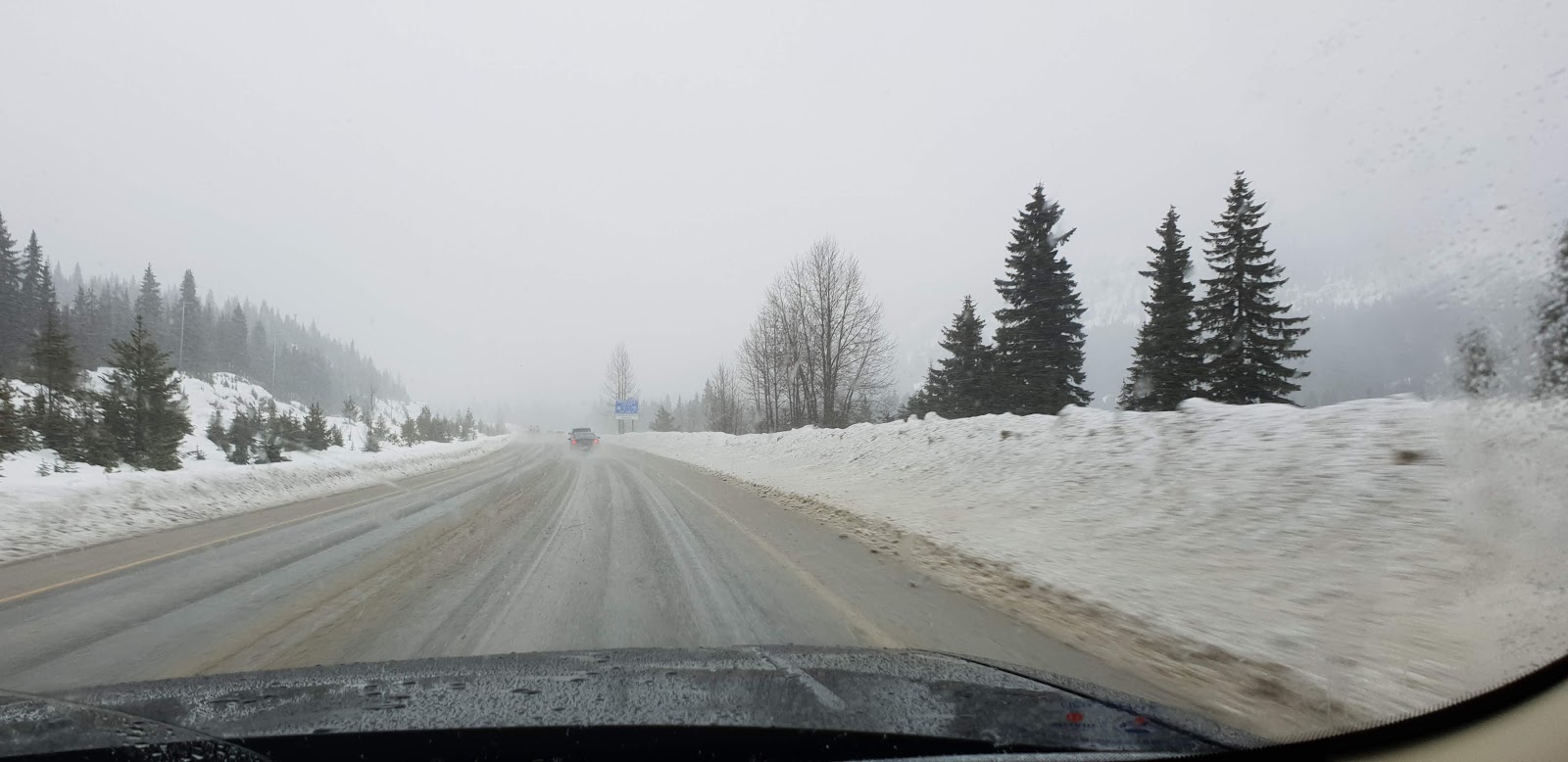
We finally leave the hotel at about half-past ten, and it is raining.  It is a simple task to get on Highway 1, the TransCanada Highway, initially, and then onto Highway 5, the Coquihalla Highway for the trip to Kamloops.

It rains all the way to the top of the mountain, progress hampered from time to time by water sprays from both vehicles and trucks.  The rain is relentless.  At the top of the mountain, the rain turns into snow and the road surface to slush.  It’s 0 degrees, but being the afternoon, I was not expecting it to turn to ice very quickly.

On the other side of the mountain, closer to Kamloops, there was sleet, then rain, then nothing, the last 100kms or so, in reasonably dry conditions.

Outside Kamloops, and in the town itself, there was evidence of snow recently cleared, and slushy roads.  Cars in various places were covered in snow, indicating the most recent falls had been the night before.

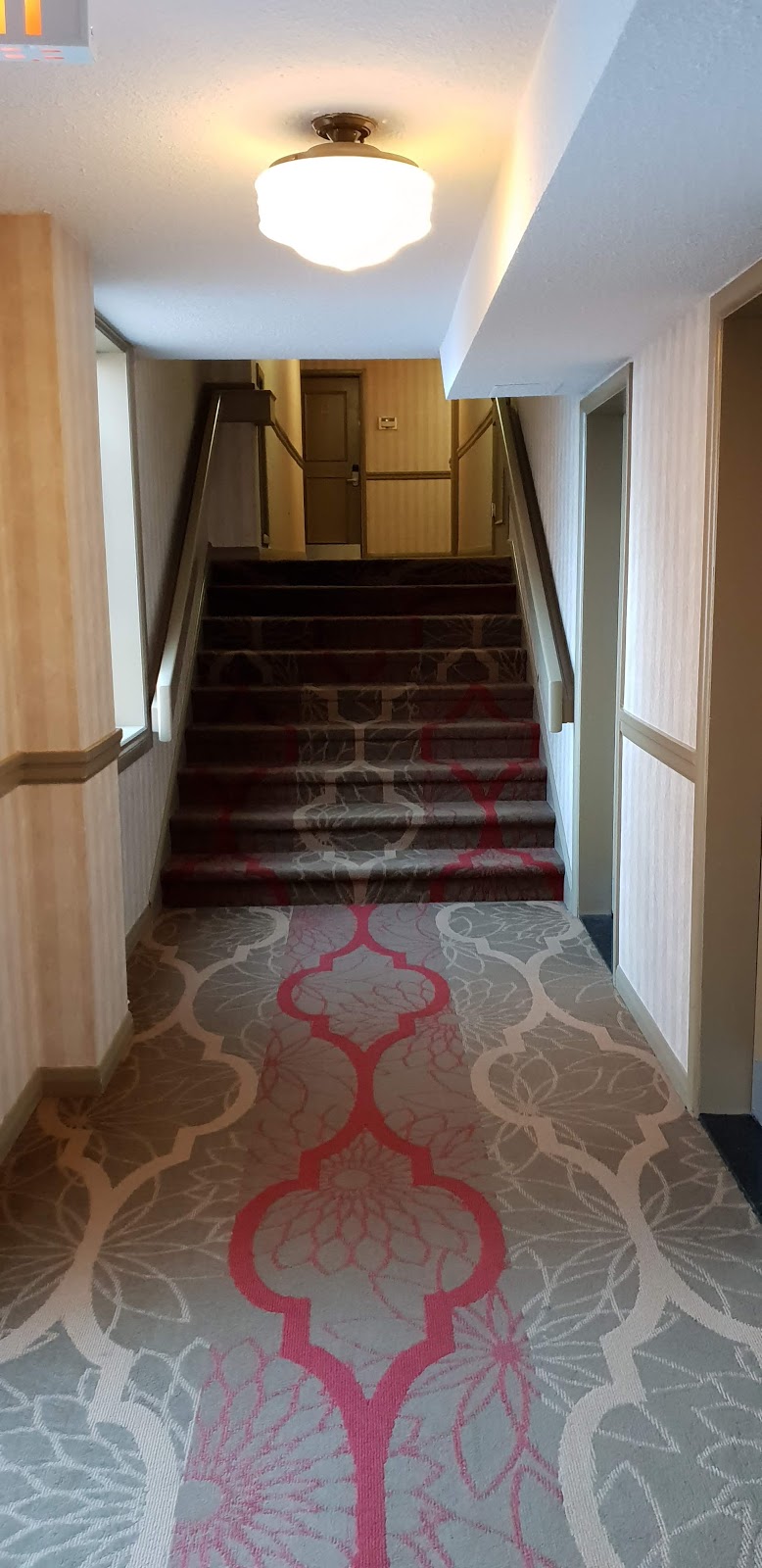
We’re staying at the Park Hotel, a heritage building, apparently built in the later 1920s.  In the style of the time, it is a little like a rabbit warren with passages turning off in a number of directions, and showing it is spread across a number of different buildings.

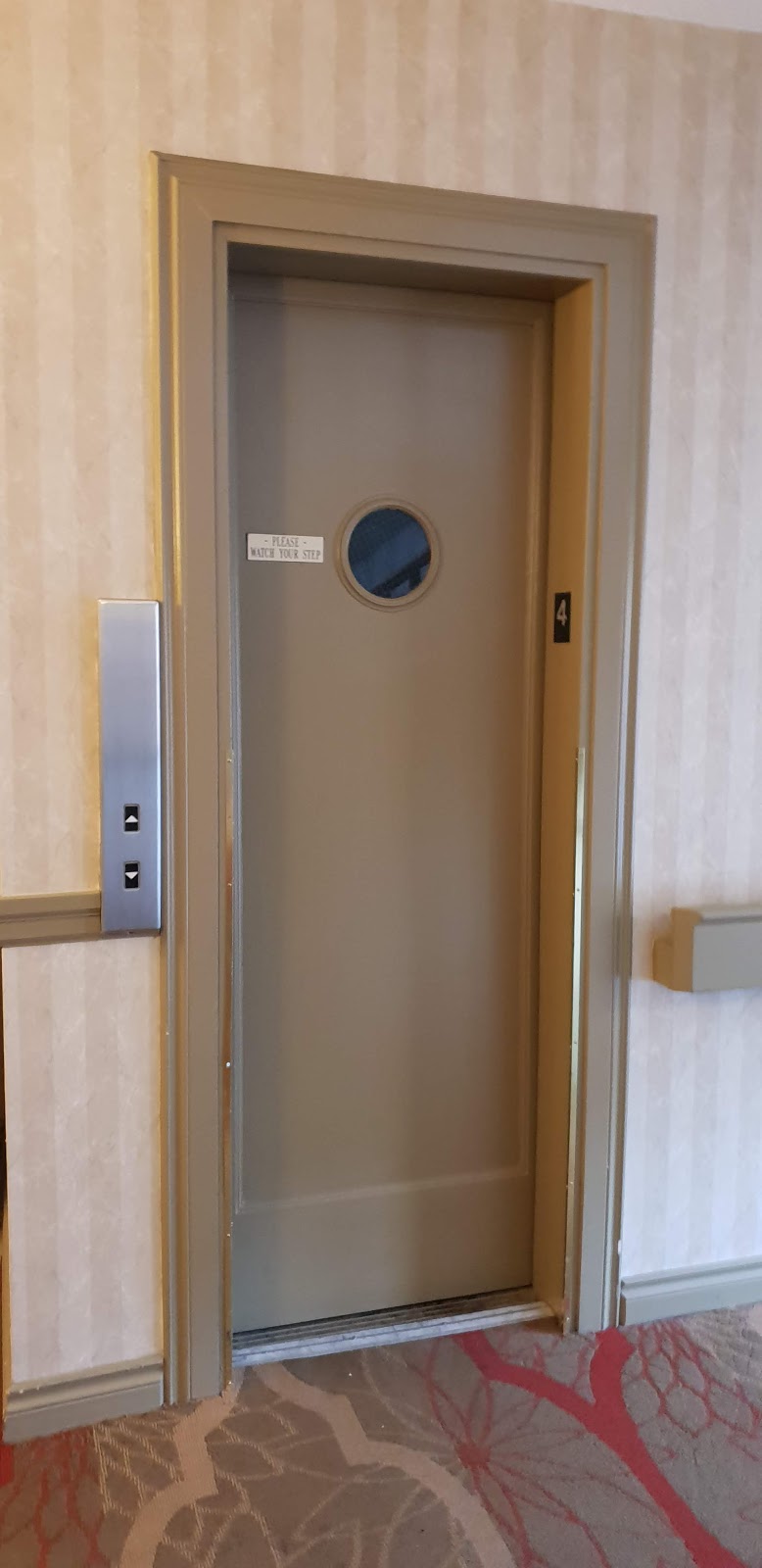
It has the original Otis elevator that can take a maximum of four passengers, and a sign on the wall that says “no horseplay inside the elevator” which is a rather interesting expression that only someone of my vintage would understand.  And, for those without a sense of humor, you definitely couldn’t fit a horse in it to play with.

The thing is, how do you find a balance between keeping the old world charm with modern-day expectations.  You can’t.  Some hotels try valiantly to get that balance.  Here, it is simply old world charm, which I guess we should be grateful for because sooner rather than later it’s going to disappear forever.

In my writer’s mind, given the importance of the railways, this was probably a thriving place for travelers, and once upon a time, there were a lot more hotels like this one.

The devil features prominently in a lot of sayings

For instance, I’ve heard someone mutter, “the devil you say…”

Or another, who was telling his friend, who, at the time was in a spot of bother, ‘You’re between the devil and the deep blue sea.”

Wrong.  We all know the sea is green, not blue.

But whatever the circumstances, the devil seems to pop up a lot.

For instance,

Better the devil you know than the devil you don’t.

It seems I’ve heard that somewhere before, or at least a part of it.  Hmmm.

Maybe you’ve “gone to the devil”.  Can that be paired with “going downhill at a rapid rate of knots”?

OK, it’s impossible to go downhill using the speed measure of knots, that only applies to boats, so who came up with that saying, a landlubber sailor?

Hang on, isn’t there a team called the New Jersey Devils?  Funny, I didn’t see if the players had horns or not, and they were using hockey sticks not tridents.

Maybe I misheard.

Neutral men are the devil’s allies, therefore there must be a lot of devils in Switzerland

The devil finds work for idle hands, oh yes, my grandmother used this often on me whenever she caught me doing nothing, or digging around in her magazine room … which was a lot

But my favorite,

When in hell, only the devil can show you the way out.

I’m still trying to find him!