This is not a treatise, but a tongue in cheek, discussion on how to write short stories. Suffice to say this is not the definitive way of doing it, just mine. It works for me – it might not work for you.
…
Now we have the where and the who. What’s the story going to be about?
I find inspiration in the most unlikely places.
Shopping malls are great, there is so many things going on, so many different types of people, there’s often enough to fill a journal.
Driving on the roads, you get to see some of the most amazing stunt driving, and it’s not even being filmed, it’s just playing out before your very eyes.
Waiting in hospitals, waiting for doctors, accountants, dentists, friends, hanging around coffee shops, cafes, bistros, restaurants, hotels, the list is endless.
But often a reliable source, the media and newspapers in particular, and a frequent go to, and the more obscure the headline the better. Then it’s simply a matter of letting your imagination run free, like:
Four deaths, four mysteries, all homeless.
This poses a few interesting scenarios, such as, were they homeless or were they made to look like they are homeless. If they are genuinely homeless how did they die? Are they connected in any way?
The point is, far from the original story that simply covers four seemingly random deaths, a writer can spin this into a thriller very easily.
It could follow a similar headline in another country where three headlines could be found, say, in London, where a man is found dead in an abandoned building, a week after he died, with no obvious signs of how he died.
A woman is killed in what seems, from the outset, an accident involving two cars, but the kicker is after three days, the driver of the second vehicle just simply disappears.
A man is reported missing after not reporting for work when he was supposed to return from a vacation in Germany.
And the third death, where an obscure piece says a man was found at the bottom of a mountain, presumed to have fallen in a climbing accident.
It’s all in the joining of the imaginary, yet possibly quite real, dots.
You could be on a train, and two people are acting oddly, note I didn’t say suspiciously, when going to or from work.
When on a holiday, you notice that a fellow hotel guest is in the same place at the same time every day but acting like he or she is waiting for someone or something. Then suddenly they’re not there.
But I’m not suggesting for a minute you should start investigating.
Just let the imagination work it’s tricks.
And, before you know it, you’re on that rollercoaster ride.
What happens when your past finally catches up with you?
Christmas is just around the corner, a time to be with family. For Will Mason, an orphan since he was fourteen, it is a time for reflection on what his life could have been, and what it could be.
Until a chance encounter brings back to life the reasons for his twenty years of self-imposed exile from a life only normal people could have. From that moment Will’s life slowly starts to unravel and it’s obvious to him it’s time to move on.
This time, however, there is more at stake.
Will has broken his number one rule, don’t get involved.
With his nemesis, Eddie Jamieson, suddenly within reach, and a blossoming relationship with an office colleague, Maria, about to change everything, Will has to make a choice. Quietly leave, or finally, make a stand.
But as Will soon discovers, when other people are involved there is going to be terrible consequences no matter what choice he makes.
Of course we all know this word is a colour, or color depending on where you live.You know, blue sky, deep blue sea, blonde hair blue eyes. Very descriptive.
But it can also mean you are down in the dumps, a rather strange, for some, expression that means you are sad or unhappy.
For others to have a blue means to have a fight with someone
And oddly, and I know this from first hand experience, that a red haired person will be called bluey, or less pleasing either carrot top or blood nut. I used to ignore those people who used those expressions, except for my father in law.
You can do something until you are blue in the face, which means do it without result until exhaustion, another way of saying your wasting your time.
And if something comes out of the blue, it usually means its entirely unexpected. For me, that’s always a bill I wasn’t expecting, for someone else an inheritance.
And in some parts of the world, blue is used as a synonym for conservative political party, for insistence, the Liberal party in Australia, and the Democrats in the United States
Blue should not be confused with the word blew, which is the past tense of blow, which is wind causing an air current, or blowing air through pursed lips.
That doesn’t mean that if something blew up it was just a giant air mass exploding because it can’t. If a bomb blew up it means it detonated.
And if that sounds complicated:
What if something blew my mind? Does that mean my head exploded? No, it just means its incomprehensible, whether good or bad.
Or
What if I blew a fortune on a three legged horse? We all throw good money after bad, but you can easily lose a fortune, or blew it.
Its the same thing with opportunities, for instance, he had a chance and he blew it. Yes, obviously something better came along, not, or he just ignored a sterling opportunity.
For a story that was conceived during those long boring hours flying in a steel cocoon, striving to keep away the thoughts that the plane and everyone in it could just simply disappear as planes have in the past, it has come a long way.
Whilst I have always had a fascination with what happened during the second world war, not the battles or fighting, but in the more obscure events that took place, I decided to pen my own little sidebar to what was a long and bitter war.
And, so, it continues…
—
I had to almost restrain Carlo from going up to the castle and singlehandedly kill everyone in it. I didn’t doubt he could do it, for a short time at least, until they realized what was going on. There were too many of them to take on alone.
It would need a careful plan, and knowledge of the layout of the castle, and the likely spots where the soldiers were located. It was a plan that had been slowly formulating in the back of my mind, especially after Carlo’s help with an internal map of the castle, some parts of which I hadn’t got to see in my brief stay.
I forgot that being built back in the middle ages, and the history of cities fighting against each other, there were ways in, out, and around, both inside and in the walls, so that soldiers could travel from one part of the castle to another without being seen, and not having to go inside the castle itself.
There were, also, tunnels, one of which I had inadvertently found, but there were more, and it seems only Carlo knew of those. Some were useful, others would lead to an early confrontation, and give early notice of our intentions. Those we would avoid, or use to escape.
We had set up a command center at the church ruins, having found several rooms off the cellar that had two exits. I didn’t like the idea of being trapped, nor waiting in a location that Fernando was familiar with and was likely to return to.
Which, in a sense, I was hoping he would because we had set a trap and he and his men would be caught in the crossfire. He was not going to get a chance to explain, nor would I ask any questions, or show him any mercy.
Especially when I found out what he had done to Martina. If it was as bad as Chiara, he would be repaid in kind, if the opportunity arose. I tentatively agreed to give Carlo five minutes in the room alone with him, but he knew that expediency might not give him that luxury. Blinky was not happy about it, but he hadn’t been here long enough to know what the man or his people were like.
We’d also worked out the surveillance system so that we would know when anyone turned up in the village, particularly our prized defector Meyer, and whether anyone left the castle to come down to the village because it was possible there would be more defectors passing through, and they needed to be warned.
What was particularly useful was finding the radio that Martina had been using. It was in the church grounds, which was not entirely unexpected, but one of Blink’s men had stumbled over it when looking to set up a latrine.
Blinky had brought a radioman, but his radio had been damaged in the parachute landing. Now he had a new toy to tinker with, and got a connection back to Thompson, after some initial difficulty in translation. That I could help him with, my Italian was marginally better than a schoolboy.
Thompson was relieved to hear from me, as I was to talk to him.
“It’s been difficult to get a clear picture with Martina, but I got the impression you had to be precise with your questions.”
“A case of getting lost in translation, perhaps.” I had not had similar problems, but Thompson was from the aristocracy, and his version of English was sometimes quaint.
“The situation is bad, I understand.”
“It is. The castle is over-run with British-German double agents. The three you sent out, and reinforcements that followed. I get the impression we have about 20 odd dead soldiers languishing in shallow graves somewhere on the Italian countryside.”
It hadn’t been hard to realize that while the officers were known British officers, the soldiers were substituted Germans whose English language and mannerisms were impeccable. I had no doubt once they’d reeled in Meyer, they would move on, integrating into invasion forces and creating havoc from within, unless of course, we stopped them.
A sigh at the other end, perhaps a lamentation of such needless loss of life. This war was getting tiresome for both of us.
“How close is Meyer? We last heard he was in Gaole, waiting for a courier to take him to the village. His arrival is anticipated to be any time from tomorrow onwards.”
“We’ve got men out keeping tabs on everyone.”
“Blinky arrive with his team?”
“All bar the radio, but as you can hear, we have access to one do it will not be a problem. I think we might finish this and talk again tomorrow. Don’t want the Germans tracking the radio waves.”
“Good. Tomorrow, and hour before today.”
I’d almost forgotten that the Germans were good at tracking radio signals, especially when they thought the enemy was using them, as those at the castle would. That radio unit could also be used to trace other radio signals, and no doubt they had picked up the signal. Hopefully, we had not been on long enough for them to run the trace.
That was not going to be a problem. One of Blinky’s soldiers on village reconnaissance was waiting for us as we approached the church ruins.”
“What is it, man?”
“There are four people at the village, looking for someone or something.”
“More defectors,” I said. “We’d better get to them before Leonardo and his men get to them first.”
So, the first treat for the day is the high-speed magnetic train, something we only learned about after arriving in China and was not on any of the pre-tour documentation.
The train line connects Shanghai Pudong International Airport and Longyang Road Station (in the outskirts of central Pudong). It is the oldest commercial maglev still in operation, and the first commercial high-speed maglev with cruising speed of 431 km/h (268 mph). At full speed, the journey takes 7 minutes and 20 seconds to complete the distance of about 30 km.
Construction of the line began on March 1, 2001 and public services commenced on 1 January 2004. It was built by a joint venture of Siemens and ThyssenKrupp from Kassel, Germany.
But, like visiting anything from a hotel, first we have to drive to the station and because we are leaving at 8, its peak hour traffic, and it takes 1 hour 10 minutes to get there.
The train also has a practical use and that is to take passengers from Shanghai to Pudong international airport as well as for those train enthusiasts, which is what we are.
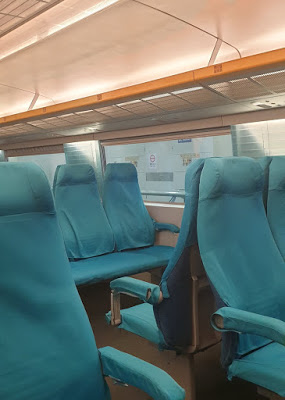
On the train, it has the same sleek look as the bullet trains, but it is completely different, and you are able to see from the front of the train to the back.
Reputed to travel at 431 kph we take a seat and it is not long before the doors shut, and a loud humming noise is soon replaced by what sounds like an engine, then we start moving. It sounds just like a normal train, and is a lot noisier than a normal bullet train.
Seating on the train was nothing special, as one might expect
It didn’t take long before it hits the advertised speed of 431 kph. This is not sustained for very long, because the distance is on 40 odd kilometers, and the whole trip takes about 7 minutes.
We go to the airport, and then we come back. Is it worth the price, yes. If you are a train enthusiast.
I’m back to writing, sitting at the desk, pad in front of me, pen in hand.
The only thing lacking, an idea.
It’s 9:03 am, too early to start on a six-pack.
To be honest, the last thing I needed was a distraction, and, having forgotten to put my cell phone on silent, it starts buzzing, indicating there are new messages, or notifications from all those social media sites like Twitter, Facebook, WordPress, Blogger…
Then the advice from all the so-called marketing gurus starts to swirl around in my head, and instead of writing, I’m now fretting over my social media presence.
The more I read the more it bothers me that if I don’t have the right social media presence if I do not start to build an email list, all of my efforts in writing a book will come to naught.
That’s when I start trawling the internet for information on marketing and found a plethora of people offering any amount of advice for anything between a ‘small amount’ to a rather large amount that gives comprehensive coverage of most social media platforms for periods of a day, a week or a month.
I move on to the people who offer advice for a cost on how to build a following, how to build a web presence, how to get a thousand Twitter followers, how to get thousands of email followers before the launch.
The trouble is I’m writing a novel, not a nonfiction book, or have some marvelous 30-page ebook on how to do something, for free just to drive people to my site.
I’m a novelist, not a handyman so those ideas while good is not going to help me.
Yet another problem to wrestle with along with actually creating a product to sell in the first place.
Except I’m supposed to be writing for the love of it without the premeditated idea of writing for gain or getting rich quick.
What am I missing here?
So should l be writing short stories and offering them for free to drive people to my site? These would have to be genre-specific so it needs time and effort and fit into a convenient size story that will highlight or showcase my talent.
Some time ago I created a website on one of those so-called free sites, but it’s rather basic and not great. Of course, if I want it to be better, all I have to do is hand over a great wad of money I don’t have to make it better. So much for free!
I don’t think I will have a good night’s sleep again with all of these social media problems I’m having.
Oh well, back to the book. It’s time to have a nightmare of a different sort!
I am constantly reminded of how curious grandchildren can be when they are not asking you what it was like to live with dinosaurs!
The second eldest who is a rather clever 15-year-old considers it interesting that I’m a writer, and having just met a ‘real’ author who came to visit them at school, asked me a few questions, some of which sounded like those that had been asked of my ‘real’ counterpart.
Like, “how old were you when you first wrote a story, and what was that story about?”
I didn’t think it was when I was at school, but sometime after that, and after a lot of reading. Perhaps it had been one of those moments when a light bulb goes on in your head, and I said to myself, I can write these stories too.
Of course, that wasn’t an answer, so she asked again, when did I start writing?
That required a little thought, and there were several triggers that gave me a date, where I lived at the time, the fact I used my mother’s old portable typewriter, and the fact I had not been long out of school. I was, in fact, about 17. It was 45 years ago; I’ll let you do the math!
What was it about; that I couldn’t tell her, but I said I had rescued a lot of old scribbling of mine and put them in a box to look at later when I had the time.
I guess that time had arrived.
And, yes, there was the book, the individually typed pages, some with corrections, unfinished.
The pages were brown with age.
The story, well, I read the first few pages, and it seems I’d started down the thriller path then, the story so far, an agent comes ashore from a trawler to a bleak and isolated village, perhaps on the Scottish coast.
Then there was the inevitable next question; “What was the first story you read that put you on the path to wanting to become a writer”.
That was easy, Alistair Maclean’s HMS Ulysses. I showed her a copy of the book.
That led to, “but this is about the British Royal Navy in World War 2…”
Perhaps I didn’t answer that correctly, it was after reading about a dozen of his novels, most of which were precursors to the modern-day thriller, perhaps more along the lines of action adventures.
The next question, understandably; “What was the first book you ever finished?”
That was The Starburst Conspiracy, the manuscript of which was in the box along with another completed novel, and quite a few short stories.
Back in those days, I remembered that I had sent some of my stories off to various publishers, and had entered a number of short story competitions, all to no avail. And for a number of years, until I because to old, used to write and enter a novel in the Vogel novel competition but never made it to the shortlist.
It’s probably why I gave up writing for a number of years, until I worked for an interesting company who had a rich history of phosphate mining in the Pacific and being given permission to look into the archives, began writing what could only be described a saga, and by the time I’d left, it was over 1200 closely typed pages long.
I showed the bulky manuscript to her, but by this time her interest had moved to something else.
For me, however, it seemed there was a lot of unfinished business.
Every time I close my eyes, I see something different.
I’d like to think the cinema of my dreams is playing a double feature but it’s a bit like a comedy cartoon night on Fox.
But these dreams are nothing to laugh about.
Once again there’s a new installment of an old feature, and we’re back on the treasure hunt.
—
Here’s the thing. Should I tell Boggs about the Ormiston’s?
Should I tell him that there was more than one lake?
Should I wait until I’d looked at the information that had been stored away? From the way Gwen was talking, no one had looked at Ormiston’s papers since the day they were deposited in the library, except perhaps Gwen herself.
And it helped that Gwen would not give any meaningful assistance to Alex Benderby or any of his cohorts. It seemed all she had given them was the briefest outline of the Ormiston story. She obviously didn’t mention that Ormiston had left anything behind.
Two tasks that I added to a list were, firstly, to start looking at old newspaper archives in the area for anything on Ormiston’s fruitless searches for the treasure, and find out, if possible, whether he works with a map of any sort. Nadia had mentioned the possibility of the pirate captain keeping a journal. Had he seen it, even owned it one time?
There was also the impression that Boggs’ father was not the only one involved with searching for the treasure. He had a map and it looked quite old. Was it possible it had been handed down from father to son, and just to take it a little further, had Ormiston and Boggs’ grandfather been rivals or cohorts? Indeed, a question for Boggs when I saw him.
Secondly, I would have to go around the various churches in the county and see what I could find about Ormiston’s relations. I would not be the only one, Alex would have people out there now doing just that. Whilst that information would be available at the County’s capital, but I knew from experience when I was looking into my own family’s history, getting information out of them was costly and time-consuming.
That was for my own family. Looking for someone else would, no doubt, be might in impossible, considering privacy regulations. There was more chance of gleaning information from tombstones in church graveyards the getting it from the local government.
It was a thought consuming exercise, considering everything after just a short talk with Gwen, and, about to cross a road to retrieve my bicycle, two things happened. The first, I was nearly run over and had only a blaring horn scaring me half to death as a timely warning, and second, the chance sighting of what looked like a man following me. He thought he’d managed to duck out of the way quick enough, but he hadn’t. It was the red check shirt that gave him away. Perhaps if he had been dressed more conservatively, I might have missed him.
I should have remembered that Alex wanted both me and Boggs followed.
Now he would know I went to the library, and if anyone asked, I hoped Gwen would not give away what we had been talking about.
It brought up another moment, one that sent a shudder through me. Had he seen me come and go to Nadia? I hadn’t seen anyone, and I was careful in both coming and going.
Now I would have to be even more careful.
As I checked before crossing the road towards the bicycle rack, I saw the man again, not exactly trying to hide the fact he was following me. At least I now had an advantage.
I delayed the arrival home until I knew my mother would have left for work. I’d worry about explaining myself to her later.
Boggs was waiting for me, sitting on the front steps to the house, absorbed by a new game on his phone. He looked up as I dropped my bike on the ground. I’d need it soon to go to work, and it was easier just to leave it outside the front door.
He had as combative look on his face, the sort he wore when things weren’t going his way. I was not sure if there was anything more I could have done for him. For a few years now, I had tried to be the best friend I could, and in the circumstances, I tried to be there for him. It was not as if I didn’t share his situation also being without a father, but the way in which we lost him was not the same as Boggs.
Perhaps in the last few days, or weeks, I’d changed a little, getting a job, whereas Boggs had no interest in doing so, and interacting with more and different people. Even just being with Nadia, even though it was a very bad idea, made a difference.
It was time that Boggs grew up and started taking some responsibility. It was just a case of I not wanting to be the one to tell him. So, in the meantime, I would just have to tolerate his attitude.
“What was more important than going to check on the other river.”
He decided to tackle me head-on. The truth is I forgot we were supposed to be going there this morning. It would not have happened if I hadn’t stayed with Nadia, but I wasn’t going to be able to use her as an excuse.
I decided to be nice and deflect his implied criticism. “Hello, and how are you?”
“Yada, yada. Now that you have a job, we have only a few hours every day to get stuff done. I could do this on my own, but I thought you would like to be included. In fact, you said that you needed something to liven up what was a very dull existence.”
I had, but that was before I got the job.
“Maybe you should try and get a job too. I’m sure that the treasure is not likely to be going anywhere.”
“You can’t be sure that Benderby or the Cossatino’s are not hot on the trail right now. Unless you saw something last night to the contrary.”
I was hoping he wouldn’t bring that up. No such luck. “Alex is going around in circles, and I’m not sure what the Cossatino’s think because they originally came up with the idea of selling fake maps which means they have no real idea where it is, a fact you told me.”
“Be that as it may for the Cossatino’s, but Alex is no fool.”
“Alex is a fool, Boggs. He was a fool as school, and just little more than a thug in a suit now. And like the people he hangs out with, and like Vince, if you look closely, they all lack the acumen of their fathers, and they are not necessarily running point for their families, I suspect neither Alex nor Vince had told their respective fathers of what they’re up to.”
That mollified him a little, but he was still looking combative.
“We still should be concentrating our efforts.”
“Well in that respect I have been doing some digging. What do you know about a man called Ormiston?”
“Sunday in New York” is ultimately a story about trust, and what happens when a marriage is stretched to its limits.
When Harry Steele attends a lunch with his manager, Barclay, to discuss a promotion that any junior executive would accept in a heartbeat, it is the fact his wife, Alison, who previously professed her reservations about Barclay, also agreed to attend, that casts a small element of doubt in his mind.
From that moment, his life, in the company, in deciding what to do, his marriage, his very life, spirals out of control.
There is no one big factor that can prove Harry’s worst fears, that his marriage is over, just a number of small, interconnecting events, when piled on top of each other, points to a cataclysmic end to everything he had believed in.
Trust is lost firstly in his best friend and mentor, Andy, who only hints of impending disaster, Sasha, a woman whom he saved, and who appears to have motives of her own, and then in his wife, Alison, as he discovered piece by piece damning evidence she is about to leave him for another man.
Can we trust what we see with our eyes or trust what we hear?
Haven’t we all jumped to conclusions at least once in our lives?
Can Alison, a woman whose self-belief and confidence is about to be put to the ultimate test, find a way of proving their relationship is as strong as it has ever been?
When it came to holidays, I preferred to get as far away from everyone as possible.
I saw my parents, and sister who lived with them, every week on Sunday, for lunch and cross-examination of why I was not married with children yet.
Explaining I was only 27 was not a reason because, “your brother married at 21 and he’s got three children, a great job, his own house..” and in and on it went.
And I saw my brother every other Saturday just to tell him that I was Ok. He was considerate in one sense, it was just the matchmaking wife always inviting what she considered suitable women for me.
That fortnight off work was an oasis in a desert full of well-meaning people.
I’d tried dating several girls at work, but they never got past the family inquisition. If I had been in their shoes I’d just say it was all too much too. The lesson I learned there was to never take a girlfriend home.
But, for now, I was footloose and fancy-free. The most recent girl I’d met had decided to return home, no it was nothing I’d done wrong, but I guess it was. Perhaps asking to go with me to Hawaii was a bit too forward too soon. Another lesson learned.
I think I’d probably get it right by the time I was fifty.
So here I was, a history buff, looking to further my knowledge of the events surrounding Pearl Harbour. I’d read a great many history books on the subject, and now, it was a matter of going there, and getting a feel for the place.
More than once I had lamented the fact I could not go back in time and live through the event. I had mentioned this once to a friend, and he asked if I was stark staring mad.
Of course, he was right. Who would want to be in the middle of such a violent attack, especially when it came largely by surprise?
Since my work required mt to fly a lot I had sufficient frequent flyer points to upgrade to first class. I was hoping after flying coach for so long, I’d notice the difference.
Certainly, the initial service after being shown my seat, and the champagne soon after as a welcome onboard, set the tone.
When the door closed, and everyone was on board, only half the seats in first class were taken. A glance at those who were fellow travelers showed an interesting cross-section. A husband and wife who definitely upgraded from coach like me, but were a little m less refined. An executive and his personal assistant, who, judging by the way she looked after him, there was more to that relationship, a woman in her sixties, definitely born to money, and casting somewhat distasteful stares at the upgrade couple, and a woman about my age, who looked very unhappy.
I managed to fit in another glass of champagne before the plane reached the runway.
Then, with a roar of the engines, we were off.
Halfway through the 13-hour flight, I found it impossible to sleep, even with the luxury first-class provided me. I just couldn’t sleep on planes. Instead, I sat up, found a book of crosswords, one of three or four I always had with me and usually got to solve one or two puzzles.
It was quiet and still except for the noise of the air rushing past outside the plane. In that almost soundless atmosphere, I thought I could detect any changes in engine speed or the gentle movement of a change of course. The ride was quite smooth, except for some turbulence and the pilot took us up another 2,000 feet to escape it. We’d been slowly coming back down over the last hour. I’d been monitoring it on the flight path screen. It might be a larger screen, but watching movies was, to me, boring, except in a cinema.
“Can’t sleep either?”
It was the soft voice of the girl from two seats across. She had several revolutions of the plane, exercising I heard her explain to the cabin crew because she couldn’t sit down for long periods.
“Not on planes, no. Trains, yes, ships yes.”
“Crossword fanatic?”
I saw her glance down towards the book. “Not really. This has been floating around for about 10 years, and I drag it out as a last resort.”
“I try reading. It doesn’t help. Where are you going, if you don’t mind me asking?”
“Oahu. Doing the whole Pearl Harbor history experience. And just laze around for a few days before going back to work.”
“New York?”
“Yonkers, upstate. Are you from New York?”
“My family is. I work in San Francisco, come over once a year, but this year I got sick of them early, so I just jumped on the first plane out that had a first-class berth. It was this one. I’ll let you get back to your crossword.”
I was going to say it wasn’t a problem, but she had gone back to her seat. A moment later our cabin attendant, Lucy, came over to deliver a glass of champagne, then came over to me. I hadn’t seen the second glass on the tray. “Miranda thought you might like a glass too.”
I looked over to nod a thankyou, but she was looking out the window. There wasn’t much to see as it was dark and most of the passengers had the shades down.
Then, just as Lucy turned to leave, the plane hit more turbulence. A second, maybe two, later the seatbelt sign went on, just as the co-pilot came on the speaker system to advise all cabin crew to sit down and belt up.
A minute later what sounded like a large bang, one I would have said was an engine exploding, made everyone jump in their seats, to be quickly followed by a sudden jerk to the right that was almost instantly corrected, but that was not the worst of it, equally suddenly the plane started to descend. Very quickly.
At the same moment, the masks dropped down from overhead, I grabbed it and fumbled putting it on, realizing that panic was setting in. It took a minute, but then it didn’t seem like there was any air flowing through it.
Not that any of that mattered. Starved of oxygen, I could feel myself losing consciousness. A minute or so later, I think the plane had started to level off, and a look at the flight path showed we were down to 10,000 feet, in the middle of the ocean. My last thought, how long we would survive if we ditched.
I felt a hand on my shoulder shaking me.
“Sir, sir, are you alright?”
I opened my eyes and blinked several times. I had to be in the middle of a nightmare.
The first thing I noticed was the engine noise, it was very loud, the loudness that came from propeller engines. The second, I was no longer on an Airbus A330. This was more like a Boeing 314, a flying boat. The third, the man shaking me awake was a steward in a white coat, with PanAm on it.
Where the hell was I. No, when the hell was I. What the hell had happened?
“Sir, there’s a message for you.” He handed me a folded sheet of paper. “The captain asked me to tell you we’ll be landing in an hour, and that you, we all, should be prepared. It’s a mess.”
“What is?”
“Pearl Harbour. It was attacked yesterday morning by the Japs. Bastards came in and practically blew everything up.”
All of a sudden there was a roaring sound outside the plane, followed by what had to be the chatter of a machine gun, followed by the sound of bullets hitting the fuselage. One minute the steward was standing next to me, the next he was a bloody heap on the floor. Above my head was a line of bullet holes. More machine gun chatter, then an explosion, followed by a cry behind me of, “got the zero.”
I got out of the seat and went to the steward, staring at me with lifeless eyes. A quick check for a pulse told me he was dead. When I looked behind me there were a dozen or so military men, army, and navy. Two sailors came up and gently maneuvered the steward towards the rear of the aircraft. He had been the only casualty. Turning back towards my seat I caught a reflection of myself in the window, that of a Lieutenant in the Navy. How, and why was I here, now?
I remembered the note the steward had given me, sat down, and unfolded it.
The receipt date was 3:00 pm on 8th December 1941. It was addressed to me, that is, a man with my exact name. Orders to report to an Admiral who would reassign me, the ship I was being sent to had been sunk, and likely not to see service again.
We’d been in the air at the time of the attack, and I guessed news would have been sent to the plane, just in case it was not safe to land. Perhaps they hadn’t counted on try Japanese Zero fighters hanging around for just such a flight as ours.
Whatever the reason I was here, however it had happened, I would have to make the most of it.
Only then did I remember what I had once said, ‘if only I could go back’.
Once again I felt a hand on my shoulder, and a voice, this time of a woman, gently shaking me awake.
“We’re arriving in Honolulu in about 40 minutes. You need to prepare for landing.”
At the same time, I heard a change in the engines as we began to descend. I looked around. More familiar surroundings, back on the A330, the quiet hum of jet engines, and the sight of familiar faces.
“Did something happen to the plane or was I imagining it?”
“Just a lightning strike. We had to go down for a bit, but these planes are designed to handle just about anything. You slept through it, the best thing to do in situations like that.”
OK. It had to be a dream. That’s all I could put it down to. Except for one small detail. My grandfather’s name was the same as mine, he was in the Navy during World War 2, and he had been sent out to Pearl Harbour and was en-route when it happened. But there was only one slight difference. He had been killed when the lone zero had struck, not the steward.





 Thrills, Spills, and just a dash of Romance