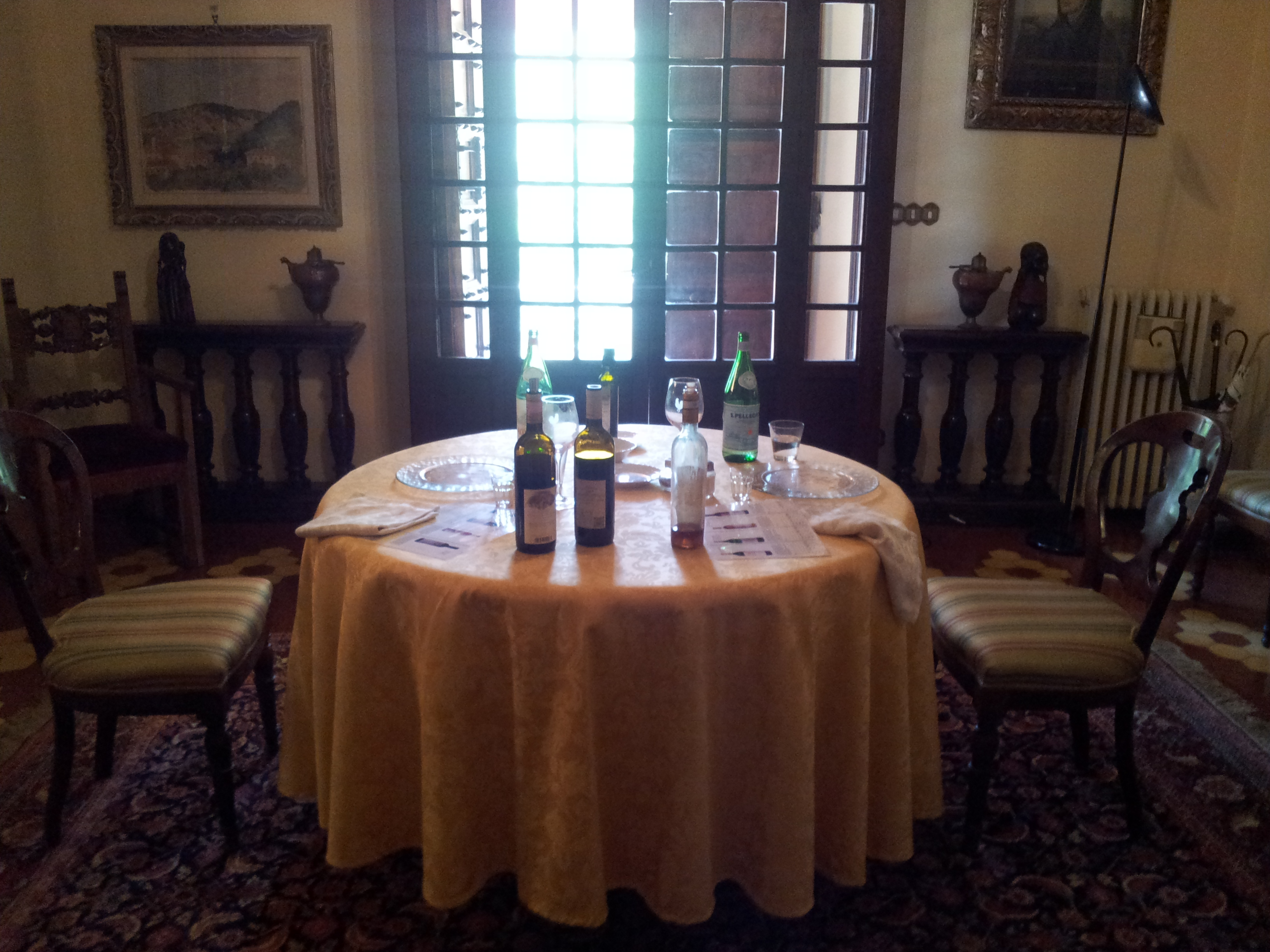
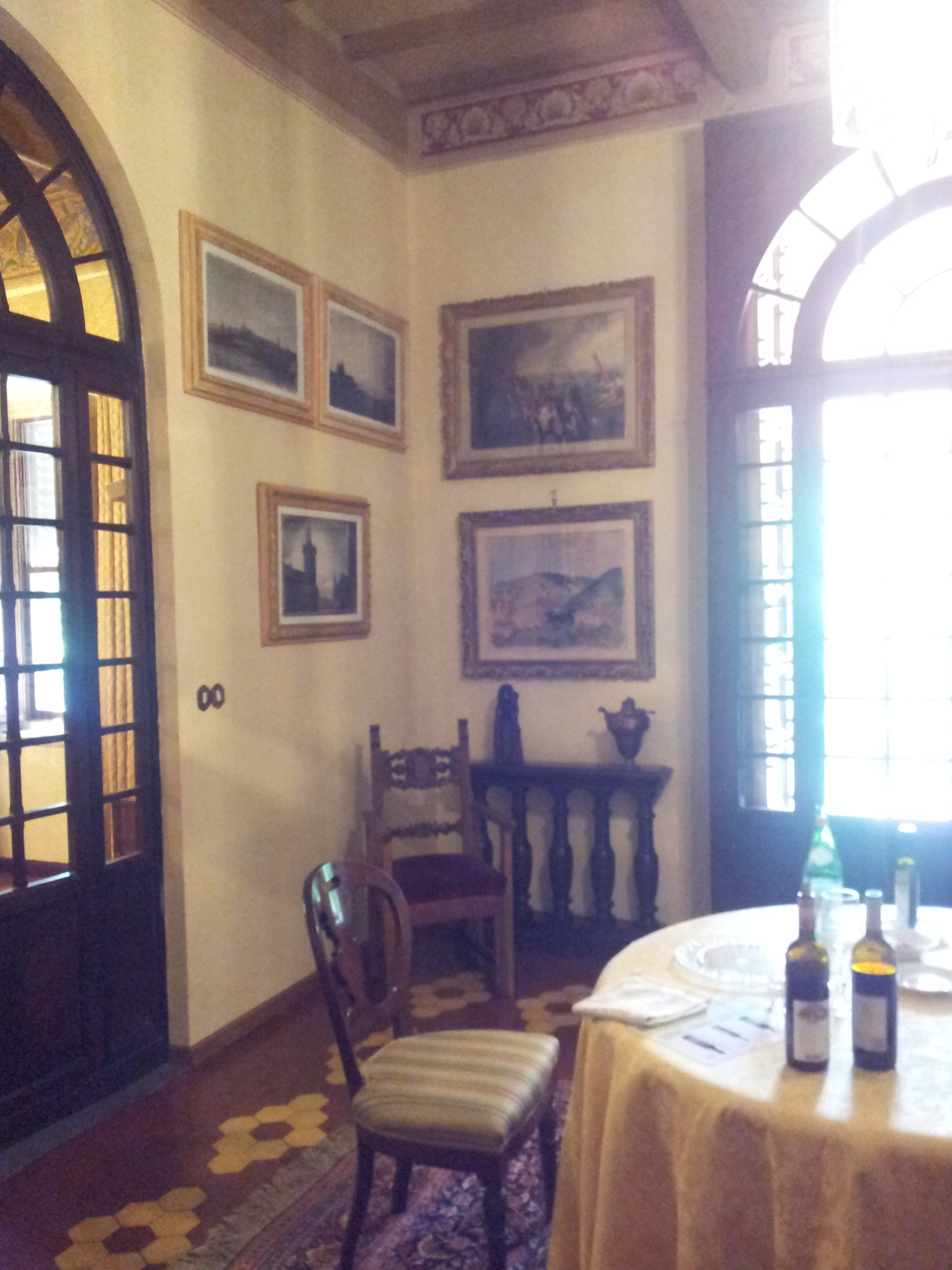
Searching for locations: Castello di Monterinaldi, Tuscany, Italy

As part of a day tour by Very Tuscany Tours, we came to this quiet corner of Tuscany to have a look at an Italian winery, especially the Sangiovese grapes, and the Chianti produced here.

And what better way to sample the wine than to have a long leisurely lunch with matched wines.  A very, very long lunch.

But first, a wander through the gardens to hone the appetite:

2013-06-18 11.56.18
2013-06-18 11.56.32
2013-06-18 11.56.51

And a photo I recognize from many taken of the same building:

2013-06-18 11.57.26

Then a tour of the wine cellar:

2013-06-18 11.50.08
2013-06-18 11.52.08

Then on to the most incredible and exquisite lunch and wine we have had.  It was the highlight of our stay in Tuscany.  Of course, we had our own private dining room:

2013-06-18 13.22.40

And time to study the paintings and prints on the walls while we finished with coffee and a dessert wine.

2013-06-18 13.23.15

And of course, more wine, just so we could remember the occasion.

Travelling after a pandemic: Destination Hobart

Hobart in June – Winter – Day 6 – Thursday

The next day we try a different fish and chips vendor.  It was a good idea to go back to Mures and have the flathead, but I was foolish and wanted a different experience

And not be disappointed.

In the end, we selected Fishy Business

This order comprised battered flake, battered flathead, hoping that it would be similar to yesterday, sea scallops in batter, chips, two potato cakes, and tartar sauce.

The battered flake was excellent.

The battered flathead was scraps, three small pieces which were probably imported from Vietnam, definitely not fresh or local and, sadly, terrible.

The scallops were delicious.

The potato cakes were alright, but not strictly potatoes cakes, but the sort you get from a supplier.  The real potato cakes game batter around a thin slice of potato.  They had mashed potatoes, and the batter was not very nice.

For the price we paid, it was enough to say I’d never go back there again.  You’d think as a place on the sea they could get it right, making the food themselves, but it gets a mega fail.  Only the flake was definitely local.

Maybe next time we’ll try Flippers.

Maybe.

There were other sights and on the obligatory walk after eating, we came across a sailing ship

This ship is called the Windeward Bound,  a two-masted brigantine-rigged vessel, and for the sailing buffs, Windeward Bound is rigged with four square sails, three headsails, three staysails between the masts, a gaff mainsail and gaff topsail, totalling 12 sails in all. The total sail area is 402 m2 (4,330 sq ft)

Later we visited the Mawson Hut Replica Museum, and it is authentic in almost every detail. And amazing that 17 men could actually stay together in it and not feel claustrophobic.

It was an eerie experience, and extremely interesting. I could not imagine myself staying in it down in Antarctica, in the freezing conditions.

Memories of the conversations with my cat – 7

As some may be aware, but many not, Chester, my faithful writing assistant, mice catcher, and general pain in the neck, passed away some months ago.

Recently I was running a series based on his adventures, under the title of Past Conversations with my cat.

For those who have not had the chance to read about all of his exploits I will run the series again from Episode 1

These are the memories of our time together…

20160917_075236-1

This is Chester.  He’s been caught almost red-handed climbing the curtains.

Of course, he is all innocence, because the evidence is circumstantial.  He was sitting on the window ledge looking out, thinking ‘if only I could get out there’.

Now he’s thinking how much trouble he’s in and whether it will be his least favorite cat food for dinner.

No, I’m not that mean.

Not unless I catch him red-handed.

‘Sunday in New York’ – A beta reader’s view

I’m not a fan of romance novels but …

There was something about this one that resonated with me.

This is a novel about a world generally ruled by perception, and how people perceive what they see, what they are told, and what they want to believe.

I’ve been guilty of it myself as I’m sure we all have at one time or another.

For the main characters Harry and Alison there are other issues driving their relationship.

For Alison, it is a loss of self-worth through losing her job and from losing her mother and, in a sense, her sister.

For Harry, it is the fact he has a beautiful and desirable wife, and his belief she is the object of other men’s desires, and one in particular, his immediate superior.

Between observation, the less than honest motives of his friends, a lot of jumping to conclusions based on very little fact, and you have the basis of one very interesting story.

When it all comes to a head, Alison finds herself in a desperate situation, she realises only the truth will save their marriage.

But is it all the truth?

What would we do in similar circumstances?

Rarely does a book have me so enthralled that I could not put it down until I knew the result. They might be considered two people who should have known better, but as is often the case, they had to get past what they both thought was the truth.

And the moral of this story, if it could be said there is one, nothing is ever what it seems.

Available on Amazon here: amzn.to/2H7ALs8

An excerpt from “Betrayal” – a work in progress

It could have been anywhere in the world, she thought, but it wasn’t.  It was in a city where if anything were to go wrong…

She sighed and came away from the window and looked around the room.  It was quite large and expensively furnished.  It was one of several she had been visiting in the last three months.

Quite elegant too, as the hotel had its origins dating back to before the revolution in 1917.  At least, currently, there would not be a team of KGB agents somewhere in the basement monitoring everything that happened in the room.

There was no such thing as the KGB anymore, though there was an FSB, but such organisations were of no interest to her.

She was here to meet with Vladimir.

She smiled to herself when she thought of him, such an interesting man whose command of English was as good as her command of Russian, though she had not told him of that ability.

All her knew of her was that she was American, worked in the Embassy as a clerk, nothing important, who life both at work and at home was boring.  Not that she had blurted that out the first tie she met, or even the second.

That first time, at a function in the Embassy, was a chance meeting, a catching of his eye as he looked around the room, looking, as he had told her later, for someone who might not be as boring as the function itself.

It was a celebration, honouring one of the Embassy officials on his service in Moscow, and the fact he was returning home after 10 years.  She had been there one, and still hadn’t met all the staff.

They had talked, Vladimir knew a great deal about England, having been stationed there for a year or two, and had politely asked questions about where she lived, her family, and of course what her role was, all questions she fended off with an air of disinterested interest.

It fascinated him, as she knew it would, a sort of mental sparring as one would do with swords, if this was a fencing match.

They had said they might or might not meet again when the party was over, but she suspected there would be another opportunity.  She knew the signs of a man who was interested in her, and Vladimir was interested.

The second time came in the form of an invitation to an art gallery, and a viewing of the works of a prominent Russian artist, an invitation she politely declined.  After all, invitations issued to Embassy staff held all sorts of connotations, or so she was told by the Security officer when she told him.

Then, it went quiet for a month.  There was a party at the American embassy and along with several other staff members, she was invited.  She had not expected to meet Vladimir, but it was a pleasant surprise when she saw him, on the other side of the room, talking to several military men.

A pleasant afternoon ensued.

And it was no surprise that they kept running into each other at the various events on the diplomatic schedule.

By the fifth meeting, they were like old friends.  She had broached the subject of being involved in a plutonic relationship with him with the head of security at the embassy.  Normally for a member of her rank it would not be allowed, but in this instance it was.

She did not work in any sensitive areas, and, as the security officer had said, she might just happen upon something that might be useful.  In that regard, she was to keep her eyes and ears open, and file a report each time she met him.

After that discussion she got the impression her superiors considered Vladimir more than just a casual visitor on the diplomatic circuit.  She also formed the impression the he might consider her an ‘asset’, a word that had been used at the meeting with security and the ambassador.

It was where the word ‘spy’ popped into her head and sent a tingle down her spine.  She was not a spy, but the thought of it, well, it would be fascinating to see what happened.

A Russian friend.  That’s what she would call him.

And over time, that relationship blossomed, until, after a visit to the ballet, late and snowing, he invited her to his apartment not far from the ballet venue.  It was like treading on thin ice, but after champagne and an introduction to caviar, she felt like a giddy schoolgirl.

Even so, she had made him promise that he remain on his best behaviour.  It could have been very easy to fall under the spell of a perfect evening, but he promised, showed her to a separate bedroom, and after a brief kiss, their first, she did not see him until the next morning.

So, it began.

It was an interesting report she filed after that encounter, one where she had expected to be reprimanded.

She wasn’t.

It wasn’t until six weeks had passed when he asked her if she would like to take a trip to the country.  It would involve staying in a hotel, that they would have separate rooms.  When she reported the invitation, no objection was raised, only a caution; keep her wits about her.

Perhaps, she had thought, they were looking forward to a more extensive report.  After all, her reports on the places, and the people, and the conversations she overheard, were no doubt entertaining reading for some.

But this visit was where the nature of the relationship changed, and it was one that she did not immediately report.  She had realised at some point before the weekend away, that she had feelings for him, and it was not that he was pushing her in that direction or manipulating her in any way.

It was just one of those moments where, after a grand dinner, a lot of champagne, and delightful company, things happen.  Standing at the door to her room, a lingering kiss, not intentional on her part, and it just happened.

And for not one moment did she believe she had been compromised, but for some reason she had not reported that subtle change in the relationship to the powers that be, and so far, no one had any inkling.

She took off her coat and placed it carefully of the back of one of the ornate chairs in the room.  She stopped for a moment to look at a framed photograph on the wall, one representing Red Square.

Then, after a minute or two, she went to the mini bar and took out the bottle of champagne that had been left there for them, a treat arranged by Vladimir for each encounter.

There were two champagne flutes set aside on the bar, next to a bowl of fruit.  She picked up the apple and thought how Eve must have felt in the garden of Eden, and the temptation.

Later perhaps, after…

She smiled at the thought and put the apple back.

A glance at her watch told her it was time for his arrival.  It was if anything, the one trait she didn’t like, and that was his punctuality.  A glance at the clock on the room wall was a minute slow.

The doorbell to the room rang, right on the appointed time.

She put the bottle down and walked over to the door.

A smile on her face, she opened the door.

It was not Vladimir.  It was her worst nightmare.

© Charles Heath 2020

The cinema of my dreams – I always wanted to write a war story – Episode 30

For a story that was conceived during those long boring hours flying in a steel cocoon, striving to keep away the thoughts that the plane and everyone in it could just simply disappear as planes have in the past, it has come a long way.

Whilst I have always had a fascination with what happened during the second world war, not the battles or fighting, but in the more obscure events that took place, I decided to pen my own little sidebar to what was a long and bitter war.

And, so, it continues…


It was a good plan.

Wallace, once he discovered his search team had gone missing would send another group to find them, and we would dispatch them in the same manner.

Each foray would reduce his group at the castle until it became, for us, a manageable size.  Currently, it was 35, with four already killed.  There was also the Leonardo factor, and his men, according to Martina, numbered seven.

If I was Wallace, who would realize once he discovered the body on the road to Chiara’s, that sending his own men out to be picked off was a bad idea, would eventually send Leonardo and his men as the first foray to resolve the problem.  

That, of course, would present the same problem as Wallace’s men, there would be deadly retribution.  The villages had all hated Leonardo, and he had dislike them for not selecting him as the local head of the resistance.  That had fallen to Martina, a more popular person, and one more capable.

It seemed to me, from what she had told me, Leonardo was more a mercenary, one who would work for the highest bidder, and that was the sort of man Wallace would have no trouble employing.

Martina was right to round up the villagers to keep them safe

But, for Carlo and I, we needed to pre-emp their strike, and the safest assumption was that they would return to Chiara’s, looking for her, and for answers.  

There was some discussion as to who would be in the attack group, and I agreed that the more we had the better chances we had of beating them, but in the end, we also needed people with the villagers, just in case the worst-case scenario happened, Leonardo knew of the underground wine storage facility and came there instead.

As far as Martina was concerned, he didn’t.  Very few people knew of its existence. 

In the end, it was decided that Carlo and I should go.  He had no doubt he could take Leonardo’s seven by himself, and I didn’t doubt him, so I went along just in case he needed some help.

I took the distant ground with the sniper rifle, and when I saw them, I was not to hesitate to shoot them.  Carlo would be closer and clean up what I missed.  We had enough ammunition to take out at least twenty.

And that’s where we were, from dusk until the following morning, waiting for the search team to arrive.  It did not occur to Carlo, or me, that there was a possibility they might not come, or that Leonardo might have something else in mind.


Alone, in the dark, and surrounded by what could only be described as an eerie stillness, it was hard to imagine that a deadly war was being waged.

In this part of the world, it was not so intense, that according to our intelligence, the Germans were getting stretched very thin on the ground, and were withdrawing soldiers from the extremities of Europe to bolster the fighting closer to home, and the imminent attack in France by the allies.

Of course, there was no way the Germans could know where and when, even I didn’t know that, but it was coming.  It seemed odd to me, by way of contrast, that the Germans high command had basically wasted a formidable and hitherto undetected group of double agents to rescue a rocket scientist which, in my mind, was hardly going to save or lose the war for them.

Perhaps that’s why it had not been up to me, and I hoped that our people knew exactly what they were doing.  Those that had been filtering through the castle were not exactly the sort of people Thompson had been expecting to defect, but once he learned of Meyer’s desire to leave, that assessment had changed.

It also caused a reassessment of the operation at the castle, which led to the discovery people were not making it beyond that point and became the reason for my mission.  The fact I’d been attacked before I reached my objective was coincidental, but it didn’t take long to realize why.

From that to here had been the proverbial hop, step, and jump.

I had not anticipated having to join the resistance, not be involved in becoming a guerrilla.

Not had I expected a dog for a companion.  Jack was lying on the ground next to me, and it looked like he was getting a well-earned rest.

Then he heard something, and lifted his head, ears pricked up.

Then I heard it.

The sound of an airplane passing overhead, but some distance away.

It was not the clearest night so all we could do was hear it, not see it.  A patrol?  A plane that had lost its way.  It was a bit south of where the action was, or where I’d expect the Germans to have either fighters or bombers.

Perhaps the allies then, but late at night surrounded by darkness, there would be little to see.

A minute later, nothing.

Jack put his head down, and I was struggling to keep my eyes open.  Something had better happen soon, or I would miss it.

© Charles Heath 2020

The cinema of my dreams – I always wanted to write a war story – Episode 29

For a story that was conceived during those long boring hours flying in a steel cocoon, striving to keep away the thoughts that the plane and everyone in it could just simply disappear as planes have in the past, it has come a long way.

Whilst I have always had a fascination with what happened during the second world war, not the battles or fighting, but in the more obscure events that took place, I decided to pen my own little sidebar to what was a long and bitter war.

And, so, it continues…


They reached a point a few kilometers from what was known as Brenner Pass at four in the morning, having navigated their way through patchy snow, icy roads, and bitter cold.

Progress at times was slow and the roads were difficult, the driver, at times, nearly losing control of the car.

The checkpoint appeared almost when they were on top of it, one that hadn’t been marked on the map, so they had not been prepared for it. Too late to turn back, they had to stop.

Once again the soldier that came out of the hut beside the boom was an army Unteroffizier who was more concerned about the cold than those in the car.

The Standartenfuhrer once again explained the nature of their business, and again the sentry went back to his hut and made a call.

While he was there the driver was checking the number of other soldiers were in attendance and had pulled his weapon out from under the seat and had it ready to use.

The Standartenfuhrer had done the same, also having checked the extent of the staffing of the post.

Then the driver said, “This looks like one of several. I think we may have walked into a hornet’s nest. The Brenner Pass is very important to the Germans for supplies from Germany to its soldiers in Italy.”

“You think our luck has finally run out?”

They had both seen the guard change expression, from the languid guard worrying more about the cold than a lone car at night, to a soldier who looked like he was about to attend a Nazi rally.

“I think they’ve finally discovered that our friend Mayer is missing.”

“Which means we’re about to get a small platoon of soldiers down on us. OK. You keep them off as long as you can so Mayer and I can get into the woods.”

The Standartenfuhrer turned to Mayer. “This is it, then end of the line for driving. We’re about to get a lot of unwanted visitors.”

He thrust the folder of plans into Mayer’s hands along with a coat.

“Let’s go.”

“Where?” Mayer was almost panic-stricken. The situation was deteriorating with each passing second. He, like the others, could see six men jogging towards them.

Their only advantage was the lack of illumination.

The driver said, “See you on the other side.”

The Standartenfuhrer leaned over, opened the door, and said, forcefully, “Get out, now.”

Mayer tumbled out almost slipping on the icy surface, and the sudden cold hitting him hard.

The Standartenfuher was right behind him, closing the door, and then literally dragging him off the side of the road and towards the tree line about 50 meters away, just barely visible again the dark sky. Thankfully there was no moon peeking through the clouds.
But light snow just began to fall, and it would hide them behind an artificial white wall.

They made it to the edge of the forest just as the soldiers reached the car.

Mayer turned to look and could see the sentry now with a torch, probably checking the car which was now barely visible to them. He had seen three people before, now there was only one.

No time to see the inevitable, the Standartenfuhrer dragged him away with, “We have to go before they bring out the dogs.”

Further into the trees, and moving as quickly as they could through the trees and undergrowth, and at times slipping and sliding on both snow and ice, it was five minutes before they heard six shots in rapid succession, followed by the sound of a machine gun.

“Let’s hope he killed at least six of them before he died.”

The problem was, Mayer thought, there was probably another hundred others waiting to take their place.


Mayer had come totally unprepared for the snow, and the cold. At least he had a coat.

Another problem was that he was hungry and that only added to his discomfort. And now they had no means of transport, it was going to take a lot longer to get to Florence, or anywhere for that matter.

An hour passed as they worked their way steadily through the trees, and cover. The dreaded dogs had not been unleashed on them, but they had to assume that someone at the border checkpoint would raise the alarm that there were fugitives in the area, and probably wait until morning before looking for them,

They could calculate how far they had walked and sent in search teams from there.

Or not.

Four hours after they’d left the car, they stumbled upon a cabin. It was not much, having been abandoned quite some time ago and left for the forest to reclaim, but it was shelter and a place to rest. It was not long before first light, and then they could assess their situation.

It was also time for the Standartenfuhrer to give Mayer all the information he needed once he got to Gaiole because at some point they were going to have to split up and Mayer would have to go alone.

Just when he thought it couldn’t get any worse.


© Charles Heath 2020

My grandchildren have just started working

It’s hard to believe that both the 17 year old and the 14 year old have just both got jobs and started on their path of working for the next 50 to 60 years.

They seem quite amused at the thought, and not without reason, and are not really considering the idea. Not yet, anyway.

The novelty is still quite new, and it has a sense of excitement, but this will no doubt wear off in the coming months. After all, as new workers, they only have to do between 3 and 5 hour shifts.

I guess the fact they have decided to work at such a young age reminded me of my experience, way back when I was 15.

Unhlike them, who will be afforded to opportunity to remain in school to the end, Year 12, and possibly the chance to go to University, in my case we did not have the money to continue education beyond Year 10, and there was no question of ever going to University. Only the rich could afford that, and we were anything but rich.

Instead, I guess hating school helped facilitate my departure, and the notion that I would have to pay my own way, forced me into working.

Of course, it helped living in a small country town, and my father having a job that brought him in contact with everyone who was an anyone, and thus got offers to work in whatever profession I chose.

I ended up in the Post Office, what I considered as the easiest of jobs, originally employed as a telegram delivery boy, and mail collector from the post boxes scatted about the town. As you can imagine, there were not many telegrams to deliver, so other duties included sorting mail, and then mail delivery. Yes I because a postman!

Then, after a few months, I became the night switchboard operator, and with a host of other operators, had some of the most interesting and varied conversations imaginable.

It was a bit of a wrench when we finally moved from the country town back to the city.

When we did, my father bought a small business, and for a year of so, I became a shop assistant.

That lasted for a year or two, until I was 17. Realising that a lack of education was going to make it difficult to ever get a good paying job, I took the opportunity to go back to night school while I had the chance, and it necessitated finding another job to help pay for it.

That was packing books for a wholesale bookseller, part of a small team hidden away in the basement of a very old building. It might not be the best paying job, or the best working conditions, but I suspect it was the universe telling me something.

That job, and being surrounded by books started me off on a journey of reading, and eventually writing.

The cinema of my dreams – I always wanted to write a war story – Episode 28

For a story that was conceived during those long boring hours flying in a steel cocoon, striving to keep away the thoughts that the plane and everyone in it could just simply disappear as planes have in the past, it has come a long way.

Whilst I have always had a fascination with what happened during the second world war, not the battles or fighting, but in the more obscure events that took place, I decided to pen my own little sidebar to what was a long and bitter war.

And, so, it continues…


By the time they reached the outskirts of Munich, what the Standartenfuhrer considered their biggest hurdle, it was quite dark and almost impossible to see where they were going.

The whole city seemed to have disappeared so effectively was the blackout.  

But there was one benefit, there was little or no traffic on the roads, which lessened the chance of running into another car or truck.

And it was time to refill the tank with two more petrol cans, leaving two remaining.  Filling up now, the Standartenfuhrer said, would get them to Innsbruck.

He sounded confident, but Mayer got the distinct impression it was mostly that he was putting on a brave face.  There had been one instance, the checkpoint before Munich where he nearly lost his nerve.  For the first time, there had been SS guards at the checkpoint, and which had been entirely unexpected.

An SS officer of the same rank had been summoned and he had requested their written orders.  They had paperwork, but Mayer wasn’t sure if it related to their current situation, further confirming his belief this had been a very carefully planned operation to get him out of Germany, and that there was a more pressing reason why.  It definitely had something to do with the V2’s, but had their intelligence services found out about something else, something he didn’t know about?

Given the level of risk to the two men with him, and that at every turn there was a possibility of capture or death, given the level of planning and the run so far, one he would have never thought of trying on his own, he didn’t have a very high level of confidence that they would get away with it.

Those in the SS were not fools, trusted no one, believed nothing they were told, and disregarded anything written on paper.  Check, double-check, then check again.  Take nothing as read.  The document he’d been given on what made a first-class SS officer in the eyes of the Reich, was fundamentally not him, nor most of the German population.

The officer at this checkpoint reminded him of the one who had shot the shooting in the hotel, and for at least ten tense minutes, during which time the other two had conferred quietly in English, one suggestion they cut and run.

That would have invited a hail of machine-gun fire that none of them would survive.

Both looked visibly relieved when he returned, having obviously called the name of the officer who had signed the order.  The only explanation he had for this was that the level of discontent among officers Military of SS must be greater than he thought.


They managed to cross over into Austria without any problems, the route they had taken, a series of back roads and tracks which had been given to them.  Once again, Mayer was surprised that so many people could be working against their own country, but, of what he’d seen, conditions were harsh no matter which part of Germany they were in.

The war was not going the way the German people were being told, and it was hard to see any resolution of the conflict any time soon.

Perhaps everyone in the high command was hoping the new V2 rockets were going to change the country’s fortunes in the war.  If they were, they were going to be bitterly disappointed.  What they needed was the jet-propelled fighters and bombers, something that remarkably had not been implemented years earlier, and would have given them air superiority.

He’d worked on those early jet engines and they were remarkable, and faster than anything the British or the Americans had.  It was hard to comprehend why high command had not pushed forward the new jet-propelled planes that Belin had finally decided to implement.  

And just when the trio had agreed that everything would work out about 100 kilometers from Innsbruck, on the road to the Italian border crossing, they took the wrong route.  It was a mistake brought on by tiredness, and a momentary lapse in concentration.

A checkpoint where there shouldn’t be one.

© Charles Heath 2020

Sayings: Flogging a dead horse

This wouldn’t be so apt if it didn’t bring back a raft of bad memories, those days I used to go to the races, and back all of the wrong horses.

I had a knack, you see, of picking horses that fell over, or came dead last.

Perhaps that’s another of those sayings, dead last, with a very obvious meaning.  Dead!  Last!

But…

In the modern vernacular, flogging a dead horse is like spending further time on something in which the outcome is already classed as a complete waste of time.

However…

Back in the old days, the dead horse referred to the first month’s wages when working aboard a ship, usually paid for before you stepped on board the ship.  At the end of the first month, the theoretical dead horse was tossed overboard symbolically, and thereafter you were paid.

It still didn’t make sense to me that someone would tell me I was flogging a dead horse, until I realized, one day, the lesson to be learned was never to get paid in advance.