Searching for Locations: Venice, Italy

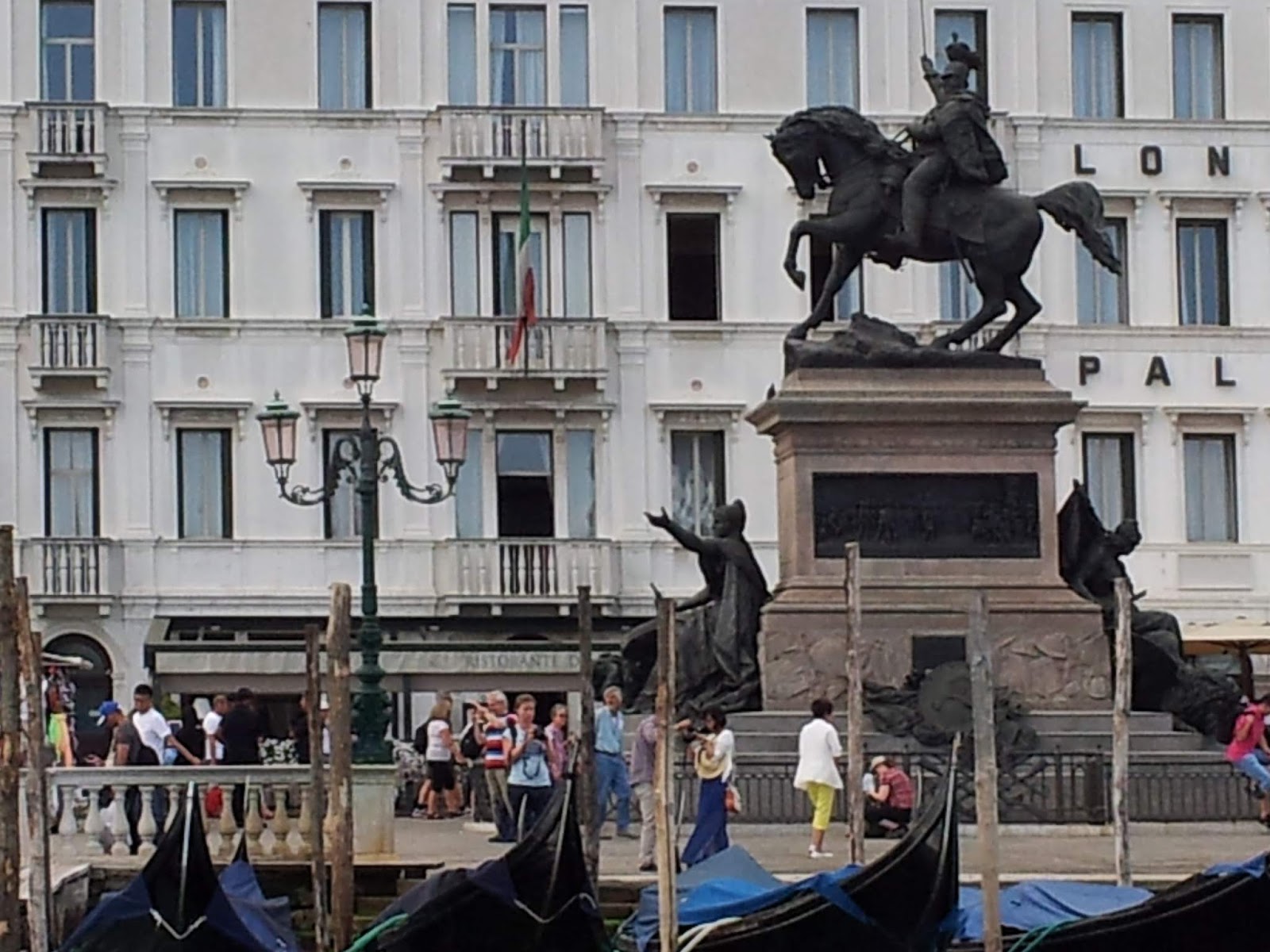
Venice is definitely a city to explore.  It has an incredible number of canals and walkways, and each time we would start our exploration at St Marks square when it’s not underwater

Everyone I have spoken to about exploring Venice has told me how easy it is to get lost.  It has not happened to me, but with the infinite number of ways you can go, I guess it is possible.

We started our exploration of Venice in St Marks square, where, on one side there was the Museo di Palazzo Ducale and, next door, the Basilica di San Marco.  Early morning and/or at high tide, water can be seen bubbling up from under the square, partially flooding it.  I have seen this happen several times.  Each morning as we walked from the hotel (the time we stayed in the Savoia and Jolanda) we passed the Bridge of Sighs.

Around the other three sides of the square are archways and shops.  We have bought both confectionary and souvenirs from some of these stores, albeit relatively expensive.  Prices are cheaper in stores that are away from the square and we found some of these when we walked from St Marks square to the Railway station, through many walkways, and crossing many bridges, and passing through a number of small piazzas.

That day, after the trek, we caught the waterbus back to San Marco, and then went on the tour of the Museo di Palazzo Du which included the dungeons and the Bridge of Sighs from the inside.  It took a few hours, longer than I’d anticipated because there was so much to see.
The next day, we caught the waterbus from San Marco to the Ponte di Rialto bridge.  Just upstream from the wharf there was a very large passenger ship, and I noticed there were a number of passengers from the ship on the waterbus, one of whom spoke to us about visiting Venice.  I didn’t realize we looked like professional tourists who knew where we were going.

After a pleasant conversation, and taking in the views up and down the Grand Canal, we disembarked and headed for the bridge, looking at the shops, mostly selling upmarket and expensive gifts, and eventually crossing to the other side where there was a lot of small market type stalls selling souvenirs as well as clothes, and most importantly, it being a hot day, cold Limonata.  This was my first taste of Limonata and I was hooked.

Continuing on from there was a wide street at the end and a number of restaurants where we had lunch.  We had a map of Venice and I was going to plot a course back to the hotel, taking what would be a large circular route that would come out at the Accademia Bridge, and further on to the Terminal Fusina Venezia where there was another church to explore, the Santa Maria del Rosario.

This is a photo of the Hilton Hotel from the other side of the canal.

It was useful knowledge for the second time we visited Venice because the waterbus from the Hilton hotel made its first stop, before San Marco, there.  We also discovered on that second visit a number of restaurants on the way from the terminal and church to the Accademia Bridge.

This is looking back towards San Marco from the Accademia Bridge:

And this, looking towards the docks:

Items to note:

Restaurants off the beaten track were much cheaper and the food a lot different to that in the middle of the tourist areas.

There are a lot of churches, big and small, tucked away in interesting spots where there are small piazza’s.  You can look in all of them, though some asked for a small fee.

Souvenirs, coffee, and confectionary are very expensive in St Marks square.
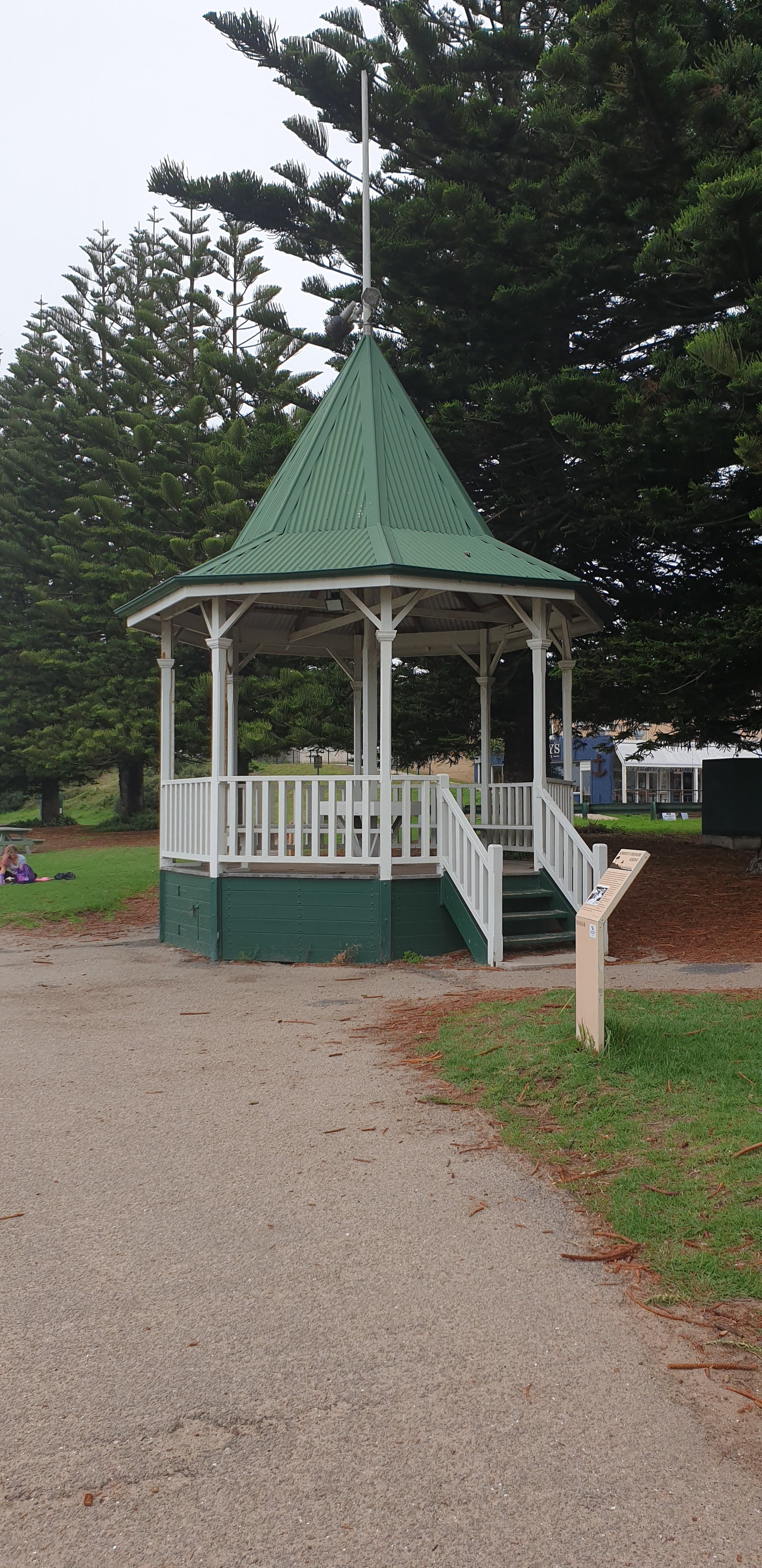
A photograph from the Inspirational bin – 28

Just what everyone needs in their backyard:  A Gazebo, or a small bandstand!

20200215_142419

Often when we go to different places, it gives us ideas, sometimes ideas beyond what is possible.

I have always wanted a gazebo, perhaps not on the same grand scale as the one above, but one where we can put a BBQ and a few seats, and relax on a sunny afternoon.

Shade, a cool breeze, a cold glass of wine or beer, and the aroma of meat cooking on an open flame.

But…

Reality sets in.  The backyard isn’t big enough, so my dream will stay just that.

But as an idea for a story, I suspect this might be the place where you first met the love of your life in circumstances that become the stuff of legends.

It can definitely be a meeting place, whether to carry on illegal activities, whether it’s after sneaking away to be with someone whom others will not approve, or whether it is many, many years later to reminisce, or to reconnect.

As usual, the possibilities are endless.

“Trouble in Store” – Short stories my way: Setting the scene

I used to like writing short stories, somewhere between two and five thousand words, but, in the end, it was too much hard work.

No chance of getting into stride with a location description, no real chance of giving a background to a character, it was simply a case of diving straight in.

But …

I’ve been thinking about writing a short story, starting it with a short succinct sentence that will set the tone.

Something like:  “Jack was staring down the barrel of a gun”

What then?

Should he start analyzing what sort of gun it was, did it have a light trigger, was the person holding it shaking, a man or a woman, or a child?

Location, in a house, a disused factory, a shop, a petrol station, the side of the road.

So, where was Jack?

Something like:  “He had gone down to the corner shop to get a pack of cigarettes.”

For himself or someone else?  Is it day, is it night, or somewhere in between?

Something like:  “He had to hustle because he knew the shopkeeper, Alphonse, liked to close at 11:00 pm sharp, and came through the door, the sound of the bell ringing loudly and the door bashed into it.”

So, Jack’s state of mind, he is in a hurry, careless coming through the door, not expecting anything out of the ordinary.

How would you react when you saw a gun, pointed at Alphonse until the sound of the door warning bell attracted the gunman’s attention?

Is it a gunman?

Something like:  “It took a second, perhaps three, to sum up the situation.  Young girl, about 16 or 17, scared, looking sideways at a man on the ground, Alphonse, and then Jack.  A Luger, German, a relic of WW2, perhaps her father’s souvenir, now pointing at him.”

The punch line:  Cigarettes can kill in more ways than one.

The revelation:  The corner store also supplied the local drug addicts.

The revised start is now:

Jack was staring down the barrel of a gun.

He had gone down to the corner shop to get a pack of cigarettes.

He had to hustle because he knew the shopkeeper, Alphonse, liked to close at 11:00 pm sharp.  His momentum propelled him through the door, causing the customer warning bell to ring loudly as the door bashed into it, and before the sound had died away, he knew he was in trouble.

It took a second, perhaps three, to sum up the situation. 

Young girl, about 16 or 17, scared, looking sideways at a man on the ground, then Alphonse, and then Jack.  He recognized the gun, a Luger, German, relic of WW2, perhaps her father’s souvenir, now pointing at him then Alphonse, then back to him.

Jack to another second or two to consider if he could disarm her.  No, the distance was too great.  He put his hands out where she could see them.  No sudden movements, try to remain calm, his heart rate up to the point of cardiac arrest.

Pointing with the gun, she said, “Come in, close the door, and move towards the counter.”

Everything but her hand steady as a rock.  The only telltale sign of stress, the bead of perspiration on her brow.  It was 40 degrees Fahrenheit in the shop.

Jack shivered and then did as he was told.  She was in an unpredictable category.

“What’s wrong with your friend?”  Jack tried the friendly approach, as he took several slow steps sideways towards the counter.

The shopkeeper, Alphonse, seemed calmer than usual, or the exact opposite spoke instead, “I suspect he’s an addict, looking for a score.  At the end of his tether, my guess, and came to the wrong place.” 

Wrong time, wrong place, in more ways than one Jack thought, now realizing he had walked into a very dangerous situation.  She didn’t look like a user.  The boy on the ground, he did, and he looked like he was going through the beginnings of withdrawal.

 “Simmo said you sell shit.  You wanna live, ante up.”  She was glaring at Alphonse. 

The language was not her own, she had been to a better class of school, a good girl going through a bad boy phase.

Nest time, point of view.

© Charles Heath 2016-2021

The cinema of my dreams – I always wanted to write a war story – Episode 33

For a story that was conceived during those long boring hours flying in a steel cocoon, striving to keep away the thoughts that the plane and everyone in it could just simply disappear as planes have in the past, it has come a long way.

Whilst I have always had a fascination with what happened during the second world war, not the battles or fighting, but in the more obscure events that took place, I decided to pen my own little sidebar to what was a long and bitter war.

And, so, it continues…

Neither of us knew what to expect, and I had tried to steel myself for the worst. It was war, and I’d seen some awful things, but when it had happened to people you knew, and to a certain extent civilians that were nothing to do with the war, it was all that much harder to both understand why, and see.

There were dead, I counted at least ten, villagers who were innocent of any crime other than the fact they didn’t like Leonardo. They had no chance, shot and left to die in almost the same positions I’d seen them when I’d left earlier.

But, after checking everywhere, I could not find Martina.

Then Jack appeared. He came up to me and tugged on my trouser leg. “So this is where you got to?” I said. Why had he come back, though?

He headed back further into the cavern near where we had been earlier, a doorway I had not seen. It was ajar. Jack simply stood still, looking at it.

I pulled out my service pistol, not wanting to be caught unaware, and moved quietly towards the door, then slowly pulled it open.

At first, I saw nothing, then, looking down, I saw a figure on the floor. I knelt down to see who it was. The boy, Enrico. I’d seen his parents earlier, both dead. He must have escaped and hidden in the room, and, luckily, no one had followed him.

Except for Jack. Or had Jack come back, having sensed something awful had happened?

I checked him but there didn’t seem to be any wounds, and, when I shook his shoulder, he jolted, and jumped up ready to attack me, until he saw who it was, then grabbed hold of me. He was shaking, and suddenly sobbing. He had seen what had happened, and it was not something he was going to forget.

And he was going to want to exact revenge.

He was not the only one.

It took ten minutes before he had calmed, and managed to sit, leaning back against the wall. The room was where empty bottles were stored on wooden boxes, and he must have hidden among the crates. Anyone searching quickly wouldn’t venture much past the doorway.

It had saved his life.

Then, when I asked, he related what happened.

It was over very quickly. There had been a pounding on the door, and Martina had assumed it was Chiara returning. Chiara, he said, had said she had a small errand to run before locking herself in with the others.

When Martina opened the door, Leonardo was there, and they captured her, then set about killing everyone else. Enrico had been in the rear of the cavern looking for extra places for the others to camp when he heard the shots being fired.

Instead of going back to see what was happening, he hid in the bottle room, afraid for his life. Afraid for his parents and the others, but he had quickly realized there was nothing he could do. Leonardo had used the act of surprise.

One of Leonardo’s men had come back to where he was hiding, and just as he put his head in the door, Leonardo had called him back. They had to leave before Carlo and I returned. One of his men suggested they remain and capture us when we came back, but Leonardo said we’d come to him as soon as we saw what had happened.

He was right.

Carlo had made up a list of the dead and found that not only Martina was missing, so was Giuseppe and Francesco.

I told him Chiara was still alive, but barely, that Leonardo and his men had almost killed her, extracting the other’s whereabouts.

Martina and the others were most likely receiving the same punishment Chiara had received, up at the castle in one of the dungeons.

We were going to have to rescue them if they were still alive.

In fact, now that Thompson had sent reinforcements, the fight was going to be a little more in our favor with six of us, instead of two. Perhaps seven, if I could not persuade Enrico not to come, but that was going to be difficult. In his place, I would feel exactly the same.

When Enrico was ready, we went back out to the main cavern where Carlo was sitting, head in hands. It was probably the only time he would get to mourn his fellow villagers/

Jack was seeking forgiveness for deserting me, but I was not mad at him. That he was able to give some form of companionship to Enrico probably saved him from making a mistake thinking he could exact revenge on his own.

I told him Leonardo would pay for this, and, predictably, he told me that he would be coming with us. I promised myself that I would find some way of keeping him safe.
© Charles Heath 2020

The Perils of Travelling: Every plane trip is, well, different

The course of plane travel can run like clockwork, or rapidly come apart at the seems.

Every time you go to the airport, it can become an adventure.  Checking in, battling the airline’s kiosk, printing and attaching bag labels, going to bag drop, remembering that every airline does it differently.

Hong Kong airport is huge and there are endless boarding gates.  Being dropped off in the zone that belongs to the airline you’re flying is simple.  The next step is to find the aisle letter where your flight is checking in and then do the automated boarding pass and baggage label.

If it’s international travel which it is today, there’s the added stress of negotiating immigration and the duty-free stores.  We followed the rules, got there early, had the usual problems at the kiosk requiring the assistance of two Cathay Pacific staff, and finally made it to the initial departure concourse.

Next, there’s the temptation of overpriced airport food if you’re hungry which we are not.  But we have a McCafe coffee to satisfy a caffeine fix before the flight.

The shops are all expensive at the initial departure concourse, so we decide to see if there are other shops near our departure gate.  To get to our particular departure gate we descend to the train and get off at the 40-80 station.  It’s a short journey, and once back up on the concourse level we find a collection of more affordable shops where we buy every man and his dog a selection of sweets.

From there it’s a couple of travellators, which sounds rediculously short, but are, in reality, very, very long, to our gate and we get there ten minutes before boarding is supposed to commence.
Today we are traveling on an Airbus A350-900, a relatively new plane so you would think there couldn’t be anything wrong with it.  We had the same plane coming to Hong Kong and was, literally, plain sailing.

We find a seat in the gate lounge and wait along with everyone else.  I’m still surprised at the number of able-bodied people who take the disabled seats for the sake of being closer to the start of the line and worse was a woman who not only took up one of the seats but also another for her cabin baggage which was extensive.

Boarding starts late, and routinely for the first and business, and disabled passengers.  The rest now start to line up in the economy line.  Some people haven’t moved, perhaps they know something we don’t.

We eventually join the line and go through initial formalities while waiting.  And waiting.  As the minute’s tick by nothing is happening other than what appears to be growing consternation by the gate staff.  The tipping point for immediate concern is when the previously boarded passengers begin to come back through the boarding gate.

One of those who had been on board came our way and said there was a problem with the plane.  They were told it was due to technical difficulties the official non-scary description for your plane Is broken.  Because of consternation among the queued economy passengers, there was an official announcement that advised of the technical difficulties, and boarding would be delayed.

We all sit back down, but this time there were a number of disabled and elderly people who needed seats, and our able-bodied lady and her baggage didn’t move.  Shame on her.  We are lucky that where we were in the waiting line it was adjacent to nearby seats putting us closer to the head of the line when it reformed.

Now we were able to watch the other passengers jockeying for position to race to be first in the economy class boarding queue the second time around.  I think they realize they have the same seat if they are at the front of the line or the back.  Because we were all asked to sit down, those at the front of the queue would now find themselves at the end if they’d decided to sit and wait.

After a delay of about an hour and a half, we are finally boarding.  The worst aspect of this delay is losing our slot in the departures and I’m guessing this was going to have an effect on our actual takeoff time.  It appears to be the case.  Boarding does not take very long and shortly after the doors are closed we’re pushing back from the gate.

From there, it becomes a chess game when we get a slot.  We are in a queue of planes waiting their turn, and before the main runway planes are separated into two queues, and we are in the second.  Since we are the only one, I suspect we’re in the delayed take-off queue, and sit watching four or so other planes take off before we finally get on the runway.

All around us, planes seem to be going by and taking off while we wait, and wait, and wait…

On the plane, we discover one of the toilets is out of action so perhaps that was the technical difficulty.  It’s not full so one toilet down will have little effect. 

Leaving in the early afternoon will get us into Brisbane late at night.  It was meant to be around 11 pm, but with the delays, and possibly making up time in flight, it will now be after midnight when we arrive.  Fortunately, we have a 24-hour airport.

The flight from HongKong to Brisbane is without event.  Lunch after takeoff, then a few hours later, an hour or so before landing, we have dinner.  Both of us are not hungry.

We land after midnight, tired but glad to be home.  I guess it could have been worse.

Memories of the conversations with my cat – 9

As some may be aware, but many not, Chester, my faithful writing assistant, mice catcher, and general pain in the neck, passed away some months ago.

Recently I was running a series based on his adventures, under the title of Past Conversations with my cat.

For those who have not had the chance to read about all of his exploits I will run the series again from Episode 1

These are the memories of our time together…

20160921_071506

This is Chester.   He’s undercover.

I’ve asked him to investigate the mouse problem, and this is how he responds.

Hiding in the ‘grass’.

Waiting, watching, ever wary.

Those mice will not see him coming.

I try to tell him that hiding on the chair, whilst the mice are on the floor doesn’t make much sense.

We’ll just have to wait and see.

Searching for locations: Rome, Italy

We visited Rome in August

It was hot.

It was verrrry hot.

We flew into Rome’s Leonardo da Vinci-Fiumicino airport after a rather bumpy flight from London.  Unlike most other airports the plane parked at a satellite terminal and after we disembarked we had to catch a train to the main terminal.

The most notable memory of this airport was my daughter’s discovery of a salami shop.

We had booked a transfer to take us to the hotel the Roma Corso Trieste Mercure in Via Gradisca from the airport.  It was a white air-conditioned van and so far we had avoided the heat.

One of the rooms had a faulty air conditioning an absolute must as the rooms were very hot without it and necessitated a room change which was done quickly and efficiently.

The hotel was in the suburbs and without a car we were dependent on public transport.  According to the reception staff, there was a bus stop nearby, and a longer walk to the tram or light railway.  The bus seemed to be the best option as it would take us to the central terminal near the railway station, where all tour buses also operated from, and particularly the open top buses that went to all the major tourist attractions.

That first day basically was given over to traveling, arriving by plane and settling into the hotel, thus we didn’t get to feel the force of the heat.  That came the next day.

After a walk around the hotel precinct to get our bearings and see what shops and restaurants were available, on returning to the hotel we were faced with the limited choices of room service or to go out for dinner.

My daughter and l go for a long walk up Via Nomentana to find several shops and a restaurant.  We went into the restaurant and sat down.   We waited for 10 minutes and got no service nor did anyone come and ask us if we wanted to order food so instead we left somewhat disappointed and go next door to what seems to be the Italian version of a delicatessen and order sandwiches and beer.   I bought a half dozen cans of Moretti beer two of which I drank on the way home.

It was still very hot even at eight at night and the sandwiches are delicious.  It just might be by that time we were starving and anything would have tasted great.

The next morning we are up and ready to chance the weather and some history.  Breakfast at the hotel is limited but very good.

We were going to use public transport and I’d studied up on the Internet.

Traveling on the bus required pre-purchase of tickets which could be bought in certain shops and locally when exploring the area near the hotel, l found a tobacconist.

Next, we needed to understand how to use the tickets. There was no one on the bus who could help so when l tried to scan the tickets and it failed, l gave up.  We had the same issue each day and in the end, the tickets never got used.

The trip to central Rome by bus took about 15 minutes.  In the morning it was reasonably cool and showed us a little of suburban Rome.  We also saw the trams but we would not be able to use them because our hotel not on a direct route.

That first full day we decided to go and see the Vatican.

Not understanding buses and which one we needed to get to the Vatican, we took a taxi.

Wow.  It was the metaphorical equivalent of driving over the edge of a cliff with a daredevil.  It was quite literally terrifying.

Or maybe we just didn’t know that this was probably the way people drove in Rome.

Shaken but delivered in one piece we found ourselves in the square opposite St Peters Basilica.

The square is impressive, with the statues atop a circular colonnaded walkway.  The church is incredible, and took a few hours to take in and to top off the day we did a tour of the Vatican museum which took the rest of the afternoon.

Then it was back to the delicatessen for more sandwiches and beer, and an interesting discussion with several elderly Italian ladies, of which I did not understand one word.

The second full day we decided to use one of the open top bus tours and eventually decided on the hop on hop off tour simply because the bus was at the central transport terminal for trains and buses and it was getting hotter.

Our first stop was the Colosseum.  There were other monuments nearby, such as the Arch of Constantine, but as the heat factor increased we joined the queue to go into the Colosseum and gladly welcomed the shade once we got inside.

The queue was long and the wait equally so, but it was worth the wait.  It would be more interesting if they could restore part of it to its former glory so we could get a sense of the place as it once was.  But alas that may never happen, but even so, it is still magnificent as a ruin.

Outside in the heat, it was off to the ruins which were a longish walk from the Colosseum, taking Via Sacra, not far from the Arch of Constantine.  This day in the walkway there were a number of illegal vendors, selling knockoff goods such as handbags and watches, and who, at the first sight of the police, packed up their wares in a blanket and ran.

Included in these ruins were The Roman Forum, or just a few columns remaining, the Palatine Hill, Imperial Fori, including the Forum of Augustus, the Forum of Caesar, and more specifically the Forum of Trajan.  It was, unfortunately very hot and dusty in the ruins the day we visited.

We walked all the way to the Foro Romano and the Septimus Severo Arch at the other end of the ruins, past the Temple of Caesar.  I found it very difficult to picture what it was like when the buildings were intact, so I bought a guide to the ruins which showed the buildings as ruins and an overlay of how they would have looked.  The buildings, then, would be as amazing as the Colosseum, and it would have been interesting to have lived back then, though perhaps not as a Christian.

I lost count of the number of bottles of water we bought, but the word ‘frizzante’ was ringing in my ears by the end of the day.  Fortunately, water did not cost a lot to buy.

At the end of the day, we caught the hop on hop off bus at the Colosseum and decided not to get off and see any more monuments but observe them from the bus.  The only one I remember seeing was Circo Massimo.  Perhaps if we’d know it was going to be twice as hot on the bus, yes, there was no air-conditioning; we may have chosen another form of transport to get back to the hotel.

The third and last day in Rome we decided to go to the Trevi Fountain, see the pantheon and walk up the Spanish Steps.  We spent most of the morning in the cool of a café watching the tourists at the fountain.  By the time we reached the top of the Spanish Steps, we were finished.


Just one of many reading lists – part 3

**Please don’t assume that you have to, nor would I ever expect you to,  read any or all of these books.  You don’t.**

Everyone, it seems, will publish what they call the top 100 books that you should read. Some are voted on, some belong to the opinion of the editor of the book review section of a newspaper, and, as you know, there are a lot of newspapers, a lot of editors, and a lot of opinions.

I’m not a newspaper, I’m not an editor, but I have a list, based on personal experience, and many, many years of reading.

It’s in no particular order.

41.  The Hound of the Baskervilles by Sir Arthur Conan Doyle, as well as a host of other Sherlock Holmes stories

42.  The Secret Agent by Joseph Conrad, one of Conrad’s later political novels, set in London in 1886 and deals with anarchism and espionage.  In those days spies were called anarchists.

43.  The Ipcress File by Len Deighton, introducing us to Harry Palmer, who was personified by Michael Caine and led to Horse Under Water, and Funeral in Berlin.  More of Len Deighton later on in the list

44.  The Remorseful Day by Colin Dexter introducing the somewhat enigmatic detective, Morse, his first name not revealed for a long time but oddly, Endeavour.  John Thaw brought him to life

45.  Crime and Punishment by Fyodor Dostoevsky, hard to pronounce and even harder to read, but perhaps worth it in the end.  By the time I read this I was wishing for a Russian writer had could use an economy of words

46.  Dr. Zhivago by Boris Pasternak wasn’t it.  A vast and lengthy dissertation on lost love, I felt very sad for Zhivago in the end.  I saw a stage play of the same name, and I’m sorry, but it’s a few hours of my life I will never get back

47.  Casino Royale, the first of the James Bond novels by Ian Fleming.  I have to say these are among my favorite spy books.  I must say I preferred the new James Bond in Casino Royale, though Sean Connery still rules!

48.  The Day of the Jackal by Frederick Forsythe, a fascinating story about an assassin

49.  Anything written by John Le Carre, but in particular, the George Smiley collection.  Finally unmasking his nemesis the Russian spymaster made it all so satisfying.

50.  The Bourne Identity by Robert Ludlam, inspiring a long series by both Ludlam and Eric Lustbader makes entertaining reading, but the first, the man who did not know who or what he really was, was excellent.  Matt Damon didn’t harm his persona either.

51.  Murder Must Advertise by Dorothy Sayers, whose detective is Lord Peter Whimsey, a 1933 mystery novel that’s eighth in the series

52.  Gorky Park by Martin Cruz Smith.  You have to admit that his Russian detective Arkady Renko is up against it when his investigation goes in a direction that uncovers corruption and dishonest in his superiors

53.  The Way of All Flesh by Samuel Butler, a semi-autobiographical novel written between 1987 and 1884, and published in 1903.  The story of the Pontifex family.

54.  Howards End by E. M. Forster, first published in 1910, is an interesting insight into the behavior of the, and between the classes, with the Schlegels acting as the catalyst.

55.  Washington Square by Henry James, originally published as a serial, and covers the conflict between daughter and father.  I must say I prefer The Ambassadors to Washington Square.

56.  Ulysses by James Joyce, a day in the life of an ordinary man, Leopold Bloom, why could it not be the 7th June rather than the 16th, for obvious reasons

57.  The Go-Between by L. P. Hartley is a view of society at the end of the Victorian period through the eyes of a young boy.  I read this while still at school and had no clue why, but later, when I read it again, I understood the meaning

58.  Atonement by Ian McEwan, I saw the film and then read the book.  Never a good idea.  Basically, a young girl makes a bad mistake and tries to atone for it.

59.  Gone With The Wind by Margaret Mitchell, the War and Peace of Americal novels, and as long by comparison.  The only book written by Mitchell, and the second most read book by Americans.  The film was interesting but awfully long.

60.  The English Patient by Michael Ondaatje, with a man with severe burns and the effect he had on three others.  Colin Firth is villain one day and hero the next, this time in the cinematic version, an out and out cad.

More to come…

The perils of traveling: the last plane out on Friday night

Everyone knows that if you are on the last flight out on a Friday night the chances of you getting away on time are remote.

Yep.

We’re on the last flight out.

Yep.

There’s no way in hell we’re leaving on time.

But, here’s the thing.

Our incoming plane arrives 6 minutes late, so there’s every hope of getting away on time.

We are, of course, delusional.

Planes can’t fly without a crew, and part of our crew on another incoming plane, which is, yep,
delayed.

In fact, the whole arrivals board is lit up with the word “delayed” for every flight but our incoming plane and one other from Sydney.

And, no, our missing crew members are not on either.

So, it becomes a waiting game and placating messages from the gate crew first to tell us we’re waiting for crew and two more times to tell us we will be boarding soon.

The look on some faces says they’ve been through all this before.

Then, one of the gate staff, communicator in hand goes out to see if the errant crew members are coming. She waits a few minutes but it probably takes longer than that for them to finalize their duties on the incoming plane and get to our gate.

She returns to the gate counter just as an electric car comes towards us from one of the satellites.

Crew found.

Boarding starts.

We leave 35 minutes late. About the average time, all the delayed planes were, well, delayed.

Ah, the joys of traveling on a Friday night

“Sunday in New York”, a romantic adventure that’s not a walk in the park!

“Sunday in New York” is ultimately a story about trust, and what happens when a marriage is stretched to its limits.

When Harry Steele attends a lunch with his manager, Barclay, to discuss a promotion that any junior executive would accept in a heartbeat, it is the fact his wife, Alison, who previously professed her reservations about Barclay, also agreed to attend, that casts a small element of doubt in his mind.

From that moment, his life, in the company, in deciding what to do, his marriage, his very life, spirals out of control.

There is no one big factor that can prove Harry’s worst fears, that his marriage is over, just a number of small, interconnecting events, when piled on top of each other, points to a cataclysmic end to everything he had believed in.

Trust is lost firstly in his best friend and mentor, Andy, who only hints of impending disaster, Sasha, a woman whom he saved, and who appears to have motives of her own, and then in his wife, Alison, as he discovered piece by piece damning evidence she is about to leave him for another man.

Can we trust what we see with our eyes or trust what we hear?

Haven’t we all jumped to conclusions at least once in our lives?

Can Alison, a woman whose self-belief and confidence is about to be put to the ultimate test, find a way of proving their relationship is as strong as it has ever been?

As they say in the classics, read on!

Purchase:

http://tinyurl.com/Amazon-SundayInNewYork