“Because it’s not me” – a short story

If the was one fault I had, it was prevarication.

For a long time, I had always been afraid of making a mistake, after I had done exactly that.  They said our mistakes didn’t define us, but that one had.  I had lost the trust of everyone, from my parents to friends.

It was only a small lie, or so I told myself, but it had far-reaching ramifications, and almost cost someone their life.  But whilst I believed it was not all that bad, and the police had agreed that anyone who had been put in the same position would have done the same, there were those who didn’t agree.

It was a moment in time I often relived in my mind, over and over, and eventually led to several outcomes.

The first, I left home, the town where up till then I’d lived all of my life, walking away from family and those who used to be friends, knowing that what they said and what they felt were two entirely different things.  For all concerned, it was better that I left, cutting all ties, and make a fresh start, away from those whom I knew would never forget, even though they forgave me.

The second, and most dire, I changed my name, and my history, even how I looked.  Today, I was a very different person to that of thirty years ago.

The third, I moved to another country and vowed never to return, always looking constantly over my shoulder, expecting someone from the past to find me.  I instinctively knew that I would never escape, that one day a stark reminder would come back and destroy everything.

I picked the one occupation that would keep me both occupied and invisible.

Journalist.

I had started at the bottom, literally writing death notices, and worked my way up to what is ubiquitously known as ‘foreign correspondent’, going to places where no one else would go, those hotbeds of unrest, and war zones, reporting from both sides.

Perhaps it could say I had a death wish, a statement my editor had once said when he came to see me in hospital back in London after I’d been caught up in a rocket attack and repatriated.  He had come to offer me a job back home, to tell me my tour was over.

I declined the opportunity, and he left, shaking his head.

But that was not the only visitor that came to the hospital that day.  The other visitor was an elderly man, immaculately dressed in a pinstripe suit and bowler hat.  It screamed public servant, and the moment I saw him wandering up the passage, a chill ran down my spine.

Although he looked like he was looking for someone else, I knew he would eventually finish up in my doorway.

Five minutes after I first saw him.

When he appeared at the door, I thought about ignoring him, but realized that wasn’t going to change anything.  Besides that, I guess I wanted to know why he would want to see me.

“James Wilson?”

“Would it make any difference if I said no?”  Well, it didn’t mean I couldn’t spar with him, just a little.  “Who are you.”

“Do you mind if I come in?”

I got the impression he would do it anyway, irrespective of what I said.  I said no, and as I suspected he came in anyway, closing the door behind him, then took a minute or two to make himself comfortable in the visitor’s chair, which was an impossible task.

Then, settled, he said, “I understand you have just been repatriated from Syria.”

“I was in the wrong place at the wrong time.”

It wasn’t common knowledge where I’d come from, so this person knew something about me, which was immediate cause for concern.

“The bane of a reporter trying to cover a dangerous situation,” he said, with just the right amount of levity in his tone.  “I get it, by the way.  I once had that devil may care attitude you need to get the story.  I was chasing a Pulitzer, believe it or not, and used a few of those nine lives in the process.  Which one are you up to?”

I was going to say that awards didn’t matter but among those who made up the press pack in those God-forsaken places, there was an unwritten desire to be rewarded other than by pay.  For me, though, it was not a defining factor.

“Lost count.  But why would that interest you, or whoever it is you represent?  By the way, just who do you represent?”

Second attempt at finding out who this man was.  If he was dodging and weaving, it would suggest a clandestine organization.

“People who would like to use your unique talent in getting into trouble spots around the world.  We’re not asking you to come work for us exclusively, rather piggyback on the job that you already do so well.”

An unnamed man from an unnamed organization.  What he was offering wasn’t unheard of, and I had been warned, more than once, that jobs, like he was suggesting, were more often than not offered to people like me.  With that came one line of advice, turn around and run like hell.

But, with nothing to amuse me in hospital, I was curious.  “Doing what exactly?”

The fact his expression changed indicated my response had taken him by surprise.  Perhaps he was used to being told where to go.  Not yet.  I had this fanciful notion in the back of my mind that what he might offer might get me closer to the story.

“Keeping your eyes and ears open.  We’ll tell you what to look for, all you’ll be doing is looking for evidence.  There will be no need to go looking for trouble, if there’s evidence we ask you to report it, if not, no harm done.”

Not so hard.  If that was all it was.  The trouble was, if something sounds simple, which that did, but inevitably, it was going to be anything but.  I’d heard stories and the consequences.

“You’re presuming that my editor will send me back.  He just offered me a job at home.”

“I think both of us know you’re not interested in domesticity.  If he isn’t willing to adhere to your wishes, I’m sure we could find someone else who would be willing to take you on.  You have had several offers recently, have you not?”

So, without a doubt, he knew a lot about me, especially if he asked around.  I had had several offers, but I was happy where I was.  I liked the no questions about your past that my current employer had promised.

Yes, looking at the determination on this man’s face, I had no doubt they or he could do what he said.  No one comes to a meeting like this without holding all the cards.  Also, not that I wanted it to be so, It told me that my agreement was not necessarily going to be optional.

But I was happy to dither and find out.  “Since I’m not sure when the hospital is going to discharge me, and the fact I’m not exactly very mobile at the moment, can I consider the proposal.  Right now, as you can imagine, getting back to work is not exactly a priority.”

“Of course.”  He took a card out of his coat pocket and put it on the bedside table.  “By all means.  Call me on that number when you’ve decided.”

He stood.  “It will be a great opportunity.  Thank you for your time.”

Of course, the two impressions I was left with were, one, he had me mixed up with someone else, and two, that I would never see him again.

It was an impossible task, for me at least, because I did not have a poker face, and could barely carry a lie.  I would be the last person they’d want for the job.

And thinking that, I rolled over, put it out of my mind, and went back to sleep.


© Charles Heath 2021

Memories of the conversations with my cat – 18

As some may be aware, but many not, Chester, my faithful writing assistant, mice catcher, and general pain in the neck, passed away some months ago.

Recently I was running a series based on his adventures, under the title of Past Conversations with my cat.

For those who have not had the chance to read about all of his exploits I will run the series again from Episode 1

These are the memories of our time together…

20160903_010425

This is Chester, he’s lurking in the shadows.

This is near the front door, so I wonder if he’s waiting for someone, or keeping guard, or he’s spotted something outside.

The grandchildren will be here soon, and I haven’t told him they are paying a surprise visit.  He has a habit of disappearing the days they usually come.

We both hear a noise outside.

He goes into stealth mode.

Then I recognize the sound, of letters being shoved into the mailbox.

He shakes his head.  I think he was expecting a mouse.

I hear the back door rattle and the loud sounds of the grandchildren arriving.

He lifts his head, stands, and bolts.

That’s the fastest I’ve seen him move for a long time.

“Trouble in Store” – Short stories my way: Character refinement

I have reworked the first part of the story with a few new elements about the characters and changed a few of the details of how the characters finish up in the shop before the policewoman makes her entrance.

This is part of the new first section is the one that involves Annalisa, and her boyfriend, Simmo:


Annalisa looked at the two men facing her.

Simmo, the boy on the floor, had told her that the shopkeeper would be a pushover, he was an old man who’d just hand over the drugs, rather than cause trouble for himself.

Where Simmo had discovered what the shopkeeper’s true vocation, dispensing drugs to the neighborhood addicts, she didn’t know, but it was not the first place like this they had visited.

She had always known Simmo had a problem, but he had assured her he had it under control.  Until a month ago, when he had tried something new.

It had changed him.

The breaking point came earlier that day when, seeing how sick he was, she threatened to leave.  It brought out the monster within him, and he threatened to kill her.  Not long after he had changed into a whimpering child pleading with her to stay, that he hadn’t meant anything he’d said before.

All he needed was one more ‘score’ to get his ‘shit’ together, and he would do as she asked, and find help.

She believed him.

He said he knew a place not far from the apartment, a small shop where what he needed was available, and said he had the money.

That should have been the first sign he was not telling the truth because she had been funding his habit until her parents cut off the money supply.  She suspected her father had put a private detective on to find her, had, and reported back, and rather than make a scene, just cut her off so she would have to come home or starve.  Her father was no better than Simmo.

And, as soon as they stepped into the shop, Simmo pulled out the gun,

Instead of the shopkeeper cowered like Simmo said he would, he had laughed at them and told them to get out.  Simmo started ranting and waving the gun around, then all of a sudden collapsed. 

There was a race for the gun which spilled out of Simmo’s hand, and she won. 

That was just before the customer burst into the shop.

It had been shortly before closing time.  Simmo had said there would be no one else around.

Wrong again.

Now she had another problem to deal with, a man who was clearly as scared shitless as she was.

This was worse than any bad hair day, or getting out of the wrong side of bed day, this was, she was convinced, the last day of her life.

She heard a strange sound come from beside her and looked down.  There was a trickle of blood coming out of his mouth and Simmo was making strange sounds like he was choking.

Any other time she might have been concerned, but the hard reality of it was, Simmo was never going to change.  She was only surprised at the fact it took so long for her to realize it.

As for the man standing in front of her, she was safe from the shopkeeper with him around, so he would have to stay.

“No.  Stay.”

Another glance at the shopkeeper told her she had made the right decision, his expression said it all.  Gun or no gun, the moment she was alone with him, he would kill her.


© Charles Heath 2016-2020

In a word: Brevity

Now, brevity is something that I have not been able to fully wrap my head around.

The dictionary explains Brevity as

‘concise and exact use of words in writing and speech’

So…

I remember working with a writer a long time ago who explained certain authors styles, and for James A Michener of Hawaii fame, he said Michener wrote sentences instead of words, paragraphs instead of sentences, pages instead of paragraphs and chapters instead of pages.

It was a little harsh considering I’d just read the book and had liked it, despite its length and the time it took.

But some time later I realized he was not criticizing Michener, but trying to tell me, in his, what I came to discover, interesting way, that I should strive to write more compactly.

I then came across a book by Brian Callison which was exactly that, the concise version, a story that fitted into about 200 pages.

That too was a good book and it took me a day to read it, and by his use of that economy of words, it read quickly.

Of course, I have tried over the years to emulate both styles, and to a certain degree, failing, because I think I have created my own style which is somewhere in between.

Still, when editing, it is always in the back of my mind that I should be

Using words instead of sentences

Using sentences instead of paragraphs

Using paragraphs instead of pages, and

Using pages instead of chapters.

The chapters, he said, with an air of amusement, will always take care of themselves.


How could that possibly happen… – A short story

I had hoped by the time I was promoted to assistant manager it might mean something other than long hours and an increase in pay.

It didn’t.

But unlike others who had taken the job, and eventually become jaded and left, I stayed. Something I realized that others seemed to either ignore or just didn’t understand, this was a company that rewarded loyalty.

It was why there were quite a few who had served 30 years or more. They might not reach the top job, but they certainly well looked after.

I had a long way to go, having been there only 8 years, and according to some, on a fast track. I was not sure how I would describe this so-called ‘fast track’ other than being in the right place at the right time and making a judicial selection.

When it was my turn to be promoted, I had a choice of a plum department, or one most of my contemporaries had passed over. At the time, the words of my previous manager sprang to mind, that being a manager for the most sought after department or the least sought after, came with exactly the same privileges.

And, he was right. I took the least sought after, much to their disdain and disapproval. One year on, that disapproval had turned almost to envy; that was when the Assistant Managers were granted a new privilege, tea, and lunch in the executive dining room.

“So, what’s it like?” John asked, when our group met on a Friday night, this the first after the privilege was granted.

He had been one of the three, including me, who had the opportunity to take the role. Both he and Alistair had both declined, prepared to wait for a more prestigious department. It hadn’t happened to them yet.

“The same as the staff dining room, only smaller. Except, I guess, the waitstaff and butler. They come and serve you when you have to go to them in the staff room. They’re the same staff, by the way, except for the butler.”

I could see the awe, or was it envy, in their eyes. “but it’s not that great. The Assistant Managers all sit at one end of the table, and we’re not part of the main group, so no sharing of information I’m afraid. And the meals are the same, just served on fancier crockery.”

“Then nothing to write home about?” Will was one of those who they also thought to be on a ‘fast track’. I was still trying to see how my ‘fast track’ was actually that fast.

“Put it this way, the extra pay doesn’t offset the long hours because you get overtime, I don’t, so on a good week, you’d all be earning more than me. Without responsibility, if anything goes wrong. I think that’s why Assistant Managers were created, to take the blame when anything goes wrong.”

That had been the hardest pill to swallow. Until I got the role, I hadn’t realized what it really involved. Nor had the others, and it was not something we could whinge about. My first-day introductory speech from Tomkins, my Manager, was all about taking responsibility, and how I was there to make his life easier. It was a speech he made a few times because he’d been Manager for the last 16 years, much the same as the others, and promotion if ever, would come when they died.

And Manager’s rarely died, because of their Assistant Managers.

“How old is Tomkins now?” Bert, a relative newcomer to our group, asked. He was still in the ‘in awe’ phase.

“About the same as Father Time,” I said. “But the reality is, no one knows, except perhaps for the personnel manager.” O looked over at Wally, the Personnel Department’s Assistant Manager. “Any chance of you telling us?”

“No. You know I can’t.”

“But you know?” I asked.

“Of course, but you know the rules. That’s confidential information. Not like what you are the custodian of, information everyone needs.”

Which, of course, was true. Communication and Secretarial Services had no secrets, except for twice a year when the company Bord of Directors met, and we were responsible for all the documents used at their meetings. Then, and only then, was I privy to all the secrets, including promotions. And be asked ‘What’s happening?’.

“Just be content to know that he’s as old as the hills, as most of them. It seems to me that one of the pre-requisites for managership is that you have been employed here for 30 years.”

Not all, though, I’d noticed, but there wasn’t one under the age of fifty.

And so it would go, the Friday night lament, those ‘in’ the executive, and those who were not quite there yet.
It seemed prophetic, in a sense, that we had been talking about Mangers and their ages. By a quirk of fate, some weeks before, that I learned of Tomkins’s currents state of health via a call on his office phone. At the time he was out, where, he had not told me, but by his the I believed it was something serious, so serious he didn’t want me, or anyone else, to know about it.

That phone call was from his wife, Eleanor, whom I’d met on a number of occasions when she came to take him home from work. I liked her, and couldn’t help but notice she was his exact opposite, Tomkins, silent and at times morose, and Eleanor, the life of the party. I could imagine her being a handful in her younger days, and it was a stark reminder of that old saying ‘opposites attract’.

She was concerned and asked me if he had returned from the specialist. I simply said he had but was elsewhere, and promised to get him to call her when he returned. Then I made a quick call around to see where he was and found that he was in Personnel. I left an innocuous message on his desk, and then let my imagination run wild.

At least for a day or so, the time it took for me to realize that it was probably nothing, the lethargy he’d been showing, gone.

I’d put it out of my mind until my cell phone rang, and it was from the Personnel Manager. On a Sunday, no less. In the few seconds before I answered it, I’d made the assumption that Tomkins’s secretive visits to the specialist meant he needed time off for a routine operation.

Greetings over, O’Reilly, the Personnel Manager, cut straight to the chase, “For your personal information, and not to be repeated, Tomkins will be out of action for about two months, and as that is longer than the standard period, you will become Acting Manager. We’ll talk more about this Tuesday morning.” Monday was a holiday.

All Assistant Managers knew the rules. Any absence of a manager for longer than a month, promotion to Acting Manager. Anything less, you sat in the office, but no change in title. There was one more rule, that in the event of the death of a manager, the assistant manager was immediately promoted to Manager. This had only happened once before. 70 years ago. If a manager retired, then the position of Manager was thrown open to anyone in the organization.

It was an intriguing moment in time.

Tuesday came, and as usual, I went into the office, with only one thought in mind, let the staff in the department know what was happening, of course, the moment I was given the approval to do so by Personnel.

Not a minute after I sat down, the phone rang. I picked it up, gave my name and greeting. It was met with a rather excitable voice of the Assistant Manager, Personnel, “I just got word from on high, you’ve been promoted to manager. How could that possibly happen…”

Then a moment later, as realization set in, “Unless…”

—-

© Charles Heath 2020-2021

Memories of the conversations with my cat – 16

As some may be aware, but many not, Chester, my faithful writing assistant, mice catcher, and general pain in the neck, passed away about 2 years ago, and I still miss him.

This is my way of remembering him.

For those who have not had the chance to read about all of his exploits, I will run the series again from Episode 1

Character development

20161008_135142

This is Chester, he thinks he is an expert on people

He has meandered in checking out what I’m doing, or maybe he’s here because the room is cooler.

He gives me the ‘What are you doing’ look.

It doesn’t matter how many times I’m a writer, it’s like talking to a brick wall.

I say I’m working on developing a new character.

Name?

I’m thinking of John.

A shake of the head and the eyes roll.  Can you be a little more inventive, like, well, Chester?

Predictable.  How about Xavier?

Would you call your kid Xavier?  He’s going to have a very rough time of it at school.  Unless this character has a tortured soul.

Good point.  How about William?

Bill, that’s what you get in the mail.  Another shake of the head.  You’re not very good at this, are you?

Apparently not.  Haven’t you got some mice to catch?

He yawns, then curls up on the seat.  Wake me when you’ve got some better ideas.

Maybe not.  I’ve come up with a name, Daniel, and I don’t care what he thinks.

For now.

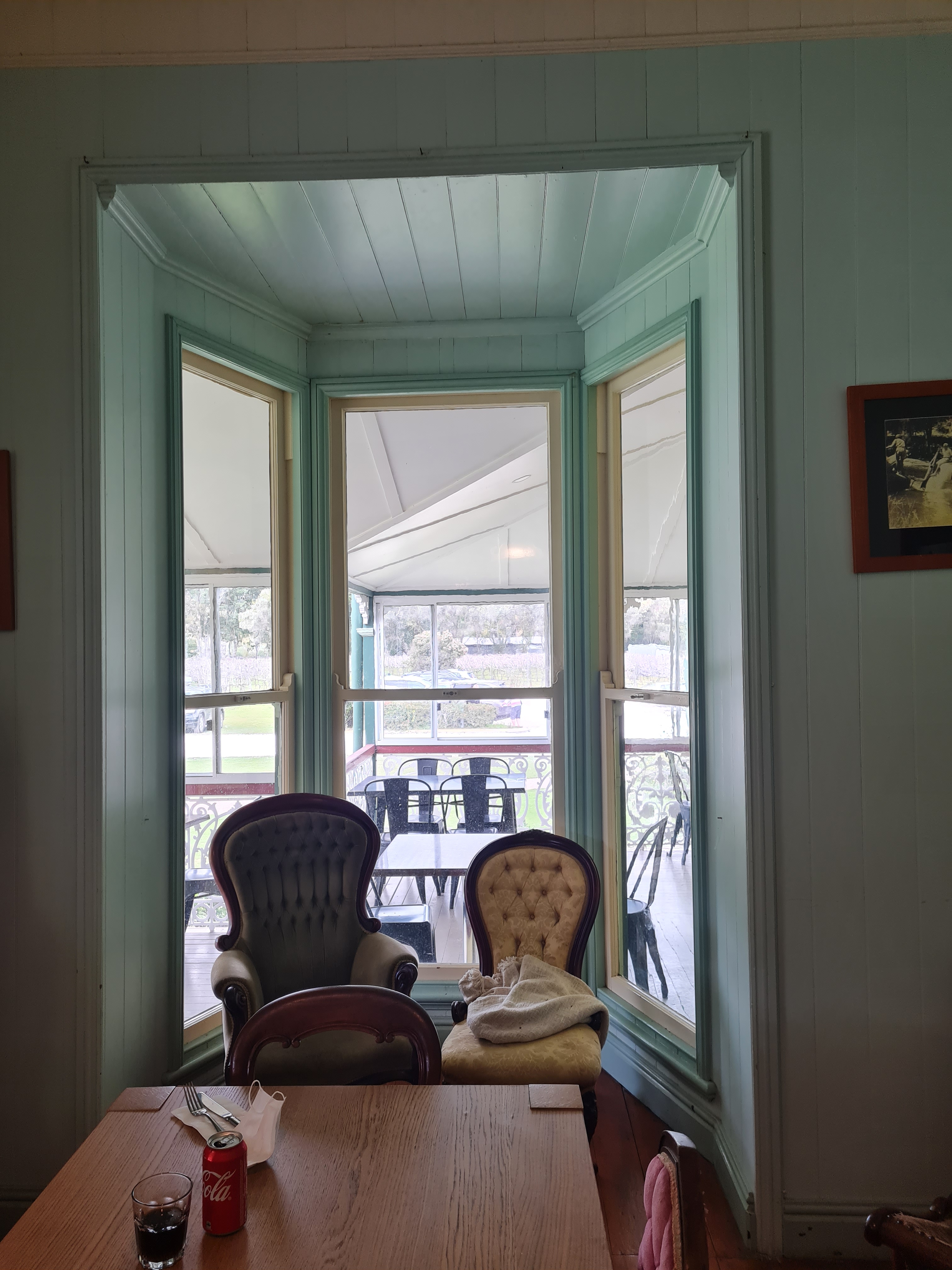
Searching for locations: An old country homestead, Canungra, Australia

Or to be more precise, the homestead at what is now O’Reilly’s vineyard, where there is a pleasant lawn out back running down to the river for picnics, an alpaca farm next door, and the homestead plays host to functions, and wine tastings.

My interest was that we had assumed there was a restaraunt, and we were going to have lunch. There might be one, but not the day we visited, it was just cafe food or a picnic available.

I was more interested in the old homestead, because it was a fine example of the homesteads built in the ‘outback’.

Today we are having lunch in the Platypus room, in the O’Reilly’s vineyard farmhouse, which, if you close your eyes and let your imagination run free, could see it as the master bedroom of a homestead.

Certainly the building is old, made completely of timber, inside and out, with the traditional high ceilings to keep the heat at bay.

At one end, a large bay window, which would be ideal to sir and view the outside, past the sweeping verandah.  There is a small lawn and a rotunda, but beyond that what might have been extended gardens, is the vineyard.

The homestead is in an ideal position midway between the main road and the river, has the traditional surrounding verandah, and shows signs of being extended on almost all sides.

On the other side of the wide corridor that leads you to the bar, and, coincidentally, down the centre of the house, is a smaller bedroom, also used as a dining room, and ubiquitously named the library.

It may be small but it does have a fireplace.  Which the assumed master bedroom does not, but now I’m thinking that room might have been the morning room.

Behind the room we’re in is another bedroom, or perhaps this might be the master, because it does have a fireplace and is quite large.  And a name, the Ambassador room.  Now it serves as the pick up place for picnic baskets.

There is another room on the opposite side of the corridor called the Drawing Room, but is not open to the public.  But, going into the room with the fireplace adjacent to it, you can sell the aroma of pizzas, so it’s probably an extension of the kitchen, and, walking around the outside that side of the house proves it to be case.

After all, they do catering for weddings and need a very large food preparation area which I discovered runs down the whole of that side of the house.

At the end of the corridor I’d the bar and spare space, and running off that and behind that is where there is a large dining area, perhaps prior to COVID, the restaurant.

It’s not hard to imagine that area as a very large entertaining area, either for very large dinner parties, or dancing.

As for the food, it’s either a picnic basket, or pizzas.  We chose the latter, not realising the bases were not home made, but bought in.  

The toppings however were both plentiful and tasty.  It could have been hotter, because it was a cold day, and it was cold in the room.

As for something to do other than taste the wine, and buy a few bottles, you can get up close to the vines, which, at this time of the year gave been pruned back and look quite dead, look at or walk an alpaca, even feed it, or all of them, or go down to the river and see if you can spot a Platypus.

Perhaps next time we’ll have a picnic down by the river.

‘Sunday in New York’ – A beta reader’s view

I’m not a fan of romance novels but …

There was something about this one that resonated with me.

This is a novel about a world generally ruled by perception, and how people perceive what they see, what they are told, and what they want to believe.

I’ve been guilty of it myself as I’m sure we all have at one time or another.

For the main characters Harry and Alison there are other issues driving their relationship.

For Alison, it is a loss of self-worth through losing her job and from losing her mother and, in a sense, her sister.

For Harry, it is the fact he has a beautiful and desirable wife, and his belief she is the object of other men’s desires, and one in particular, his immediate superior.

Between observation, the less than honest motives of his friends, a lot of jumping to conclusions based on very little fact, and you have the basis of one very interesting story.

When it all comes to a head, Alison finds herself in a desperate situation, she realises only the truth will save their marriage.

But is it all the truth?

What would we do in similar circumstances?

Rarely does a book have me so enthralled that I could not put it down until I knew the result. They might be considered two people who should have known better, but as is often the case, they had to get past what they both thought was the truth.

And the moral of this story, if it could be said there is one, nothing is ever what it seems.

Available on Amazon here: amzn.to/2H7ALs8

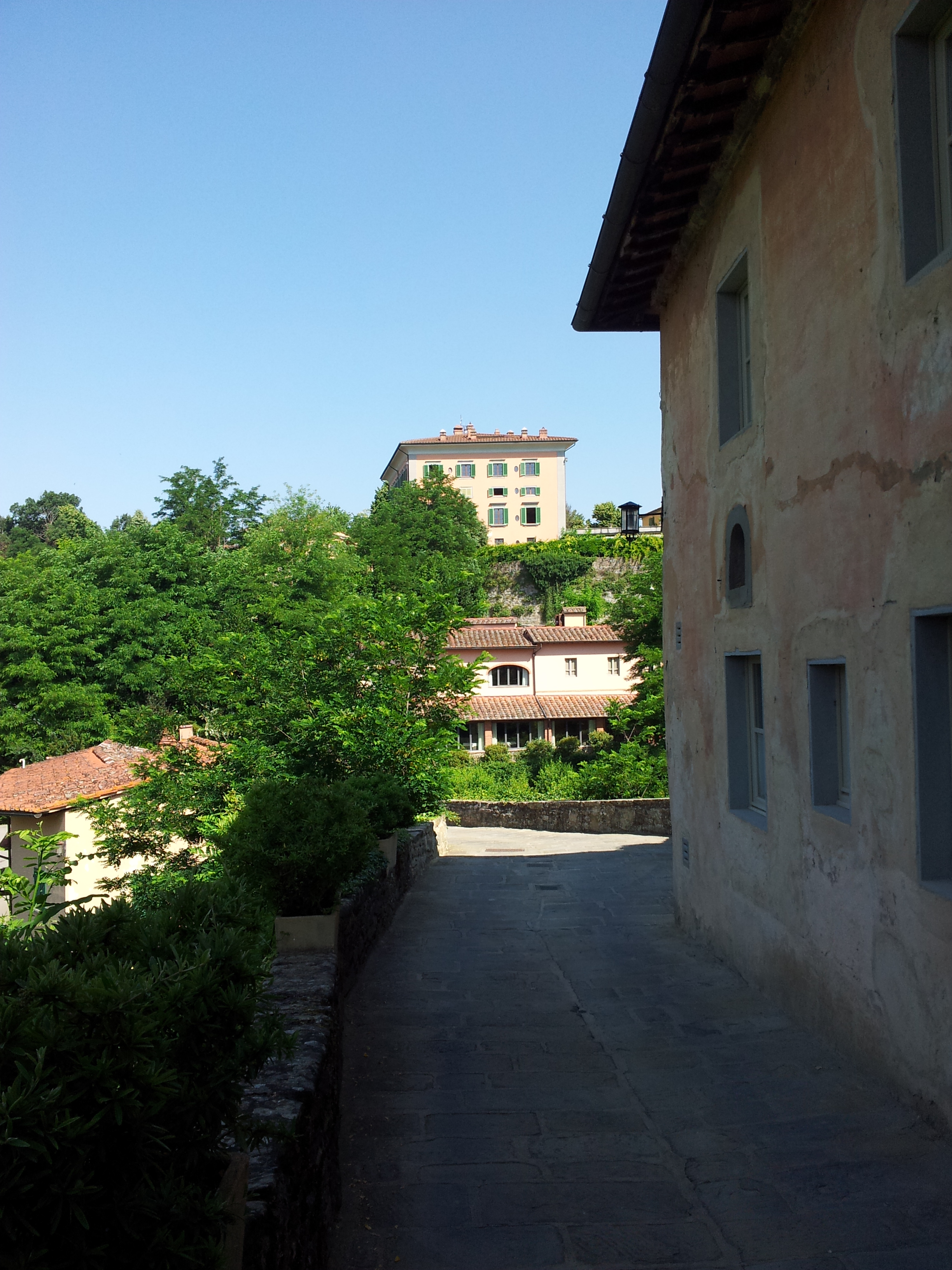
Searching for locations: Somewhere in Tuscany, Italy, a hilltop town

It’s a town we visited in Italy when on a private tour.  Of course, I wrote it down on a notepad app on my phone at the time, and, yes, not long after that, an accidental reset lost all the data.

Now, I have no idea with the name of the town is, just that it was a picturesque stopover in the middle of a delightful private tour of Tuscany.

2013-06-20 10.12.54

There are narrow laneways that I suspect no one 300 hundred years ago planned for cars

2013-06-20 10.17.36

Narrower walkways that lead to very dark places


Walkways on the side of the hills that look down on the picturesque valleys

2013-06-20 10.15.27

And rather interesting hillsides, some of which provided inspiration for Leonardo da Vinci

2013-06-20 10.15.48

Or maybe it was this landscape, though it is difficult to see what could be found as inspiration in such a bland hillside

2013-06-20 10.15.55

A lot of houses, some of them quite large, nestled in amongst the trees

2013-06-20 10.17.41 (2)

Gardens, of sorts, balcony’s, not so big, and hidden doorways

2013-06-20 10.17.53 (2)

Even not so secret passageways between houses.

All in all, it was an interesting visit, and it made me wonder what it would be like to live here, all crowded together, rather than living on our relatively isolated quarter-acre blocks.

The cinema of my dreams – I always wanted to write a war story – Episode 37

For a story that was conceived during those long boring hours flying in a steel cocoon, striving to keep away the thoughts that the plane and everyone in it could just simply disappear as planes have in the past, it has come a long way.

Whilst I have always had a fascination with what happened during the second world war, not the battles or fighting, but in the more obscure events that took place, I decided to pen my own little sidebar to what was a long and bitter war.

And, so, it continues…

Johannsen hadn’t signed up for this. He’d been in the room when Leonardo reported to Wallace, to tell him that the villagers had been neutralised, and he brought the ring leaders of the so-called resistance to the castle.

By his reckoning, Leonardo and his men had killed probably 20 or so people who had nothing to do with the war, other than try to live around the war going on in their backyard.

In fact, when he had arrived at the castle, the intention was to work with the locals and the resistance to facilitate the onward movement of prized defectors. Until Jackerby arrived, and the dynamic changed.

Johannsen hadn’t realised that Wallace was a double agent, not until it was too late.

The thing of it was, Wallace thought he was a double agent too, a belief Johannsen had taken extreme care not to dispel. And, where it was possible, he had tried to help those caught up in Wallace’s trap.

Wallace was already in situ at the castle when Johannsen arrived with another four men to join those already there, on order from London to vet the incoming defectors. Those four he had met at the plane, and he hadn’t realised they were not who they were supposed to be. By the time the four who had been replaced were found, it was too late to stop the mission.

That brought the complement to 10 including Wallace and himself. Then he received a message, one he assumed was from Thompson, advising the arrival of a further 5, Jackerby and four soldiers.

He soon discovered that those orders were false.

When Jackerby reported to Wallace, and the fact Wallace sent him out of the room, he stayed behind, hidden, to listen to the conversation. There he discovered he was in the midst of an enemy operation that had enlisted a number of double agents across Euprope from the German Army.

He then tried to warn Thompson in a coded message, but that had been substituted by Wallace with another, causing another lamb to be sent to the slaughter, Atherton. When Jackerby first arrived, he advised Wallace, not Johannsson, that Atherton was not one of them, so an attempt was made on,his life, but failed.

For a while that was the equivalent of throwing a cat among the pigeons.

By the time the paratroopers arrived, there was no effort to hide who they were or what they were doing. The castle was, for all intents and purposes, a Nazi stronghold, there to collect and execute defectors. All he had to do was play his part, and try not to rouse the suspicions of Jackerby, whom, it seemed, trusted no one.

Wallace wasn’t all that interested in being as suspicious as Jackerby, who had to be gestapo, or worse, one of the SS.

But luck was on Johansson side when he took a plan to Wallace that would essentially free Atherton, and then have Atherton lead them to the other resistance. It was also a master stroke to select Burke, a simple man who liked to think everything was his idea.

That Atherton had got away was no fault of his, but those charged with following him. Jackerby had tried to mess with him, but Wallace intervened, telling Jackerby that he had had missing people too and should be out there looking for them.

With any luck, Johansson thought, they would be dead, a likely result since none of them had come back yet.
Now, all he could do was sit and wait for Atherton and whoever was left from the resistance to come and stop Wallace, and especially Jackerby.

Johansson knew that Atherton had a good working knowledge of the castle’s architecture, because on one occasion they had discussed archaeology. Johansson was not an archaeologist, but had worked with one and an assistant, before the war, at several digs.

He was hoping Atherton had a idea where there might be a secret entrance to the castle. It was old, and in his spare time, he had been pacing out room measurements, looking for nooks and crannies, and anything else that would be useful.

He had found a room full of swords, not exactly in fighting condition, but might be useful in a situation that called for a weapon. After all, he had taken a few sword fighting lessons at the university.

He had traversed several stone passageways, found two different passageways from the upstairs down to the radio room, and beyond that, where there was an exit or entrance, what in modern terminology would be called the tradesman’s entrance.

It was for all intents and purposes, a back door.

He had also gone around the whole perimeter of the outer castle wall, looking for holes. When he thought about it, leaving holes in the wall was asking for trouble because the idea was to keep people out, not to leave quickly and quietly in the middle of a siege.

And this castle had seen a few sieges in its time. More than once if he could travel back in time, he would have like to see what it was like 200 years ago, or more.

But there were only three entrances or exits that he knew of. There were no grates on the ground, or anywhere within 20 yards of the exterior wall, or conveniently hidden in the surrounding forests.

He was also sure there were hidden passageways inside the castle that must go somewhere, a result of checking internal measurements of rooms, and a few came up oddly short a few yards.

Still down in the dungeon on another of his subterfuges, the new arrivals guard had just appeared.

“The woman is awake.”

“Thanks.”

Now, if he could just get some sense out of her.

© Charles Heath 2020-2021