Searching for locations: San Gimignano, Italy

We have visited this town on a hill, famous for its fourteen towers, twice.  The first time we stayed in a hotel overlooking the main piazza, and the second time, for a day visit, and return to a little restaurant tucked away off the main piazza for its home cooking.

No cars are allowed inside the town and parking is provided outside the town walls.  You can drive up to the hotel to deliver your baggage, but the car must return to the carpark overnight.

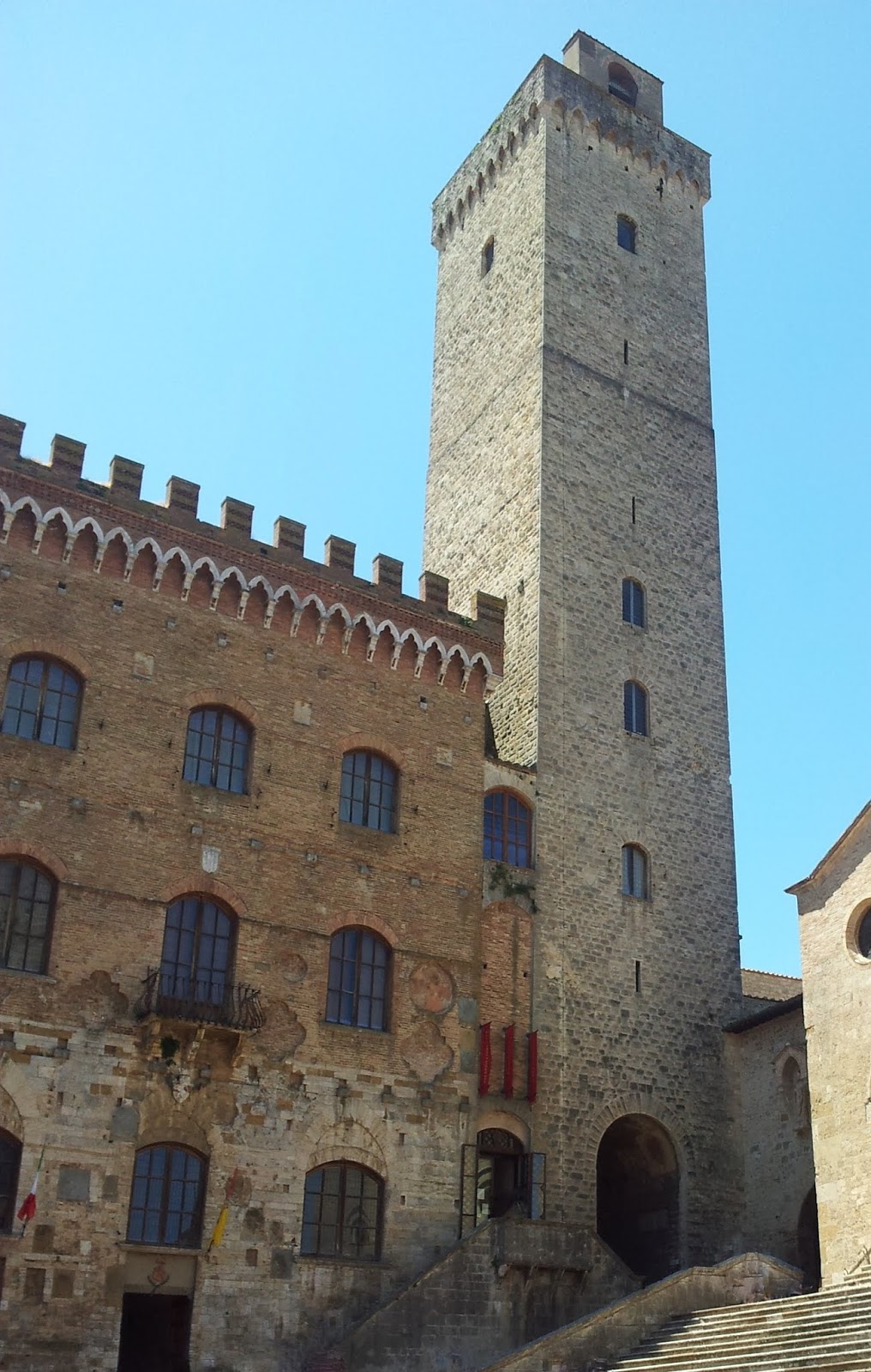
This is one of the fourteen towers

I didn’t attempt to climb to the tower, which you can do in some of them, just getting up the church steps was enough for me.  Inside the building was, if I remember correctly, a museum.

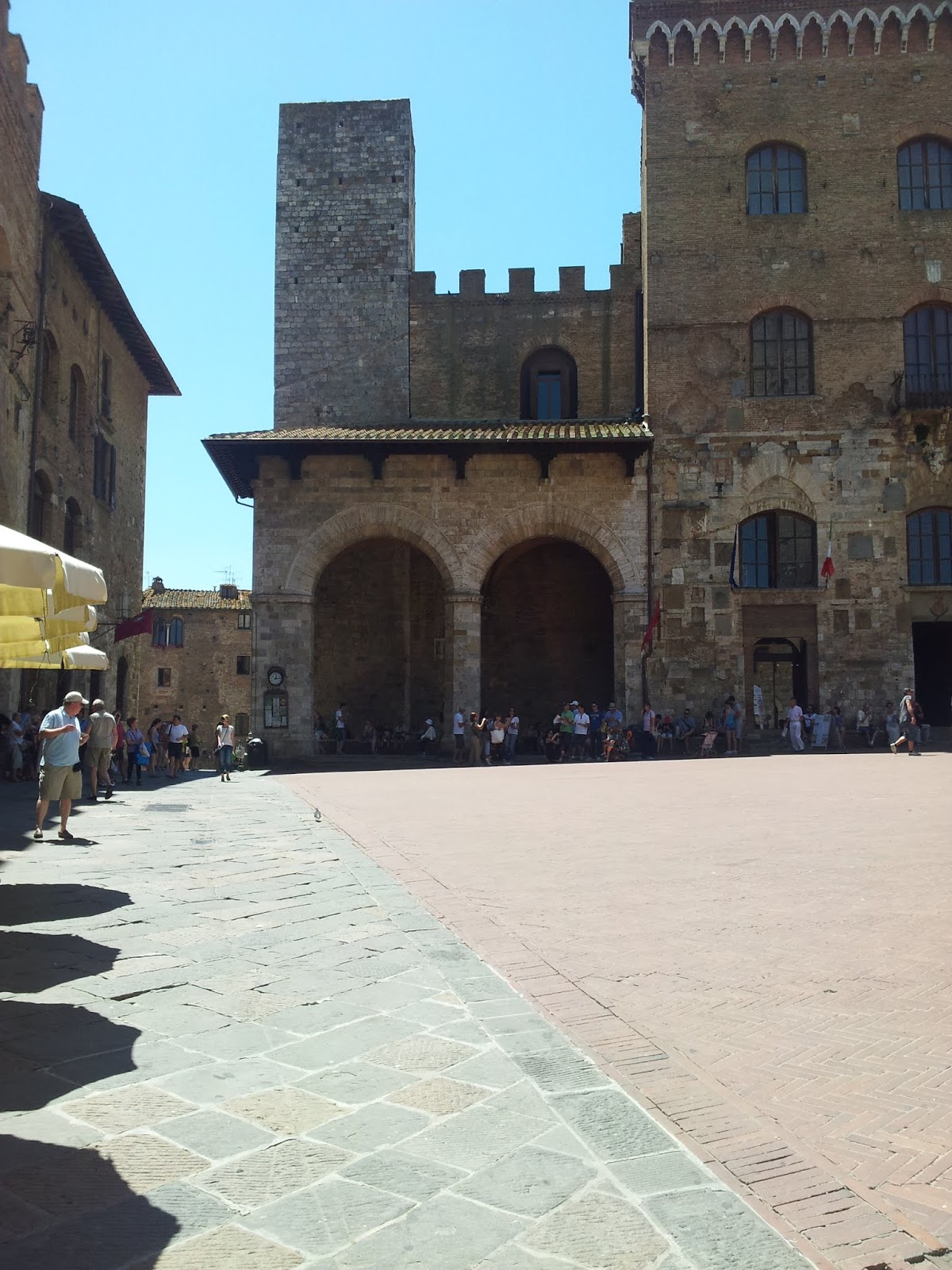
Looking up the piazza towards some battlements, and when you reach the top and turn left, there is a small restaurant on the right-hand side of the laneway that had the best wild boar pasta.

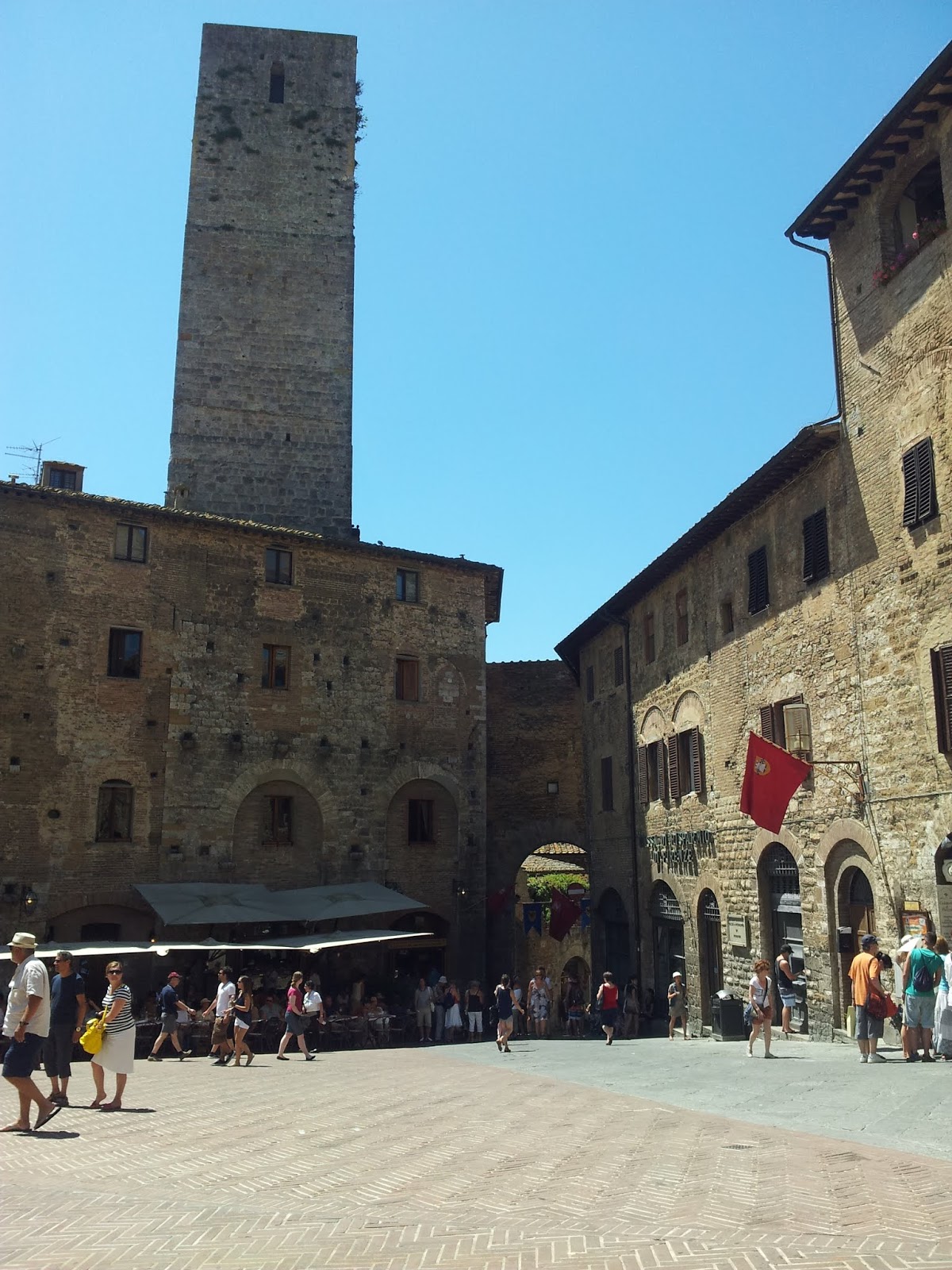
Another of the fourteen towers, and through the arch, down a lane to the gated fence that surrounds the town.  The fortifications are quite formidable and there are several places along the fence where you can stand and look down the hill at the oncoming enemy (if there was one).

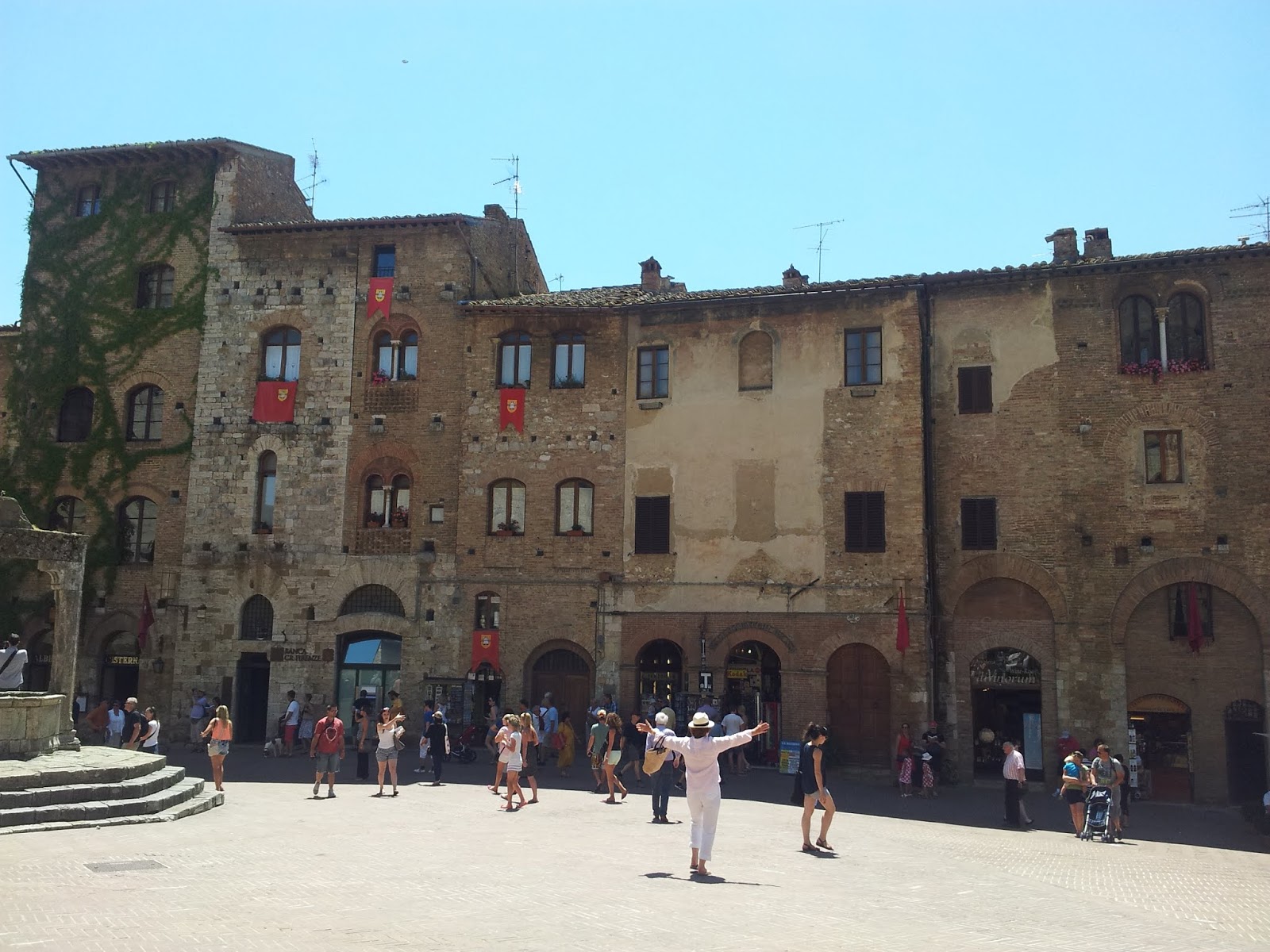
Part of the main piazza which is quite large, and on the right, the wishing well where my wish for a cooler day was not granted.

Officially, the Piazza della Cisterna is the most beautiful square of the town, San Gimignano.  The well was built in 1273 and enlarged in 1346 by Podestà Guccio dei Malavolti.

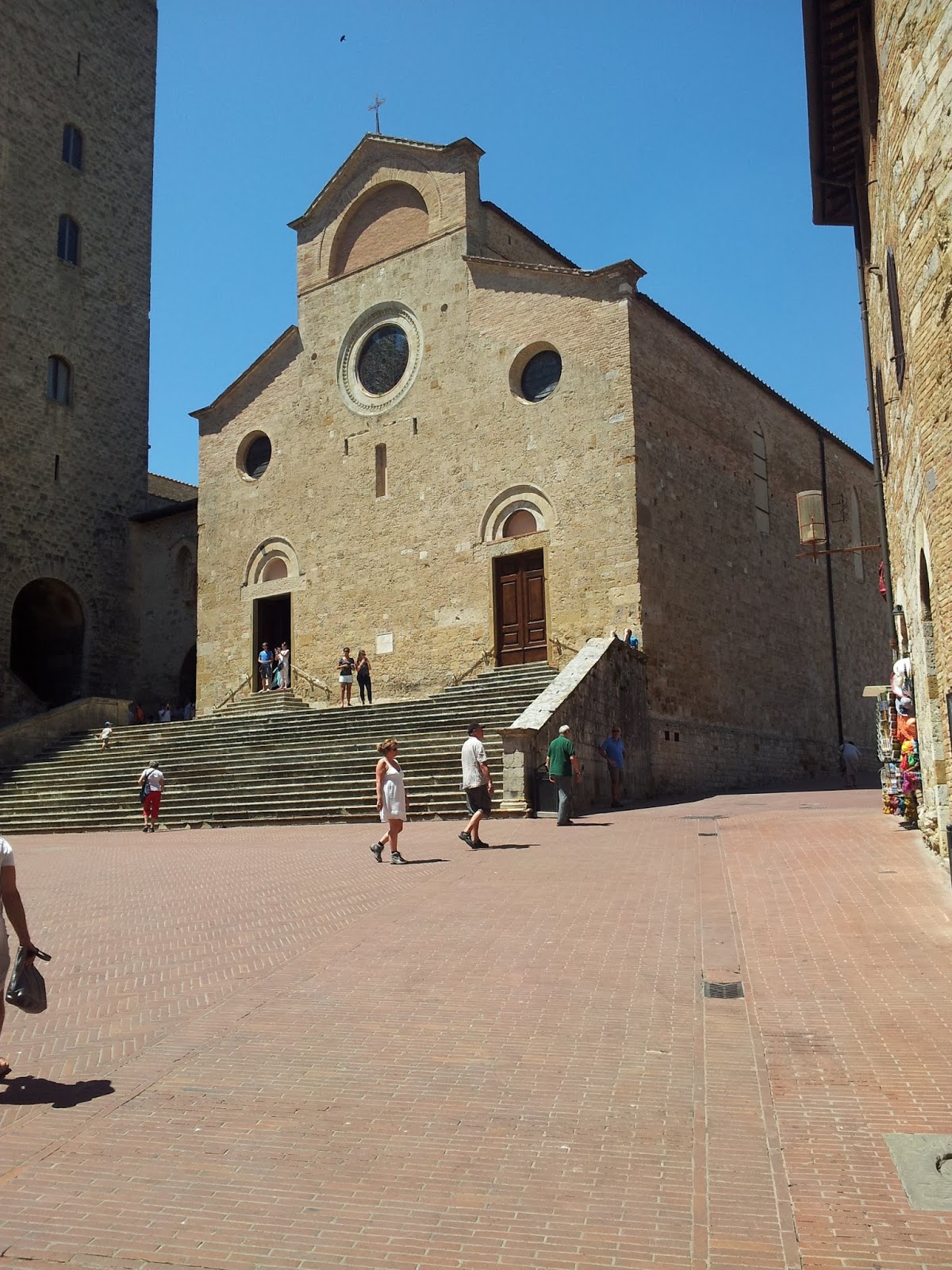
And not to be outdone by any other the other old towns, there is an old church, one of several.  It is the Collegiate Church or the Duomo di San Gimignano, a monument of Romanesque architecture built around 1000 and enlarged over time.

Next door is the Museum of Sacred Art.

And I guess it’s rather odd to see television aerials on top of houses that are quite literally about a thousand years old.  I wonder what they did back then for entertainment?

The cinema of my dreams – I always wanted to write a war story – Episode 7

This is a story inspired by a visit to an old castle in Italy. It was, of course, written while travelling on a plane, though I’m not sure if it was from Calgary to Toronto, or New York to Vancouver.

But, there’s more to come. Those were long flights…

And sadly when I read what I’d written, off the plane and in the cold hard light of dawn, there were problems, which now in the second draft, should provide the proper start.


If it had been Jackerby in charge and not Johansson, I had no doubt I’d be at the end of a firing squad now.

Jackerby was not Army, nor a man of honour.  His gait, his manner gave him away, despite the fact he was out of his usual uniform.  I suspect now I had been taken care of, that would change, and we’d get to see his true colours.

After leaving the hall, I was escorted downstairs to the cellar, and where I knew there were a number of rooms with iron gated fronts, places I suspected, in olden days, enemies of the castle were held, enslaved or executed in these cells.

There were several male prisoners is the first two cells, awaiting their fate, one which would not include escaping to the other side, but perhaps something a lot worse than death.

At the end, there was another corridor, and several smaller cells, where second from the end, I was roughly shoved by one of the guards.  He was going to add the butt of his rifle to the back of my head for good measure, but Jackerby stopped him.

I was sure it wasn’t out of respect for Johansson.  It appeared that Johansson needed me for something else.

After the door closed I yelled out, “All the rooms upstairs filled?”

“Yes.  It’s high season.”  So Jackerby had a semblance of a sense of humour.


The room, if it could be called that, had a camp stretcher, a seat, and a bucket.  The light came from a burning torch out in the corridor, an interesting touch that electricity had not made it down this far.

The floor was cobbled, and, like the walls, damp.  There was an overbearing odour of mustiness in the room.

It was also cold, so these cells must be located not only under the old castle but underground.  That meant centuries of history, and probably a ghost or two.  I was sure terrible things had happened, down in these cells, not just back then but also recently.

Outside the wall, I could hear the sound of running water, so the back wall must border onto the stream.  And there must be a gap, or hole somewhere for the sound to reach me, but it was too dark to see.

When night fell, it was going to be a lot worse; the light wouldn’t be affected, but it was going to get a lot colder.  As it was the torchlight from the passage barely made an impact, and it took a few minutes for my eyes to adjust.  And I was sure there were rats, just waiting for the dark to come out to play.

I moved the seat to beside the door and sat down, trying to make myself comfortable, in a position where I might hear them coming if they came back.

Then a voice quite near, said, “What are you here for?”


© Charles Heath 2019

It must be the seasonal change

Earlier today, or yesterday now since the clock has ticked over to a new day, I was writing a post about the weather.

Boring as hell, except it gradually turned into a rant about greed, both corporate and government,

There has to be better stuff to talk about than that.

Like father’s day.

It’s possibly the most interesting aspect of my life, having never expected as a teenager that I would ever become a father.  No, back in those dark and gloomy days I had neither the confidence nor the wherewithal to be or do anything.

I guess meeting someone, falling in love, and getting married, pulls you out of the lethargy of youth and forces you to take stock, and become someone, someone who has to have a good job that pays good money so you can get the necessities like a house and a car.  You might have these before you get married, we had the cars, but not the house.

Then you realise you need more money because you never seem to earn enough until a baby comes along, and your whole life as you knew it turned upside down and inside out.  Bad enough trying to sustain two, it’s now three.

More money, a larger house, a larger car, a damn good washing machine, and lots of nappies.  Wow, I had thought having a baby meant more than a clothesline perpetually filled with nappies.

Until another baby comes along, the cycle repeats, then one has to go to school, and a whole new money pit opens and this costs more than the annual house payments.

Then there are sports, and extracurricular activities like dancing (though we didn’t have girls, thankfully), and then kids get to be very good at sports, so, you guessed it, another money pit.  And a steadily growing grocery bill as they get larger and start eating you out of house and home.

There’s never a let-up, from the moment they’re born till the moment they leave home, and that, sometimes, can take a few more years than you expected.

Along the way you hope that your kids will respect you are their father and their mother.  Sometimes that’s a forlorn hope.  Other times children become a blessing and are always there.  At least we don’t have to travel to either the other side of the country, or the other side of the world, to see ours, and with any luck, I will see them both later today.

I don’t expect much.  My relationship with my father is strained, now, but for many years I was there for him, much more than I should according to my wife.  I don’t want for them what happened to me, so I do what I can to make sure it doesn’t happen.

But the unexpected surprise, that one thing that you never expect when this lifelong journey starts, is the eventuality of grandchildren.  Yes, it’s a natural progression in the circle of life, but often it doesn’t quite happen.

We have three granddaughters, and though I know as we get older we will not see them as much or if at all as they make their way out into a very large and far more accessible world than we had at the same time, but I will cherish those moments I have with them now.

I guess today, being the first day of spring, is not such a bad day after all, and it’s amazing that twelve hours later after feeling the gloom and doom of the world, that mood has changed, and that it took so little to change it.

Perhaps that’s what life is really all about.

Family.

My disdain for some reporters, and reporting these days

It is sometimes quite trashy and that’s saying something!

Having been a journalist in a previous lifetime, and one that always believed that the truth mattered, it didn’t take long to realize that journalists should never let the truth get in the way of a good story.

Newspapers, and all other forms of media, will only write what they believe will sell, or what they think the public wants to read. The truth, sadly, is not the first thing on the reader’s mind, only that someone is to blame for something they have no control over, and it doesn’t matter who.

And the more outlandish the situation, the more the public will buy into it.

This, I guess, is why we like reading about celebrities and royalty, not for the good they might do, but the fact they stumble and make mistakes, and that somehow makes us feel better about ourselves.

Similarly, if the media can beat up a subject, like the coronavirus, and make it worse than it is, then people will lap up the continuing saga, as it relates to them, and will take one of two stances, that they believe the horror of it, and do as they’re asked, or disbelieve it because nothing can be that bad, and ignore it and the consequences of disobedience. knowing the government will not press too hard against the non-compliers simply because of democracy issues it will stir up.

That is, then the media will get a hold of this angle and push it, and people will start to think disobedience is a good thing, not a bad one.

So, our problem of trying to get a fair and balanced look at what the coronavirus is all about is nigh on impossible. We are continuously bombarded with both right and wrong information, and the trouble is, both sides are very plausibly supported by facts.

And that’s the next problem we have in reporting. We can get facts to prove anything we want. It’s called the use and abuse of statistics and was an interesting part of the journalism degree I studied for. We were told all about statistics, good and bad, and using them to prove the veracity of our piece.

I remember writing a piece for the tutor extolling the virtues of a particular person who was probably the worst human since Vlad the Impaler, using only the facts that suited my narrative. I also remember the bollocking he gave me for doing so but had to acknowledge that sometimes that would happen.

The integrity of reporting only went as far as the editor, and if the editor hated something, you had to hate it too. This is infamously covered in various texts where newspaper publishers pick sides and can influence elections, and governments. It still happens.

So, the bottom line is, when I’m reading an article in the media, I always take it with a grain of salt, and do my own fact-checking, remembering, of course, not just to fact check to prove the bias one way of the other, but then get a sense of balance.

We have state elections coming up where I live, but it does not sink to the personal sniping level as it does in the US, we haven’t sunk that low yet, but we haven’t got past the sniping about all the wrongs and failed promises of the government of the day, or the endless tirade against the opposition and how bad a job they did when they were previously in government.

You can see, no one is talking about what they’re going to do for us, no one is telling us what their policies are. It’s simply schoolyard tit for tat garbage speak. What happened to the town hall meeting, a long and winding speech encompassing the policies, what the government plans to do for its people in the next three years, and then genuinely answering questions?

Perhaps we should ban campaigning, and just get each party to write a book about what they intend to do, and keep them away from the papers, the TV, and any other form of media, in other words, don’t let them speak!

And don’t get me started about the drivel they speak in the parliament. Five-year-olds could do a better job.

OK, rant over.

Searching for locations: Venice, Italy (Again)

We have visited Venice twice, in 2006 and not so long ago.

Not much had changed from visit to visit.

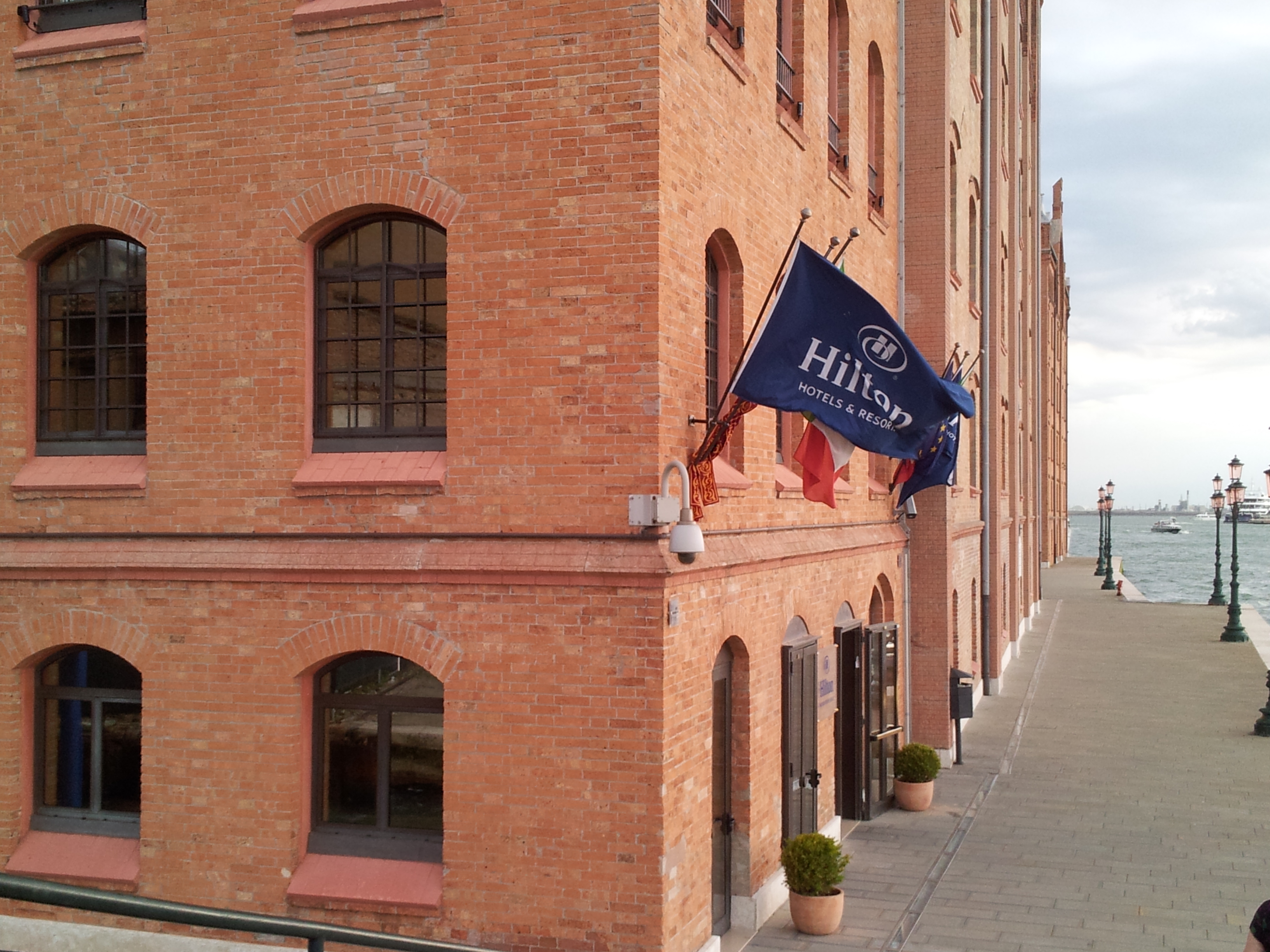
Instead of staying in a hotel selected by a travel agent, the Savoia and Jolanda on the waterfront of Riva Degli Schiavoni, because I’m a Hilton Honors member, more recently we stayed at the Hilton Molino Stucky.  It was located on an island, Giudecca, and had its own transport from the hotel to St Mark’s Square for a very reasonable one-off charge for the stay.

hiltonmolinostuckey2

On our first visit, we traveled from Florence to Venice.  We were advised to take a water taxi to the hotel, not only the most direct route but to see some of Venice from the water.  The only drawback, you have to negotiate a price with the driver.

We were not very good negotiators, and it cost 60 Euros.

But, despite the cost, it was worth every Euro because the taxi driver took us by the scenic route, directly from the Station to the doorstep of our hotel.  For a first time in Venice, and you want to see it from the water, a water taxi is the best option.

2013-06-25 17.09.16

The first time we stayed at the Savoia and Jolanda Hotel, which was at the time quite old, and the room we had, on the ground floor, was comfortable enough, but being November, they had just stopped using the air conditioning, it was still quite warm and at times uncomfortable.

There were better rooms, but this was beyond the knowledge of the travel agent, and one of the reasons we stopped using agents to book hotels.

The most recent visit we had driven down from Salzburg to Venice airport where we had to return the hire car.  From there we were intending to take a private water taxi from the airport to the hotel, for an estimated 120 Euros.

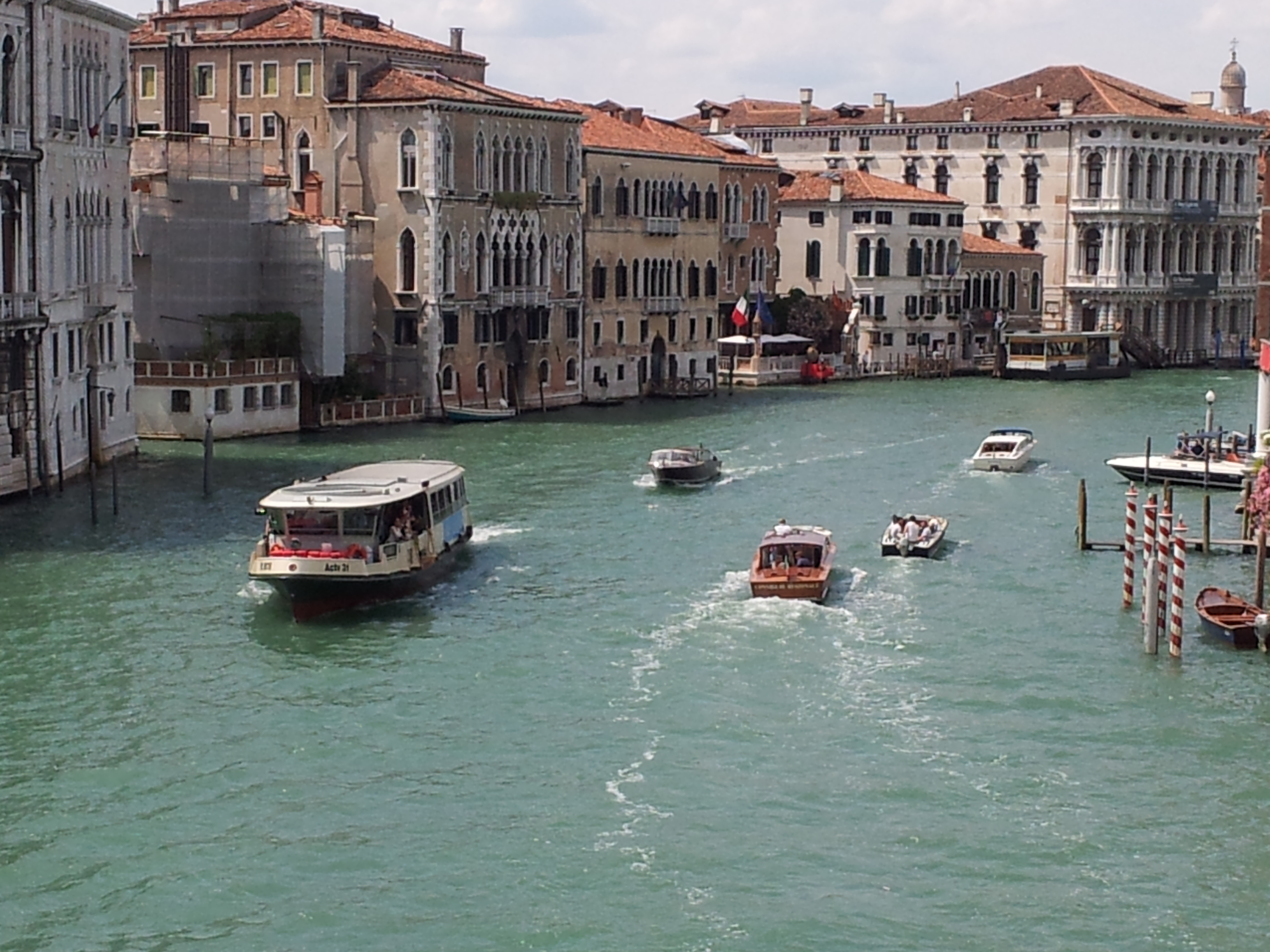
We saved our money and took the ACTV public waterbus, from the airport to the hotel, with one stop.  It took a little over an hour and was equally as scenic.

venicecanals1

Our room in the Hilton was on one of the upper levels, floor four, and had a view of the canal, the large passenger ships coming and going, as well as a remarkable view of Venice itself as far up the canal to St Marks Square in one direction, and the port for the passenger ships in the other.

20130627_081601

We got to see three or four very large passenger ships come and go, along with a lot of other craft.  I hadn’t realized how busy the waterways, and the Grand Canal, were.

20130627_174408

Each evening after a day’s exploring we would end up in the Executive Lounge, and then one of the many restaurants, usually Il Molino for breakfast, and the Rialto Lobby Bar and Lounge for dinner.  After that, it was a stroll down the waterfront taking in the night air, and perhaps to walk off the delicious dinner.

Is it cybersickness or something else?

There’s this new affliction going about.

Everyone seems to be talking to themselves and I think it has something to do with smoking, perhaps a side effect.

You know how it is, you are walking by and someone near you starts talking.  You think they are talking to you, but they are not.

And then they take a puff of a cigarette.

It’s not an uncommon assumption.

But the thing is, if you take a closer look you notice they have a Bluetooth device in their ear and they are really talking to someone out there in cyberspace.

Or for the uninitiated, they’re talking on their mobile phone.

Not many years ago men in white suits would be collecting these people and taking them to an asylum typically called Bellevue.  The stuff of 1950’s horror films.  You really didn’t want to be caught talking to yourself.

It, of course, has a number of symptoms, this condition we’ll call cybersickness.  Like, for instance, wandering aimlessly and either bumping into people or in front of cars on the street.

Is it the voices in their head telling them what to do?

Can we say we have just created a viable excuse for these people, or should they be locked up?  Maybe we’re too late because I think a lot of them are already living in their own world.

A life so ordinary – the beginning

When I was trying to think of a title for this post, and probably a lot more in the same vein, I thought of using

The Life of an Ordinary man

or

The life of an ordinary person

and realized that political correctness wasn’t going to make the title any easier to create.

The other thing is that should we have the right to say our life is ordinary?

What is ordinary life?

Is it the life the Joe and Jane Average have?

Dear God, I think I’ll just give up and go home.

Then I started thinking about school and the first girl I liked. I was five, and with absolutely no understanding of what I was feeling, I think it was great we were just friends.

It was 1958.

That was a long, long time ago.

No need to worry about politics, where the next paycheck was coming from, can I afford the car payments, and why do my children hate me so much.

Five was a great age. You go to school, sit around having fun, have an afternoon sleep, you always got a bottle of milk mid-morning (pity there was no flavoring in it) and lunchtimes you sat outside near the oval and made daisy chains in summer, or ran through the puddles in winter.

Or play on the monkey bars.

I remember the school, Dandenong State School. A large gothic, or so I thought then, building, that looked really scary from the outside, and then, when you met the teachers, really scary inside.

It had a quadrangle and a bell.

We had an assembly every morning and sang God Save the Queen.

Halcyon days indeed.

We lived in a house in Bess Court.

It was odd how our places of residence were reduced to a street name.

From my first, Valetta street, I think the first house my parents moved into.

Later in a foray into the past via genealogy we discovered my father had qualified for a war service loan and built the house himself.

We stayed there for a few years, then moved to Warren Road, for a very short time. There was no rhyme or reason for this move but it was notable for one reason, my younger brother was born while we were there.

And one single other memory I have, that I used to go picking jonquils in a field behind the house

Then we moved to Bess Court, where we stayed for a number of years, what literally become a house of horrors, a time that consisted on only bad memories.

While here, I started grade school.

Then it was a move to Henty Street, where I spent the rest of my life before getting married and moving out.

Each had a significance, and a definitive set of memories, some good, some bad, some really bad, some all at the same time.

As for that ordinary, perhaps we’ll explore it tomorrow.

Searching for Locations: Venice, Italy

Venice is definitely a city to explore.  It has an incredible number of canals and walkways, and each time we would start our exploration at St Marks square when it’s not underwater

Everyone I have spoken to about exploring Venice has told me how easy it is to get lost.  It has not happened to me, but with the infinite number of ways you can go, I guess it is possible.

We started our exploration of Venice in St Marks square, where, on one side there was the Museo di Palazzo Ducale and, next door, the Basilica di San Marco.  Early morning and/or at high tide, water can be seen bubbling up from under the square, partially flooding it.  I have seen this happen several times.  Each morning as we walked from the hotel (the time we stayed in the Savoia and Jolanda) we passed the Bridge of Sighs.

Around the other three sides of the square are archways and shops.  We have bought both confectionary and souvenirs from some of these stores, albeit relatively expensive.  Prices are cheaper in stores that are away from the square and we found some of these when we walked from St Marks square to the Railway station, through many walkways, and crossing many bridges, and passing through a number of small piazzas.

That day, after the trek, we caught the waterbus back to San Marco, and then went on the tour of the Museo di Palazzo Du which included the dungeons and the Bridge of Sighs from the inside.  It took a few hours, longer than I’d anticipated because there was so much to see.

The next day, we caught the waterbus from San Marco to the Ponte di Rialto bridge.  Just upstream from the wharf there was a very large passenger ship, and I noticed there were a number of passengers from the ship on the waterbus, one of whom spoke to us about visiting Venice.  I didn’t realize we looked like professional tourists who knew where we were going.

After a pleasant conversation, and taking in the views up and down the Grand Canal, we disembarked and headed for the bridge, looking at the shops, mostly selling upmarket and expensive gifts, and eventually crossing to the other side where there was a lot of small market type stalls selling souvenirs as well as clothes, and most importantly, it being a hot day, cold Limonata.  This was my first taste of Limonata and I was hooked.

Continuing on from there was a wide street at the end and a number of restaurants where we had lunch.  We had a map of Venice and I was going to plot a course back to the hotel, taking what would be a large circular route that would come out at the Accademia Bridge, and further on to the Terminal Fusina Venezia where there was another church to explore, the Santa Maria del Rosario.

This is a photo of the Hilton Hotel from the other side of the canal.

It was useful knowledge for the second time we visited Venice because the waterbus from the Hilton hotel made its first stop, before San Marco, there.  We also discovered on that second visit a number of restaurants on the way from the terminal and church to the Accademia Bridge.

This is looking back towards San Marco from the Accademia Bridge:

And this, looking towards the docks:

Items to note:

Restaurants off the beaten track were much cheaper and the food a lot different to that in the middle of the tourist areas.

There are a lot of churches, big and small, tucked away in interesting spots where there are small piazza’s.  You can look in all of them, though some asked for a small fee.

Souvenirs, coffee, and confectionary are very expensive in St Marks square.

The cinema of my dreams – I always wanted to write a war story – Episode 3

This is a story inspired by a visit to an old castle in Italy. It was, of course, written while travelling on a plane, though I’m not sure if it was from Calgary to Toronto, or New York to Vancouver.

But, there’s more to come. Those were long flights…
And sadly when I read what I’d written, off the plane and in the cold hard light of dawn, there were problems, which now in the second draft, should provide the proper start.

There were eleven stormtroopers and Wallace, eighteen in Johansson and Jackerby’s group. One of those would be in the communications centre, leaving, at worst, twenty-nine men out looking for me.

I also assumed that Jackerby would approach the search in much the same manner as I would, the men in pairs, as singly, he knew that I would have an advantage.

Eight pairs would be inside, doing a room-to-room search, from the top down.

Five pairs would be outside, one group in the centre, one group at each of the corners, all working the perimeter, all in constant communication with each other.

In normal circumstances, I would be caught.

These were not normal circumstances.

Jack padded his way just ahead of me, stopping every few yards and both sniffing and listening.  At a junction he would stop, wait, and then make a decision about which way to go.

I had to trust his instincts.

Just ahead of me there was a cracking sound followed by falling rocks and a shaft of light.

An opening in the roof where it was too close to the surface.

Jack went quite still.  Voices.

“Be careful.”  German.

Followed immediately by “Speak in English you fool.  You were saying,”

The man switched to careful English, “Be careful, or you’ll fall down that hole.  They should have told us the ground around here is on top of an old mineshaft.”

“Better, Corporal.  Remember. English at all times.”

“Could be where they buried the bodies hastily before they left.”

The man was referring to the story the previous custodians of the castle had killed about a hundred of the nearby villagers and buried them in a mass grave near the castle.  No one had been able to verify the account, nor had anyone found any skeletal evidence.

Yet.

“Let’s get out of here.  The last thing I want to see is a ghost.”

© Charles Heath 2019-2022

Searching for locations: Rome, Italy

We visited Rome in August

It was hot.

It was verrrry hot.

We flew into Rome’s Leonardo da Vinci-Fiumicino airport after a rather bumpy flight from London.  Unlike most other airports the plane parked at a satellite terminal and after we disembarked we had to catch a train to the main terminal.

The most notable memory of this airport was my daughter’s discovery of a salami shop.

We had booked a transfer to take us to the hotel the Roma Corso Trieste Mercure in Via Gradisca from the airport.  It was a white air-conditioned van and so far we had avoided the heat.

One of the rooms had faulty air conditioning an absolute must as the rooms were very hot without it and necessitated a room change which was done quickly and efficiently.

The hotel was in the suburbs and without a car we were dependent on public transport.  According to the reception staff, there was a bus stop nearby, and a longer walk to the tram or light railway.  The bus seemed to be the best option as it would take us to the central terminal near the railway station, where all tour buses also operated from, and particularly the open-top buses that went to all the major tourist attractions.

That first day basically was given over to travelling, arriving by plane and settling into the hotel, thus we didn’t get to feel the force of the heat.  That came the next day.

After a walk around the hotel precinct to get our bearings and see what shops and restaurants were available, on returning to the hotel we were faced with limited choices of room service or to go out for dinner.

My daughter and l go for a long walk up Via Nomentana to find several shops and a restaurant.  We went into the restaurant and sat down.   We waited for 10 minutes and got no service nor did anyone come and ask us if we wanted to order food so instead we left somewhat disappointed and go next door to what seemed to be the Italian version of a delicatessen and ordered sandwiches and beer.   I bought a half dozen cans of Moretti beer two of which I drank on the way home.

It was still very hot even at eight at night and the sandwiches are delicious.  It just might be by that time we were starving and anything would have tasted great.

The next morning we are up and ready to chance the weather and some history.  Breakfast at the hotel is limited but very good.

We were going to use public transport and I’d studied up on the Internet.

Travelling on the bus required pre-purchase of tickets which could be bought in certain shops and locally when exploring the area near the hotel, l found a tobacconist.

Next, we needed to understand how to use the tickets. There was no one on the bus who could help so when l tried to scan the tickets and it failed, l gave up.  We had the same issue each day and in the end, the tickets never got used.

The trip to central Rome by bus took about 15 minutes.  In the morning it was reasonably cool and showed us a little of suburban Rome.  We also saw the trams but we would not be able to use them because our hotel not on a direct route.

That first full day we decided to go and see the Vatican.

Not understanding buses and which one we needed to get to the Vatican, we took a taxi.

Wow.  It was the metaphorical equivalent of driving over the edge of a cliff with a daredevil.  It was quite literally terrifying.

Or maybe we just didn’t know that this was probably the way people drove in Rome.

Shaken but delivered in one piece we found ourselves in the square opposite St Peters Basilica.

The square is impressive, with the statues atop a circular colonnaded walkway.  The church is incredible and took a few hours to take in and to top off the day we did a tour of the Vatican museum which took the rest of the afternoon.

Then it was back to the delicatessen for more sandwiches and beer, and an interesting discussion with several elderly Italian ladies, of which I did not understand one word.

On the second full day we decided to use one of the open-top bus tours and eventually decided on the hop-on hop-off tour simply because the bus was at the central transport terminal for trains and buses and it was getting hotter.

Our first stop was the Colosseum.  There were other monuments nearby, such as the Arch of Constantine, but as the heat factor increased we joined the queue to go into the Colosseum and gladly welcomed the shade once we got inside.

The queue was long and the wait equally so, but it was worth the wait.  It would be more interesting if they could restore part of it to its former glory so we could get a sense of the place as it once was.  But alas that may never happen, but even so, it is still magnificent as a ruin.

Outside in the heat, it was off to the ruins which were a longish walk from the Colosseum, taking Via Sacra, not far from the Arch of Constantine.  This day in the walkway there were a number of illegal vendors, selling knockoff goods such as handbags and watches, and who, at the first sight of the police, packed up their wares in a blanket and ran.

Included in these ruins were The Roman Forum, or just a few columns remaining, the Palatine Hill, Imperial Fori, including the Forum of Augustus, the Forum of Caesar, and more specifically the Forum of Trajan.  It was, unfortunately very hot and dusty in the ruins the day we visited.

We walked all the way to the Foro Romano and the Septimus Severo Arch at the other end of the ruins, past the Temple of Caesar.  I found it very difficult to picture what it was like when the buildings were intact, so I bought a guide to the ruins which showed the buildings as ruins and an overlay of how they would have looked.  The buildings, then, would be as amazing as the Colosseum, and it would have been interesting to have lived back then, though perhaps not as a Christian.

I lost count of the number of bottles of water we bought, but the word ‘frizzante’ was ringing in my ears by the end of the day.  Fortunately, the water did not cost a lot to buy.

At the end of the day, we caught the hop on hop off the bus at the Colosseum and decided not to get off and see any more monuments but observe them from the bus.  The only one I remember seeing was Circo Massimo.  Perhaps if we’d known it was going to be twice as hot on the bus, yes, there was no air-conditioning; we may have chosen another form of transport to get back to the hotel.

On the third and last day in Rome, we decided to go to the Trevi Fountain, see the pantheon and walk up the Spanish Steps.  We spent most of the morning in the cool of a café watching the tourists at the fountain.  By the time we reached the top of the Spanish Steps, we were finished.